Categories
Editorial Editorial of the Day

Vehicle Scrappage Policy: All You Need To Know

Prime Minister Narendra Modi announced the Vehicle Scrappage Policy or National Automobile Scrappage Policy at the Investor Summit at Gujarat in August 2021. There are plenty of old vehicles in the country, which is not only a safety hazard but also contribute to pollution. The policy aims to discard old vehicles that are not fit to operate on roads. At the same time, it encourages consumers to buy new vehicles, giving a boost to the automobile industry

What Is The Vehicle Scrappage Policy?

Fitness Testing 

Private vehicles older than 20 years and commercial vehicles older than 15 years will have to undergo a fitness test at government-registered ‘Automated Fitness Centres’. In the fitness test, various systems of the vehicle will be tested. If the vehicle passes the test, the owner can re-register the vehicle with a hefty fee. If the vehicle fails the fitness test, it will be deemed as End Of Life Vehicle (ELV) and will be scrapped at an Authorised Vehicle Scrapping Facility (AVSF). The entire initiative will be set up under a Public-Private Partnership (PPP) Model.

The Union Road and Transport Ministry has issued rules for scrapping facilities, their registration, their powers, and scrapping methods to be followed.

Incentives and Disincentives

  • If an owner chooses to scrap the vehicle, they will be given a scrappage value of 4-6% of the ex-showroom price of the vehicle. 
  • A rebate of up to 25% for Passenger Vehicles and 15% on Commercial Vehicles will be given in Road Tax. 
  • A discount of 5% will be given on a new vehicle’s ex-showroom price by the auto-manufacturer. 
  • No registration fees for the new vehicle will be charged. 

What Is The Significance Of The Vehicle Scrappage Policy?

With this policy, the government aims to: 

  • Incentivize scrapping old vehicles and buying new ones. 
  • Ensure that the vehicles plying on road are safe to use, thereby reducing road accidents. 
  • Increase its revenue by charging people who wish to use old vehicles. 
  • Scrapping old metals and spares provides cheap raw materials, which means auto-manufacturers can reduce the cost of production. 
  • Reduce pollution caused by old vehicles.

Vehicles that are not fit to ply on roads are a safety hazard and a leading cause of pollution. India has plenty of such old vehicles. According to a speech made by Transport Minister Nitin Gadkari in Parliament, there are close to 51 lakh Light Motor Vehicles (LMVs) that are above 20 years old and 34 lakh LMVs more than 15 years old. This policy is expected to garner Rs 10,000 crore in investments and create up to 35,000 jobs in the sector, creating a ‘circular economy’. 

Recycling such cars will help reduce the import of Aluminium, Copper, Steel, Iron, and more. This will even boost demand as unfit vehicles will be replaced with better, newer vehicles. This could eventually drive demand for electric vehicles (EVs) as recycled spares could even be used over there too.  

Categories
Editorial

Minda Industries: A Bright Investment Opportunity?

Minda Industries or Uno Minda is an automobile component manufacturer with companies like BMW, KTM, Honda, Ford, Royal Enfield, Toyota, and many more in its client list. Essentially, the company has almost all major automobile manufacturers on its client list. Recently, the company had announced that it was investing Rs 500 crore to expand its four-wheeler lighting and alloy wheels business.

Mind you, Minda Industries should not be confused with its namesake Minda Corp or Spark Minda. Pretty much like the Ambanis and Reliance, there was a split in business between brothers Nirmal K Minda and Ashok Minda. Nirmal Minda took hold of Minda Industries and Ashok Minda held Minda Corp. Both the companies are indeed excelling in their own paths.

Minda Industries posted a net profit of 168% and 34% in the last two quarters respectively. Between 2013 and 2019, the company posted a profit growth in all years except one. What makes Minda Industries a bright investment opportunity? Let us find out. 

The Business

  • A motor vehicle has many fine tunings like noise control, ambient lighting, switches, wheel turning, alloys, sound systems, sensors, controllers, etc. Minda Industries manufactures and sells these to major automobile players for both 2/3 wheeler and 4 wheelers. Both segments contribute nearly equally to total revenue. 
  • The Company has 16 direct subsidiaries, 12 step-down subsidiaries, 8 joint ventures, and 2 associates as of 31 March 2020. To know more about them, click here. 
  • The company has a strong domestic as well as international presence. In FY2019-20, the international business contributed 19% to the revenue stream, the remaining 81% being a domestic business. 
  • Segment-wise share of business by production volume. This shows how much amount of output for produced for each segment:
    • Passenger Vehicles: 13%
    • Commercial Vehicles: 3%
    • Three-wheelers: 3%
    • Two-wheelers: 81%
  • The company has 5 major divisions. Switch, Lighting, Acoustics, Light Metal(LMT), and Others. The Switch division contributes the most to the revenue stream and operates five plants in India and two overseas plants in Indonesia and Vietnam. The products are manufactured out of different locations across India viz. Manesar, Pune, Hosur, Aurangabad, and Pantnagar, catering to many domestic as well as international two-wheeler and four-wheeler manufacturers.
  • The company constantly keeps acquiring new technology to stay upbeat in the market. Over the past 5 years, the company has added and/or acquired close to 13 subsidiaries, 5 joint ventures(JVs), and 4 step-down subsidiaries estimating close to Rs 880 crore. Some of these include Minda Kosei for alloy wheels for Passenger Vehicles(PV), Minda TG Rubber for brake, and fuel hoses, Roki Minda for air intake systems, carbon canisters, Spain-based Rinder Group for lighting systems.  
  • With more than 22,000 employees, Minda Industries has 62 manufacturing plants in India, Spain, Morocco, Mexico Colombia, Indonesia, Vietnam, Germany design centers in Taiwan, Japan & sales offices in North America, Europe, and other ASEAN countries.
  • People might delay accessorizing their vehicles or vehicle sales might go up during a festive season. Just like the rest of the automobile industry, Minda’s business remains cyclical. 

Finances

Vital Financials(Source: Company Annual Report)
  • The company hasn’t faced a net loss in a decade nearly. It has consistently grown its revenue and value of total assets.
  • For FY2019-20, the company had a Return on Equity(RoE) of 16.82%, which nearly halved in FY2020-21 to 8.5%. Return on Equity indicates the ability of a company to generate profits from what its shareholders invest in the company. A falling RoE indicates poor return or management of shareholder’s investment in the firm.
  • The Return on Capital Employed or RoCE for FY2019-20 was 18.8% which reduced to 11.2%. A RoCE of 11.2% means that the company got Rs 11.2 in return for every Rs 100 of Capital Employed or the amount invested by the company with the intention of making a profit.
  • Mutual Funds’ shareholding in the company has almost doubled since 2018 from 4.23% to 9.74%. While Public shareholding of the company has decreased by ~5% since 2018, Domestic Institutional Investors(DIIs) have jacked up shareholding by ~6% in the past 3 years. 
  • The share price of Minda Industries has grown by 2438.9%, this means that had you invested Rs 1 lakh in the company 10 years ago, they would have become close to ~24 lakhs. Over the past year, the share price has increased ~113%.
  • Minda’s debt or borrowings are increasing, but so are its revenue and cash flows from operations for the past 5 year. The company’s liquidity position is fairly strong, sufficient to cover its short term debt. 
  • The company has had a declining Inventory Turnover Ratio. It is a measure of the number of times inventory is sold or used in a given time period. A decline in the inventory turnover ratio highlights that the operations of the company have become more working capital intensive.

What Lies Ahead

Recently, the company had announced that it was investing Rs 500 crore to expand its four-wheeler lighting and alloy wheels business. The company has had a good history when it comes to rewarding its shareholders, be it healthy dividend payouts or good value returns. Apart from this, the company has a good project execution rate. Its debt position is in sync with its revenue growth and profitability. To know more about the company, you can check out their Annual Report 2020, over here.

The auto-sector had just managed to recover when India was hit with the Second-wave of COVID-19. What followed is a series of night-curfews, weekend curfews and partial lockdown like situation across many states. Auto sales are likely to go down and the company’s position might be impacted again? Do you think the company offers a good return in the current financial year? Let us know in the comments section in the marketfeed App

Categories
Editorial

The PLI Scheme – All You Need to Know

One of the most important strategies to improve the economic growth of a country is to promote domestic production and become self-reliant. This is exactly what our Indian Government has been aiming for. The policies such as Make in India and the Atmanirbhar Bharat Abhiyan are prime examples of this. On November 11, the Union Cabinet announced the approval of a Production Linked Incentive (PLI) Scheme for 10 key sectors. This scheme would help to further strengthen the foundation of India’s path towards self-reliance.

Here at marketfeed, we always make sure to fulfill our promises and provide you with the best insights about such important events. Let us understand what this scheme is all about, and which sectors are included in it.

What is the PLI Scheme?

The Production Linked Incentive (PLI) scheme is a relatively new concept that was introduced in India earlier this year. The Government believed that it was time to initiate concrete steps to boost domestic manufacturing and cut down on huge import bills. Through the PLI scheme, companies would be provided with certain incentives to scale up production activities in India. It has three main objectives:

  1. To encourage foreign companies to set up their production activities in India. When this happens, we could see more foreign investments coming into our country.
  2. To provide support towards the existing domestic companies to expand their manufacturing units.
  3. To ensure that more employment opportunities are provided to Indian citizens in the manufacturing sector.

The PLI Scheme for Electronics Manufacturing

This scheme has become an absolute game-changer. Let us find out how our country adopted it initially. In April 2020, the Government introduced a PLI scheme worth Rs 40,000 crore for large-scale electronics manufacturing. The main aim of this particular scheme was to boost domestic manufacturing of mobile phones in India. The eligible companies were promised an incentive of 4%- 6% on incremental sales of goods that were manufactured in our country. This incentive would be applicable for 5 years. 

A total of 22 companies applied for the PLI scheme in August. And, three of these firms were contract manufacturers for Apple iPhones. We could also see that the share price of companies that had applied for the scheme (for eg, Dixon Technologies) had seen a surge during those periods.

According to Ravi Shankar Prasad, the Minister of Electronics and Information Technology, production worth Rs 11.5 lakh crore and exports valuing Rs 7 crore is expected over the next 5 years. It is very reassuring to learn that this scheme had received quite an overwhelming response from companies around the globe. It has become such a huge success.

The Latest PLI Scheme

In the notification made on November 11, the Government stated that it will offer incentives to an additional 10 vital sectors. The Union Cabinet has approved Production Linked Incentive Scheme worth up to Rs 1.45 lakh crore, for a period of 5 years. 

This would ensure that necessary support is provided to make India a global manufacturing hub, and create more jobs in the economy. The domestic companies would get the necessary push to cater to the local demand. The policy has been strategically targeted to very important sectors and would make Indian goods more competitive.

We can also state that the scheme has come at a very perfect time, in relation to the present global scenario. Most companies around the world are planning to shift their manufacturing operations from China. India could grab this opportunity and transform India into one of the best manufacturing centers in the world. The scheme would accelerate the existing plans of foreign companies that were considering to invest in India.

Which Sectors are Included in the PLI Scheme?

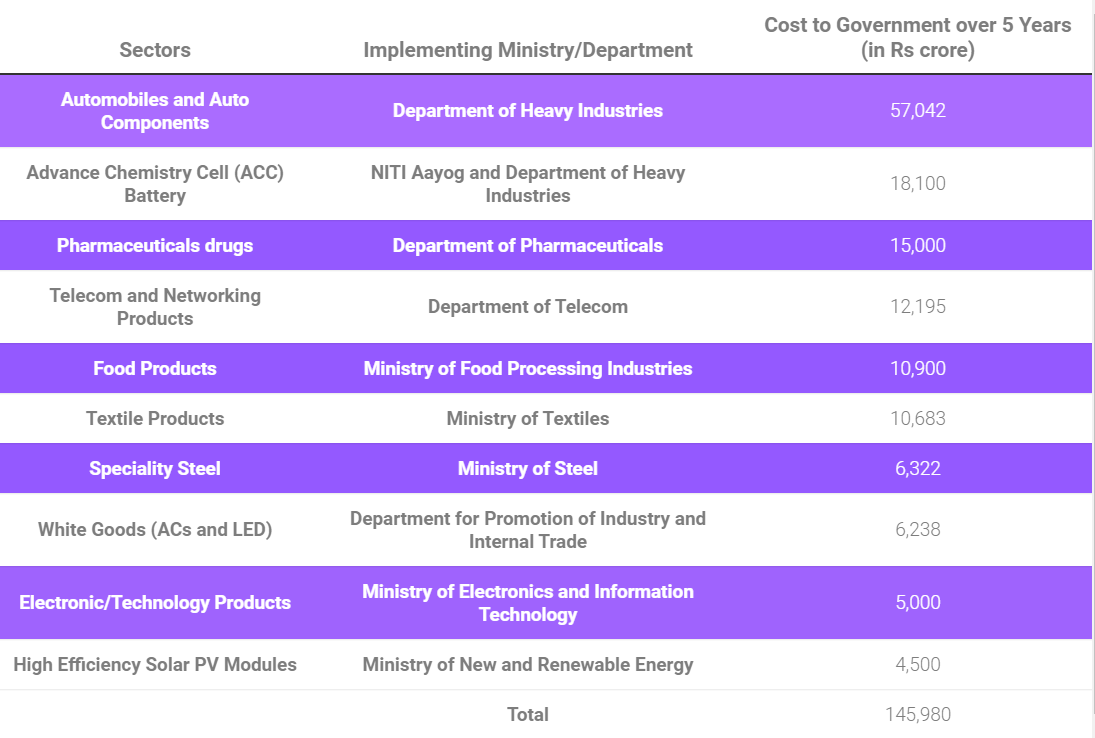
Given below is a table that shows the 10 sectors that will come under the PLI scheme, and the amount allocated to each sector.

Source: BloombergQuint

As we can see, the automobile and auto components sector has been allocated the highest amount in the PLI scheme. This would definitely help the sector to become a large exporter, and reduce import dependence. It has also been ensured that an amount of Rs 18,100 crore has been allocated for advanced chemical cell batteries. This would provide a major boost to the production of electric vehicles, as batteries are a key component of it. 

As per a statement from the Finance Minister, Smt. Nirmala Sitharaman, speciality steel in India could become a potential champion in the country’s exports. Hence, an amount of Rs 6,322 crore has been allocated for incentivizing its production as well.

Similarly, eight other sectors will be provided with sufficient incentives to completely improve the overall manufacturing capacity in India.

India and PLI

India has definitely received a massive Diwali gift from the government. If this scheme goes through precise planning and execution, it could become one of the most vital initiatives that have been adopted in our country. Our producers would certainly get the push to cater to the domestic demand, and foreign firms would be encouraged to invest heavily in India. The citizens of India would obtain more employment opportunities as well. It is a win-win situation for all the parties that would be involved!

At the same time, we would urge our readers to follow the latest updates surrounding this scheme. We could see listed companies applying to get the benefit of these incentives, and ramping up their production activities in India. This would certainly become a factor for many stocks to rally. We would also keep an updated list of the specific stocks that have been selected for the PLI scheme. Let us look forward to a positive outcome and see our country grow into one of the best manufacturing hubs in the world.