Categories
Market News Top 10 News

Finance Ministry Announces New Stimulus Package – Top Indian Market News

Finance Ministry unveils 12 new stimulus measures through Atmanirbhar Bharat 3.0

The Finance Ministry has announced a series of new measures to provide a further boost to India’s Covid-hit economy. The size of the stimulus package has been estimated at Rs 2.65 lakh crore. The Atmanirbhar Bharat 3.0 has focussed on sectors such as real estate and infrastructure. It has also introduced various steps to increase job opportunities in our country.

Read more here.

Cold storage chain ready for Covid-19 vaccine: Apollo Hospitals CEO

Suneeta Reddy, the CEO of Apollo Hospitals, has stated that the company is ready for the administration of the Covid-19 vaccine in India. She has said that Apollo has the necessary cold storage chain in place for the vaccine. They have also trained about 10,000 people to administer the vaccine.

Read more here.

Retail inflation rises 7.61% in October: Govt data

The growth rate of India’s retail inflation, which is measured by the Consumer Price Index (CPI), had increased to 7.61% in October. The CPI for September was reported at 7.27%. On a separate notice, it was stated that the Index of Industrial Production (IIP) had posted a growth of 0.2% YoY to 123.2 in September. The IIP measures India’s factory output. The two sets of data were released by the Ministry of Statistics & Programme Implementation.

Read more here.

Cochin Shipyard Q2 Results: Net Profit falls 48% YoY to Rs 107 crore

Cochin Shipyard Ltd. reported a 48% year-on-year (YoY) decline in net profit to Rs 107.16 crore, for the quarter ended September (Q2). The company’s revenue declined by 32.43% YoY to Rs 657.40 crore, during the same period. The shipbuilding company has stated that its main sales activities have not recovered to pre-Covid levels.

Read more here.

Eicher Motors Q2 Results: Net Profit declines 40% YoY to Rs 343 crore

Eicher Motors Ltd. reported a 40% YoY decline in consolidated net profit to Rs 343 crore, for the quarter ended September (Q2). The company’s revenue from operations declined by 2.65% YoY to Rs 2,143 crore, during the same period. Eicher Motors has stated that its sales of Royal Enfield motorcycles and commercial vehicles had fallen sharply, as compared to Q2 of the previous financial year.

Read more here.

Grasim sells fertilizer business to Indorama for Rs 2,649 crore

Grasim Industries has sold 100% stake in its fertilizer business- Indo Gulf Fertilizers (IGF), to Singapore-based Indorama Corporation Ltd. IGF is engaged in manufacturing and trading of urea and other agriculture inputs in India. The total value of the sale has been estimated at Rs 2,649 crore. The transaction is subject to necessary regulatory approvals.

Read more here.

Natco Pharma Q2 Results: Net Profit rises 73% YoY to Rs 204 crore

Natco Pharma Ltd. reported a 72.23% year-on-year (YoY) increase in consolidated net profit to Rs 203.9 crore, for the quarter ended September (Q2). The drug company’s consolidated revenue stood at Rs 827.9 crore, during the same period. The Board of Directors of Natco Pharma has approved an interim dividend of Rs 2 per share.

Read more here.

Advanced Enzymes Q2 Results: Net Profit rises 21% YoY to Rs 38 crore

Advanced Enzymes Technologies Ltd. reported a 21% YoY increase in net profit to Rs 38.56 crore, for the quarter ended September (Q2). The company’s revenue increased by 8.03% YoY to Rs 120.39 crore, during the same period. The research-driven company has stated that a majority of the revenue came from its healthcare segment. Its performance had not been adversely affected by the Covid-19 pandemic.

Read more here.

India imposes anti-dumping duty on clear float glass imports from Malaysia

India has imposed an anti-dumping duty on clear float glass from Malaysia for five years. The main aim of this duty is to protect the domestic industry from cheap imports. This was announced after a recommendation was made by the Directorate General of Trade Remedies (DGTR). Clear float glass is a material used in the automobile and refrigeration industries.

Read more here.

Jubilant Foodworks Q2 Results: Net Profit rises 4% YoY to Rs 76 crore

Jubilant Foodworks Ltd. reported a 3.82% YoY increase in consolidated net profit to Rs 75.77 crore, for the quarter ended September (Q2). The company’s revenue from operations declined by 18.20% YoY to Rs 816.32 crore, during the same period. The group had to close down 105 stores in Q2 FY21. Jubilant Foodworks is the master franchisee of Domino’s Pizza in India.

Read more here.

Categories
Editorial

The Atmanirbhar Bharat Abhiyan 3.0 Explained

The Finance Ministry on Thursday (November 12) made a series of announcements with respect to a new stimulus package. Named as the Atmanirbhar Bharat Abhiyan 3.0, the package has allocated significant amounts to vital sectors of our economy. The total package has been estimated at Rs 2.65 lakh crore. With a focus on boosting production and becoming self-reliant, the latest economic package has addressed concerns regarding the sectors which need the most support. Let us look at the 12 important announcements that were made by the Finance Minister, Smt. Nirmala Sitharaman.

1. The Atmanirbhar Bharat Rozgar Yojana

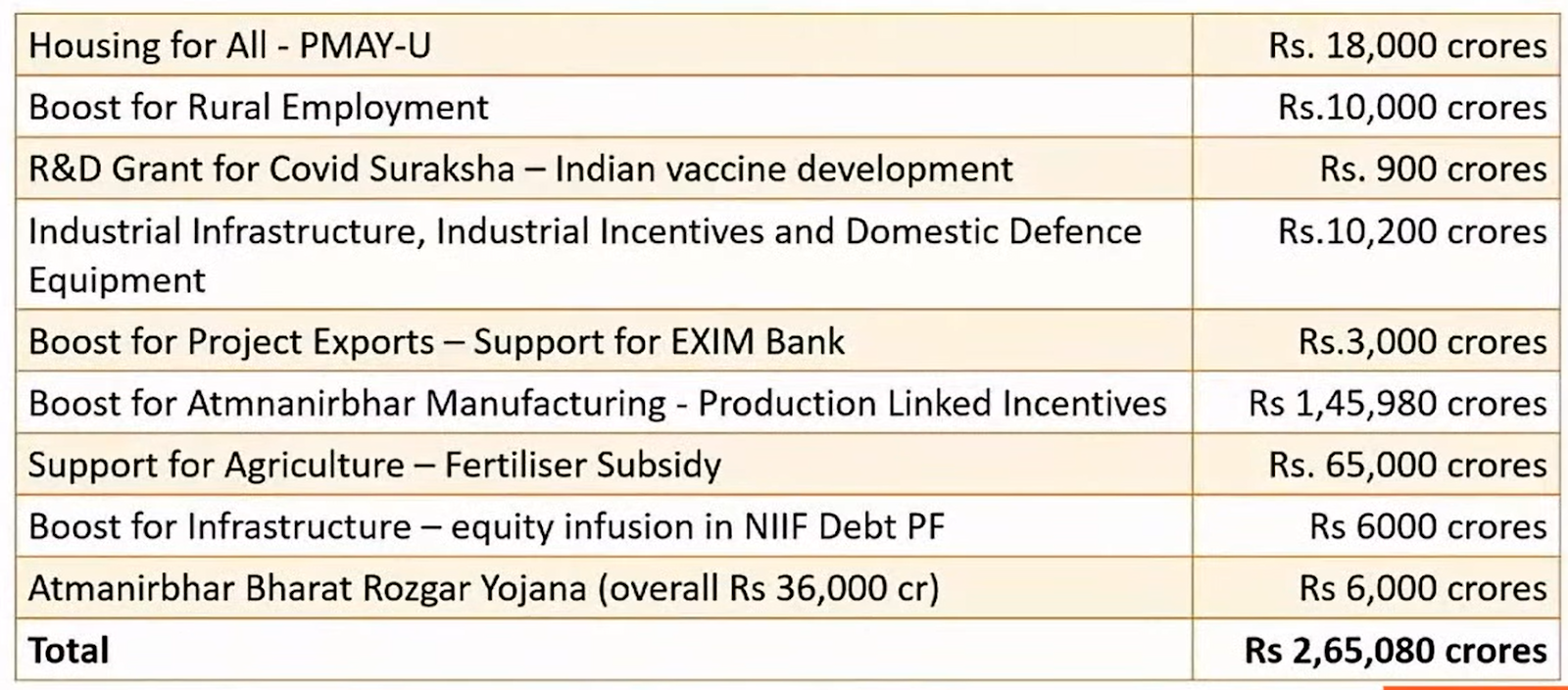
In order to boost employment in India, a new scheme by the name of Atmanirbhar Bharat Rozgar Yojana (ABRY) has been created. The main aim of this program would be to create new employment opportunities during the Covid-19 recovery phase. An amount of Rs 6,000 crores has been allocated towards ABRY

Under this scheme, benefits would be given to any new employee that joins an establishment that is registered with the Employees’ Provident Fund Organisation (EPFO). The employees’ monthly salary should be less than Rs 15,000. Any member who had lost their job due to the Covid-19 pandemic between 1st March and 30th September, and is now entering into a new job would also benefit from the scheme. The ABRY scheme would be operational till 30th June 2021.

2. Launch of the ECLGS 2.0

The Emergency Credit Line Guarantee Scheme (ECLGS), worth Rs 3 lakh crore has been extended till 31st March 20201. This scheme provides fully guaranteed, collateral-free loans to business enterprises, MSME units, and individuals for business purposes. According to the new ECLGS 2.0, loans will be provided to an additional 26 “stressed sectors”. These are specific sectors in India that were affected by the Covid-19 pandemic, such as power, steel, and real estate. The scheme would provide support by helping businesses to retain their employees and meet certain liabilities.

3. Production Linked Incentive (PLI) Scheme

On 11 November, the Union Cabinet had approved this particular scheme for an additional 10 key sectors. The main purpose of the PLI scheme is to boost domestic production, by encouraging foreign companies to start their production activities in India. Domestic companies would also get the necessary push to expand their manufacturing units. This scheme will be worth Rs 1.46 lakh crore and would be applicable for 5 years.

The sectors that will benefit from the scheme include automobiles, pharmaceuticals, electronic products, etc.

4. Additional amount for PM Awaas Yojana- Urban

The Prime Minister’s Awaas Yojana- Urban (PMAY-U) is a scheme to revive the Housing and Real Estate Sector. The Finance Ministry has stated that Rs 18,000 crore will be provided over and above the Budget Estimates for 2020-2021 for this particular scheme. This would help around 18 lakh houses to complete construction. It is also expected to generate around 78 lakh additional jobs in urban areas. This scheme is also part of the government’s “Housing for All” mission.

5. Support for Construction & Infrastructure

To provide support to contractors, the performance security on contracts has been reduced to 3%, instead of 5%-10%. Performance security is commonly used in the construction industry. It is a means of insuring a client against the risk of a contractor failing to fulfill contractual obligations to the client. This relaxation will be applicable till 31 December 2021.

6. Income Tax Relief for Developers & Home Buyers

The economic slowdown due to the Covid-19 pandemic has led to a decline in the prices of residential units. At the same time, taxes for these units are significantly higher. To provide a demand boost for residential real estate, new relaxations on the income tax regulations have been introduced. The differential between circle rate and agreement value has been increased from 10% to 20% till June 30, 2021, under the Income Tax Act. This would be applicable only on a primary sale of residential units worth up to Rs 2 crore. This particular move will help middle-class families to buy real estate properties.

7. Equity Infusion in NIIF Debt Platform

The Government will invest Rs 6,000 crore in the National Investment and Infrastructure Fund’s (NIIF) Debt Platform. The NIIF attracts a lot of sovereign funds from other countries and provides major support for the infrastructure activities in our country. It has a target of raising Rs 1.10 lakh crore by 2025 through the debt market, for various infrastructure projects.

8. Fertilizer Subsidies for the Agriculture Sector

The Government has announced Rs 65,000 crore for providing fertilizer subsidies to Indian farmers. This would help farmers to meet the ever-growing consumption needs of our country’s population. According to this particular scheme, 140 million farmers would be provided with subsidized fertilizer. It would be ensured that all farmers receive the proper resources before the upcoming crop season.

The Expenditure Secretary has also clarified that Rs 65,000 crore for this subsidy is over and above the last budget estimate. Total expenditure in this financial year would be in the order of Rs 1.38 lakh crores for fertilizer subsidy.

9. Boost for Rural Employment

Prime Minister Garib Kalyan Rozgar Yojana (PMGKRY) is a very successful scheme that provides guaranteed employment opportunities for members of the rural population in India. It is active in almost 116 districts in India. The Government has allocated an additional amount of Rs 10,000 crore to the PMGKRY scheme. This would help to accelerate the growth of the rural economy.

10. Boost for Exports

The Export-Import Bank of India (EXIM Bank) is a specialized financial institution, wholly owned by the Government of India. It was set up in 1982 for financing, facilitating, and promoting foreign trade in India. The EXIM Bank provides Lines of Credit (LOC), on behalf of the Government, to certain developing countries. A line of credit is a flexible loan from a financial institution that consists of a defined amount of money that you can access as needed, and repay either immediately or over time. This scheme allows Indian exports to receive a boost, as the developing countries must import items worth 75% value of the LOC.

The Government has allocated Rs 3,000 crore to the EXIM Bank for the promotion of exports through the LOC scheme. The sectors that would benefit are railways, power, automobile & auto components, sugar projects, etc.

11. Capital and Industrial Stimulus

The Government believes that public expenditure on infrastructure is important at this period of time. An additional amount of Rs 10,200 crore will be provided towards the Capital and Industrial Expenditure. This amount would be used for domestic defense equipment, industrial incentives, industrial infrastructure, and green energy initiatives.

12. R&D Grant for Covid Vaccine Development

An amount of Rs 900 crore will be provided for Covid Suraksha Mission for research and development activities. This particular mission is headed by the Department of Biotechnology to develop the Covid vaccine in India. This does not include the cost for distribution of the vaccine, once developed.

The following table shows the amount that has been allocated for each scheme that has been announced by the Finance Ministry on November 12, 2020.
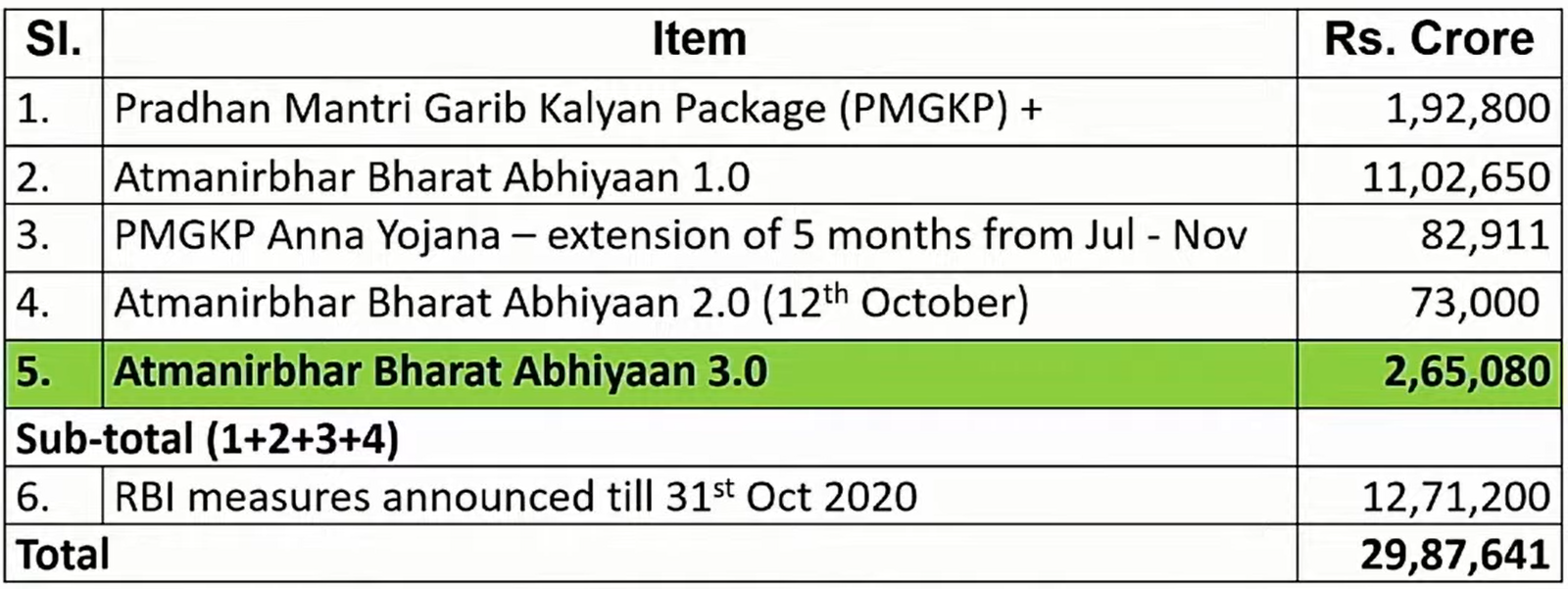
The following table shows the total amount that has been allocated for various stimulus packages announced by the Government in the current financial year. 
 “We are yet again proving that the policy that we are taking up even in PLI through which we want manufacturers to come to India is clearly to say we want to build on our strength but yet link with the global value chains.”- Finance Minister Nirmala Sitharaman.

India’s Future

The series of measures included in Atmanirbhar Bharat 3.0 will definitely provide a boost to India’s Covid-hit economy. The most important feature of the package is that it would help towards creating new jobs in India. It has also provided a major push towards the target of ‘housing for all’. Infrastructure activities will also receive adequate incentives. The Government has focused on those sectors that essentially need support for a major recovery, amidst the Covid-19 pandemic. The Production Linked Incentive(PLI) Scheme is also going to give a push to India’s dream of becoming the world’s manufacturing hub.

Pushing rural housing and job creation, along with subsidies on fertilisers is also sure to give a boost to the rural economy. And as we all know, if the rural economy is doing well, it is definitely good for an agriculture-driven economy of India. Tractor sales and two-wheeler sales are expected to go up as the life of a rural Indian gets better.

As investors, we need to keep a close watch on how the measures would be implemented. Also, make sure you take up the mission to find all the listed companies that would benefit from these schemes, both directly and indirectly.

Categories
Editorial

The PLI Scheme – All You Need to Know

One of the most important strategies to improve the economic growth of a country is to promote domestic production and become self-reliant. This is exactly what our Indian Government has been aiming for. The policies such as Make in India and the Atmanirbhar Bharat Abhiyan are prime examples of this. On November 11, the Union Cabinet announced the approval of a Production Linked Incentive (PLI) Scheme for 10 key sectors. This scheme would help to further strengthen the foundation of India’s path towards self-reliance.

Here at marketfeed, we always make sure to fulfill our promises and provide you with the best insights about such important events. Let us understand what this scheme is all about, and which sectors are included in it.

What is the PLI Scheme?

The Production Linked Incentive (PLI) scheme is a relatively new concept that was introduced in India earlier this year. The Government believed that it was time to initiate concrete steps to boost domestic manufacturing and cut down on huge import bills. Through the PLI scheme, companies would be provided with certain incentives to scale up production activities in India. It has three main objectives:

  1. To encourage foreign companies to set up their production activities in India. When this happens, we could see more foreign investments coming into our country.
  2. To provide support towards the existing domestic companies to expand their manufacturing units.
  3. To ensure that more employment opportunities are provided to Indian citizens in the manufacturing sector.

The PLI Scheme for Electronics Manufacturing

This scheme has become an absolute game-changer. Let us find out how our country adopted it initially. In April 2020, the Government introduced a PLI scheme worth Rs 40,000 crore for large-scale electronics manufacturing. The main aim of this particular scheme was to boost domestic manufacturing of mobile phones in India. The eligible companies were promised an incentive of 4%- 6% on incremental sales of goods that were manufactured in our country. This incentive would be applicable for 5 years. 

A total of 22 companies applied for the PLI scheme in August. And, three of these firms were contract manufacturers for Apple iPhones. We could also see that the share price of companies that had applied for the scheme (for eg, Dixon Technologies) had seen a surge during those periods.

According to Ravi Shankar Prasad, the Minister of Electronics and Information Technology, production worth Rs 11.5 lakh crore and exports valuing Rs 7 crore is expected over the next 5 years. It is very reassuring to learn that this scheme had received quite an overwhelming response from companies around the globe. It has become such a huge success.

The Latest PLI Scheme

In the notification made on November 11, the Government stated that it will offer incentives to an additional 10 vital sectors. The Union Cabinet has approved Production Linked Incentive Scheme worth up to Rs 1.45 lakh crore, for a period of 5 years. 

This would ensure that necessary support is provided to make India a global manufacturing hub, and create more jobs in the economy. The domestic companies would get the necessary push to cater to the local demand. The policy has been strategically targeted to very important sectors and would make Indian goods more competitive.

We can also state that the scheme has come at a very perfect time, in relation to the present global scenario. Most companies around the world are planning to shift their manufacturing operations from China. India could grab this opportunity and transform India into one of the best manufacturing centers in the world. The scheme would accelerate the existing plans of foreign companies that were considering to invest in India.

Which Sectors are Included in the PLI Scheme?

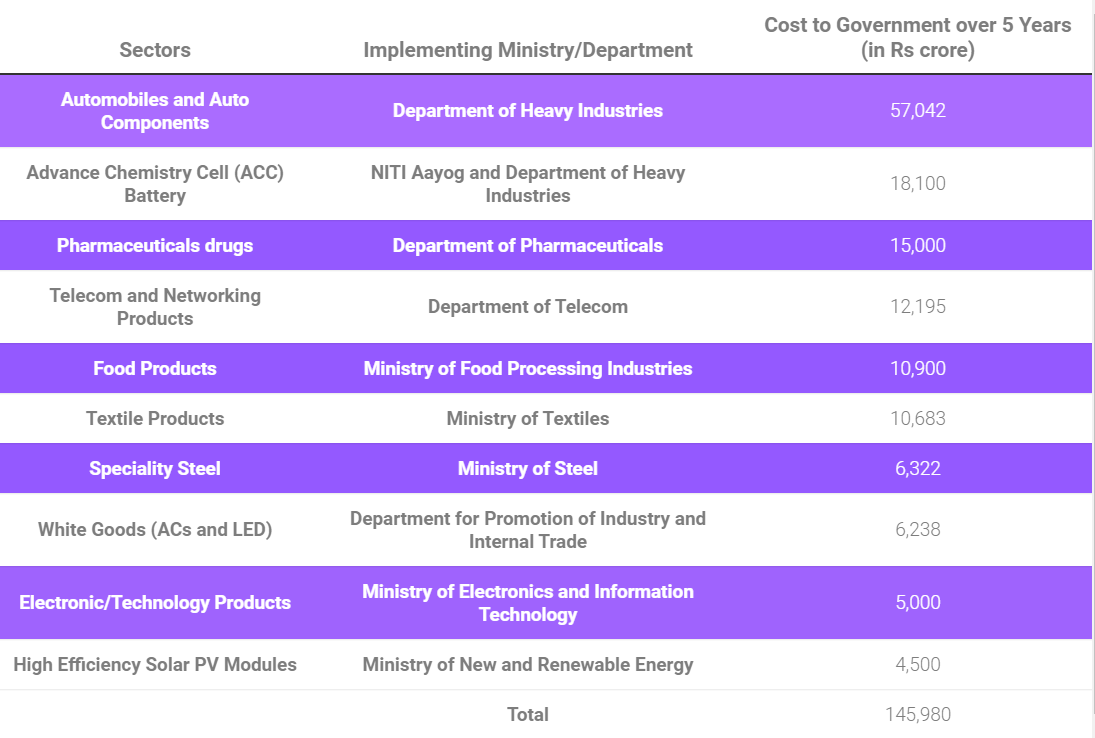
Given below is a table that shows the 10 sectors that will come under the PLI scheme, and the amount allocated to each sector.

Source: BloombergQuint

As we can see, the automobile and auto components sector has been allocated the highest amount in the PLI scheme. This would definitely help the sector to become a large exporter, and reduce import dependence. It has also been ensured that an amount of Rs 18,100 crore has been allocated for advanced chemical cell batteries. This would provide a major boost to the production of electric vehicles, as batteries are a key component of it. 

As per a statement from the Finance Minister, Smt. Nirmala Sitharaman, speciality steel in India could become a potential champion in the country’s exports. Hence, an amount of Rs 6,322 crore has been allocated for incentivizing its production as well.

Similarly, eight other sectors will be provided with sufficient incentives to completely improve the overall manufacturing capacity in India.

India and PLI

India has definitely received a massive Diwali gift from the government. If this scheme goes through precise planning and execution, it could become one of the most vital initiatives that have been adopted in our country. Our producers would certainly get the push to cater to the domestic demand, and foreign firms would be encouraged to invest heavily in India. The citizens of India would obtain more employment opportunities as well. It is a win-win situation for all the parties that would be involved!

At the same time, we would urge our readers to follow the latest updates surrounding this scheme. We could see listed companies applying to get the benefit of these incentives, and ramping up their production activities in India. This would certainly become a factor for many stocks to rally. We would also keep an updated list of the specific stocks that have been selected for the PLI scheme. Let us look forward to a positive outcome and see our country grow into one of the best manufacturing hubs in the world.