Categories
Editorial

Union Budget 2023-24: Key Highlights

Finance Minister Smt. Nirmala Sitharaman presented the Union Budget 2023-24 in Parliament today (February 1, 2023). The budget has brought some much-needed tax relief for citizens and included a set of important schemes that target different sectors of our economy. Let us take a look at some of the key highlights from the Budget presentation and the sectors that could benefit in the long term!

Relief for Taxpayers?

With inflation on the rise and loans getting expensive, we were all hoping for a relaxation in income tax rates. The Finance Minister made a much-anticipated mega announcement: there will be no tax on income of up to ₹7 lakh a year in the NEW REGIME

But bear in mind that there are no changes for taxpayers under the old tax regime! (The old income tax regime will continue with existing tax exemptions and deductions).

Here are some of the changes declared under the new tax regime system:

  • The country’s highest tax bracket has been brought down from 42.74% to 39%.
  • The surcharge on those earning between ₹50 lakh to ₹1 crore has been reduced from 37% to 25% in the new tax regime.
  • A five-slab structure will apply now under the new regime:
(Those earning up to ₹7 lakh per year are entitled to a tax rebate/refund)
  • Say, for example, you earn ₹7.5 lakhs a year. Then you’ll have to pay 5% tax on your income between ₹3 lakh to ₹6 lakh, and 10% between ₹6 lakh and ₹7.5 lakh.
  • Salaried people with an income of ₹15.5 lakh or more can subtract ₹52,500 as Standard Deduction while calculating their taxable income in the new tax regime. Till now, a standard deduction of ₹50,000 was available only under the old tax regime.
  • The new tax regime will be the default choice, but citizens can still opt for the old tax regime. You can make an informed decision after going through the opinions of tax experts.
  • To read about the current income tax structure for stock market investors & traders, click here!

Huge Jump in Capital Expenditure

The Central government will spend ₹10 lakh crore (up 33% YoY) on long-term capital expenditure (capex) in FY2023-24 to enhance growth potential & job creation and boost private investments. This amount is higher than the ₹7.5 lakh crore budgeted in the previous year and the highest on record!

This push in capex is crucial for India’s growth dreams to become the third-largest economy in the world and create sufficient jobs.

Boost for Railways Sector

The Finance Ministry allocated ₹2.40 lakh crore to Indian Railways. This is the largest capital outlay for railways to date and is nine times the amount provided in FY2013-14. This railway budget is likely to prioritise the completion of unfinished projects and development of infrastructure. The govt. will focus on the launch of more Vande Bharat high-speed trains. It will also allocate funds to introduce hydrogen-powered trains and the Ahmedabad-Mumbai bullet train project.

Do look out for stocks related to our railway sector: Indian Railway Catering and Tourism Corporation (IRCTC), Indian Railway Finance Corporation (IRFC), RailTel, Container Corporation of India, RITES, and Rail Vikas Nigam Ltd (RVNL).

Boost for Green Energy Sector

  • India has targeted to reach net-zero carbon emissions by 2070. In a strategic move, the Finance Minister announced ₹35,000 crore for priority capital investment towards energy transition, net zero objectives, and energy security by the Ministry of Petroleum & Natural Gas.
  • The govt. will support the development of battery energy storage of 4,000 megawatt-hours (MWh).
  • In August 2021, our govt launched the National Hydrogen Energy Mission (NHEM) and announced its decision to transform India into a global hub for green hydrogen production and export. This mission will now receive an outlay of ₹19,700 crore to help achieve a target of 5 million metric tonnes (MMT) of green hydrogen production capacity by 2023! 
  • The top 5 companies leading the green hydrogen revolution in India are Reliance Industries Ltd (RIL), NTPC, Indian Oil Corp, and Larsen & Toubro. These firms are also examining methods to bring down the cost of production and find alternate use cases. To learn more about NHEM, click here.

Boost for Agricultural Sector

  • Around ₹20 lakh crore will be allocated towards agricultural credit targeted at animal husbandry, dairy, and fisheries.
  • One crore farmers will get assistance to adopt natural farming over the next three years.
  • An Agriculture Accelerator Fund will be set up to encourage agri-startups by young entrepreneurs.
  • Nearly 63,000 credit societies across the country will be computerised. The Finance Ministry will allocate ₹2,516 crore towards this initiative.
  • Smt. Nirmala Sitharman also announced a new scheme to provide incentives for the adoption of alternative and natural fertilisers. 

The top companies operating in the agricultural sector include UPL, Coromandel International, Rallis India, Avanti Feeds, PI Industries, and Bayer CropScience.

Boost for Defence Sector

The govt. will increase the defence budget for FY2023-24 by 12.95% YoY to ₹5.94 lakh crore. This will allow the military to develop or buy advanced weapons systems, including new fighter jets, submarines and tanks!

Stocks related to the defence sector include Hindustan Aeronautics Ltd, Bharat Dynamics, Zen Technologies, Bharat Electronics, and Paras Defence & Space.

The Way Ahead

The Indian government continues to focus on getting the economy back on track and speeding up growth. The Budget will provide a boost to the ‘Make-in-India’ initiative by focusing on infrastructure, power, railways, defence, and agriculture. The Centre’s extended focus on digitisation through new-age technologies and electric vehicles is highly commendable. The govt. seeks to launch policies that promote fair growth, reduce inequalities, and build a more inclusive society.

Now, let’s look forward to seeing how these strategic policies are implemented! 

What are your views on Union Budget 2023-24? Let us know in the comments section of the marketfeed app!


Disclaimer: The stocks mentioned in the article are solely for educational purposes. Please do your own research before investing.
Categories
Market News Top Crypto News

FinMin Seeks to Tighten Norms for Crypto Taxation – Top Crypto News

Finanace Ministry seeks to tighten norms for crypto taxation

The Govt has proposed to tighten norms for crypto taxation by disallowing the set-off of losses with any gains from digital assets (crypto, NFT, etc). As per the amendments to the Finance Bill, 2022, the Finance Ministry proposes to remove the word ‘other’ from the section relating to set off of losses from gains in virtual digital assets. From April 1, a 30% income tax plus cess and surcharges will be levied on all crypto transactions. It will be levied in the same manner as it treats winnings from horse races or other speculative transactions.

Crypto prices today: Bitcoin up 2%, ETH rises 2.8%

Bitcoin is currently trading at $44,117.32, a 2.1% increase over the previous day. Ethereum is up 2.8% over the last 24 hours to $3,141.12. Solana surged 7% to $103.74, while Cardano is trading higher by 3.8% at $1.15. Polygon (MATIC) rose 3.6% to $1.64. The global crypto market cap stands at $2 trillion, a 1.94% increase over the previous day.

Bank of England lays out first regulatory approach to crypto

The Bank of England (BoE) has begun sketching out the UK’s first regulatory framework for crypto assets. BoE said the rapid growth of cryptos could pose risks to financial stability in the future if left unregulated. Crypto-assets have come under the regulatory spotlight amid concerns they could be used to bypass financial sanctions imposed on Russia since its invasion of Ukraine.

Solana price gains 10% as gaming adoption accelerates

Solana jumped ~10% in 24 hours, moving from about $96 to $103 at one point today. The move comes shortly after Krafton announced it is partnering with Solana Labs to develop blockchain games on the network. Krafton is the publisher of the popular battle royale game PUBG. Earlier this week, Web3 gaming startup Block Tackle said it is developing a Solana NFT skateboarding game.

Categories
Market News Top 10 News

India Achieves Full Recovery in Pre-Pandemic Output Level in Q2 – Top Indian Market News

India achieves full economic recovery of pre-pandemic level in Q2: Finance Ministry

In its Monthly Economic Review report for November, the Ministry of Finance stated that India’s real GDP in Q2 FY22 has grown by 8.4% YoY, thereby recovering over 100% of the pre-pandemic output in the corresponding quarter of FY20. India is among the few countries that have recorded four consecutive quarters of growth amidst the Covid-19 pandemic, reflecting the resilience of our economy.  Data also shows that the investment cycle has kickstarted in the country.

Read more here.

Antony Waste’s subsidiary secures order from North Delhi Municipal Corp

AG Enviro Infra Projects Pvt Ltd, a wholly-owned subsidiary of Antony Waste Handling Cell Ltd, has received an order for door-to-door collection and transportation of municipal solid waste to disposal sites at Sadar Paharganj Zone of North Delhi Municipal Corporation (NDMC). The contract is for ten years, and the company is estimated to handle ~1,000 tonnes of municipal waste per day.

Endurance Tech commences commercial production at new plant in Waluj

Endurance Technologies Ltd has commenced commercial production at its new plant at E-7 1, MIDC Industrial Area, Waluj in Aurangabad, Maharashtra. The plant will manufacture braking systems for the company’s original equipment manufacturer (OEM) customers. Endurance Tech will gradually ramp up the volumes of its disc brake assembly and rotary discs up to 36 lakh units per annum.

Read more here.

Vedanta to pay Rs 13.5 per share as interim dividend

Vedanta Ltd will reward shareholders with a dividend payout for the second time this year after reporting back-to-back bumper profits in the past year. The mining company has approved an interim dividend of Rs 13.50 a share, totalling Rs 5,019 crore. Earlier this week, Vedanta’s subsidiary Hindustan Zinc Ltd had approved an interim dividend of Rs 18 per share, amounting to a payout of Rs 7,605.57 crore.

Read more here.

Dr. Reddy’s Labs receives USFDA approval for VeraRing

Dr. Reddy’s Laboratories Ltd has received approval from the US Food and Drug Administration (USFDA) for its Abbreviated New Drug Application (ANDA) 207577- VeraRing. The pharma company is evaluating further steps in relation to this product. VeraRing covers the category of intra-uterine contraceptive devices.

Four IPOs to hit the markets next week

Medplus Health Services, Data Patterns (India) Ltd, HP Adhesives, and Supriya Lifescience will launch their initial public offerings (IPOs) between December 13th and 16th. Medplus Health Services Ltd is India’s second-largest pharmacy retailer in terms of the number of stores and revenue. It has fixed a price band for its Rs 1,398.3 crore IPO at Rs 780-796 per share.

Data Patterns (India) Ltd is set to launch its Rs 588.22 crore-IPO on December 14 at a price band of Rs 555-585 per share. It is a defense and aerospace electronics solutions provider.

HP Adhesives Ltd, a manufacturer of adhesives and sealants, will launch its initial public offer on December 15. The company has fixed Rs 262-274 per share as the price band for its Rs 125.96 crore IPO.

Supriya Lifesciences Ltd will launch its maiden public offer for subscription on December 10. The company is engaged in the manufacturing of Active Pharmaceutical Ingredients (APIs).

Categories
Market News Top 10 News

Finance Ministry Announces Rs 6.28 lakh crore Stimulus Package – Top Indian Market News

Finance Ministry announces relief measures for sectors impacted by Covid-19

Union Finance Minister Nirmala Sitharaman has announced a Rs 6.28 lakh crore stimulus package to boost Covid-affected sectors. An amount of Rs 23,220 crore will be set aside for the expansion of medical infrastructure for one year. Once issuance resumes, five lakh tourist visas will be issued free of charge. This incentive will cost the government around Rs 100 crore. 

The Finance Ministry also announced a Rs 1.1 lakh crore loan guarantee scheme for Covid-affected sectors. Under this scheme, around 25 lakh beneficiaries will be able to borrow up to Rs 1.25 lakh through micro-finance institutions (MFIs). The cap of the Emergency Credit Line Guarantee Scheme (ECLGS) will be raised from Rs 3 lakh crore to Rs 4.5 lakh crore. The Centre will also allocate Rs 3.03 lakh crore to revamp state-owned power distribution companies.

Read more here.

HAL Q4 Results: Net profit rises 31% YoY to Rs 1,622 crore

Hindustan Aeronautics Ltd (HAL) reported a 31.27% YoY increase in consolidated net profit to Rs 1,622.19 crore for the quarter ended March (Q4). Net profit has increased by 90% when compared to the previous quarter. Its total income rose 4.38% YoY (or 97% QoQ) to Rs 10,870.24 crore during the same period. Net profit for the financial year ended March 31, 2021 (FY21) increased by 12.37% YoY to Rs 3,239.46 crore. HAL’s board has recommended a final dividend of Rs 30 per share.

Tata Motors to launch 10 new electric vehicles by 2025

Tata Motors Ltd has announced plans to roll out 10 new battery electric vehicles (BEVs) in its domestic portfolio by 2025. Going ahead, the automaker plans to drive its business model towards sustainable mobility. The company is also exploring opportunities to invest in lithium cell manufacturing in India and Europe. This is to establish a proper supply chain for its zero-emission vehicles in the coming decade. Tata Motors will also leverage its resources to set up a wide network of charging infrastructure in India. 

Read more here.

NALCO Q4 Results: Net profit jumps 830% YoY to Rs 935 crore

National Aluminium Company Ltd (NALCO) reported an 830.99% YoY jump in consolidated net profit to Rs 935.74 crore for the quarter ended March (Q4). Net profit has increased by 290.36% when compared to the previous quarter. Its total income rose 40.75% YoY (or 19% QoQ) to Rs 2,874.47 crore during the same period. Net profit for the financial year ended March 31, 2021 (FY21) jumped 853.8% YoY to Rs 1,299.41 crore.

Power Mech Projects secures order worth Rs 9,300 crore from Coal India

Power Mech Projects Ltd has received an order worth Rs 9,294 crore for a mine development and operation (MDO) project from Central Coalfields Ltd (CCL), a subsidiary of Coal India. The contract consists of mine infrastructure development, extraction of coking coal, processing, crushing, and transportation of coal to a washery of CCL. The project has been awarded to a consortium of Power Mech Projects and AMR India. Interestingly, the market cap of Power Mech Projects is less than Rs 1,000 crore.

Read more here.

Tech Mahindra to acquire US-based Brainscale

Tech Mahindra Ltd, through its wholly-owned subsidiary Tech Mahindra (Americas) Inc., will acquire a 100% stake in US-based Brainscale. The cost of the acquisition is $28.8 million (~Rs 214 crore). Brainscale is a cloud-focused company that has expertise in cloud consulting, application development, and data analytics. This acquisition will help Tech Mahindra drive the growth of its cloud-related IT services in the North American market.

Read more here.

KIOCL gets in-principle approval for mining in Devadari mines

The Union Ministry of Environment, Forests, and Climate Change has given Stage-I approval for the diverting 401.57 hectares of forest land at Devadari Hill Range in Ballari district (Karnataka) for iron ore and manganese ore mining by KIOCL Limited. The contract is for a period of 50 years. The Stage-II clearance is likely to be received by the end of the current financial year. Mining operations are expected to commence in 2022-23 (FY23).

Read more here.

Commercial Bank of Kuwait selects TCS’ BaNCS for treasury solutions

The Commercial Bank of Kuwait (CBK) has selected Tata Consultancy Services (TCS) Ltd’s ‘BaNCS for Treasury’ solution to manage risks, enhance asset class coverage, and drive future growth. The solution will help CBK offer a wider range of cash and derivative treasury products and integrate various trading and messaging platforms. It will also help CBK offer extensive accounting and reporting capabilities and manage cash and positions in real-time.

Read more here.

NLC India Q4 Results: Net profit rises 52% YoY to Rs 756 crore

NLC India reported a 51.9% YoY increase in consolidated net profit to Rs 756.83 crore for the quarter ended March (Q4). Its revenue from operations declined by 7.4% YoY to Rs 2,839.55 crore during the same period. The revenue from the lignite mining segment declined by 24.88% YoY to Rs 1,258.93 crore in Q4. Net profit for the financial year 2020-21 (FY21) declined by 7.4% YoY to Rs 1,345.44 crore. NLC India’s board has recommended a final dividend of Rs 1.5 per share. NLC India is a state-owned company engaged in fossil fuel mining and thermal power generation.

Read more here.

Emami hikes stake in male grooming startup The Man Company

Emami Limited has increased its stake in Helios Lifestyle from 33.09% to 45.96%. Helios Lifestyle is a direct-to-consumer startup that sells male grooming products under The Man Company brand. It offers a wide range of premium men’s grooming products under the bath and body, beard management, shaving, and perfumes category. FMCG firm Emami said this investment was in line with its strategy of leveraging emerging online opportunities brought about by rapid digitisation. This transaction makes Emami the largest shareholder in Helios Lifestyle.

Read more here.

Categories
Editorial

Union Budget 2021-22: Main Highlights and Stocks To Benefit

Finance Minister Smt. Nirmala Sitharaman presented the Union Budget 2021-22 in the Parliament on February 1, 2021. It will facilitate a ‘reset of the Indian economy’. Amidst the pandemic, the total impact of Atmanirbhar Bharat and measures by RBI was at Rs 27.1 lakh crore (~30% of our GDP). The budget has now included a set of important schemes that target different sectors of our economy. Let us take a look at some of the key highlights from the Budget presentation.

Boost for the Healthcare Sector

The Finance Minister has announced a Rs 64,180 crore package for the healthcare sector, which will be spread over the next 6 years. This would come under the PM Atmanirbhar Swastha Bharat Yojana. Under this scheme, around 17,000 rural and 11,000 urban health and wellness centres will be set up. Launch of Integrated public health labs will happen in each district of the country.

The Finance Minister also said that more Covid-19 vaccines will be produced and linked to labs across India. An amount of Rs 35,000 crore will be allocated for the manufacturing and distribution of vaccines. The budget outlay for Health and Welfare is Rs 2.23 lakh crore, a 137% increase compared to the previous year. Pharma stocks can be watched.

The Scrappage Policy

The FM has announced a voluntary scrapping policy. Passenger vehicles (PVs) older than 20 years and commercial vehicles (CVs) older than 15 years must undergo a fitness test. This will help reduce the pollution levels in our country. It will also provide a demand boost for the automobile sector.

The fitness test will be conducted at automated fitness centres, which will determine whether the vehicle in question is qualified to run on roads or headed for the scrap heap. Each fitness test would cost approximately Rs 40,000. This is in addition to the road tax, and possible “Green Tax” that you have to pay while mandatorily renewing your private vehicle’s registration after the 15-year period. This would ultimately ensure that individuals get rid of their old cars and purchase new ones. We are waiting for more details. Stocks like Ashok Leyland, Tata Motors and Eicher Motors will benefit the most.

Boost for Infrastructure Sector

The Finance Ministry will set aside a total amount of Rs 5.54 lakh crore for the infrastructure sector. The Government will set up a Development Finance Institution (DFI), which will receive an initial capital of Rs 27,000 crore. The DFI aims to have a lending portfolio of Rs 5 lakh crore in 3 years. This DFI will be used to finance both social and economic infrastructure projects identified under the National Infrastructure Pipeline (NIP). It will be beneficial for infra companies like GMR Infra, which may otherwise not be able to take more loans as they already have high debt.

A National Monetisation Pipeline for brownfield projects will be launched. This includes:

  • 5 operational roads with an estimated enterprise value of Rs 5,000 crore will be transferred to the National Highway Authority of India (NHAI) Infrastructure Investment Trust (InvIT).
  • Transmission assets worth Rs 7,000 crore will be transferred to Power Grid Corporation of India Ltd (PGCIL) InvIT.

The Ministry of Road Transport & Highways will be allocated a total amount of Rs 1.18 lakh crore. Highway infrastructure projects will be given a boost. This includes building 8,500-km of highways by March 2022. We could see many listed construction or infrastructure companies receiving orders from NHAI for taking over such projects. Highway builders including Dilip Buildcon and even L&T will benefit. The proposed highway works include:

  • 3,500 km corridor in Tamil Nadu
  • 1,100 km in Kerala at an investment of Rs 65,000 crore
  • 675 km in West Bengal at a cost of Rs 95,000 crore
  • 1,300 km in Assam in the next 3 years
  • Out of the Rs 1.10 lakh crore allocated for Railways, Rs 1.07 lakh crore will be towards capital expenditure. JSPL will benefit for more track laying. Also, the Indian Railways will monetise dedicated freight corridor assets for operations and maintenance after commissioning. IRCTC will obviously benefit.
  • The FM said that Indian Railways will prepare a future-ready railway system by 2030 referred to as the National Rail Plan.

Boost for Power Sector

The Indian power sector will receive additional funding of Rs 3.06 lakh crore. Pipelines of GAIL (India) Ltd, Indian Oil Corp (IOC), and HPCL will be monetised. The Ujjwala scheme will be extended to cover 1 crore more beneficiaries. [The Pradhan Mantri Ujjwala Yojana is a scheme of the Ministry of Petroleum & Natural Gas for providing LPG connections to women from Below Poverty Line (BPL) households]

  • 100 more districts will be added to the Ujjwala scheme in the next 3 years for city gas distribution.
  • An independent gas transport system operator will be set up to ensure equal access to all citizens.
  • The government has announced a new gas pipeline project for Jammu and Kashmir. 

The Finance Minister has also proposed to allocate Rs 1,000 crore to the Solar Energy Corporation and Rs 1,500 crore to the Renewable Energy Development Agency.

PLI Schemes

The government aims to spend Rs 1.97 lakh crore on various Production Linked Incentive (PLI) schemes over the next 5 years. This is in addition to the Rs 40,951 crore announced for the PLI for electronic manufacturing schemes. To achieve double-digit economic growth, PLI schemes to create manufacturing global champions for an ‘Atmanirbhar Bharat’ have been announced for 13 sectors.

In November 2020, the government announced a mega PLI scheme for 10 sectors. This included advanced chemistry cell batteries, electronic products, automobiles & auto components, pharma, telecom & networking products, textile, food products, white goods, and speciality steel. This will encourage global players to kickstart their manufacturing activities in India. It would also provide employment opportunities to lakhs of people.

Divestment Targets

Divestment target has been set at Rs 1.75 lakh crore for the upcoming financial year.

  • For the current financial year (FY21), the government had budgeted to raise Rs 2.1 lakh crore through divestments. However, they have fallen short of the target.
  • The stake sale of Life Insurance Corporation (LIC) will be completed this year. The initial public offering (IPO) of LIC will be conducted in FY22.
  • The strategic disinvestment of companies including BPCL, Air India, Pawan Hans, IDBI Bank, Container Corporation of India (CONCOR) will be completed in 2021-22.
  • Seven major ports worth Rs 2,000 crore will see their operations privatised in the year 2021-2022.
  • The next lot of airports will be privatized in Tier 2 and 3 towns and cities. As we know, the Adani Group has taken over the operations of multiple airports from the Airports Authority of India (AAI). Adani Enterprises and GMR Infra can be noted.
  • The government has approved a new Public Sector Enterprise Policy, which aims to accelerate privatisation activities.

Boost for Banking and Insurance Sector

The Finance Minister has announced a further infusion of Rs 20,000 crore for public sector banks. Another major update is the proposed launch of an Asset Reconstruction and Asset Management Company. This particular institution will take over the existing stressed/bad debts of commercial banks. It will acquire bad loans from banks at a negotiated price (at a discount from book value) and pay by way of cash and security receipts. The funds for buying the bad loans will come from the sponsors (government and other banks) and alternative investment funds. The institution will then restructure and turnaround the bad loans for a fee. PSU Banks will benefit the most.

A hike in Foreign direct investment (FDI) in the insurance sector to 74% from the existing 49%. Under the new structure, the majority of directors and key management persons have to be Indian residents. However, this move will help increase capital inflow in insurance companies and enhance their expansion and growth. This increase in FDI limits will help insurance companies to raise funds to ensure that financial stability is maintained- in line with growing business needs. Insurance stocks will benefit, both life and general.

Boost for the Agricultural Sector

The Finance Minister has proposed to increase the agricultural credit target to Rs 16.5 lakh crore. The Finance Minister stated that the government is committed to the welfare of farmers. State-run Agricultural Produce Marketing Committees (APMCs) will now be able to access the Rs 1 lakh crore Agriculture Infrastructure Fund (AIF). However, the budget allocation for the Department of Agriculture, Cooperation and Farmers Welfare has been slashed 8.5% for 2021-22. The flagship PM-KISAN scheme, meant to provide income support to farmers, saw a 13% drop in its budget. Certain provisions in the budget for the agricultural sector include:

  • The provisions for the rural infrastructure development fund will be increased to Rs 40,000 crore from the existing Rs 30,000 crore. Infra companies including road builders and cement manufacturers will benefit.
  • The amount allocated for micro-irrigation activities will be doubled to Rs 10,000 crore.
  • The agriculture infrastructure fund will be made available to Agricultural Produce Marketing Committees (APMCs).
  • The government has proposed a farm cess of Rs 2.5 per litre on petrol, Rs 4 per litre on diesel. Prices of petroleum products will likely go up even more.

Boost for Real Estate Sector

This government continues to see ‘Housing for All’ and affordable housing as priority areas. The Ministry of Housing and Urban Affairs has been granted Rs 54,581 crore in the Budget 2021. To incentivise home buyers and real estate developers, it is proposed to increase the safe harbour limit from 10% to 20% for the specified primary sale of residential units. [Safe harbor is a legal provision to eliminate regulatory liability in certain situations, provided that certain conditions are met. It refers to an accounting method that avoids certain tax regulations]

In the July 2019 Budget, the government provided an additional deduction of interest, amounting to Rs 1.5 lakh, for loans taken to purchase affordable houses. The Finance Minister has proposed to extend the eligibility of this deduction by one more year, to March 31, 2022. Also, affordable housing projects can avail a tax holiday for one more year. All realty stocks will benefit but do note especially the ones who provide affordable housing.

Cement stocks will benefit, including ACC and UltraTech Cement among others.

Tax Relief

No COVID-cess was announced, with no increase in corporate taxes. Senior citizens above the age of 75 years will now be exempt from filing income tax returns. However, such individuals will have to continue to pay income tax at their respective tax slabs. FM Sitharaman has proposed to give tax holiday for aircraft leasing businesses in Gujarat International Finance Tec-City (GIFT City). [A tax holiday is a temporary reduction or elimination of a tax] The minister has also proposed an extension of tax holiday for start-ups by one more year.

Other announcements on tax include:

  • Dividend payment for Real Estate Investment Trusts (REIT) and Infrastructure Investment Trusts (InvITs) will be exempted from tax. Watch REITs stocks.
  • The government has proposed to increase the threshold for tax audits from Rs 5 crore to Rs 10 crore (for those transacting 95% digitally).
  • Advance tax liability on dividends will arise only after the declaration of the dividend.
  • Foreign Portfolio Investors (FPIs) will get a deduction of tax on dividends at a lower treaty rate. We may see more inflow of FII funds.
  • The government will also notify rules to eliminate the double tax for NRIs on foreign retirement funds.

Customs Duty Structure

  • MSMEs and other user industries have been severely hit by a recent sharp rise in iron and steel prices. Thus, customs duty on semi, flat, and long products of non-alloy, alloy, and stainless steels will be cut to 7.5%.
  • The duty on copper scrap will be reduced from 5% to 2.5%.
  • Customs duty on Naptha (used in solvents, paints, etc) will be reduced to 2.5%.
  • The customs duty on certain auto parts will be increased to 15%. This will bring them on par with the general rate on auto parts.
  • To benefit farmers, the customs duty on cotton will be raised to 10%. The duty on raw silk and silk yarn will be increased from 10% to 15%. 
  • The customs duty on mobile components will be increased to 2.5%. Domestic electronics manufacturers like Amber and Dixon will benefit.

Other Major Announcements

  1. With the continuing focus on Atmanirbhar Bharat, Nirmala Sitharaman announced the establishment of 7 mega textile parks over the next 3 years. Also, 5 major fishing hubs will be developed across India.
  1. The Finance Ministry will notify the Securities and Exchange Board of India (SEBI) as the regulator for gold exchanges.
  1. A scheme to promote the flagging of merchant ships in India will be launched by providing subsidy support to Indian shipping companies in global tenders. An amount of Rs 1,624 crores will be provided over 5 years.
  1. The government has proposed a Rs 1,500 crore-scheme to promote digital transactions in the country. This will support the adoption of e-payments in smaller cities.
  1. The fiscal deficit has been estimated at 9.5% of GDP for 2020-21. Fiscal deficit for 2021-22 at 6.8% of GDP. [Fiscal deficit is the difference between total revenue and total expenditure of the government]. The estimated gross borrowing by the government for FY 2021-22 will be Rs 12 lakh crore.

Finance Minister Nirmala Sitharaman has tabled the 15th Finance Commission report in Lok Sabha. 

Categories
Editorial

Union Budget 2021: Expectations

All eyes are focussed on the Union Budget 2021-22 that will be presented by Finance Minister Nirmala Sitharaman on February 1. As we know, the Covid-19 pandemic had led to disruptions in all major economic activities. The upcoming Budget has greater significance, as it would give us a clear picture of how the Central Government plans to allocate essential funds to revive our economy. The Finance Minister had stated that this budget would be unlike anything we have seen over the past 100 years of India’s history.

Over the past few months, there have been multiple reports or rumours that indicate the different sectors of India’s economy that are likely to benefit from the Budget. Let us take a look at some of these sectors.

Agriculture Sector

The agriculture sector had single-handedly supported the Indian economy while other major sectors were at a near standstill amidst the Covid-19-related lockdown. With the ongoing farmers’ agitation in Delhi, the government is expected to send across a positive message to the farmers in the country. It has been reported that the Union Budget would continue to focus on agriculture and allied sectors. In fact, ‘farmer welfare’ could be the central theme of this Budget.

A sharper focus is needed on the development of farm gate infrastructure, formulation, and strengthening of farmer collectives. Experts have suggested that the government could spend more to improve warehousing and cold storage facilities for farmers. There should be a further limit on the price of fertilizers and other chemicals. There are also expectations of providing nominal logistics support to poor farmers.

However, farmers have made their demands clear: a guarantee on the Minimum Support Price (MSP) and permanent withdrawal of the three farm laws. As farmers continue to protest, it will be interesting to see if the government has any plans to put an end to the agitation through its Budget. 

Healthcare Sector

The ongoing Covid-19 pandemic has taught the entire world the importance of having a strong healthcare sector. Increased public spending on healthcare will be one of the primary expectations of the upcoming Budget. We have realised the importance of improving healthcare infrastructure in public hospitals throughout India. More funds will have to be pumped into Ayushman Bharat, which is a scheme that aims to help economically vulnerable Indians who require healthcare facilities. People could expect the government to increase the deduction threshold for medical insurance. 

On the GST front, the government can consider making healthcare more affordable by introducing a ‘zero-rating’ of GST for healthcare services. [Zero rating means that the entire value chain of the supply is exempt from tax]. This will help in keeping the credit chain intact and ensuring that tax is not added to the cost of healthcare services.

One of the critical requirements in the healthcare ecosystem is a skilled workforce. The arrival of new products and technologies makes it imperative that there are continuous learning and skill enhancement for healthcare professionals. It is also important to provide greater investment for preparedness against other health emergencies that may arise in the future. Thus, there should be more investments in diagnostic testing capabilities and contact tracing mechanisms.`

Banking Sector

The financial system has been under severe stress following the Covid-19 outbreak, and the banking system is still facing asset quality issues. In Union Budget 2021, industry experts are hoping that the government will focus on better governance in the banking sector and simplification of compliance and regulation. There is an expectation that the number of public sector banks will be reduced from 12 to 4. This may include merging and also privatisation of banks. 

According to RBI, the gross non-performing assets (NPAs) of banks could increase to 14.8% by September 2021, under the worst-case scenario. Through recent interactions with the media, the Finance Ministry indicated the idea of setting up a ‘bad bank’ to handle the expected influx of bad loans after the Covid-19 pandemic. A bad bank will have the power to purchase bad loans from banks at the market price. It acts as an aggregator of all the stressed assets in the banking system. This will allow the banks to clear their balance sheets and improve their fundraising capabilities.

Automobile Sector

The automobile sector had been witnessing a slowdown even before the pandemic. This was primarily due to regulatory changes, millennial buying preferences, and an increase in the cost of ownership. According to Moody’s, the Indian auto sector is expected to decline by 30% in the calendar year 2020, amid a contraction in GDP and the Covid-19 pandemic. Even though the festive season had provided a boost to vehicle sales, the automakers are worried that the demand would not sustain. Large automobile firms are also increasing the prices of their two-wheelers, passenger vehicles, or commercial vehicles due to an increase in input costs.

The automobile industry has high hopes from Union Budget 2021. Here are a few: 

  • Currently, a bike that costs Rs 50,000 is taxed at 28% GST- which is similar to a passenger car worth lakhs. It has been reported that a 10% GST reduction could boost demand for two-wheelers. 
  • Vehicle loans under Rs 5 lakh could be considered as priority sector lending (PSL) by banks. This will encourage banks to provide more loans to customers and lead to enhanced credit creation. Ultimately, it would also increase the demand for automobiles.
  • A new policy to scrap cars, buses, and trucks that were more than 15-years-old, is expected to be announced in the Budget. It would also incentivise the purchase of new vehicles. You can read more about the vehicle scrappage policy here.
  • Electric mobility is another key priority area for the government. There are many Indian promoters and international groups that are willing to invest in the electric vehicle (EV) segment. To boost demand, India needs to improve upon essential infrastructure such as electric charging stations.

Realty Sector

The contribution of the real estate and construction sector to India’s overall economic activity is quite significant. The Covid-19-related lockdowns had caused severe disruption in sales and construction. With the easing of restrictions, there has been a strong recovery in sales and development activities. However, the housing sector will look forward to additional measures that can support recovery in demand and remove supply-side challenges faced by developers. 

There have been several reports stating that the Union Budget would consider expanding the current income tax benefits available for homeowners. There is an expectation that buyers will get home loans at affordable rates and a moratorium on loan payments. This would encourage more people to buy properties. Realty firms have stated that the government should allow real estate developers to set off Goods & Service Tax (GST) paid on inputs like cement from tax liability on rental income. This would help avoid double taxation and give a boost to the office market to help India maintain its advantage in various sectors like IT and startups. 

Covid Cess

Amidst the Covid-19 pandemic, the Centre should focus on providing more access to basic necessities such as healthcare, drinking water, and housing. More money should be put into the hands of citizens so that consumption receives a push. This is possible through well-defined tax reliefs or exemptions. In order to ensure a V-shaped recovery of the economy, all financial resources must be utilised or allocated judiciously. 

However, the government is likely to impose Covid Cess to fund additional spending due to the pandemic, including that on vaccines. If the government charges an additional 2% Covid cess on income tax, then the total cess amount would go up to 6%. The current 4% cess imposed on income tax was introduced in Union Budget 2018 by ex-finance minister Arun Jaitley. This means that our tax liability would go up (based on the current tax slabs). 

Such a cess will only help the Centre obtain more revenue, while states will gain nothing. Several reports indicate that the Covid-19 cess will be primarily imposed on large corporates and high net-worth individuals (HNIs).

Markets do not like increased taxes. In fact, when Nirmala Sitharaman decreased corporate taxes on 19 September 2019, markets rallied like anything and the candlestick formed was called the Nirmala Sitharaman candle. Will we see a fall like this if an increase in tax is announced?

Conclusion

We have only mentioned a mere five sectors that could receive benefits from the Union Budget 2021-22. Fast-moving consumer goods (FMCG), retail, logistics, power generation, telecommunications, and other essential sectors are also expected to receive a much-needed boost. To attain self-reliance of essential resources, the government is likely to introduce more programmes under the Atmanirbhar Bharat Abhiyan. Production linked incentive (PLI) schemes could be launched for more sectors. These measures would encourage domestic and multinational companies to ramp up their production activities in India. Lakhs of people would be able to obtain employment opportunities. It is also vital that our country gives additional importance to renewable energy sources and the infrastructure surrounding them. 

The Narendra Modi government may also introduce the Cryptocurrency and Regulation of Official Digital Currency Bill, 2021 in the Budget session of the Parliament. This would lead to the ban of private cryptocurrencies in India (such as Bitcoin). Interestingly, the government has plans to launch a digital version of the Indian Rupee.

The Finance Ministry has sought valuable insights from industry experts from all major sectors. They have now prepared one of the most important budgets in India’s recent history, which would set the path for further economic growth. Will all the essential sectors receive the incentives or benefits that they require? We will have to wait and watch.

Categories
Editorial

The Atmanirbhar Bharat Abhiyan 3.0 Explained

The Finance Ministry on Thursday (November 12) made a series of announcements with respect to a new stimulus package. Named as the Atmanirbhar Bharat Abhiyan 3.0, the package has allocated significant amounts to vital sectors of our economy. The total package has been estimated at Rs 2.65 lakh crore. With a focus on boosting production and becoming self-reliant, the latest economic package has addressed concerns regarding the sectors which need the most support. Let us look at the 12 important announcements that were made by the Finance Minister, Smt. Nirmala Sitharaman.

1. The Atmanirbhar Bharat Rozgar Yojana

In order to boost employment in India, a new scheme by the name of Atmanirbhar Bharat Rozgar Yojana (ABRY) has been created. The main aim of this program would be to create new employment opportunities during the Covid-19 recovery phase. An amount of Rs 6,000 crores has been allocated towards ABRY

Under this scheme, benefits would be given to any new employee that joins an establishment that is registered with the Employees’ Provident Fund Organisation (EPFO). The employees’ monthly salary should be less than Rs 15,000. Any member who had lost their job due to the Covid-19 pandemic between 1st March and 30th September, and is now entering into a new job would also benefit from the scheme. The ABRY scheme would be operational till 30th June 2021.

2. Launch of the ECLGS 2.0

The Emergency Credit Line Guarantee Scheme (ECLGS), worth Rs 3 lakh crore has been extended till 31st March 20201. This scheme provides fully guaranteed, collateral-free loans to business enterprises, MSME units, and individuals for business purposes. According to the new ECLGS 2.0, loans will be provided to an additional 26 “stressed sectors”. These are specific sectors in India that were affected by the Covid-19 pandemic, such as power, steel, and real estate. The scheme would provide support by helping businesses to retain their employees and meet certain liabilities.

3. Production Linked Incentive (PLI) Scheme

On 11 November, the Union Cabinet had approved this particular scheme for an additional 10 key sectors. The main purpose of the PLI scheme is to boost domestic production, by encouraging foreign companies to start their production activities in India. Domestic companies would also get the necessary push to expand their manufacturing units. This scheme will be worth Rs 1.46 lakh crore and would be applicable for 5 years.

The sectors that will benefit from the scheme include automobiles, pharmaceuticals, electronic products, etc.

4. Additional amount for PM Awaas Yojana- Urban

The Prime Minister’s Awaas Yojana- Urban (PMAY-U) is a scheme to revive the Housing and Real Estate Sector. The Finance Ministry has stated that Rs 18,000 crore will be provided over and above the Budget Estimates for 2020-2021 for this particular scheme. This would help around 18 lakh houses to complete construction. It is also expected to generate around 78 lakh additional jobs in urban areas. This scheme is also part of the government’s “Housing for All” mission.

5. Support for Construction & Infrastructure

To provide support to contractors, the performance security on contracts has been reduced to 3%, instead of 5%-10%. Performance security is commonly used in the construction industry. It is a means of insuring a client against the risk of a contractor failing to fulfill contractual obligations to the client. This relaxation will be applicable till 31 December 2021.

6. Income Tax Relief for Developers & Home Buyers

The economic slowdown due to the Covid-19 pandemic has led to a decline in the prices of residential units. At the same time, taxes for these units are significantly higher. To provide a demand boost for residential real estate, new relaxations on the income tax regulations have been introduced. The differential between circle rate and agreement value has been increased from 10% to 20% till June 30, 2021, under the Income Tax Act. This would be applicable only on a primary sale of residential units worth up to Rs 2 crore. This particular move will help middle-class families to buy real estate properties.

7. Equity Infusion in NIIF Debt Platform

The Government will invest Rs 6,000 crore in the National Investment and Infrastructure Fund’s (NIIF) Debt Platform. The NIIF attracts a lot of sovereign funds from other countries and provides major support for the infrastructure activities in our country. It has a target of raising Rs 1.10 lakh crore by 2025 through the debt market, for various infrastructure projects.

8. Fertilizer Subsidies for the Agriculture Sector

The Government has announced Rs 65,000 crore for providing fertilizer subsidies to Indian farmers. This would help farmers to meet the ever-growing consumption needs of our country’s population. According to this particular scheme, 140 million farmers would be provided with subsidized fertilizer. It would be ensured that all farmers receive the proper resources before the upcoming crop season.

The Expenditure Secretary has also clarified that Rs 65,000 crore for this subsidy is over and above the last budget estimate. Total expenditure in this financial year would be in the order of Rs 1.38 lakh crores for fertilizer subsidy.

9. Boost for Rural Employment

Prime Minister Garib Kalyan Rozgar Yojana (PMGKRY) is a very successful scheme that provides guaranteed employment opportunities for members of the rural population in India. It is active in almost 116 districts in India. The Government has allocated an additional amount of Rs 10,000 crore to the PMGKRY scheme. This would help to accelerate the growth of the rural economy.

10. Boost for Exports

The Export-Import Bank of India (EXIM Bank) is a specialized financial institution, wholly owned by the Government of India. It was set up in 1982 for financing, facilitating, and promoting foreign trade in India. The EXIM Bank provides Lines of Credit (LOC), on behalf of the Government, to certain developing countries. A line of credit is a flexible loan from a financial institution that consists of a defined amount of money that you can access as needed, and repay either immediately or over time. This scheme allows Indian exports to receive a boost, as the developing countries must import items worth 75% value of the LOC.

The Government has allocated Rs 3,000 crore to the EXIM Bank for the promotion of exports through the LOC scheme. The sectors that would benefit are railways, power, automobile & auto components, sugar projects, etc.

11. Capital and Industrial Stimulus

The Government believes that public expenditure on infrastructure is important at this period of time. An additional amount of Rs 10,200 crore will be provided towards the Capital and Industrial Expenditure. This amount would be used for domestic defense equipment, industrial incentives, industrial infrastructure, and green energy initiatives.

12. R&D Grant for Covid Vaccine Development

An amount of Rs 900 crore will be provided for Covid Suraksha Mission for research and development activities. This particular mission is headed by the Department of Biotechnology to develop the Covid vaccine in India. This does not include the cost for distribution of the vaccine, once developed.

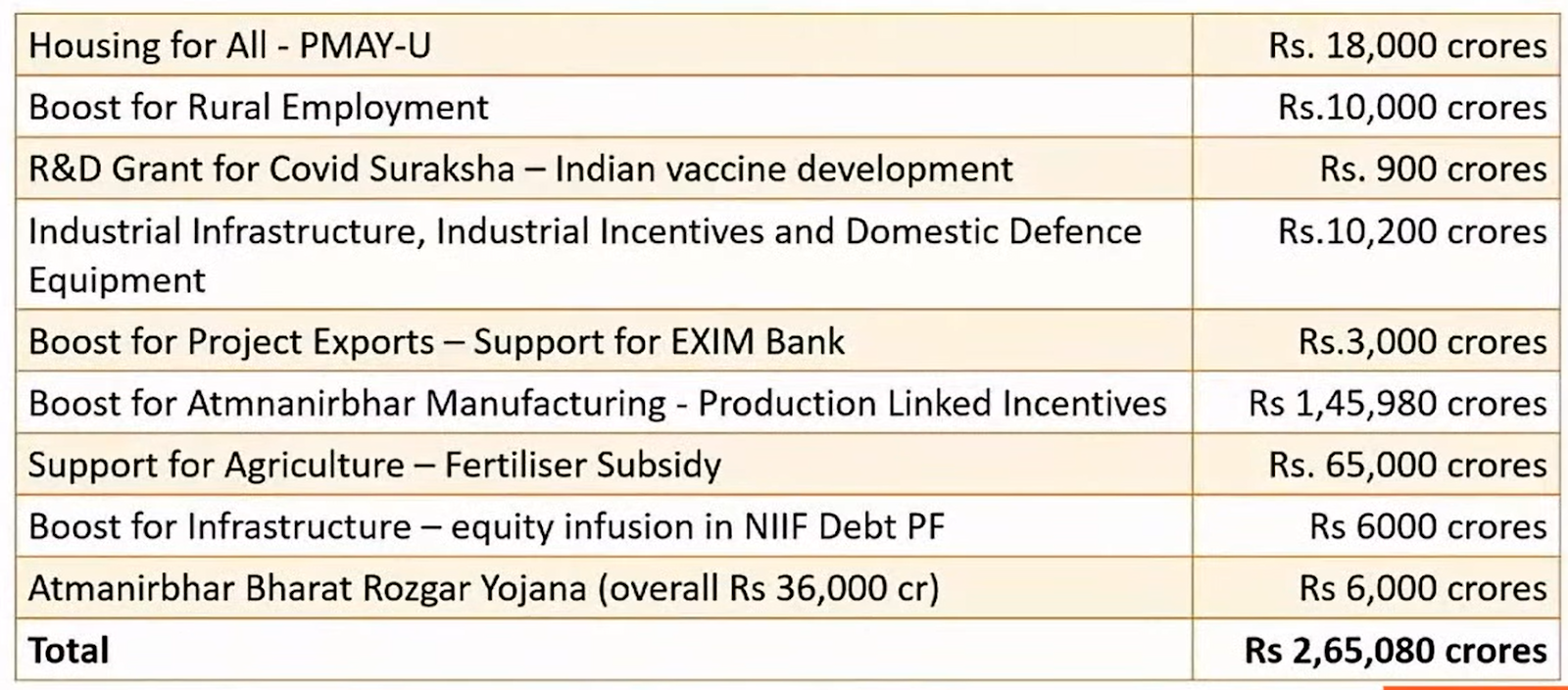
The following table shows the amount that has been allocated for each scheme that has been announced by the Finance Ministry on November 12, 2020.

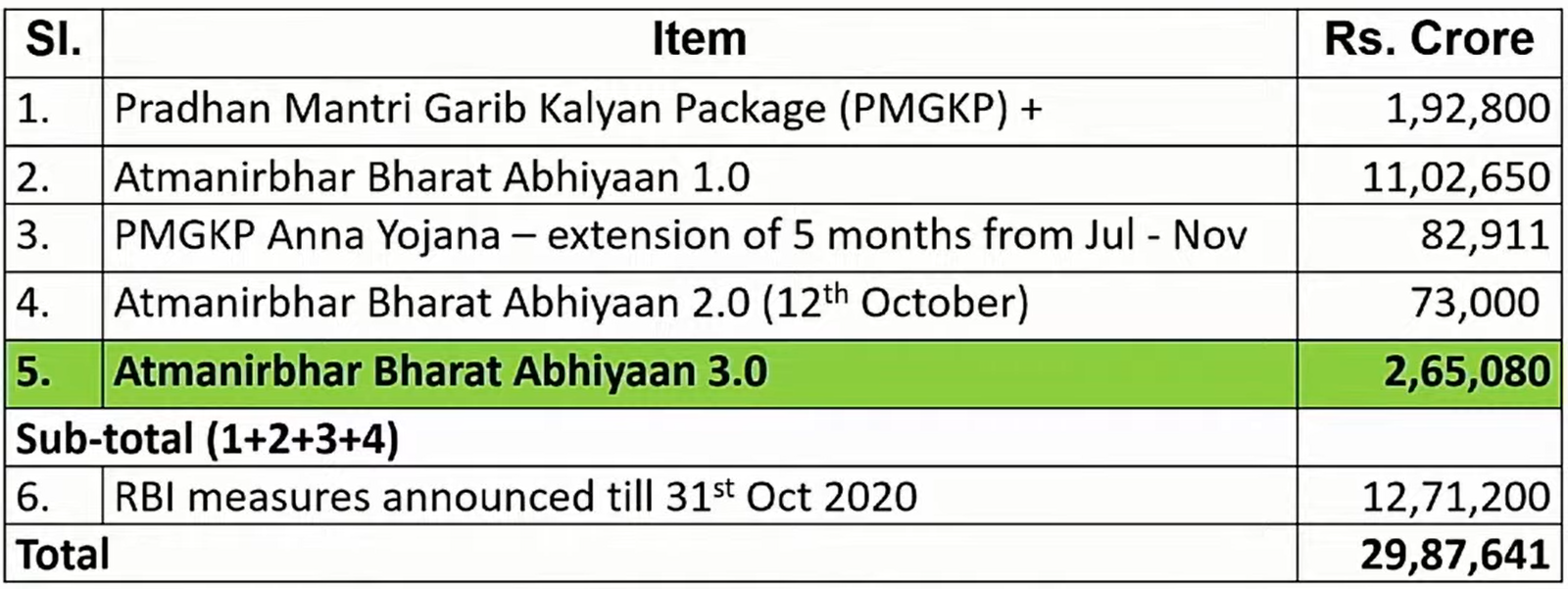
The following table shows the total amount that has been allocated for various stimulus packages announced by the Government in the current financial year. 

 “We are yet again proving that the policy that we are taking up even in PLI through which we want manufacturers to come to India is clearly to say we want to build on our strength but yet link with the global value chains.”- Finance Minister Nirmala Sitharaman.

India’s Future

The series of measures included in Atmanirbhar Bharat 3.0 will definitely provide a boost to India’s Covid-hit economy. The most important feature of the package is that it would help towards creating new jobs in India. It has also provided a major push towards the target of ‘housing for all’. Infrastructure activities will also receive adequate incentives. The Government has focused on those sectors that essentially need support for a major recovery, amidst the Covid-19 pandemic. The Production Linked Incentive(PLI) Scheme is also going to give a push to India’s dream of becoming the world’s manufacturing hub.

Pushing rural housing and job creation, along with subsidies on fertilisers is also sure to give a boost to the rural economy. And as we all know, if the rural economy is doing well, it is definitely good for an agriculture-driven economy of India. Tractor sales and two-wheeler sales are expected to go up as the life of a rural Indian gets better.

As investors, we need to keep a close watch on how the measures would be implemented. Also, make sure you take up the mission to find all the listed companies that would benefit from these schemes, both directly and indirectly.