Categories
Editorial

Union Budget 2023-24: Key Highlights

Finance Minister Smt. Nirmala Sitharaman presented the Union Budget 2023-24 in Parliament today (February 1, 2023). The budget has brought some much-needed tax relief for citizens and included a set of important schemes that target different sectors of our economy. Let us take a look at some of the key highlights from the Budget presentation and the sectors that could benefit in the long term!

Relief for Taxpayers?

With inflation on the rise and loans getting expensive, we were all hoping for a relaxation in income tax rates. The Finance Minister made a much-anticipated mega announcement: there will be no tax on income of up to ₹7 lakh a year in the NEW REGIME

But bear in mind that there are no changes for taxpayers under the old tax regime! (The old income tax regime will continue with existing tax exemptions and deductions).

Here are some of the changes declared under the new tax regime system:

  • The country’s highest tax bracket has been brought down from 42.74% to 39%.
  • The surcharge on those earning between ₹50 lakh to ₹1 crore has been reduced from 37% to 25% in the new tax regime.
  • A five-slab structure will apply now under the new regime:
(Those earning up to ₹7 lakh per year are entitled to a tax rebate/refund)
  • Say, for example, you earn ₹7.5 lakhs a year. Then you’ll have to pay 5% tax on your income between ₹3 lakh to ₹6 lakh, and 10% between ₹6 lakh and ₹7.5 lakh.
  • Salaried people with an income of ₹15.5 lakh or more can subtract ₹52,500 as Standard Deduction while calculating their taxable income in the new tax regime. Till now, a standard deduction of ₹50,000 was available only under the old tax regime.
  • The new tax regime will be the default choice, but citizens can still opt for the old tax regime. You can make an informed decision after going through the opinions of tax experts.
  • To read about the current income tax structure for stock market investors & traders, click here!

Huge Jump in Capital Expenditure

The Central government will spend ₹10 lakh crore (up 33% YoY) on long-term capital expenditure (capex) in FY2023-24 to enhance growth potential & job creation and boost private investments. This amount is higher than the ₹7.5 lakh crore budgeted in the previous year and the highest on record!

This push in capex is crucial for India’s growth dreams to become the third-largest economy in the world and create sufficient jobs.

Boost for Railways Sector

The Finance Ministry allocated ₹2.40 lakh crore to Indian Railways. This is the largest capital outlay for railways to date and is nine times the amount provided in FY2013-14. This railway budget is likely to prioritise the completion of unfinished projects and development of infrastructure. The govt. will focus on the launch of more Vande Bharat high-speed trains. It will also allocate funds to introduce hydrogen-powered trains and the Ahmedabad-Mumbai bullet train project.

Do look out for stocks related to our railway sector: Indian Railway Catering and Tourism Corporation (IRCTC), Indian Railway Finance Corporation (IRFC), RailTel, Container Corporation of India, RITES, and Rail Vikas Nigam Ltd (RVNL).

Boost for Green Energy Sector

  • India has targeted to reach net-zero carbon emissions by 2070. In a strategic move, the Finance Minister announced ₹35,000 crore for priority capital investment towards energy transition, net zero objectives, and energy security by the Ministry of Petroleum & Natural Gas.
  • The govt. will support the development of battery energy storage of 4,000 megawatt-hours (MWh).
  • In August 2021, our govt launched the National Hydrogen Energy Mission (NHEM) and announced its decision to transform India into a global hub for green hydrogen production and export. This mission will now receive an outlay of ₹19,700 crore to help achieve a target of 5 million metric tonnes (MMT) of green hydrogen production capacity by 2023! 
  • The top 5 companies leading the green hydrogen revolution in India are Reliance Industries Ltd (RIL), NTPC, Indian Oil Corp, and Larsen & Toubro. These firms are also examining methods to bring down the cost of production and find alternate use cases. To learn more about NHEM, click here.

Boost for Agricultural Sector

  • Around ₹20 lakh crore will be allocated towards agricultural credit targeted at animal husbandry, dairy, and fisheries.
  • One crore farmers will get assistance to adopt natural farming over the next three years.
  • An Agriculture Accelerator Fund will be set up to encourage agri-startups by young entrepreneurs.
  • Nearly 63,000 credit societies across the country will be computerised. The Finance Ministry will allocate ₹2,516 crore towards this initiative.
  • Smt. Nirmala Sitharman also announced a new scheme to provide incentives for the adoption of alternative and natural fertilisers. 

The top companies operating in the agricultural sector include UPL, Coromandel International, Rallis India, Avanti Feeds, PI Industries, and Bayer CropScience.

Boost for Defence Sector

The govt. will increase the defence budget for FY2023-24 by 12.95% YoY to ₹5.94 lakh crore. This will allow the military to develop or buy advanced weapons systems, including new fighter jets, submarines and tanks!

Stocks related to the defence sector include Hindustan Aeronautics Ltd, Bharat Dynamics, Zen Technologies, Bharat Electronics, and Paras Defence & Space.

The Way Ahead

The Indian government continues to focus on getting the economy back on track and speeding up growth. The Budget will provide a boost to the ‘Make-in-India’ initiative by focusing on infrastructure, power, railways, defence, and agriculture. The Centre’s extended focus on digitisation through new-age technologies and electric vehicles is highly commendable. The govt. seeks to launch policies that promote fair growth, reduce inequalities, and build a more inclusive society.

Now, let’s look forward to seeing how these strategic policies are implemented! 

What are your views on Union Budget 2023-24? Let us know in the comments section of the marketfeed app!


Disclaimer: The stocks mentioned in the article are solely for educational purposes. Please do your own research before investing.

Categories
Editorial

Here are the Best Sectors to Look Out For in 2023!

What a thrilling year it’s been! NIFTY50 touched an all-time high of 18,887.60 amidst some heavy volatility. We’ve seen the markets make wild movements in both directions. Fears of an upcoming economic recession and interest rate hikes have spooked most investors. But we’re sure our community continues to be highly bullish on India’s economic growth and are holding on to smart investments. 🚀

In today’s special article, we take a look into some of India’s fastest-growing and promising sectors that could flourish in 2023. You may potentially find better investment opportunities or even your next multibagger!

Green Energy

The Centre, state governments, business groups, and the general public need to recognise the urgency of climate action and advocate it on a wider scale. It’s high time we take coordinated actions to reduce carbon emissions. We need to rapidly increase its renewable energy deployment to meet the rising energy demands:

  • India has pledged to achieve net-zero carbon emissions by 2070
  • The Central Govt. has committed to installing a non-fossil fuel electricity generation capacity of 500 gigawatts (GW) and sourcing 50% of India’s energy requirement from renewable sources by 2030. 
  • It also aims to reduce 1 billion tonnes of projected emissions within the same time frame. As India continues to rely heavily on fossil fuels, it will be a mammoth task to reach these green targets.

According to India’s Ministry of Power, the Indian renewable energy sector received a total investment of about ₹5.2 lakh crore over the last seven years. By 2028, this sector could reportedly see investments worth $500 billion (~₹37.25 lakh crore). We’re seeing some highly ambitious projects in the solar, wind, green hydrogen, and battery cell manufacturing sectors.

Here are some of the companies that have aligned their business strategies with the government’s green energy targets:

  • Reliance Industries
  • Adani Group (Adani Enterprises, Adani Green Energy)
  • Tata Power
  • Borosil Renewables (solar glass manufacturer)
  • JSW Energy
  • Sterling & Wilson (contract manufacturer of solar power infrastructure)

Speciality Chemicals

India is one of the world’s fastest-growing markets for chemical products of all kinds. According to recent estimates, our country ranks sixth in chemical sales worldwide and contributes 4% to the global chemical industry! Meanwhile, specialty chemicals are a vital segment of chemicals used as finished product ingredients and to improve manufacturing processes. It accounts for 22% of India’s total chemicals market! 

The Indian middle class is showing a significant shift in demand for food, clothing, medicines, and transportation— all of which drive demand for specialty chemicals! As per a report from India Brand Equity Foundation (IBEF), the specialty chemicals sector is expected to grow at a CAGR of 12.4% to $64 billion within the next four years. No wonder there are a large number of players in this industry:

The companies mentioned above have been focusing extensively on enhanced research & development (R&D) capabilities to launch new and improved offerings. The future of the chemical sector is bright indeed. To learn more about leading fertilizer & agrochemical companies, click here

Digital Transformation & Inclusion

We’ve seen the information technology (IT) sector grow to new heights over the past few years, especially in artificial intelligence (AI), data analytics, data science, and big data. Business entities and govt. agencies around the world are shifting from traditional/outdated systems to seamless, customer-driven digital operations. Moreover, government initiatives such as Digital India seek to improve internet connectivity throughout the country. 

5G has been officially launched in India, and telecom operators & network infrastructure providers are gearing up for a pan-India rollout. It will pave the way for new economic opportunities and benefits for Indian societies.

However, there is significant room for expansion as internet penetration is only 47-48% in India, compared to more than 90% in developed countries. Let’s look at some of the listed entities leading the digital revolution:

  • IT majors like Tata Consultancy Services, Infosys, and Wipro
  • Telecom operators like Jio (Reliance Industries), Bharti Airtel
  • Digital payments – SBI Cards & Payment Services, HDFC Bank, IndusInd Bank 
  • Online Communications Services – Route Mobile

Electric Mobility

The Government of India has set a target of achieving sales of 60-70 lakh hybrid and electric vehicles (EVs) every year from 2020 onwards. You may also be aware of several Central and state government initiatives aimed at increasing EV production and sales. The primary goal of such programs is to make a seamless transition from internal combustion engine vehicles (ICEs) to reduce pollution levels. It will also reduce India’s reliance on costly fuel imports.

Source: Bloomberg Green

Several Indian companies have already begun to work toward gaining a foothold in the rapidly evolving EV market:

  • Tata Motors
  • Mahindra & Mahindra
  • JBM Auto Ltd (electric buses for public transportation)
  • Olectra Greentech
  • TVS Motor Company
  • Ashok Leyland (through its UK-based electric mobility arm Switch Mobility)

Make in India! (Or China-Plus-One Strategy) 

For decades, China has been known as the “World’s Factory” as it’s the center of global manufacturing or supply chains. It offered cheap labour and production costs. Unfortunately, China’s Zero-Covid Policy has led to prolonged industrial lockouts and supply chain disruptions. So, large multinational companies are adopting a new strategy to avoid investing only in China and diversify into other countries. It’s called “China Plus One”. 

Thus, Indian firms could benefit from this shift by analysing the demand in global markets and ramping up production capabilities. The government has introduced several initiatives like the Production Linked Incentive (PLI) scheme to offer special subsidies for manufacturers in key sectors.

Many listed companies in our country have a competitive advantage to offer the best speciality chemicals, electronic products (like Dixon Tech, Havells India), and textiles (Trident, Welspun India). 


Now, it’s up to you to figure out the right investment options or themes that fit your profile and financial goals. Go for those investments that you clearly understand from your own research. Let’s hope for a profitable 2023! HAPPY INVESTING

Disclaimer: The stocks mentioned in this article are purely for educational purposes. Invest your hard-earned money only after thorough research.

Categories
Market News Top 10 News

Adani Group to Build 3 Giga Factories as Part of Green Energy Push – Top Indian Market Updates

Here are some of the major updates that could move the markets tomorrow:

Adani Group to build 3 giant factories as part of green energy push

Adani Group will build three giant factories in India leading to the world’s most integrated green energy value chains, said Chairman Gautam Adani. The giga factories will manufacture polysilicon for solar modules, wind turbines, and hydrogen electrolysers. In July, the group announced plans to invest $70 billion in green energy transition and infrastructure projects to become a net exporter of clean energy.

Read more here.

NCLT allows to convene shareholders’ meeting to seek approval of ZEEL-Sony merger

The National Company Law Tribunal (NCLT) has allowed Zee Entertainment Enterprises Ltd. (ZEEL) to convene a meeting of its shareholders to seek the approval of its proposed merger with Culver Max Entertainment Pvt. Ltd. (formerly known as Sony Pictures Networks India Pvt Ltd). ZEEL and Sony Pictures Network India signed a definitive agreement to merge the two companies on December 22, 2021.

The broadcasters are yet to receive formal approval from the Competition Commission of India (CCI).

Read more here.

Coal India’s production up by 44.6 MTs in 5 months

Coal India Ltd’s production in the ongoing financial year (FY23) increased by 44.6 million tonnes (MTs) in five months and four days, beating the previous best of 44.5 MTs registered in FY16 (full year). The company is hopeful of reaching close to the apportioned target of 306 MTs in the April-September period (H1) of FY23.

Read more here.

Lupin, DKSH to market Alvotech biosimilars in Philippines

Lupin Ltd has signed an exclusive license and supply agreement with Swiss healthcare distributor DKSH to commercialize five of Alvotech’s proposed biosimilars in the Philippines. Multicare Pharmaceuticals, Lupin’s subsidiary in the Philippines, will file for marketing approval and be responsible for the distribution of the biosimilars once approved. This agreement enhances Multicare’s oncology, rheumatology, gastroenterology, and ophthalmology portfolio.

Read more here.

Bank of Maharashtra raises ₹710 crore via bonds

Bank of Maharashtra has raised ₹710 crore from bonds to fund business growth. The fund was raised via Basel-III compliant Additional Tier 1 (AT1) bonds of Rs 710 crore (including a green shoe option of ₹610 crore) at a coupon rate of 8.74%. The capital raised through the AT1 bonds will support the bank’s business growth.

Read more here.

Cipla gets USFDA approval for Lenalidomide Capsule

Cipla Ltd has received final approval for its Abbreviated New Drug Application (ANDA) for Lenalidomide Capsule from the US Food & Drug Administration (USFDA). Lenalidomide is an immunomodulatory prescription drug indicated for several hematological malignancies (cancers that begin in blood-forming tissue) in adults. The drug had sales of ~$2.58 billion during the 12 months ended June 2022 in the US.

Read more here.

Max Ventures to acquire Acreage Builders for ₹292 crore

Max Ventures and Industries Ltd (MaxVIL) announced the acquisition of Acreage Builders for ₹291.5 crore. The company executed the share purchase agreement on September 6 for the acquisition of a 100% stake in the realty firm. This acquisition marks MaxVIL’s entry into Gurugram, a key market for Commercial Real Estate (CRE) both within Delhi-NCR and pan-India.

Read more here.

Axis Bank partners with Paynearby; aims to grow loan book organically

Axis Bank has announced plans to grow its Priority Sector Lending (PSL) book organically and make it a profitable business. The bank has partnered with Paynearby, a distribution as a service (DAAS) company. As part of the partnership, Axis Bank will get access to more than 50 lakh micro-retailers and aims to source better lending opportunities on a range of products. 

Read more here.

Maruti Suzuki to enter mid-SUV segment to lift market share to 50%

Maruti Suzuki India Ltd (MSIL) is all set to consider the sports utility vehicle (SUV) segment as the key area to lift its overall market share in India to 50%. The automaker’s overall market share is currently under 45%. It does not have a car in the mid-SUV segment, whose total domestic market size stands at 5.5 lakh. MSIL will launch a model under the mid-SUV segment in the last week of September 2022. 

Read more here.

Categories
Editorial

Reliance vs Adani Group: Spearheading India’s Green Energy Revolution

At the recent United Nations Climate Change Conference at Glasgow (COP26), India pledged to achieve net-zero carbon emissions by 2070. The Centre has committed to installing a non-fossil fuel electricity generation capacity of 500 gigawatts (GW) and sourcing 50% of India’s energy requirement from renewable sources by 2030. The government also aims to reduce 1 billion tonnes of projected emissions within the same time frame. As India continues to rely heavily on fossil fuels, it will be a mammoth task to reach these green targets.

Two of our country’s largest conglomerates, Reliance Industries and Adani Group, are now competing to dominate the gradually developing green energy sector. In this article, we explain how both business houses are working to push green energy in India.

The Strategic Plans of Reliance Industries Ltd

Reliance Industries Ltd (RIL) has entered the green energy sector with highly ambitious plans. Chairman Mukesh Ambani had revealed a roadmap to invest $10 billion (~Rs 74,400 crore) in solar, green hydrogen, batteries, and fuel cells over the next three years. A significant portion of the investment will go towards setting up four “giga factories”. This move will boost domestic production of solar photovoltaic modules, fuel cells, and energy storage batteries. They will also work towards strengthening the value-chain partnerships and future technologies.

In June, Ambani announced that RIL has started developing the Dhirubhai Ambani Green Energy Giga Complex in Jamnagar, Gujarat. Spread across an area of 5,000 acres, the complex will turn into one of the largest integrated renewable energy manufacturing facilities in the world. RIL is also attempting to manufacture solar modules and essential components indigenously to bring down the overall cost of production. This initiative will also help reduce the reliance on Chinese products.

Acquisitions and Targets

One of RIL’s subsidiaries, Reliance New Energy Solar (RNES), recently acquired Norway-based REC Solar Holdings for $771 million (~Rs 5,740 crore). REC is a leading manufacturer of solar cells and modules, along with solar-grade raw polysilicon. RNES has also acquired a 40% stake in Sterling & Wilson Solar for Rs 2,755 crore.

Reliance aims to generate 100 gigawatts of solar energy by 2030. They will also invest in carbon fibre plants for sustaining their hydrogen and solar ecosystems. This whole ecosystem will be developed and operated by a dedicated Renewable Energy Project Management and Construction Division. These factors will help the company meet its goal of becoming net carbon-zero by 2035. As a company that still generates ~60% of its revenue from oil refining and petrochemicals, it will be interesting to see how RIL executes its strategic plans.

Adani Group’s Green Energy Roadmap

The Adani Group had recently announced plans to invest $20 billion (~Rs 1.4 lakh crore) over the next ten years in solar, wind, green hydrogen, and energy infrastructure. The group aspires to triple the share of renewable power generation capacity in its total portfolio to 63% from the present 21%. It aims to make Adani Ports a net-zero carbon emitter by 2025 and power all data centers with renewable energy by 2030. Moreover, the Adani Group will spend 75% of its planned capital expenditure (capex) until 2025 on green technologies.

In October 2021, Adani Green Energy Ltd completed the acquisition of SB Energy India for $3.5 billion (~Rs 26,000 crore). SB Energy India was a joint venture between Japan-based SoftBank Group and India’s Bharti Group. It is the largest acquisition in the renewable energy sector in India so far!

The Market Potential

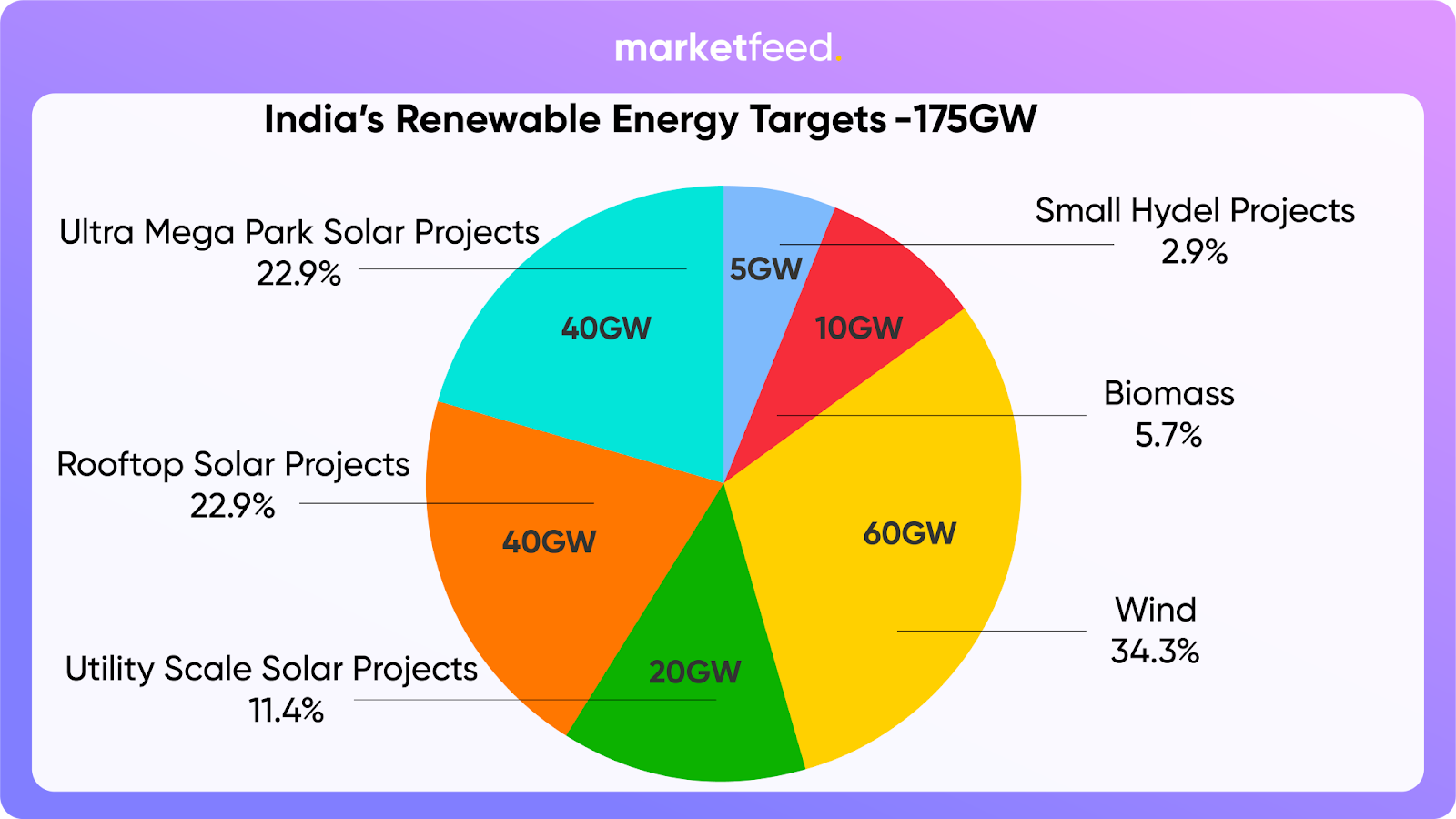
India was ranked fourth in wind power and renewable power in terms of installed capacity as of 2020. It obtained the fifth position in solar power. The Centre and state governments are providing subsidies and benefits for boosting clean energy. It is anticipated that around 49% of the total electricity will be generated by renewable energy by 2040. Green hydrogen also has immense potential to grow in India.

Source: Ministry of New & Renewable Energy

According to reports, the Indian renewable energy sector received a total investment of about Rs 5.2 lakh crore over the last seven years. By 2028, this sector could reportedly see investments worth $500 billion (~Rs 37.25 lakh crore). As two of India’s biggest business tycoons enter into the green energy sector, we will be able to witness more competition, investments, and job opportunities. Ambani and Adani have aligned their business strategies with PM Narendra Modi’s green energy targets.

However, it will be a tedious task for India to implement its green energy commitments. The Centre and state governments, large corporations, and the general public will have to take coordinated actions to reduce carbon emissions. We need to recognise the urgency of climate action and advocate it on a wider scale. India needs to rapidly increase its renewable energy deployment to meet the rising energy demands.

The stage is set for India’s green energy revolution. Can Reliance Industries and Adani Group become giants in the global renewable energy space? What are your views on the future of green energy in India? Let us know in the comments section of the marketfeed app.

Categories
Editorial

Can Clean Energy Take Reliance to New Heights?

Reliance’s Annual General Meeting last week looked positive, the announcements were put forward with great vision, the markets they are competing in have huge scope. But even with this, the stock price is seeing selling pressure. One of the main takeaways from the AGM was the venture of Reliance into the much-talked Green energy business. However, an oil-to-telecom conglomerate moving into this new energy domain might feel awkward to a few, but it is not. Mukesh Ambani has already stated last year that he wants his company to lead India’s fight for sustainable energy.

Let’s see what are the prospects of the green energy business sector and how Reliance is planning to become a major player here.

Indian Renewable sector

The age of fossil fuels cannot run endlessly. It will have a conclusion and this might not be very far now. To boost a new sector, it is important to allow investors to pump money. With this in mind, India’s foreign investment policy allows 100% FDI through the automatic route. According to the reports, the Indian renewable energy sector has received a total investment of about Rs 5.2 lakh crore in the last seven years. Not only this, by 2028, India can reportedly see investments worth $500 billion in this sector. 

As of 2019, India was ranked fifth in wind and solar power and fourth in renewable power installed capacity. What makes this sector even more interesting is the subsidies and benefits offered by both central and state governments. The governments of different states want the factories to be set up in their area so that their unemployment numbers can reduce and benefit from the taxes in the long run. 

By 2040, it is expected that around 49% of the total electricity will be generated by renewable energy. The Central Electricity Authority (CEA) also says that the share of renewable energy generation would increase from 18% to 44%, while that of thermal power is expected to reduce from 78% to 52% by 2030. If you notice, all these aims are for the next 10-15 years. And, any massive change in the short-term is not expected. 

Reliance AGM revealing the Green energy push

Reliance is entering into this segment with the aim to bridge the energy divide between India and other countries. They have announced plans to invest Rs 60,000 crore in building four factories. These will be a solar photovoltaic module factory, electrolyser factory, fuel cell factory, and energy storage battery factory. Apart from this, they will also invest Rs 15,000 crore in strengthening the value-chain partnerships and future technologies. 

Both of these investments will be made over the next three years. Mukesh Ambani also revealed that the company has already started developing the Dhirubhai Ambani Green Energy Giga Complex on 5,000 acres in Jamnagar. The chairman claims that this complex will be one of the largest integrated renewable energy manufacturing facilities in the world. Overall, this will help the company to meet its ambitious goal of becoming net-carbon zero by 2035. 

Reliance has the aim of enabling 100 gigawatts of solar energy by 2030. They will also invest in carbon fibre plants for sustaining their hydrogen and solar ecosystems. This whole ecosystem is planned to be bolstered by a dedicated Renewable Energy Project Management and Construction Division.

Unlimited scope to grow

Reliance is sure to be a great part of India’s future but if they can meet their targets in the defined period, their growth won’t be restricted to India but will spread to the global market. Now we have the countries of super-rich businessmen competing against each other in one of the most lucrative sectors. Yes, we are talking about Reliance’s Mukesh Ambani and Adani Green’s Gautam Adani. One international top competitor you can expect will be Tesla’s Elon Musk.

Just like many other sectors, China has a huge hold in the development of clean energy as well. Four of the Chinese companies are responsible for producing nearly half of the world’s solar polysilicon supply. Recently, US president Joe Biden added three of these companies to its export blacklist. The sentiments against China are very high due to the Covid-19 spread. 

Allegedly, it was from China where this virus actually started surfacing. This has not been received well by many countries who demand action against China. Indian companies like Reliance can take benefit of this lost love and spear ahead to dominate in the clean energy business. It’s a new road for Reliance. And, a road of unlimited growth potential. Can they become a giant in this clean renewable energy sector? What are your views? Let us know in the comments section of the marketfeed app.

Categories
Editorial

Renewable Energy Sector In India To Fly After Budget 2021?

India has installed a renewable energy capacity of close to 136 GW as of February 2021. It has an installed solar energy capacity of 36.91 GW and a wind energy capacity of 38.43 GW. Additionally, India has installed a strong hydro-power capacity of 45 GW. The government plans to install 500 GW of renewable energy capacity by 2030. The Budget 2021 is a game-changer for the renewable energy sector. 

The Electricity Amendment Bill that has received praise in the public domain can also prove to be a much-needed change for the power generation, transmission and distribution companies. Let’s explore what the renewable energy sector has in its books for investors. 

Current Scenario/Budget 2021 Impact

The solar and wind energy sectors aren’t having the best time. Poor tariffs, bad government regulation, and high payment default rates are what the sector is facing. According to a 2019 report, power distribution companies owed renewable energy companies Rs 6,800 crores in payment dues. Delays in payment by State Electricity Regulatory Commissions(SERCs) make it difficult for renewable energy companies to set up new projects. 

The pricing of renewable energy by government bodies isn’t a transparent process and has its own set of challenges. Financial institutions do not have much understanding or expertise in renewable energy projects. Moreover, the taxation of renewable energy still falls under the grey area.  

In the Budget Session of 2021, the Finance Minister announced reforms in the power and the renewable energy sector. These reforms will ensure improvement in infrastructure financing, clearing payment dues, and improving energy efficiency. The government will be infusing Rs 2,600 crores into the solar power sector through loans, incentives, and subsidies. It will also jack up import duty on solar panels to promote domestic production. 

The government has also announced reforms that will improve the financial position of transmission and distribution companies. This will ensure that the amount of money owed to renewable power generation companies is paid.  

Stocks To Watch Out For

Adani Green

Adani Green is a renewable energy company owned and operated by the Adani Group, headquartered in Ahmedabad, Gujarat. It has a project portfolio of 14,000 GW/Gigawatts. It means that if all of his projects become operational they will generate 14 GW of electricity, which can realistically power up to 42 lakh homes. Adani Green’s projects include solar energy, wind energy, and hybrid solar-wind energy projects. Adani Green has a market capitalization of Rs 1.75 lakh crore. The company’s share price has risen by 1,207% in one year’s time.

To Know More, Click Here.

NHPC 

National Hydroelectric Power Corporation was set up in 1975 with the objective of setting up hydropower projects. It has a market cap of Rs 25514 crore It has a total installed capacity of 7071.2 MW. It has executed 22 hydro projects with an installed capacity of 6717 MW on an ownership basis plus some on a joint venture basis. The company holds projects majorly in the states of Himachal Pradesh, Uttarakhand, and Jammu, and Kashmir to name a few.

Sterling & Wilson Solar

Sterling & Wilson Solar is a Shapoorji-Pallonji Group company that works in end-to-end solar solutions, procurement, construction, operation, and maintenance of solar units. The company has a market cap of Rs 1975 crore. The Engineering, Procurement, and Construction (EPC) business contributed to 96.7% of company revenue in FY 19-20. Operation And Maintenance (O&M) contributed to 3.3% of the revenue in the same year.

The Company’s unexecuted orders stood at Rs 11,396 crore as of March 31, 2020, up 47.3%, from Rs 7,739 crore as of March 31, 2019. This is a minor cause of worry, even though they are getting new orders every other week.

JSW Energy

JSW Energy currently generates 4,559 MW, out of which 3158 MW is thermal power,1391 MW is hydropower, and 10 MW solar power. Close to ~34% of JSW’s portfolio is in renewable energy. JSW Solar bagged an order from Solar Energy Corporation of India for setting up of 2500 MW ISTS or Interstate Transmission System. 

Tata Power

Apart from thermal power production, Tata Power’s renewable business capacity is 2,637 MW (932 MW Wind & 1705 MW Solar). Close to 36% of its total energy is produces from renewables. The company also has an installed hydropower capacity of 693 MW, of which 65% is generated for the domestic market. The company plans to expand its renewable energy capacity base from 4.1 GW to 15 GW by 2025

Other Listed Companies

  • Waa Solar
  • Suzlon
  • Gita Renewables
  • Ujaas Energy and much more..

FM Nirmala Sitharaman announced in the budget 2021 that provisions were being laid for power consumers to choose between multiple power distribution companies. This will promote healthy competition and at the same time, help for better price discovery.

The renewable energy sector shares were struggling for much of its time in the stock exchanges. This is the reason behind poor valuations and price growth of renewable energy companies since IPO, often getting classified as ‘penny stocks’ or ‘operator-driven stocks’.

Factors like the Electricity Amendment Bill, power sector reforms, increased power trading on the Indian Energy Exchange, Renewable Purchase Obligation (RPO), and so on, will spark a movement in the renewable energy sector. 

These changes in the power sector will ensure an increase in cash flows for these companies.  Struggling distribution companies may be able to pay their dues on time, this way reducing the financial burden on the entire sector. A defined tax-structure for electricity too can help power companies transfer tax-burden to their clients. 

There are plenty of small-cap or “penny-stock” renewable companies listed on NSE and BSE, some of these infant companies might turn out to be power giants in the future if they manage to clear off their very high debts. Do you know any? Let us know in the comment section down below!

However, in our opinion, try to go for good companies like the ones we have mentioned above even if their valuations are higher. High debt levels and poor technology may limit these penny stocks from making a comeback, while good companies will flourish.