Categories
Editorial

Renewable Energy Sector In India To Fly After Budget 2021?

India has installed a renewable energy capacity of close to 136 GW as of February 2021. It has an installed solar energy capacity of 36.91 GW and a wind energy capacity of 38.43 GW. Additionally, India has installed a strong hydro-power capacity of 45 GW. The government plans to install 500 GW of renewable energy capacity by 2030. The Budget 2021 is a game-changer for the renewable energy sector. 

The Electricity Amendment Bill that has received praise in the public domain can also prove to be a much-needed change for the power generation, transmission and distribution companies. Let’s explore what the renewable energy sector has in its books for investors. 

Current Scenario/Budget 2021 Impact

The solar and wind energy sectors aren’t having the best time. Poor tariffs, bad government regulation, and high payment default rates are what the sector is facing. According to a 2019 report, power distribution companies owed renewable energy companies Rs 6,800 crores in payment dues. Delays in payment by State Electricity Regulatory Commissions(SERCs) make it difficult for renewable energy companies to set up new projects. 

The pricing of renewable energy by government bodies isn’t a transparent process and has its own set of challenges. Financial institutions do not have much understanding or expertise in renewable energy projects. Moreover, the taxation of renewable energy still falls under the grey area.  

In the Budget Session of 2021, the Finance Minister announced reforms in the power and the renewable energy sector. These reforms will ensure improvement in infrastructure financing, clearing payment dues, and improving energy efficiency. The government will be infusing Rs 2,600 crores into the solar power sector through loans, incentives, and subsidies. It will also jack up import duty on solar panels to promote domestic production. 

The government has also announced reforms that will improve the financial position of transmission and distribution companies. This will ensure that the amount of money owed to renewable power generation companies is paid.  

Stocks To Watch Out For

Adani Green

Adani Green is a renewable energy company owned and operated by the Adani Group, headquartered in Ahmedabad, Gujarat. It has a project portfolio of 14,000 GW/Gigawatts. It means that if all of his projects become operational they will generate 14 GW of electricity, which can realistically power up to 42 lakh homes. Adani Green’s projects include solar energy, wind energy, and hybrid solar-wind energy projects. Adani Green has a market capitalization of Rs 1.75 lakh crore. The company’s share price has risen by 1,207% in one year’s time.

To Know More, Click Here.

NHPC 

National Hydroelectric Power Corporation was set up in 1975 with the objective of setting up hydropower projects. It has a market cap of Rs 25514 crore It has a total installed capacity of 7071.2 MW. It has executed 22 hydro projects with an installed capacity of 6717 MW on an ownership basis plus some on a joint venture basis. The company holds projects majorly in the states of Himachal Pradesh, Uttarakhand, and Jammu, and Kashmir to name a few.

Sterling & Wilson Solar

Sterling & Wilson Solar is a Shapoorji-Pallonji Group company that works in end-to-end solar solutions, procurement, construction, operation, and maintenance of solar units. The company has a market cap of Rs 1975 crore. The Engineering, Procurement, and Construction (EPC) business contributed to 96.7% of company revenue in FY 19-20. Operation And Maintenance (O&M) contributed to 3.3% of the revenue in the same year.

The Company’s unexecuted orders stood at Rs 11,396 crore as of March 31, 2020, up 47.3%, from Rs 7,739 crore as of March 31, 2019. This is a minor cause of worry, even though they are getting new orders every other week.

JSW Energy

JSW Energy currently generates 4,559 MW, out of which 3158 MW is thermal power,1391 MW is hydropower, and 10 MW solar power. Close to ~34% of JSW’s portfolio is in renewable energy. JSW Solar bagged an order from Solar Energy Corporation of India for setting up of 2500 MW ISTS or Interstate Transmission System. 

Tata Power

Apart from thermal power production, Tata Power’s renewable business capacity is 2,637 MW (932 MW Wind & 1705 MW Solar). Close to 36% of its total energy is produces from renewables. The company also has an installed hydropower capacity of 693 MW, of which 65% is generated for the domestic market. The company plans to expand its renewable energy capacity base from 4.1 GW to 15 GW by 2025

Other Listed Companies

  • Waa Solar
  • Suzlon
  • Gita Renewables
  • Ujaas Energy and much more..

FM Nirmala Sitharaman announced in the budget 2021 that provisions were being laid for power consumers to choose between multiple power distribution companies. This will promote healthy competition and at the same time, help for better price discovery.

The renewable energy sector shares were struggling for much of its time in the stock exchanges. This is the reason behind poor valuations and price growth of renewable energy companies since IPO, often getting classified as ‘penny stocks’ or ‘operator-driven stocks’.

Factors like the Electricity Amendment Bill, power sector reforms, increased power trading on the Indian Energy Exchange, Renewable Purchase Obligation (RPO), and so on, will spark a movement in the renewable energy sector. 

These changes in the power sector will ensure an increase in cash flows for these companies.  Struggling distribution companies may be able to pay their dues on time, this way reducing the financial burden on the entire sector. A defined tax-structure for electricity too can help power companies transfer tax-burden to their clients. 

There are plenty of small-cap or “penny-stock” renewable companies listed on NSE and BSE, some of these infant companies might turn out to be power giants in the future if they manage to clear off their very high debts. Do you know any? Let us know in the comment section down below!

However, in our opinion, try to go for good companies like the ones we have mentioned above even if their valuations are higher. High debt levels and poor technology may limit these penny stocks from making a comeback, while good companies will flourish.

Categories
Editorial

Company Analysis: Indian Energy Exchange

What is the Indian Energy Exchange?

The Indian Energy Exchange or IEX is an electronic power trading marketplace for electricity corporations and boards to trade contracts related to energy. In simple terms, just like how individuals can trade in the stock market to gain profit, electricity corporations can trade on the IEX to increase profitability and have better price discovery. It is a place where participants can buy and sell energy through a double-sided closed auction process. 

State Electricity Boards, power-producing companies, power transmission companies, and power traders that have a huge capital trade on IEX. IEX is one of the only two power exchanges apart from Power Exchange India Limited(PXIL).

The IEX started operations in 2008. The Central Electricity Regulation Commission(CERC) regulates the IEX, just like how SEBI regulates the NSE and BSE.

Financial Vitals of IEX

Share Performance

  • As of January 2021, the company’s share price has grown by ~38% since IPO and by ~94% in the past 1 year. The company’s share price has been less volatile but with consistent growth. It has a market cap of Rs. 7000 crore.

Growth in Net Profits/Revenue/Earnings

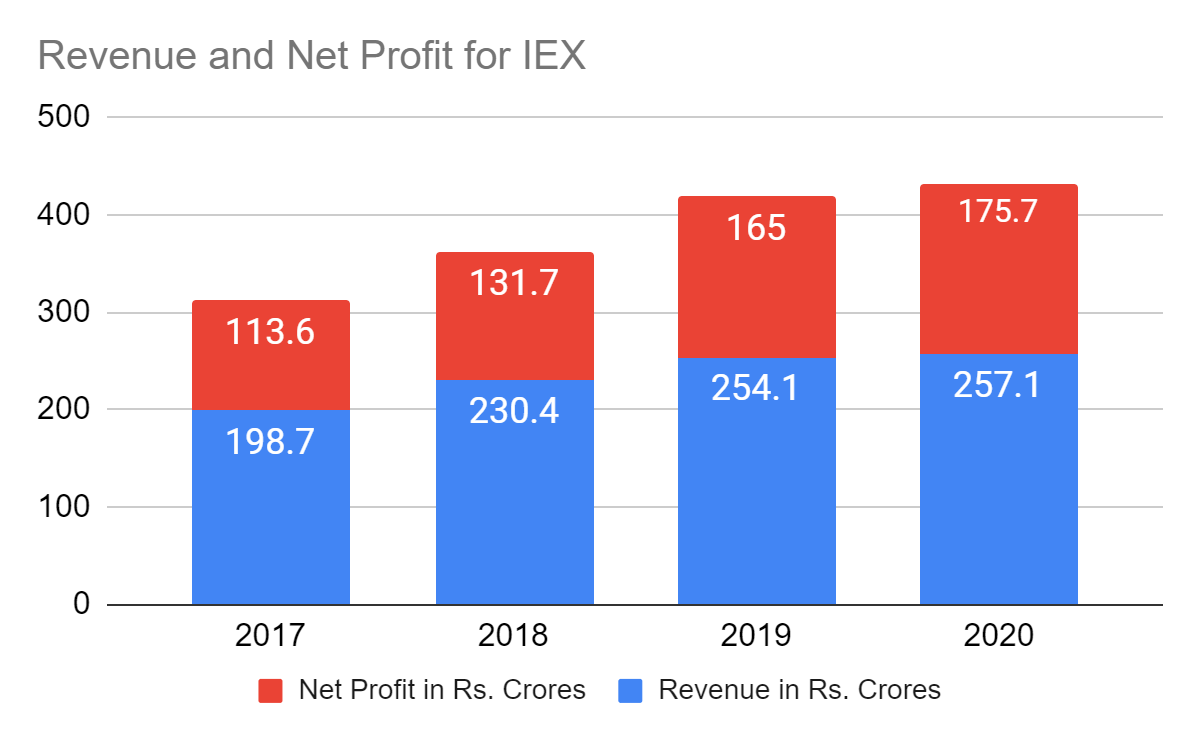
  • The company’s sales, revenue, and net profit have been growing constantly for the past 5 years. As demand for power increases, there will be an increase in power trading to find a better price for power.

Increasing Trading Volumes

  • On average, 6000+ MW of electricity is traded daily on the exchange. The traded volume is growing at 32% CAGR. It has a consumer base of 4000+ Industries, 55+ distribution companies, 500+ generators, and 1500+ renewable energy generators. The company has also seen increased trading volumes on the BSE and NSE.

Increasing ROE/EPS

  • For IEX, the Return on Equity(%) or ROE is ~45%. This means that for every Rs. 100 invested in the company, the investors earn close to Rs. 45 every year. The company’s price-to-earnings ratio or PE ratio has been declining constantly for the past few years. The fact that the company has excellent profitability and increasing revenue, it could probably mean that the company is undervalued and sees higher growth potential in the markets. 

Increasing FII/MF shareholding

  • The company has an increasing FII(Foreign Institutional Investors) shareholding in the company. In fact, it has doubled between September 2018 and September 2020. This shows that foreign investors are bullish on the idea of power trading in India and see a greater potential in IEX. Mutual Fund’s shareholding has also increased by 4.5 times in the past two years between 2018 and 2020.

No Debt

  • The company has no debt or is not operated on credit. This saves it from default risk. 

Decreasing Clearing Price

  • The clearing price is the price that companies pay to buy power after the bidding process is complete. The average market clearing price has gone from as high as Rs.3.38 per unit in July 2019 to as low as Rs. 2.35 per unit in June 2020. A decreasing clearing price means that more companies would flock to power exchanges for cheaper electricity.

Increasing Dependency on Green Energy Over Coal

As Governments push for environmental regulations and promote green energy, there is a greater incentive for companies to invest in them. Moreover, coal prices are pretty volatile citing quality concerns, regulation, and also the recent decision for Coal Mine Auction by the Government. Products like Energy Saving Certificates, Green TAM, and Renewable Energy Certificates on IEX will have a greater demand. 

Indian Gas Exchange

The Indian Gas Exchange or IGX is a subsidiary of IEX which is an exchange for trading in gas. It is India’s first electronic delivery-based gas exchange. It is regulated by the Petroleum and Natural Gas Regulatory Board. IGX currently offers trading in five contracts namely: Daily, Weekly, Weekday, Fortnightly, and Monthly. It has three physical setups, two in Gujarat and one in Andhra Pradesh. 

Electricity Amendment Bill

The Electricity Amendment Bill is a prospective bill that will enable power companies to retain greater profits. The bill also aims to prevent the high number of defaults in the energy sector, often by the state regulatory board themselves. The bill also addresses the weak financial health of power companies. It aims to privatize and centralize electricity transmission and distribution. The National Renewable Energy Policy also promotes the production and use of renewable energy throughout the country. 

IEX as a share to invest in hasn’t caught the eye of retail investors. The company’s price is supported by a good balance sheet and awaits a great future considering the recent developments in power policy and the shift of focus towards renewable energy. One should look out for future events like the Electricity Amendment Bill. A mix of all can ensure greater participation in the Indian Energy Exchange, thereby increasing trading volumes and cash flows for the companies.

To know more about how the exchange functions and the products it offers, click here.

Categories
Editorial

What is the Indian Energy Exchange(IEX)? How Does it Work?

What is IEX?

The Indian Energy Exchange or IEX is an electronic power trading marketplace for electricity corporations and boards to trade contracts related to energy. In simple terms, just like how individuals can trade in the stock market to gain profit, electricity corporations can trade on the IEX to increase profitability and have better price discovery. It is a place where participants can buy and sell energy through a double-sided closed auction process. 

State Electricity Boards, power-producing companies, power transmission companies, and power traders that have a huge capital trade on IEX. IEX is one of the only two power exchanges apart from Power Exchange India Limited(PXIL).

The IEX started operations in 2008. It is regulated by the Central Electricity Regulation Commission, which regulates the IEX just like how SEBI regulates the NSE and BSE. 

How Does Trading Work On the IEX?

Say, for example, there is a shortage of power in Bangalore, which will increase the price of electricity and also eat into the profits of the electricity board. The electricity board will then log on to IEX and find out if another electricity board/transmission company/renewable energy company which offers a lower price. There will then be a bidding process for that segment. This way Bangalore’s electricity board will be able to procure electricity at a lower rate. At the same time, the entity which sold the electricity will be able to make profits.

Products on the IEX trade on a normal demand-supply basis. There are 4 major products traded on the IEX:

Renewable Energy Certificates(REC) – An REC certifies that the bearer owns one megawatt-hour (MWh) of electricity generated from a renewable energy resource. Companies need to meet requirements related to show that they are not causing pollution and are meeting the environmental requirements. A REC helps them achieve this compliance which can later translate into government grants, profits, or lower taxation. 

For example Ajay Renewables is a renewable energy company based out of Kochi, that sets up wind turbines, generates electricity, and then sells it to companies. The Government of India comes out with a subsidy plan where it gives Rs. 100 crores to any company that has generated more than 30 lakh megawatt-hours that year in green energy. Two months for year-end, Ajay Renewables has managed to generate only 29 lakh megawatt-hours that year. It does not have time to set up new wind turbines and meet the target. It approaches the IEX and buys 200,000 RECs in the spot market. This certifies that the company has produced 2 lakh megawatt-hours of power in renewable energy. Ajay Renewables ends up getting the Rs. 100 crores subsidy,

Energy Saving Certificates(ESCerts)– Energy Saving Certificates are similar to RECs, just that they represent one megawatt-hour (MWh) of energy saved from a project. These certificates can be bought and sold like normal certificates 

Both EScerts and RECs can be bought and sold on the exchange by companies. This means that even if a company might be causing a lot of pollution, yet it buys enough of these certificates, it gets a clean chit.

Day-Ahead-Market (DAM) – It is a physical electricity trading market where power is delivered within 24 hours of the next day starting from midnight. They are traded in 15 minute time blocks The prices and quantum of electricity closed the auction bidding process. 

Term-Ahead Market (TAM) – It provides a range of products allowing participants to buy/sell electricity on a term basis for a duration of up to 11 days ahead.

Real-Time Market (RTM) – In RTM, power is physically delivered within an hour of the bidding process.

Can I Trade on the IEX?

IEX isn’t a ground for retail traders. The exchanges involves physical delivery of electricity. An individual may trade on the exchange provided he/she owns an establishment that requires tons of loads of power. Apart from this, the individual requires the necessary clearance from the CERC to be able to trade on the platform. According to the exchange guidelines, a member or a client should have a capital of atleast Rs. 150 Lakhs to be able to transact on the platform.

Looking Ahead

Energy exchanges provide an economic as well as environmental benefit. It provides a fair price discovery on electricity, at the same time encouraging companies to use green energy. 

The IEX is listed on NSE and BSE. On average, 6000+ MW of power is traded daily on the exchange. The traded volume is growing at 32% CAGR. It has a consumer base of 4000+ Industries, 55+ Distribution companies, 100+ ESCert Entities, 500+ Generators, 1500+ renewable energy generators. 

Apart from being an energy exchange, IEX is also an interesting company with interesting financials. The company has strong fundamentals as of now and with the Electricity Amendment Bill around the corner, things seem bright for the energy sector. We will be covering more in a company analysis of IEX. Stay tuned.

To know more about functioning of the IEX, check out their FAQ page, click here.