Here are some of the major updates that could move the markets tomorrow:
L&T and Spain’s Navantia sign agreement for submarine project worth Rs 43,500 cr
Larsen & Toubro (L&T) has signed a teaming agreement with Spanish-based Navantia for the submission of a techno-commercial bid for the Indian Navy’s prestigious P75 (India) submarine programme. P75 (India) Submarine Project is expected to be valued at €4.8 billion (over Rs 43,500 crore) and is India‘s largest defence acquisition project. L&T and Navantia signed a memorandum of understanding (MOU) for the programme on April 11, 2023, in Madrid.
Nazara Technologies to raise Rs 750 crore via equity issue
Nazara Technologies Ltd’s directors’ board approved fundraising of up to ₹750 crores. The board has approved the fundraising through equity shares having a face value of ₹4/- each of the company or any other equity-linked instruments/securities or any combination thereof.Also, Nazara Technologies has increased authorised share capital from ₹30 crore to ₹50 crore subject to shareholders’ approval.
Sanghvi Movers gets work orders worth Rs 150 crore from independent power producers
Sanghvi Movers Ltd received work orders worth ₹150 crore from eminent independent power producers (IPPs) in the renewable energy sector. It will provide crane rental services along with allied services comprising WTG surface logistics, inter-carting, installation and pre-commissioning of WTGs, and development of wind farm and storage yard. The crane services account for approximately 50% of the total contract value.
GPT Infraprojects Ltd secured an order worth ₹64 crores. The company received the order from the Principal Materials Manager of South Eastern Railway. The order details include the manufacturing and supply of a Mono-Block Pre-Stressed Concrete Sleeper, which confirms to RDSO Drg No 8746.
HPCL gets bids to lease part of Chhara LNG terminal
Hindustan Petroleum Corp Ltd (HPCL) has received six or seven bids from industries to lease a part of its Chhara liquefied natural gas (LNG) import terminal on the west coast. HPCL aims to commission the terminal with a planned capacity of 5 million metric tons per year (tpy) in the December quarter. HPCL was looking to lease a capacity of 3 million tpy to other companies for a period of more than 10 years.
Tata Communications Singapore arm acquires remaining 41.9% stake in Oasis
Tata Communications Ltd’s Singapore-based subsidiary Tata Communications International Pte Ltd (TCIPL) has acquired the remaining 41.9% equity in Oasis Smart SIM Europe SAS (Oasis). As part of the share purchase agreement, Tata Communications will buy out the remaining stake from the non-controlling shareholders of Oasis. It is expected that the acquisition will be complete within one month, subject to customary legal requirements.
Aurobindo Pharma subsidiary enters pact with BioFactura for biosimilar ustekinumab
Aurobindo Pharma’s subsidiary CuraTeQ Biologics has entered into an exclusive license agreement with the US-based BioFactura to commercialise BFI-751, a proposed biosimilar to Stelara (ustekinumab). Ustekinumab is used for treating Crohn’s disease, ulcerative colitis, plaque psoriasis and psoriatic arthritis. As part of the agreement, BioFactura will receive license fees of a total not exceeding $33.5 million spread across different milestones leading to commercialisation in regulated markets.
India’s power consumption grows by 4.4% to 139.23 billion units in June
India’s power consumption grew by 4.4% to 139.23 billion units in June this year compared to last year. In the year-ago period, power consumption stood at 133.26 billion units (BU), higher than 114.48 BU in June 2021. The peak power demand met, which is the highest supply in a day, rose to 223.23 GW in June 2023. The peak power supply stood at 211.72 GW in June 2022 and 191.24 GW in June 2021.
MICL Real Estate acquires development rights of 10 housing societies in Mumbai’s Ghatkopar
Man Infraconstruction Ltd’s (MICL) property development entity MICL Real Estate has acquired development rights for a total of 10 adjoining housing societies in the Ghatkopar suburb of Mumbai. The company has acquired the rights to redevelop these housing societies wherein it holds a 60% partnership interest. The entire project spread over a total of more than 3 acres is estimated to have a total development potential of 1.3 million sq ft and a free-sale component of over 4 lakh sq ft.
Here are some of the major updates that could move the markets tomorrow:
Maruti Suzuki to recall 9,125 vehicles to fix possible defects in seat belts
Maruti Suzuki India will recall 9,125 units of Ciaz, Brezza, Ertiga, XL6, and Grand Vitara models to fix possible defects in a part of the front row seat belts. The affected vehicles were manufactured between November 2-28, 2022. The automaker has decided to recall the suspected vehicles for inspection and replacement of the faulty part, free of cost.
Global airline industry to post $6.9 billion loss in 2022: IATA
The global airline industry is projected to report a lower loss of $6.9 billion in 2022, according to International Air Transport Association (IATA). There were stronger passenger yields and cost control measures by airlines amid rising fuel prices. The industry registered a loss of $42 billion and $137.7 billion in 2021 and 2020, respectively. IATA said the global airline industry is expected to return to profitability in 2023 and post a small net profit of $4.7 billion.
Bharti Airtel launches WorldPass, a data pack for roaming across 184 countries
Bharti Airtel has revamped its international roaming (IR) offerings under the newly launched WorldPass, which offers IR services in 184 countries. A customer with a layover at an international airport or travelling to two or more countries can use one plan for the entire trip. The pass also gives customers access to 24×7 call centre support from any corner of the world free of cost on call and WhatsApp.
Aditya Birla Fashion & Retail Ltd (ABFRL) is now the frontrunner to acquire TCNS Clothing Co, owner of the listed women’s branded apparel retailer that owns brands such as W, Elleven, and Aurelia. This could well be the largest branded apparel buyout by the $60-billion Aditya Birla Group. Promoters of the retailer (New Delhi-based Pasricha family) and private equity investor TA Associates together own 61.24% of TCNS Clothing.
World Bank upgrades India’s GDP growth forecast to 6.9% for FY23
The World Bank cut India’s gross domestic product (GDP) growth forecast for FY23 from 7.5% to 6.5% in October. Now, it has upgraded the projection to 6.9% for FY2022-23 (April 2022-March 2023). A senior economist at the WB said that India is better positioned than its peers to weather external financial shocks this financial year.
India’s thermal power generation rises 16% YoY in Nov
India’s thermal power generation rose 16.28% year-on-year (YoY) to 87,687 million units (MU) in November. The country’s overall power generation increased by 14.63% YoY to 1,18,029 MU last month. Power utilities’ despatch rose 3.55% YoY to 62.34 million tonnes (MT) during November 2022. Total coal output also rose 11.66% YoY to 75.87 MT.
Gravita India begins production at recycling plant in West Africa
Gravita India Ltd (GIL) has started commercial production of aluminium cast alloys from a new recycling plant in Togo, West Africa. The plant is operated by Gravita Togo SAU, a step-down subsidiary of GIL. With an annual capacity of 4,000 million tonnes per annum (MTPA), it can produce aluminium cast alloys in Phase 1. The company forecasts an additional revenue of ₹60 crore per annum from the new capacity.
Adani Green raises Japanese Yen-denominated refinancing facility
Adani Green Energy Ltd, through its subsidiary Adani Solar Energy AP Six Pvt Ltd, has raised Japanese Yen-denominated facility to refinance its existing debt. The facility comprises JPY 27,954 million (or $200 million) amortising project loan facility. The project loan facility is supported by AGEL’s strong relationship with MUFG Bank Ltd and Sumitomo Mitsui Banking Corp, with equal participation.
IDFC First partners with Sa-Dhan to provide digital microfinance solutions
IDFC First Bank has partnered with the association of microfinance institutions (MFI) Sa-Dhan and Delhi-based fintech solutions provider NextGen to provide digital microfinance solutions to feature phone users. This partnership will help in developing a new payment and collection system by using feature phones. It will provide additional benefits for entities in the MFI ecosystem, including UPI, banking & wallets, bill payment systems, and individual & merchant money transfers.
India, just like the rest of the world, is in the middle of an energy crisis. Major cities are planning for blackouts if the supply of coal is not normalised. India is in a sticky situation. Fuel and food are expensive, and so is energy. Despite the grim economic situation, there is one very vibrant place, Dalal Street. The Indian stock market seems virtually unaffected by economic parameters. One stock, in particular, seems to be reaping the benefit of this energy crisis. It is the Indian Energy Exchange (IEX).
The Indian Energy Exchange (IEX) is a marketplace for trading energy-related entities. IEX is an electronic power trading marketplace for electricity corporations and boards to trade contracts related to energy. In simple terms, just like how individuals can trade in the stock market to gain profit, electricity corporations can trade on the IEX to increase profitability and have better price discovery. It is a place where participants can buy and sell energy through a double-sided closed auction process.
In January 2021, we at marketfeed covered Indian Energy Exchange, extensively elaborating on their business model and financial analysis as well. Since then, the company’s share price has risen by almost ~250%!
To read about the functioning of the Indian Energy Exchange, click here.
Why Did IEX Rally So Much?
Necessity is the mother of invention. In the past few months, parts of India have been facing power shortages. There is a need for better price discovery in terms of power to make it affordable and accessible. There have been multiple factors that have driven the price of IEX in the last six months. The most recent rally was caused by the fact that the Supreme Court consented to allow the introduction of new market instruments for electricity trading. This move will pave the way for cheaper and accessible electricity while allowing power companies to hedge on it.
After the Supreme Court hearing, the shares of Multi Commodity Exchange (MCX) rallied by 8.5% and Indian Energy Exchange (IEX) by 9.11% in a single trading session.
In August 2021, the Power Ministry had allowed Tata Power and Adani Power to sell power on IEX. Around this period, the country had just recovered from a daunting second wave of COVID-19. Development and growth had taken place, and the energy demand had risen. This led to swelling electricity prices. The average prices for electricity on IEX were between Rs 6-7 per unit compared to Rs 3 per unit. To drive down these energy prices, the government had to loosen up the supply of electricity.
Where Does IEX Stand?
IEX declared a total revenue of Rs 102 crore in June 2021, up 27% YoY from Rs 81 crore in the previous year. In the same period, the company declared a net profit of Rs 62.8 crore, seeing an increase of 49.23% YoY.The company has no debt or is not operated on credit. This saves it from default risk.
On average, 6,000+ megawatts (MW) of electricity is traded daily on the exchange. The traded volume is growing at 32% CAGR. It has a consumer base of 4,000+ industries, 55+ distribution companies, 500+ generators, 1,500+ renewable energy generators. IEX has a monopoly in the energy trading business in India, covering 90% market share. The remaining being covered by Power Exchange India Limited (PXIL).
Energy prices on the IEX are generally lower than in the open market. The average market clearing price per unit has been consistently decreasing on IEX. A decreasing clearing price means that more companies would flock to power exchanges for cheaper electricity. As energy prices get volatile in India, companies will have to look for an alternate energy source. IEX could act as a connecting web between these companies.
From an investor’s perspective, all technical indicators suggest that the company is ‘overbought’. This shall not be a problem if the exchange maintains a proportionate profit in the future quarterly results. While IEX is in an excellent financial position, the current bull run in the market has managed to inflate share prices. As the Indian energy economy liberalizes and we see a spike in power trade, IEX has great growth potential.
Update: The Indian Energy Exchange (IEX) has announced that the company’s board will meet on October 21, 2021, to discuss a bonus issue for its shareholders. The company’s share surged ~16% since market open after the announcement.
India has installed a renewable energy capacity of close to 136 GW as of February 2021. It has an installed solar energy capacity of 36.91 GW and a wind energy capacity of 38.43 GW. Additionally, India has installed a strong hydro-power capacity of 45 GW. The government plans to install 500 GW of renewable energy capacity by 2030. The Budget 2021 is a game-changer for the renewable energy sector.
The Electricity Amendment Bill that has received praise in the public domain can also prove to be a much-needed change for the power generation, transmission and distribution companies. Let’s explore what the renewable energy sector has in its books for investors.
Current Scenario/Budget 2021 Impact
The solar and wind energy sectors aren’t having the best time. Poor tariffs, bad government regulation, and high payment default rates are what the sector is facing. According to a 2019 report, power distribution companies owed renewable energy companies Rs 6,800 crores in payment dues. Delays in payment by State Electricity Regulatory Commissions(SERCs) make it difficult for renewable energy companies to set up new projects.
The pricing of renewable energy by government bodies isn’t a transparent process and has its own set of challenges. Financial institutions do not have much understanding or expertise in renewable energy projects. Moreover, the taxation of renewable energy still falls under the grey area.
In the Budget Session of 2021, the Finance Minister announced reforms in the power and the renewable energy sector. These reforms will ensure improvement in infrastructure financing, clearing payment dues, and improving energy efficiency. The government will be infusing Rs 2,600 crores into the solar power sector through loans, incentives, and subsidies. It will also jack up import duty on solar panels to promote domestic production.
The government has also announced reforms that will improve the financial position of transmission and distribution companies. This will ensure that the amount of money owed to renewable power generation companies is paid.
Stocks To Watch Out For
Adani Green
Adani Green is a renewable energy company owned and operated by the Adani Group, headquartered in Ahmedabad, Gujarat. It has a project portfolio of 14,000 GW/Gigawatts. It means that if all of his projects become operational they will generate 14 GW of electricity, which can realistically power up to 42 lakh homes. Adani Green’s projects include solar energy, wind energy, and hybrid solar-wind energy projects. Adani Green has a market capitalization of Rs 1.75 lakh crore. The company’s share price has risen by 1,207% in one year’s time.
To Know More, Click Here.
NHPC
National Hydroelectric Power Corporation was set up in 1975 with the objective of setting up hydropower projects. It has a market cap of Rs 25514 crore It has a total installed capacity of 7071.2 MW. It has executed 22 hydro projects with an installed capacity of 6717 MW on an ownership basis plus some on a joint venture basis. The company holds projects majorly in the states of Himachal Pradesh, Uttarakhand, and Jammu, and Kashmir to name a few.
Sterling & Wilson Solar
Sterling & Wilson Solar is a Shapoorji-Pallonji Group company that works in end-to-end solar solutions, procurement, construction, operation, and maintenance of solar units. The company has a market cap of Rs 1975 crore. The Engineering, Procurement, and Construction (EPC) business contributed to 96.7% of company revenue in FY 19-20. Operation And Maintenance (O&M) contributed to 3.3% of the revenue in the same year.
The Company’s unexecuted orders stood at Rs 11,396 crore as of March 31, 2020, up 47.3%, from Rs 7,739 crore as of March 31, 2019. This is a minor cause of worry, even though they are getting new orders every other week.
JSW Energy
JSW Energy currently generates 4,559 MW, out of which 3158 MW is thermal power,1391 MW is hydropower, and 10 MW solar power. Close to ~34% of JSW’s portfolio is in renewable energy. JSW Solar bagged an order from Solar Energy Corporation of India for setting up of 2500 MW ISTS or Interstate Transmission System.
Tata Power
Apart from thermal power production, Tata Power’s renewable business capacity is 2,637 MW (932 MW Wind & 1705 MW Solar). Close to 36% of its total energy is produces from renewables. The company also has an installed hydropower capacity of 693 MW, of which 65% is generated for the domestic market. The company plans to expand its renewable energy capacity base from 4.1 GW to 15 GW by 2025
Other Listed Companies
Waa Solar
Suzlon
Gita Renewables
Ujaas Energy and much more..
FM Nirmala Sitharaman announced in the budget 2021 that provisions were being laid for power consumers to choose between multiple power distribution companies. This will promote healthy competition and at the same time, help for better price discovery.
The renewable energy sector shares were struggling for much of its time in the stock exchanges. This is the reason behind poor valuations and price growth of renewable energy companies since IPO, often getting classified as ‘penny stocks’ or ‘operator-driven stocks’.
Factors like the Electricity Amendment Bill, power sector reforms, increased power trading on the Indian Energy Exchange, Renewable Purchase Obligation (RPO), and so on, will spark a movement in the renewable energy sector.
These changes in the power sector will ensure an increase in cash flows for these companies. Struggling distribution companies may be able to pay their dues on time, this way reducing the financial burden on the entire sector. A defined tax-structure for electricity too can help power companies transfer tax-burden to their clients.
There are plenty of small-cap or “penny-stock” renewable companies listed on NSE and BSE, some of these infant companies might turn out to be power giants in the future if they manage to clear off their very high debts. Do you know any? Let us know in the comment section down below!
However, in our opinion, try to go for good companies like the ones we have mentioned above even if their valuations are higher. High debt levels and poor technology may limit these penny stocks from making a comeback, while good companies will flourish.
Ever wondered about how the power sector in our country works? And what are the opportunities that lie in the industry? For the first time since the liberalization policy in 1991, India’s power sector is going to change for good, in a way that could benefit both consumers as well as power companies. The Finance Ministry is pushing for privatization and delicensing of the power sector which could change the way the power sector works in India.
The total installed capacity of power stations in India stood at 373.43 GW as of October 2020. The transmission lines in India are 4,98,651 km long. According to India Brand Equity Foundation (IBEF), between 2000 and 2020, the power sector attracted Rs 1.11 Lakh Crores in Foreign Direct Investment (FDI), which is close to 3% of the total Foreign Direct Investment(FDI) inflow in India.
Currently, the power distribution companies(Discoms), transmission companies(Transcos), and generation companies(Gencos) are distressed financially due to reduced electricity demand along with unfair pricing and power policy.
With the Budget 2021 and the Electricity Amendment Bill 2020, the power sector is in for a revolution. If the bill is passed in the parliament, it could change the face of the industry. In this piece, we explore how the power sector fairs in the stock market and the listed power companies that have a potentially good investment perspective.
The Companies in the Sector
Power Grid
With a market cap of Rs 96,496 crore, Power Grid is India’s largest state-owned power transmission company in India. It is classified as a Maharatna PSU. It has an annual Return on Equity of 17%, which means that for every Rs 100 invested in the company, one makes another Rs 17 on it. The company has a Return on Capital Employed(ROCE) of 5.44% and Return on Asset(ROA) of 4.3% which means that it is utilizing its capital and infrastructure pretty efficiently. With 5G coming in and the rising electric vehicle market, the need for additional transmission grids are also likely to increase. Power Grid has also filed for an InvIT or an Infrastructure Investment Trust IPO. The IPO is likely to put the company in a favorable position in the markets.
Adani Transmission Ltd
Adani Transmission Ltd is the subsidiary of the Adani Group. It is the largest power transmission company in India. Adani Transmission Ltd. has:
A 27,000+ megavolt ampere of transmission capacity.
3,000,000+ distribution customers
15,400 in transmission line length
Adani Group companies are almost intensively fuelled by debt, but it has a reputation of repaying and gaining a position with time. Adani Transmission over the years took huge debt burdens but managed to pay it back all in time. Most of its debt now is forex debt, which according to the company is cheaper than domestic loans.
The company transmits electricity to Mumbai, the financial capital of India along with holding assets in 8 other major projects. Adani Transmission has returned 1131.5% in the last 5 years. This means that Rs 1 lakh invested would have turned into 11 lakhs in a period of 5 years, from 2016 to 2021.
Torrent Power
Torrent Power is a power generation, transmission and distribution company based in India.Torrent’s stronghold is the state of Gujarat where it transmits and distributes electricity to major cities. Apart from Gujarat, the company holds its presence in Bhiwandi(Near Mumbai), Agra(Uttar Pradesh) and other cities in Maharashtra. It has a total generating capacity of 3191.6 MW.
Some electricity that is produced isn’t able to reach the right customers through transmission and distribution lines in case of theft, damage or heat dissipation. This is known as T&D Loss. Torrent Power’s T&D loss is one of the lowest in the country, which is ~4.5% as compared to India’s average T&D loss of 20%. This means that Torrent Power has the right technology, surveillance and assets to supply electricity seamlessly.
Speaking from a financial perspective, the company has constantly rising Profit After Tax(PAT) and Sales Volumes. Over the past 5 years, the company has returned 31.2% on investment. The company’s Return on Equity stands at 12.82% as compared to Industry ROE of 9.5%.
Torrent Power Adjusted Profit and Net Sales(Source:Edelweiss)
CESC or Calcutta Electric Supply Corporation Limited
CESC Ltd. is a power generation, transmission and distribution in and around the city of Kolkata and a few districts of West Bengal. Along with West Bengal, the company also holds generation and distribution businesses in Rajasthan and Maharashtra.
The company did not fare well in the past 3-4 years, however, there have been recent changes in volumes. The sales volumes in West Bengal has crossed pre-COVID levels and their generation businesses in Rajasthan are likely to turn profitable pretty soon. Loses in the distribution business has reduced significantly. The company is likely to get a push with the Rs 3 Lakh crore stimulus package for electricity distribution companies. The company also offers one of the highest dividends to its shareholders in the power sector. Shares have gained 14.2% in the past 6 months since August 2020.
CESC Price Performance(Source: ICICIDirect)
Tata Power
Tata Power specializes in both generation and power supply. Close to 60% of Tata Power’s revenue comes from power generation, whereas the other 40% comes from transmission and distribution. Tata Power supplies electricity to the cities of Mumbai, Ajmer, and Delhi. It caters to around 26 lakh consumers in Mumbai and Delhi distribution areas, having close to 21,000 circuit kilometers in transmission and distribution grids. The company also holds ~10% market share in the rooftop solar(RTS) energy market in India.
During COVID-19 lockdown, like the rest of the sector, Tata Power too saw a reduction in transmission and distribution revenue segment. Tata Power has been focusing on reducing debt by selling non-core assets or assets that do not add to the core revenue of the company. It has managed to reduce close to ~14% of its debt in the past 1 year. The company’s debt to equity ratio has been decreasing constantly which signifies that the company has been cutting down on debt and catching up on equity in the company.
Privatisation and Delicensing of the power sector will indeed be a positive sign for Tata Power considering that it is the third largest power producing company in India.
IEX
The Indian Energy Exchange or IEX is an electronic power trading marketplace for electricity corporations and boards to trade contracts related to energy. In simple terms, just like how individuals can trade in the stock market to gain profit, electricity corporations can trade on the IEX to increase profitability and have better price discovery. All the three, i.e. Power Generation Companies(Gencos), transmission companies(Transcos) and Distribution Companies(Discoms) can trade on the IEX. IEX has recently seen a spike in volume due to volatility in electricity prices. marketfeed has dedicated two special articles on IEX.
To know more about how the company functions internally and the process of power trading, Click Here.
To know about, IEX as a stock to invest in, financial analysis, profitability and future prospects, Click Here.
Budget 2021
Budget 2021 has received a positive response from the power sector. Finance Minister(FM) Nirmala Sitharaman allowed a much expected Rs 3 lakh crore to the power sector with the intention of reviving stressed discoms. The distribution of the fund will be over a period of 5 years. It will help in reducing losses and also improve efficiency along with increasing rural penetration. The FM also announced developing a framework for allowing the consumers to have their choice of electricity supplier. This will promote healthy competition and allow for healthy price discovery.
The FM also announced the aspects of the Electricity(Amendment) Bill 2021, wherein the power sector will be ‘delicensed’ and thereby give smaller power companies a greater opportunity to expand. Apart from this, the government has also announced a Rs 2,606 crore allocation specifically for the solar power sector and also laid emphasis on shifting from using coal as a fuel to renewables.
Invest In Power
The Budget 2021 was indeed a historical one as it addressed a needed boost after the impact of COVID-19. It addressed not only the problems of the distressed power distribution companies but also hinted that the renewable energy sector is taking off. India currently is undergoing a coal crisis. Coal resources are being depleted and renewable energy is relatively more expensive.
The Indian Power Sector is undergoing a major change, in a way that will change the market outlook for the first time in decades. The power policies in India are made in a way that politically benefits the governments of respective states. They are addressed to benefit the common man. This impacts the power companies as they are faced with reducing demand, falling profits, and increased costs. The power sector was given a ‘Negative Outlook’ by ICRA, a renowned credit rating agency. Due to the COVID-19 pandemic, the demand for power took a fall and dented the power sector.
The focus of power companies right now is to increase rural penetration, boost profits and achieve maximum efficiency. ‘Delicensing’ of the power sector will ensure less government intervention and increase cash flows for the power companies. India’s infrastructure boom, rising electric vehicle industry and the 5G revolution shall definitely enhance demand for the power sector. The future of the power sector is bright indeed.
The Indian Energy Exchange or IEX is an electronic power trading marketplace for electricity corporations and boards to trade contracts related to energy. In simple terms, just like how individuals can trade in the stock market to gain profit, electricity corporations can trade on the IEX to increase profitability and have better price discovery. It is a place where participants can buy and sell energy through a double-sided closed auction process.
State Electricity Boards, power-producing companies, power transmission companies, and power traders that have a huge capital trade on IEX. IEX is one of the only two power exchanges apart from Power Exchange India Limited(PXIL).
The IEX started operations in 2008. The Central Electricity Regulation Commission(CERC) regulates the IEX, just like how SEBI regulates the NSE and BSE.
Financial Vitals of IEX
Share Performance
As of January 2021, the company’s share price has grown by ~38% since IPO and by ~94% in the past 1 year. The company’s share price has been less volatile but with consistent growth. It has a market cap of Rs. 7000 crore.
Growth in Net Profits/Revenue/Earnings
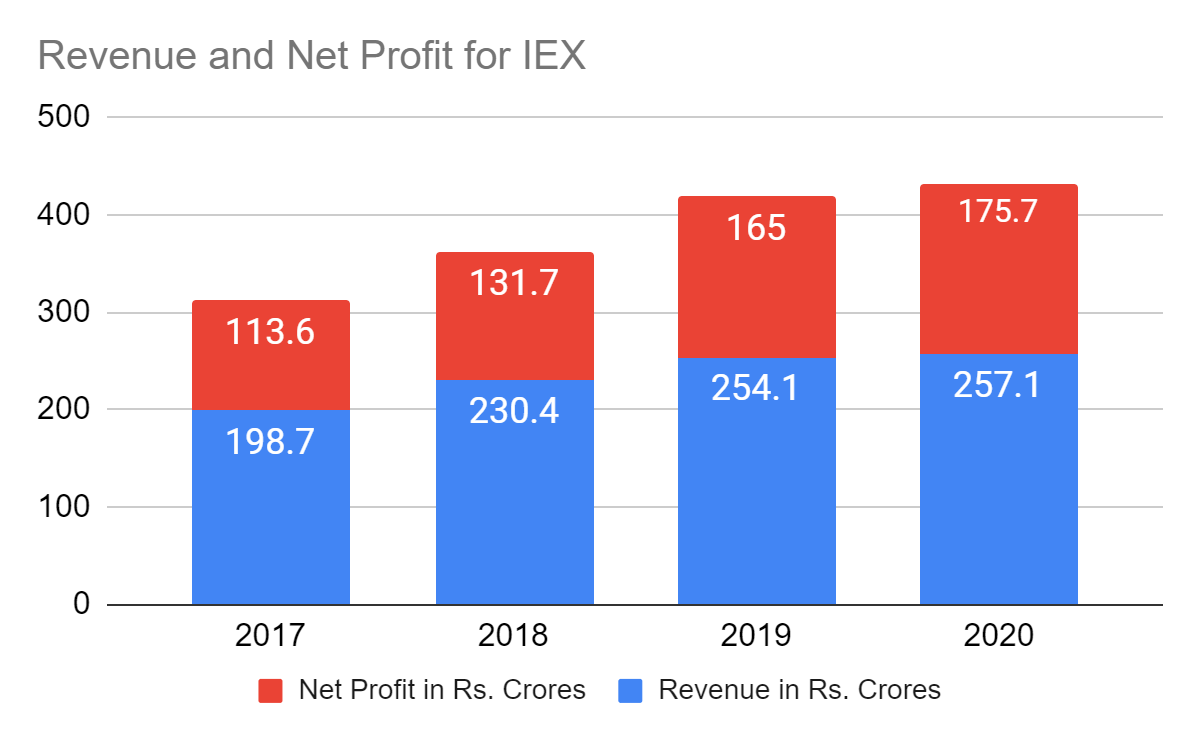
The company’s sales, revenue, and net profit have been growing constantly for the past 5 years. As demand for power increases, there will be an increase in power trading to find a better price for power.
Increasing Trading Volumes
On average, 6000+ MW of electricity is traded daily on the exchange. The traded volume is growing at 32% CAGR. It has a consumer base of 4000+ Industries, 55+ distribution companies, 500+ generators, and 1500+ renewable energy generators. The company has also seen increased trading volumes on the BSE and NSE.
Increasing ROE/EPS
For IEX, the Return on Equity(%) or ROE is ~45%. This means that for every Rs. 100 invested in the company, the investors earn close to Rs. 45 every year. The company’s price-to-earnings ratio or PE ratio has been declining constantly for the past few years. The fact that the company has excellent profitability and increasing revenue, it could probably mean that the company is undervalued and sees higher growth potential in the markets.
Increasing FII/MF shareholding
The company has an increasing FII(Foreign Institutional Investors) shareholding in the company. In fact, it has doubled between September 2018 and September 2020. This shows that foreign investors are bullish on the idea of power trading in India and see a greater potential in IEX. Mutual Fund’s shareholding has also increased by 4.5 times in the past two years between 2018 and 2020.
No Debt
The company has no debt or is not operated on credit. This saves it from default risk.
Decreasing Clearing Price
The clearing price is the price that companies pay to buy power after the bidding process is complete. The average market clearing price has gone from as high as Rs.3.38 per unit in July 2019 to as low as Rs. 2.35 per unit in June 2020. A decreasing clearing price means that more companies would flock to power exchanges for cheaper electricity.
Increasing Dependency on Green Energy Over Coal
As Governments push for environmental regulations and promote green energy, there is a greater incentive for companies to invest in them. Moreover, coal prices are pretty volatile citing quality concerns, regulation, and also the recent decision for Coal Mine Auction by the Government. Products like Energy Saving Certificates, Green TAM, and Renewable Energy Certificates on IEX will have a greater demand.
Indian Gas Exchange
The Indian Gas Exchange or IGX is a subsidiary of IEX which is an exchange for trading in gas. It is India’s first electronic delivery-based gas exchange. It is regulated by the Petroleum and Natural Gas Regulatory Board. IGX currently offers trading in five contracts namely: Daily, Weekly, Weekday, Fortnightly, and Monthly. It has three physical setups, two in Gujarat and one in Andhra Pradesh.
Electricity Amendment Bill
The Electricity Amendment Bill is a prospective bill that will enable power companies to retain greater profits. The bill also aims to prevent the high number of defaults in the energy sector, often by the state regulatory board themselves. The bill also addresses the weak financial health of power companies. It aims to privatize and centralize electricity transmission and distribution. The National Renewable Energy Policy also promotes the production and use of renewable energy throughout the country.
IEX as a share to invest in hasn’t caught the eye of retail investors. The company’s price is supported by a good balance sheet and awaits a great future considering the recent developments in power policy and the shift of focus towards renewable energy. One should look out for future events like the Electricity Amendment Bill. A mix of all can ensure greater participation in the Indian Energy Exchange, thereby increasing trading volumes and cash flows for the companies.
To know more about how the exchange functions and the products it offers, click here.
Jindal Steel and Power Ltd has reported a consolidated net profit of Rs 268 crore in the first quarter of the financial year 2021, as against a net loss of Rs 87 crore during the same quarter previous year, due to increased volumes and lower raw material prices
The company grew at 5.02% QoQ in terms of revenue but has its Net Profit trimmed by -12.45%, which is not huge considering the global slowdown due to COVID
Q1 FY21(Rs. Cr)
Q4 FY20(Rs. Cr)
Q1 FY20(Rs. Cr)
QoQ%
YoY%
Revenue
9,279
8,835.2
9,945.58
5.02%
-6.7%
Net Profit
268.00
305.6
-87.4
-12.45%
-12.1%
The company managed to reduce its operating cost and managed to obtain Raw materials for cheap. The operating expense has also been decreasing over the past 1 year.
Decreasing Operating Expenses
On the day of the result, the market moved sideways due to split opinion and sentiment regarding the stock. Which was later followed by a 3.2% decline at the close which could have been because of reduced profit as compared to last quarter. There is a certain optimism in the market looking at the fundamentals, reducing operating expense and profit.
You can check out the Official Q1FY21 result by clicking here.