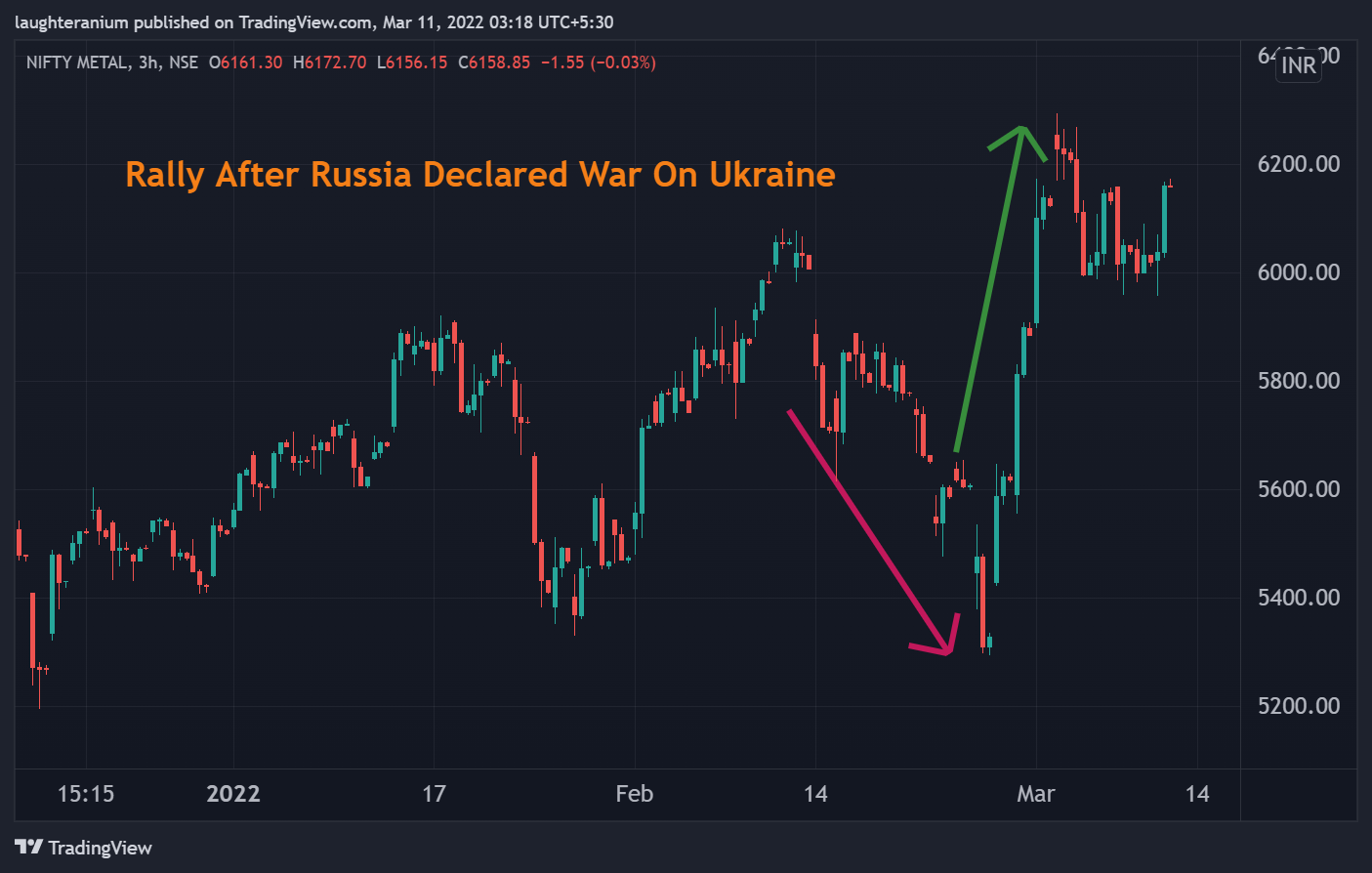
The Indian Metal and Mining Stocks are on a rally. NIFTY Metal, the benchmark index for metal and mining stocks, is trading at record levels. Amidst the Ukraine-Russia crisis, rising oil prices, damaged supply chain, and high inflation levels, metal and mining stocks have offered great returns in the last 3-4 months. What exactly could be the reason for such a rally?
The Big Picture
The NIFTY Metal index was off for a casual start after the beginning of CY2022. With two consecutive waves of rallies and subsequent profit bookings taking place, we did notice significant gap-down openings towards the end of February. This was around the time when the Ukraine-Russia escalations were fresh, and there was a bear run in the broader markets.
Consequently, we notice a steep hike in the NIFTY Metal index just a day after Russia declared war on Ukraine. Around this time, NIFTY Metal grew by nearly 16% in three consecutive trading sessions. After Russia declared war on Ukraine, the NIFTY Metal index moved against the broader NIFTY 50 index, i.e. Nifty Metal rallied but NIFTY 50 stocks tanked. After an abrupt rally, we notice a drop in NIFTY Metal, possibly due to profit booking.
Why Did The Metal Sector Rally Amidst Global Financial and Socio-Political Tensions?
Rising Metal Prices Would Mean Greater Margins
There was an inherent fear in the market that the Ukraine-Russia crisis would impact the supply chain of metals globally. Eventually, stock prices across the world started to soar. The cost of churning out a metal, be it steel, nickel, aluminum, or copper, remains in a fixed price range. If the market price is greater than the production cost, the producer makes a profit. The fact remains that metal prices have soared to record levels. Indian companies have managed to churn metal while demand was stable. An increase in metal prices can help them bag greater profit margins.
Weaker Rupee Helps Export-based Segments
A weaker rupee generally tends to benefit exporters. An exporter would get more rupees for every dollar worth of goods exported. The Indian National Rupee (INR) has hit its weakest of all times, crossing Rs 77 for every US Dollar. This means that for every dollar worth of metal that an Indian company exports, it would get more rupees in return. Even if metal prices were to subside, Indian metal players could benefit from exports if the rupee remains weak.
Potential Gain From Global Supply Shortage
Russia accounts for around 9-10% of global aluminum exports, ~11-12% of nickel exports, 20% of thermal coal exports, and 12% of global steel trade. The ongoing and increasing number of sanctions on Russia could significantly damage its ability to export crude oil, natural gas, and metals. India could potentially use this opportunity and hype its exports in the metal industry.
What Next?
In the first week of March, Ukraine and Russia organized a meeting in Turkey to discuss a ceasefire. Unfortunately, the talks failed. Oil prices crashed after reaching record highs as UAE pushed OPEC to increase oil production amidst a global call to boycott Russian oil. More production of oil would mean lower oil prices and therefore lower inflation rates. The fact that Ukraine and Russia have both agreed to make ‘compromises’ could have added to the crash in oil prices.
By now, Indian metal players would already be looking out for opportunities to pump up the export. A rise in international prices could eventually lead to an increase in metal prices in domestic markets. This could make infrastructure projects more expensive. Rising metal prices, a weak rupee, and the potential to capture a missing market seem to have fuelled the current bull run in the metal markets. Investors should look out for other factors like export volumes, sanctions, and the global supply chain to track the metal markets. It is advised that investors perform thorough research before investing in the markets.
For years, the world has been glorifying renewable energy or green energy. Many climate change accords have been signed, and countries have capped their carbon emission limits. However, the propensity towards ‘green energy’ seems to have left the globe in an energy crisis. The crisis that seems to have spread from Europe through Asia can have repercussions on other countries as well. In this article, we discuss the whole global energy crisis and its impact on India and other countries.
What Is The Energy Crisis All About?
Power Shortage in China
China is facing an extreme power shortage. Factories have been asked to stay shut, and cities have been facing blackouts. Simply speaking, China is facing a power shortage because of one reason— a coal deficit. China relies on coal for 60% of its electricity. It mainly gets this coal from Australia.
China’s relationship with Australia has been shaky over the past year, with both countries fighting a trade war. Amidst all this, Australia restricted the supply of coal to China. Now, China has been relying majorly on Australian coal to power its factories. When Australia stopped supplying coal, the prices of domestic coal shot up. If this was not enough, China decided to ‘crackdown’ and ‘improve’ its current coal mines so that they are safe and do not contribute vastly to carbon emissions. The crackdown on establishments giving out emissions comes amidst China’s goal of becoming a ‘carbon neutral’ country by 2060.
In 2022, Beijing is set to host the Winter Olympics. The country has set the goal to hold a ‘green’ Winter Olympics to leave a legacy in low emission urban development.
UK Fuel Shortage
The United Kingdom’s fuel crisis is pretty severe. The supply chain has halted completely, gas stations have dried up, and the supply of essential goods disrupted. The shortage of fuel could last a few more weeks before things fall in place. Both electricity and gas station bills are getting fatter by the day. The country has failed to produce enough natural gas to meet demand. UK’s renewable energy assets have been unable to meet production targets due to low winds in the North Sea. The country heavily relies on these renewable resources, and therefore, a shortage has impacted prices. The army has been kept on standby to keep the situation in check.
Another reason why the UK is not able to replenish its gas stations is the shortage of qualified truck drivers. Throughout COVID-19, the country has put trucking licenses on hold. Before Brexit, many truck drivers in the UK came from European countries. Post-Brexit, these drivers were required to obtain a work visa to operate in the UK. The country has decided to relax its visa rules and grant 10,000 temporary visas to truck drivers to meet its supply chain needs. UK’s Road Haulage Association (RHA) says that the country currently faces a shortage of 100,000 truck drivers in total.
European Energy Crisis
Apart from the UK, natural gas prices across Europe are on fire with electricity bills almost doubled or tripled. What seems to be worrisome is the approaching winter. Some fear that Europe might not have enough natural gas to power Europe if the winter is too cold. Just like the UK, Europe’s ‘green transition’ seems to be taking a toll on energy prices. The phasing out of coal and a grave year for wind energy production has skyrocketed the demand for natural gas.
Global Supply Chain Disruption
After the COVID-19 pandemic, China became one of the first economies to open up. Naturally, it bagged more export orders where factories decided to pump up production capacity, which led to rising demand for power. China could not keep up with the demand when it faced a shortage of its primary source of energy, coal.
Globally, the supply chain has been hammered for the past year. If the shipping container shortage wasn’t enough, China decided to shut down the world’s third busiest port, Ningbo Zhoushan, after detecting one COVID positive case. According to Russel Group, the port shutdown could cost $17 billion per month and increase further every month the shutdown persists.
The Port of Los Angeles is facing a ‘historic’ backlog of ships waiting to unload cargo. The normal waiting time for a ship used to be 0-1 day in total, which has now gone up to weeks. Ships are being forced to park in the waters and await their turn to docks while the port functions 24×7.
Impact on India
Organization of the Petroleum Exporting Countries (OPEC) is a cartel of countries that controls the supply and price of oil across the world. The organization faced turbulence when UAE and Saudi Arabia locked horns on production issues. We at marketfeed covered the topic in a July 2021 issue.
Moving on, OPEC’s supply constraints have impacted petrol prices globally, more so in India. The Indian government refuses to decrease excise duty on fuel, eating into the household incomes and contributing to inflation. Lower the savings, lower the investment. A global energy and supply chain crisis could seriously impact inflation in India, eating away household savings eventually affecting investments in India. With US Fed interest rate hikes around the corner, increasing costs could compel Indians to dilute their investments, ultimately impacting broader markets.
India’s automobile sector could face some heat as well. With winter approaching, China has started to cut down on production to meet overall power requirements until it mobilizes enough resources. China cutting down on electronic equipment and chip manufacturing could fire the pre-existing semiconductor crisis in the automobile sector. Just like the rest of the world, India is staring at a shortage of fossil fuels as well. It won’t be long before the crisis starts impacting our economy. The only way the world can get out of the crisis is through mutual co-operation and focussing on improving the global supply chain.
Right now, the economic situation in Sri Lanka is grave. It has piled up external debt over the years, has run out of its foreign reserves, and is facing a food crisis. Two superpowers are plotting a strategic game amidst the crisis— India and China. In this piece, we discuss the economic crisis, what led to it, and how it could possibly impact India.
The Situation
Simply put, Sri Lanka has taken a lot of loans from other countries. It accumulated a massive amount of debt over time. Between 2011 and 2021, Sri Lanka’s total external debt has more than doubled. The total debt owed by Sri Lanka in fiscal 2020 was USD 49.2 billion.This was close to ~57% of Sri Lanka’s total GDP. Sri Lanka did pay back a tiny part of the debt over time. In the process, it depleted its foreign exchange (forex) reserves. For a developing country like Sri Lanka, a forex reserve would help in three ways:
To maintain confidence in its monetary policyand exchange rate in the foreign market for its own currency, the Sri Lankan Rupee (LKR).
To pay back the debt that it took from other countries.
For having a greater buying power that would enable Sri Lanka to import goods.
India was in a similar situation in 1991. It had nearly depleted all of its forex reserves that would roughly last three weeks. That is when the government decided to liberalize and privatize the Indian economy to attract foreign investment.
Coming back to Sri Lanka. The country is now facing a severe food shortage. Imports of essential goods were banned. These included motor vehicles, clothes, cosmetics, and even Sri Lanka’s staple item, turmeric. Sri Lanka imports 7,000 tonnes of turmeric every year, out of which 5,000 tonnes come from India. This has sent the price of turmeric skyrocketing, causing a row in Sri Lanka. Even its primary source of foreign currency was shut during the COVID-19 pandemic, the Tourism Industry.
Sri Lanka has banned the import of fertilizers as well. The government is encouraging farmers to undertake ‘Organic Farming’. This fertilizer ban has caused a decline in crop production while impacting farmers’ financial conditions. Shortage of food has sent its prices skyrocketing.
Sri Lanka has the daunting task of boosting economic growth, increasing forex reserves, and cutting down on its external debt. All of this is combined with the uncertainty of COVID-19. However, amidst Sri Lanka’s grim economic situation, two countries seem to play a tug of war amidst Sri Lanka’s grim situation, India and China.
China At Play
China is playing what is known as debt-trap diplomacy. In a debt trap move, China would target countries with poor economic conditions yet are rich in resources and raw materials. Chinese companies, banks, or financial institutions would then lend money to these countries for unsustainable projects, at commercial interest rates. Countries desperate enough for financial assistance would accept this deal, hoping to replenish forex reserves and boost economic activity. Unable to pay back the loan on time, these countries would then be ‘compelled’ to lease their essential assets to China. One such example is Sri Lanka’s port, Hambantota.
Sri Lanka intended to develop the Hambantota seaport in Southern Sri Lanka. The only country that showed a willingness to fund the project was China, through its EXIM Bank. The bank extended loans to Sri Lanka between 2007-2016. For the first phase of the project, the bank lent USD 307 million to Sri Lanka at an interest rate of 6.3%, a considerably high interest rate.
Sri Lanka did manage to complete the project, but there was no ship traffic to the port because of a rock in the sea bed that was blocking the way for ships. In 2016, low on forex reserves and unable to pay the loans, Sri Lanka was left with no choice but to lease it to China for a period of 99 years. There are reports that China is planning to turn around the project into a multipurpose port by 2022. Recently, a Chinese ship with radioactive material was intercepted by Sri Lankan authorities at Hambantota port. Is it possible that China is planning to convert it into a strategic military base?
When China took control of the Hambantota seaport, India initiated talks with Sri Lanka to run a joint venture and operate Hambantota Airport. This was an indicator of a power tiff between rivals India and China.
What’s At Stake For India?
China has benefited immensely from Sri Lanka’s economic crisis. Close to 10% of Sri Lanka’s external debt is owed to China. In fiscal 2020, China beat India in being Sri Lanka’s top import partner. Although Sri Lanka forms a tiny portion of India’s export basket, its location is strategically crucial.
India and China haven’t had the best trade relationships lately. China has now strategically surrounded India from all sides by acquiring important seaports and routes in all directions. This will not only give its Navy an advantage but will also help China in advancing its shipping route positions. Sri Lanka has till now been a small yet significant ally to India, in terms of diplomacy, military support, and trade. Nevertheless, China seems to be courting Sri Lanka.
India has had a bumpy relationship with Sri Lanka lately. In Feb 2021, India refused to extend a currency swap facility to Sri Lanka. Sri Lanka was allegedly responsible for the death of three Tamil Nadu fishermen that had apparently strayed into Sri Lanka waters.
To get out of a similar forex crisis in 1991, India took the help of the International Monetary Fund (IMF) but faced severe economic restrictions. Eventually, India got out of the crisis, and the rest is history. Sri Lanka has refused any help from the IMF and continues to take loans, grants, and currency swaps with China. Moving ahead, Korea, India, China, and even the Asian Development Bank have extended their support to Sri Lanka through grants and currency swaps. Banning imports cannot be the solution in the long term to maintain stability within the country. Sri Lanka will have to undertake some austerity measures to ensure sustainable growth.
Our country’s Gross Domestic Product (GDP) estimates for the January-March quarter (Q4) were published on May 31, 2021. GDP is the money value of all finished goods and services produced within a country during a specific period. After India’s GDP growth dropped to a record low of -24.4% in the April-June quarter (Q1), the economy had shown great signs of recovery in the succeeding quarters. A sharp recovery is evident in the estimated GDP figures for Q4 as well.
Let us look at some of the key highlights of the data released by the Ministry of Statistics and Programme Implementation (MoSPI).
Main Highlights
India’s GDP grew by 1.6% in the January-March quarter (Q4 FY21). GDP at constant prices (based on 2011-12 levels) in Q4 FY21 stood at Rs 38.96 lakh crore. According to estimates, GDP grew by 0.4% in the quarter ended December (Q3).
The GDP for the entire financial year 2020-21 (FY21) contracted by (-)7.3%, compared to a growth of 4.18% in FY20.
In gross value-added terms (GVA), the economy contracted by (-)6.2% in FY21. GVA, which is a more accurate way of assessing the economy, grew 3.7% in Q4. This is compared to a 1% growth in the previous quarter (Q3).
GDP based on current prices in FY 2020-21 is estimated at Rs 197.46 lakh crore.
Sector-Wise Results
We had expected a good recovery in the manufacturing sector. There were multiple data sets from various sources (monthly auto sales data, PMI, etc) which showed that industrial activity in India had improved. This was mainly on account of higher demand amidst the gradual removal of almost all lockdown restrictions. The manufacturing sector showed a strong growth of 6.9% in Q4, compared with just 1.7% growth in Q3. The agriculture sector grew 3.1% in the January-March quarter. It is the only sector that has shown positive growth throughout the financial year 2020-21.
The table below shows the sector-wise growth of India’s economy over the previous quarters:
Some Noteworthy Sectoral Growth Rates:
The construction sector posted a very strong recovery from Q1 levels. It grew 14.5% in Q4, compared to a growth of 6.5% in Q3.
Trade, hotel, transport, and communication sector narrowed its contraction to 2.3% in Q4. It had contracted by 7.9% in Q3. This sector has been the worst hit by the Covid-19 pandemic.
The finance and real estate sectors posted a growth of 5.4% in Q4, compared to a growth of 6.7% in Q3.
Performance of Eight Core Industries in April 2021
The eight core industries comprise nearly 40.27% of the weight of items included in the Index of Industrial Production (IIP). The IIP is an index that tracks manufacturing activity in different sectors of the economy. According to data released by the Ministry of Commerce, growth in the eight core sectors rose sharply by 56.1% year-on-year (YoY) in April. This is mainly due to the low base effect (as India was under strict lockdowns in April 2020) and a massive increase in steel and cement output. The total output of these core sectors recorded a contraction of (-)15.1% in April 2021 when compared with March 2021 (month-on-month).
Core Industry
Growth in April 2021 (YoY)
Coal
9.5%
Crude Oil
-2.1%
Natural Gas
25%
Refinery Products
30.9%
Fertilizers
1.7%
Steel
400%
Cement
548.8%
Electricity
38.7%
India’s Expenditure During Q4
Private consumption grew 2.7% in Q4, compared to a contraction of 2.8% in Q3. This refers to the money spent by all people in our country. The overall contraction of 9.1% in FY21 shows how Indians had cut back on their expenditure as income levels fell and many lost their jobs. There was a huge decline in spending due to restrictions placed on mobility and delivery of non-essential items by e-commerce firms.
Investments (or Gross Fixed Capital Formation) grew by 10.9% in Q4, compared to a growth of 2.6% in Q3. These are investments made by private players into local entities and businesses in India. Over the past few months, we have seen a series of investments and acquisitions being conducted in our country.
Government expenditure grew sharply by 28.3% in Q4, after contracting by 1% in Q3. This shows that the Centre has focused on ramping up public expenditure to control the effects of the economic downturn caused by the Covid-19 pandemic. The government and RBI had announced a series of measures to help revive growth. It has also procured essential Covid-19 vaccines for the public.
Conclusion
The GDP figures for Q4 and the entire financial year 2020-21 were better than analysts’ estimates. Almost all sectors of the economy had posted strong positive growth. There was a major revival in overall demand in the second half of FY21, and recovery had gained strength. Indians had just begun to buy/consume more after lockdowns were eased, and the government focused on increased spending to support economic growth. The cement and steel industries have thrived over the past few months as a result of higher demand and prices. Construction activities had resumed and were in full swing. Things were looking very promising.
This was until the second wave of the Covid-19 pandemic struck the nation. Unfortunately, we are back in the same situation as last year. Almost all states went into strict lockdowns as Covid-19 cases started peaking in April-May. Our healthcare system had completely collapsed, and people could not receive adequate treatment. Many companies were forced to close down their production units, and construction activities have been hit. Private consumption in India is likely to fall significantly (again). The economic recovery that we witnessed towards the end of the previous financial year (FY21) has lost strength.
India is critically lagging behind other countries in terms of vaccination rates. The country must focus all its efforts on ensuring access to Covid-19 vaccines and medicines to all citizens. The health sector needs complete support now more than ever. Ultimately, the GDP growth in FY22 will depend on these factors. Interestingly, India’s Chief Economic Adviser Krishnamurthy Subramanian and many analysts have stated that the economic impact of the second wave is unlikely to be very large. Let us look forward to seeing how the concerned authorities tackle these pressing challenges.
Just Dial, the hyperlocal search engine, has ventured into a new initiative that can turn the company into gold. It was launched in 1994 as a phone-based local directory. The Mumbai-headquartered company has launched its Business-2-Business(B2B) e-commerce portal which will be known as JD Mart. The new JD Mart will directly compete against IndiaMart and Udaan which are already present in this B2B e-commerce market. Just Dial promises to bring a new wholesale experience for the customers with the aid of JD Mart. They will ensure to offer quality vendors with wide categories of products.
JD Mart will aim to provide you with a complete experience with the help of interactive content cataloguing and 24×7 support. The products will be certified and verified so that the customers are not fooled to buy poor quality products.
When we visit Flipkart’s website and buy products from there, it is Flipkart’s Business-2-Customer(B2C) business. With JD Mart, Just Dial is trying to lure sellers who want to buy products in a bulk hence the B2B. This will help them to sell their products at a wholesale price.
The Legal Battle
JD Mart was scheduled to launch in the latter half of 2020 but the launch was delayed. This was because of India Mart who went to Delhi High court against JD Mart over copyright violation. India Mart was successful to obtain a temporary injunction which stalled Just Dial’s entry into the B2B e-commerce space.
In return, JD Mart termed India Mart’s complaints as “absolutely baseless and frivolous”. Also, they accused IndiaMart of data-copying and cybersquatting. The Delhi High Court launched an investigation of the alleged data theft by Just Dial. Finally, after the 4-5 month tussle, Just Dial unveiled JD Mart in the last week of February.
A Look at Just Dial’s Financials
Just Dial is one of those very few companies that have consistently seen an increase in their numbers. Their revenues have never seen a dip since 2012. In FY19, their revenue was Rs 984 crore which increased to Rs 1092 crore in FY20. The same can be said about their net profits as well. They amassed a net profit of Rs 272 crore in FY20 which was almost 25% higher than what they recorded in FY19 (Rs 206 crore).
In the last three years, their EPS also increased from 17.46 (FY17) to 42 (FY20). EPS stands for Earnings per Share which tells how much an investor is able to earn per share. Thus, the higher the EPS, the better for the investor. Before you invest in a company, it is important to gauge how risky that bet is. This can be mapped out via the debt company holds.
Another positive news for the company is that over the last 5 years, their debt to equity ratio has been 1.27%. This is way lower than 3.49% which is the industry average for this ratio. In the last year (from December 2019 to December 2020), the promoters of Just Dial have increased their holding in the company from 32% to almost 36%. The last share buyback took place just a few months ago. Promoters increasing their stake in their company is always a good signal for the investors. It is interpreted as proof of the confidence of promoters in their business.
The Success of IndiaMart
Weekly Chart of IndiaMart since its IPO
IndiaMart has given massive returns to its investors since its IPO in 2019. The IPO price of IndiaMart was Rs 973. The IPO was listed at Rs 1,180 and closed the day at Rs 1,302. That is more than Rs 300 benefit on just one share! Currently, the stock is trading at more than Rs 8000. If an investor has held even one share for 1.5 years, he would have earned a capital appreciation of Rs 7000. Last month, it touched it’s all-time high of Rs 9950. If any of you have enjoyed this unbelievable rally, then do let us know in the comments section below. You can also view India Mart’s price chart above.
The Final Take
The speculation in the markets is wide that the arrival of JD Mart can potentially be as big as IndiaMart in the next few years. Just Dial has been in business for years and they have a huge client base. They are a well-known company when you have to search for any store nearby. The new JD Mart can take the benefits of the huge client base of Just Dial.
This will increase their reach on the new web portal and can be a very strong competitor to India Mart. The B2B e-commerce market is a space with a lot of potential in the future. With low competition, and high potential to expand, we think that if JD Mart can attract people, they can surely be a big thing in future. What do you think about the B2B market in India? What is your opinion on JD Mart vs India Mart? Share your views with us in the comments section below!
Ever wondered about how the power sector in our country works? And what are the opportunities that lie in the industry? For the first time since the liberalization policy in 1991, India’s power sector is going to change for good, in a way that could benefit both consumers as well as power companies. The Finance Ministry is pushing for privatization and delicensing of the power sector which could change the way the power sector works in India.
The total installed capacity of power stations in India stood at 373.43 GW as of October 2020. The transmission lines in India are 4,98,651 km long. According to India Brand Equity Foundation (IBEF), between 2000 and 2020, the power sector attracted Rs 1.11 Lakh Crores in Foreign Direct Investment (FDI), which is close to 3% of the total Foreign Direct Investment(FDI) inflow in India.
Currently, the power distribution companies(Discoms), transmission companies(Transcos), and generation companies(Gencos) are distressed financially due to reduced electricity demand along with unfair pricing and power policy.
With the Budget 2021 and the Electricity Amendment Bill 2020, the power sector is in for a revolution. If the bill is passed in the parliament, it could change the face of the industry. In this piece, we explore how the power sector fairs in the stock market and the listed power companies that have a potentially good investment perspective.
The Companies in the Sector
Power Grid
With a market cap of Rs 96,496 crore, Power Grid is India’s largest state-owned power transmission company in India. It is classified as a Maharatna PSU. It has an annual Return on Equity of 17%, which means that for every Rs 100 invested in the company, one makes another Rs 17 on it. The company has a Return on Capital Employed(ROCE) of 5.44% and Return on Asset(ROA) of 4.3% which means that it is utilizing its capital and infrastructure pretty efficiently. With 5G coming in and the rising electric vehicle market, the need for additional transmission grids are also likely to increase. Power Grid has also filed for an InvIT or an Infrastructure Investment Trust IPO. The IPO is likely to put the company in a favorable position in the markets.
Adani Transmission Ltd
Adani Transmission Ltd is the subsidiary of the Adani Group. It is the largest power transmission company in India. Adani Transmission Ltd. has:
A 27,000+ megavolt ampere of transmission capacity.
3,000,000+ distribution customers
15,400 in transmission line length
Adani Group companies are almost intensively fuelled by debt, but it has a reputation of repaying and gaining a position with time. Adani Transmission over the years took huge debt burdens but managed to pay it back all in time. Most of its debt now is forex debt, which according to the company is cheaper than domestic loans.
The company transmits electricity to Mumbai, the financial capital of India along with holding assets in 8 other major projects. Adani Transmission has returned 1131.5% in the last 5 years. This means that Rs 1 lakh invested would have turned into 11 lakhs in a period of 5 years, from 2016 to 2021.
Torrent Power
Torrent Power is a power generation, transmission and distribution company based in India.Torrent’s stronghold is the state of Gujarat where it transmits and distributes electricity to major cities. Apart from Gujarat, the company holds its presence in Bhiwandi(Near Mumbai), Agra(Uttar Pradesh) and other cities in Maharashtra. It has a total generating capacity of 3191.6 MW.
Some electricity that is produced isn’t able to reach the right customers through transmission and distribution lines in case of theft, damage or heat dissipation. This is known as T&D Loss. Torrent Power’s T&D loss is one of the lowest in the country, which is ~4.5% as compared to India’s average T&D loss of 20%. This means that Torrent Power has the right technology, surveillance and assets to supply electricity seamlessly.
Speaking from a financial perspective, the company has constantly rising Profit After Tax(PAT) and Sales Volumes. Over the past 5 years, the company has returned 31.2% on investment. The company’s Return on Equity stands at 12.82% as compared to Industry ROE of 9.5%.
Torrent Power Adjusted Profit and Net Sales(Source:Edelweiss)
CESC or Calcutta Electric Supply Corporation Limited
CESC Ltd. is a power generation, transmission and distribution in and around the city of Kolkata and a few districts of West Bengal. Along with West Bengal, the company also holds generation and distribution businesses in Rajasthan and Maharashtra.
The company did not fare well in the past 3-4 years, however, there have been recent changes in volumes. The sales volumes in West Bengal has crossed pre-COVID levels and their generation businesses in Rajasthan are likely to turn profitable pretty soon. Loses in the distribution business has reduced significantly. The company is likely to get a push with the Rs 3 Lakh crore stimulus package for electricity distribution companies. The company also offers one of the highest dividends to its shareholders in the power sector. Shares have gained 14.2% in the past 6 months since August 2020.
CESC Price Performance(Source: ICICIDirect)
Tata Power
Tata Power specializes in both generation and power supply. Close to 60% of Tata Power’s revenue comes from power generation, whereas the other 40% comes from transmission and distribution. Tata Power supplies electricity to the cities of Mumbai, Ajmer, and Delhi. It caters to around 26 lakh consumers in Mumbai and Delhi distribution areas, having close to 21,000 circuit kilometers in transmission and distribution grids. The company also holds ~10% market share in the rooftop solar(RTS) energy market in India.
During COVID-19 lockdown, like the rest of the sector, Tata Power too saw a reduction in transmission and distribution revenue segment. Tata Power has been focusing on reducing debt by selling non-core assets or assets that do not add to the core revenue of the company. It has managed to reduce close to ~14% of its debt in the past 1 year. The company’s debt to equity ratio has been decreasing constantly which signifies that the company has been cutting down on debt and catching up on equity in the company.
Privatisation and Delicensing of the power sector will indeed be a positive sign for Tata Power considering that it is the third largest power producing company in India.
IEX
The Indian Energy Exchange or IEX is an electronic power trading marketplace for electricity corporations and boards to trade contracts related to energy. In simple terms, just like how individuals can trade in the stock market to gain profit, electricity corporations can trade on the IEX to increase profitability and have better price discovery. All the three, i.e. Power Generation Companies(Gencos), transmission companies(Transcos) and Distribution Companies(Discoms) can trade on the IEX. IEX has recently seen a spike in volume due to volatility in electricity prices. marketfeed has dedicated two special articles on IEX.
To know more about how the company functions internally and the process of power trading, Click Here.
To know about, IEX as a stock to invest in, financial analysis, profitability and future prospects, Click Here.
Budget 2021
Budget 2021 has received a positive response from the power sector. Finance Minister(FM) Nirmala Sitharaman allowed a much expected Rs 3 lakh crore to the power sector with the intention of reviving stressed discoms. The distribution of the fund will be over a period of 5 years. It will help in reducing losses and also improve efficiency along with increasing rural penetration. The FM also announced developing a framework for allowing the consumers to have their choice of electricity supplier. This will promote healthy competition and allow for healthy price discovery.
The FM also announced the aspects of the Electricity(Amendment) Bill 2021, wherein the power sector will be ‘delicensed’ and thereby give smaller power companies a greater opportunity to expand. Apart from this, the government has also announced a Rs 2,606 crore allocation specifically for the solar power sector and also laid emphasis on shifting from using coal as a fuel to renewables.
Invest In Power
The Budget 2021 was indeed a historical one as it addressed a needed boost after the impact of COVID-19. It addressed not only the problems of the distressed power distribution companies but also hinted that the renewable energy sector is taking off. India currently is undergoing a coal crisis. Coal resources are being depleted and renewable energy is relatively more expensive.
The Indian Power Sector is undergoing a major change, in a way that will change the market outlook for the first time in decades. The power policies in India are made in a way that politically benefits the governments of respective states. They are addressed to benefit the common man. This impacts the power companies as they are faced with reducing demand, falling profits, and increased costs. The power sector was given a ‘Negative Outlook’ by ICRA, a renowned credit rating agency. Due to the COVID-19 pandemic, the demand for power took a fall and dented the power sector.
The focus of power companies right now is to increase rural penetration, boost profits and achieve maximum efficiency. ‘Delicensing’ of the power sector will ensure less government intervention and increase cash flows for the power companies. India’s infrastructure boom, rising electric vehicle industry and the 5G revolution shall definitely enhance demand for the power sector. The future of the power sector is bright indeed.
As we are aware, stock markets around the world saw a major crash on December 21 (Monday). After witnessing a very impressive bull run over the past few weeks, the Nifty50 Index fell by 432.15 points (or 3.14%) on a single day! The major reason behind such an absolute bloodbath in the markets has been linked to the emergence of a new coronavirus strain in the United Kingdom. People all around the world have entered into a panic mode. Certain governments have also banned international flights to limit the spread of the virus. It has turned out to be a major cause of concern for all of us.
Let us understand the specific details surrounding the new Covid-19 strain, and find out what experts have stated about it.
Important Facts on the New Strain of Covid-19
Viruses keep mutating and changing their behaviour as time passes. Here are specific details regarding the new variant/strain of coronavirus that poses a threat:
The United Kingdom has identified a fast-moving new variant of the coronavirus, which is more than 70% more transmissible than existing strains. It has been termed as “B.1.1.7”. Three major factors are causing concern over the new variant:
The new strain is said to spread faster than the other versionsand is 70% more infectious.
It is the most common version of the virus in the UK. It is also rapidly replacing other versions of the virus.
There have been changes to the spike protein of the virus, which plays a key role in unlocking the doorway to the body’s cells.
The new Covid-19 variant is believed to have been first detected in September. By November, around a quarter of cases in London were of the new variant. And, by mid-December, nearly two-thirds of cases in London were of the new virus. Over the last week, the number of cases in London doubled, with at least 60% of the infections being from this strain.
This new strain was identified by the COVID-19 Genomics UK (COG-UK) consortium. It is a partnership of the UK’s four public health agencies, as well as the Wellcome Sanger Institute and 12 academic institutions. The group undertakes random genetic sequencing of positive coronavirus samples around the UK.
The most likely explanation is that the variant has emerged in a patient with a weakened immune system that was unable to beat the virus. Instead, their body became a breeding ground for the virus to mutate.
There is no proper evidence that suggests that this new strain or variant is more dangerous. However, the increase in the rate of transmission means more people could get infected than before. This leads to an added burden on an already strained healthcare system.
It has been found that this new strain has been spread from the UK to Denmark, Netherlands, Australia, and even India.
It has been found that vaccines produce antibodies against many regions in the spike protein. Spike proteins are what allows the coronavirus to enter into human cells. So, it is unlikely that this change would make the approved Covid-19 vaccine less effective.
“With this variant, there is no evidence that it will evade the vaccination or a human immune response. But if there is an instance of vaccine failure or reinfection then that case should be treated as high priority for genetic sequencing.” – Sharon Peacock, Director of COG-UK.
What is happening in UK?
On December 20 (Sunday), the UK alerted the World Health Organisation (WHO) and stated that the new Covid-19 variant appears to be accelerating the spread of Covid-19. While UK Prime Minister Boris Johnson announced Tier-4 restrictions for London and Southern England, several countries like Italy and Belgium have suspended incoming travel from Britain. Under the Tier-4 restrictions, mixing of households will not be allowed- except under very limited conditions outside in public places. Travel in and out of Tier 4 areas won’t be allowed unless it is an emergency.
The following graph shows the spike in Covid-19 cases in the United Kingdom (as of December 21):
Source: The New York Times
International Developments
On December 21, the Kingdom of Saudi Arabia has halted all international flights for a week and has taken several precautions against the new Covid-19 strain. Countries such as Poland, Germany, France, Ireland, Canada, and around 15 others have also suspended all flights from the UK. India has also taken a proactive step and has banned all flights from the UK till December 31.
On the same day, the German Health Minister, Jens Spahn, stated that the vaccines are effective against the new coronavirus strain. This is very promising news indeed.
We also received another shocking update on December 22. Five out of 266 passengers and crew members of a flight which arrived at Delhi from London have tested positive for Covid-19. Experts also believe that the new variant of coronavirus is already spreading across India.
Conclusion
The news related to vaccine approvals had lifted our spirits, and in turn, the stock markets. The United States and UK governments have already launched a massive vaccination drive in their respective countries. Despite such positive news, the number of coronavirus cases is surging all around the world. The second wave of Covid-19 is surely upon us, and countries are gearing up to make sure that the situation is contained. Moderna and Pfizer-BioNTech are confident about tackling this new strain. The general global sentiment has returned to the confidence that we can beat the pandemic.
Keeping the markets aside, the new variant of Covid-19 poses a threat to all of humanity. India has the second-highest infection count in the world. This is the time to prepare ourselves for the worst-case scenario. As the Christmas season is upon us, we need to refrain from moving around and stop the spread of the virus. Will this lead to a huge surge in global cases and stress the healthcare sectors? Will India and other countries return to strict lockdowns? We will have to patiently wait and watch.
88088089 - hand holding coins vector, business growth concept
India is losing Rs 75,000 crore in taxes every year: Report
India is losing over $10.3 billion or about Rs 75,000 crore in taxes every year because of global tax abuse by MNCs (57.4%) and tax evasion by individuals(42.6%), says a report , State of Tax Justice. Cayman Islands, Netherlands, and the UK topped the list of countries responsible for tax evasion across the world.
Majesco, an insurance technology firm, has announced a share buyback plan of up to Rs 631.26 crore. The buyback will open on November 27 and close on December 11. The company will be buying back close to 74 lakh shares amounting to Rs.631 Crores which is close to 24.78 per cent of the total paid-up capital of the company.
Prime Minister Narendra Modi has said that India has set a target of cutting down its carbon footprint by 30 to 35 per cent.He made the statement while addressing at Pandit Deendayal Petroleum University (PDPU) at the convocation ceremony through video conference.
Bharti Airtel to acquire 5.2% stake in Solar Power Company Avaada MHBuldhana
Bharti Airtel on Friday has announced that it will acquire a 5.2 percent stake in solar power company Avaada MHBuldhana for Rs 4.55 crore. Avaada MHBuldhana Private Limited is a newly-formed company that is expected to go fully functional in 2021. It is a subsidiary of Avaada Energy Private Limited (AEPL).
Mittal, UK Govt to offer telecom connectivity via space
One Web, a global communications company in collaboration with the UK Govt are planning to offer telecom connectivity via space. Sunil Mittal’s Bharti Enterprises and the UK Govt. both own 45% stake each in the company. The company plans to begin testing anytime next year and officially launch by October 2022.
Unilever to introduce mouthwash formulation to battle COVID-19
Unilever has said that it is working on a mouthwash formulation, which, it claims, will reduce 99.9 percent of coronavirus after 30 seconds of rinsing. The company has stated that the product is expected to launch in India by December 2020.
Coffee Day Enterprises has entered into a share purchase agreement with Shriram Credit Company Limited to buy stakes in Way2Wealth Securities Pvt Ltd for a consideration of Rs.65 Crores subject to adjustments.
Punjab Farmers To Stop Train Blockades For 15 Days
Punjab farmers have agreed to Punjab CM Amarinder Singh’s request to stop the blockade of trains for 15 days. The farmers are protesting the three Farm Bills that were passed in the last session of parliament.” Had a fruitful meeting with Kisan Unions. Happy to share that starting 23rd Nov night, Kisan Unions have decided to end rail blockades for 15 days. I welcome this step since it will restore normalcy to our economy. I urge the Central Govt to resume rail services to Punjab forthwith” read the CM’s tweet
The Adani Group is an Indian multinational conglomerate that deals in Petroleum, Gas, Power, Green Energy, Infrastructure, etc. The group led by industrialist Gautam Adani has been in a stir in the past for tax evasion, charges of corruption, and environmental degradation. Moreover, Australians are hating on Adani, protesting, and trying to stop him from operating there. Let’s find out why.
What is Adani Doing in Australia?
Why do the Australians Not Want Adani?
What is Adani Doing in Australia?
The Adani group in Australia is working on the following:
Carmichael Rail Project, a 200 km rail project, which will be used for passenger and freight transport, mostly coal from the Carmichael Coal Mine.
Running two major solar power plants with a total capacity of 194 Mega Watts.
The Abbot Point Terminal, which is a cargo handling shipyard on the coast of Queensland.
Lastly, The Carmichael Coal Mine Project, which the center of all the controversies and protests in Australia.
Adani took an opportunity to learn the politics of Queensland. As the elections neared, Adani set sail. It got the politicians of the Australian Labor party to convince the citizens about how unlocking the Carmichael Coal Mine can lead to economic development in the area. Adani and its lobbyist held public meetings to convince the locals on how India’s demand for coal can fuel fortune for Queensland.
The Carmichael Coal Mine project is expected to cost A$2 Billion(Australian Dollars) and close to 2000 jobs in the region. Moreover, both the state and federal governments at the time had even given subsidies to fuel the Carmichael coal mine and railway line project.
These are the major projects being handled by Adani, in Australia. But clearly the locals are not happy with the company’s proceedings. Let us see why!
Why Do Australians Not Want Adani?
The Carmichael Coal Mine Project is the reason why there are mass protests against Adani. According to the website www.stopadani.com, the reasons for the protest against the coal mine project and Adani is as follows:
It allows more than 500 coal ships to travel through the Great Barrier Reef World Heritage Area every year for 60 years. Coal being a pollutant could damage the reef and aquatic life.
They get access to 270 billion liters of Queensland’s precious groundwater for 60 years, for free.
It adds 4.6 billion tonnes of carbon pollution to our atmosphere.
The coal project unlocks the Galilee Basin, a 2.47 lakh square kilometer thermal coal basin, which is primarily untouched ecologically.
These are not the only reasons however, these are simply environmental risks associated with the project. There is more as to why the Australians do not want Adani in the country and that is Adani’s bad reputation.
Speculations suggest that there is a political motive of the Australian Labor Party behind it. However, Adani doesn’t have clean hands either, a website called AdaniFiles, states that this could be “a dodgy setup for dodging taxes“ linking Adani’s Australia project and his offshore assets in the Cayman Islands.
Adani has been fined by Australia’s regulators for misinformation. Additionally, Adani is a part of controversies such as the Belekeri Port Scandal, 2011 Mumbai Oil Spill Case, Zambia KCM Pollution Case, Jharkhand Land Grabbing Case, and other countless legal and regulatory battles. Adani’s massive lobbying and contacts with the Indian government has given him a clean cheat for most of its wrongdoings.
Adani was caught up in the news for hiring a private investigator to spy on a nine-year-old girl. Yes, imagine this. How much more creepy can this company be? She is the daughter of an environmental activist who was a part of protests against Adani in Australia.
This is what the Australians fear. Adani’s disregard for regulatory authorities and the environment. They fear that Adani might commit an economic, environmental, and/or financial atrocity and get away with it.
To know more about why Australians are protesting against Adani along with the legal and regulatory developments, You can visit:
Even though the website names are funny and catchy, the topics discussed and the fight are indeed serious. The Adani Group is creating problems in India, as well. We can observe how this rapidly growing company continues to make problems everywhere it goes. Next day, we can also talk about the current protests in Goa, and how Adani is involved there too!
Indian Banks have performed unexpectedly and exceptionally well in the second quarter(Q2) of this financial year. Markets too were not sure of why the big banks in India are posting such good profits, reduction in bad loans, and improvement in asset quality. BANKNIFTY, the benchmark index for all the retail banks in India, too didn’t reflect for long on the profits that the banks were posting. This kind of exceptional performance wasn’t expected since India’s 23.9% April-June GDP contraction, the damage done to businesses by the COVID-19 Pandemic, and the RBI being vigilant on rising Bad Loans/Non-Performing Assets(NPAs).
The reason is clear for these high profit numbers. The banks are sitting on an NPA(Non-Performing Asset) time bomb, which will explode sooner or later.
Why Are The Banks Posting Such Good Profits?
What is The NPA Time Bomb?
What Next?
Why Are The Banks Posting Such Good Profits?
In the second quarter, ICICI Banks has posted a profit of 242.46% (YoY). HDFC Bank has posted a profit of 15% (YoY), RBL and IDFC First Bank have posted profits of 185% and 116% respectively. None of the 12 listed PSU banks have posted a loss. Even banks which have posted consecutive losses earlier have posted profits in this ‘stressed’ quarter. All of this, while the ill-effects of the COVID-19 pandemic still continue to impact businesses in India.
There are mainly two reasons for such good profits.
Net Interest Income: The Net Interest Income is the difference between the interest paid out and interest received by banks. The Net Interest Income has increased substantially. This means that banks received more interest money than the money it gave out to account holders, lenders, etc. As the economy gets back to normalcy, businesses and people are more likely to pay back the money that they had borrowed from these banks.
Improved Asset Quality and Reduced Provisions: The banks have seen an improved asset quality because they are vigilant and cautious while lending money. Banks aren’t lending money as freely as they did before. This decreases the NPA to some extent. The banks have to set aside “provisions” for these NPAs. Provisions are funds set aside by a company as current liabilities to pay for anticipated future losses. These provisions were reduced to almost half of what they were in the last quarter in many banks. The amount of provisions reduced coupled with reduced NPAs gets added to the companies’ book of accounts, thus increasing the profits.
What is The NPA Time Bomb?
India has been struggling with rising NPAs, low borrowings, and a low growth rate even before the COVID-19 pandemic came around. The RBI has been working on these problems for a long time through regulation and open market operations. It hasd implemented Long Term Repo Operations or LTRO to boost borrowing. The RBI has also announced frequent moratoriums and debt restructuring schemes for Micro, Small & Medium Enterprises(MSMEs).
This is where the problem arises. Banks were asked not to classify many loans as Non-Performing Assets(NPA) in case somebody defaulted during the moratorium period. The loan moratorium and debt restructuring schemes have been around way before the COVID-19 lockdown period. The Supreme Court has said that accounts that were not declared as NPAs till August 31, shall not be declared NPA till further orders. As said before, reduced NPA equals reduced provisions, equals more profit. The impact of NPAs has just been delayed and not written off.
SBI has funds worth Rs 8.2 lakh crores under the moratorium scheme. Kotak Mahindra Bank has Rs 9,000 crores, ICICI Bank has Rs 14,000 crores and HDFC Bank has 15,000 croresworth of loans which are under debt restructuring schemes or moratoriums. A huge chunk of them may turn out to be Non Performing Assets (NPAs), all at once. This will lead to banks keeping higher provisions aside which will eat into the operating profits of the company. You can expect an explosion of NPAs somewhere around Q3 FY 2020-21.
What Next?
The government has announced a waiver on the interest-on-interest on the loans availed for the period between 1st March and 31st August for an amount of upto Rs 2 crores. This might be a slight relief for borrowers and reduces the burden of NPAs on the banks.
Apart from this, there has been not much activity by the centre or the RBI to mitigate the burden of the bad debt that will arise in the future. One shall prepare for a turbulent ride for the banks in Q3 of this financial year.
On November 15, 2020, 15 countries signed arguably the largest free trade agreement in history. Originally, 16 countries were supposed to sign the deal. Who was the 16th one? India. But on 4th November 2019, India decided against signing the RCEP pact. Why did India choose to stay away from the largest FTA which could help the nations thrive economically?Let’s seehere.
What is the RCEP Agreement?
Why did India Opt-Out?
The Never-Ending Debate
What Can India Do Now?
What is the RCEP Agreement?
RCEP or The Regional Comprehensive Economic Partnership is an agreement between the members of the Association of Southeast Asian Nations (ASEAN) and countries with which they have free trade agreements (FTAs), namely India, China, Australia, Korea, Japan and New Zealand. The 16 countries involved in this deal (including India) covered almost one-third of the global population. Together these countries account for 29% of the world’s gross domestic product (GDP).
According to the deal, RCEP members will eliminate about 92% of the tariffs on goods traded between all of them. The countries involved will work to create an integrated market. With this, products and services of each of these countries can be easily available. Other than trades of goods & services, RCEP members will focus on investment, intellectual property, economic cooperation and dispute settlement.
Why did India Opt-Out?
“The present form of the RCEP Agreement does not fully reflect the basic spirit and the agreed guiding principles of RCEP. It also does not address satisfactorily India’s outstanding issues and concerns in such a situation” – PM Narendra Modi during the RCEP meeting last year.
According to the Indian officials, the RCEP deal will give freeway to the importers to import in huge quantities. Many products made in China cost much less than what an Indian variant of that product cost. Thus, importers will import foreign goods to generate higher demand. This will decrease the expenditure of the people but at the same time, it will haunt domestic producers.
If India removes the import duties, there will be no protection for the domestic players. The domestic manufacturers will not be able to engage in the price war due to expensive raw materials or poor technology. Eventually, people will choose the cheaper foreign goods, thus, pushing the domestic players out of the market. India has an enormous trade deficit with China. In 2019-20, the deficit stood at $48.64 billion. Indian officials fear that this number would increase if the current RCEP agreement is inked.
Source: The Indian Express
There is another benefit for India if they maintain their distance from the RCEP agreement. The “largest regional trading agreement” does not include the United States of America and the European Union. This step away from the deal could serve in India’s favour to clinch bilateral trade agreements with the US and the EU. The global negative sentiments against China has already pushed the US and India on similar fronts. Any step against China can be counted as a step towards the United States.
The Never-Ending Debate
Globalisation has been a topic of deliberation for decades. Whether its the economists, politicians or other policymakers, there has always been people “for-globalisation” and “against-globalisation”. Often people have voiced that globalisation will fall under the stress of economic nationalism. Globalisation has both positives and negatives which gives birth to this divided opinion.
The positives come mainly to the customers. They get a variety of products to choose from. These products may vary in cost and quality. Thus, customers have the luxury to choose what is best for them. Also, globalisation helps to increase the productivity of the company. More competition from foreign brands forces the domestic players to upskill themselves and produce better output. Economic theories also say that all nations should have open economies for the world to prosper.
On the other hand, the vulnerable sections of Indian society are negatively affected due to this “openness”. Foreign competitors may have better human, capital or technological resources. Whereas the small-scale industries in India still aim to survive rather than thrive. Under the pressure of foreign products, these small-scale or medium-scale domestic ventures lose their business. “In the name of openness, we have allowed subsidised products and unfair production advantages from abroad to prevail. And all the while, this was justified by the mantra of an open and globalised economy. Those who argue stressing openness and efficiency do not present the full picture” – External Affairs Minister S. Jaishankar.
One of the recent targets of this has been the Indian textile Industry.They struggled to cope up with the low prices offered by the garments coming from other Asian countries like Bangladesh and Sri Lanka. With the RCEP agreement, the Indian government is fearing that unlimited foreign influx of goods will expose the domestic players.
What Can India Do Now?
Agriculture and Industrial sectors will benefit from India shying away from this deal. But many sectors which produce better and cheaper products than other nations will lose a golden opportunity. They will miss a chance to tap into the huge global market and generate more revenue. The gates for India to return in RCEP are not closed. The current signatory countries have said that they will welcome India for negotiations but only if they submit a request to join the pact “in writing”.
The RCEP countries are also aware that India offers them an enormous market to explore. If Indian rejoins the pact, it will benefit every country. But the Narendra Modi led government is standing firm on their grounds. The recent struggles with China in the Ladakh region have made their comeback even tougher. The RCEP agreement will help every country but China is one of the biggest beneficiaries of the deal. With this strain in the relationship, it is very tough to see India inking the deal without any favourable amendments.
India does have an alternative: the bilateral trade agreement. They already have Free-Trade Agreements (FTA) with some of the members of RCEP. Currently, India has a kind of trade treaty or agreements with Nepal, South Korea and Japan. They are also reported to be negotiating with Australia and New Zealand on bilateral trade deals. They can strengthen their existing bilateral FTAs and explore the possibilities of newer agreements. It will give Indian producers a chance to explore international markets. Also, it will help the Indian government to keep their market away from Chinese goods and services.
That being said, consistent steps away from foreign competition will increase the prices of goods. Keeping that in mind, the Government should not show their backs to international trade. But yes, they have to make sure that their rivals are not gaining more than them. RCEP should be just one of the events where they felt to move out due to much larger benefits to China.
Indians always seem to hold a sentimental value towards their first vehicle. We find it difficult to sell or dispose of our cars even after 10-15 years of use. However, these vehicles could end up causing a lot of negative effects on the environment. Times are definitely changing, and our country is making a conscious effort to bring in sustainable development plans. To protect our environment from further pollution, the government is planning to introduce a vehicle scrappage policy soon. Let us learn more about what this policy is all about.
What is the Vehicle Scrappage Policy?
What are the Effects of the Scrappage Policy
How Will the Vehicle Owners Benefit?
Too Late, or Better Late Than Never?
What is the Vehicle Scrappage Policy?
According to a CNN report in February 2020, India has 21 of the world’s 30 cities with the worst air pollution. The carbon emissions from end-of-life vehicles (ELV) is one of the biggest contributors to air pollution. These old cars have already caused a major health crisis in cities such as Delhi. In fact, almost 5 years ago, the National Green Tribunal had ordered cars older than 15 years from plying on the roads in Delhi-NCR. But this order was enforced only much later. It has not been very successful due to the absence of government-operated scrapping units.
In July 2019, the Central Government held discussions for bringing essential changes to the motor vehicle rules throughout India. Currently, the fitness certificate for commercial vehicles older than 15 years has to be renewed every year. The government has proposed to change the renewal process to once every six months.
But, the major change to the motor vehicle rules would be the introduction of the Vehicle Scrappage Policy. The government suggested the scrapping of vehicles that had exceeded 15 years of usage. This meant that old vehicles would not be allowed to run on our Indian roads if it is older than 15 years. The policy would basically target old vehicles that are approaching end-of-life. This essential scheme which was initially implemented in Delhi will now apply to every state in India.
Reports have stated that the Minister of Road and Highways, Nitin Gadkari, and the president of the Society of Indian Automobile Manufacturers (SIAM) are in talks to implement the policy at the earliest.
What are the Effects of the Scrappage Policy
As we have already mentioned, this policy would help to reduce carbon emissions that arise from these old cars. This could be one of the most important policies that support green initiatives by the government.
Apart from the environmental concerns, the Vehicle Scrappage Policy could also help to increase demand in the market. This means that new vehicles that are launched in the automobile industry could get a major boost in demand. Kenichi Ayukawa, the President of Siam is also the CEO of Maruti Suzuki India. This could be why SIAM is encouraging the government to implement the scrapping policy at the earliest. The policy could also reduce India’s steel import, as the metal deposits from the scrapped cars could be recycled and used for other purposes. So, we can say that the overall benefit of this policy would help our country to become self-sufficient and boost domestic production.
How Will the Vehicle Owners Benefit?
We know that the resale value of 15-year-old vehicles could be extremely low. The owners of these cars will get next to nothing if they are selling it by themselves. The Vehicle Scrappage Policy would help to tackle this problem as well. If these owners send their old cars to the scrapyard, they will be eligible for monetary compensation through the policy.
The Government is also in talks with automobile manufacturers, to provide discounts or other incentives to new car buyers if they have scrapped their old vehicles. Hence, it will be a win-win solution for everyone!
Too Late, or Better Late Than Never?
Vehicle Scrappage Policies have been highly successful in countries such as Canada and the United Kingdom. But these policies have been around for more than a decade. So, we can state that India is quite late in implementing this highly important scheme. But, better late than never, right?
This policy, if implemented with great accuracy and commitment, could be a major step towards securing India’s sustainable development goals. Let us hope that the guidelines will be followed, and important incentive schemes are provided for the automakers and car owners. Let us look forward to the latest notification from the government regarding the much-awaited scrappage policy.