Categories
Editorial

Indian Energy Exchange (IEX) Shares Rise 50% in 6 Days: Analysis

India, just like the rest of the world, is in the middle of an energy crisis. Major cities are planning for blackouts if the supply of coal is not normalised. India is in a sticky situation. Fuel and food are expensive, and so is energy. Despite the grim economic situation, there is one very vibrant place, Dalal Street. The Indian stock market seems virtually unaffected by economic parameters. One stock, in particular, seems to be reaping the benefit of this energy crisis. It is the Indian Energy Exchange (IEX).

The Indian Energy Exchange (IEX) is a marketplace for trading energy-related entities. IEX is an electronic power trading marketplace for electricity corporations and boards to trade contracts related to energy. In simple terms, just like how individuals can trade in the stock market to gain profit, electricity corporations can trade on the IEX to increase profitability and have better price discovery. It is a place where participants can buy and sell energy through a double-sided closed auction process. 

In January 2021, we at marketfeed covered Indian Energy Exchange, extensively elaborating on their business model and financial analysis as well. Since then, the company’s share price has risen by almost ~250%! 

To read about the functioning of the Indian Energy Exchange, click here

Why Did IEX Rally So Much?

Necessity is the mother of invention. In the past few months, parts of India have been facing power shortages. There is a need for better price discovery in terms of power to make it affordable and accessible. There have been multiple factors that have driven the price of IEX in the last six months. The most recent rally was caused by the fact that the Supreme Court consented to allow the introduction of new market instruments for electricity trading. This move will pave the way for cheaper and accessible electricity while allowing power companies to hedge on it. 

After the Supreme Court hearing, the shares of Multi Commodity Exchange (MCX) rallied by 8.5% and Indian Energy Exchange (IEX) by 9.11% in a single trading session. 

In August 2021, the Power Ministry had allowed Tata Power and Adani Power to sell power on IEX. Around this period, the country had just recovered from a daunting second wave of COVID-19. Development and growth had taken place, and the energy demand had risen. This led to swelling electricity prices. The average prices for electricity on IEX were between Rs 6-7 per unit compared to Rs 3 per unit. To drive down these energy prices, the government had to loosen up the supply of electricity. 

Where Does IEX Stand?

IEX declared a total revenue of Rs 102 crore in June 2021, up 27% YoY from Rs 81 crore in the previous year. In the same period, the company declared a net profit of Rs 62.8 crore, seeing an increase of 49.23% YoY. The company has no debt or is not operated on credit. This saves it from default risk. 

On average, 6,000+ megawatts (MW) of electricity is traded daily on the exchange. The traded volume is growing at 32% CAGR. It has a consumer base of 4,000+ industries, 55+ distribution companies, 500+ generators, 1,500+ renewable energy generators. IEX has a monopoly in the energy trading business in India, covering 90% market share. The remaining being covered by Power Exchange India Limited (PXIL). 

Energy prices on the IEX are generally lower than in the open market. The average market clearing price per unit has been consistently decreasing on IEX. A decreasing clearing price means that more companies would flock to power exchanges for cheaper electricity. As energy prices get volatile in India, companies will have to look for an alternate energy source. IEX could act as a connecting web between these companies. 

From an investor’s perspective, all technical indicators suggest that the company is ‘overbought’. This shall not be a problem if the exchange maintains a proportionate profit in the future quarterly results. While IEX is in an excellent financial position, the current bull run in the market has managed to inflate share prices. As the Indian energy economy liberalizes and we see a spike in power trade, IEX has great growth potential.   

Update: The Indian Energy Exchange (IEX) has announced that the company’s board will meet on October 21, 2021, to discuss a bonus issue for its shareholders. The company’s share surged ~16% since market open after the announcement.

Categories
Editorial

Company Analysis: Indian Energy Exchange

What is the Indian Energy Exchange?

The Indian Energy Exchange or IEX is an electronic power trading marketplace for electricity corporations and boards to trade contracts related to energy. In simple terms, just like how individuals can trade in the stock market to gain profit, electricity corporations can trade on the IEX to increase profitability and have better price discovery. It is a place where participants can buy and sell energy through a double-sided closed auction process. 

State Electricity Boards, power-producing companies, power transmission companies, and power traders that have a huge capital trade on IEX. IEX is one of the only two power exchanges apart from Power Exchange India Limited(PXIL).

The IEX started operations in 2008. The Central Electricity Regulation Commission(CERC) regulates the IEX, just like how SEBI regulates the NSE and BSE.

Financial Vitals of IEX

Share Performance

  • As of January 2021, the company’s share price has grown by ~38% since IPO and by ~94% in the past 1 year. The company’s share price has been less volatile but with consistent growth. It has a market cap of Rs. 7000 crore.

Growth in Net Profits/Revenue/Earnings

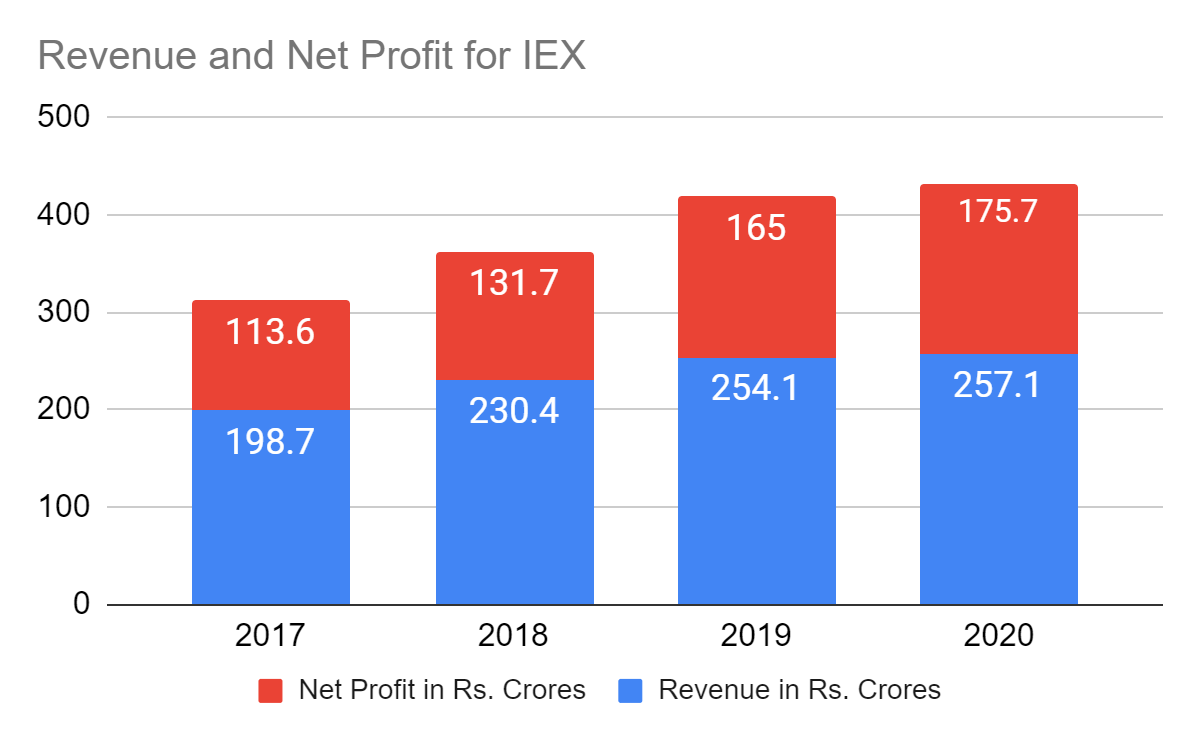
  • The company’s sales, revenue, and net profit have been growing constantly for the past 5 years. As demand for power increases, there will be an increase in power trading to find a better price for power.

Increasing Trading Volumes

  • On average, 6000+ MW of electricity is traded daily on the exchange. The traded volume is growing at 32% CAGR. It has a consumer base of 4000+ Industries, 55+ distribution companies, 500+ generators, and 1500+ renewable energy generators. The company has also seen increased trading volumes on the BSE and NSE.

Increasing ROE/EPS

  • For IEX, the Return on Equity(%) or ROE is ~45%. This means that for every Rs. 100 invested in the company, the investors earn close to Rs. 45 every year. The company’s price-to-earnings ratio or PE ratio has been declining constantly for the past few years. The fact that the company has excellent profitability and increasing revenue, it could probably mean that the company is undervalued and sees higher growth potential in the markets. 

Increasing FII/MF shareholding

  • The company has an increasing FII(Foreign Institutional Investors) shareholding in the company. In fact, it has doubled between September 2018 and September 2020. This shows that foreign investors are bullish on the idea of power trading in India and see a greater potential in IEX. Mutual Fund’s shareholding has also increased by 4.5 times in the past two years between 2018 and 2020.

No Debt

  • The company has no debt or is not operated on credit. This saves it from default risk. 

Decreasing Clearing Price

  • The clearing price is the price that companies pay to buy power after the bidding process is complete. The average market clearing price has gone from as high as Rs.3.38 per unit in July 2019 to as low as Rs. 2.35 per unit in June 2020. A decreasing clearing price means that more companies would flock to power exchanges for cheaper electricity.

Increasing Dependency on Green Energy Over Coal

As Governments push for environmental regulations and promote green energy, there is a greater incentive for companies to invest in them. Moreover, coal prices are pretty volatile citing quality concerns, regulation, and also the recent decision for Coal Mine Auction by the Government. Products like Energy Saving Certificates, Green TAM, and Renewable Energy Certificates on IEX will have a greater demand. 

Indian Gas Exchange

The Indian Gas Exchange or IGX is a subsidiary of IEX which is an exchange for trading in gas. It is India’s first electronic delivery-based gas exchange. It is regulated by the Petroleum and Natural Gas Regulatory Board. IGX currently offers trading in five contracts namely: Daily, Weekly, Weekday, Fortnightly, and Monthly. It has three physical setups, two in Gujarat and one in Andhra Pradesh. 

Electricity Amendment Bill

The Electricity Amendment Bill is a prospective bill that will enable power companies to retain greater profits. The bill also aims to prevent the high number of defaults in the energy sector, often by the state regulatory board themselves. The bill also addresses the weak financial health of power companies. It aims to privatize and centralize electricity transmission and distribution. The National Renewable Energy Policy also promotes the production and use of renewable energy throughout the country. 

IEX as a share to invest in hasn’t caught the eye of retail investors. The company’s price is supported by a good balance sheet and awaits a great future considering the recent developments in power policy and the shift of focus towards renewable energy. One should look out for future events like the Electricity Amendment Bill. A mix of all can ensure greater participation in the Indian Energy Exchange, thereby increasing trading volumes and cash flows for the companies.

To know more about how the exchange functions and the products it offers, click here.