
Categories
Editorial

Can a Relief Package Save the Telecom Sector?

Telecos Vodafone Idea and Bharti Airtel can finally breathe a sigh of relief. The Union Cabinet has approved a crucial relief package that will ease the financial burden of telecom companies. The new measures seek to drive progress, facilitate investments, and increase employment opportunities in India’s telecom industry. In this article, we shall dive into the reforms approved by the Centre. 

What’s in the Relief Package?

  • The Union Cabinet has approved a four-year moratorium on payment of unpaid spectrum and AGR dues by telecom companies. For clarity, spectrum dues is the amount payable to the Centre for airwaves that were purchased via auctions. Adjusted Gross Revenue or AGR is a percentage of a telecom firm’s total revenue “shared” with the government. [You can learn more about AGR here] Interest will be levied if companies opt for the moratorium
  • The government has also decided to allow 100% foreign direct investment (FDI) in the telecom sector through the automatic route. It means that foreign investors can now invest fully in telecom firms without prior approval. Currently, only 49% FDI is allowed through the automatic route. Anything beyond that has to necessarily go through the government route. 
  • The definition of Adjusted Gross Revenue (AGR) paid to the government will be changed to exclude all non-telecom revenue. Currently, telecos have to share a percentage of their total income, including those from interest income, sale of assets, and other miscellaneous income. 
  • There will be an increase in the tenure of spectrum ownership to 30 years, compared to the current tenure of 20 years. It means that companies securing the rights to use spectrum (or airwaves) can now leverage the assets for up to 30 years after bidding for them in future auctions. There will be a cut in spectrum usage charges (SUC) to reduce the capital cost (fixed, one-time charges) of telecom firms. The government will also scrap SUC for airwaves acquired in the upcoming auctions.
  • The package is also expected to boost and expand the 4G network footprint in India. It will also create an enabling environment for investment in 5G networks.

How Will it Benefit the Telecom Sector?

The structural reforms introduced by the Centre are expected to bring positive changes to the entire telecom landscape of India. These measures are aimed at providing much-needed relief to players such as Vodafone Idea (Vi) and Bharti Airtel, who are struggling with huge debt. Vi, who has been losing lakhs of subscribers every month, is on the brink of declaring bankruptcy. 

As of 2019, telecom operators collectively owed nearly Rs 1.47 lakh crore to the Centre. Out of this, Vodafone Idea’s deferred spectrum charges stand at ~Rs 1.06 crore! In 2019, telecos were offered an extension of two years to pay off all financial obligations with interest. Reports suggest that Vi has to pay an installment of Rs 16,000 crore at the end of March 2022. Unfortunately, the financial condition of most telecom companies has continued to deteriorate. Thus, the government has now deferred these payments by another four years. This measure will provide space for financially stressed telecos to improve their business and clear dues over a longer period. 

We know that Vi has been losing lakhs of subscribers due to cutthroat competition in the telecom space in India. The company is unable to compete with aggressive tariff rates from Reliance Jio and Airtel. The risk of a duopoly (two firms dominating a market) would lead to a further hike in tariffs. Moreover, the cash-strapped firm is not in a position to invest in 4G/5G infrastructure. The approval of 100% FDI in the telecom sector will help address the cash flow issues faced by Vodafone Idea. Foreign institutions could swoop in and save the company from its inevitable death. Vi needs to raise capital quickly to survive in the industry. 

Conclusion

The relief package will be instrumental in generating more jobs (due to new investments) and protecting the overall interests of consumers, employees, banks, and the government at large. It comes as a virtual lifeline for Vodafone Idea. The moratorium will bring relief to lenders that have massive exposure to distressed telecom operators. If companies are still finding it difficult to pay off their financial obligations at the end of four years, the government will be open to acquiring their equity. 

The package has made vital changes to telecom regulations, which will support the growth of entities in the telecom sectors in the long term. However, the Centre may find it difficult to support BSNL from collapsing while also extending measures to private players. There is no clarity whether the relief package will resolve all challenges faced by Vodafone Idea. However, it will surely help them to tide over the immediate crisis. Vi has found a breathing space but still has a long way to go. As per the recent data released by India’s telecom regulator, Vi continues to lose subscribers. Meanwhile, Reliance Jio and Bharti Airtel are in tight competition to secure more market share. 

Ultimately, we have to analyse how telecos take advantage of these relief measures and improve their financial metrics. What are your views on the relief package for the telecom sector? Let us know in the comments section of the marketfeed app.

Categories
Market News Top 10 News

Cabinet Approves Rs 3,500 crore Sugar Export Subsidy – Top Indian Market News

Cabinet approves Rs 3,500 crore sugar export subsidy

Union Minister Prakash Javadekar announced that the Cabinet Committee on Economic Affairs (CCEA) has approved a Rs 3,500 crore subsidy for sugar farmers. The subsidy will be given on 60 lakh tonnes of sugar exports at the rate of Rs 6,000 per tonne. He stated that 5 crore sugarcane farmers will benefit from this Cabinet decision. The subsidy will be directly transferred to the farmers’ accounts.

In other news, the Cabinet has also approved a project for establishing 2,100 km of additional transmission lines and 36 new Sub Stations in 6 North-Eastern states.

Read more here.

Laxmi Organics files draft papers for Rs 800-crore IPO

Laxmi Organics has filed draft papers with the Securities and Exchange Board of India (SEBI) to raise Rs 800 crore as its initial public offering (IPO). The IPO consists of a fresh issue of Rs 500 crore and an offer for sale (OFS) of Rs 300 crore by its promoter, Yellow Stone Trust. Laxmi Organic is a Mumbai-based specialty chemicals manufacturer. The company will utilise the proceeds from the issue for setting up a manufacturing facility for fluorospecialty chemicals, working capital requirements, and purchase of plant and machinery. 

Read more here.

SEBI eases profitability criteria for mutual fund sponsors

The Securities and Exchange Board of India (SEBI) has decided to relax profitability criteria for becoming a mutual fund sponsor. This is to facilitate innovation and expansion in the mutual fund sector. The SEBI board also approved proposals which include dispensing with the requirement to issue physical unit certificates, reducing maximum permissible exit load, and reducing the timeline for payment of dividend.

Read more here.

Jio fastest network in 4G download in November: TRAI

According to the latest data update from telecom regulator TRAI, Reliance Jio has topped the 4G speed chart with a data download rate of 20.8 megabits per second (Mbps) in November. This was followed by Vodafone at 9.8 Mbps and Bharti Airtel at 8 Mbps. Vodafone was ahead of others in upload speed at 6.5 Mbps, during the same month. Jio’s upload speed was recorded at 3.7 Mbps.

Read more here.

Future Enterprises Q2 Results: Net Loss at Rs 320 crore

Future Enterprises Ltd reported a consolidated net loss of Rs 320 crore, for the quarter ended September (Q2). The company had posted a net profit of Rs 21.78 crore in Q2 of the previous financial year. Its revenue from operations declined to Rs 237.88 crore in Q2 FY21, as compared to Rs 1,699.84 crore in the corresponding quarter in FY20. Future Enterprises develops, owns, and leases retail infrastructure for the Future Group.

Read more here.

Ratnamani Metals & Tubes secures order worth Rs 105 crore

Ratnamani Metals & Tubes Ltd (RMTL) has received a domestic order of Rs 105 crore for coated carbon steel pipes from the Oil and Gas sector. The company stated that the order will be executed between May 2021 and September 2021. Gujarat-based RMTL is a leading producer of stainless steel and titanium welded tubes. It also provides total piping solutions to a diverse range of industries.

Read more here.

Cipla launches Covid-19 diagnostic test kit ‘CIPTest’

Cipla Limited has partnered with Premier Medical Corporation Pvt Ltd to launch ‘CIPTest’- a rapid antigen Covid-19 testing kit. While Premier Medical Corp will manufacture the kits, Cipla will be responsible for marketing and distribution. The pharma company stated that the testing kit will be able to generate results in 15-20 minutes.

Read more here.

Jubilant Foodworks launches biryani brand ‘Ekdum!’

Jubilant Foodworks announced the expansion of its portfolio with a new biryani brand- Ekdum! The company stated that Ekdum! will offer 20 different varieties of biryanis curated from different parts of India. In addition to biryanis, customers will also be able to choose from an extensive range of kebabs, curries, desserts, and beverages. Currently, Ekdum! has opened three restaurants in Gurgaon, and has plans to launch more in NCR over the next few months.

Read more here.

Indian Bank declares IL&FS Financial Services account as fraud

State-owned Indian Bank has declared the account of IL&FS Financial Services Ltd (IFIN), as fraud. The bank has fully provided for the non-performing account of IFIN with outstanding dues of Rs 408 crore. The lender has reported the account to the Reserve Bank of India (RBI), as per regulatory requirements. In October, Punjab and Sind Bank had also reported the account of IFIN as fraud, with outstanding dues of over Rs 561 crore. 

Read more here.

Vedanta to raise $8 billion for BPCL bid: Report

According to a report from Livemint, Vedanta Group plans to raise as much as $8 billion (~Rs 58,913 crore) to secure funds for the acquisition of state-run Bharat Petroleum Corp. Ltd (BPCL). It has been reported that Vedanta Resources Plc has already started talks with banks, and discussions with JP Morgan are at an advanced stage. The report states that funds will be raised through a mix of debt and equity instruments, to acquire a 52.98% stake in BPCL.

Read more here.

RBL Bank migrates to Infosys Finacle’s digital banking solution

RBL Bank announced that it will migrate its systems to Infosys Finacle, a digital banking solutions platform developed by EdgeVerve Systems. Finacle’s extensive open API (application programming interface) repository will provide the agility required to seamlessly integrate and co-innovate with ecosystem partners, which is one of the key focus areas for the bank. EdgeVerve Systems is a wholly-owned subsidiary of Infosys Ltd.

Categories
Editorial

The PLI Scheme – All You Need to Know

One of the most important strategies to improve the economic growth of a country is to promote domestic production and become self-reliant. This is exactly what our Indian Government has been aiming for. The policies such as Make in India and the Atmanirbhar Bharat Abhiyan are prime examples of this. On November 11, the Union Cabinet announced the approval of a Production Linked Incentive (PLI) Scheme for 10 key sectors. This scheme would help to further strengthen the foundation of India’s path towards self-reliance.

Here at marketfeed, we always make sure to fulfill our promises and provide you with the best insights about such important events. Let us understand what this scheme is all about, and which sectors are included in it.

What is the PLI Scheme?

The Production Linked Incentive (PLI) scheme is a relatively new concept that was introduced in India earlier this year. The Government believed that it was time to initiate concrete steps to boost domestic manufacturing and cut down on huge import bills. Through the PLI scheme, companies would be provided with certain incentives to scale up production activities in India. It has three main objectives:

  1. To encourage foreign companies to set up their production activities in India. When this happens, we could see more foreign investments coming into our country.
  2. To provide support towards the existing domestic companies to expand their manufacturing units.
  3. To ensure that more employment opportunities are provided to Indian citizens in the manufacturing sector.

The PLI Scheme for Electronics Manufacturing

This scheme has become an absolute game-changer. Let us find out how our country adopted it initially. In April 2020, the Government introduced a PLI scheme worth Rs 40,000 crore for large-scale electronics manufacturing. The main aim of this particular scheme was to boost domestic manufacturing of mobile phones in India. The eligible companies were promised an incentive of 4%- 6% on incremental sales of goods that were manufactured in our country. This incentive would be applicable for 5 years. 

A total of 22 companies applied for the PLI scheme in August. And, three of these firms were contract manufacturers for Apple iPhones. We could also see that the share price of companies that had applied for the scheme (for eg, Dixon Technologies) had seen a surge during those periods.

According to Ravi Shankar Prasad, the Minister of Electronics and Information Technology, production worth Rs 11.5 lakh crore and exports valuing Rs 7 crore is expected over the next 5 years. It is very reassuring to learn that this scheme had received quite an overwhelming response from companies around the globe. It has become such a huge success.

The Latest PLI Scheme

In the notification made on November 11, the Government stated that it will offer incentives to an additional 10 vital sectors. The Union Cabinet has approved Production Linked Incentive Scheme worth up to Rs 1.45 lakh crore, for a period of 5 years. 

This would ensure that necessary support is provided to make India a global manufacturing hub, and create more jobs in the economy. The domestic companies would get the necessary push to cater to the local demand. The policy has been strategically targeted to very important sectors and would make Indian goods more competitive.

We can also state that the scheme has come at a very perfect time, in relation to the present global scenario. Most companies around the world are planning to shift their manufacturing operations from China. India could grab this opportunity and transform India into one of the best manufacturing centers in the world. The scheme would accelerate the existing plans of foreign companies that were considering to invest in India.

Which Sectors are Included in the PLI Scheme?

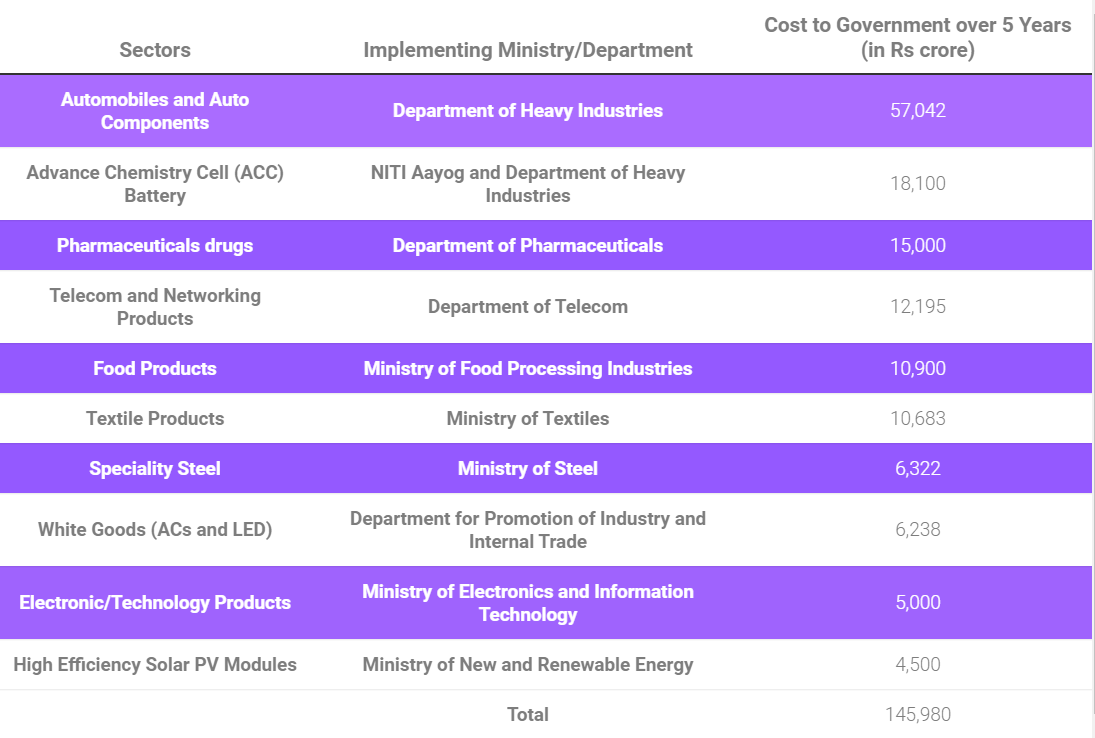
Given below is a table that shows the 10 sectors that will come under the PLI scheme, and the amount allocated to each sector.

Source: BloombergQuint

As we can see, the automobile and auto components sector has been allocated the highest amount in the PLI scheme. This would definitely help the sector to become a large exporter, and reduce import dependence. It has also been ensured that an amount of Rs 18,100 crore has been allocated for advanced chemical cell batteries. This would provide a major boost to the production of electric vehicles, as batteries are a key component of it. 

As per a statement from the Finance Minister, Smt. Nirmala Sitharaman, speciality steel in India could become a potential champion in the country’s exports. Hence, an amount of Rs 6,322 crore has been allocated for incentivizing its production as well.

Similarly, eight other sectors will be provided with sufficient incentives to completely improve the overall manufacturing capacity in India.

India and PLI

India has definitely received a massive Diwali gift from the government. If this scheme goes through precise planning and execution, it could become one of the most vital initiatives that have been adopted in our country. Our producers would certainly get the push to cater to the domestic demand, and foreign firms would be encouraged to invest heavily in India. The citizens of India would obtain more employment opportunities as well. It is a win-win situation for all the parties that would be involved!

At the same time, we would urge our readers to follow the latest updates surrounding this scheme. We could see listed companies applying to get the benefit of these incentives, and ramping up their production activities in India. This would certainly become a factor for many stocks to rally. We would also keep an updated list of the specific stocks that have been selected for the PLI scheme. Let us look forward to a positive outcome and see our country grow into one of the best manufacturing hubs in the world.