Categories
Editorial

Titan Company Limited, The New Hot Stock

Titan Company Limited, a subsidiary of the Tata Group, has been in the news for the past few days. It is this very company that helped ace investor Rakesh Jhunjhunwala make Rs 900 crore in a single day. In this piece, we dive down into what makes Titan so unique.

Why Is It In The News?

On October 7, 2021, Titan’s shares prices rocketed in a matter of minutes from the time the market opened. The company’s share price rallied 10% in a day. On the same day, ace investor Rakesh Jhunjhunwala earned Rs 1,125 crore in total from two of Tata’s firms. One being Titan, the other one being Tata Motors Ltd. The sudden spurt came in light of Titan Company’s announcement of solid growth in Q2 FY22, suggesting a strong recovery in demand. The company has not officially announced its results for the quarter yet. 

Titan’s update mentions that its Jewellery business grew by 78% over a year’s time. Its jewelry business brand, Caratlane, walked on the same lines and grew by 95% over a year. Additionally, the revenue for its Watches & Wearables business grew by 73%, EyeWear business by 74%, and other business by a staggering 121% over a year. Its other businesses include its flagship saree company, Taneira, and its perfume and accessories brand SKINN.

Source: Titan Official Website

Titan Engineering and Automation Limited (TEAL) had a subdued quarterly performance due to delays in execution and shipments. This was primarily caused by semiconductor shortages and logistics & travel restrictions, which are expected to ease in the second half of the financial year.

Where Does Titan Stand In The Future?

In the post-COVID-19 bull run, many stocks beat the benchmark NIFTY 50 index in terms of growth, and Titan wasn’t one of them. The company gained exceptional traction after it announced its last quarterly results. As we head into the festive season and recover from the financial setbacks of the COVID-19 pandemic, demand for jewellery and luxury goods has pumped. While Q2 isn’t exactly the season for jewellery sales, most shops were not operational in the previous quarter (Q1 FY22) and last year as well. This led to a massive ‘pent-up’ demand. Pent-up demand is a sudden increase in demand for a particular product after a brief period of subdued spending. Another example of pent-up demand is the increase in flight and hotel booking as a part of ‘revenge travel’, as travel restrictions were lifted gradually across the country. 

Titan’s share price has appreciated ~88% over a year, ~50% over the last six months, and ~36% over the last quarter. Titan’s market cap crossed Rs 2 lakh crore after the 10% rally, making it the only Tata Group company after Tata Consultancy Services (TCS) to do so. 

A close look at the 5-year chart of Titan Company suggests that the company has provided consistent returns for value investors. The share price hasn’t witnessed much volatility for quite some time.

If you are thinking of investing in Titan, then you need to keep a few things in mind. While the official quarterly financial results for Q2 FY22 haven’t been announced, the stock might face a strong correction if it fails to run on the lines of the current company update. Despite a certainty of strong Q2 results, any ‘unpleasant’ aspect of the quarterly result might impact the share price. Secondly, while the company has witnessed a very strong financial growth in the last five years, the stock seems best suited for value investors than traders due to its low volatility and consistent returns.  

What are your views on Titan Company Ltd? Let us know in the comments section of the marketfeed app.

Categories
Editorial

The PLI Scheme – All You Need to Know

One of the most important strategies to improve the economic growth of a country is to promote domestic production and become self-reliant. This is exactly what our Indian Government has been aiming for. The policies such as Make in India and the Atmanirbhar Bharat Abhiyan are prime examples of this. On November 11, the Union Cabinet announced the approval of a Production Linked Incentive (PLI) Scheme for 10 key sectors. This scheme would help to further strengthen the foundation of India’s path towards self-reliance.

Here at marketfeed, we always make sure to fulfill our promises and provide you with the best insights about such important events. Let us understand what this scheme is all about, and which sectors are included in it.

What is the PLI Scheme?

The Production Linked Incentive (PLI) scheme is a relatively new concept that was introduced in India earlier this year. The Government believed that it was time to initiate concrete steps to boost domestic manufacturing and cut down on huge import bills. Through the PLI scheme, companies would be provided with certain incentives to scale up production activities in India. It has three main objectives:

  1. To encourage foreign companies to set up their production activities in India. When this happens, we could see more foreign investments coming into our country.
  2. To provide support towards the existing domestic companies to expand their manufacturing units.
  3. To ensure that more employment opportunities are provided to Indian citizens in the manufacturing sector.

The PLI Scheme for Electronics Manufacturing

This scheme has become an absolute game-changer. Let us find out how our country adopted it initially. In April 2020, the Government introduced a PLI scheme worth Rs 40,000 crore for large-scale electronics manufacturing. The main aim of this particular scheme was to boost domestic manufacturing of mobile phones in India. The eligible companies were promised an incentive of 4%- 6% on incremental sales of goods that were manufactured in our country. This incentive would be applicable for 5 years. 

A total of 22 companies applied for the PLI scheme in August. And, three of these firms were contract manufacturers for Apple iPhones. We could also see that the share price of companies that had applied for the scheme (for eg, Dixon Technologies) had seen a surge during those periods.

According to Ravi Shankar Prasad, the Minister of Electronics and Information Technology, production worth Rs 11.5 lakh crore and exports valuing Rs 7 crore is expected over the next 5 years. It is very reassuring to learn that this scheme had received quite an overwhelming response from companies around the globe. It has become such a huge success.

The Latest PLI Scheme

In the notification made on November 11, the Government stated that it will offer incentives to an additional 10 vital sectors. The Union Cabinet has approved Production Linked Incentive Scheme worth up to Rs 1.45 lakh crore, for a period of 5 years. 

This would ensure that necessary support is provided to make India a global manufacturing hub, and create more jobs in the economy. The domestic companies would get the necessary push to cater to the local demand. The policy has been strategically targeted to very important sectors and would make Indian goods more competitive.

We can also state that the scheme has come at a very perfect time, in relation to the present global scenario. Most companies around the world are planning to shift their manufacturing operations from China. India could grab this opportunity and transform India into one of the best manufacturing centers in the world. The scheme would accelerate the existing plans of foreign companies that were considering to invest in India.

Which Sectors are Included in the PLI Scheme?

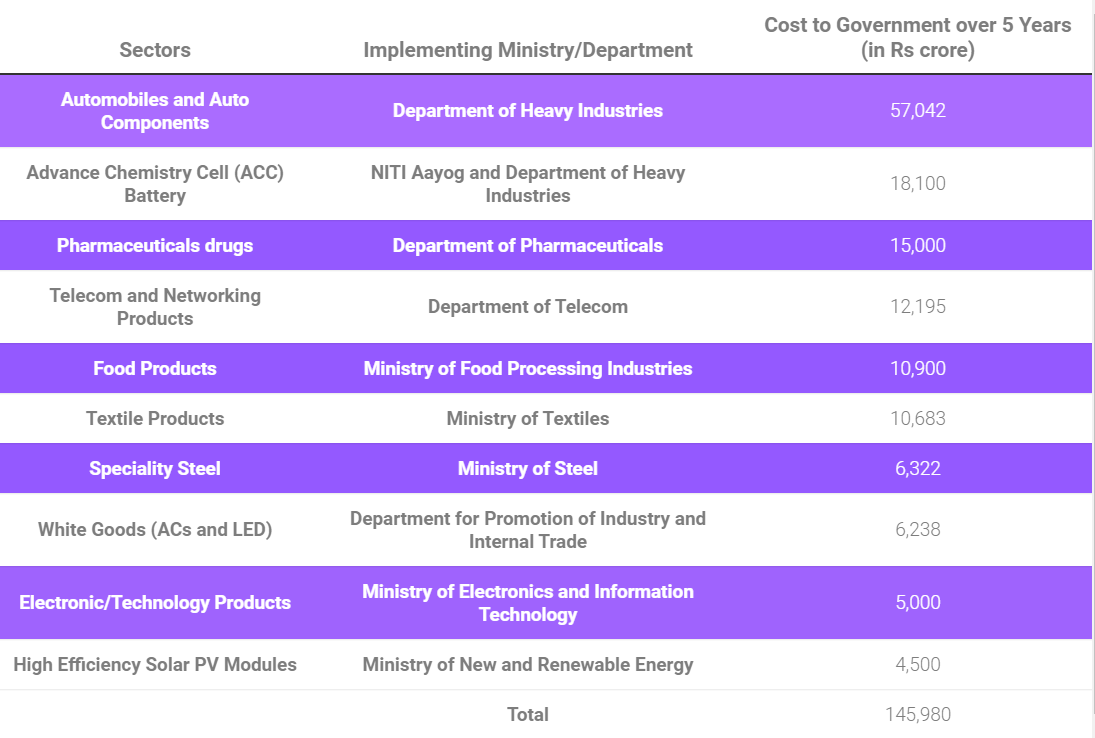
Given below is a table that shows the 10 sectors that will come under the PLI scheme, and the amount allocated to each sector.

Source: BloombergQuint

As we can see, the automobile and auto components sector has been allocated the highest amount in the PLI scheme. This would definitely help the sector to become a large exporter, and reduce import dependence. It has also been ensured that an amount of Rs 18,100 crore has been allocated for advanced chemical cell batteries. This would provide a major boost to the production of electric vehicles, as batteries are a key component of it. 

As per a statement from the Finance Minister, Smt. Nirmala Sitharaman, speciality steel in India could become a potential champion in the country’s exports. Hence, an amount of Rs 6,322 crore has been allocated for incentivizing its production as well.

Similarly, eight other sectors will be provided with sufficient incentives to completely improve the overall manufacturing capacity in India.

India and PLI

India has definitely received a massive Diwali gift from the government. If this scheme goes through precise planning and execution, it could become one of the most vital initiatives that have been adopted in our country. Our producers would certainly get the push to cater to the domestic demand, and foreign firms would be encouraged to invest heavily in India. The citizens of India would obtain more employment opportunities as well. It is a win-win situation for all the parties that would be involved!

At the same time, we would urge our readers to follow the latest updates surrounding this scheme. We could see listed companies applying to get the benefit of these incentives, and ramping up their production activities in India. This would certainly become a factor for many stocks to rally. We would also keep an updated list of the specific stocks that have been selected for the PLI scheme. Let us look forward to a positive outcome and see our country grow into one of the best manufacturing hubs in the world.

Categories
Editorial

The Pfizer Vaccine – All You Need to Know

A major announcement from the United States on November 9 has completely lifted our hopes and spirits! Since March, scientists around the world have been working tirelessly towards creating an effective vaccine against the novel coronavirus. And now, drugmakers Pfizer and BioNTech have come out with a very positive result. The vaccine developed by the two companies was found to be 90% effective in preventing Covid-19 infections in ongoing Phase-3 trials.

We saw that the announcement made a ripple effect across the world, with the stock markets reaching new highs. Let us dive deep into the details of the vaccine, and recent developments surrounding it.

  1. Pfizer’s Covid-19 Vaccine Trials
  2. What Happened After the Announcement?
  3. Will the Vaccine be Available in India?
  4. Will a Vaccine Solve All Our Problems?

Pfizer’s Covid-19 Vaccine Trials

US-based Pfizer Inc and Germany-based biotechnology firm BioNTech had begun their collaboration in March 2020. Their partnership is aimed at co-developing and distributing a potential Covid-19 vaccine. Here are some important facts about the recent Phase-3 trials of the potential vaccine:

  1. The Phase-3 trials of the vaccine involved 44,000 participants in six countries. Half of them were administered with the vaccine, and the other half were given a placebo- a pill with no effect (like a sugar pill). A participant would not know if he got the vaccine or the placebo, thus helping to analyse the psychological effects.
  1. As per Pfizer’s interim analysis, the vaccine is 90% effective in preventing Covid-19 in participants who had no prior history of a SARS Cov-2 infection. However, Pfizer had not disclosed how many participants from the total number were used to formulate this interim analysis. In this sample, it is not clear how many had received the vaccine, and how many had received the placebo.
  1. Pfizer has stated that protection against the virus is achieved 28 days after the injection of the vaccine.
  1. The announcement made on November 9 offers the first compelling evidence that a vaccine can prevent Covid-19. Pfizer’s report from Phase-3 trials is being welcomed by other scientists around the world. It also puts Pfizer-BioNtech ahead of the other vaccine makers.
  1. Pfizer is planning to approach the United States Food and Drug Administration (USFDA) for emergency authorization of the vaccine later this month. Meanwhile, the Phase-3 trials will continue until there are 164 Covid-19 cases among the volunteers. This final analysis will confirm the actual percentage of effectiveness of the vaccine.
  1. An important factor to be noted is that experts in the field are yet to receive an answer on how much protection the vaccine offers, and for how long it would last. So, we can say that this announcement is being taken with “cautious optimism”.

What Happened After the Announcement?

Ever since Pfizer made the statement on Nov 9, we can see that important decisions are being taken at a very rapid pace. According to a statement from Pfizer, the company has plans to globally produce up to 50 million vaccine doses in 2020, and up to 1.3 billion doses in 2021.

Reports have also stated that many countries have already made deals with the drugmaker and have plans to hoard the vaccine. The US Government has signed a $1.95 billion (~Rs 14,474 crore) deal with Pfizer to buy 100 million doses. According to Alex Azar, the US Health Secretary, their government would begin vaccinating Americans in December. This is only possible if Pfizer submits the initial positive data from its vaccine trials to the USFDA, as soon as possible.

On the day of the announcement, Pfizer CEO Albert Bouria made a very calculated move. As per a regulatory filing, 1,32,508 Pfizer shares were sold by the CEO at a price of $42 per share. This means that he had sold $5.6 million of his shares in the company. This has raised many eyebrows as almost 62% of his entire stock in the company was sold right at the peak. Several questions have also been raised regarding the effectiveness of the vaccine after this high profile stake sale.

Will the Vaccine be Available in India?

Our Indian Government is now in discussions with Pfizer to make the vaccine available in our country. So far, the American firm does not have a distribution pact with any Indian company. It has been reported that India would soon sign an agreement with the US drugmaker. However, India has some significant hurdles to overcome to ensure that we can obtain Pfizer’s vaccine.

In a statement made on November 10, Kiran Mazumdar Shaw, the Managing Director of Biocon, stated that the Pfizer vaccine is unlikely to make its way to India. The reason that she had put forth was that the vaccine requires an ultra-cold chain of minus 70 degrees. This means that the vaccine has to be stored and transported in an ultra-cold facility. Currently, India does not have the necessary logistical support to conduct such a highly specialized task. The cost of the vaccine in India may also become very high due to this reason.

Around the same time, we had also received some positive statements from Snowman Logistics. The company has found an opportunity to improve its business, by creating a super-cold storage facility for Pfizer’s Covid-19 vaccine. Sunil Nair, the CEO of Snowman Logistics, has stated that they will come up with a technology to address these requirements. On November 10, the share price of Snowman Logistics saw a surge of 14% in an intraday movement to Rs 40.95. 

Last month, Apollo Hospitals had announced that they are ready to administer 10 lakh doses of the Covid-19 vaccine per day. Today, the company’s CEO, Sunita Reddy, has said that they have the cold storage chain ready for the Pfizer vaccine.

Will Vaccine Solve All Our Problems?

Scientists have yet again proved to become a worthy opponent in the fight against a deadly virus. We have finally received an amazing update from the vaccine makers. A very effective vaccine would hopefully be available all over the world soon. The news from Pfizer had also created a very positive sentiment around the global markets. We also saw our stock market indices reaching new highs.

Our Indian companies are also preparing to create a possible technology to store and transport the vaccine. All the issues caused by the Covid-19 pandemic would soon be countered. Although a vaccine would not immediately turn around the world economies, it gives hope that there will be a brighter future going ahead. As Indians and as human beings, in the face of a problem such as Covid, we will come back much stronger. The economic conditions could become more stable, and more importantly, things are finally looking very optimistic!

Let us look forward to the latest updates surrounding the vaccines, including many others from India and around the world. We must also be aware of how our country is planning to further gear up to make the vaccine available for all citizens. And as intelligent stock market participants, identify which all sectors will benefit from the announcement of a vaccine.

Categories
Editorial

‘Free Stock Tips’ on SMS/Telegram and How it Can Trap You

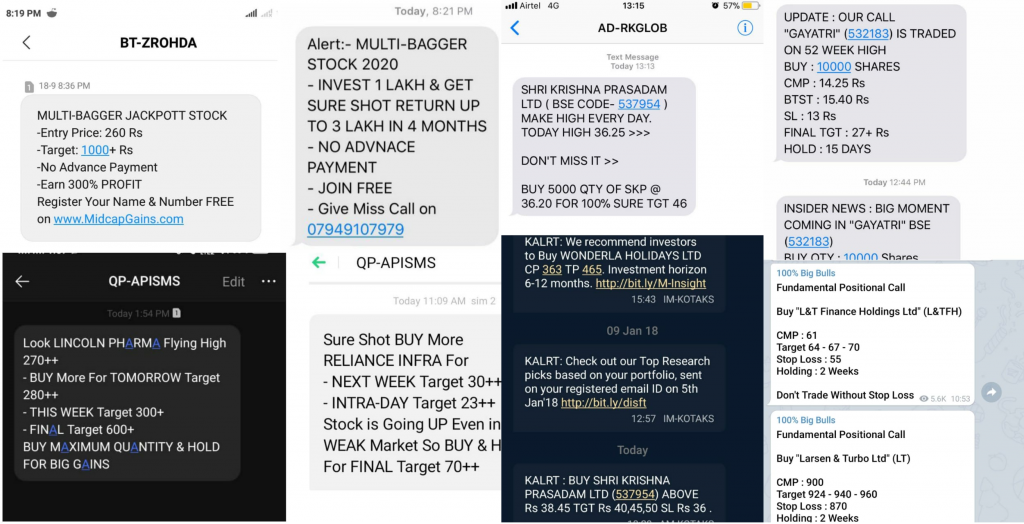
There is a scam going around in the stock market, for almost a decade. Both new and old investors have fallen prey to it. The regulators are trying to find a way around it, but have failed to do so. The scam we are talking about is a ‘Pump and Dump’ scheme that finds its way around through Telegram channels, WhatsApp Groups, and Text Messages. They come in many forms. Chances are you might have come across such ‘unsolicited’ stock market tip messages as given below.

In this scam, the market manipulators or ‘operators’, pump the price of a particular stock by sending stock market tips to traders and investors through bulk text messages and other social media handles. Firstly, The operators buy a certain stock in bulk beforehand, for a cheap price. Secondly, the operators focus on once particular stock and continue sending bulk messages for a week or two. Considering the high returns that these stock tips promise, some investors fall prey to it and buy these illiquid stocks. The buying spree continues, till the operators book profit and SURPRISE!, the price of the stocks comes down tumbling. Many newbies as well as seasoned investors have lost lakhs to these schemes.

How do I Recognize If a Stock Tip is Fake?

  • Firstly, these stocks tips are generally for penny stocks often marketed as ‘MULTIBAGGER!’. The ones which you have never heard of, or ones that exist only on paper. They have no website. No annual or quarterly results. These stocks offer extremely ambitious returns and have stop-losses that have no chances of triggering.
  • Secondly, these are generally from commercial numbers, which are spelled or sound like the names of famous brokerage firms or banks, for example- BT-ZRODHA, VT-KOTKB, etc. Moreover, the operators put a genuine link at the end of some messages. This makes the reader less suspicious of the message or stock tip.
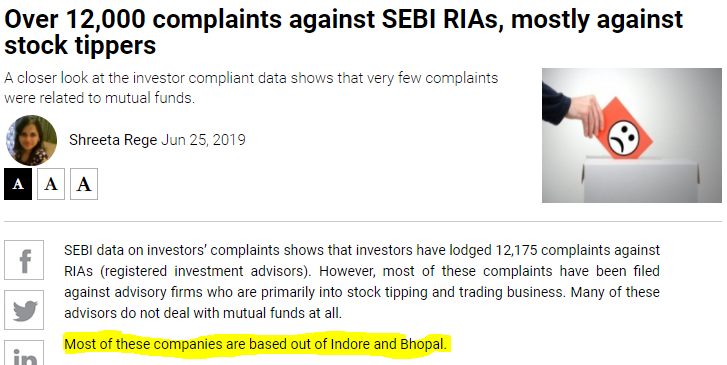
  • Thirdly, many firms that give such advice are registered with SEBI as RIA(Registered Investment Advisors), this gives them a license to give sham recommendations. Do not fall prey to their registration, they are not difficult to come by.
  • Most of these messages are ‘unsolicited’ or ones that you never signed up for. The operators send these text messages to the ones who might have just opened a Demat account. Recently, due to action by TRAI and SEBI, the operators have switched to platforms like Telegram or WhatsApp. This makes it difficult for TRAI or SEBI to regulate the messages, giving them certain anonymity.

The Indore Connection

marketfeed accessed the registration of many such firms that provide these ‘SMS Stock Tips’. Most of these companies do not have an established corporate presence online. What was noticed was that most of these companies were registered in one city, Indore, Madhya Pradesh.

Many users have claimed to have gotten calls from Indore, asking them to invest in a certain stock and get very high returns. The stock market scam is now being related to the city as the ‘Indore Stock Tips Scam’.

Most of these scams are based out of Indore.

Many such companies have been probed and banned by SEBI in the past. These companies would charge huge amounts as fees, running into lakhs, use this money to pump the markets, and then give a part of profits to the client as well. Sometimes the clients wouldn’t get their part of the profit and even end up losing money.

The scam is an open house, anyone can join, anyone can leave. There is no one particular entity controlling it. There are many bulk SMS providers that are available online which anybody can make use of.

Scandal and Candle

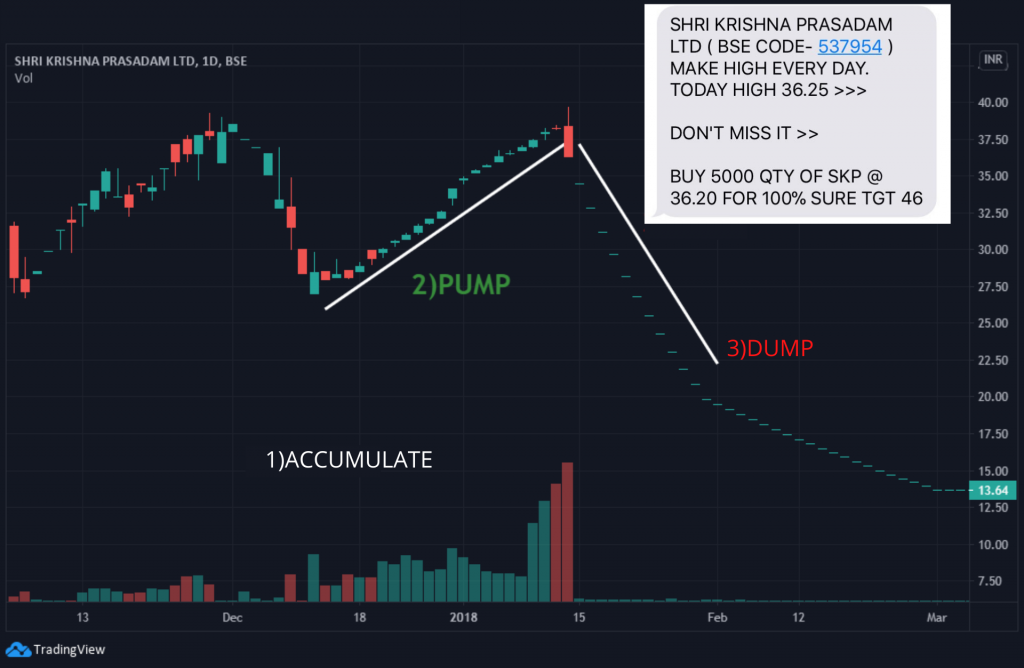
Sri Krishna Prasadam was one such stock that was operated around December 2017 and January 2018. As you can see that there is a bulk purchase in the ‘ACCUMULATE’ phase. The companies then start sending bulk SMS messages and pump the stock. Soon enough, the companies DUMP and book profits as seen in the chart given below. The volume bar given at the bottom of the chart shows the volume traded on a particular date. Sri Krishna Prasadam was restricted from trading by BSE for failing to file the necessary paperwork. 

Pump and Dump Scheme in Sri Krishna Prasadam

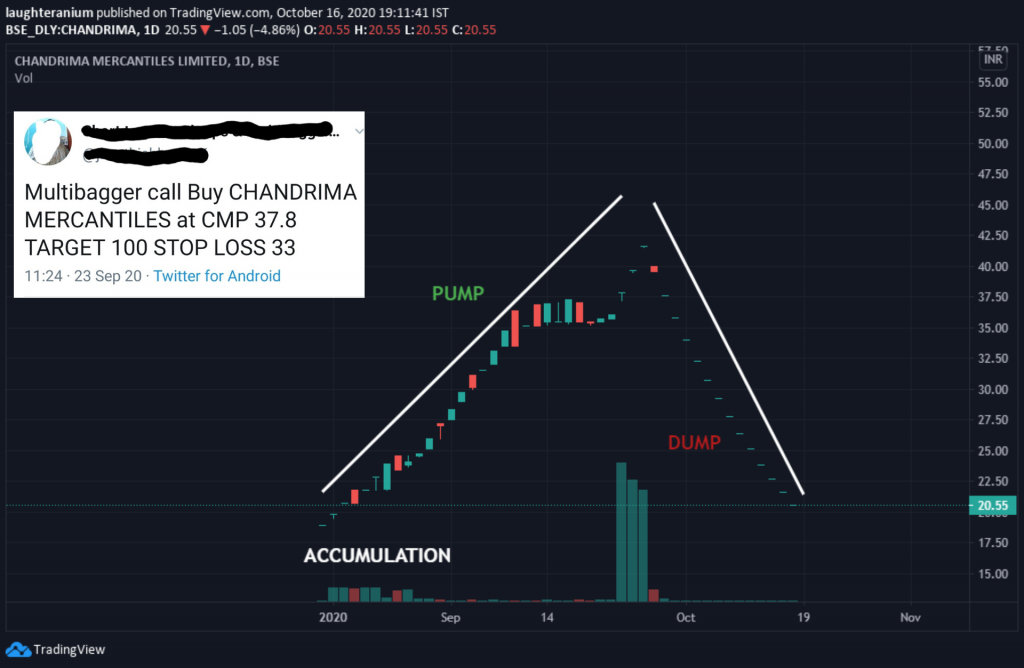
A recent case of the scam was Chandrima Mercantiles. It was manipulated throughout August-September 2020. it is evident that the operators acquired their stock during the ‘ACCUMULATION’ phase. What followed was a ‘Pump and Dump’ activity as evident from the chart.

Chandrima Mercantiles was manipulated throughout September. 

Mid caps, small caps, genuine companies, and shell companies, all have been part of the SMS Stock Tip Scams. Some have knowingly and some have unknowingly been a part of it.

What are Regulators Doing About it?

  • The scam increased a lot during the COVID-19 lockdown, since more and more new players, who had no idea of the stock market started trading and investing.
  • SEBI, NSE, BSE, TRAI, and market participants are trying their best to combat the scam.
    • Report Unsolicited Messages here
    • Watchlist for Unsolicited Messages here
    • Resources on Illicit Stock Tips by Zerodha here
    • List of Stocks with Unsolicited Messages by Zerodha here
  • If at all a stock is noticed by regulators for circulation of unsolicited stock tips, it gets restricted from trading till it meets certain liquidity and regulatory requirements.

The scam has been around for a decade, regulators have failed to curb it. We can even see such low volume stocks being suggested by many ‘SEBI-registered’ Telegram groups. Both seasoned, as well as amateur traders, have fallen prey to it. It could have been lack of knowledge, it could have been greed, it could have been that some joined the bandwagon thinking that other ‘fools’ might invest in the ‘Pump and Dump’ scheme. Whatever the reason might be, an investor should always research before investing in a stock, it is advised that one defers from taking decisions based on these stock tips. As we say at marketfeed: stay invested, stay safe.