Categories
Editorial

Meet the Top 5 Succesful Investors in India!

The Indian stock market has evolved into one of the most dynamic business environments, with all parties involved sharing the same hopes and aspirations. The way it operates and reaps losses & gains has always always been a site of great interest for all budding investors. In fact, the market capitalisation of all listed firms on BSE hit a new record high of ₹280.5 lakh crore this August!

With the proper strategy and tactics, a ₹10,000 investment per month can turn into a portfolio worth crores over a few years. 

The above statement might seem unbelievable or absurd, but superstar investors like Rakesh Jhunjhunwala, Vijay Kedia, and R.K. Damani have truly turned the tide and have created phenomenal fortunes from the market. 

In today’s article, we will highlight some of the most successful stock market investors in India, in addition to their overall merits and investment strategies!

Rakesh Jhunjhunwala 

  • The late Rakesh Jhunjhunwala, known as the Warren Buffet of India, was admired as a market god. He mastered the art of beating the markets consistently.
  • This billionaire business magnate started investing with merely ₹5,000 in 1985.
  • In 1999, he launched Hungama Digital Media with four other partners. As of 2021, Hungama Music and Hungama Play are available in the OTT market.
  • He held several positions of authority as the chairman and a member of the board of directors of numerous reputable firms.
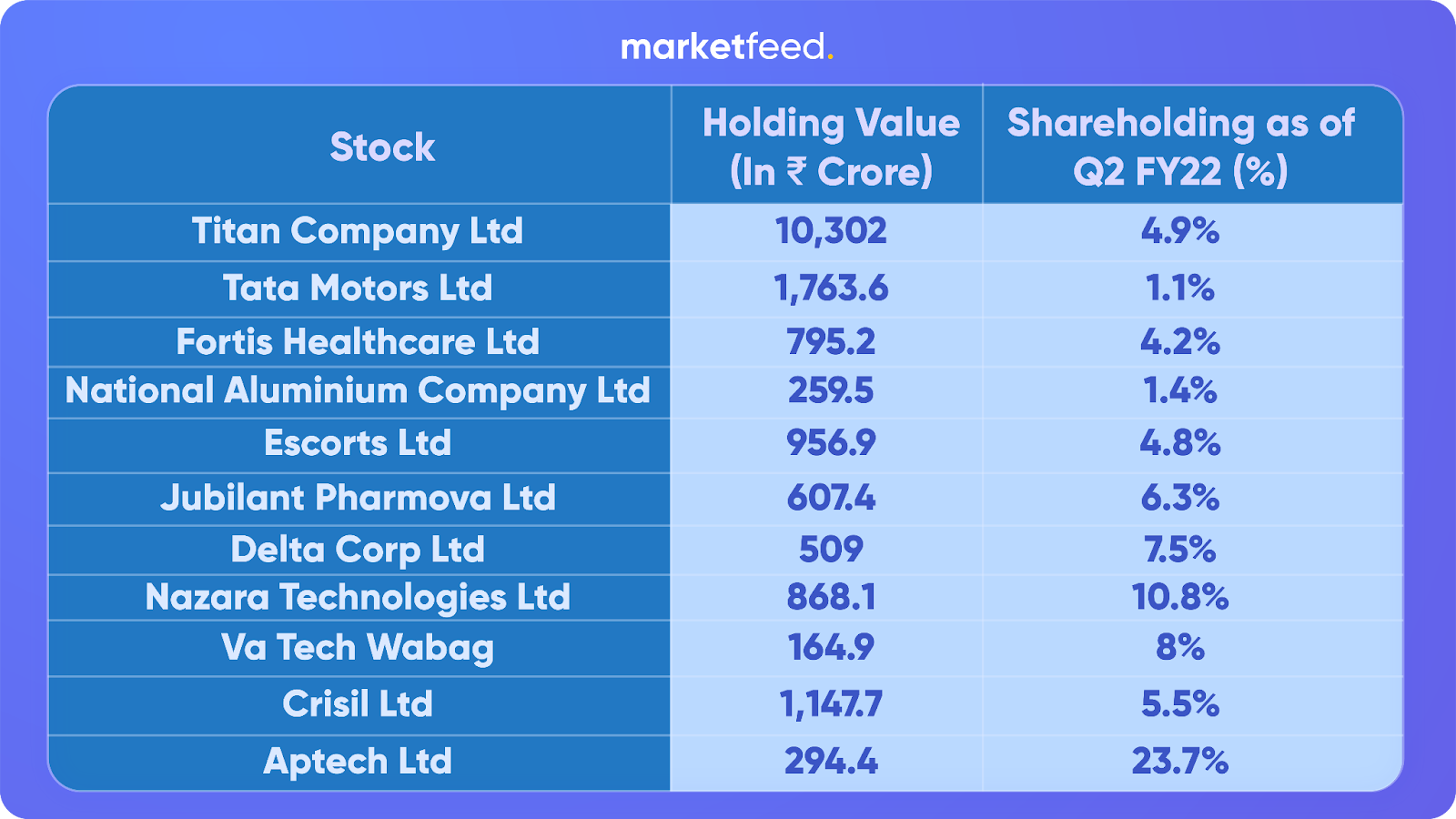
  • His Titan holdings alone are valued at ₹11,000 crore as of 2022. 
  • Rakesh Jhunjhunwala & Associates (Rare Enterprises) publicly hold 30 stocks with a net worth of over ₹34,320.2 crore.
  • Jhunjhunwala invested $35 million in 2021 for a nearly 40% stake in Akasa Air. He was the co-founder of this new ultra-low-cost Indian airline. 
StocksHolding Value (in ₹ crore)Shareholding (%)
Titan Company Ltd1,3047.105.5
Star Health & Allied Insurance Company Ltd6,982.8017.4
Metro Brands Ltd3,130.5014.4
Tata Motors Ltd1,556.401.1
Crisil Ltd1,193.405.5
(Source: Trendlyne. Holdings as of Q2 FY23)

Radhakishan Damani

  • Radhakishan Shivkishan Damani is a billionaire investor hailing from Bikaner, Rajasthan. He is also the founder of Avenue Supermarts, which operates the DMart chain of supermarkets.
  • He is an astute investor in the Indian stock market with 13 stocks and a portfolio net worth running up to ₹185,782.4 crore. 
  • He manages his portfolio through his investment firm called Bright Star Investments Ltd.
  • In 2022, he was ranked the 98th richest person in the world.
  • His prudence as an investor is evident in the way his stocks have grown over the years. In the previous year, the value of his stocks increased from ₹157.65 crores to ₹322.65 crores.
  • This doubling occurred right after the Russia-Ukraine war when the Indian stock market was at its lowest point. 
  • As per Forbes, Damani has held stakes in an array of businesses, including the 156-room Radisson Blu Resort in Alibag, tobacco firm VST Industries, beer maker United Breweries, and others like India Cements, Sundaram Finance, Blue Dart, and Spencer’s Retail.
StocksHolding Value (in ₹ crore)Shareholding (%)
Avenue Supermarts Ltd1,80,592.5067.5
VST Industries Ltd1,760.4032.3
India Cements Ltd1,566.8020.8
Trent Ltd769.301.5
Sundaram Finance Ltd610.702.4
(Source: Trendlyne. Holdings as of Q2 FY23)

Mohnish Pabrai

  • An ardent follower of Warren Buffet, Mohnish Pabrai is an Indian-American investor.
  • He founded an investment firm named Pabrai Investment Funds in 1999.
  • His firm has generated a staggering 517% return till now.
  • The focus of Pabrai’s investing strategies is considered to be on low-risk, high-certainty stocks, and well-managed businesses with minimal downsides.
  • Mohnish Pabrai publicly holds 3 stocks with a net worth of over ₹1,260.3 crore.
  • With the goal of giving back to society, Monish Pabrai and his wife started the Dakshana Foundation. It helps poor students from rural and semi-urban government schools to crack competitive exams.
StocksHolding Value (in ₹ crore)Shareholding (%)
Rain Industries Ltd517.608.8
Sunteck Realty Ltd379.706.7
Edelweiss Financial Services Ltd3636.4
(Source: Trendlyne. Holdings as of Q2 FY23)

Vijay Kedia 

  • Popularly known as the “Market Master”, Vijay Kishanlal Kedia is an Indian investor hailing from Kolkata.
  • He has been in the market since he was 19 years old. 
  • The commonly used acronym SMILE, which stands for Small in size, Medium in experience, Large in aspiration, and Extra-large in market potential, refers to Kedia’s investment strategy. 
  • As per the latest corporate filings, Vijay Kedia publicly holds 16 stocks with a net worth of over ₹765.9 crore.
  • He invests only after doing a deep study of the management of the respective company and how it functions. 
  • Kedia believes that in order to reap greater rewards, it is crucial to wait and invest for a long period. 
  • From 2000 to 2022, some of his shares have grown by over 47,150%, which shows the vision with which he invests in every stock. 
StocksHolding Value (in ₹ crore)Shareholding (%)
Tejas Networks Ltd246.102.6
Vaibhav Global Ltd103.302
Elecon Engineering Company Ltd97.401.9
Cera Sanitaryware Ltd72.201
Mahindra Holidays & Resorts India Ltd55.501
(Source: Trendlyne. Holdings as of Q2 FY23)

Ashish Kacholia

  • Ashish Kacholia is one of the most prudent investors in the Indian stock market and has built a reputation for being the “whiz-kid” of stocks.
  • The media refers to Kacholia as the “Big Whale”. He began his career with Prime Securities and Edelweiss. Kacholia established his own broking firm, Lucky Investment Managers, in 1995.
  • His investment strategy includes investing in small and mid-size companies.
  • In 1999, he co-founded Hungama Digital (along with Rakesh Jhunjhunwala) and began assembling his portfolio in 2003.
  • Ashish Kacholia publicly holds 41 stocks with a net worth of over ₹1,900.3 crore.
  • Recently, he bought a multi-bagger stock named Best Agrolife that has had a 6000% increase in just five years!
StocksHolding Value (in ₹ crore)Shareholding (%)
Safari Industries (India) Ltd1152.6
Fineotex Chemical Ltd97.202.6
Shaily Engineering Plastics Ltd96.906.5
NIIT Ltd91.202.2
PCBL Ltd91.101.9
(Source: Trendlyne. Holdings as of Q2 FY23)

The stock market is a volatile platform that can swing in either direction at any time. It is not the place to make a rash, uninformed choice. Many people keep a close eye on prominent investors, their investment strategies, and the performance of each stock they own. The methods used by these investors to profit from the equity market provide immense inspiration to aspiring investors.

The tales of wealthy investors convey many vital messages. First and foremost, it’s critical to have a solid investing plan built on thorough observation, and secondly, diversification is key. It is also important to acknowledge the possibility of losses. Keeping that in mind, there is absolutely no doubt that the Indian equity market is a fantastic sector to learn, grow and develop. 

Happy Investing!

Categories
Editorial

Rakesh Jhunjhunwala: The Big Bull

The “Warren Buffett of India”, “King of Bull Market”, and the “Investor with a Midas touch”. These are all used to describe one of the most successful investors in our country today— Rakesh Jhunjhunwala. From a humble beginning in Mumbai to becoming a self-made billionaire through investments and trading, he has inspired many to start a career in the stock markets. Most of us follow his recommendations and advice religiously. In this article, learn more about Rakesh Jhunjhunwala and his investment strategies.

Rakesh Jhunjhunwala – A Brief Profile

Rakesh Jhunjhunwala (RJ) was born in 1960 into a middle-class family in Mumbai. Ever since he was a teenager, RJ used to constantly hear his father discussing the stock market with his friends. He became curious about the world of stocks and how people made money from them. Soon after his schooling, RJ expressed his wish to pursue a career in the stock market. However, his father suggested he get a graduate degree and secure his career. Thus, in 1985, Rakesh Jhunjhunwala graduated as a Chartered Accountant. He was still passionate about the stock markets and wanted to try his luck.

At the age of 25, he entered Dalal Street with an investment of just Rs 5,000. At that time, Sensex was at 150 points! He was not permitted to ask for initial capital from his father or any of his friends and relatives. Nevertheless, RJ was able to generate sufficient returns from the small capital and build confidence. Around the same time, he approached some of his close friends to raise funds with the promise of generating higher returns compared to fixed deposits.

In 1986, RJ got his first “big” profit. He was able to catch a good momentum in Tata Tea. He bought 5,000 shares of the company at Rs 43 per share. Within just three months, the stock surged to Rs 143, giving him a profit of Rs 5 lakh. Over the next few years, he was able to make good profits on multiple stocks. He was able to earn Rs 20-25 lakh between 1986 and 1989 by investing in Tata Power at a time when the market had gone into a depression.

Major Stocks in His Portfolio

Over his 36-year career in the stock market, Rakesh Jhunjhunwala has invested in several multi-bagger stocks. Interestingly, he bought Titan Company Ltd at an average price of just Rs 3 in 2002-’03. It is currently trading at Rs Rs 2,435! As per the latest corporate shareholding reports, Rakesh Jhunjhunwala and Associates publicly hold 39 stocks with a net worth of over Rs 24,237.8 crore. 

According to Forbes, Rakesh Jhunjhunwala’s net worth stands at $5.9 billion (~Rs 44,340 crore). He is the 48th richest person in India as per Forbes’ Rich List. RJ is also on the Board of Directors of large companies such as Viceroy Hotels, Geojit Financial Services, Praj Industries, and Concord Biotech. His privately owned stock trading firm, Rare Enterprises, derives its name from the first two initials of his name and his wife Rekha’s name. Rakesh Jhunjhunwala is also well-known for his love for Bollywood films and has even produced multiple movies.

Earlier this year, the ace investor announced plans to launch his own airline— Akasa Air.  He will invest $35 million (~Rs 260 crore) and hold a 40% stake in the company. Akasa Air aims to be India’s most dependable, affordable, and greenest airline. You can read more about it here.

Important Lessons from His Life & Career 

Rakesh Jhunjhunwala is highly bullish on India’s growing economy and its success as an emerging market. In fact, he credits his entire success in wealth creation to his strong belief in our country’s growth potential. In a recent interview, he said India is in a long bull market, and retail investors should invest at home and not in the US markets for better returns. Currently, he is bullish on the Indian metal, banking, and pharma sectors.

RJ often advises investors not to go for stock recommendations in the newspapers and media. People buy shares of a company when it becomes popular and often end up in losses. Instead, one must study the fundamentals of different businesses and take responsibility for their own actions. More importantly, always make a deliberate effort to learn from the mistakes you make in the stock market. Never worry about short-term corrections as they are natural. Never let emotions be your enemy. Simply buy in dips and wait patiently! Seek investments for longer time horizons, and let your investment mature.

We would advise our readers not to jump into buying a particular stock just because Rakesh Jhunjhunwala has added it to his portfolio. Instead, we can analyse the logic and reasoning behind why he chose that company and find its true potential. This will help us become intelligent stock market participants. 

“Whatever you can do or dream you can, begin it. Boldness has genius, power, and magic in it.” –  Rakesh Jhunjhunwala.

Categories
Editorial

Titan Company Limited, The New Hot Stock

Titan Company Limited, a subsidiary of the Tata Group, has been in the news for the past few days. It is this very company that helped ace investor Rakesh Jhunjhunwala make Rs 900 crore in a single day. In this piece, we dive down into what makes Titan so unique.

Why Is It In The News?

On October 7, 2021, Titan’s shares prices rocketed in a matter of minutes from the time the market opened. The company’s share price rallied 10% in a day. On the same day, ace investor Rakesh Jhunjhunwala earned Rs 1,125 crore in total from two of Tata’s firms. One being Titan, the other one being Tata Motors Ltd. The sudden spurt came in light of Titan Company’s announcement of solid growth in Q2 FY22, suggesting a strong recovery in demand. The company has not officially announced its results for the quarter yet. 

Titan’s update mentions that its Jewellery business grew by 78% over a year’s time. Its jewelry business brand, Caratlane, walked on the same lines and grew by 95% over a year. Additionally, the revenue for its Watches & Wearables business grew by 73%, EyeWear business by 74%, and other business by a staggering 121% over a year. Its other businesses include its flagship saree company, Taneira, and its perfume and accessories brand SKINN.

Source: Titan Official Website

Titan Engineering and Automation Limited (TEAL) had a subdued quarterly performance due to delays in execution and shipments. This was primarily caused by semiconductor shortages and logistics & travel restrictions, which are expected to ease in the second half of the financial year.

Where Does Titan Stand In The Future?

In the post-COVID-19 bull run, many stocks beat the benchmark NIFTY 50 index in terms of growth, and Titan wasn’t one of them. The company gained exceptional traction after it announced its last quarterly results. As we head into the festive season and recover from the financial setbacks of the COVID-19 pandemic, demand for jewellery and luxury goods has pumped. While Q2 isn’t exactly the season for jewellery sales, most shops were not operational in the previous quarter (Q1 FY22) and last year as well. This led to a massive ‘pent-up’ demand. Pent-up demand is a sudden increase in demand for a particular product after a brief period of subdued spending. Another example of pent-up demand is the increase in flight and hotel booking as a part of ‘revenge travel’, as travel restrictions were lifted gradually across the country. 

Titan’s share price has appreciated ~88% over a year, ~50% over the last six months, and ~36% over the last quarter. Titan’s market cap crossed Rs 2 lakh crore after the 10% rally, making it the only Tata Group company after Tata Consultancy Services (TCS) to do so. 

A close look at the 5-year chart of Titan Company suggests that the company has provided consistent returns for value investors. The share price hasn’t witnessed much volatility for quite some time.

If you are thinking of investing in Titan, then you need to keep a few things in mind. While the official quarterly financial results for Q2 FY22 haven’t been announced, the stock might face a strong correction if it fails to run on the lines of the current company update. Despite a certainty of strong Q2 results, any ‘unpleasant’ aspect of the quarterly result might impact the share price. Secondly, while the company has witnessed a very strong financial growth in the last five years, the stock seems best suited for value investors than traders due to its low volatility and consistent returns.  

What are your views on Titan Company Ltd? Let us know in the comments section of the marketfeed app.

Categories
Editorial

Can Rakesh Jhunjhunwala’s ‘Akasa’ Fly to New Heights?

You must have heard it by now. Ace investor Rakesh Jhunjhunwala has announced plans to launch his own airline, “Akasa”, with 70 aircraft over the next four years. He will invest $35 million (~Rs 260 crore) and hold a 40% stake in the company. Interestingly, Vinay Dube, the former CEO of Jet Airways and GoAir, will be leading the new venture. Reports also state that former IndiGo boss Aditya Ghosh has joined the Akasa team. They have sought a No Objection Certificate (NOC) from the Ministry of Civil Aviation to commence operations. 

At a time when the entire airline industry is struggling to cope amidst the Covid-19 pandemic, is it wise to launch a new airline? Let’s find out.

The Present State of India’s Aviation Industry

According to a report from consultancy firm CAPA, airlines in India are expected to incur losses of over $4 billion (~Rs 29,750 crore) for the second year in a row. Air traffic has declined considerably due to Covid-related restrictions across our country. Data published by the Directorate General of Civil Aviation (DGCA) revealed that the number of air passengers fell from ~233 lakh in the quarter ended March (Q4 FY21) to 109 lakh in Q1 FY22. Major airlines such as IndiGo, SpiceJet, and Go First (previously known as GoAir) are currently operating at 65% of their pre-pandemic seat capacity. 

Revenues have taken a severe hit due to restrictions on the movement of people. IndiGo reported its highest-ever quarterly loss of Rs 3,174 crore in the April-June quarter (Q1). Moreover, the companies mentioned above are burdened with high costs and debt. Airlines are incurring extra costs to set up health and safety systems for passengers. At the same time, the cost of aviation turbine fuel is surging. The ongoing effects of the pandemic will continue to cause trouble to the airline industry. Existing airlines are a long way away from recovery. The government is not providing any direct support as well.

Now, on the onset of a third wave, the Big Bull Rakesh Jhunjunwala is betting on the future prospects of the aviation sector

The Right Time to Launch a New Airline?

  • Currently, all prominent companies in India’s airline space are financially weak. Some are likely to go bankrupt if the Covid-19 situation prevails. Many analysts feel that this is a perfect time to launch a new airline in India. And that too, a well-funded ultra-low-cost carrier (ULCC). Other airlines will have no option but to reduce their prices to compete with a ULCC, which will cause further strain on their financial performance.
  • Most airline companies across the world lease aircraft rather than outrightly purchasing them. They borrow the large Boeings and Airbus planes from leasing companies and make payments in installments. With the onset of the Covid-19 pandemic, these leasing firms had a large fleet of aircraft at their disposal that was simply left idle or unused. As a result, they started offering huge discounts on lease rates to new customers. Akasa could greatly benefit from this.
  • A lot of pilots and cabin crew members across all airlines in India lost their jobs amidst the pandemic. They are desperately looking for new work and are willing to take salary cuts. Thus, Akasa’s initial expenses would be minimal. 

Conclusion

Akasa will be an ultra-low-cost carrier, which means that Rakesh Jhunjhunwala and his team plans to capture a significant portion of the Indian market. The airline is expected to bring down average fares and make flying affordable to a larger population base. However, the success of a new airline will ultimately depend on the kind of airport slots they get access to. Moreover, IndiGo (a low-cost carrier) has over 54% market share. Jet Airways is all set to make a comeback as well. Akasa will have to compete heavily with the well-established networks of these existing airlines. 

In his interview with Bloomberg TV, Jhunjhunwala said: “I’m very bullish on the Indian aviation sector in terms of demand and I think some of the increment players will not recover”.

Many believe that Rakesh Jhunjhunwala’s deep pockets and business acumen will play a vital role in Akasa’s launch and success. If they deliver on promises and manage to keep expenses low, Akasa will be able to perform well. If the prices are attractive enough, Indian customers would simply move to the new airline. We will have to patiently wait and watch how they execute all strategic plans in the near future.

Will Akasa be able to take off smoothly and disrupt the aviation industry? Let us know your views on this new airline venture in the comments sections of the marketfeed app.

Categories
Editorial

Best Stocks to Watch in the Education and Training Sector

India’s Education and Training sector is relatively young. There is a low school enrollment rate coupled with increasing demand for “skilled” labor. This leaves room for massive growth and investment in the sector. Around a decade ago, there were close to zero education and training stocks. However, the past decade has seen several IPOs of companies dealing in education and technology(Ed-Tech).

According to IBEF, the Indian Education Sector was valued at Rs 6 lakh crore in FY18. Moreover,  the sector is growing at ~13% CAGR. The COVID-19 lockdown forced the world to switch to Ed-Tech companies for academic needs, so this CAGR figure may improve more. From workshops to MOOCs to University courses, all of it was online. The EdTech sector’s market size is close to ~Rs. 21,000 crore. Education as a virtue has been talked of for ages, let us dig deep into the finances of the sector.

The Opportunity

  • India has a fairly young population. Such a young population requires the correct level of education and skill-building. Besides, Access to proper offline education is a problem in rural India. This allows expanding into online teaching.
  • India’s Gross Enrollment Ratio(GER) is 27% as compared to 88% in the United States. Gross Enrollment Ratio is the measure of students enrolled in a given level educational course, regardless of age. With such low GER figures, there is an opportunity in making education affordable and accessible. 
  • The growing middle class with rising income levels have encouraged better education opportunities. Rising expectations of parents and pupils might not be met with classroom education. This is leading to a switch to online learning where there are multiple sources to learn from that are affordable, sometimes even free. 
  • Evolving Technology: Data Science courses are a popular choice for freshers in the industry. Used in business analytics, finance, stock market, IoT, automobile, etc. As the field evolves, there is a need to update one’s skill sets to keep pace with the rising market. This is when IT training companies like NIIT come into the picture. 

Zee Learn

Zee Learn has three product segments:

  • Educational Services- Schools, Preschools, Vocational Courses, etc.
  • Construction and Leasing (for education) – constructing, leasing, and renting education infrastructure. 
  • Training and Manpower- training and consultancy in human resources, manpower, business processes, etc.

As of January 2021, the company’s share price has depreciated by ~35% over the past year. The company has a market cap of Rs 423 crore. Educational services contribute a maximum(~75%) to their revenue stream followed by Construction/Leasing and Training and Manpower. In the Educational Services segment, preschool brand KidZee is the highest contributor. The company suffered major losses during the COVID-19 lockdown since it mostly operates physical schooling infrastructures and very few digital platforms. However, the company has slowly started incorporating digital media onto its revenue stream with products such as Robomate, KidZee Learning App, and Tablet. 

MT Educare or ‘Mahesh Tutorials’ another test-prep and after-school education center was bought by Zee Learn for a sum of Rs 200 crore. You may check out this interesting investor presentation which gives an overview of Zee Learn, its risks, its competition, and the education sector as a whole.

Career Point

The market cap of Career Point is close to Rs 311.4 crore. The company is a strong performer in the market as compared to its other counterparts in the sector. It has consistently increasing Net Profit and Revenue since March 2016. The company began by offering ‘coaching’ or test preparation for Engineering and Medical entrances in Kota, Rajasthan. However, it now has its hand in both formal and digital education all over the country. The company owns universities, schools, and colleges. It offers e-learning services, live coaching for students, and skill development services to industries. Career Point also has its own Non-Banking Finance Company(NBFC), which specializes in home and education loans. It also has a subsidiary that deals in the publication and production of educational material and accessories. 

NIIT

National Institute of Information Technology or NIIT is a skills and talent development corporation with a market capitalization of Rs 1,983 crores. The company has operated on low debt, has an increasing EPS or Earning Per Share, giving great returns over the past 5 years. It has an increasing interest amongst Foreign Institutional Investors(FIIs). The company provides corporate training and skill development services to corporates all across the globe. Its clientele includes DELL, SAP, Shell, Bank of America, Standard Chartered, and many more. Its revenue stream has three segments, Corporate Learning, Skills and Career(SNC), and School Learning Group. The company has changed paths over time. Previously, its main income source was the Skills and Careers Group, where it trained and counseled young individuals right before employment. The focus then shifted to corporate training now, where most of its income comes from. 

Source: Company Reports & Ventura Research

Aptech

Aptech is a company, much like its counterpart NIIT.  Its market capitalization is close to ~Rs 704 crore. Big Bull Rakesh Rakesh Jhunjhunwala and his wife Rekha Jhunjhunwala together own a 23% stake in the company.  Its products and services include:

  • Arena Animation
  • Maya Academy of Advanced Cinematics
  • Aptech Aviation Academy
  • Preschooling
  • IT Training
  • Banking and Financial Services Training
  • Assessment and Testing Solutions
  • Corporate Training

As education gets digitized and costs come down, EdTech companies are likely to spring up. One such company with an amazing valuation is BYJUs. Starting as a small EdTech startup, to sponsoring the Indian Cricket Team, the company has come a long way. The company might go public around next year with an IPO.

Conclusion

Indian Education Sector in the stock market has been an underperformer. There are very few companies that hold value and continue to perform well. COVID-19 was a blow for companies that owned physical setups and a boon for the ones invested in e-learning and digital media. Speaking of e-learning, the New Education Policy(NEP) 2020 has emphasized vocational courses, extracurricular activities, and online education. Besides, the Government has rolled out its e-learning platforms like SWAYAM, DISHA, etc. Furthermore, NEP 2020 also emphasizes teacher and faculty training. You can check out the NEP 2020 over here.

Categories
Editorial

Rakesh Jhunjhunwala-backed Nazara Technologies Comes Up With IPO

Nazara Technologies, a Mumbai-based gaming, and e-sports company has come up with its IPO starting 17th March 2020. Nazara’s products comprise Subscription, Freemium, eSports, Skill-Based Games. It has expanded its operations in Africa, North America, and the Middle East as well.

The company is backed by High Net Investors like IIFL, Rakesh Jhunjhunwala, Westbridge Capital, and a few more. The company doesn’t have any ‘listed’ competitors and will be the first of its kind to debut in the Indian Stock Market. In this piece, we explore what Nazara Technologies’ role is in the IPO Bull run. 

IPO Review

IPO Opening DateMar 17, 2021
IPO Closing DateMar 19, 2021
Issue TypeBook Built Issue IPO
Face ValueRs 4 per equity share
IPO PriceRs 1100 to Rs 1101 per equity share
Min Order Quantity13 Shares
Listing AtBSE, NSE
Issue Size5,294,392 Eq Shares / upto Rs 582.91 crore
Offer for Sale5,294,392 Eq Shares / upto Rs 582.91 crore

Business Model

  • The Indian gaming industry works differently from abroad. PC gaming was fairly successful in India, yet there was a low-penetration of high-end ‘personal computers’ due to the high costs involved. Subsequently, ‘box gaming systems like the PlayStation and Xbox didn’t have much success. India directly transitioned to mobile gaming. Mobile phones were inexpensive, the internet was cheap, and had a good penetration rate. PUBG mobile is a perfect example of how these factors were monetized. 
  • Since the company operates in the virtual space, it has an asset-light business model. It has tie-ups with various telecom operators, including but not limited to Airtel, Vodafone, and Idea in India and Etisalat and Ooredo in the Middle East for gaining subscription-based users. Apart from this, the company has tied-up with over 113 telecom operators in 61 countries. It offers a catalog of over 1,000 android games on its subscription service through different content aggregators across the globe
  • The company essentially deals in the online gaming space and e-sports. The company generates cash flows from the following elements:
    • Freemium – Game can be downloaded for free but the user may have to watch ads or pay for full access  
    • Gamified Early Learning– approaching early level education by using video 
    • game design and game elements in learning environments.
    • Esports – Competitive online multiplayer gaming.
    • Subscription –One-time payment of a monthly or annual fee to gain unlimited access for the duration  
    • Apart from this, the company gains cash flows from advertisements and paid/premium use games.
  • The company has newly entered the ‘gamified early learning’ segment. The segment targets kids between ages 2-6 years of age. The subscription for this segment increased during the COVID-19 pandemic. This was since remote accessibility of educational content became a necessity during the pandemic. From contributing 7% to total revenue in March 2020, this segment now contributes ~39%, the highest of all segments.
  • The company also works on competitive online multiplayer gaming or esports. The company’s subsidiary Nodwin Gaming specializes in it. Nodwin Gaming partners with other brands to create multiple gaming events and intellectual properties in India, such as Mountain Dew Arena, Indian Gaming Show, and Asus ROG Masters. It has partnered with ESL, the biggest esports organizer in the world. It handles gamers, events, broadcasting, prizes, and other aspects of the segment. 
  • The company faces competition from companies like Sony Interactive Entertainment, Reliance Jio, Tencent, and Microsoft Game Studios to emerging gaming start-ups such as Dream11, Mobile Premier League (MPL), Games 24×7 

Financials

.30-Sep-2031-Mar-2031-Mar-1931-Mar-18
Total Assets7,986.557,768.295,145.834,707.59
Total Revenue2,070.062,621.461,860.981,819.40
Profit After Tax(101.07)(266.15)67.1310.23
  • The company was profitable in the past. However, in the past year, the company has made many acquisitions in the gaming industry in order to expand its domain in the field. In FY20, the company acquired Paper Boat Apps Pvt Ltd, AbsoluteSports Pvt Ltd, CrimzonCode Technologies Pvt Ltd, Halaplay Technologies Pvt Ltd. These acquisitions have eaten into the profit books.
  • The company’s assets and revenue have grown constantly. Its revenue has grown ~69.8% in the past 2 years.
  • Nazara has borrowings worth Rs 1.64 crore. The company operates on a low level of debt. 
  • India and North America businesses contribute an equal proportion of ~41% each to the revenue stream. The remaining 18% is contributed by Asia Pacific and Middle East countries.

After the COVID-19 pandemic, the consumption of online content increased. Nazara did eventually benefit from it. It is going to be the first listed company in the online gaming segment. It has a grey market premium of 77% as of 16th March, 2020. The company was in profits 3 years ago, but has been recording constant losses for the past 2 years because of its high number of acquisitions.

Krafton, the company behind PUBG Mobile has acquired 15% stake in Nodwin Gaming, a subsidiary of Nazara. There might be a possibility of Nodwin Gaming playing a part in PUBG Mobile’s operations after its relaunch in India. The company’s long term prospects on profitability and operations are a little tricky, but the company can definitely make a good one for listing gains. 

You can check out the Red Herring Prospectus for fine details on Nazara Technologies IPO over here.