Categories
Editorial

Rakesh Jhunjhunwala: The Big Bull

The “Warren Buffett of India”, “King of Bull Market”, and the “Investor with a Midas touch”. These are all used to describe one of the most successful investors in our country today— Rakesh Jhunjhunwala. From a humble beginning in Mumbai to becoming a self-made billionaire through investments and trading, he has inspired many to start a career in the stock markets. Most of us follow his recommendations and advice religiously. In this article, learn more about Rakesh Jhunjhunwala and his investment strategies.

Rakesh Jhunjhunwala – A Brief Profile

Rakesh Jhunjhunwala (RJ) was born in 1960 into a middle-class family in Mumbai. Ever since he was a teenager, RJ used to constantly hear his father discussing the stock market with his friends. He became curious about the world of stocks and how people made money from them. Soon after his schooling, RJ expressed his wish to pursue a career in the stock market. However, his father suggested he get a graduate degree and secure his career. Thus, in 1985, Rakesh Jhunjhunwala graduated as a Chartered Accountant. He was still passionate about the stock markets and wanted to try his luck.

At the age of 25, he entered Dalal Street with an investment of just Rs 5,000. At that time, Sensex was at 150 points! He was not permitted to ask for initial capital from his father or any of his friends and relatives. Nevertheless, RJ was able to generate sufficient returns from the small capital and build confidence. Around the same time, he approached some of his close friends to raise funds with the promise of generating higher returns compared to fixed deposits.

In 1986, RJ got his first “big” profit. He was able to catch a good momentum in Tata Tea. He bought 5,000 shares of the company at Rs 43 per share. Within just three months, the stock surged to Rs 143, giving him a profit of Rs 5 lakh. Over the next few years, he was able to make good profits on multiple stocks. He was able to earn Rs 20-25 lakh between 1986 and 1989 by investing in Tata Power at a time when the market had gone into a depression.

Major Stocks in His Portfolio

Over his 36-year career in the stock market, Rakesh Jhunjhunwala has invested in several multi-bagger stocks. Interestingly, he bought Titan Company Ltd at an average price of just Rs 3 in 2002-’03. It is currently trading at Rs Rs 2,435! As per the latest corporate shareholding reports, Rakesh Jhunjhunwala and Associates publicly hold 39 stocks with a net worth of over Rs 24,237.8 crore. 
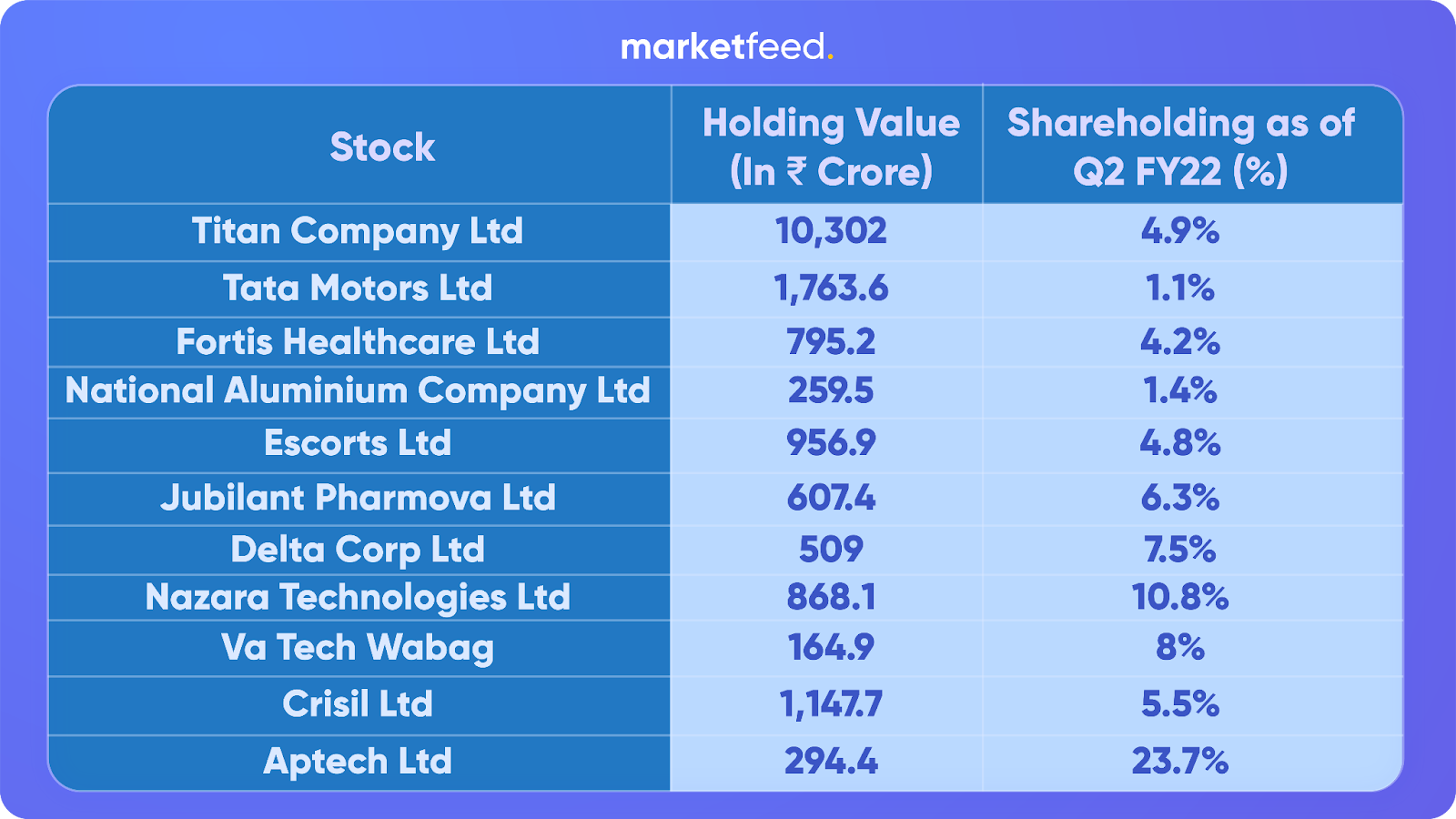
According to Forbes, Rakesh Jhunjhunwala’s net worth stands at $5.9 billion (~Rs 44,340 crore). He is the 48th richest person in India as per Forbes’ Rich List. RJ is also on the Board of Directors of large companies such as Viceroy Hotels, Geojit Financial Services, Praj Industries, and Concord Biotech. His privately owned stock trading firm, Rare Enterprises, derives its name from the first two initials of his name and his wife Rekha’s name. Rakesh Jhunjhunwala is also well-known for his love for Bollywood films and has even produced multiple movies.

Earlier this year, the ace investor announced plans to launch his own airline— Akasa Air.  He will invest $35 million (~Rs 260 crore) and hold a 40% stake in the company. Akasa Air aims to be India’s most dependable, affordable, and greenest airline. You can read more about it here.

Important Lessons from His Life & Career 

Rakesh Jhunjhunwala is highly bullish on India’s growing economy and its success as an emerging market. In fact, he credits his entire success in wealth creation to his strong belief in our country’s growth potential. In a recent interview, he said India is in a long bull market, and retail investors should invest at home and not in the US markets for better returns. Currently, he is bullish on the Indian metal, banking, and pharma sectors.

RJ often advises investors not to go for stock recommendations in the newspapers and media. People buy shares of a company when it becomes popular and often end up in losses. Instead, one must study the fundamentals of different businesses and take responsibility for their own actions. More importantly, always make a deliberate effort to learn from the mistakes you make in the stock market. Never worry about short-term corrections as they are natural. Never let emotions be your enemy. Simply buy in dips and wait patiently! Seek investments for longer time horizons, and let your investment mature.

We would advise our readers not to jump into buying a particular stock just because Rakesh Jhunjhunwala has added it to his portfolio. Instead, we can analyse the logic and reasoning behind why he chose that company and find its true potential. This will help us become intelligent stock market participants. 

“Whatever you can do or dream you can, begin it. Boldness has genius, power, and magic in it.” –  Rakesh Jhunjhunwala.

Categories
Editorial

India’s Richest Investor: Radhakishan Damani

The Indian stock market is passing through a golden era. It has moulded sharp, disciplined, and inspiring investors over the years. Radhakishan Damani is one such individual who has taught us the beauty of value investing. He has applied analytical skills to build India’s largest retail supermarket chain, DMart. From living at a one-bedroom apartment in Bombay to owning 156 rooms at a Radisson Blu resort in Alibaug, his journey is inspiring for all stock market participants. In this editorial, we shall analyse Damani’s investment journey and his current portfolio.

Journey to Dalal Street

Radhakishan S Damani was born on January 1, 1954, into a Marwari family in Mumbai. His father, Shivkishanji Damani, worked as a stockbroker in Dalal Street. It is interesting to note that Damani was not enthusiastic about joining his father’s path. Instead, he pursued a Bachelor’s Degree in Commerce at the University of Mumbai. He always had a strong business acumen, which resulted in him dropping out of college and starting an enterprise in the field of ball bearings. Unfortunately, the passing of his father forced Damani into the world of the stock market in his late 20s.

Investment Journey

Damani was never satisfied with being a stockbroker. He started to analyse trading and investing activities in the Bombay Stock Exchange (BSE). During this period, the Indian stock market was controlled by a few powerful players. It was not open to foreign investors. He started getting exposure and insights from well-known personalities in Dalal Street such as Manu Manek (the Black Cobra) and Harshad Mehta (the Big Bull). Interestingly, Damani entered into short-sell positions in stocks that were manipulated by Harshad Mehta. He firmly believed that the stocks backed by Mehta were highly overvalued and would go through decent corrections.

In the l990s, Damani’s roots in value investing got deeper after meeting Chandrakant Sampat (a legendary value investor, started his investment career during the 1950s). VST Industries, HDFC Bank, Sundaram Finance, 3M India, Gillette, ITC, ICRA, CRISIL, Blue Dart are the stocks that were added to his initial portfolio. Damani found huge potential in HDFC Bank, at a time when public sector undertaking (PSU) banks such as State Bank of India (SBI) ruled the banking sector.

The Birth of DMart

Damani always wanted to start and grow his own venture. At the age of 45, he established a franchisee of Apna Bazar Supermarkets in 1999. After acquiring more knowledge of the Indian retail space and having disagreements with Apna Bazar’s master franchisor, he decided to start a single-store supermarket named DMart in 2002. The company bought parcels of land to commence its operations. Now, DMart enjoys the benefits of land appreciation, which directly makes the balance sheet strong. Damani always focused on building the fundamental aspects of the business. From 2002 to 2010, there were 25 DMart stores across India.

DMart launched its initial public offering (IPO) in 2017 to raise Rs 1,870 crores at an issue price of Rs 299. The shares were listed on the exchanges at Rs 600. Currently, the company has a presence in 238 locations across 11 states in India. DMart is trading at ~Rs 3,970 in the NSE, giving the investors a Compounded Annual Growth Rate (CAGR) of 45% over the past 5 years.

Portfolio Analysis

Now, let us look at Damani’s current portfolio and look for some key patterns.

Damani is the major promoter of DMart. His holdings are worth around Rs 1,66,800 crore, which makes up 97% of his total portfolio. We can exclude it from our analysis as it will make other constituents negligible.

radhakishan damani portfolio | marketfeed

We can see that Damani is a conservative investor. Currently, mid-cap companies contribute 55% to his total portfolio, followed by large-cap at 42%, and small-cap at less than 2%.

Portfolio Diversification

Let us look at the segments he is betting big on:

StockSegment
Avenue SupermarketsRetail – Department Stores
VST IndustriesFMCG – Tobacco
India CementsCement
Sundaram FinanceConsumer Finance
Trent LtdRetail – Apparel
United BreweriesAlcoholic Beverages
3M IndiaStationery
Blue DartLogistics
Metropolis Health careHospitals & Diagnostic Centres
Sundaram Finance holdingsDiversified Financials
BF UtilitiesRenewable Energy
Astra MicrowaveCommunication & Networking
Mangalam OrganicsChemicals
Andhra PaperPaper Products
Diversification of Damani’s portfolio

He has followed the same principle as his mentor Chandrakant Sampat:

“I will only buy those companies that are in a business that even fools can understand, have very little debt, have free cash flows, or do not have much capital expenditure”

Damani’s portfolio stocks have a low debt-to-equity ratio (debtless companies). Also, most of the mid-cap and large-cap companies mentioned above have a strong moat.

However, his holdings are highly sensitive to market conditions. The portfolio has a beta of just 0.7, which means that if NIFTY500 moves either upside or downside by 1%, his portfolio will react in the same direction with a lower magnitude of 0.7%.

Recent Purchases

Damani added a few stocks to his portfolio after the stock market crashed in March-April 2020 due to the Covid-19 pandemic. India Cements, Sun Pharma, Vodafone Idea, HPCL, Delta Corp, and DLF were purchased in March 2020. He also added Cochin Shipyard, India’s leading shipbuilding company in October 2020.

Portfolio Performance

It is interesting to see how Damani’s portfolio has performed over the past year. Let us take NIFTY500 as the benchmark to do a comparison.

radhakishan damani portfolio performance | marketfeed

Over the past year, NIFTY500 has surged 56%, while Damani’s portfolio grew 40%. Interestingly, the benchmark and portfolio have performed identically over the last 5 years.

Conclusion

There are a lot of takeaways from Damani’s journey in the stock market. He is conservative, patient, and disciplined. With the knowledge he acquired from large investors, he has been able to accurately analyse the financial performance and other fundamental aspects of companies. He has developed skills for identifying multi-bagger stocks. We can compare his portfolio with ours, and adopt essential features such as diversification and position sizing.

However, never jump into buying a particular stock just because Damani has added it to his holdings. Instead, we should understand the logic and reasoning behind why he chose that company and find its true potential. This will help us become intelligent investors. 

Is your portfolio similar to Damani’s? Let us know in the comments section of the marketfeed app.