Categories
Editorial

Company Analysis: Dixon Technologies

Dixon Technologies Limited is one of the favourite stocks of retail investors as it has given enormous returns in the previous years. But do you know what their business is? Why do you never see their products being sold in a store even though they are said to make TVs, mobiles etc? Let’s jump in straight to analyse what the company is all about and what we can understand from their financials.

Company Profile – Dixon

Dixon Technologies (India) started manufacturing colour television in 1994 and slowly expanded its operations to various segments of electronics. The company was founded in 1993. Currently, it deals in manufacturing consumer durables, home appliances, lighting, mobile phones and security devices. They have 14 State-of-the-art manufacturing facilities and three R&D centres in India and China. These manufacturing sites are located in Uttar Pradesh, Uttarakhand and Andhra Pradesh. 

It provides design-focused solutions in consumer durables, lighting, mobile phones and security devices. In fact, they are the leading electronic manufacturing services (EMS) company in India. They already have a strong market hold in the smartphone segment even after starting the manufacturing in 2016 only. Not only smartphones, but they are also setting up in-house units to manufacture key components of the device like batteries and sheet material.

In 2020, they took another step to expand their reach by stepping into the manufacturing of medical equipment. They started making Quattro Real-Time Quantitative micro PCR Analyzer machines that can conduct 190-200 tests per day. This product was approved by the Indian Council of Medical Research (ICMR) for conducting Covid-19 tests.

The much-awaited share split

A stock that is trading at Rs 200 or Rs 2000 will have much higher liquidity as compared to a stock trading at Rs 20,000. A high percentage of retail investors will find it tough to invest in a stock that is trading at such a high price. You can compare it with an IPO. Generally, the minimum amount you need to invest in an IPO is Rs 15,000. You get a number of shares by investing Rs 15,000. 

In comparison to that, you won’t even get one share with that amount if Dixon was still traded at around Rs 20,000. Thus, many retail investors shy away from investing in these stocks as they are afraid that their capital will get stuck. To investor’s delight, Dixon announced a 1:5 Stock Split a few weeks back which brought it around the Rs 4,000 mark. It experienced a bit of correction which might have frightened some of the retail investors but it is back in the strong zone which tells that was just a momentary dip.

Robust Financials

Super strong!

I failed to hide my delight but the finances are just so healthy that I have a great smile on my face. From 2012 to 2021, their revenue has increased massively. In 2012, they had a total sales of Rs 573 crore and in 2021, they recorded it worth Rs 6449.75 crore! Over the past five years, total revenue has grown at a yearly rate of 30%. You might think that this might be only because of a boom in the whole industry. But the industry grew by only 14% in the same period.

Coming to the profits, it was recorded to be Rs 11 crore in 2015. After 6 years, in 2021, the net income is amassed to be Rs 159.80 crore. The yearly growth rate in profits in the last five years is mighty Rs 60%! How great does that sound? All of this success has been due to their increasing market share. In the past half-decade, their market share has increased by almost 5X times, from 2% to around 10%.

Earnings per share (EPS) is another pivotal metric for shareholders. In FY19, the EPS was Rs 11.19 and in FY21, this has zoomed up to Rs 27.49. At the beginning of the article, we termed Dixon as “one of the favourite stocks of retail investors”. The reason is that retail investors hold 35% of the stake in the company, joint-highest with a stake which is held by the promoters. From March 20 to March 21, the foreign institutions have almost doubled their stake from 10.76% to 19.84%. 

The automatic beneficiary of government schemes

The Indian government is keen to bolster its manufacturing capacity. They want to improve their trade balance. For that to happen, they are eager to cut imports by building their goods in India itself. Many initiatives like PLI Schemes and Make-in-India have given these companies a space to grow which is beyond one can imagine. 

For example, the Indian smartphone market is the second-largest smartphone market across the world. If the Indian government is incentivising foreign companies to manufacture here, companies like Dixon will benefit directly. Dixon manufactures not only a smartphone but TVs, washing machines and several consumer electronics in India. The scope of growth is huge, but can Dixon remain on the right path and continue to work tirelessly?

Have you enjoyed a rally in Dixon previously? Is this stock in your portfolio currently? Do make your own analysis before investing and let us know your insights on Dixon in the comments section of the Marketfeed application. Until next time!

Categories
Editorial

India’s GDP Contracts 7.5%; Enters Technical Recession – All You Need to Know

Our country’s Gross Domestic Product (GDP) estimates for the period July-September (Q2) was published on 27th November 2020. GDP is the money value of all finished goods and services produced within a country during a specific period. We had all been patiently waiting for this data, to understand how India’s economy has recovered from its horrifying 23.9% contraction in the previous quarter. As we know, the main reason for this fall had been due to strict pan-India lockdowns amidst the Covid-19 pandemic. It had caused widespread disruption of all economic activities. 

However, as the lockdown restriction was gradually removed, we could see recovery in some major sectors. This has been confirmed with the recent GDP data as well. Let us look at the key highlights of the data released by the Ministry of Statistics and Programme Implementation.

Main Highlights

  • India’s Real GDP fell to 7.5% in the July-September quarter (Q2), compared to a contraction of 23.9% in the quarter ended June (Q1). Real GDP is the GDP that has been adjusted for yearly rise in prices.
  • With the economy shrinking for two consecutive quarters, the country has officially entered into a technical recession. 
Source: Ministry of Statistics and Programme Implementation.
  • GDP at current prices was estimated at Rs 47.22 lakh crore, showing a contraction of 4.0 percent.
  • In gross value added terms (GVA), the economy contracted 7% compared to a contraction of 22.8% last quarter.

Sector-Wise Results

We had already expected a great recovery in the manufacturing sector. There were multiple data sets from various analysts which showed that industrial activity in India had improved. This was mainly due to the removal of lockdown restrictions by the Government. The agriculture sector remains at a 3.4% growth rate. The growth of all other sectors remains to be on a decline. However, these sectors have narrowed their contraction, as compared to the results of the previous quarter. 

The table below shows the sector-wise growth of India’s economy over the previous quarters:

Source: BloombergQuint

Some Noteworthy Sectoral Growth Rates

  • The mining sector contracted 9.1% in Q2, as compared to a contraction of 23.3% in the last quarter.
  • Construction contracted 8.6% in Q2 compared to a drop of 50.3% in Q1.
  • Trade, hotel, transport, and communication fell15.6% compared to a contraction of 47% in the previous quarter.
  • Electricity and other public utilities grew 4.4%, against a contraction of 7% in Q1.

Performance of Core Industries in October 2020

The data from the Ministry of Commerce show that four out of eight core industries remained in contraction in October 2020. The eight core industries comprise nearly 40.27% of the weight of items included in the Index of Industrial Production (IIP). The IIP is an index that tracks manufacturing activity in different sectors of an economy. The total output of these core sectors has dropped by 2.5% in October. This has mainly been due to a sharp decline in the production of crude oil, natural gas, steel, and refinery products. Let us take a look at these 8 core industries:

Core IndustryGrowth in OctoberSeptember Data
Coal11.6%21.2%
Crude Oil-6.2%-6%
Natural Gas-8.6%10.6%
Refinery Products-17%-9.5%
Fertilizers  6.3%-0.3
Steel-2.7%2.8
Cement2.8%-3.5
Electricity10.5%4.8

India’s Expenditure During Q2

  • Private consumption contracted 11.3% in Q2, as compared to a drop of 26.7% in Q1. This refers to the money spent by all the people of our country. With the arrival of the festive season and the removal of lockdowns, most people have increased their spending. At the same time, many people have suffered a loss of income. Such individuals would have to increase their savings and limit their consumption activities.
  • Investments contracted 7.3%, as compared to a high fall of 47.1% in Q1. These are investments made by private players into local entities and businesses in India. Over the last few months, we have seen a series of investments and acquisitions being conducted in our country.
  • Government expenditure contracted 22.2% in Q2 after growing 16.4% in Q1. The expenditure made by the Government had increased in the previous quarter due to various stimulus packages being introduced due to the Covid-19 pandemic. The Atmanirbhar 3.0 package is yet to be released to certain specified sectors. This expenditure will be reflected in the GDP results of the next quarter.

The table below shows India’s expenditure patterns over the previous quarters:

Source: BloombergQuint

An Analysis of the Data

As mentioned before, India has officially entered into a technical recession. This is because our country’s GDP has declined for two consecutive quarters. This is the first time in 41 years that India has fallen into such a recession. But, do bear in mind that our country’s economy was already in a slowdown in 2018 and 2019. GDP figures had declined even before the Covid-19 pandemic had hit.

Now, the situation in our country looks quite promising. The economy has been able to recover from its deep fall in Q1. The festive season and removal of lockdowns have led to the creation of demand. The rural sector activities have constantly remained strong in the current financial year. Manufacturing or production activities have seen a very sharp recovery. Several indicators like car sales and services activity have also shown a great improvement over the past two months. 

Even before the GDP data had been released, the RBI Governor Shaktikanta Das was confident that the economic recovery was much stronger than expected. Our policymakers have also introduced a new stimulus package to provide support to specific sectors. We could see the allotted amounts being pumped into the selected sectors in the weeks to come. It would certainly increase demand and offer more employment opportunities. The government has also made proactive efforts to ensure that imports are reduced, and domestic production is given more importance. You can read more about it here.

However, certain economists believe that these positive signs may not be enough for India to remove its current position of recession. Historic data shows us that recessions last for a few quarters. Currently, it is believed that our country could come out of recession if the spread of Covid-19 is controlled.

Despite all odds, there is high optimism that India would see positive growth in the October-December quarter (Q3). In case a vaccine is launched in our country during the next few months, we might see a much speedy recovery. Let us wait and watch for the next result and hope for some major positive changes. 

Categories
Editorial

The PLI Scheme – All You Need to Know

One of the most important strategies to improve the economic growth of a country is to promote domestic production and become self-reliant. This is exactly what our Indian Government has been aiming for. The policies such as Make in India and the Atmanirbhar Bharat Abhiyan are prime examples of this. On November 11, the Union Cabinet announced the approval of a Production Linked Incentive (PLI) Scheme for 10 key sectors. This scheme would help to further strengthen the foundation of India’s path towards self-reliance.

Here at marketfeed, we always make sure to fulfill our promises and provide you with the best insights about such important events. Let us understand what this scheme is all about, and which sectors are included in it.

What is the PLI Scheme?

The Production Linked Incentive (PLI) scheme is a relatively new concept that was introduced in India earlier this year. The Government believed that it was time to initiate concrete steps to boost domestic manufacturing and cut down on huge import bills. Through the PLI scheme, companies would be provided with certain incentives to scale up production activities in India. It has three main objectives:

  1. To encourage foreign companies to set up their production activities in India. When this happens, we could see more foreign investments coming into our country.
  2. To provide support towards the existing domestic companies to expand their manufacturing units.
  3. To ensure that more employment opportunities are provided to Indian citizens in the manufacturing sector.

The PLI Scheme for Electronics Manufacturing

This scheme has become an absolute game-changer. Let us find out how our country adopted it initially. In April 2020, the Government introduced a PLI scheme worth Rs 40,000 crore for large-scale electronics manufacturing. The main aim of this particular scheme was to boost domestic manufacturing of mobile phones in India. The eligible companies were promised an incentive of 4%- 6% on incremental sales of goods that were manufactured in our country. This incentive would be applicable for 5 years. 

A total of 22 companies applied for the PLI scheme in August. And, three of these firms were contract manufacturers for Apple iPhones. We could also see that the share price of companies that had applied for the scheme (for eg, Dixon Technologies) had seen a surge during those periods.

According to Ravi Shankar Prasad, the Minister of Electronics and Information Technology, production worth Rs 11.5 lakh crore and exports valuing Rs 7 crore is expected over the next 5 years. It is very reassuring to learn that this scheme had received quite an overwhelming response from companies around the globe. It has become such a huge success.

The Latest PLI Scheme

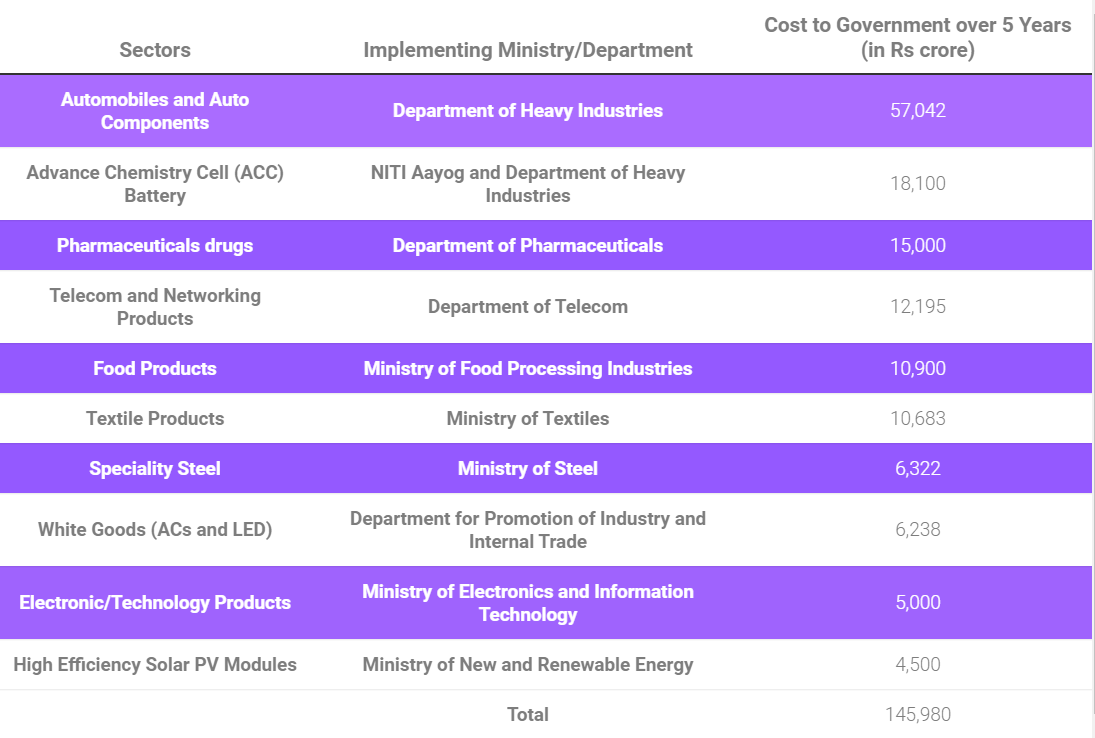
In the notification made on November 11, the Government stated that it will offer incentives to an additional 10 vital sectors. The Union Cabinet has approved Production Linked Incentive Scheme worth up to Rs 1.45 lakh crore, for a period of 5 years. 

This would ensure that necessary support is provided to make India a global manufacturing hub, and create more jobs in the economy. The domestic companies would get the necessary push to cater to the local demand. The policy has been strategically targeted to very important sectors and would make Indian goods more competitive.

We can also state that the scheme has come at a very perfect time, in relation to the present global scenario. Most companies around the world are planning to shift their manufacturing operations from China. India could grab this opportunity and transform India into one of the best manufacturing centers in the world. The scheme would accelerate the existing plans of foreign companies that were considering to invest in India.

Which Sectors are Included in the PLI Scheme?

Given below is a table that shows the 10 sectors that will come under the PLI scheme, and the amount allocated to each sector.

Source: BloombergQuint

As we can see, the automobile and auto components sector has been allocated the highest amount in the PLI scheme. This would definitely help the sector to become a large exporter, and reduce import dependence. It has also been ensured that an amount of Rs 18,100 crore has been allocated for advanced chemical cell batteries. This would provide a major boost to the production of electric vehicles, as batteries are a key component of it. 

As per a statement from the Finance Minister, Smt. Nirmala Sitharaman, speciality steel in India could become a potential champion in the country’s exports. Hence, an amount of Rs 6,322 crore has been allocated for incentivizing its production as well.

Similarly, eight other sectors will be provided with sufficient incentives to completely improve the overall manufacturing capacity in India.

India and PLI

India has definitely received a massive Diwali gift from the government. If this scheme goes through precise planning and execution, it could become one of the most vital initiatives that have been adopted in our country. Our producers would certainly get the push to cater to the domestic demand, and foreign firms would be encouraged to invest heavily in India. The citizens of India would obtain more employment opportunities as well. It is a win-win situation for all the parties that would be involved!

At the same time, we would urge our readers to follow the latest updates surrounding this scheme. We could see listed companies applying to get the benefit of these incentives, and ramping up their production activities in India. This would certainly become a factor for many stocks to rally. We would also keep an updated list of the specific stocks that have been selected for the PLI scheme. Let us look forward to a positive outcome and see our country grow into one of the best manufacturing hubs in the world.

Categories
Market News

Production-Linked Incentive (PLI) – A boost for electronics sector?

Manufacturing will be key to India’s success. Why do we say this? India has a huge population and a large chunk of them require a job to survive. When we see the growth of China, it’s not because of the digital transformation they are into now. Their growth is because of a solid and robust manufacturing sector. This secondary sector arranged the way for their working population to find jobs and drive the country’s growth.

India has certainly missed the stepping stone of making a robust secondary sector and relied directly on the tertiary sector to support the economy’s growth. Now, the tides are changing. The “Atmanirbhar” mission is on the heads of the national government and they have come out with a scheme which can boost their mobile manufacturing sector altogether.

The Production-Linked Investment Scheme

To make India a global electronics manufacturing hub, the national government has rolled out a ₹41,000 crore Production-Linked Incentive (PLI) scheme.

According to this initiative, a financial incentive of 4%-6% will be given to electronics companies that manufacture mobile phones and other electronic components. 22 companies, including the likes of Wistron, Samsung, Micromax, Foxconn, Lava, etc, have already applied for this incentive program. The shortlisted companies will have to take 2019-’20 as a base year and produce more goods in the next five years. The more incremental sales you generate, the higher the financial incentive you receive. 

The total ₹41,000 crore scheme is distributed under the five years. Year 1 – Rs 5,334 crore, Year 2 – Rs 8,064 crore, Year 3 – Rs 8,425 crore, Year 4 – Rs 11,488 crore and Year 5 – Rs 7,640 crore. Any reason for this uptrend? This is done so that the jobs created are for long-term and no company can take benefit by producing more only one year.

“We have introduced the PLI scheme for five years to boost local production. Besides this, we have received commitments to make mobile phone and parts worth Rs 11.5 lakh crore.” – Union Minister for Information Technology and Communications Ravi Shankar Prasad. 

Why now?

The US trade war and then the COVID-19 mystery, both has put Chinese administration under scrutiny in the eyes of the world. All the political and social situations are going to leave a heavy impact on business, and major companies are looking to shift their manufacturing facilities out of China. Resources like land and labour leaves India as the best option for these companies to shift to. The question is, can India make use of opportunity and become the world’s factory?

Why is the government rolling out incentives for manufacturing companies? Creation of jobs. The secondary sector needs a boost. India has a huge labour force (49.42 crore as of 2018). According to estimates, more than 12 lakh people will get employment due to this scheme. Out of this, 3 lakh people will receive direct employment and more than 9 lakh will receive indirect employment.

What will be the long-term impact?

A huge supply of labourers will cut down any manufacturer’s cost of producing their goods. This will help the company drive down prices of their products, and hence attract more customers. Production within Indian boundaries will cut down the cost of imports, thus reducing the import bill. On the other hand, more employment will generate more income for the nation. This will drive the Gross Domestic Product (GDP) of India, higher. Clearly, a win-win situation for all parties involved.