
Categories
Editorial

New WhatsApp Privacy Policy – All You Need to Know

All of us would have received a pop-up notification from WhatsApp, which states that its terms and privacy policy have been updated. Users have until February 8 to accept these new terms. In most cases, we do not go through the clauses mentioned in these policies and simply click ‘Agree’. However, the new update has caused a lot of concern over the type of data that is shared with WhatsApp’s parent company, Facebook. There have been numerous discussions regarding the motive behind this change, and people have already started using alternate messaging apps.

Let us understand the specific conditions mentioned in the updated privacy policy and why it has caused such an uproar. Let us also learn why alternatives such as Telegram and Signal are a safe bet.

WhatsApp’s New Privacy Policy

  • The updated policy states that WhatsApp may share user information with its family of companies to “facilitate, support and integrate their activities and improve our services.” This means that the app would automatically collect your basic information and share it with Facebook.
  • WhatsApp will collect and share details regarding user activity, how often you use the app, specific features that are used, and even your profile photo and status. Since WhatsApp has its own payment system, it would also share information regarding all transaction data. It may also collect data from any interactions you make with a business account.
  • The app will also collect information about the type of device that you use, your mobile network, IP address, and battery usage. It may also use precise location information from your device.
  • All this information would be used by Facebook and its products to make suggestions, personalise features & content, and “help” its users complete purchases. The policy update also states that data-sharing with Facebook will help to ensure better security and fight spam.
  • The data collected from WhatsApp would ultimately be used to show offers and advertisements across Facebook Company Products. This includes Messenger, Instagram, Oculus Products, Facebook Shops, and many more.

The important fact to be noted is that WhatsApp had already been sharing certain types of data with Facebook. However, these policies were not very transparent until now. While WhatsApp users in the European Union can opt-out of data-sharing with Facebook, the rest of the world does not have the same choice. Users have until February 8 to accept these changes. In case you are not comfortable with WhatsApp’s new user-data policy and do not accept it, the app will become inaccessible. 

Should You Be Concerned?

Nearly two billion people use WhatsApp daily to send information in the form of text, voice notes, images, videos, and documents. With the updated privacy policy, many people feel that the app will become more risky or unsafe. They are worried that personal messages that are sent to friends, family, or colleagues could now be accessed by WhatsApp. The information collected from the interaction between a user and a WhatsApp business account would also be shared with that particular business firm. Facebook would also have access to such data. Thus, we will have to be extra careful while sending content to such accounts.

Moreover, data that WhatsApp collects and shares will now be governed by the privacy policy of Facebook. As we know, the tech giant does not have a good track record when it comes to securing data from billions of people across the globe. There have also been multiple instances where WhatsApp private chat groups have been exposed on Google Search. This means that anyone can have access to basic details such as your mobile number.

WhatsApp Issues Clarification

On January 12, WhatsApp updated their FAQ page to bring more clarity on its new privacy policy. They also initiated a widespread ad campaign for the same. It stated that all messages will remain end-to-end encrypted. WhatsApp will not keep logs of user communications. Also, Facebook and other third-party apps will not have any access to private messages or calls.

On the location sharing part, WhatsApp pointed out that it could not view the shared location of users, and neither could Facebook. The location cannot be seen by anyone except the people with whom it is shared. In terms of data sharing, the Facebook-owned platform said that the update primarily focused on ‘business messaging’ on WhatsApp. The statement assured that WhatsApp will not share your contacts with Facebook or any other third-party apps.

WhatsApp posted this full-paged ad on multiple newspapers, dated 13/01/2021

What are the Alternatives?

Despite the reassurance from the company, many people have become sceptical about using WhatsApp. We feel insecure about using the app, as there seem to be a lot of additional or underlying clauses attached to each policy. Recently, we saw that Elon Musk sent a tweet that sent shockwaves across the world. He promoted the use of Signal as a better alternative to WhatsApp. 

https://twitter.com/elonmusk/status/1347165127036977153?ref_src=twsrc%5Etfw%7Ctwcamp%5Etweetembed%7Ctwterm%5E1347165127036977153%7Ctwgr%5E%7Ctwcon%5Es1_&ref_url=https%3A%2F%2Fwww.deccanherald.com%2Fspecials%2Fpeople-begin-to-shun-whatsapp-over-privacy-concerns-937109.html

Fun Fact: The shares of a company named Signal Advance, which has no connection with the Signal Messenger App, has surged by 11,708% since the tweet was sent by the Tesla CEO!

Signal is an encrypted app that lets you send messages and make calls. The platform’s unique selling proposition (USP) is its focus on privacy. The app was established by The Signal Foundation, which is a US-based non-profit organization. Signal is open source and its code is peer-reviewed. This means that its privacy and security are regularly checked by independent experts. The app supports group chats and group video calls as well. Signal is a much more private alternative, where the parent company’s business interests do not clash with your privacy. The company has assured its users that all content would be private and secure. We are now witnessing a huge surge in the number of downloads of the Signal app.

Telegram could also be a better alternative. By default, Telegram chats are not end-to-end encrypted. It lets users choose whether they want their chats to be backed up on the cloud. The app also has features like multi-device support. It has currently surpassed the 50-crore subscriber mark.

.WhatsAppSignalTelegram
End-to-End Encryption (E2E)Yes (Backups are not encrypted)YesOnly for secret chats, all calls
Disappearing MessagesYesYesYes
Chat BackupsYes, Google Drive or iCloudNo, stored locally on the deviceYes, on Telegram’s cloud
Screen LockYesYesYes
AdvertisementsNoNoNot currently, but plans to add soon
Group Chat SecurityYes, E2EYes, ETENo
Video and Voice CallsYesYesYes
Source: Indian Express

Conclusion

Despite the ‘scary’ update on WhatsApp’s privacy policy, many people would still be using the platform. Ever since the app’s launch in 2009, consumer sentiment has always remained strong. Many of us would find it difficult to move to another messaging platform. However, this whole situation has become a wake-up call for all of us. We tend to blindly accept all terms without even glancing at a company’s policies. To avoid risks in the online world, we need to thoroughly go through the terms and conditions of each app that we use. An interesting factor to be noted is that WhatsApp has become more transparent with its updated policy. They have clearly stated what it intends to do with the collected information and with whom it will be shared.

Now, it is our responsibility to decide whether to accept these terms or not. There should be a clear understanding of how these changes would affect our lives. If we accept it, we would have to take extra precautions while sending sensitive information. Even if you plan to move to another messaging platform, it is always advisable to carefully go through its privacy policy. Will we see a further decline in the number of WhatsApp users? Let us know what you think in the comments!

Categories
Market News Top 10 News

Jio & Facebook to Accelerate India’s $5 trillion Economy Push – Top Indian Market News

Jio and Facebook to accelerate India’s $5 trillion economy push: Mukesh Ambani

Facebook founder Mark Zuckerberg and Reliance Industries Chairman Mukesh Ambani, on Tuesday, spoke about the partnership between Facebook and Jio- highlighting how each company benefits from the association. They were speaking at the Facebook Fuel for India 2020 event. Opening up on the potential of a technology-enabled ecosystem in propelling the economic growth of India, Ambani said that he sees the country accelerating as a premier digital society. He stated that both Jio and Facebook will work hand-in-hand to make this a reality. The partnership will also focus on digitizing small businesses.

In April 2020, Facebook purchased a 9.9% stake in RIL’s telecom unit Jio for $5.7 billion (Rs 43,574 crore).

Read more here.

Mrs Bectors IPO subscribed nearly 4 times on Day 1

Mrs Bectors Food Specialties’ initial public offering (IPO) was subscribed nearly 4 times on the first day of the bidding process. The issue received bids for 4.92 crore shares, which was 3.72 times the issue size of 1.32 crore shares. The quota for retail investors was filled in 6.83 times, while that for employees’ quota received 9.46 times bids. The price band of the Rs 541-crore IPO was fixed at Rs 286-288 per equity share.

Read more here.

M&M subsidiary SsangYong fails to repay loans worth Rs 408 crore

SsangYong Motor Company, the South Korean subsidiary of Mahindra and Mahindra Ltd (M&M), has missed repayment of Rs 480 crore to JP Morgan Chase Bank. The amount was due and payable on 14 December 2020. M&M clarified that the missed loan repayment is part of SsangYong’s outstanding loans aggregating to Rs 680 crore, which will be covered under M&M’s commitments to the subsidiary’s lenders.

Read more here.

Adani Ports’ joint venture to raise $300 million to retire debt

Adani Ports and Special Economic Zone Ltd (APSEZ) said that its joint venture firm, Adani International Container Terminal Pvt Ltd (AICTPL), will raise $300 million (~Rs 2,207 crore) to retire some of its debt. AICTPL intends to use the funds to repay all of its existing senior debts. Senior debt refers to borrowings that are prioritized for repayment in the case of bankruptcy. Such debts have the highest priority, as compared to other types of borrowings.

Read more here

Kalpataru Power secures orders worth Rs 1,300 crore

Kalpataru Power Transmission Ltd announced that it has secured orders worth Rs 1,300 crore in India and overseas. The orders include an engineering, procurement, and construction (EPC) job for pipeline laying and associated works in India. It also includes an order for railway electrification by the Central Organization for Railway Electrification (CORE). The firm also stated that its international subsidiary has secured new T&D (transmission & distribution) projects in Europe.

Read more here.

Majesco announces interim dividend of Rs 974 per share

Majesco Limited announced that its board has approved payment of an interim dividend of Rs 974 per equity share for the financial year 2020-21. The interim dividend is at the rate of 19,480% of the face value of the company. Majesco’s dividend payment translates to an amount of Rs 2,788.4 crore, on a shareholder base of 2.85 crore shares. The record date for the dividend is December 25.

Read more here.

Dilip Buildcon receives letter of acceptance from NHAI for Gujarat project

Dilip Buildcon Ltd has received a letter of acceptance (LOA) from the National Highway Authority of India (NHAI) for a hybrid annuity mode project in Gujarat. The project includes four-laning of Dhrol-Bhadra Patiya section of NH-151A and Bhadra Patiya-Pipaliya Section of NH-151A in Gujarat. The cost of the project has been estimated at Rs 880 crore, and it will be completed in 2 years. 

Read more here.

IDBI Bank opens QIP to raise Rs 6,000 crore

The Qualified Institutions Placement (QIP) committee of IDBI Bank’s Board of Directors has authorised the opening of the bank’s QIP issue on December 15. IDBI Bank plans to raise up to Rs 6,000 crore via the QIP issue. The floor price of the issue has been fixed at Rs 40.63 per equity share.  QIP is a method by which listed companies can raise funds by issuing shares to certain institutions, without going through standard regulatory approvals.

Read more here.

Mindtree accelerates cloud business through Global Microsoft Azure Experience Center

Mindtree Limited announced the launch of a dedicated Microsoft go-to-market business unit. The unit will be centered on building new solutions based on Microsoft platforms and technologies. The new business unit is a component of Mindtree’s multi-tiered initiative to support the continued demand for cloud services and solutions. It will also expand its Global Azure Experience Center in Washington, to ensure that all technical professionals are proficient and certified on Microsoft Azure technologies.

Cyient signs MoU with Australian firm Decipher

Cyient Limited has signed a Memorandum of Understanding (MoU) with Decipher, an Australian company that provides cloud monitoring and governance platform for tailing storage facilities. Tailings are the mineral waste remaining after ore processing to extract mineral concentrates. It is typically stored within an engineered containment structure known as a tailing storage facility (TSF).

Under the agreement, Cyient will help Decipher with the global rollout of its cloud mining platform for tailings and rehabilitation monitoring. Hyderabad-based Cyient Ltd is an outsourcing company, which is focused on engineering, manufacturing, data analytics, and networks & operations. 

Read more here.

Categories
Editorial

US Tech Giants’ Results and AntiTrust Cases

Global tech giants Alphabet, Amazon, and Facebook reported their third quarter (Q3) results on October 29. Apple released its fourth-quarter results as well. During the current financial year, these companies have exceeded all expectations and have emerged as the world’s top-earning corporations. As we know, there has been a massive transformation and growth in online businesses amidst the Covid-19 pandemic. And, the recent results from these companies have completely crushed all street estimates. Let us find out how they performed during the July-September period.

Alphabet Quarterly Report

Google’s parent company, Alphabet Inc, had its first-ever revenue decline in Q2. However, the company has reported a very impressive 14% year-on-year (YoY) increase in revenue to $46.17 billion, for the quarter ended September (Q3). The company has completely beaten estimates that were made by financial analysts, and has returned to sales growth. A major portion of its revenue comes from advertising through its platforms such as YouTube. During the July-September period, revenue from YouTube ads has seen a 32% YoY jump to $5.04 billion. We can also see more businesses and individuals using Google’s Cloud Platform to perform their daily tasks efficiently. Hence, there has been a major increase in earnings from that segment as well. 

From what we can understand, the company has made a complete rebound in its revenue generation from Google Ads, as compared to the previous two quarters. Businesses around the world had seen a major decline in sales during lockdowns, and are now investing more in advertising through various Google platforms. The Cloud Platform has also helped to provide support to the work-from-home (WFH) model for corporations. Alphabet CEO Sundar Pichai has stated that Q3 has been ‘a strong quarter, consistent with the broader online environment’.

Last month, the US Justice Department filed one of the biggest antitrust lawsuits against Google. The IT company has been accused of partnering with other tech giants for ensuring that its rival companies do not rise to power. Google has also been criticized for using its search platform illegally to maintain its power.

Amazon Quarterly Report

Amazon.com, Inc is another company that completely beat estimates provided by analysts such as Yahoo Finance. The company has reported a 37% year-on-year (YoY) increase in revenue at $96.1 billion, for the quarter ended September (Q3). Even though lockdown restrictions were lifted in most countries, people preferred to get essential commodities through online methods. Third-party merchants also pay Amazon to advertise their products on its online shopping platform. The company has also created more than 4 lakh jobs this year, in order to support the surge in online sales.

The retail giant also receives a major part of its revenue from Amazon Web Services (AWS). It is one of the leading cloud technology platforms in the world, and accounts for a majority of Amazon’s total profits. There has been a 29% YoY increase in revenue from AWS to $11.6 billion, in the third quarter of the current financial year. On the other hand, Amazon’s video streaming service has been constantly registering a massive spike in viewership. Those movies which could not be released in theatres were also launched through Amazon Prime Video.

This year, Amazon has come under the scanner of regulatory authorities over a number of cases. It was found that the prices of essential items were increased in the US. Merchants who sell their products through Amazon have been under massive pressure. These sellers have not received any support from the retail giant. The company was also criticized for its treatment of warehouse workers. Interestingly, amidst all these accusations, it had been reported that Amazon employees were given very high bonuses during the lockdown period.

Apple Quarterly Report

The revenue for Apple Inc. was supported by international sales, which makes up 59% of its overall sales. The company has reported a 1% year-on-year (YoY) increase in revenue to $64.7 billion, for the fourth quarter ended September. The company’s financial year is calculated as the 52-week period that ends on the last Saturday of September. Apple’s iPhone sales were down by 20% YoY to $26.44 billion. Even though there had been strong iPad and Mac sales, it was not enough to make up for the decline of iPhones. 

With the launch of its new iPhone 12 and entry into 5G support, Apple is highly optimistic about a major boost in sales within the next few quarters. The company is also changing its focus to improve its streaming services, which include Apple TV+ and Apple Music.

Over the last few months, the company has been criticized for increasing its cut in Apple Store purchases to 30%, which is very high. Apple has also been accused of anti-competitive behaviour, and illegally maintaining power over its iPhone and iPad apps.

Facebook Quarterly Report

Facebook Inc. has reported a 22% year-on-year (YoY) increase in sales to $21.47 billion. Just like the previous three companies, the social media giant has also beaten street estimates. Facebook, which also owns Instagram and WhatsApp, stated that its daily active user base has increased by 12% YoY to 1.82 billion. With families and friends being separated due to Covid-related restrictions, there had been a spike in the use of these apps in the previous quarters. Interestingly, this growth in user base in the US and Canada has slowed down in Q3. Certain analysts have termed it as a ‘very rare decrease’, and was probably due to TikTok gaining all attention.

Facebook also receives a major part of this revenue from digital advertising, which has shown a great recovery as compared to previous quarters. Last week, the company also added shopping and pricing features to WhatsApp Business, in a move to help small enterprises to boost their sales. Facebook CEO Mark Zuckerberg has announced that the company would be focusing on services related to virtual and augmented reality. As we can see, there is a huge demand for these platforms in the global markets today. 

There had been a lot of criticism aimed at Facebook, especially regarding the handling of political content on its social media platforms. Also, there was an ad boycott movement by major companies to support #StopHateForProfit, over the last few months. However, these issues have not created an impact on the company’s revenue.

The Attack Against US Big Tech

Now, we shall keep these outstanding results aside for a moment. When people found out the methods through which the US Big Tech companies operate, many red flags had been raised. The non-ending competition amongst these companies has made them extremely greedy for more profits. Several institutions and individuals have protested against these ‘monopolistic acts’. Like many who watched ‘The Social Dilemma’ on Netflix, I too was pretty astonished by the various methods by which these companies used to attract more ‘customers’. The use of artificial intelligence (AI) to manipulate the behavior of individuals is evident by the high rise in the number of active users. 

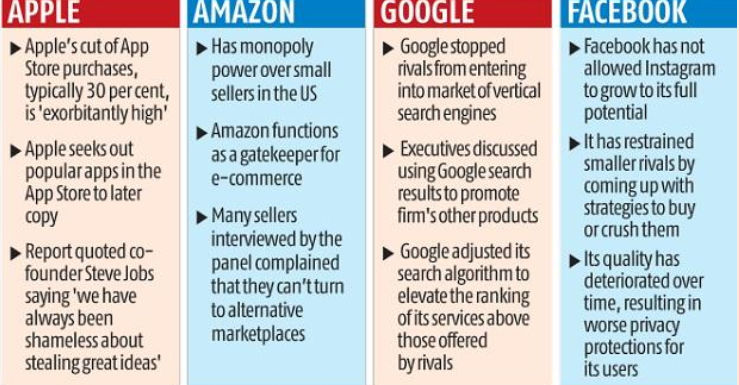
The US legislators have studied the long-standing issues surrounding the matter. They have created a panel to make Amazon, Google, Facebook, and Apple more accountable for their actions. Here are some of the factors for which the companies are under the scanner of US lawmakers:

Source: Business Standard

The Antitrust Subcommittee of the Judiciary Committee in the US is currently looking into the matter. The CEOs of all four companies have already made several appearances before the panel. However, like most cases, these tech companies find loopholes and seem to simply not mind about its consequences. 

With these impressive Q3 results, we can see that no factors seem to affect the growth in their high revenues. At a point when all economic activities were hit, these companies used their position to make the best out of every new possibility. A fine of thousands of crores is okay for these companies when they are making ten thousand crores of profits. Do not forget that these companies are also heavily involved in India, and its development. Let us wait and watch how the Big Tech companies are planning to further dominate in their respective fields.

Categories
Editorial

The Big Techs are too Big!

Yesterday, after the market hours Apple, Alphabet, Amazon and Facebook reported their Q2 earnings of 2020. As millions of people have lost their jobs, it was interesting to see how the big tech giants of the US has fared during the worldwide pandemic.

Apple

Apple reported Q2 2020 results which destroyed the Wall Street estimates. Total net revenue of $59.7 billion was declared, which is a mighty 11% higher than what was recorded in the same period last year. Net profits also increased by 12% from $10.04 billion to $11.2 billion. The major chunk of the increase in revenue has come through the services domain. Revenue from the services segment has increased by 14% whereas from products segment has increased by 10%.

Better financial performance in the quarter has forced Earning per share to rise by almost 19% to reach $2.6. Again, the rise in EPS has beaten the estimates of Yahoo Finance data. 

“We’re conscious of the fact that these results stand in stark relief during a time of real economic adversity for businesses, large and small, and certainly for families. We do not have a zero-sum approach to prosperity, and especially in times like this, we are focused on growing the pie, making sure our success isn’t just our success.” – Chief Executive Officer Tim Cook.

Apple also delivered on its commitment to double its annual service revenue within four years. All this had a positive effect on the company’s stock price. Apple shares went up by 4.7% in after-hours trading. The booming performance in the stock market has prompted them to go for a stock split for the fifth time in their history.

The aim behind the stock split is to make the stock cheaply accessible to the investors who are interested to buy the stock. To know more about the stock split, click here. As coronavirus forced offices, schools and colleges to operate from home, demand for products like iPad and Mac surged. iPad had its best June quarter in eight years whereas the Mac had its second strongest quarter in its history.

Amazon

Amidst the global pandemic, when companies are reporting losses, Amazon has just declared the biggest profit in its 26-year history. As compared to the same quarter previous year, Amazon has reported an increase of 29% in their total revenues, from $63.2 billion to $88.9 billion. With the retail shops shut around the world and fears of stepping out in the mind of people has forced them to look for e-commerce to buy things. 

This has worked hugely in favours of Amazon whose Online grocery sales tripled year over year. Also, their streaming video platform has seen video hours doubled. The sales in online stores have increased exponentially by more than 48% to reach $45.9 billion in the second quarter. 

“Everyone was looking for masks; everyone was looking for gloves; everyone was buying groceries online. That mix is not super profitable,” he said. “What we saw in Q2 was not only did the mix start to shift back to a more normal mix” but that “we also were able to ship a lot more than we had originally thought.” – Brian Olsavsky, Amazon’s chief financial officer.

As the demand for online shopping increased, third-party merchants paid Amazon more to sponsor their products extensively. The companies worldwide are forced to shift to the online mode. Thus, Amazon’s cloud services also saw higher demand as the revenue from Amazon Web Services (AWS) increased by 28% $10.81 billion.

As the demand soared up, Amazon hired 175,000 people in recent months. The costs related to COVID-19 also increased as the company spent around $4 billion on protective equipment for staff. Yet, after incurring high operational expenses, Amazon was able to double in net profit from $26.2 billion to $52.4 billion in just one year.

Alphabet

Alphabet reported Q2 2020 earnings with a 2% dip in total revenue but still beating the street estimates. Total revenue and net income were amassed to be $38.3 billion and $6.96 billion in COVID-hit quarter. A big note of worry for the company is the falling revenue from Google ads for the second straight quarter. Revenue from google ads this quarter was $29.8 billion which is 8% less than what was amassed in the same quarter last year.

“We’re working to help people, businesses and communities in these uncertain times,” said Sundar Pichai, Chief Executive Officer of Google and Alphabet. “As people increasingly turn to online services, our platforms — from Cloud to Google Play to YouTube — are helping our partners provide important services and support their businesses.”

On a brighter side, revenue from Youtube ads and Google Cloud shot up by 5.4% and 43% respectively. The strong growth in both of these segments has aided Alphabet to beat the market estimates. With people putting in their home, video hours of Youtube platform increased which also forced merchants to pay more for their ads to come up. Similarly to AWS, Google Cloud grew massively as offices are switching to the work-from-home model.

Facebook

Just like the previous three tech giants, Facebook went past all the street estimates and registered an 11% rise in revenue from $16.9 billion last year to $18.7 billion. Due to the lower tax rate, their net income has shot up by more than 90%. Facebook daily active users (DAUs) has increased by 12% year-on-year to reach 1.79 billion in June 2020.

Facebook monthly active users (MAUs) also rose by 12% to stand at 2.70 billion. A 15% rise Family monthly active people (MAP) took the number to 3.14 billion as of June 30, 2020. The company has been under severe social pressure in this quarter. A public campaign was run against the company a while ago. Mark Zuckerberg failed to remove one of the comments of President Donald Trump which was deemed instigating by twitter and the public.

A worldwide ad boycott by more than 1,100 companies took place to support #StopHateForProfit campaign. Some of the major brands that have pulled their ads are Coca-Cola, Ford Motor, Puma, Unilever, etc. Even after so many issues, Facebook has managed to do well financially and overcome the street estimates.

Conclusion

The more this pandemic continues, more these tech giants are going to benefit as people shift to online medium for every reason. Whether they want to study or teach, whether they want to buy or sell, whether they want to talk or meet, all of this will be done via online medium. And, the business models of these tech giants readily support this movement of people during the pandemic.

The large tech giants have seen a huge surge in the demand for their products. The dependence of people has increased on them which has helped them to thrive during this pandemic. Every segment of the economy is depending on the tech facilities and this has created a huge boom for these companies. All in all, it has shaped a perfect Tech world.