Categories
Market News Top 10 News

Loan Moratorium Cannot be Extended, says Supreme Court – Top Indian Market News

Loan moratorium cannot be extended: Supreme Court

The Supreme Court (SC), on Tuesday, refused to extend the six-month loan moratorium period offered by the Reserve Bank of India (RBI) last year, saying that it is a ‘policy decision’ on the part of the Central government and RBI. The SC also said that a complete waiver of interest during the moratorium period could not be granted, as banks have to pay interest to account holders and pensioners. The court directed that no compound or penal interest will be charged from borrowers for the moratorium period. Banks can now start declaring their non-performing assets (NPAs) or bad loans. 

On March 27, 2020, the RBI had announced a moratorium on loan installments due between March 1 and May 31 and later extended it by three months till August 31, 2020.

Read more here.

Adani Ports to acquire 58% stake in Gangavaram Port for Rs 3,604 crore

Adani Ports and Special Economic Zone Ltd (ASPEZ) will acquire a 58.1% stake held by DVS Raju and his family in Gangavaram Port Limited (GPL). The cost of the acquisition is Rs 3,604 crore. On March 3, ASPEZ had announced the acquisition of Warburg Pincus’s 31.5% stake in GPL. After the completion of both transactions, ASPEZ will hold an 89.6% stake in GPL. GPL is located in the northern part of Andhra Pradesh and has a capacity of 64 million metric tonnes (MMT).

Read more here.

Mahindra Defence to make armoured tactical vehicles for Indian army

Mahindra Defence Systems Ltd (MDSL) has secured a contract worth Rs 1,056 crore to manufacture and supply armoured tactical vehicles for the Indian Army for its weapon carrier requirements. The light specialist vehicles (LSVs) have undergone rigorous and elaborate trial procedures carried out by the Indian Army in different terrains. The induction of LSVs is said to be completed within four years. MDSL is a subsidiary of Mahindra & Mahindra Ltd.

Read more here.

Allana Group acquires 1% stake in LT Foods for Rs 20 crore

Processed food manufacturer Allana Group said it has pickled a 1% stake in LT Foods Limited for Rs 20 crore. Both companies have plans to use their synergies and technology transfer to expand LT Foods’ consumer products business to focus on value-added and impulse products. LT Foods is a leading player in the rice market with leading brands like Daawat, Royal, and Devayya. The company has established a network in over 65 countries.

Read more here.

Cipla’s subsidiary partners with SIGA Technologies to develop novel antibiotics

Cipla Limited said its subsidiary, Cipla Therapeutics, has partnered with US-based SIGA Technologies to develop novel antibiotics. The partnership is aimed at making Cipla’s novel antibiotics available to the US government as part of preparations against biological threats. The strategic partnership will deliver sustained innovation and access to novel anti-bacterial drugs, particularly against biothreats.

Read more here.

Govt to raise Rs 755 crore by selling 15% stake in RVNL

The Central government will raise nearly Rs 755 crore by selling its 15% stake in Rail Vikas Nigam Ltd (RVNL) through an offer for sale (OFS). The floor price for the OFS has been fixed at Rs 27.50 per share. The issue will open on Wednesday for non-retail investors and on Thursday for retail investors. The Centre’s shareholding in RVNL will decline to 74.67% after the stake sale.

Read more here.

HG Infra receives provisional completion certificate for road project in Maharashtra

HG Infra Engineering has received a provisional completion certificate from the National Highways Authority of India (NHAI) for a road project in Maharashtra. The project consisted of four-laning the Bhandara- Khat-Ghotitok Junction section (NH-7, NH-547E) in Maharashtra on an engineering, procurement, and construction (EPC) mode. The NHAI had declared the project fit for entry into operation as of February 29, 2020.

Read more here

Bharti Airtel’s Africa unit to sell 1,421 towers to Helios for $108 million 

Bharti Airtel’s Africa unit (Airtel Africa) has signed a pact with Helios Towers Plc to sell 1,229 towers in Madagascar and Malawai for $108 million (~Rs 782 crore). Airtel Africa Plc will also build 195 sites across the two regions over the next three years for $11 million (~Rs 79.72 crore). These sites will be handed over to Helios Towers upon completion. The transactions are expected to close in or around Q4 of calendar year 2021.

Read more here.

Glenmark Pharma gets USFDA approval for diltiazem hydrochloride capsules

Glenmark Pharmaceuticals said it has received final approval from the US Food & Drug Administration (USFDA) for diltiazem hydrochloride extended‐release (ER) capsules. The product is indicated for the treatment of hypertension. As per IQVIA data, the generic version of the capsules had sales of approximately $56.7 million (~Rs 410.75 crore) for the 12 months ended January 2021.

Read more here.

Trident partners with California-based Kathy Ireland Worldwide

Trident Limited said it has further strengthened its brand portfolio with the recent addition of the “Kathy Ireland” brand. The company has entered into a licensing agreement with California-based Kathy Ireland Worldwide Inc. As per the agreement, Trident will have the right to use the “Kathy Ireland” trademark under its range of home textile products. The collection will also be included in Trident’s rapidly expanding e-commerce business.

Alkem Labs partners with Tata Memorial Centre

Alkem Laboratories has partnered with Tata Memorial Centre (TMC) for establishing an advanced radiotherapy facility in Muzaffarpur and to set up three mini cancer centers in Bihar. These centers will connect cancer patients of Buxar, Jehanabad, and Bhagalpur districts by telemedicine to Homi Bhabha Cancer Hospital & Research Center, Muzaffarpur. The centers will also work with the district administration on community activities such as cancer awareness and screening.

Read more here.

Categories
Editorial

A Timeline of the Farmers’ Protests in India

Farmers have been protesting against the highly controversial farm laws that were passed by the Indian Parliament in September 2020. Till date, the government and farmers’ unions have not reached an agreement on this matter. The agitating farmers had also intensified their protests by boycotting the products of Reliance, as they believed that the new laws would benefit the company. Recently, the Central Government put forth an offer towards the farmer groups. They have proposed to suspend the three farm laws for a period of up to 1.5 years. 

Let us now have a clear understanding of the important events that have taken place over the past few months.

What are the Three Farm Laws?

The Farmers’ Produce Trade and Commerce (Promotion and Facilitation) Act, the Farmers (Empowerment and Protection) Agreement of Price Assurance and Farm Services Act, and the Essential Commodities (Amendment) Act were passed by both houses of the Parliament in September. The bills mentioned were turned into laws on September 27, after receiving the approval of the President.

The Union Government stated that these laws would help accelerate the overall growth of the agricultural sector. It would encourage private investments in improving infrastructure and supply chains for farm produce in national and global markets. The laws were essentially intended to help small farmers get a better price for their agricultural produce. The primary aim of one of these laws was to allow farmers to sell their produce to any buyer of their choice. They would be able to bypass middlemen or commission agents at state-controlled marketplaces (mandis). 

The legislation on contract farming will allow farmers to enter into a contract with agricultural business firms or large retailers on pre-agreed prices of their produce. The Essential Commodities (Amendment) Bill seeks to remove commodities like cereals, pulses, oilseeds, edible oils, onions, and potatoes from the list of essential commodities. This will end the imposition of stock-holding limits, except under extraordinary circumstances.

Why are Farmers Protesting?

Farmers are afraid that these laws may allow the government to introduce a price-discovery mechanism that would completely replace/scrap the current system that they are content with. Many farmers see the minimum support price (MSP) as a vital safety net and fear that it could be removed. In the absence of state-owned marketplaces (mandis) and MSPs, farmers would be forced to sell their products at a cheaper rate. They have even alleged that large companies such as Reliance Industries and Adani Group would benefit from these laws. We recently saw that farmers damaged more than 1,500 telecom towers of Reliance Jio in Punjab. You can read more about it here.

Since November 26, lakhs of farmers from Punjab, Haryana, and Uttar Pradesh have been protesting and camping at the borders of Delhi. They have become extremely angry at the government for introducing laws that could potentially harm them. The farmers and support groups have stated that they would not stop until all three laws have been repealed. They have also demanded the government to ensure a legal guarantee of MSP. Protests are going on in agriculture-dominated states in India as well. As we know, there have been violent clashes between the agitated protesters and police.

Agriculture Minister Narendra Singh Tomar assured that the MSP mechanism will be continued. He also stated that adequate protection of land ownership was in place to protect farmers’ interests. PM Narendra Modi also stated that these laws are meant to protect and provide benefits to all farmers in India. However, the farmers are not ready to stop their protests until their demands are met.

What Happened Next?

Since the beginning of December, the Central Government and farmers’ associations have conducted numerous talks/discussions to find a middle ground. All discussions have failed miserably, and farmers have further intensified their protests. On December 15, it was reported that the farmers’ protests affected trade and other economic activities worth Rs 5,000 crore during the past 20 days. The blocking of national highways has led to disruptions in supply chains. The Confederation of Indian Industry (CII) stated that the protests could also affect India’s ongoing recovery from the economic contraction due to Covid-19.

Ultimately, the Supreme Court (SC) had to intervene, as it observed that the farmer’s protests had become extremely violent and even led to several deaths. On December 16, a Supreme Court bench, led by Chief Justice SA Bobde and Justices AS Bopanna & V Ramasubramanian, stated that it intends to form a committee consisting of representatives from farmers unions, government, and other stakeholders to end the deadlock. Since then, the special bench of SC has been hearing statements from all concerned parties. 

Recent Developments

On January 11, the Chief Justice stated that the court was extremely disappointed with the way the Centre was dealing with the farm laws. It also observed that current negotiations between a delegation of protestors and several Union Ministers were not reaping any results. On January 12, the Supreme Court stayed the implementation of the Centre’s three farm laws till further notice. It constituted an expert committee that will take inputs from all the relevant stakeholders regarding the protests and the farmers’ concerns. The committee comprised of the following members:

1. Bhupinder Singh Mann, President of the Bharatiya Kisan Union and Chairman of the Kisan Coordination Committee

2. Policy expert Dr. Pramod Joshi

.3 Agricultural economist Ashok Gulati

4. Anil Ghanvat of the Shetkari Sangathan (A Maharashtra-based farmers union)

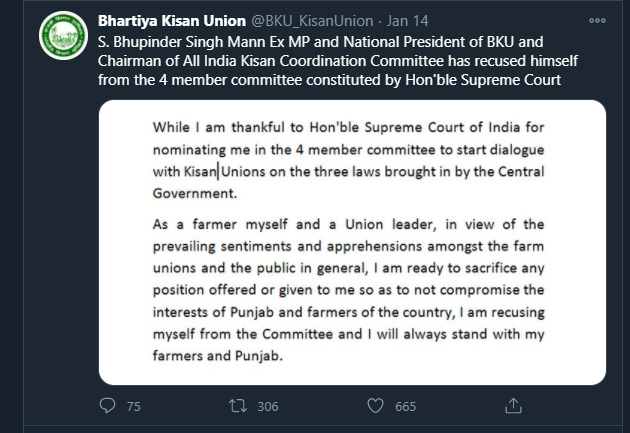
The farmer unions have welcomed the stay on the three bills but have rejected the committee. They argue that all four appointed members had openly supported the laws in the media. The protesting farmers and support groups said that the committee is one-sided and will work in favour of the government. On January 14, Bhupinder Singh Mann opted out of becoming a part of the SC-appointed panel. He said, “Since protesting farmers have announced not to appear before the committee, there is no point in being part of it.”

The ninth round of talks between the government and farmers’ unions was held on January 15. Both parties were still not able to reach an agreement. “It was a 120% failure. We suggested that the government remove the changes made to the Essential Commodities Act instead of scrapping it altogether. But the Agriculture Minister has not said anything on this”, said farmers’ leader Dr. Darshan Pal. Leaders of 40 farmers’ unions negotiating with the Centre stated that they want direct communication with top government officials, and not “brokers”.

The Way Ahead

Time and again, the farmer groups have reiterated that they would not stop their protests until all three laws have been repealed. On January 20, the Central Government proposed to suspend the three farm laws for 1-1.5 years and set up a joint committee to discuss them. The farmer leaders did not immediately accept the proposal, stating that they would hold internal consultations first. In a full general body meeting of Samyukt Kisan Morcha (the umbrella body of 41 protesting farmer unions), the members rejected the government’s proposal.

Meanwhile, Reliance Industries (RIL) has been facing the heat of the protesters. The farmers and support groups had called for a total boycott of the group’s products. Recent reports state that retail stores of RIL were forced to shut down due to the farmers’ protests, which caused losses for the company. RIL has outrightly stated that the farm laws would not benefit them in any way. The company said it would continue to show its support for the upliftment of farmers in India. On the other hand, they even made a serious allegation that Bharti Airtel and Vodafone Idea had created false propaganda, which led to the telecom tower vandalism and Reliance Jio losing its subscribers. For now, the “blame-game” between these companies has seemed to quiet down.

The agitated farmers are planning to show their dissent by organising a tractor march on Republic Day. Let us hope to see positive results from these negotiations and Supreme Court judgments in the days to come. It is disheartening to see reports stating that more than 70 farmers have died at the protest sites. Will the Central Government fulfil the demands of the farmers? We will have to wait and watch.

Categories
Market News

SC reserves order on the timeline for AGR dues to be paid.

The Supreme Court today once again reserved its order on the much-talked-of AGR (Adjusted Gross Revenue) case. The timeline for the payment of AGR dues is still debatable.

The Sum and Substance of Today’s Hearing

  •  A three-judge bench of Justices Arun Mishra, S Abdul Nazeer and MR Shah heard the case. The court reserved their order to decide the timeline withing which the telecom operators were to pay their dues.
  • The SC stated that the calculation of AGR dues by the Department Of Telecommunications should be treated as final as that there is no room for self-assessment or renegotiation by any of the respondents.
  • Vodafone-Idea represented by counsel Mukul Rohatgi expressed poor liquidity, disposable assets and lack of sufficient funds on part of Vodafone-Idea to be able to pay the dues. Moreover, he requested for a period of 20 years and at best 15 years for Vodafone-Idea to pay its AGR dues.
  • Bharti Airtel represented by counsel Abhishek Manu Singhvi stated that the Government had wrongly charged Bharti Airtel for Spectrum Usage Charges (SUC) which should not be a part of AGR dues. He requested for a period of 10 or 20 Years since upfront payments could affect the 11,000 employees of the company and services provided by the company itself.
  • Senior Advocate Mohan Parasaran on behalf TATA Telecommunications stated that the company submits to SC that a 7-10 year period would be reasonable for repaying AGR dues.

As per DoT estimates, telecom companies owe a total of Rs 1.19 lakh crore with payments received so far at Rs 26,896 crore. The balance amount to be paid is currently at Rs 92,520 crore.