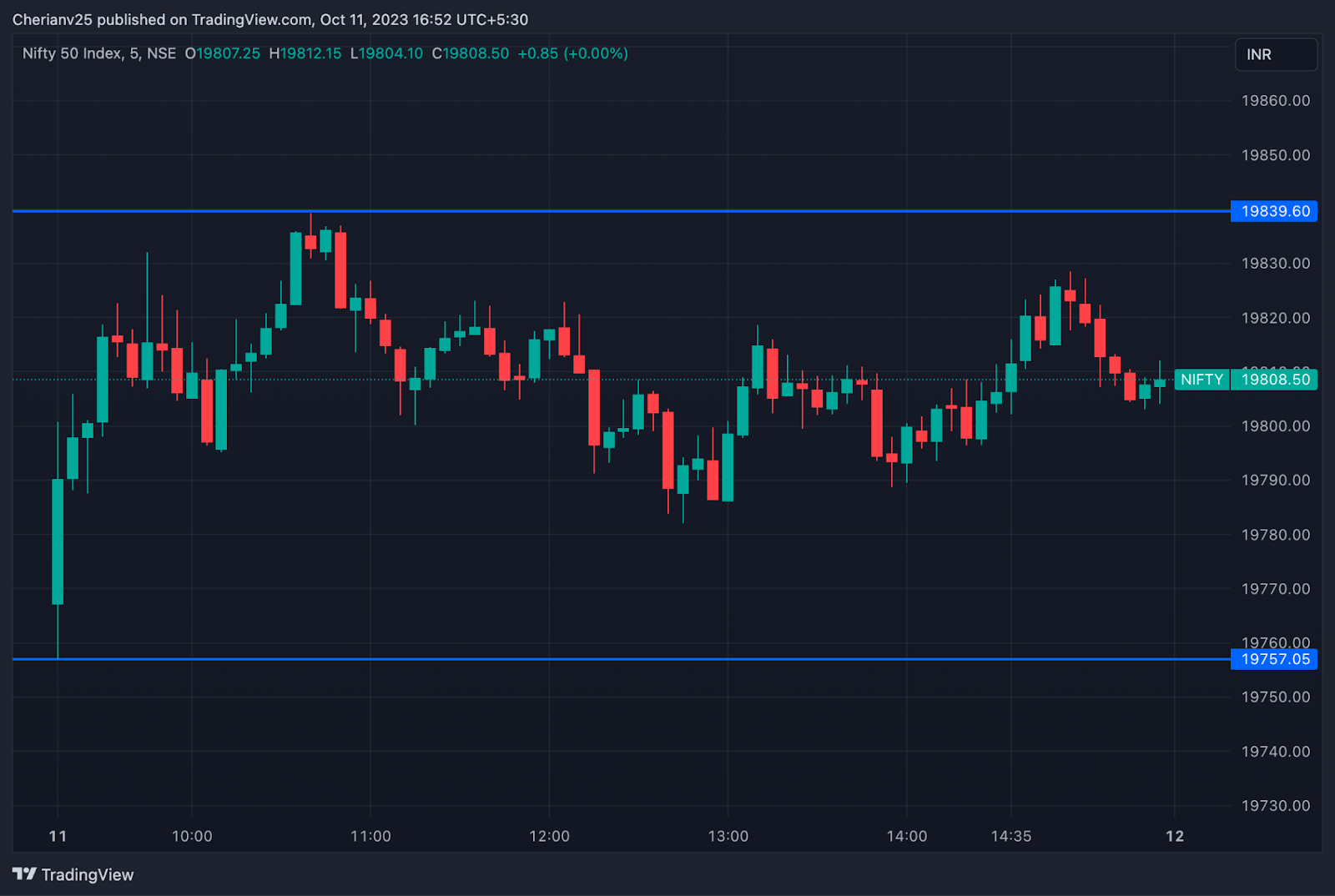
NIFTY started the day at 19,767 with a gap-up of 77 points. After moving up to 19,840 levels, the index consolidated in a 50-point range throughout the day. Nifty closed at 19,811, up by 121 points or 0.62%.
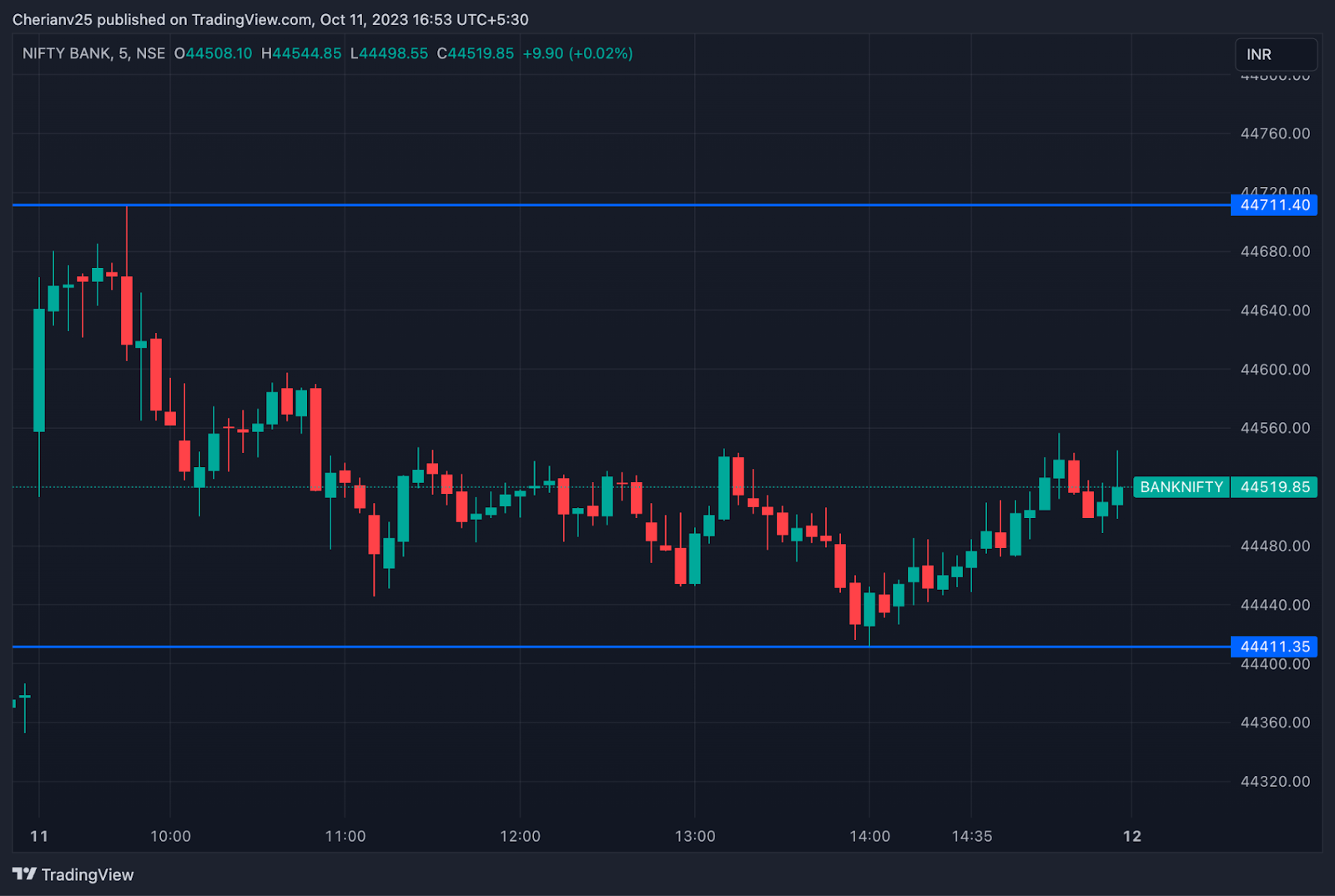
BANK NIFTY (BNF) started the day at 44,554 with a gap-up of 194 points. After moving up to 44,700 levels, the index consolidated with a negative bias till yesterday’s closing levels of 44,400. BNF closed at 44,516, up by 156 points or 0.35%.
All indices except Nifty PSU Bank (-0.73%) closed flat-to-green. Nifty Auto (+0.92%) moved up the most.
Major Asian markets closed up to 1.5% in the green. France’s CAC40 is currently trading in the red, while Germany’s DAX and the UK’s FTSE100 are trading in the green.
Today’s Moves
Hero MotoCorp (+4.17%) was NIFTY50’s top gainer. Brokerage firm CLSA has upgraded its rating on the stock to ‘Buy’ and raised the target price to ₹3,701 per share (from ₹3,142 earlier).
Laxmi Organics (+11.43%) surged after the company raised ₹259 crore through a qualified institutional placement (QIP).
Vodafone Idea (+7.2%) rose after the telco moved the Supreme Court regarding its Adjusted Gross Revenue (AGR) dues plea, with the apex court agreeing to consider the matter.
HCL Tech (-1.28%) was NIFTY50’s top loser. The IT major is expected to report growth in the constant currency revenue in Q2 FY24 after a consecutive decline in the previous two quarters.
Bank of Baroda (-3.31%) fell sharply after RBI suspended the bank from onboarding new customers on its ‘bob World’ app.
Markets Ahead
Nifty has hit our target of 19,800 levels and faced resistance from the gap-filling levels of 19,840 and stayed there. Bank Nifty is also holding the upper levels and might continue the up-move if today’s lows are not breached.
Nifty: The immediate support for the index is near 19,780. Meanwhile, the immediate resistance to watch out for is the 19,880 level. A breakout from there could take Nifty up to 19,946 and 20,000 levels eventually.
Bank Nifty: The immediate support is near 44,400. A breakdown from this level might take the index down to 44,180 and 44,080. On the other hand, 44,750 is the immediate resistance to watch out. A breakout from there may give us targets of 45,000 and 45,100.
Being Bank Nifty expiry today, the market was more or less calm and consolidating. Tomorrow’s Nifty expiry can be trending based on the breakdown or breakout levels. So watch out for the key levels.
Tata Consultancy Services (TCS) has kick-started the results season! The IT major reported a 9% year-on-year (YoY) growth in consolidated net profit for the quarter ended September 2023 (Q2 FY24) to ₹11,342 crore. Consolidated revenue grew nearly 8% YoY to ₹59,692 crore in Q2.
What levels are you watching out for Nifty tomorrow? Let us know in the comments section below!
Please tune in to The Stock Market Show at 7 PM on our YouTube channel.
Here are some of the major updates that could move the markets tomorrow:
NCLT approves ZEEL’s merger with Sony
The Mumbai bench of the National Company Law Tribunal (NCLT) has approved the merger scheme between Zee Entertainment Enterprises Ltd (ZEEL) with Culver Max Entertainment (Sony). The tribunal has also dismissed all objections regarding the merger. This is a key regulatory approval for the mega-merger, aimed at creating a $10-billion media giant.
Reserve Bank of India (RBI) left the repo rate (key policy rate) unchanged at 6.5%. The central bank’s Monetary Policy Committee (MPC) also retained its withdrawal of accommodation stance to ensure that the retail inflation remains within the target of 4%. The RBI retained the GDP growth projection for the current financial year (FY24) at 6.5% and raised the inflation projection marginally to 5.4%
Grasim Q1 Results: Net profit falls 18% YoY to ₹1,576 crore
Grasim Industries reported an 18% YoY fall in consolidated net profit to ₹1,576 crore for the quarter ended June (Q1 FY24). Its consolidated revenue for the quarter stood at ₹31,065 crore, up 10.7% YoY. The decline in net profit could be attributed to an over 14% YoY jump in its total expenses for Q1 at ₹27,923.38 crore.
SBI Card and National Payments Corporation of India (NPCI) announced the linking of SBI credit cards on the RuPay platform with UPI. The company’s customers will now be able to make UPI transactions through credit cards issued on RuPay. The facility can be availed of by registering the credit card with third-party UPI apps.
Samvardhana Motherson Q1 Results: Net profit jumps four-fold to ₹601 crore
Samvardhana Motherson reported a four-fold rise in consolidated net profit to ₹601 crore for the June quarter (Q1 FY24). Its consolidated revenue from operations rose 27% YoY to ₹22,462 crore during the same period. EBITDA stood at ₹1,940 crore, up 69% YoY, driven by operating efficiency, and softening of material and energy prices.
Pidilite Q1 Results: Net profit rises 32% YoY to ₹474 crore
Pidilite Industries reported a 31.5% YoY jump in net profit to ₹473.7 crore for Q1 FY24. Its consolidated revenue rose 5.6% YoY to ₹3,275.1 crore during the same period. EBITDA rose 33.5% YoY ₹706.8 crore from ₹529.5 crore in the same quarter last year. EBITDA margin also expanded by 450 basis points (bps) from 17.1%, YoY to 21.6%.
Godrej Cons to build manufacturing facility in Tamil Nadu
Godrej Consumer Products Ltd (GCPL) announced that it has signed a Memorandum of Understanding (MoU) with the state government of Tamil Nadu. The MoU is for building a manufacturing facility near Chennai. The company will make an investment of ₹515 crore over the next five years. It will serve as a manufacturing hub for brands such as Cinthol, Godrej Expert Rich Crème, Godrej Selfie Shampoo Hair Colour, and Goodknight.
Hero MotoCorp Q1 Results: Net profit rises 32% YoY to ₹825 crore
Hero MotoCorp reported a 32% YoY increase in net profit to ₹825 crore for Q1 FY24. Its consolidated revenue rose 4.5% YoY to ₹8,767.3 crore during the same period. EBITDA grew 28% YoY ₹1,206 crore in Q1. The company incurred a one-time cost of ₹160 crore towards the voluntary retirement scheme (VRS) offered to certain employees.
NHPC plans to build pumped hydro storage projects of 22,000 MW
NHPC Ltd is planning to develop around 20,000-22,000 MW of pumped hydro energy storage projects in the coming years. The capacities are being explored in Odisha, Maharashtra, Madhya Pradesh and Andhra Pradesh. However, the detailed project report and the approvals are likely to take a couple of years for at least some of these capacities to start building.
Vi seeks time till Dec to clear its statutory dues
Vodafone Idea has sought time till the end of December 2023 to clear its remaining statutory dues. The company hopes to close its fundraising from banks and third-party investors in the “near future” and is reiterating that its promoters are “committed” to supporting the company. Replying to a Department of Telecommunications (DoT) show cause notice, the company cited continuing liquidity challenges due to its delayed fundraising.
LIC Q1 Results: Net profit jumps 14x to ₹9,544 crore
Life Insurance Corporation of India (LIC) reported a 14x YoY increase in net profit to ₹9,544 crore for Q1 FY24. Its net premium income was flat at ₹98,363 crore during the same period. Income from investments rose 30% YoY to ₹90,309 crore in Q1.
Hindalco, Texmaco to make aluminium rail wagons, coaches
Hindalco Industries and Texmaco Rail & Engineering have entered into a strategic alliance and announced a ₹200 crore investment to develop and manufacture aluminium rail wagons and coaches that will help the Indian Railways achieve emission goals and boost operating efficiency. Texmaco is the flagship of the Adventz Group.
The Government of India has become the largest shareholder in private telecom company Vodafone Idea. Vi has faced quite some turbulence in terms of its finances and is heavily burdened by debt to banks as well as the government. The government will be the largest shareholder in Vodafone Idea after converting all of its pending interest on Adjusted Gross Revenue (AGR) dues to equity. The government would now own a 35.8% stake worth Rs 16,000 crore in Vi. This piece covers all you need to know about the deal between the two entities.
Click here to know more about the AGR dues saga that shook the telecom industry.
Government Holds The Largest Stake in Vodafone Idea (Vi)
Quite a few telecom companies came under pressure after a Supreme Court verdict ordered them to pay ‘pending’ AGR dues to the Telecom Regulatory Authority of India (TRAI). These dues ran into thousands of crores—something which they could not afford after a disrupted telecom sector.
Moving on, the government had come up with financial relief packages for distressed telecom companies burdened by AGR dues. While these relief packages have managed to keep Vodafone Idea and Bharti Airtel afloat, they have done little to ensure faster recovery dues. Vodafone Idea owed the government ₹58,254 crore in AGR dues. It has paid back ₹7,854 crore or 13% of the total dues. The company faced stiff competition from its relatively better-off rivals Airtel and Jio. BothVi and Airtel had the daunting task of clearing AGR dues along with expanding their business.
The government eventually proposed converting all the pending interest on the spectrum and AGR dues into anequity stake in telcos. Vodafone Idea accepted the deal.
It is a pretty common practice in the business world wherein a lender converts the pending debt into equity shareholding. The government now owns a 35.8% stake worth Rs 16,000 crore in Vodafone Idea. This deal has brought down the combined promoter holding of Vodafone Plc and Aditya Birla Group from ~72% to ~46%. “The shares may be held through the statutory undertaking of the Unit Trust of India (SUUTI) on behalf of the Government of India or by any trustee-type or other suitable arrangement,” said Vodafone Idea in an exchange filing.
Vodafone Idea NOT a Public Sector Undertaking (PSU)
The stock hit the lower circuit after the announcement. The first question that comes to the mind of an average shareholder is: Will Vodafone Idea become a PSU? The answer is, no.
The government holding a majority stake in Vi does not make the company a PSU. TRAI has confirmed that the government shall not pay to acquire any shares, nor does it intend to convert telcos into PSUs.
Vodafone Idea’s Managing Director Ravinder Takkar said in a statement that the government had no intention to manage the company’s business. He stated that the article of association was amended to allow voting rights to shareholders with taking over 13%, allowing promoters to make decisions even if their shareholding falls below 21%. Long story short, the promoters Vodafone Group and Aditya Birla Group will continue to manage the company.
Vodafone Idea’s shares rallied ~11% after the statement by MD Ravinder Takkar.
Despite reassurances from government officials and company management, one must not forget that the government is the largest shareholder in Vodafone Idea. It could decide to move back on its word and take over or influence Vi’s management if the need arises.
The Way Ahead
After the decision to convert pending dues into equity was announced, Vi’s shares nosedived ~20% in a single trading session. The company gained ~11% after MD Ravinder Takkar announced that the government had no intention to participate in management decisions.
After Vodafone Idea, Tata Teleservices said it is planning to convert its interest on AGR dues into government equity. Tata Teleservices has AGR dues of Rs 16,798 crore, of which it has paid Rs 4,197 crore. Following conversion, it is expected that the Government will hold nearly 9.5% of the company’s total outstanding shares. The company’s stock price (NSE: TTML) hit a lower circuit after the announcement.
There is also BSNL and a possible merger with the state-run telecom. Although the current stand is to not interfere in Vi’s operations, there is a possibility it could be changed.
Mukesh Ambani’s Jio had managed to capture a significant market share through its competitive pricing. According to a Competition Commission of India (CCI) report, there were 21 telecom companies in 2009. The figure died down to just 6 companies in 2021. Out of the six, two are financially distressed PSUs. One is defunct, and the remaining three are the only active private players in the country. The government is trying to keep afloat all three private players, i.e. Jio, Airtel, and Vodafone Idea. If one company shuts down, there would be a duopoly in the sector. A duopoly would give telecom companies greater bargaining power over their consumers, which would go against an average Indian citizen and thereby the government.
Vodafone Idea Ltd (Vi) has been all over the news lately. Unfortunately, none of the reports about the company are positive. They are losing lakhs of subscribers rapidly and are destined to file for bankruptcy soon. There is a high level of uncertainty surrounding the survival of the telecom operator. Many feel that Vi is staring at slow death. The company’s shares have plummeted nearly 30% over the past month.
In this article, we take a closer look into the current state of Vodafone Idea and its recent financial performance.
Vi’s Massive Debt
With the exception of Reliance Jio, the major players in the Indian telecom industry are struggling with high debt. Companies have to pay hefty charges for operating and using the public airwaves in our country. They obtain rights to transmit signals over specific bands through telecom spectrum auctions. As of 2019, telecom operators collectively owed nearly Rs 1.47 lakh crore to the Centre. They were offered an extension of two years to pay off all financial obligations with interest. Vodafone Idea’s deferred spectrum charges stand at Rs 1.06 lakh crore! Reports suggest that Vi will have to pay an installment of ~Rs 16,000 crore at the end of March 2022.
Then comes Adjusted Gross Revenue (AGR) dues. Under this revenue-sharing model (introduced in 1999), telecos are required to share a percentage of their total income with the government as annual license fees and spectrum usage charges. AGR covers the revenue earned by telecom firms, including from non-telecom sources such as deposit interests and the sale of assets. [Read more on AGR dues here].
Vodafone Idea’s total liability towards AGR dues stands at Rs 62,180 crore (as of June 30, 2021)! An installment of ~Rs 8,400 is due in March 2022. Moreover, Vi’s debt from banks and financial institutions stands at Rs 23,400 crore. All these have caused a severe dent in the company’s balance sheet.
Heavy Competition
As we know, Vodafone Idea faces stiff competition from Reliance Jio Infocomm and Bharti Airtel. Jio dominates India’s mobile market and has maintained over 35% gross subscriber market share since July 2020. They plan on launching 5G services very soon. On the other hand, Bharti Airtel had outperformed Jio in terms of active subscriber rates over the past few quarters. In February 2021, they also became the first telecom company to demonstrate 5G over a live commercial network in India (in Hyderabad).
Meanwhile, Vodafone Idea has been losing lakhs of subscribers. The company has been in deep trouble ever since Jio introduced aggressive tariff rates in India. From November 2019 to February 2021, Vi reportedly lost over 5 crore subscribers. Their rivals had collectively added over 6.6 crore subscribers during the same period. The cash-strapped company is finding it extremely difficult to compete with low tariff rates and invest in 4G/5G infrastructure.
Vi’s management has to constantly focus on retaining customers and paying their AGR dues.
Disappointing Q1 Results
Vi posted its quarterly results for the April-June quarter (Q1 FY22) on August 14, 2021. The results were below the street/analysts’ estimates. Let us look at the main highlights:
Vodafone Idea reported a net loss of Rs 7319.1 crore for the quarter ended June (Q1 FY22). It had posted a net loss of Rs 7,022.8 crore in the previous quarter (Q4 FY21). Net loss in Q1 FY21 stood at Rs 25,460, mainly due to provisioning for AGR dues liability.
The telecom operator’s revenue fell 4.7% QoQ (or 14% YoY) to Rs 9,152.3 crore in Q1. This is the company’s lowest quarterly revenue in more than two years. Fewer recharges due to localised lockdowns, free validity extensions for low-cost customers, and a general slowdown in economic activity affected revenue in Q1.
Vi’s wireless subscriber base stood at 25.54 crore as of June 30, 2021. Unfortunately, they had lost 1.23 crore subscribers since March. The 4G subscriber base stood at 1.23 crore, a decline of 10 lakh subscribers during the quarter.
The Average Revenue Per User (ARPU) declined to Rs 104 in Q1 FY22, compared to Rs 107 in Q4 FY21. For comparison, Bharti Airtel had an ARPU of Rs 146, whereas Jio had an ARPU of Rs 138 in Q1.
Vi’s net debt stood at Rs 1,90,670 crore in Q1, an increase of 5.95% QoQ (or 65.1% YoY).
What Next for Vi?
Sadly, theVodafone Group has made it clear it will not infuse any additional capital into the loss-making venture with Aditya Birla Group. In a desperate attempt to save Vi, Kumar Mangalam Birla wrote a letter to the Indian government last month. He offered to hand over his stake in the company to any public sector entity. He pleaded with the Centre to consider the “looming crisis” that the telecom operator is going through and bail them out. On August 4, Vodafone Idea announced the Birla has stepped down as Non-Executive Director and Non-Executive Chairman of the Board. Many argue that the Indian telecom industry is struggling now as a result of the brutal or repressive policies introduced by past governments.
Over the past few months, Vi has been trying to convince the Telecom Regulatory Authority of India (TRAI) to impose a floor price or a minimum tariff rate. The company has stated that such a measure will help existing telecom operators to earn more. Vodafone Idea has also pleaded to the Centre to extend the moratorium on spectrum dues. They are eagerly awaiting a judgment on these appeals.
According to analysts, Vi is staring at a ‘slow death’ if it fails to quickly raise ~Rs 26,000-37,000 crore that it urgently requires to clear AGR dues, payment obligations, and invest in 4G networks. Reports are flying around stating that the Centre will soon announce a telecom relief package, and work is underway to provide aid to stressed telecom companies.
Will Vodafone Idea survive? Or will it completely collapse and die? We will have to patiently wait and watch. Let us know your views on the topic in the comments section of the marketfeed app.
The Union Government has abolished the much-despised ‘Retrospective Taxation Law’ that was introduced in 2012. This move could change India’s reputation as an investment hub in foreign markets. So what exactly is retrospective taxation? Why was it introduced? Why was it abolished and what does it mean for the country? Read on to know more.
What Is Retrospective Tax?
Retrospective taxation allows a country to pass a rule on taxing certain products, items, services, and deals, and charges companies from a time behind the date on which the law is passed. Many countries use the law to correct any irregularity in their taxation policies that allowed companies to take advantage of such loopholes in the past. In simple terms, the government can tax companies for transactions made in the past.
Let us take a simple example. Raj is a student who has recently moved to Banglore. For the first three months, he pays a rent of Rs 5,000 as agreed with the landlord. After three months, the landlord increases the rent to Rs 6,000. Raj agrees to pay, but the landlord says that the rent for the first three months should also be Rs 6,000. Therefore, Raj will have to pay Rs 1,000 extra per month for the first three months he has stayed. This is exactly the kind of power the government has with the retrospective taxation law.
The History
The law was introduced in 2012 when the government was fighting Vodafone in the courts. Vodafone acquired Hutch (Hutchison Essar Telecom services) in 2007. In 2011, the government raised a tax demand of Rs 7,990 crore as capital gains tax. The government believed that the company had made capital gains and it should have retained the tax amount during the transaction itself.
The company declined to pay since it believed that the transaction did not fall under India’s tax jurisdiction. This was because Vodafone UK, through its subsidiary in the Netherlands, had acquired Hutchison which was based in Hongkong. Moreover, the entire transaction took place in the Cayman Islands.
Subsequently, the company and the government took the case to the High Court, which ruled in favor of the government. Subsequently, Vodafone appealed to the Supreme Court and won the case. Late Pranab Mukherjee, who was the Finance Minister at that time, decided to have Retrospective Taxation in India. This allowed the government to tax companies based on previous transactions. So, if a new tax law came today, the government could apply it and tax companies based on past transactions.
Another such dispute was with UK-based Cairn Energy. The company took a similar case against the Indian Government to the Arbitral Tribunal in Hague (Netherlands) and won a ruling in its favor. The Permanent Court of Arbitration at the Hague ruled that the Indian government should pay damages worth $1.2 billion to Cairn Energy since it had wrongfully applied a retrospective tax demand.
What Next?
The Retrospective Tax aimed to increase government revenue by ensuring that companies do not doge tax. All this, but at what cost? The law was unfair for corporations since taxing previously dated transactions was against the spirit of justice. As in the case of Cairn Energy (UK), the Permanent Court of Arbitration ruled that “the Indian government’s retrospective demand was in breach of the guarantee of fair and equitable treatment”. Retrospective Taxation earned India severe disrepute in the international forum. A country in a dire need of foreign investments has to ensure that its taxation policies are welcoming for multinational companies.
The Indian government has signed a bilateral treaty with both the UK and the Netherlands. This ensures that both countries allow businesses to function seamlessly in each other’s jurisdiction without unfair treatment. India seems to have failed to uphold its obligations under both treaties.
On the retrospective taxation law, Prime Minister Narendra Modi said that ‘thedecision taken by India to get rid of retrospective taxation shows our commitment, shows consistency in policies and gives a clear message to all the investors that India is not only opening the doors of new possibilities but the decisive Government of India, has the will to fulfill its promises’.
Here’s a question for you. Do you think that the Indian government’s taxation policy is hostile to international investment? You can let us know in the comment section of the marketfeed app.
Vodafone-Idea Group has re-branded as ‘Vi’ as it looks for a fresh start. The company announced the move after the Supreme Court gave its verdict on the AGR dues case (Read More Here). In the verdict, the apex court gave Vodafone-Idea Ltd, a period of 10 years to clear its pending dues of Rs 54,754 crore.
Many of us still don’t the amazing journey of the brand where it moved from Max Touch to Orange to Hutch to Vodafone to Vodafone Idea and finally now to Vi. So come let’s learn about this journey, both from the perpectives of Vodafone and of Idea.
What is now Vodafone-Idea Ltd is actually a result of a mixture of Mergers and Acquisitions. From Max Touch to Orange to Hutch to Vodafone Idea to Vi. The Indian economy became an easier playing ground for private sector telecom companies in the early 1990’s. Both today’s Idea and today’s Vodafone were early movers in the field.
The Journey of Vodafone
Vodafone India didn’t just start out as Vodafone. At first, it was Hutchison Max Telecom Ltd (HMTL), a joint venture between Hong Kong based Hutchison Whampoa and India’s Max Group. The company was established in 1992 and commercially called Max Touch.
In the year 2000, the company was rebranded to Orange.
In 2005-06, Max group sold its entire 41% stake to Hutchison, and exited the partnership. Meanwhile Essar Group entered as a strategic partner in the equation.
BPL, another telecom player, was merged with Hutchison Essar in 2004.Furthermore, the company rebranded itself from ‘Orange’ to ‘Hutch’ in 2005, after facing an issue with international copyrights.
Thereafter, it also targeted business users and high-end post-paid customers which helped Hutch to consistently generate a higher Average Revenue Per User (ARPU) than its competitors. By adopting this focused growth plan, it was able to establish leading positions in India’s largest markets providing the resources to expand its footprint nationwide.
Vodafone, which was a leading telecom operator in UK entered the Indian market and acquired the entire 67% stake of Hutchison in February 2007. The company was soon rebranded to Vodafone India. Vodafone later went on to buying out the entire company from other promoters Essar Group and Li Ka Shing Holdings in 2011.
The Journey of Idea
In another side of the story, Aditya Birla Group’s Idea was slowly building up their business as well. Idea Cellular began as Birla Communications Limited in 1995 after GSM licenses were won in Gujarat and Maharashtra circles.
As part of their expansion plans, American telecom giant AT&T was roped in as a strategic partner by Birla in 1996. In 1997, in order to expand into more geographical areas, a tie-up with Tata Communications led by Ratan Tata was also formed. The merged entity was known as Birla AT&T and Tata Communications Ltd, commonly known as BATATA.
The company name was changed to Idea Cellular in 2002 after a series of changes following mergers and joint ventures. In 2004, AT&T exited the partnership to concentrate on their US operations. In 2006, Tata Group exited the partnership as well as they wanted to launch their own telecom brand, which later failed anyway. So after all the partnerships ended, the Birla Group led the company alone until the eventual merger with Vodafone in 2018.
We hope you remember the popular telecom operator Escotel (fun fact : They were the first telecom operator to start operations in Kerala in 1996). Interestingly, Escotel was merged with Idea in 2004 (Another fun fact : Escotel was the disastrous telecom wing of Tractor manufacturer Escorts Ltd).
Four days later after Vodafone entered the country in 2007, Idea Cellular launched its IPO and raised ₹2,125 crores. The IPO was oversubscribed by 57 times. It is interesting to note that the paths of Vodafone and Idea have crossed many times like two soulmates, and ultimately ending up in their merger.
The Merger
The first merger between Vodafone and Idea was approved by The National Company Law Tribunal (NCLT) on 30th August 2018. As per the scheme of the arrangement, Vodafone India and Idea would merge to form a single listed entity.However, both continued to operate two separate brands until September 2020.
Share Holding Pattern of Vodafone Idea Ltd
With Jio entering the Indian telecom sector in 2016, current players in the industry were put in a very tough spot. Mukesh Ambani’s Reliance came into the scene with deep pockets and huge offers. The sudden drop in voice and data tariffs were not tolerable to players like Vodafone and Idea, who were running a highly leveraged business (high debt). Many telecom operators were forced to shut shop, or merge to sustain in the market, including Tata Docomo’s merger with Airtel and the Vodafone-Idea merger.
Hope you all know about the recent AGR case, which has become a huge headache for telecom operators in India. Read more about it here, if you haven’t already. In the recent verdict to the case, The Supreme Court of India has given a period of 10 Years for Vodafone-Idea to pay Rs 54,754 crore, in pending AGR dues.
The Future
On 7th September, Vodafone and Idea rebranded and completely merged into a single brand ‘Vi’. The rebranding was a welcomed move as it came right after the the company’s Annual General Meeting where fundraising prospects were discussed. The share price rose 3% the day the rebranding was announced.
The merged entity is looking to raise Rs 10,000 crore via the sale of its fibre and data centre business, and another Rs 25,000 crore through debt and equity.
The rebranding of Vodafone-Idea along with its fundraising initiative has unlocked many possibilities. Vi is also exploring possibilities of the future 5G spectrum where Jio stands as a tough competition, with its homegrown 5G hardware.
Vodafone-Idea still has long term borrowings worth Rs 1,05,388 crore. It has a cash reserve of Rs 525 crores. Looking at results for Q1FY21, the company can meet its short term obligations, however, it needs to focus on enhancing its cash flow. It cannot afford to finance itself on debt. A cautious investor should watch out for Q2 results, which is likely to tell us how the company has restructured its finances.
Whether or not VI gains traction depends on how it manages to gain back its lost faith by customers and investors. They are currently forced to concentrate on both gaining lost customers and paying their AGR dues. As an investor, one needs to watch out for every single move made by the management of the company. Certainly, the company is too big to fail, with its high levels of debts from leading banks in the country. With the upcoming 5G spectrum sale, the government will want more than just Airtel and Jio to get a healthy bid value. The economy will not be able to handle the fall of this titan.
Vodafone Idea Ltd in its Q1 FY21 result reported a Net Loss of Rs 25,460 crore. Last year in the corresponding quarter, the debt-ridden telecom player reported a net loss of Rs 4873.9 crore. It is almost a five-fold increase in net loss year-on-year (YoY).
Q1 FY21
Q4 FY20
Q1 FY20
QoQ%
YoY%
Revenue
106,593
117,542
112,699
(-)9.4%
(-)6%
Net Profit/Loss
(-)254,600
(-)116,435
(-)48,739
(-)118%
(-)429%
Operating Profit
4,098.4
4,380.1
3,650
(-)6.43%
(+)12.28%
Amount in Rupees Crore
Vodafone India Limited merged into Idea Cellular Limited (ICL) on August 31, 2018. Consequently, the name of the company has been changed from ICL to Vodafone Idea Limited. Vodafone Idea Limited is an Aditya Birla Group and Vodafone Group partnership. Vodafone Idea like many telecoms has been in news lately, because of the AGR Dues Case Pending in the Supreme Court.
Vodafone-Idea’s performance indicators given below show the reduced Subscriber Base and Total Data Subscribers. Other indicators show the increase in BroadBand Usage, Increased Data Volume Usage, Average Data Usage per person, 4G Coverage Population and Total Unique Broadband Towers.
The company’s ARPU(Average Revenue Per User) jumped at the beginning of the lockdown from Rs.109 to Rs.121 but reduced to Rs.114 this quarter. The reason behind this could be the eased restrictions where people started using Commercial/Office Broadband over Personal Data Packs.
Key Performance Indicators
The Future
“We have rolled out a further cost optimization plan across the company in line with the evolving industry structure and business model. Through this, we plan to achieve Rs. 40 billion of annualized cost savings over the next 18 months. As a step in that direction, we are in the process of organization-wide restructuring“, Vodafone Idea said in its press release.
The company also said “The merger of Indus Towers and Bharti Infratel has received FDI approval. The long stop date on the original agreement has been extended to August 31, 2020. We have the option to monetize our 11.15% stake in Indus on completion of the Indus-Infratel merger“.
Vodafone-Idea’s balance AGR dues were placed at Rs 50,400 crores in the preliminary SC hearing. The final hearing is expected to be on 10th August 2020.
The advent of Jio put a huge blow to other telecoms due to its unconventional pricing. The company report shows its interest and willingness in raising liquidity, paying bank AGR dues in due course of time and expansion in terms of infrastructure. If the company manages to raise investment at the same time price competitively the company can very well manage to get back on its feet.
You can read the Official Result by clicking here.
The Supreme Court today once again reserved its order on the much-talked-of AGR (Adjusted Gross Revenue) case. The timeline for the payment of AGR dues is still debatable.
The Sum and Substance of Today’s Hearing
A three-judge bench of Justices Arun Mishra, S Abdul Nazeer and MR Shah heard the case. The court reserved their order to decide the timeline withing which the telecom operators were to pay their dues.
The SC stated that the calculation of AGR dues by the Department Of Telecommunications should be treated as final as that there is no room for self-assessment or renegotiation by any of the respondents.
Vodafone-Idea represented by counsel Mukul Rohatgi expressed poor liquidity, disposable assets and lack of sufficient funds on part of Vodafone-Idea to be able to pay the dues. Moreover, he requested for a period of 20 years and at best 15 years for Vodafone-Idea to pay its AGR dues.
Bharti Airtel represented by counsel Abhishek Manu Singhvi stated that the Government had wrongly charged Bharti Airtel for Spectrum Usage Charges (SUC) which should not be a part of AGR dues. He requested for a period of 10 or 20 Years since upfront payments could affect the 11,000 employees of the company and services provided by the company itself.
Senior Advocate Mohan Parasaran on behalf TATA Telecommunications stated that the company submits to SC that a 7-10 year period would be reasonable for repaying AGR dues.
As per DoT estimates, telecom companies owe a total of Rs 1.19 lakh crore with payments received so far at Rs 26,896 crore. The balance amount to be paid is currently at Rs 92,520 crore.
Whenever a company makes money, they are liable to pay tax to the government. Telecom companies charge Interconnect Usage Charge (IUC) but it is not a part of the income which stays with them. They have to pass it to different operators. Thus, this charge only inflates their total revenue. It won’t be fair if the government taxes a telecom company on this inflated number. Hence, the total gross revenue is adjusted downwards which is known as Adjusted Gross Revenue.
Where it All Began
After 1994, telecom companies were allowed to operate in a fixed license system which was very expensive. From 1999, the government allowed the telcos to migrate from the expensive license-based model to the revenue-sharing model. This model helped the company to share a part of what they earned rather than paying out a high fixed amount. The payment under the new model was divided into two parts annual license fee (LF) and spectrum usage charges (SUC). The former would be 8% of AGR and the latter would be 3%-5% of AGR.
This AGR was the base of the argument which started in 2005 when the Cellular Operators Association of India (COAI) challenged the definition of AGR calculation that was followed by the government. This leads us to dive deep into the definition given by both the parties and the dispute which continued for a decade and a half.
The “AGR Definition” Dispute
The telecom companies believe that the government should be charging tax from the revenue generated only from the core business and not from other businesses. For example, a telecom company like Airtel will generate revenue not only by providing services in the telecom area but also by selling off its assets or by investing in equities or bonds.
Now, the DoT says that AGR includes the revenue generated by the company as a whole and not only from its core business. They believe that companies are earning revenue only because they are allowed to do business in the country. Hence, they are liable to pay taxes on their total AGR, no matter if it is coming from the company’s core business or the non-core business.
We bring you a timeline of things that have shaped this whole saga –
October 24, 2019
The judgment day. After 14 years of indecision and uncertainty, the Supreme Court of India announced their mammoth verdict. The SC decided to widen the definition of AGR and include revenues coming for non-core items for taxation. The bombshell was that the apex court has asked the companies to pay all their dues amassing Rs 1.19 lakh crore by 23rd January 2020.
January 23, 2020
Vodafone Idea, Bharti Airtel and others miss the deadline citing poor financial health of their companies. The government also asked DoT not to take any action against the defaulting on payments.
February 14, 2020
As expected, the red-hot SC blasted the Centre, DoT and the telecom companies for not respecting their orders. The apex court declared March 17 as the new deadline for the companies to clear all their AGR dues.
March 18, 2020
In the past few weeks, telecom companies started clearing their dues but only partially. Supreme Court was asked to give 20 years for companies to clear their AGR dues. The apex court fiercely rejected the idea and also declared that companies won’t be allowed to self-assess their dues.
June 18, 2020
Supreme Court cooled its stance a tad bit. They asked the companies to present a detailed plan of action as to how they intend to clear their dues. This plan of action should consist of the years that the companies would be asking for and the guarantees they will be giving in the meantime. No allowance for staggered payment would be issued if companies fail to provide adequate bank guarantees and a proper roadmap for payment in upcoming years.
July 20, 2020
The Supreme Court reserved its orders for the AGR payment timeline. They reiterated that the calculation done by DoT is final and binding. Vodafone accepted the dues levied on them but requested 15 years to pay back the dues. Their counsel stated that the company is in “deep waters”. They even asked the government to retain the Rs 8,000 crore worth of GST refunds for this year.
With all this, the Supreme Court voiced their concern on how they can “rely” on a company to pay their dues in future if they already are in shambles. The next hearing is scheduled on 10th August 2020.
AGR Dues for Vodafone Idea:
Dues Outstanding: Rs 58,254 crore
Dues Paid: Rs 7,854 crores
Balance Due: 50,400 crore
Vodafone’s counsel told the Supreme Court that the company is “barely afloat”. If the apex body forces the company for an upfront payment, they will be forced to shut down their operations in India which will directly impact over 1100 employees.
AGR Dues for Bharti Airtel:
Dues Outstanding: Rs 43,980 crore
Dues Paid: Rs 18,004 crore
Balance Due: Rs 25,976 crore
Airtel has paid 60% of the total dues paid by the telecom companies till now. Several analysts believe that Airtel is in a much better financial condition when compared to Vodafone and will be able to pay its dues soon. Doubts remain on the survival of Vodafone Idea.
The AGR saga continues and its next hearing will be on 30th July. This story of Adjusted Gross Revenue from telecom sector has been continuing for the past 16 years.
Supreme Court’s order of October 2019, widened the definition of AGR to include non-core items. Companies like Airtel, Vodafone and others missed the apex court’s deadline of 23rd January to make payments.
After SC’s decision, the Department of Telecommunication estimated that Vodafone Idea owes Rs 58,254 crore and Bharti Airtel owes Rs 43,980 crore. Out of this amount, Vodafone Idea and Bharti Airtel have paid Rs 6,354 crore and Rs 18,004 crore respectively.
Both the telecom companies have stated that, currently, they are not in a position to pay statutory dues anymore. Therefore, they have asked for a period of 20 years and offered to pay in a staggered form during that timeline. Supreme Court didn’t accept this plan but have asked the telecoms to present a detailed roadmap of the payment timeline.
Vodafone Idea has voiced their concerns with the decision. They have already warned that they will be forced to shut their shops in the country if asked to pay their dues without being in instalments.
Telecom experts believe that while Bharti Airtel can manage to clear the dues, Vodafone Idea’s financial position looks uncertain.