Categories
Editorial

A Simple Guide to Trading Gold and Silver on MCX

Ever wondered why so many traders are drawn to gold and silver trading? Well, it’s not just about the shine! These precious metals are incredibly popular in the commodity market, thanks to their high liquidity and the big players (like jewellers and institutions) who actively trade them. In this article, we dive into everything you need to know about trading gold, silver, and bullion in the Multi Commodity Exchange of India (MCX).

How to Start Trading Gold and Silver?

One of the advantages of commodity trading is the ability to trade after regular market hours, from 5 PM to 11:30 PM in the Indian market. You can start trading through regulated brokers such as:

  • Zerodha
  • Upstox
  • Fyers
  • IIFL Securities

These established brokers provide reliable platforms for MCX trading and ensure proper regulatory compliance. When selecting contracts through your broker’s terminal, always choose MCX contracts over NSE ones due to higher liquidity in the MCX segment.

Understanding Gold Trading in MCX

Gold trading in MCX is exclusively done through derivatives contracts – either futures or options. There are four different categories of gold contracts available:

1. Gold (Main Contract): Trading unit of 1 kg
2. Gold Mini: Trading unit of 100 grams
3. Gold Guinea: Trading unit of 8 grams
4. Gold Petal: Trading unit of 1 gram

    Each of these categories is tailored for different types of traders based on the trading unit, margin requirements, and liquidity. Let’s explore them in detail.

    Capital Requirements for Gold Trading

    Each category requires different margin amounts:

    • Gold (Main): Approximately ₹8 lakhs per lot
    • Gold Mini: Around ₹79,000 per lot
    • Gold Guinea: About ₹6,436 per lot
    • Gold Petal: Less than ₹800 per lot

    While gold mini and gold futures dominate in terms of liquidity, gold guinea and gold petal contracts often experience low participation. If you’re a beginner, you could focus on gold mini contracts for better price action and stability.

    Understanding Silver Trading in MCX

    Similar to gold, silver trading in MCX is available through derivatives contracts with three categories:

    1. Silver (Main): Trading unit of 30 kg
    2. Silver Mini: Trading unit of 5 kg
    3. Silver Micro: Trading unit of 1 kg

      Capital Requirements for Silver Trading

      The margin requirements vary significantly across categories:

      • Silver Main: Approximately ₹5.27 lakhs
      • Silver Mini: Around ₹87,000
      • Silver Micro: About ₹17,000

      Unlike gold’s smaller contracts, Silver Micro maintains decent liquidity, making it a viable option for traders with smaller capital.

      Understanding Bullion Index

      The MCX Bullion Index (BULLDEX) combines gold and silver futures contracts in a ratio of 63.7% gold to 36.3% silver. While this might seem like an interesting trading instrument, it’s important to note that BULLDEX suffers from extremely low liquidity and is not recommended for active trading.

      Price Impact and PnL Calculations

      Understanding price impact on profit and loss (PnL) is crucial:

      For Gold:

      • Main Contract: ₹100 PnL per ₹1 price movement
      • Gold Mini: ₹10 PnL per ₹1 price movement

      For Silver:

      • Main Contract: ₹30 PnL per ₹1 price movement
      • Silver Mini: ₹5 PnL per ₹1 price movement
      • Silver Micro: ₹1 PnL per ₹1 price movement

      Key Factors Affecting Gold and Silver Prices

      Several factors influence precious metal prices:

      1. Global Economic Conditions: Gold typically performs well during economic uncertainty as a safe-haven asset

      2. Interest Rates and Inflation: Higher inflation often drives increased demand for gold

      3. Currency Fluctuations: USD-INR exchange rates directly impact Indian market prices

      4. Geopolitical Events: Global uncertainty tends to boost gold prices

      5. Supply and Demand Dynamics: Particularly important for silver, given its industrial applications

        The Gold-to-Silver Ratio Trading Strategy

        The gold-to-silver ratio is a valuable tool for positional trading. When the ratio exceeds 80, it suggests gold is overvalued relative to silver, indicating potential outperformance by silver in bullish markets. Conversely, a ratio below 60 suggests silver is overvalued, pointing to potential outperformance by gold.

        Important Trading Considerations

        1. Contract Expiry:

        • Gold and Silver main contracts expire on the 5th of every alternate month
        • Mini and micro contracts typically expire on the last trading day of the month

        2. Risk Management:

        • Always use proper capital allocation
        • Never trade with 100% of available capital
        • Maintain reserves for potential drawdowns

        3. Technical Analysis:

        • Price action and technical analysis work well in precious metals
        • Support and resistance levels are generally well-respected
        • Monitor global gold and silver ETF flows for additional insights

          Trading precious metals can be profitable with proper understanding and risk management. Start with more liquid contracts like Gold Mini or Silver Mini, and always stay informed about global economic conditions affecting these markets.

          Watch: Gold & Silver Trading after 5 PM! | Commodity Series #3 | marketfeed
          Categories
          Editorial

          An Explainer on Commodities Trading and India’s MCX

          Our country is truly blessed with an abundance of natural resources. We have some of the largest reserves of metals in the world. A majority of our population is engaged in agricultural activities, and essential pulses and grains are grown in plenty. Such resources or commodities drive industries and provide a source of livelihood to farmers. 

          At the same time, there are exchanges in India that provide a platform to trade commodities such as gold, copper, crude oil, and even pulses! In this article, we will briefly discuss the concept of commodities trading. More importantly, we shall analyse MCX, the largest commodity derivatives exchange in India.

          What is Commodities Trading?

          A commodity is any basic good that is interchangeable with other goods of the same type. It can be a group of items that are essential for everyday life, such as food, energy, or metals. Simply put, commodities trading is the buying and selling of basic goods such as metals, energy, and agricultural products. Commodity markets/exchanges provide a centralised platform for producers (farmers, power generation companies, etc) to easily sell their commodities to consumers.

          Commodities trading usually takes place through derivative contracts such as commodity futures and options (F&O). These are contracts that derive their value from the underlying commodity itself. An agreement can be formed to buy or sell a predetermined quantity of a commodity at a specific price on a specific date in the future. At the time of maturity, one can either take physical delivery of the commodity or settle in cash, as per the terms of the contract. There are spot markets as well, wherein commodity trading happens instantly and in exchange for cash.

          Commodities traded on an exchange include:

          1. Metals – Gold, Silver, Platinum, and Copper.
          2. Energy – Crude oil, Gasoline, Heating gas, etc.
          3. Agriculture – Wheat, Rice, Cocoa, Ragi, Soy, etc.
          4. Livestock & Meat – Eggs, Cattle, Pork, etc.

            Commodity trading is usually done in lots, such as barrels of oil, bushels of corn, kilograms of wheat, etc.

            Company Profile – Multi Commodity Exchange (MCX)

            Multi Commodity Exchange of India Ltd (MCX) provides a platform to facilitate the online trading of commodity derivatives in our country. It started operations in 2003 and is regulated by the Securities and Exchange Board of India (SEBI). When many entities buy and sell commodity derivatives on an exchange and negotiate on prices, it can lead to better price discovery. It provides a better estimate of the true value of a commodity at a particular point in time.  

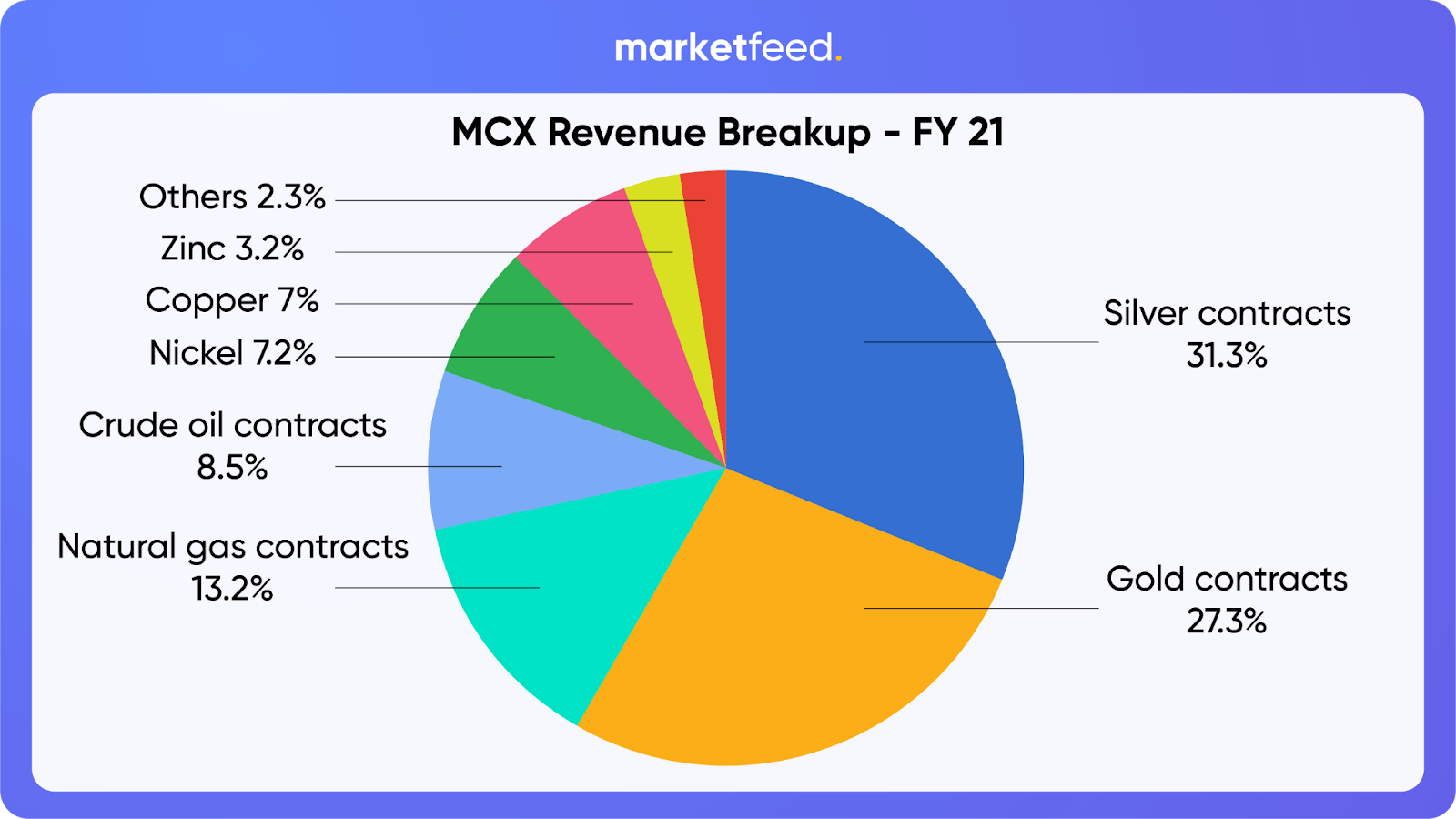
            Just like any other exchange, MCX derives its revenues from transaction fees, admission & subscription fees from brokers, and terminal charges. The company’s transaction fees are calculated on the total turnover (or overall value) of the commodity futures and options (F&O) contracts. MCX has a 95.04% share in the Indian commodity derivatives market!

            Other Offerings

            An important feature offered by MCX is its series of India Commodity Indices or iCOMDEX, which provides real-time data of commodity futures price indices. If you visit their website, you can analyse different indices that are based on commodity futures contracts traded on the exchange. It includes iCOMDEX Base Metals, iCOMDEX Bullion, iCOMDEX Crude Oil, and many more. These indices conform to the best global practices set by the International Organisation of Securities Commissions (IOSCO). 

            The company operates a web-based data service known as Commodity Receipts Information System or ComRIS. It maintains an electronic record of all transactions made on commodities from registered warehouses. MCX transmits this recorded data online in real time. Trading volumes, prices, and changes in prices are completely transparent on MCX.

            MCX also provides trade clearing and settlement services and data feed services. Moreover, they have strategic alliances with leading exchanges across the globe. This includes Dalian Commodity Exchange (China), London Metal Exchange, Taiwan Futures Exchange, and Zhengzhou Commodity Exchange (China). These collaborations allow MCX to seamlessly integrate its operations with the global commodities ecosystem.

            Main Commodities Traded on MCX:

            • Bullion – Gold, Gold Guinea, Gold Petal, Gold Petal (in New Delhi), Gold Global, Silver.
            • Agriculture Commodities – Cardamom, Cotton, Crude Palm Oil, Kapas, Mentha Oil, Castor seed, RBD Palmolien, Black Pepper.
            • Energy – Crude Oil, Natural Gas, Brent Crude Oil 
            • Metal – Aluminium, Copper, Lead, Nickel, Zinc, Brass

            Financial Overview of MCX

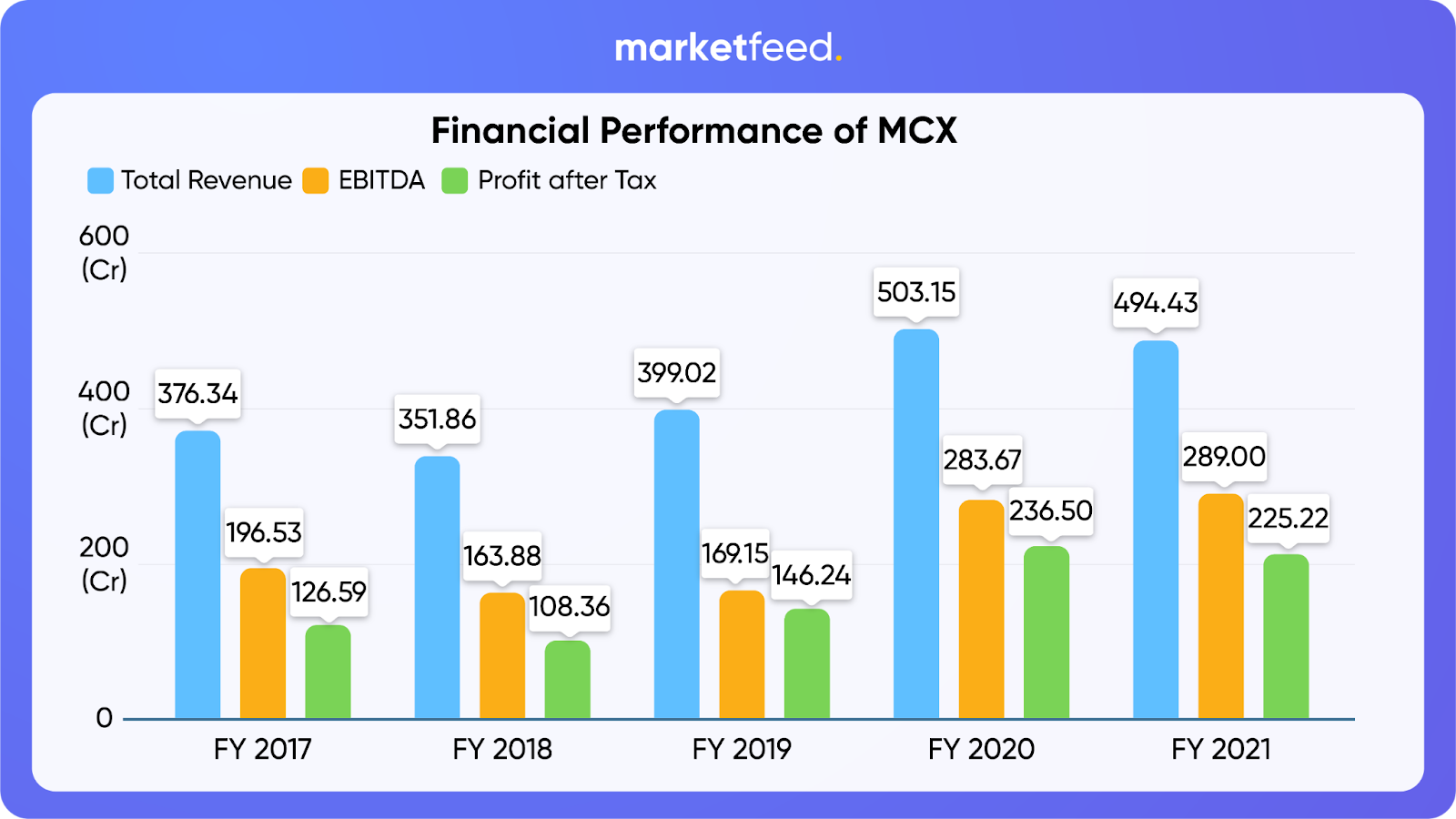
            The company’s revenue and profit growth has been quite inconsistent. MCX reported a 41.3% year-on-year (YoY) decline in consolidated net profit to Rs 38.44 crore for the quarter ended March 2021 (Q4 FY21). Its total income declined by 19.6% YoY to Rs 108.46 crore during the same period. The average daily turnover in commodity futures on MCX declined by 13% YoY to Rs 31,823 crore in Q4 FY21. 

            Net profit for the financial year 2020-21 (FY21) declined by 4.77% YoY to Rs 225.22 crore. The company’s Earnings Per Share (EPS) fell 4.8% YoY to Rs 44.25 in FY21. Based on certain assessments, MCX said the Covid-19 pandemic had a very minimal impact on its operations.

            Let us take a look at some of the positive financial cues. Over the past five years, the company’s profits have grown at a good CAGR of 20.31%. MCX is almost debt-free. The company is also well-known for declaring huge dividends. It has maintained a healthy dividend payout of 65.72%. [Dividend Payout Ratio refers to the percentage of net earnings that is distributed to shareholders in the form of dividends].

            Conclusion

            Trading in commodities can be a great way to diversify your portfolio. A large number of investors use commodities to limit their risks on other financial instruments (also known as hedging). It also provides great liquidity. However, there are a large number of factors that can influence commodity markets. As we know, weather conditions influence the production of agricultural commodities, and thereby its prices. The economic and political conditions of a country can have a significant impact on commodity prices. You should have a broad understanding of the different cycles (trends) of commodity prices.

            You can easily trade in commodities through brokers such as Zerodha, Upstox, Angel Broking, etc.

            On the other hand, MCX as a company/stock is favoured by many investors due to its future growth potential. Ace investor Rakesh Jhunjhunwala recently increased his stake in the commodity trading platform from 3.92% to 4.90%. MCX has announced plans to introduce futures contracts on more commodities across different categories.

            Have you invested in MCX stock? Let us know your views on commodities trading in the comments section of the marketfeed app.