Categories
Editorial

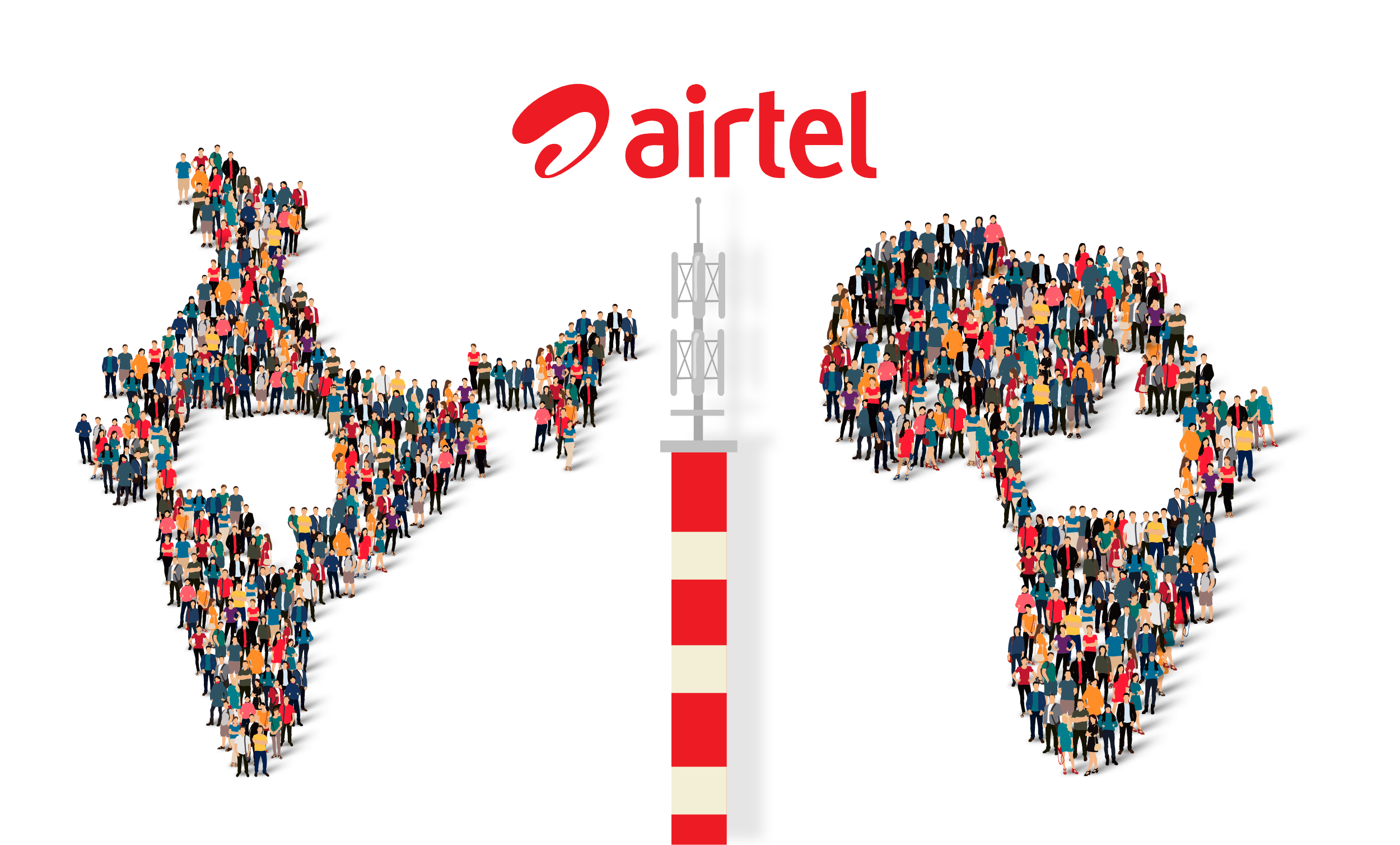
Airtel: Struggling in India, Thriving in Africa

Airtel has been in bad waters in India for almost a decade. There are some reasons for it. Firstly, there are the taxing regulations and interventions by the TRAI or the Telecom Regulatory Authority of India. Then comes the one-and-only, Reliance Jio, which changed the face of the Indian telecom industry. The price competition that it offered threw a major blow to its counterparts in India. Airtel was one of them. However, in a land far far away, Airtel seems to be making some big bucks. That land is the African Sub-Continent. So what makes Airtel Africa different from Airtel India?

The Market Of Airtel Africa

Airtel Africa consists of 14 countries under it. The biggest market for Airtel Africa is Nigeria, which contributes to more than 40% of its total revenue. Africa is an unexplored place in terms of telecom ventures, therefore Airtel saw potential in exploring Africa for a stint in telecom. Airtel Africa was officially launched in June 2010. Since then Airtel Africa has gained a subscriber base of 111 million people, which is 11.1 crore users. 

Why did Airtel choose Africa of all places though? What separated the African telecom market from the Indian market is its low-competition, its low population density, easy availability of spectrum, no strict regulatory authority in Africa unlike the TRAI in India. Also cheap availability of resources like land and labour, and finally, the immense potential in the unexplored African telecom market also makes the market very lucrative. 

Airtel Africa also has its own mobile money service, Airtel Money, which includes payments systems, micro-loans, savings, and international money transfers with an 18 crore user base. Airtel Money contributes close to 9% of Airtel Africa’s total revenue. Through this Airtel is promoting financial inclusion in the region.


Is Airtel Africa a lifesaver? 

  • Airtel Africa contributes close to 23% of Bharti Airtel’s total revenue. After the pandemic, the September 2020 Q2 that the contribution of Airtel Africa to the consolidated revenue increased by 5%.
  • During the COVID-19 lockdown period, While Airtel India lost close to 80 lakh subscribers in the first quarter of this year, Airtel Africa GAINED close to 1 crore subscribers. The COVID-19 pandemic did not impact the financials of Airtel Africa as much as it impacted Airtel India’s performance. This is because of the low population density and far fewer COVID-19 cases in Africa, as compared to the rest of the world. 
  • Airtel Africa’s ARPU or Average Revenue Per User is generally 35-40% more than that of Airtel India’s. Airtel Africa’s ARPU was Rs 210(or $2.8) as compared to Rs 162 for Airtel India as of September 2020. This is mainly due to less competition, unlike in India.
  • Coming to deploying funds ‘efficiently’, Airtel Africa is performing much better than Airtel India. Airtel Africa’s average Return on Capital Employed(Read as Capital Invested) is 13% as compared to Airtel India’s 6%, over a period of five years. This means that for every Rs 100 of capital invested Airtel Africa makes Rs 13 as profit, whereas Airtel India makes only Rs 6 as profit.
  • Airtel Africa, which was a debt-ridden company since inception, has almost halved its debt over the years. Whereas Airtel India continues to mount more and more debt, with the AGR dues issue adding fuel to the fire. The Debt/Equity ratio has decreased over the years for Airtel Africa. The Debt/Equity ratio shows how much a shareholder is exposed to debt-related risk. The lower the ratio, the better the financial health of the company.

The company is also looking to sell its tower assets to reduce debts, While the world is racing towards 5G, Africa hasn’t touched the finishing line for 4G. Due to the low population density, telecom operators have to spend more on infrastructure to cover a greater user base.

The higher cost of deployment makes it harder for telecom operators to roll out 4G and increase its coverage. Since the coverage for 4G is less, users prefer switching to 2G/3G for its convenience. Sub-Saharan Africa still awaits investment in 4G technologies, 4G is where the investment potential lies and unused 4G capacity. Companies like Vodacare, MTN, and Airtel Africa are filling that gap.

Having adopted the correct cost management strategies, debt management, and marketing, Airtel Africa is filling the gap for 4G and possibly even 5G. Airtel Africa has recently spoken on its ‘readiness’ on 5G technology in Nigeria.

If Airtel Africa maintains its current subscriber growth, continues to reduce its dependency on debt, faces no unfair competition, and maintains its liquidity, it can surpass major telcos in Africa and become the blue-eyed boy for Bharti Airtel. 

Categories
Editorial

Indian Airline Industry under the lens of COVID-19

We are in unprecedented times with COVID-19 having a lasting effect on every industry. And then there is the aviation industry and tourism industry which has hit rock bottom, and not recovered. Today, we are going to talk about how the Indian aviation industry has fared during these unusual times.

The aviation industry might be facing the worst turbulence in its history. To reduce the spread of the virus, the domestic airline industry came to a screeching halt in March. After a month and a half, the airline’s services were given the nod to continue subject to numerous conditions. Data from DGCA (Directorate General of Civil Aviation) showed that air traffic has plummeted by 85% year-on-year in the month of June. It is expected that the airline traffic in the Asia-Pacific region will be the hardest hit during these times.  

Competition based on Price

India had 650 aircraft in service last fiscal year. The industry generated employment for more than 75 lakh individuals. India’s business model in the aviation sector is very different from other countries. Flights like Indigo, Air India or GoAir does not offer a lot of premium services. An average Indian passenger would want to travel from X destination to Y destination safely and at a cheap price. International carriers like Etihad offer more services and charge additional fees for those services. Thus, the Indian airline sector competes on the basis of price and not on the basis of luxury service.

Here comes the component of success for this strategy : Passenger load factor. 

Passenger load factor measures the capacity utilisation of an airline. The more the passengers on a flight, the more beneficial it is for an airline. This is because, with the limited number of crew members and no luxury services, the additional cost of adding one more passenger is not much. Thus, the money which comes from additional passenger adds more to the company’s profit. This passenger load factor has decreased to 50%-60% for almost all the airline during the recent months. Last December, this factor varied between 80%-90%. As the number of passengers decreased, airlines failed to break-even and earn profits. 

Recent Numbers

Indigo is the biggest airline in India. It has a market share of over 40%. Their Q1 FY21 was below what market estimated and dismal, to say the least. Their revenue fell by 91% and net losses of Rs 2844 crore were recorded. To get more idea, read here.  SpiceJet is yet to declare their results for the first quarter. In Q4 FY20, SpiceJet reported losses worth Rs 807.1 crore and the results for the subsequent quarter is expected to be worse. 

The demand for air travel is already very low and reports suggest that the overall demand for air travel this fiscal year might fall by 45%-50%. According to ICRA ( a credit rating agency), India’s aviation sector is losing Rs 75 crore per day. It is further expected that the sector will lose Rs 17,000 crore in the current fiscal year. According to the report of Crisil (an Indian rating agency), this loss might stretch till Rs 25,000 crore for this year.

In order to conserve cash flow, Indigo has already announced 35% pay cuts for its senior employees. This was the second pay cut for the company in as many months as they had announced a 25% pay cut in May. The company has also announced to lay-off 10% of its workers. 

Spicejet has not announced any lay off till now, but will not be paying full salary to 92% of their employees. Vistara also announced a pay cut of 5% to 20% for its 40% of employees till the end of this year.

One of the main reasons why the airlines are still able to stay afloat is the low prices of crude oil. Jet fuel is recovered from refining the crude oil. The prices of crude oil have consistently declined over the past 6 months due to a sharp fall in demand amid COVID. This has helped the airline by cutting their fuel expenses sharply and giving some space to their bottom line to breathe.

How can the government help?

The airlines have been forced to cut shifts, ground their fleets and reduce the workforce. Even after desperately trying to cut costs, the industry has been forced to pay for fixed costs with cash. This is a very grim sign for any business.

The airline industry is highly leveraged. It needs heavy investment and regular cashflows so that the company do not default from their payments. Their primary source of cash flows is blocked. Thus, the chances of bankruptcy for the companies belonging to this industry is very high.

One thing is clear that the airlines cannot survive on their own and they need help from outside. This leaves the responsibility on the national government to roll out friendly schemes for the revival of the industry. The national government should look to waive off taxes and other charges of landing and parking. They should also think to let the airlines take loans at a very low rate and ask the banks to be lenient during the restructuring of the loans.

Companies are also pondering over the idea to switch passenger planes into cargo planes as the demand for the latter is higher. SpiceJet also showed their intent to increase the number of aircraft flying (cargo+cargo on the seat) to more than 50%.

Can the situation change any time soon? No one knows till when this pandemic will last. There is a huge uncertainty on how the things will fold for this sector. It is fair to say that airlines are set to continue their struggle for survival. The government and the aviation ecosystem should take this pandemic as a learning event and proceed to build a robust, efficient and viable structure for the industry.

Categories
Daily Market Feed

Oxford University COVID 19 Vaccine Hopes – Share Market Today

News Shots

  • The first set of results from early-stage clinical trials of Oxford University Covid 19 vaccine has shown that the vaccine is safe and induces an immune reaction. Indian vaccine manufacturer Serum Institute, which has a manufacturing agreement with British pharma giant AstraZeneca, announced that it would seek regulatory approvals to manufacture the vaccine in bulk in India.
  • AGR Case: The Supreme Court to announce the AGR repayment timeline by next hearing on August 10. Vodafone Idea had paid Rs 1000 crores to Department of Telecommunication before the hearing and expects 15 years to make the remaining in payment in instalments. The court also expressed doubt over Vodafone Idea’s capacity to clear the dues, asking on how to “rely” on the company for payment over a period given its financial position. 
  • Reliance Jio has sought spectrum in certain frequencies from the Department of Telecom for holding trials of the latest 5G technology. The company’s wholly-owned US-based subsidiary Radisys has already started selling some of the 5G solutions to foreign companies.
  • Jubilant Life Sciences has received drug regulator DCGI approval for generic version of antiviral drug remdesivir 100 mg/vial for restricted emergency use in India for treatment of severe COVID-19. Also, Mr Rakesh Jhunjhujnwala has increased his stake in Jubilant Life Sciences by 0.70%.
  • ACC Cements reported a 40 per cent fall in consolidated net profit at Rs 270.95 crore during the June quarter of financial year 2021 as against Rs 455 crore in the same period last year, on the back of subdued demand for cement as the construction sector is hit by the nationwide lockdown.
  • SBI Card posted 13.80 per cent year-on-year (YoY) rise in net profit at Rs 393.29 crore for the quarter ended June 30. It had posted a net profit of Rs 345.59 crore in the corresponding quarter last year.
  • Dabur has filed a case in the Delhi High Court alleging that its Mumbai rival Marico’s Saffola Honey “imitated” the bottle, trade-dress, label and packaging of Dabur’s honey.
  • Tata Power’s arm CGPL – which runs Mundra power plant – has raised Rs 350 crore by issuing non-convertible debentures (NCDs) on private placement basis.
  • Britannia Industries will invest over Rs 700 crore to open five new manufacturing units in the next two-and-a-half years to meet the growing demand in different parts of India, its MD Varun Berry said on Monday.
  • Q1 Result Announcements Today:
    • Hindustan Unilever (HUL)
    • Axis Bank
    • Bajaj Finance
    • ICICI Prudential Life
    • Bajaj Finserv
    • Crisil
    • DCM Shriram
    • IndiaMART InterMESH
    • Syngene International

What to expect today?

  • Yesterday was a day with the least movement in NIFTY in the last 3 months. NIFTY traded in a very small range of just 80 points (10,950 – 11,030). So, 11,000 did act as a resistance but there was a rally before closing (thanks to IT led by INFY) and NIFTY closed strongly near 11,030.
  • Global markets are on a high. US, European and Asian markets are mostly up, NASDAQ reaching all time high. SGX NIFTY is currently trading very high at 11,130, indicating a huge gap up opening in the Indian Market!
  • NIFTY is likely to trade between 11,000 and 11,200 today. There is support at 10,970 and 10,930, and resistance at 11,050 and 11,090.
  • Highest Call Open Interest at 11,500, followed by 11,000. Highest Put Open Interest at 10,500, followed by 10,800. 
  • Foreign institutional investors (FIIs) bought shares worth Rs 1,709.97 crore, while domestic institutional investors (DIIs) sold shares worth Rs 1,521.99 crore.
  • Banks, as conveyed yesterday, started well but ended on a low. They could still be under watch.
Categories
Market News

What’s up with the IT sector during COVID?

One of the few sectors that didn’t face the wrath of COVID apart from Pharma and Logistics is the IT Sector. Since the IT sector has the advantage of remote work policy, increase digital footprint in the market and e-commerce flourishing the IT sector has outperformed expectations. Let’s have a detailed analysis of the impact of COVID-19 on the IT sector and the opportunities that lie ahead.

How did the IT Sector manage to get back on its feet?

The Government announced a nationwide lockdown on 25th March 2020 across all states in India. The lockdown came as a sudden blow. Since it left many across the nation unemployed, stranded or despaired. The supply chain became dysfunctional. The Law Enforcement across the nation was a hotchpotch. Cash Flows became disrupted as companies across the world defaulted on payments, especially to IT companies where foreign companies outsourced their work to in India. However, this blow was temporary because of the suddenness and uncertainty of COVID.

The IT sector did not take much time to get back on its feet, as the rules for lockdown became more defined, the necessity for eCommerce increased and work-from-home became the norm. Likewise, Meetings and Online classes happened on platforms like Google Meet and Zoom. Moreover, Business communication platforms like Slack gained momentum as well.

Infosys announced in its 39th Annual General Meeting that it was considering a hybrid work-from-home model in the future. Wherein a part of its employees would be working from home permanently and the rest from office.

Colleges and Academic Institutions started investing in online platforms to conduct classes as universities and schools across the globe remained closed. As internet traffic started to increase companies found it necessary to expand their virtual presence. Companies of all sectors all across the world had just one saviour keeping things going , that was the IT sector. Companies started investing in IT Infrastructure to accommodate their increasing online traffic.

How has the IT performed in Q1?

Info Edge (India) Ltd.NIIT Technologies Ltd.MindTree Ltd.TECH MWipro Ltd.
Net Profit QoQ Growth %199.39%-3.35%3.30%-34.71% 2.75%
Net Profit
Quarterly YoY
Growth%
(Between Q1FY20 and Q1FY21)
8.7%13.01%129.77% -37.7% 0.19%

Source:TrendLyne
HCL Technologies Ltd.Infosys Ltd.Larsen & Toubro Info..TCSMphasiS Ltd.
Net Profit QoQ Growth %-7.47%-1.45%-2.60%-12.90% 20.31%
Net Profit
Quarterly YoY
Growth%
(Between Q1FY20 and Q1FY21)
31.61%12.36% 17.06%-13.54% 32.72%
Source:TrendLyne

As expected most players in the IT have declared a decreased quarterly revenue growth(QoQ) and decreased quarterly profit growth(QoQ). This, however, shouldn’t be misinterpreted as the performance for NIFTY YoY is marginally high. Many Force Majeure clauses were triggered which affected the cash flows and balance sheet of many IT players with regards to pending projects.

We expect Tier-1 IT companies to report a revenue decline in the range of 5-8 per cent QoQ in constant currency (CC) terms. This, coupled with a cross-currency headwind of 30-60 bps, will further negatively impact dollar revenue growth,” said ICICI Securities.

Tech MahindraWipro and HCL Technologies are likely to see around 8-9 percent sequential fall in the topline but L&T Infotech may be best among them as well as midcaps, reporting 4.5-5 percent decline in revenue QoQ, according to MoneyControl.

To sum it up, the IT sector managed to save itself from a greater fall but there was a noticeable loss of revenue and profits.

What is the Good, Bad and Ugly for the IT sector?

Good

  • Work from home means decreased fixed costs
  • Remote work policy promoted by many companies
  • Plenty of potential post-COVID-19 once market recovery begins.
  • COVID has given a boost to E-Commerce bridging the gap between Retailers and Customers.
  • The E-Commerce growth boosts prospects in IT, Logistics, Transport and Auto Industry.
  • Mid Caps hold advantage over Tier 1 IT stocks
  • Atmanirbhar Bharat and Reliance’s 5G announcement leave long term investors pretty optimistic.

Bad

  • As Force Majeure clause implementation increases, there is a lot of credit default and rise in bad debts with respect to minor IT contracts. However, the Tier-1 companies remain safe because of Higher Cash Reserves
  • SMEs are impacted the most due to high credit dependency, reduced sub-contracting demand from foreign companies and leveraged projects are impacted the most.

Ugly

  • Mass Layoffs across the world has shaken the IT industry. Companies like Cognizant made mass layoffs, benching almost 18000 staff in Karnataka.
  • The US H1B visa ban prospects for projects in the US remain bleak.
  • Startups with conventional themes were forced to shut shop.

With this, the future prospects for short and medium-term investments remain volatile. In order to book profits in the market, it is necessary to recognize a suitable entry point. Health agencies across the world are fearing the second wave of coronavirus. However, with the preparation done in the first wave, it can be expected that the second wave may not impact the IT sector after all. Companies have already begun with the human trails of the vaccines. There is substantial optimism that the vaccine might be our very soon. If the vaccine indeed does come out you can expect a fair recovery in broad markets and a rally in the IT Sector as well.