
Categories
Market News Top 10 News

Bharti Airtel Adds 58.9 Lakh Subscribers in January – Top Indian Market News

Bharti Airtel adds 58.9 lakh subscribers in January, Vi adds 17.1 lakh subscribers: TRAI

Bharti Airtel added more wireless subscribers than market leader Reliance Jio for the sixth straight month in January. According to data released by telecom regulator TRAI, Bharti Airtel added 58.92 lakh subscribers, while Jio added 19.56 lakh subscribers in January 2021. Vodafone Idea (Vi) gained 17.1 lakh subscribers during the same month. This is the first time in 15 months that Vi is adding subscribers.

Read more here.

BHEL emerges lowest bidder for NPCIL’s Rs 10,800-crore tender

Bharat Heavy Electricals Ltd (BHEL) has emerged as the lowest (L1) bidder for the supply of equipment for the 6×700 megawatt (MW) nuclear power projects of Nuclear Power Corporation of India (NPCIL). The lowest bid price offered by BHEL was Rs 10,800 crore. With this tender, BHEL has retained its market leadership position of being the sole Indian supplier of nuclear steam tubes. 

Read more here.

Domestic air traffic declines 36% YoY in February: DGCA

A total of 78.27 lakh domestic passengers travelled by air in February 2021, which is 36% lower than the corresponding period in 2019. IndiGo carried 42.38 lakh passengers in February, thus securing a 54.2% share of the total domestic market. SpiceJet flew 9.62 lakh passengers, which is a 12.3% share of the market. The data was released by the Directorate General of Civil Aviation (DGCA).

Read more here.

L&T Technology Services partners with Aspen Tech to deliver engineering solutions

L&T Technology Services Ltd (LTTS) has partnered with Aspen Technolgy, Inc. to offer a complete suite of digital engineering solutions across global enterprises. This will empower customers to optimize the performance of their assets and achieve operational excellence through cloud hosting and virtualisation. LTTS’ cloud engineering services will provide design, delivery, and support for computing, storage, and virtual network infrastructure. 

Read more here.

ABB Power secures order worth Rs 124 crore from BALCO

Hitachi ABB Power Grids in India has received an order from Bharat Aluminium Company (BALCO) to strengthen power infrastructure at its Korba plant in Chattisgarh. The estimated value of the order is Rs 124 crore. The equipment required for this project will be manufactured domestically in line with the government’s Make-in-India initiative. 

Read more here.

DLF to raise up to Rs 500 crore via NCD issue

DLF Limited has announced plans to raise up to Rs 500 crore through the issuance of secured, rated, redeemable non-convertible debentures (NCDs). The NCDs will be issued at a coupon rate of 8.25% on a private placement basis in one or more tranches to eligible investors. The realty firm had earlier announced plans of restructuring existing loans with a target of saving Rs 300 crore annually.

Read more here.

SC orders restoration of MF units back to Dalmia Bharat Group

The Supreme Court of India (SC) has ordered IL&FS Security Services Ltd (ISSL) to release mutual fund units worth Rs 344 crore back to the Dalmia Bharat Group. In August 2019, the SC had passed an interim order that Dalmia Cement, which is a subsidiary of Dalmia Bharat, may encash the securities and an amount of Rs 344 crore shall lie in fixed deposit with ISSL. The mutual fund units of two subsidiaries of Dalmia Cements were fraudulently and illegally transferred by Allied Financial Services Pvt Ltd in collusion with ISSL.

Read more here.

Shakti Pumps secures export orders worth $35 million from Uganda Government

Shakti Pumps (India) Ltd has secured a contract from the Ministry of Water and Environment, Government of Uganda, for supplying solar-powered water pumping systems. The total contract value is $35.30 million (~Rs 256.23 crore). Shakti Pumps is a manufacturer and exporter of stainless-steel water pumps, motors, and solar pumps.

Read more here

Subex partners with SkyLab to offer cybersecurity solutions for shipping industry

Subex Limited has entered into a partnership with SkyLab to offer Internet of Things (IoT) and Operational Technology (OT) cybersecurity solutions and services to the maritime sector. The companies will jointly offer Security Operations Center services and threat risk management support to improve the overall cybersecurity structure of the shipping industry. Subex is a leading enterprise software company based in Bangalore.

Read more here.

IPO Updates:

Kalyan Jewellers

The Rs 1,175-crore initial public offering (IPO) of Kalyan Jewellers was subscribed 1.21 times on the second day of bidding. The portion reserved for retail investors was subscribed 1.90 times. The portion set aside for non-institutional investors (NIIs) saw a subscription of 89% and that of qualified institutional buyers (QIBs) 24%. To know more about the IPO, click here.

Laxmi Organic Industries

The Rs 600-crore initial public offering (IPO) of Laxmi Organic Industries was subscribed 106.77 times on the final day of bidding. The portion reserved for retail investors was subscribed 19.97 times. The portion set aside for non-institutional investors (NIIs) saw a subscription of 217.62 times and that of qualified institutional buyers (QIBs) 175.43 times. You can learn more about the IPO here.

Suryoday Small Finance Bank

The Rs 582-crore initial public offering (IPO) of Suryoday Small Finance Bank was subscribed 42% on the first day of bidding. The portion reserved for retail investors was subscribed 84%. The portion set aside for non-institutional investors (NIIs) saw a subscription of 4% and that of employees 6%. To know more about the IPO, click here.

Nazara Technologies

The Rs 582-crore initial public offering (IPO) of Nazara Technologies was subscribed 4.01 times on the first day of bidding. The portion reserved for retail investors was subscribed 16.75 times and that of employees 2.28 times. The portion set aside for non-institutional investors (NIIs) saw a subscription of 2.85 times and that of QIBs 36%. To know more about the IPO, click here.

Categories
Editorial

The Real Estate Boom in India. Who Will Benefit?

The real estate sector is one of the largest contributors to India’s economy. It is a highly competitive industry that constantly faces massive hurdles. Amidst the Covid-19 pandemic, real estate developers were forced to halt construction activities. They saw a considerable decline in sales volumes. The rental income from malls and office complexes saw a fall. All external conditions led these companies to incur losses. 

Fortunately, with the removal of lockdowns, things are finally looking positive for the sector. Certain realty firms are now witnessing demand recovery and have also posted great Q3 results. However, we must understand an interesting concept that defines the trend of this particular industry. We shall look at how the present conditions prove to be favourable for large real estate companies. Let us dive right in. 

What is the Real Estate Cycle?

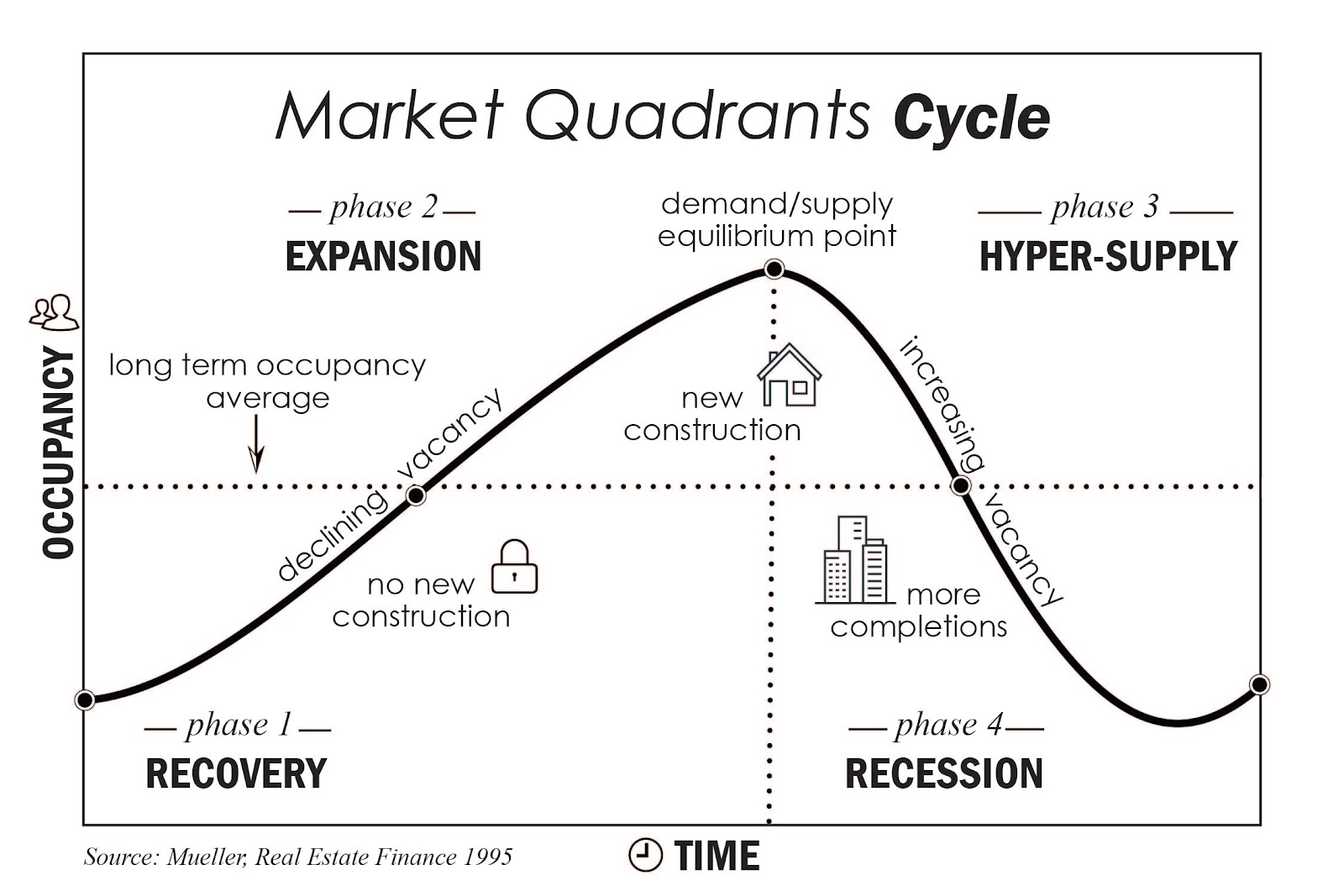
The real estate cycle is a concept that helps predict the income and appreciation performance of a real estate property. It is a sequence of recurrent events based on the economic and emotional factors that affect supply and demand for properties. Historically, it is found that the average real estate cycle spans 15-18 years. However, these cycles are unpredictable and can sometimes last much longer. The population structure, interest rates, overall health of the economy, and government policies (taxation) are some of the major factors that affect this cycle. With interest rates of loans at very low levels, there is no doubt that Indian Real Estate is in a booming cycle now.

Four Phases of the Real Estate Cycle

The real estate cycle consists of four main phases- recovery, expansion, hyper-supply, and recession. This means that there has never been a sustained period of expansion or hyper-supply without a recession- followed by recovery. Let us understand each phase in detail:

1. Recovery: This is a period when rental growth remains stagnant and there are no signs of new construction. Due to financial setbacks, people would be hesitant to buy or construct new properties. It is also a phase when investors buy and hold distressed properties and add value to them. This would allow them to sell or rent out these properties at high rates, right as the economy shifts into the expansion phase.

2. Expansion: This refers to a period when the general economy is improving, with more people being employed. They will regain their confidence in the economy, and thus, the real estate market. Individual renters and homebuyers will be in a better position to move to higher-quality houses/apartments. Real estate developers receive greater demand for their properties. New residential or commercial projects would be launched to meet this growing demand.

3. Hyper Supply: During the expansion phase, there would be a tipping point when supply begins to exceed demand. This could be due to the availability of too many apartments or houses in the market. And, there could be a sudden shift in the economy that leads to a decline in demand. Property owners often start to liquidate their assets out of fear that their properties will go vacant or unsold. 

4. Recession: This is a period when supply exceeds demand by a wide margin, and property owners suffer from high vacancy rates. People would be suffering from the economic downturn, and landlords would be forced to lower their rental rates. At the same time, certain investors use this opportunity to purchase distressed properties at very high discounts. They hold on to these properties, add value to them, and finally sell or rent them out just as the economy begins to recover.

The Current Scenario in India

Major real estate developers in India feel that the real estate cycle has now turned for the better. According to Pirojsha Godrej (Executive Chairman of Godrej Properties), demand is picking up and inventory is getting absorbed steadily. Customers and investors who had stayed away from residential real estate over the last 4-5 years are returning to the sector. This is primarily due to lower interest rates and higher disposable income among individuals. With the removal of all lockdown restrictions, we are witnessing a great recovery in economic activities. Developers have been receiving an influx of demand from home buyers or even investors who wish to buy and hold properties. There is a marginal increase in demand for commercial spaces, as people are now slowly returning to work from offices.

As we know, people were forced to work from home amidst the Covid-19 pandemic. Many felt an urge to shift to better locations or apartments/houses. The geographical markets of Bengaluru, Hyderabad, Pune, and Gurugram have contributed heavily to the overall sales volumes of real estate companies. These firms believe that the real estate sector will continue to perform well over the next 6 months. The Maharashtra Government even reduced all premiums related to this sector by 50% till December 31, 2021. It has been reported that other states would follow suit and introduce cuts on stamp duties and registration fees. The Centre had also introduced a ‘last-mile’ funding mechanism for delayed housing projects. These measures would bring down the financial burden on developers and allow them to offer properties at cheaper rates. 

On the other hand, construction activities have resumed and are now in full swing. To meet the growing demand, developers are focusing on completing existing projects. They have also acquired land in major cities and towns to launch new projects. This ultimately provides a well-needed boost for the cement, steel, paint, and other allied industries. It also generates employment opportunities for lakhs of people in India.

Listed Companies in Focus

As mentioned above, real estate companies in India are now showing an improvement in overall operational performance. Some of the major players in this sector had posted very strong results for the October-December quarter (Q3). Let us look at some of these: 

  • Oberoi Realty Ltd reported a 93% year-on-year (YoY) increase in net profit to Rs 286 crore in Q3, while its revenue rose 57% YoY to Rs 828 crore. There was a sharp surge in demand for higher-end apartments in Mumbai, where the company has a strong foothold.
  • Indiabulls Real Estate Ltd reported a 64% YoY increase in net profit to Rs 80.69 crore in Q3. Its revenue stood at Rs 756.81 crore during the same period. We saw that the share price of the company jumped 12% after it posted these results.
  • Sobha Ltd is yet to post its Q3 financial results. However, the company announced that it had achieved its highest-ever quarterly sales volume in Q3 FY21. It posted a total sales volume of 11.33 lakh square feet of super built-up area, valued at Rs 888 crore. Sales volume and total sales value were up by 27% and 29%, respectively, as compared to Q2 FY21.

It is expected that prominent firms such as DLF, Godrej Properties, Phoenix Mills, Prestige Estate, Embassy Office Parks REIT, and others are very likely to show robust sales growth during Q3. These companies have a positive outlook on India’s real estate sector for the upcoming fiscal year.

Allied Sectors

As construction activities have resumed, the demand for steel and cement are at a record high. At the same time, the prices of both these components have skyrocketed due to alleged cartelisation by large domestic players. China has also been importing and hoarding large quantities of steel, even though they contribute ~51% to global steel production. Now, companies such as SAIL, Tata Steel, JSW Steel, ACC, JK Cements, and Ambuja Cements are benefiting from increased margins

Similarly, we are also witnessing strong sales growth of companies such as Asian Paints, Berger Paints, and Kansai Nerolac Paints. The paint business in India is booming, and we can see conglomerates having a strong desire to enter this segment. For example, Aditya Birla Group’s flagship company- Grasim Industries Ltd announced its plans to enter into the paints business with an initial capital of Rs 5,000 crore. 

Conclusion

After going through a prolonged period of difficulties, things are finally looking positive for the real estate sector. With the anticipation of robust growth and financial performance, we could see an uptrend in the share prices of companies mentioned above. These firms are highly confident about the future prospects of the industry as a whole. This is supported by the present economic conditions, which encourage people to invest or buy new properties. The very low interest rates offered in housing loans, and lower stamp duties and other taxes are making this a perfect time for house-owners.

Developers are in a position to offer incentives or attractive payment schemes. The state and central governments had also introduced mechanisms to decrease the financial burden faced by these companies. The changing patterns of consumer behaviour and the integration of online and offline retail formats have positively influenced the real estate sector. Firms that offer interior-decoration solutions will also obtain a massive boost.

In the upcoming Union Budget 2021, this sector will look forward to additional measures that can support a further recovery in demand and remove supply-side challenges faced by developers. Such policies would help them show increased growth in the prevailing favourable conditions. Exemptions or deductions in tax rates would encourage people to acquire the houses or apartments of their choice. All eyes are focused on how the developers make use of the recovery and expansion phases of the real estate cycle. Will they be able to leverage the current situation and cater to the rising demand? Let us wait and watch.

Categories
Market News Top 10 News

Government working on next stimulus package – Top Indian Market News

Government working on next stimulus package: Finance Ministry official

Economic Affairs Secretary Tarun Bajaj, on Wednesday, stated that the Indian Government is working on the next stimulus package. The new stimulus would help to further support the Indian economy, amidst positive signs of a fall in Covid-19 cases. He also stated that the Union Cabinet is considering a new public sector enterprise policy, that will define strategic sectors that would not have more than four state-owned firms.

Read more here.

Bajaj Finance reports 36% YoY decline in net profits

Bajaj Finance Limited reported a 35.94% year-on-year (YoY) decline in net profit to Rs 964.88 crore, for the quarter ended September (Q2). The net interest income of the company increased 4% YoY to Rs 4,165 crore, during the same period. The share price of Bajaj Finance saw a decline of 0.31%, and closed at Rs 3,525 on Wednesday.

Read more here.

Union Cabinet approves bonus for 30 lakh government employees

Union Minister Prakash Javadekar announced that the cabinet has approved an amount of Rs 3,737 crore to be given out as bonus to 30.67 lakh public sector employees. The minister stated that this move would help boost demand in the economy, as people can purchase more ahead of the festive season. The bonus will be given as a single installment, through the medium of Direct Benefit Transfer, before 25th October. 

Read more here.

Colgate Palmolive Q2 Results: Net profit increases 12% YoY

Colgate Palmolive (India) Ltd reported a 12% year-on-year (YoY) increase in net profit to Rs 274.2 crore, for the quarter ended September (Q2). The company’s revenue saw a rise of Rs 5.2% YoY to Rs 1,285.5 crore, during the same period. The Board of Directors of the company has also declared an interim dividend of Rs 18 per share.

Read more here.

Dhoot family offers to pay Rs 30,000 crore to settle debts of Videocon

The Dhoot family, who are promoters of Videocon Industries Ltd, has offered to pay Rs 30,000 crore to the company’s lenders, and pull out 13 Videocon group firms from insolvency proceedings. A proposal for paying the amount has been forwarded to the Committee of Creditors (CoC). Insolvency means the financial state of a company of not being able to pay its bills or other obligations such as loans. When this happens, the company has to sell off its assets and raise funds in order to pay lenders. 

Read more here.

UltraTech Cement reports 113% YoY increase in net profits

UltraTech Cement Limited reported a 113% year-on-year increase in net profit to Rs 1,234 crore, for the quarter ended September (Q2). During the same period, the company’s net sales increased 7.8% to Rs 10,231 crore. The share price of UltraTech saw a rise of 1.93%, and closed at Rs 4.631.95 on Wednesday.

Read more here.

DLF pre-leases 7.7 lakh sq ft office space to Standard Chartered GBS

Real estate developer DLF’s rental arm has given on lease 7.7 lakh square feet of office space to Standard Chartered Global Business Services (GBS). The office space is in an upcoming commercial tower in Chennai, which will be constructed at a cost of Rs 450 crore. This is one of the largest commercial office space deals in India during recent times.

Read more here.

Fire breaks out at Royal Enfield stockyard in Jaipur

A fire broke out at a transit stockyard of Royal Enfield in Jaipur, at around 12:30 PM on Wednesday. Eicher Motors (the parent company), in a statement, said that the fire was largely contained and damage to inventory was very minimal. The cause of the incident will be investigated by local authorities. The share price of Eicher Motors Ltd saw a fall of 0.71%, and closed at Rs 2,178.90 on the NSE today.

Read more here.

Newgen Software Q2 Results: Net profit rises seven-fold YoY to Rs 29 crore

Newgen Software Technologies reported a seven-fold increase in net profit at Rs 29.2 crore, for the quarter ended September (Q2). The operational revenue remained unchanged at Rs 155 crore, during the same period. The share price of the company saw a rise of 9.07%, and closed at Rs 245.95 on the NSE today.

Read more here.

SEBI orders Prabhat Dairy Ltd to deposit Rs 1,292 crore

Market regulator SEBI has ordered Prabhat Dairy Limited to deposit Rs 1,292 crore for not cooperating with its auditor. The company is currently being investigated by auditor Grant Thornton Bharat LLP, over illegal diversion of funds and wrongful representation of its financial books. The auditor has only received 3 out of the 27 required documents from Prabhat Dairy.

Read more here.