Categories
Editorial

A Deep Dive Into Relaxo Footwear Ltd

The footwear industry in India contributes nearly 2% to India’s overall GDP. It employs over 25 lakh workers, making the sector one of the top employment generators in our country. It is also an engine of growth for the entire Indian leather industry. 

India is only behind China as the largest producer of footwear globally, with 9% of the annual global production of 22 billion pairs. As per Invest India, India’s contribution to global footwear production is 10.7%. Nearly 90% of the footwear produced in India is consumed by the domestic market, and the rest is exported. The revenue in the footwear market in India stood at $23.73 billion in 2022, and the market is estimated to grow annually at a 6.77% CAGR between 2022-2027.

Having said that, let’s talk of an iconic brand synonymous with rubber slippers. It offers some of the most versatile footwear for all segments of society and reflects the attitude, style, dynamism, and spirit of young India. Yes, you guessed it right: it’s none other than Relaxo!

In today’s article, we throw light on how Relaxo monopolised the footwear industry in India and how it remains a trademark brand for most Indian households. 

Relaxo’s Origin Story

In the 1970s, two brothers, Mukand Lal Dua and Ramesh Kumar Dua, aspired to grow their father’s footwear business. With an initial deposit of ₹10,000, they established the venture in Delhi and gave birth to what Relaxo is today— one of the largest and most popular footwear manufacturers in India.

Relaxo initially manufactured both footwear and cycle components. However, it discarded the second segment in 1976 and decided to concentrate solely on footwear. Its most popular brands— Relaxo, Sparx, Flite & Bahamas are a leader in their respective categories. Relaxo’s range of footwear boasts a fine combination of comfort, style, and quality workmanship. The company offers a wide collection of fashionable, colorful, comfortable, and durable footwear. They have products for every age group and more than 6,000 Stock Keeping Units (SKUs).

With eight manufacturing units, Relaxo has the capacity to produce over 7.25 lakh pairs of footwear every day! It has a pan-India distribution footprint and a network of more than 50,500 stores. The company operates 50,000 multi-brand outlets (MBOs), and 402 exclusive brand outlets (EBOs). The company exports its products primarily to China and Sri Lanka.

Financial Performance

Over the years, Relaxo has consistently performed in a superior way. Even though Covid-19 restrictions severely impacted the sales of most footwear companies, Relaxo’s sales declined by just 2.13%. The company sold around 19 crore pairs in FY21! Coming to most recent figures, it sold 3.9 crore pairs in Q2 FY23, down from 4.6 crore pairs sold in Q2 FY22.

Relaxo’s sales have expanded remarkably faster than those of its competitors in terms of CAGR. The 3-year and 5-year sales CAGR growth of Relaxo Footwears was 6.7% and 6.6%, respectively. Meanwhile, CAGR sales growth was in the range of 1-3% for competitors Mirza International and Khadim India. Even in the past three years, Bata India, Liberty Shoes, and Sreeleather’s sales growth had fallen to negative double digits.

Relaxo Footwears has also posted healthy double-digit margins over the years, while other footwear manufacturers have struggled in maintaining healthy and constant EBITDA margins. 
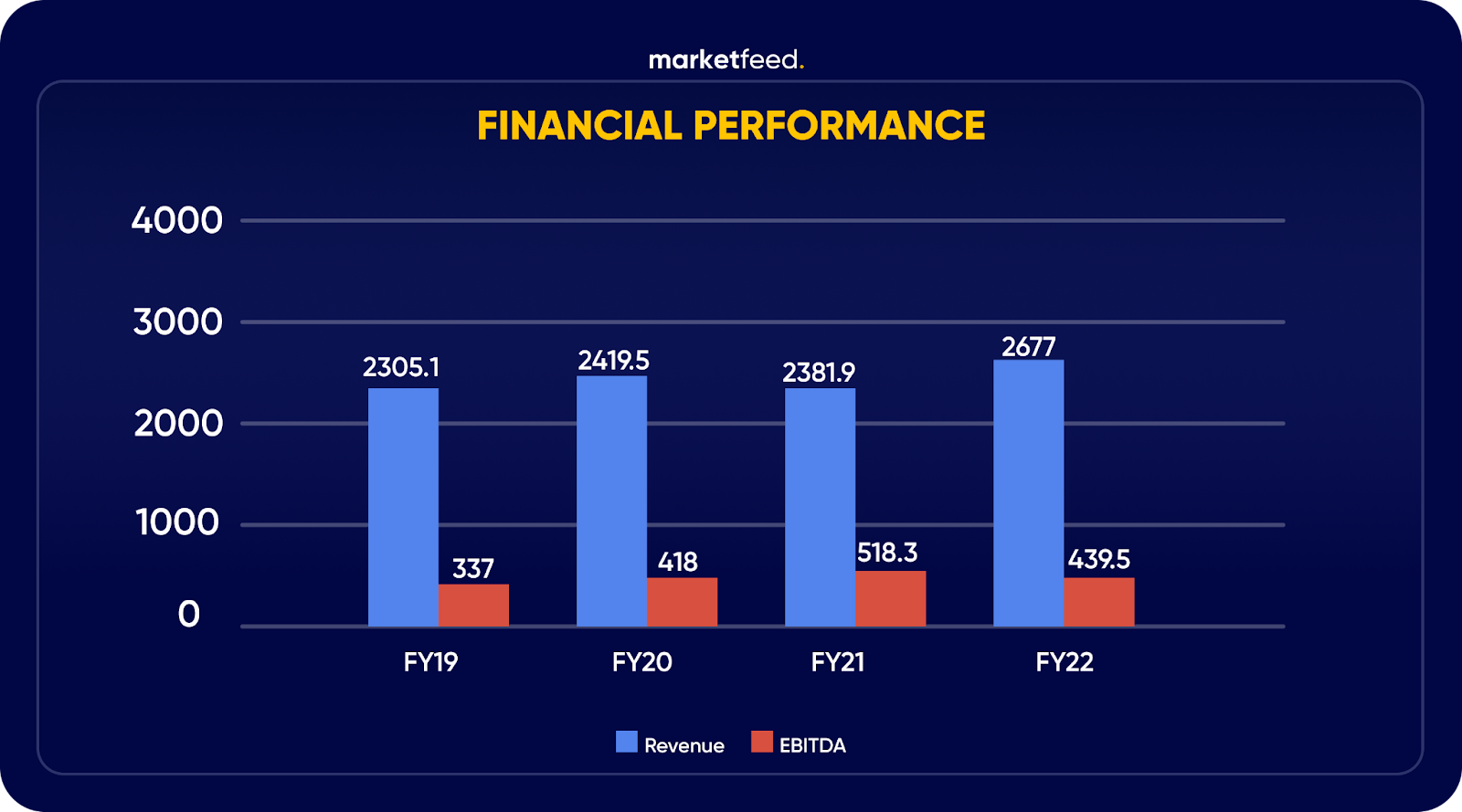
In the quarter ended Sept (Q2 FY23), revenue stood at ₹670 crore, compared to ₹714 crore in Q2 FY22. There was a decline in volumes of categories serving the mass segment, which was experiencing inflationary pressures with reduced affordability. EBITDA stood at ₹59 crore as compared to ₹117 crore in the corresponding period of the previous year. EBITDA was under pressure due to high raw material prices.

Peer Analysis 

Apart from organised and unorganised players, the market is now seeing listed players such as Metro Brands Ltd., Bata India, and Mirza International.

Regardless of high competition, Relaxo Footwears is able to maintain both quality and reasonable pricing. The organisation can sustain high profits because of a persistent focus on healthy margins, operational optimization, and capacity utilisation. This isn’t necessarily true for its competitors that utilise an asset-light model or a hybrid approach that combines asset-light and in-house manufacturing. Due to its substantial dependence on outside manufacturers, Relaxo had an advantage during the Covid-19 disruptions, while others were more negatively affected.

The Challenges

  • Intense competition: In addition to developed and developing competitors, the market also includes unlisted competitors. We can anticipate initial public offerings from these firms in the upcoming months/years. In this circumstance, Relaxo can experience price undercutting, which might impact its profitability and margins.
  • Volatility in Commodity Prices: The production of footwear requires several important raw materials, including ethylene vinyl acetate (EVA), polyurethane (PU), and natural and synthetic rubber. The company’s expenses are greatly impacted by the supply, volatility, and movements of prices of crude oil and its derivatives.  EVA and PU are typically imported by Relaxo for the manufacture of footwear products. As a result, the company also runs the risk of fluctuations in the exchange rate.
  • High MBO Dependency: Relaxo Footwears is highly dependent on its 50,000 MBOs or retailers. The MBOs channel is under significant liquidity stress, which might harm the company’s revenue trajectory.

The Way Ahead

The footwear industry is recognized by the Indian government as a priority sector under the Make In India mission. The Indian footwear industry expects to reach $27.84 billion by 2027, with the potential to grow 10-fold! Without a doubt, there is scope for footwear brands to flourish and strengthen leadership.

Relaxo Footwears seems to be ahead of its peers in this race. The firm has outperformed its competitors in terms of operational and capital efficiency as a result of strong internal manufacturing facilities, successful addition of higher value-added categories, and a solid distribution network. The company may benefit from these aspects in the years to come as well.

Do you think this multinational footwear manufacturer can continue to expand its market share and dominate the industry? Have you invested in Relaxo? Let us know your views in the comments section of the marketfeed app!

Categories
Editorial

Campus Activewear Ltd IPO: All You Need to Know

Leading sports & athleisure footwear manufacturer Campus Activewear Ltd has launched its three-day initial public offering. In this article, we analyse the company and its IPO.

Company Profile – Campus Activewear Ltd

Campus Activewear Ltd (CAL) is the largest sports and athleisure footwear brand in India in terms of value and volume as of FY21. Incorporated in 2005, the company manufactures and distributes a wide range of running shoes, walking shoes, casual shoes, floaters, slippers, flip-flops, and sandals. It offers multiple choices across styles and colour palettes. Their products target different price points, geographical locations, and demographics. As of Dec 31, 2021 (Q3 FY21), CAL sold 1,433 active styles of footwear for men, 241 styles for women, and 485 styles for children.

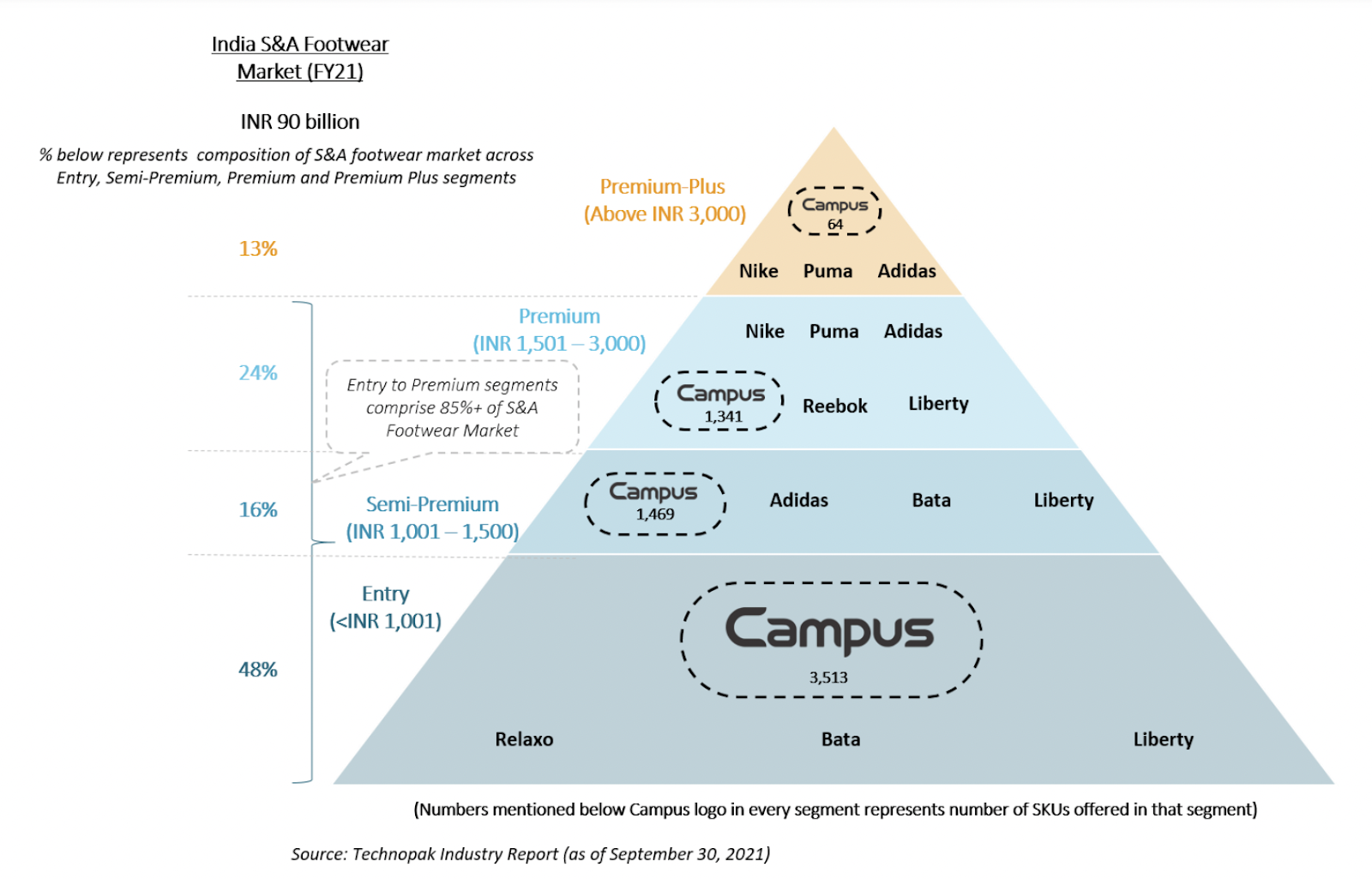
Interestingly, CAL’s products cover 85% of the addressable market of shoes with a price range of Rs 500-3,500 a pair. It sold 1.3 crore pairs in FY21 and 1.36 crore pairs during the nine months ended Dec 2021

The company owns and operates five manufacturing facilities across India, with an installed annual capacity of 2.88 crore pairs as of Q3 FY21. It has strong in-house manufacturing and assembling capabilities. CAL’s retail operations are carried out through offline stores and online channels (Flipkart, Myntra). They have a network of over 425 distributors and ~19,200 retailers across 664 cities in India

CAL secured a ~17% market share in the branded sports & athleisure (S&A) footwear industry in India in the financial year 2020-21 (FY21). The company aims to emerge as the most preferred sports and athleisure brand in India and touch the daily active lifestyle of every citizen. 

About the IPO

Campus Activewear Ltd’s public issue opens on April 26 and closes on April 28. The company has fixed Rs 278-292 per share as the price band for the IPO.

The IPO is entirely an offer for sale (OFS) of 4.79 crore equity shares by promoters and early investors, aggregating to Rs 1,400.14 crore. Individual investors can bid for a minimum of 51 equity shares (1 lot) and in multiples of 51 shares thereafter. You will need a minimum of Rs 14,892 (at the cut-off price) to apply for this IPO. The maximum number of shares that can be applied by a retail investor is 663 equity shares (13 lots).

The primary objective of the IPO is to provide an exit strategy (or liquidity) for CAL’s promoters. The company aims to achieve the benefits of listing the equity shares on NSE and BSE. The total promoter holding in Campus Activewear will decline from 78.21% to 74.1% post the IPO.

Financial Performance

*FY19FY20FY21
Total Assets505.55719.22684.75
Total Income596.69734.11715.08
Profit After Tax38.662.3626.86
(Values in Rs crore)

Campus Activewear Ltd posted a 57% year-on-year (YoY) decline in net profit to Rs 26.86 in FY21. Its revenue declined 2.6% YoY to Rs 715.08 crore during the same period. The temporary shutdown of CAL’s manufacturing facilities during the Covid-19 pandemic adversely affected its gross margins. It incurred higher staff welfare with payments during a period with no production and for nearly five months.

However, the company posted impressive results for the nine months ended December 2021 (9M FY22). They reported a 403% YoY jump in net profit to Rs 84.80 crore, while revenue grew 93% YoY to Rs 841.8 crore. EBITDA surged 204% YoY to Rs 165.2 crore in 9M FY22. The average selling price per pair came higher at Rs 615 during the same period, compared to Rs 533 in 9M FY21. Their total borrowings stood at Rs 174.1 crore as of December.

CAL is back on track and ready for bright prospects with rising demands for its products in Tier-1 and Tier-2 cities.  

Risk Factors

  • Campus Activewear Ltd is reliant on its trade distribution and direct-to-consumer (D2C) channels for a majority of its sales. Any disruptions in the operations of these channels or the inability to expand/grow them may adversely affect sales and cash flows.
  • The sports and athleisure footwear industry is extremely competitive. The failure to compete effectively or develop successful products will affect CAL’s business and financial condition.
  • The company’s sales will be severely affected if they are unable to anticipate popular trends and consumer preferences.
  • CAL often experiences moderate fluctuations in its average selling price (ASP) based on seasonality. Historically, revenues in the first and second quarters have been lower when compared to those in the third and fourth quarters.
  • Any disruptions in warehousing and logistics will severely impact the company’s overall business.
  • Pricing pressure from customers could affect gross margin, profitability, and the ability to increase prices.

IPO Details in a Nutshell

IPO DateApril 26, 2022 – April 28, 2022
Issue TypeBook Built Issue IPO
Face ValueRs 5 per equity share
IPO PriceRs 278 to Rs 292 per equity share
Lot Size51 shares (1 lot)
Issue SizeAggregating up to Rs 1,400.14 crore
Offer for Sale (goes to promoters)Aggregating up to Rs 1,400.14 crore
Listing AtNSE, BSE

The book-running lead managers of the public issue are JM Financial, BofA Securities, CLSA India, and Kotak Mahindra Capital. CAL filed the Red Herring Prospectus (RHP) for its IPO on April 18. You can read it here. Out of the total offer, 50% is reserved for Qualified Institutional Buyers (QIBs), 15% for Non-Institutional Investors (NIIs), and 35% for retail investors.

Conclusion

According to a Technopak report, the sports & athleisure (S&A) footwear market is expected to grow at a CAGR of 21% to Rs 22,000 crore! Many are now focusing on improving their general health and well-being. Campus Activewear’s products cover a large portion of our country’s S&A footwear market at various price points. The company’s in-house manufacturing and assembly capabilities allow them to ensure all-round availability and quality of products.  

However, the market is dominated by international brands like Nike, Addidas, Puma, and much more. CAL also faces competition from Indian brands such as Bata India, Relaxo Footwear, Metro Brands, etc. It will be difficult for the company to grow and expand in any pricing segment of the S&A footwear market.

Source: Campus Activewear RHP

CAL’s IPO shares are trading at a premium of Rs 100 in the grey market. So far, the portion reserved for NIIs has been subscribed 3.37 times and that of retail investors 3.2 times. As always, consider the risks associated with the company and come to your own conclusion.

What are your views on Campus Activewear Ltd’s IPO? Will you be applying for it? Let us know in the comments section of the marketfeed app.