Categories
Daily Market Feed

Dalal Street Week Ahead: Nifty Analysis for Next Week

Last Week in Nifty

Nifty continued consolidation, once again failing to break the all-time high at 15,900 resistance. The week opened at 15,800 and closed at 15,690, down 0.73% for the week.

Services PMI was announced last week at 42, an 11-month low. It was expected to fall because of the lockdowns in the past month.

GST Collection also came down below Rs 1 lakh crore, a 9-month low.

Tata Motors fell 10% on Tuesday afternoon, with Jaguar Land Rover saying that they will have a negative free cash flow for the upcoming quarter. The stock is down 11% for the week. Nifty Auto fell 2.5% in the week.

Kerala’s Kitex hit a 20% Upper Circuit on Friday after announcing they will be leaving the state.

Heavyweights remained weak, with midcaps giving a rally for the week. Nifty Realty and Nifty Metal performed well in the week.

Nifty Metal rallied with member stocks going up. China failing to control price inflation of metal and aluminium prices gaining back has given confidence to traders. Tata Steel has reached back to its all-time highs after June month fall. 

Crude oil prices remained volatile with the Saudi-UAE fight going in the OPEC+ group. There are reports from the U.S. showing there is high demand for oil with the summer tourist season in the country. Note – India likes lower crude oil prices as it is an importing country.

TCS results came out in the week with profits of Rs 9,008 crores but still did not meet the street expectations. The stock remained weak.

Reliance broke 2,100 downwards again and is struggling to move back up. Along with this, FIIs sold more than Rs 4,000 crores worth of equity this week. A weaker rupee has been causing problems for the market. These numbers will need to change for Nifty to break out this week.

Week Ahead in Nifty

Realty shares closed bullish and expected to continue the rally if Nifty consolidates. If Nifty is bullish, then these stocks might take a back-seat.

Clean Science and GR Infra IPOs saw good responses from investors and both will list on July 19th. The much-awaited Zomato IPO will open on July 14th.

More Q2 results are expected this week. On Wednesday, can expect Infosys and Wipro on Thursday. 75 companies are expected to announce Q2 results including Mindtree, LTI, Dodla Dairy, 5 Paisa, Angel Broking, Cyient, Tata Elxsi, Den and Tata Steel Long Products. 

CPI Inflation data for June will be out on Monday and Wholesale Inflation data on Wednesday. A high inflation rate may risk action from the Reserve Bank.

With the bullish close of U.S. and European markets on Friday, there are high chances of Asian markets to trade in the green. Indian markets are expected to open with a gap-up tomorrow.

15,500 continues to be good support for Nifty this week. But if we are being a bit more aggressive, the correct range for Nifty is between 15,630 and 15,915. Breaking these levels and sustaining above them may give further moves to either side.

35,800 has been respected by Bank Nifty multiple times in the past months. The index is struggling to break it. Will need some strength in Kotak Bank, which is underperforming even other private banks. 34,000 will be a good support for the index is turning really weak.

Experts are expecting consolidation. So do you expect the opposite? What do you think? Let us know in the comments section of the marketfeed app!

Categories
Daily Market Feed

Week Ahead: Nifty Analysis for Next Week

Last Week in Nifty

Let us look at what all happened in the last week, and try to understand Nifty for the next week ahead.

For the last whole week, Nifty traded in a 280 point zone. Monday, Nifty opened at 15,915 at a fresh all-time high. Every single day from Monday till Thursday, Nifty opened with a gap-up and fell. 

But on Friday, Nifty opened with a gap-up and created a green candle in the daily charts.

India VIX closed at a post-Covid low of 12 with options premiums continuing to fall.

Happiest Minds, Tata Elxsi and Route Mobiles were some of the crowd favourite stocks that rallied this week.

Tata Motors reported it will be launching 10 electric vehicles by 2025. This also coincided with Tata Nexon EV hitting a new sales high in June 2021.

Auto sales data came out last week, with data showing good sales for June as expected. After the lockdown in April and June across the country, there was a lot of pent-up demand in the sector. Nifty Auto still closed 0.2% down.

Nifty Pharma performed the best last week with Nifty Metal performing the worst.

U.S. jobs data looked positive, with a good number of jobs being added to the economy.

Foreign institutional investors (FIIs) have been net sellers for the last three months but outflows have slowed down. Last week, FIIs sold equities worth Rs 5,416.84 crore, while domestic institutional investors (DIIs) bought equities worth Rs 6,418.3 crore.

As expected, the manufacturing sector showed a slowdown in the month of June. At a level of 48.1, it showed a contraction. The PMI was 50.8 in May. Above 50 means expansion, below 50 means contraction.

Week Ahead in Nifty

Experts see the Nifty to move ahead with 15,500 as strong support. Reopening of the economy, speeding up vaccination rates and continuing low-interest rates will help the market.

The services sector PMI from India will be out on July 5.

Data of Services PMI from the U.S. is also expected on Tuesday, July 6.

Crude oil prices can continue to be watched as OPEC+ will sit for discussion again on Monday. They had failed to reach a deal on oil output policy on Friday because the United Arab Emirates blocked some aspects of the pact.

High chances of Asian markets to trade in the green, and Indian markets to open with a gap-up tomorrow.

Results season is starting once again as Q1 has ended. The season is starting with TCS coming out with their results on July 8th.

15,500 is good support for Nifty this week. 15,900 is the next immediate resistance for the index. There is a good straddle being built up in 15,700, showing there is a chance for consolidation again. If there is a sharp crossing of 15,900, we may also see 16,000 and further this week.

34,000 to 35,500 is a big consolidation zone for Bank Nifty.

What do you think? Will Nifty break out above 15,900 in the week and touch fresh all-time highs? Or will weakness continue?

Categories
Jargons

Options Greeks: What is Theta?

Before you go through this article, we request you to go through the basic terms of Options. You can find it here. If you are learning about options, you have to be thorough with the knowledge of Option Greeks. It helps the trader to know how and why the price of the options changes. So let us learn about what theta is, known as an option seller’s friend and an option buyer’s worst enemy.

We will start this series by explaining one of the most important Option Greeks, which is the Theta or time decaying factor. Both Call and Put options lose value as the expiry date nears. The rate at which they lose value is called Theta. A Theta value of -2 indicates that the option premium will fall by Rs 2 each day which is passed. But why do the options lose value? Let’s find it out here.

Explaining Theta

How important is time? Does time have a cost? If yes, how will you associate a price with time? Before you read forward, take a minute and form your own opinion on these three questions.

Let’s look at an example. Imagine you want to become an established cricketer in the Indian team. How would that happen? You have to put in years of practice and learn many skills. You have to devote your time day in and day out to become a better cricketer. Still, there is no guarantee that if you decide to give 20 hours each day, you will be selected for the national team.

But, you will surely have a better chance of becoming a cricketer if you spend your time upskilling yourself rather than doing absolutely nothing in the field. Thus, the likelihood of you becoming a cricketer directly correlates with the time you put in. Similarly, you will be more confident about an exam if you have more days to study for it. Why? This is because you would feel that you have an ample amount of time to prepare for it. The longer the time for preparation, the more confident you will be.

This same logic is followed in the stock market as well. Suppose Nifty 50 is around 13,500. You have two options contracts among which you can buy anyone. Firstly, Nifty 14,000 Call Option which expires in 2 days. Secondly, Nifty 14,000 Call Option which expires in 20 days. Obviously, you will feel safe and confident in buying the second Call Option. Why? This is because more the time, the better the likelihood for the index to move up. In short, more time to expiry leads you to have a better chance of ending your position in profits.

Risk of an Option Seller

All the conversations we had above were from the perspective of an option buyer. Now, let’s switch our hats to that of Option sellers/writers. As an Options seller, you don’t want the Nifty to cross 14,000 in the above example. If Nifty crosses above 14,000 then you have to pay money to the option buyer. If Nifty remains below 14,000 points, you will get to retain the option premium you received from the buyer.

Out of the two Call Options, in which one do you feel the risk for you as an option seller is higher? Yes, it is the second one which is riskier. Nifty crossing 14,000 points in 2 days has a lower probability than it crossing that mark in 20 days. What do you want to compensate for this risk? Money! This concept in the world of finance is known as Time Risk. Options premium is always the summation of the intrinsic value of your option and the time value involved.

Option Premium = Time value + Intrinsic Value

Hence, one can easily draw a conclusion from this. If you are buying a call option with a farther expiry date, then you are obliged to pay a higher option premium for it. This higher option premium is paid to compensate for the Options Writers’ time risk.

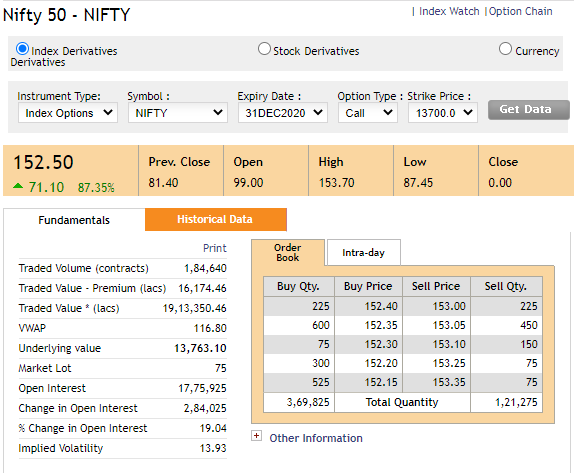
The chart below shows the Nifty option chart with a strike price of 13,700. The expiry date of this Call Option is 31st December 2020. The Option Premium which the buyer has to pay to the writer is Rs 152.50.

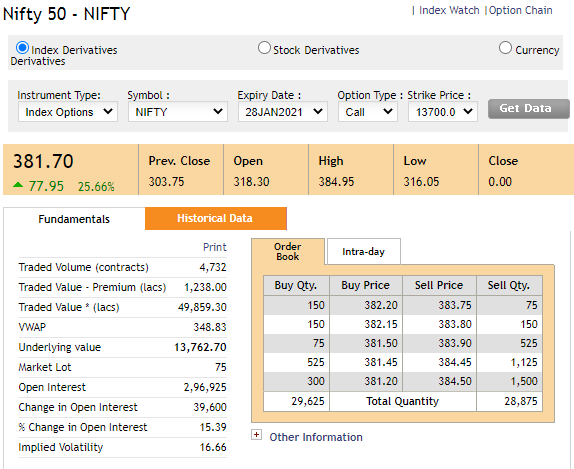
The second chart shows the Nifty Call Option with the same strike price but with a farther expiry date. The contract has to be closed on 28th January 2021. The Option Premium which the buyer has to pay to the writer is Rs 381.79. Between the two Call Options with the same price, an option buyer has to pay a higher option premium to the option seller/writer for the contract whose expiry date is farther.

Conclusion

As the option reaches closer to its expiry date, the time risk of the option seller/writer decreases. Due to this, the option premium loses some of its time value. Thus, decreasing the option premium which has to be paid to the option seller/writer.

Theta is considered very difficult to understand. But in reality, it is very easy. Just remember that time has an opportunity cost and that cost is reflected in Theta. Wait for the next chapter of this series to get a better idea of what Options Greeks are. Till then, happy trading!

Categories
Jargons

What is India VIX? Find it here!

You must have seen us talking about India VIX on The Stock Market Show on YouTube and our Pre-Market Reports. But are you really aware India VIX is? Does it tell you something about the market? How should retail investors read this parameter? Find all about this here!

India VIX

VIX stands for Volatility Index. This tells that India VIX is nothing but India Volatility Index. It tells about the volatility which can be expected by the investors in the Indian market. In simpler terms, volatility is referred to as the “rate and magnitude of changes in prices” expected in either direction. Originally, VIX is a trademark of the Chicago Board Options Exchange. The National Stock Exchange of India (NSE) has been granted a license to use this mark with the name of India VIX.

The calculation of this volatility index is done with the help of the NIFTY Index Option prices. It is the representation of the annualized change that can be expected in the Nifty 50 for the duration of the next 30 days. Do focus on the word annualized change. Let’s take an example to make it clearer. 

Suppose India VIX is 20.97%. That means for the next 30 days, Nifty 50 is expected to move in either direction by the investors by an annualized rate of 20.97%. The value of VIX cannot go below 0 and cannot exceed 100.

How Does Vix Affect You?

It has been seen previously that VIX and Nifty move in opposite directions. We saw the biggest example of this during Covid-19 last March. On 24th March 2020, India VIX touched the mark of 83.63! This is when the market was unpredictable due to the Covid-19 lockdowns around the world. But, do not judge the direction of the market with the movement in VIX. The India VIX will only tell how big a move can happen in the market irrespective of the direction. 

The higher the VIX, the higher the risk is for retail investors. Equities may not be a very safe asset class when VIX is unusually high. India VIX is said to be normal if it is around the 20-mark, which it is currently at as of April 2021.

You cannot buy/sell India VIX, it is not a tradeable index.

Categories
Editorial

The Onion Futures Act of USA and How India can Solve its Onion Crisis

Onion prices keep popping up in the news once in a while for their skyrocketing prices. Mostly, this happens because of poor storage facilities, crop damage, too much or too little rainfall, delay in logistics and transportation, high demand for onions during festive seasons, shortage of supply, and many other factors that take place. To curb the shortage, India often bans the export of onions. This ban causes a rise in onion prices globally as India is the third-largest exporter of onion in the world. This volatility in onion prices proves to be catastrophic for the farmers many times. There are no risk management mechanisms against which farmers hedge themselves.

There used to be a tool in the United States to hedge the risk, which was made illegal in the year 1958. The ‘Onion Futures Act’ banned the dealing in onion derivatives, which could be used to hedge the risks associated with it.

What is the Onion Futures Act?

In the early 50s in the US, onions were traded in the open market alongside the Chicago Mercantile Exchange, where onion derivatives or onion future contracts were traded

A derivative is a security which traces its value from an underlying asset. As an example, NIFTY Futures derive their value from the underlying asset which is NIFTY itself. A ‘futures contract’ is a contract where a person agrees to buy/sell something in the future at a predetermined price and time. You can find index, stock, and commodity futures on your broker’s terminal.

A futures contract allows a person to hedge or offset the risk involved. In this case, the product was onion and the risks associated were droughts, floods, changes in supply, and demand which could lead to a huge rise or fall in onion prices.

So let’s get into the story. Two gentlemen; Vincent Kosuga and Sam Siegel, were onion farmers who also traded in onion derivatives. Onion derivatives was a hot product in 1950. They made up for 20% of Chicago Mercantile Exchange’s trades. 

In early 1955, Kosuga and Siegel bought enough onion and onion futures to control close to 90% of Chicago’s onion market. This meant that they had a higher bargaining power and could set the price very very high. A million pounds of onions were shipped to Chicago and stored at facilities. By late 1955, Kosuga and Siegel had hoarded 14,000 tonnes of onions. They had these onions stored at storage facilities all across the country to prevent suspicion. The shortage of supply caused the prices to increase.

They profited in two ways:

Firstly, Kosuga and Siegel threatened the other small traders to buy onions from them stating that if they didn’t comply they would flood the market with onions and drive the price down. They profited from this since traders were buying onions from them, that too at a high price.

Secondly, Kosuga and Siegel bought short-positions on onion derivatives beforehand. When you hold a short position, you benefit from the fall in the price of the underlying stock or product, in this case, it was onions. What they did with these short-positions made them millionaires.

Kosuga and Siegel dumped the onions in the market and there was an excess supply. This caused futures traders to think that there was an excess supply of onions, they too started holding short positions which further drove down onion prices. Onion prices sunk from $2.75 a bag (23 Kg) to 10 cents a bag. At one point the onions were cheaper than the bags in which they were packed. However, since Kosuga and Siegel had held a short-position on onion futures, they benefitted massively from the fall in onion prices. They made millions of dollars.

Then-Congressman Gerald Ford of Michigan sponsored a bill called the ‘Onion Futures Act’, which banned futures trading on onions. President Dwight D. Eisenhower signed the bill in August 1958. The bill was very unpopular amongst traders. E.B. Harris, the president of the Chicago Mercantile Exchange, lobbied hard against the bill. The Chicago Mercantile Exchange also filed a lawsuit against the act, but the ban stood.

Does India Need Onion Derivatives?

Every time there is a certain spike in onion prices, the government invokes restrictive measures like a stock limit or an export ban. This has failed to resolve the agony that a farmer has faced for centuries, the uncertainty of prices. Such spikes and dips in prices affect both the consumer as well as the farmer. If a farmer enters into a futures contract, then he/she will surely get the amount per unit as promised in the contract after a successful yield. This is already being implemented in the form of contract farming, where corporates like McDonald’s and Reliance get into agreements with farmers before yield season.

Futures can be the future for farmers. MCX and NCDEX are the two primary commodity exchanges that allow you to trade in commodity derivatives. Commodities such as Cotton, Guar Seeds, Wheat, Maize, Turmeric, Castor, and many other commodities can be traded on these platforms. These exchanges also allow for physical delivery of the commodities. Farmers can get connected through these platforms. NCDEX has onboarded close to 258 Farmer-Producer Organizations(FPOs) which represent close to 5,23,000 farmers and MCX has onboarded close to 78 such FPOs.

When a farmer gets into a futures contract, he sets a fixed ‘lock-in’ price for his crops. The futures market gives a farmer two pros- Price Discovery and Risk Management. As for Risk Management, it means that there is no possibility that his ‘selling’ price will fall in the future. This is called ‘hedging’ the risk. The risk of price changes gets transferred to speculators who are willing to accept the risk in hope of making a profit out of it. As far as price discovery is concerned, the futures market reflects the price expectation of buyers and sellers in the future, this allows the farmer to estimate the selling price and plan the harvest or sowing accordingly. 

Onion Futures in India

India’s Agricultural Economy is liberalized with three agricultural bills passed in late September 2020. This allows farmers to become entrepreneurs. This gives them great flexibility in making decisions that best suit their economic interests along with risks. Onion derivatives were planned by NCDEX thrice. Once in 2003, another in 2006 and 2013. The proposition however didn’t pass through despite getting a go-ahead from the FMC or Forward Markets Commission. 

Onions have been the lead topic of dozens of political campaigns throughout the country. Considering the lack of education amongst farmers, onion derivatives might seem like a scam to them and might become the centre of another political stir. Farmers must be imparted financial knowledge to elevate their economic situation.