The Bata shoe organization on Monday 30th November, named it’s India CEO Sandeep Kataria, as it’s global CEO. He becomes the first Indian to head 120 year old retailer – Bata, globally. The company said that he as CEO has helped to attain consistent growth and profitability. He joined Bata India as its CEO in 2017. He has also worked with global firms such as Unilever, Yum Brands and Vodafone in India and Europe. Under his leadership, Bata India doubled its profits. He has completed his M.A, M.Phil and Ph.D. He has been directly involved in leading business and powerhouse brands. His strategies helped to boost consumer demand and global reach.
Bata remains as a family-owned business originated from Czech Republic, selling more than 180 million pairs of shoes annually. They have 5,800 outlets all over the globe with 22 Bata-owned manufacturing facilities. Out of 5,800 stores, 1,200 stores are situated in India. They are also providing employment opportunities to more than 35,000 employees around the world.
Bata India is a mid-cap company with a market capitalization of around Rs 20,000 crore. The share price of the company closed at Rs 1544.20, down 1.82% following the news.
CAGR stands for the Compound Annual Growth Rate. It is the measure of an investment’s annual growth rate over time (n years), with the compounding effect taken into account. It is the average year-on-year growth rate of an investment over a number of years. As Albert Einstein famously said, he who understands compounding earns it; he who doesn’t, pays it. The growth of companies is usually measured in CAGR %.
How to calculate CAGR?
CAGR= compound annual growth rate Vbegin = beginning value Vfinal = final value t = time in years
What Does CAGR Tell You?
According to Investopedia, “CAGR is essentially a number that describes the rate at which an investment would have grown if it had grown the same rate every year and the profits were reinvested at the end of each year.“
In order for an investor to know whether it is worth investing in a particular mutual fund, the CAGR becomes an important measure for the investor to estimate the performance of a mutual fund.
Easier Method of Calculation
In the above example, we have taken the sales of the company for 8 years where the Ending Value is 1800 and the Beginning Value is 1000. We assumed n-1 number of years since growth from Rs X to Rs 1000 could not be calculated or assumed in Year 1. We place the given data in the formula, and we get a CAGR of 7.62%.
The National Statistical Office of India’s GDP(Gross Domestic Product) estimates and National Accounts for the period of April-June were published on 31st August 2020. Gross domestic product (GDP) is the money value of all finished goods and services made within a country during a specific period. Observers of the Indian economy keenly awaited the NSO GDP data because it would provide the first benchmark of the state of the Indian economy after the Covid-19 pandemic disrupted it and forced the country into widespread and repeated lockdowns. The highlights of the result were as follows:
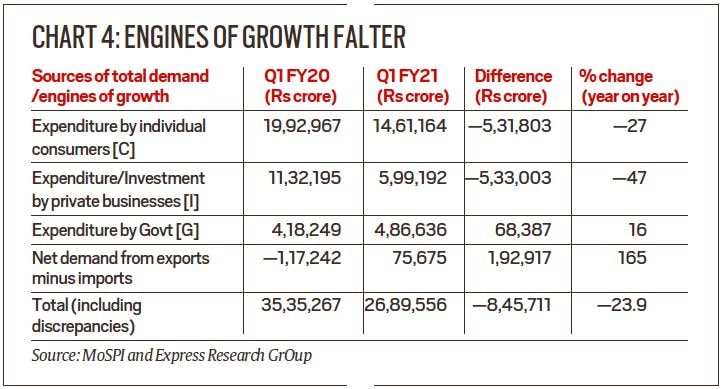
India’s Real GDP (GDP adjusted for yearly rise in prices) contracted by 23.9% as compared to Q1 2019-20. It contracted from ₹35.35 lakh crore to ₹26.90 lakh crore. Real GVA or Value of Goods and Services Produced in the economy)contracted by 22.8%.
Production of Coal reduced by 15%, and that of Crude Oil by 6.5%. The production of crude oil didn’t fall much since India imports crude oil from other countries. The production of cement reduced by 56.8%
Indicators of Production of Key Goods.
Industrial production (IIP) took a huge hit. The Metallic Minerals industry contracted by 43.3% followed by Manufacturing Industry at (-)40.7%. This was evident looking at the slumped metal consumption this quarter. Read More about India’s metal sector Here.
Index of Industrial Production(%)
The only industry in India with positive growth was Agriculture, Forestry and Fishing which was up by 3.4%. To read why the agriculture and other rural industries prospered during the lockdown, Click Here.
The Hospitality ( -50.3%) and Construction (-47%) industries were the most affected.
Gross Value Added By Different Industries.
Components of GDP
GDP(Y)= C + I + G + NX
The formula of GDP is as given above. Where:
C = Consumption. Money spent by people or private expenses.
I = Investment. The investment made by private players into local entities and businesses.
G = Government. Government. Government expenditure or transfer payments such as education, healthcare, social protection.
NX = Net Export (Export Minus Import)
Lets understand how each of the four engines of GDP worked out this Quarter.
The private consumption expenditure (C) fell 27%. Additionally, investments into businesses(I) also slumped by 47%. Government Expenditure increased by 16%. This is due to the Aid which the government had provided in the wake of the COVID-19 Pandemic.
The net exports increased by 165%, but is this a good thing? Generally, India’s imports are always more than its exports. Now, imports have fallen because India’s total demand has fallen as well, which is not good.
Conclusion
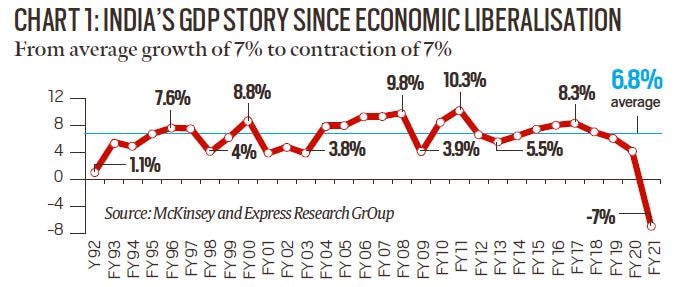
India’s contraction of GDP was unexpected. The GDP Growth estimate by World Bank was (-)4.5%.
According to the Centre for Monitoring Indian Economy (CMIE), salaried jobs suffered the biggest hit during the lockdown, with a total loss estimated stands at 18.9 million during the first quarter. Meanwhile, recovery in the second quarter has also not picked up as expected with various states announcing lockdowns due to rise in coronavirus cases in July and August.
When private consumption(C) falls sharply, businesses stop investing. Since both of these are voluntary decisions, there is no way to absolutely force people or businesses to spend more or indulge in expansionary economic activity. Lower interests in your Fixed Deposits and saving account is one way to try and make people spend money. Also, loans given out by banks have all-time low interests now to incentivise businesses to expand.
India is increasing Government Expenditure(G) with multiple PSUs announcing huge expansion projects. The second way out is Monetary policy. RBI has been involved recently in important Open Market Operations and Long Term Repo Operations(LTRO). Read more about it over here. Hopefully, these measures taken by the government will see quick reactions from the economy.