Categories
Jargons

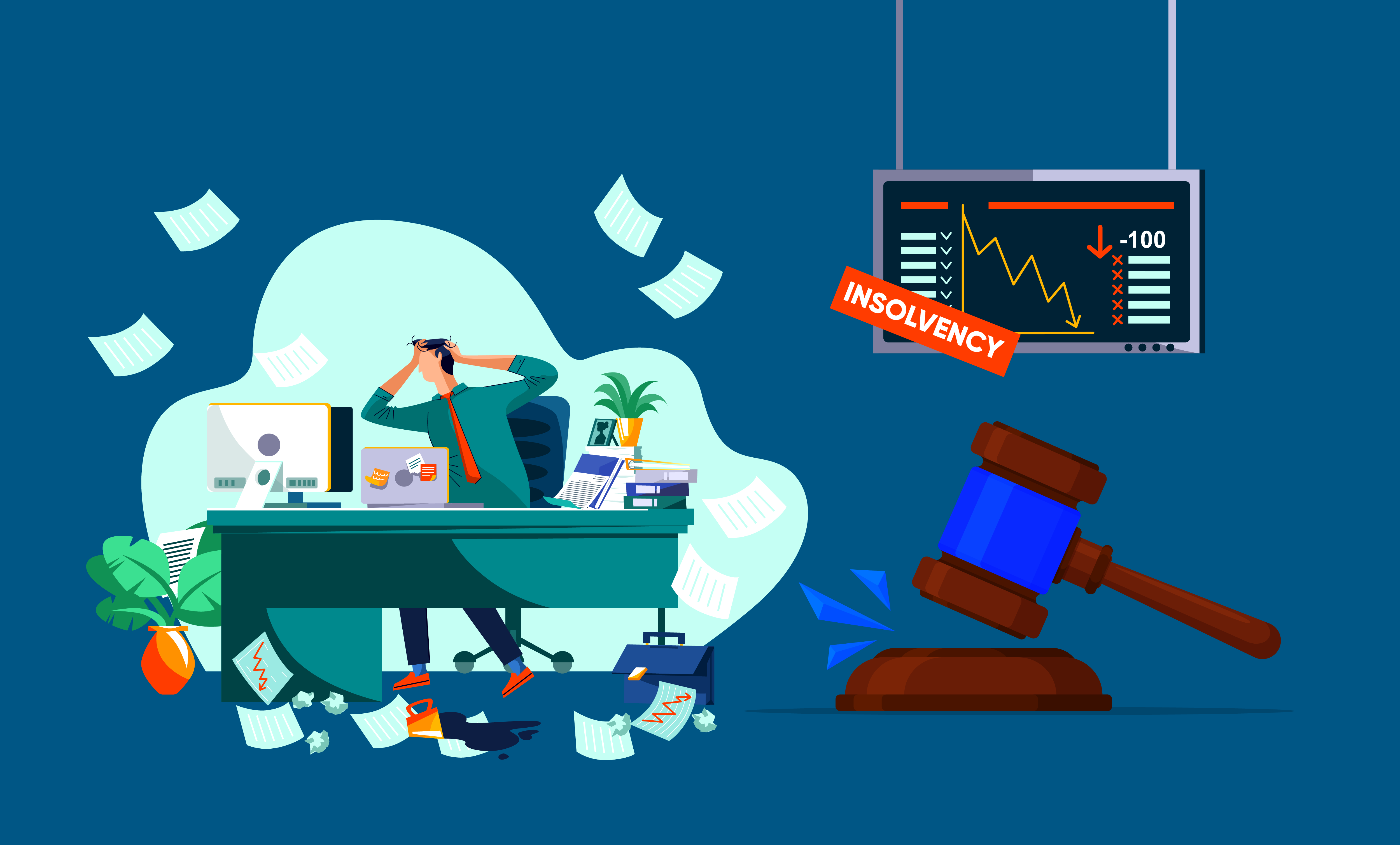
What is Insolvency? How Do Companies Go Bankrupt?

We often come across reports of companies being declared bankrupt or ‘insolvent’. We also see large investment firms or business groups entering into tough competition to acquire these insolvent companies. Recently, Piramal Capital acquired debt-ridden DHFL for Rs 34,250 crore! Let us have a detailed understanding of what insolvency means and look into the insolvency procedure followed in India.

What is Insolvency?

At some point in time, a company or an individual may not be in a position to pay off their debt or other financial obligations. This may be due to a variety of factors such as a sharp decline in revenue (or income), increase in competition, poor market conditions, bad financial management, lack of proper budgeting, high debt, and failure of debt recovery procedures. The state of being unable to make repayment of debts by a person or company is known as insolvency. Those entities that are in a state of insolvency are said to be insolvent. In most cases, the insolvent company or person has to convert their assets into cash to pay off their lenders.

Types of Insolvency

1. Cash-flow insolvency – This is when a person or a company has enough assets to pay what is owed, but does not have an appropriate form of payment. For example, a person (the debtor) may own a large house or other valuable properties, but may not have enough liquid assets to pay his debts when it falls due. [A liquid asset is anything that can be converted into cash easily, within a very short period of time. Eg- cash, stocks, savings account in banks, etc]

2. Balance sheet insolvency – This is when a person or a company does not have enough assets to pay all of their debts. In most cases, these entities might enter bankruptcy, which is a legal process through which they may seek relief from some or all of their debts. Once a loss is accepted by all creditors (or lenders), the parties would negotiate and resolve the situation.

The Insolvency & Bankruptcy Code, 2016

Until 2015, an insolvency resolution in India took an average of 4.5 years to complete. There were constant delays in court proceedings and a lack of clarity. The entities involved in these cases used to incur very high legal costs. Thus, Indian lawmakers wanted to introduce a more structured and time-bound procedure for completing the entire insolvency process. 

The Insolvency and Bankruptcy Code (IBC) was brought into effect in 2016. It is the one-stop solution for resolving insolvency cases in a very economical manner. The code protects the interests of small investors and makes the process of doing business more efficient. The IBC has over 255 sections and 11 Schedules.  When a default in repayment occurs, creditors (lenders) gain control over the debtor’s assets and must make decisions to resolve insolvency within a 180-day period. The code also provides a framework for creditors and debtors to have detailed discussions on how to resolve the issue.

Insolvency Procedure

Let’s say a company- ABC- is in a poor financial state and is unable to pay off large debts. The lenders of the firm submit a plea for insolvency to the National Company Law Tribunal (NCLT). The NCLT is the adjudicating authority for insolvency proceedings in the case of corporate entities. It looks into the financial records and information provided by the lenders of ABC and must reject/accept their plea within 14 days.

  • If the plea is accepted, the tribunal has to appoint an Interim Resolution Professional (IRP), who will draft a resolution plan for ABC within 180 days (this can be further extended by 90 days).
  • A resolution plan is a proposal that seeks to resolve the company’s insolvency by finding methods to pay off creditors. During this period, the Board of Directors of ABC will be suspended. The promoters do not have a say in the management of the company.
  • The IRP will manage ABC’s assets and provide information to its creditors and assist them in decision-making.
  • The insolvency professional forms a committee of creditors (CoC) who lent money to ABC. The CoC will decide the future of the outstanding debt owed to them. They may choose to revive ABC’s debt by changing the repayment schedule or by selling (liquidating) the assets of the company.

In case the Corporate Insolvency Resolution Procedure (CIRP) fails to revive the company within 180 days, the liquidation process is initiated. This means that all of ABC’s assets will be converted into cash through auctions or direct acquisitions. Proceeds from the sale of these assets will be distributed to the creditors, priority shareholders of ABC, and equity shareholders. The IRP will also receive remuneration for his contribution to the insolvency proceedings.

A Recent Example

Dewan Housing Finance Corporation Ltd (DHFL) was the first financing company in India to go through insolvency proceedings. It had been facing liquidity issues (cash crunch) and had defaulted on loans. Upon further investigation by the Enforcement Directorate (ED), it was found that DHFL had diverted thousands of crores illegally. In November 2019, the Reserve Bank of India (RBI) filed for an insolvency proceeding to be initiated against DHFL. The financial creditors of DHFL submitted claims worth Rs 86,892 crores against the company! The share price of DHFL, which was trading at ~Rs 600 levels in 2018, fell to Rs 15 within a year

The Committee of Creditors (CoC) of DHFL failed to formulate a resolution plan within 180 days. It was decided that the financing company and its assets would be put up for auction. In October 2020, several reports stated that Adani Group, Piramal Enterprises, US-based Oaktree, and Hong Kong’s SC Lowy had placed bids for acquiring DHFL. After months of negotiations and counter-bidding, Piramal Capital emerged as the successful owner of DHFL.

Now, you may wonder why these firms had shown interest in acquiring a company that was poorly managed and involved in illegal activities. The main factor is the cost of the acquisition. Buying a company in the same industry is often time-consuming and expensive. When these investment firms and large corporations want to expand, it is easier and more economical to acquire distressed companies at very discounted prices. Moreover, Piramal took a risk and found value in the DHFL brand- which has a great hold in semi-urban and rural markets. 

Categories
Editorial

How Cox & Kings Promoters Trapped Investors

Cox & Kings Limited (CKL) used to be one of India’s largest tour and travel operators. Many people in India and abroad would have used their services for land, air, and cruise bookings, hotel bookings, visa processing, and passport solutions. The Mumbai-based company was also a pioneer in outbound tourism, business travel, conferencing, trade fairs, foreign exchange, and insurance services. Cox & Kings had a strong presence in almost every state in India and had major subsidiaries across the United States, United Kingdom, UAE, and Australia.

The company that once had a great reputation and legacy has collapsed due to certain fraudulent activities committed by its promoters. The share price of CKL, which was trading at Rs 200 levels in 2018, is now at a mere Rs 1.30. Let us have a detailed understanding of what led to the downfall of Cox and Kings.

What Led to the Fall of Cox & Kings?

Leveraged Buyouts

The shares of Cox & Kings got listed on the Indian stock exchanges in December 2009. It was showing constant growth in revenue and profit during this period. At that point, the company initiated a massive expansion plan. They acquired US-based East India Travel Company for around $22 million, Tempo Holidays for $25 million, LateRooms Limited for £8.5 million, and Holidaybreak plc for £323 million. The company even entered into certain businesses they had no prior experience with (such as NBFCs, education business, etc). CKL used a method known as leveraged buyout to acquire most of these firms.

A leveraged buyout (LBO) refers to when a company borrows a significant amount of money from banks to acquire another company. The assets of the company being acquired are often used as collateral for these loans. 

High Debt Obligations and Cash Crunch

Things started to go downhill for Cox & Kings immediately after the acquisitions. The company was burdened with very high debt as a result of its highly ambitious expansion plan. The firm had borrowed thousands of crores from commercial banks in India and abroad. On top of this, their newly-acquired subsidiaries were performing poorly and started to incur heavy losses. They also found it difficult to manage those businesses in which they had no prior experience. As compared to competitors, CKL failed to adapt to the changes in technological advancements in the field of travel and tourism. The company began to face a severe cash crunch, which meant that it did not have sufficient funds to cover normal business expenses. 

Thus, CKL started to sell off many of its assets/subsidiaries from foreign countries from 2014 onwards. Given below is a list of business units or subsidiaries that were sold:

YearName of Business UnitAmount
June 2014Camping division Holiday BreakRs 892 crore
Dec 2015Explore Worldwide Limited£25.8 million
March 2016LateRooms£20 million
March 2016Superbreak business£9.25 million
2018Education businessRs 4370 crore

Manipulation of Financial Records

The company began to default on its loans in 2019. In April 2019, CKL announced that it would not be able to declare its financial results for the first quarter (Q1) of FY 2019-20. The firm did not repay two sets of loans of Rs 150 crore and Rs 50 crore, respectively.

During this period, many found irregularities in the firm’s books of accounts. In the balance sheet dated 31 March 2019, the company had Cash & Cash Equivalents of Rs 1,830 crore and Receivables (ie, amount due to CKL) of over Rs 2,000 crore. With such a significant amount of cash in their books, many wondered why the firm was unable to pay off its loans. Moreover, it was found that only a part of the net proceeds from the sale of various business units was used for meeting debt obligations. The remaining amount could not be traced in the company’s financial records. 

Many shareholders lodged a formal complaint against Cox & Kings and its management to the Serious Fraud Investigation Office (which is under the Ministry of Corporate Affairs) around this time. CKL’s stock price started to fall heavily.

Source: TradingView

The Forensic Audit 

Yes Bank was one of the biggest lenders of Cox & Kings. The company owed around Rs 2,267 crore to the private sector lender. The bank approached PricewaterhouseCoopers (PWC) and asked them to conduct a forensic audit on CKL (as it had defaulted on loan repayments). 

The results of the audit were quite alarming. It was found that Cox & Kings had been illegally transferring money and falsifying its financial records between 2014-2019. The company did not take board approvals for loans worth Rs 6,071 crore extended to at least 20 ‘related parties’.

Bankrupt firm Alok Industries received a loan of Rs 1,100 crore from Cox & Kings. The Chief Financial Officer (CFO) of this firm was Sunil Khandelwal, the brother of Anil Khandelwal— the CFO of Cox and Kings!

The audit also revealed that the company made sales of over Rs 9,000 crore to 160 fake customers between 2014 and 2019. Physical verification of the addresses of these ‘customers’ showed that they were residential addresses, and no travel agencies ever operated in those places. Most of the amount received from sales could not be traced in its bank accounts. This was because Cox and Kings never really received any of this money.

Another major observation was in the company’s debt status. For the financial year 2018-19, CKL reported a total (consolidated) debt at Rs 2,000 crore. However, its standalone debt by itself was Rs 3,600 crore. There was also a credit card debt of Rs 750 crore that was not disclosed to the company’s lenders. Ultimately, the company was declared bankrupt and insolvent. [Insolvency means a state of financial trouble when the company is unable to pay its bills. An insolvent company would have to convert all its assets to cash and pay off its lenders]

Recent Developments

Cox & Kings began to shut down many of its branches across the country. It stopped all operations (including ticketing services) without any fair warning. Most of their customers who had booked slots for domestic or international tour packages did not receive their tickets. There were instances of tickets getting cancelled at the last minute. Most of their customers have not received refunds for the same. Franchisee owners did not get any commission from the company. Moreover, CKL failed to pay its employees for several months. Many angry customers and franchisee owners filed police complaints against the company. Private sector lenders including Kotak Mahindra Bank, HDFC Bank, Axis Bank, IndusInd Bank also filed separate FIRs against CKL for defaulting on loans.

ED, CBI Investigation of Cox and Kings

Towards the end of 2019, the Enforcement Directorate (ED) and CBI began their investigation into the alleged fraudulent activities of CKL and its promoters. It was estimated that the company owed a total of more than Rs 5,800 crore to banks and financial institutions. Between 2019 and 2020, both investigation agencies (and even local police) filed numerous cases against Cox & Kings Group entity, its promoters, and other related parties for alleged fraud involving thousands of crores. CKL’s promoter Peter Kerkar, other senior officials, and employees were arrested.  Recently, ED named Kerkar as the mastermind behind this large-scale fraud.

The insolvency proceedings of Cox & Kings are now underway. The Insolvency Resolution Professional (IRP) of CKL, appointed by the National Company Law Tribunal (NCLT), had initially sent recovery notices to 57 debtors of the company that owes Rs 1,775 crore. Out of these, notices to 11 debtors— including two connected to the promoters and employees of Cox & Kings that owe Rs 479 crore— were returned undelivered. Four debtors have denied any liabilities and four others asked for more documents from the IRP. 

Let us look forward to seeing how the concerned parties are held accountable for their actions.