Categories
Editorial

Top 5 Bluechip Stocks to Watch During a Market Fall

As the festive season of Diwali approaches, it’s not just the festive deals in traditional or e-commerce stores turning heads—investors are spotting opportunities in the stock market, too. The Nifty 50 index has dropped by over 5% in the past month, with many stocks facing even sharper declines. This dip offers Indian investors a chance to buy low and potentially benefit from future gains. In this article, we’ll break down the market’s recent correction and unveil five bluechip stocks to watch out for.

Why Has the Nifty 50 Fallen Recently?

1. Heavy Selling by Foreign Institutional Investors (FIIs)

One of the primary reasons for the recent downturn in the Nifty 50 is the significant selling activity by Foreign Institutional Investors (FIIs). Following a recent SEBI circular that impacted futures and options (F&O) trading, FIIs have been pulling substantial amounts of money out of Indian markets. [FIIs buy assets, pledge them as collateral, and then use the funds for F&0 trading]. From October 1-21, 2024, FIIs have sold more than ₹80,000 crores worth of stocks in the cash market, marking a notable shift from their earlier buying trend.

2. Corporate Earnings Disappointments

Another contributing factor to the market’s decline is the flat earnings reports from major companies. For instance, the earnings for giants like Reliance Industries failed to meet market expectations, leading to a sell-off. Combined with FII selling, these earnings reports have contributed to a bearish sentiment in the market.

Why a Rebound is Likely to Occur

Despite these challenges, several indicators suggest that the market could rebound from its current levels:

1. Resilience of Midcap and Smallcap Stocks

Interestingly, while the Nifty 50 has fallen over 5%, midcap and smallcap stocks have not experienced a similar downturn. Historically, large-cap stocks tend to fall more sharply during market corrections. However, the relative strength of midcap and smallcap stocks this time indicates that the overall market sentiment may not be as bearish as it appears.

NIFTY50 bluechip stocks to watch | marketfeed
1-month data

2. International Market Correlation

The Indian stock market has shown a strong correlation with international markets. Currently, U.S. and European markets are trading near their all-time highs. If these markets continue their upward trajectory, it is likely that Indian markets will follow suit, leading to potential gains for investors who enter the market now.

Top 5 Bluechip Stocks to Watch

With the festive season upon us, here are five Nifty 50 stocks that present compelling investment opportunities:

1. Reliance Industries (RIL)

Reliance Industries has seen a decline of over 15% since July 2024. Currently trading below its 200-day exponential moving average, the stock has been under pressure due to FII selling and disappointing earnings, particularly in its oil-to-chemicals business. However, with an upcoming bonus issue on October 28, investor interest could rebound. Watch for resistance around ₹2,765, as a break above this level could indicate strength.

2. Tata Consultancy Services (TCS)

TCS has fallen by over 11% from its 52-week high and is currently near its 200-day exponential moving average (EMA). The stock has a strong support zone between ₹3,973 and ₹4,055, making it a solid pick for those looking to invest in a blue-chip technology company. As digital transformation continues to be a priority for businesses, TCS stands to benefit in the long run.

3. Kotak Mahindra Bank

Despite a recent earnings report that sent the stock down over 7%, Kotak Mahindra Bank has shown resilience, falling less than other banking stocks. Currently near its 200-day EMA with a support level around ₹1,730, this stock may provide a favourable risk-reward scenario for investors looking to enter the banking sector.

4. Tata Motors

Tata Motors has experienced a significant decline of more than 24% recently from its all-time high. Currently trading below its 200-day EMA, the stock’s support level at ₹888—previously an all-time high—offers an attractive entry point. With the Diwali season promising increased automobile sales, Tata Motors, with its low PE ratio, presents a compelling investment opportunity.

5. Titan Company

Titan has fallen approximately 13% recently from ₹3,866 levels, making it another attractive option. Historically, jewellery companies like Titan perform well during the festive season. The stock is nearing a critical support level around ₹3,200, and if it holds, it could be a solid investment, especially with the festive buying likely to boost sales.

Conclusion

The current market conditions present a unique opportunity for investors willing to do their homework. While the recent declines in the Nifty 50 and its constituent stocks may seem alarming, there are underlying reasons to believe a rebound is on the horizon. The stocks highlighted in this article offer a combination of strong fundamentals and favourable technical setups.

As always, it’s essential to conduct your research and consider your risk tolerance before making any investment decisions. The Diwali stock market sale could be your chance to invest in fundamentally strong companies at discounted prices. Happy investing, and may this festive season bring you financial prosperity!

Disclaimer: We are not SEBI-Registered Investment Advisors. The stocks and analysis mentioned in the article are purely for educational purposes. Kindly do your own research before investing!
Categories
Jargons

What is an Index? What is Nifty and Sensex? 

You may have often heard news channels speak about Nifty50 or Sensex. Monitoring both of these helps investors and the general public analyse the stock market’s direction and a country’s economic conditions. In this article, we will discuss what a stock market index is and what Nifty50 and Sensex are.

What is an Index?

An index simply means an indicator, sign, or measure of something. It is a number that measures or indicates something. A stock market index is used to measure the performance a specific group of stocks or stocks belonging to a particular sector. It provides a snapshot of how the overall market or a particular sector is performing. Essentially, it helps investors analyse the pulse of the stock market.

What is the Purpose of an Index?

The economic growth of a country is measured using various indicators like gross domestic product (GDP), employment rates, etc. A stock market index also acts as a barometer or indicator of an economy by reflecting the collective performance of stocks of listed companies. When an index rises, it suggests optimism, economic growth, and positive investor sentiment. On the other other, a decline may indicate caution, economic challenges, or a more pessimistic outlook.

An index provides insights into the overall health of the stock market, allowing investors, analysts, and policymakers to measure economic conditions, trends, and potential risks. As a result, it becomes a key tool for decision-making, helping people make informed choices based on the prevailing economic climate.

NSE has around 2,000 listed companies, while BSE has around 5,000 listed companies. So it’s practically impossible to look at the performance of all these stocks daily. Therefore, we use an index. This index represents the performance of the constituent stocks in the index.

What is Nifty50?

Nifty50 is the benchmark index of the National Stock Exchange (NSE). It represents the top 50 companies listed on the NSE. When Nifty50 rises, it indicates that the prices of the underlying stocks are generally increasing, and vice versa. Click here to learn more about the constituent companies.

What is Sensex?

Sensex is the benchmark index of the Bombay Stock Exchange (BSE). It represents the performance of 30 well-established and financially sound companies listed on BSE. Click here to learn more about the constituent companies.

Why are Stock Market Indices Important?

  • Indices offer a quick overview of whether the market is bullish (rising) or bearish (falling).
  • Investors use indices as benchmarks to evaluate the performance of their portfolios against the broader market. An investor can aim to beat the benchmark set by the index while investing for the long term. 
  • Indices help investors diversify their investments by offering exposure to different sectors.
  • Movement in indices reflects the economic conditions and trends in specific industries.
  • They provide insights into investor sentiment and confidence.
  • Indices also serve as the basis for other investment products such as ETFs and Index funds.

How Are Nifty50 and Sensex Calculated?

We know that NIFTY50 comprises the top 50 companies on the NSE. The value of Nifty50 is calculated using a complex formula that involves the price of the stocks and their free-float market capitalization. In simple terms, the level of the index reflects the total market value of all the stocks included in the NIFTY 50, relative to a particular base period.  NSE has fixed November 3, 1995 as the base period, which marks the completion of one year of operations of NSE’s Capital Market Segment. The base value of the index has been set at 1,000, and a base capital of Rs 2.06 lakh crore.

A similar formula is applied to calculate BSE’s Sensex, but it involves only the top 30 companies.

How Are These Companies Selected?

For calculating Nifty50 and Sensex, their respective exchanges have complex criteria for selecting constituent companies. The Nifty50 undergoes semi-annual rebalancing, while the Sensex is rebalanced on a monthly basis. When a company falls out of the criteria, it will be swapped out by another new company that falls within the criteria. 

To learn more about how stocks are included/excluded in NIFTY50, click here.

What Are Sectoral Indices?

We saw that NIFTY50 can be used to measure the stock market performance of the Indian economy. NIFTY is calculated based on market cap, or we can say that it is a broad-based index. Similarly, indices can be made based on sectors, which are termed sectoral indices. A sectoral index represents the top companies in a specific sector such as IT, Pharma, Metal, Auto, etc. The performance of different sectors can be measures using such indices. 

Nifty Pharma is a sectoral index of NSE which represents the performance of top pharmaceutical companies in the country. Similarly, there are 11 sectoral indices in the NSE that represent various sectors of the economy. 

Just like NSE has various sectoral indices, BSE also has different indices that represent various sectors of the country.

In conclusion, a market index is an invaluable tool for investors in many ways, such as a benchmark for their investment portfolios and knowing the state of a country’s economy. These indexes can represent the top companies in the country, and companies in different sectors, segments, and asset classes. If used correctly, an index could be your best friend to make investment decisions.

Categories
Daily Market Feed Post Market Analysis

BNF Indicates Consolidation This Week. PSU Banks Shine! – Post Market Analysis

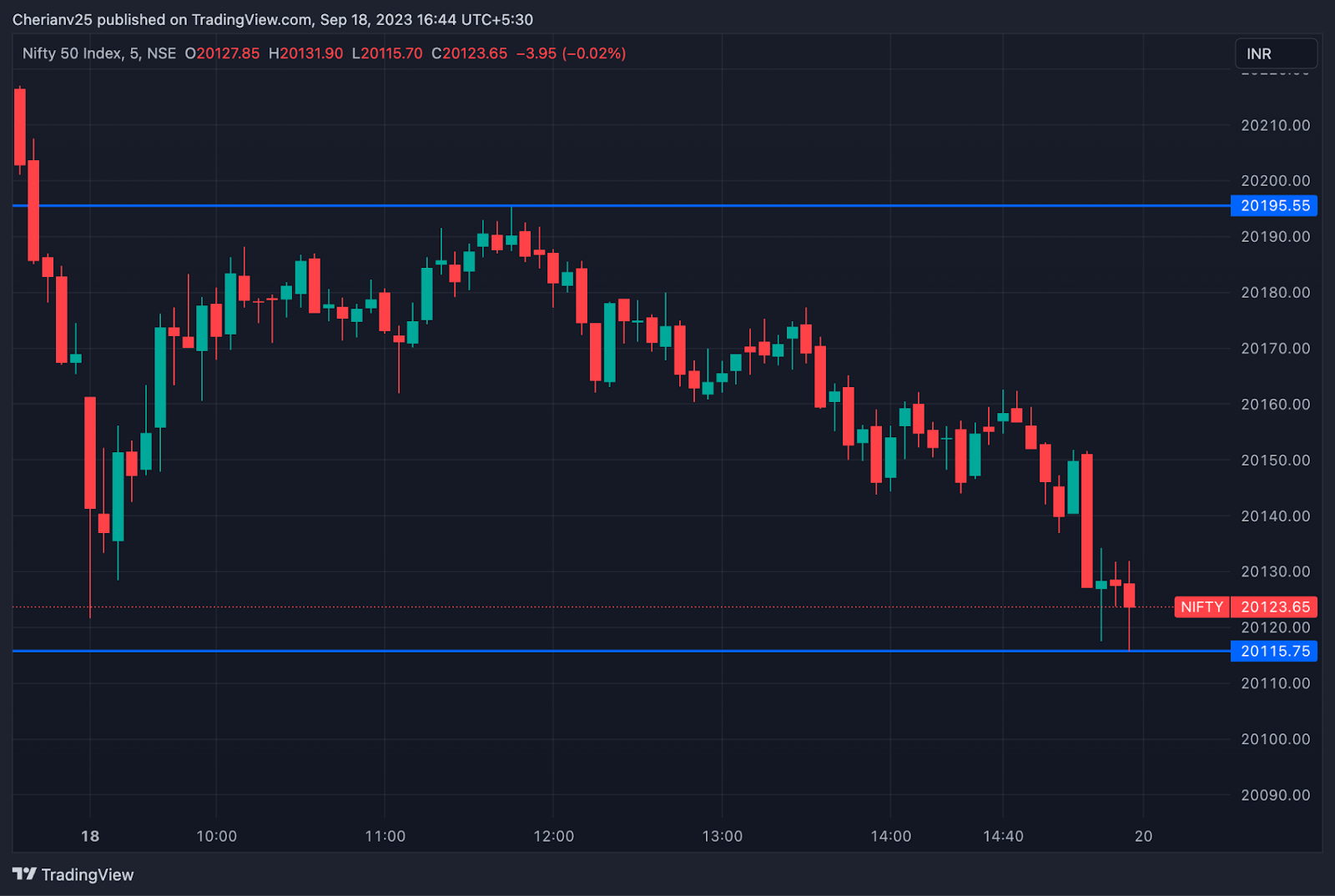
NIFTY started the day at 20,155 with a gap-down of 36 points. After falling to 20,120 levels in the first candle, the index moved up gradually to 20,195 (the day’s high). Post 12 PM, it fell nearly 80 points (making lower lows) to hit 20,115. Nifty closed at 20,133, down by 59 points or 0.29%.

Nifty chart Sept 18 - post-market analysis | marketfeed

BANK NIFTY (BNF) started the day at 46,100 with a gap-down of 130 points. After trading in a 110-point range initially, the index broke out of the consolidation, and rose to 46,250 levels. Then, similar to Nifty, Bank Nifty fell sharply by 345 points over the remaining part of the day! BNF closed at 45,979, down by 251 points or 0.54%.

Bank Nifty chart Sept 18 - post-market analysis | marketfeed

All indices except Nifty PSU Bank (+3.39%), Nifty Auto (+0.84%), and Nifty FMCG (+0.58%) closed in the red. Nifty Realty (-1.37%) fell the most.

Major Asian markets closed mixed. European markets are currently trading up to 1% in the red.

Today’s Moves

PowerGrid (+3.09%) was NIFTY50’s top gainer.

Indian Overseas Bank (IOB) hit a 20% upper circuit amid a strong rally in PSU bank stocks. UCO Bank (+15.1%) and Central Bank (+9.8%) also closed well in the green.

BEL (+3.1%) went up nearly 7% intraday after the company received multiple orders worth ₹3,000 crore on Friday.

Hindalco (-2.43%) was NIFTY50’s top loser amidst selling pressure in metal stocks.

Vodafone Idea (-6.8%) fell sharply after the telecom company denied reports that US-based Verizon, Amazon, and Starlink are in a race to acquire it.

J B Chemicals (-49.79%) shares have turned ex-split. The company had announced a stock split in the ratio 1:2.

Markets Ahead

Nifty and Bank Nifty have closed without major changes, and our market is witnessing small profit booking. In the upcoming days, we can expect decent selling after every intraday rise. To catch this move, you can use simple trendlines.

The major support to look out for in Nifty will be the 20,100-130 zone. However, Bank Nifty is struggling to trade above 46,000 as the region is close to its all-time high (ATH).

Bank Nifty may not show bullishness at least for this week. Here are the reasons: 

  • ICICI Bank is facing resistance near the ₹1,000 mark. If the stock breaks this level, it will be a strong double-bottom breakout and could be a big move after a small retracement.
  • HDFC Bank failed to break the resistance at ₹1,650. Will be watching how the stock behaves near the ₹1,620 support region.
  • Bank Nifty might trade in a 1000-points range of 45,480-46,330 for a few more days. Even an ATH breakout would be a trap, because Pivot levels are indicating a strong resistance near the 46,680 region.

Reliance is testing its major trendline support, but proper horizontal-level support is only available near ₹2,400.

The markets will remain closed tomorrow (Sept 19) on account of Ganesh Chaturthi.

How did FIN NIFTY expiry go? Let us know in the comments section of the marketfeed app.

Don’t forget to tune in to The Stock Market Show at 7 PM on our YouTube channel!

Categories
Editorial

How to Deal With a Recession in 2023?

2022 was a rollercoaster of a year for the global economy! Most sectors had just started showing signs of recovery after two pandemic-hit years. Unfortunately, Russia’s invasion of Ukraine, a cost-of-living crisis triggered by inflationary pressures, and the slowdown in China have hurt economic sentiments again. As we approach 2023, there are talks of an economic recession heading our way. 

In today’s article, we’ll discuss what a recession is, whether we’re really in one, and how we can deal with it intelligently.

What is a Recession?

A recession is a prolonged period of economic downturn. It’s typically indicated by a fall in the gross domestic product (GDP), an increase in unemployment, and a decline in consumer spending. GDP is the total market value of all the finished goods and services produced within a country’s borders during a specific period.

Economists generally agree that a technical recession happens when the real GDP growth (or inflation-adjusted GDP) declines for two quarters consecutively. It can be caused by a decline in consumer confidence, a fall in business investment, or an increase in interest rates. [When interest rates are hiked or the cost of borrowing rises, people will have to pay more to repay debts, thereby reducing their purchasing power. There will be less money in the hands of people to spend, and thus, businesses get less revenue.]

So during a recession, businesses may struggle to stay afloat. It can be difficult for people to keep their jobs or find new ones. Governments may have to provide extra support to citizens and businesses through financial assistance or stimulus packages. Like most countries, India entered a recession in FY21 due to strict lockdowns imposed by the government to curb surging Covid-19 cases. 

Will There Be a Recession in 2023?

Many financial experts and institutions (including the Centre for Economics & Business Research) have predicted a global recession to begin in 2023. WHY? Well, multiple factors such as rising interest rates (to curb inflation), trade tensions, and global political uncertainty can contribute to a prolonged economic downturn.

In fact, the International Monetary Fund’s (IMF) annual economic forecast has predicted sluggish global growth in 2023. It gives attention to three issues: Russia’s invasion of Ukraine and its impact, the long-term effects of the Covid-19 pandemic (especially in China), and high inflation & tight monetary policies. We could be paying the price for trying to bring down inflation to more comfortable levels!

Impact on the Stock Market

Stock prices tend to fall during a recession as companies struggle to maintain profitability and investors quickly withdraw their funds from the market. Such a bear market can help you buy stocks of fundamentally-strong companies at cheap prices! You could essentially take a look at your investment portfolio now and make the necessary adjustments for such a scenario.

How to Deal With a Recession in 2023:

Now, many of you might be freaking out about losing your jobs and life savings. But don’t panic! Here are some simple tips for surviving a recession in 2023:

  • Build an emergency fund: We can’t stress how important this is! An emergency savings fund can provide a buffer against unexpected job losses, expenses, and other financial setbacks that may occur during a recession. Aim to save up to 4-6 months’ worth of living expenses, or more if possible.
  • Manage your debt wisely: High levels of debt are like having a giant weight strapped to your back during a recession. They’ll make it harder to stay afloat if your income takes a hit. So pay down as much debt as possible before the recession hits, and prioritize the debts with the highest interest rates.
  • Cut unnecessary expenses: Look for ways to reduce extravagant expenses ​​ (such as dining out) and find ways to save on necessities like groceries and utilities. 
  • It may become necessary to explore alternative sources of income to help make ends meet during a recession. Consider taking on part-time or freelance work or starting a side hustle. You could even learn to trade and make money consistently from the stock market! (Visit marketfeed.com 🚀)
  • Seek financial assistance: If you’re struggling to make ends meet during a recession, don’t be afraid to ask for help. There are government programs and other resources that can provide financial assistance, such as unemployment benefits and food/grocery stamps.
  • Keep an eye on economic conditions and be ready to adjust your financial plan whenever required. This includes reassessing your budget, adjusting investments, or finding new ways to generate income.

These are just a few pointers on our survival guide for the next recession. It may not be an easy ride for many. But with a little bit of preparation and some flexibility, you’ll be able to weather the economic storm and come out stronger on the other side! 

Are you prepared to face an economic recession? Let us know in the comments section of the marketfeed app!

Categories
Editorial

How are Stocks Included/Excluded in NIFTY50?

Have you ever wondered how a stock gets added or removed from the NIFTY 50? In this article, find out how the process actually works.

What is NIFTY 50?

The NIFTY 50 is a benchmark stock market index that represents the weighted average of 50 of the largest Indian companies listed on the National Stock Exchange (NSE). The index includes companies that fall under 13 sectors of India’s economy. The index is owned and managed by India Index Services and Products Ltd (IISL). It also manages 67 sub-indices that fall under NIFTY. This includes NIFTY 100, NIFTY Next 50, NIFTY Small Cap, NIFTY Bank, NIFTY IT, etc.

The NIFTY 50 is computed using a free-float market capitalisation weighted method. In simple terms, the level of the index reflects the total market value of all the stocks included in the NIFTY 50, relative to a particular base period. The base period has been fixed as November 3, 1995, which marks the completion of one year of operations of NSE’s Capital Market Segment. The base value of the index has been set at 1,000, and a base capital of Rs 2.06 lakh crore.

Criteria for Including/Excluding a Stock in the NIFTY 50

The NIFTY 50 index goes through a reconstitution/rebalancing process every six months (semi-annually). This means that the list of companies included in the NIFTY 50 keeps changing with time. IISL has constituted an Index Maintenance Subcommittee (IMS), which checks the performance of each stock included in the index and also its sub-indices. The IMS makes all decisions on inclusions and exclusions in the index. Let us understand the eligibility criteria for a company to be included in the NIFTY 50:

  • It must be an Indian company registered with the NSE.
  • The company’s stock must be highly liquid (must have a large number of buyers and sellers). This is measured by the average impact cost. Impact cost is the trading price of single security in relation to the index’s weight to the company’s market capitalisation. (We shall understand this concept briefly later in the article). The stock should have traded at an average impact cost of 0.50% or less during the last six months for 90% of the observations, for a portfolio of Rs 10 crore.
  • For the last six months, the company’s trading frequency should be 100%. As the name suggests, trading frequency is the number of trades executed in a specific time interval.
  • The company’s average free-float market capitalisation should be at least 1.5 times greater than that of the smallest company on the index. Using the free-float method, market capitalisation is calculated by taking the company’s stock price and multiplying it by the number of shares readily available in the market.
  • Shares of the companies that have Differential Voting Rights (DVR) can also be eligible for the NIFTY 50 Index. Companies issue DVR shares to prevent any hostile takeover or dilution of voting rights. DVR shares are offered with superior, lower, or fractional voting rights to public investors. You can read more about DVR shares here.

A list of new eligible stocks is reviewed against the current index constituents twice a year. In case any changes are to be made, then the smallest constituents are excluded from NIFTY50, and new stocks replace them. The index also goes through a reconstitution process when a company undergoes mergers or acquisitions, suspensions, compulsory delisting, etc. The IISL conducts quarterly screening of the companies to keep track of whether they are adhering to all regulations.

What is Impact Cost?

Impact cost is the cost a buyer or a seller incurs while executing a transaction. This cost is dependent on the existing market liquidity. In other words, it represents the cost of executing a transaction of a given security, with a specific predefined order size, at any given point in time. Liquidity in the context of stock markets means a market wherein large orders can be executed without incurring a high transaction cost. Let us look at an example of impact cost:

Suppose a buyer wants to purchase 3,000 shares of a company named XYZ. If the best buy order for 1,000 shares is placed at Rs 127 and the best sell order for 1,500 shares is placed at Rs 129, the ideal price for the deal should be (127+129) ÷ 2 = Rs 128. At this price, one can expect the buyer to ideally get the desired quantity of XYZ shares.

Buy QuantityBuy PriceSell QuantitySell Price
10001271500129
15001281000130
8001291200131

However, suppose that the buyer was able to buy the 3,000 shares of XYZ at an average cost of Rs 129.5. This was calculated as [(1500 x 129) + (1000 x 130) + (500 x 131)] ÷ 3000 = 129.67. So, the impact cost will now be calculated as the following:

(Actual Cost – Ideal Cost) ÷ Ideal Cost x 100

(129.67- 128) ÷ 128 x 100 = 1.3%

This is the cost that buyers incur due to a lack of market liquidity. An important point to be noted here is that the impact cost varies for different transaction sizes. In the above example, an investor could end up incurring a high impact cost while buying large quantities of shares.

Now you know how stocks are added and removed in the NIFTY50! As per reports, Indian Oil Corp (IOC) holds a good chance of being excluded from the index. In its place, Apollo Hospitals or Info Edge (Naukri) may be added next year.

Categories
Jargons

What is an Index Fund? A Complete Guide to Index Funds in India

If you are a beginner in the stock market or a conservative investor, index funds can be a great way to diversify your investment portfolio with minimal cost and effort. In this article, we’ll cover everything you need to know about index funds, starting from the basics to choosing the suitable one. We will also discuss how it differs from actively managed funds.

What is an Index Fund?

An index fund is a type of mutual fund or exchange-traded fund (ETF) that tracks and replicates the performance of a specific market index (like NIFTY50/Sensex in India or S&P500 in the US). These funds replicate the performance of an index regardless of the state of the markets. When you invest in an index fund, you automatically own a tiny piece of all the companies in the index. So, if the companies in the index perform well, your investment does too. These funds provide exposure to the broad market at a low cost.

Veteran investor Warren Buffet has recommended index funds as an investment option to park savings for retirement. He argues that investing in an index fund is more sensible for an average investor than picking and investing in individual stocks. This is because index funds provide exposure to the market as a whole.

How do Index Funds Work?

Consider an index fund that replicates/tracks NSE’s Nifty50 Index. There will be 50 stocks in this fund’s portfolio, all of which will have the same weightage as in Nifty50. When you put money in this index fund, that cash is used to invest in every company that makes up the particular index. It gives you a more diverse portfolio than if you were buying individual stocks. The fund’s value rises and falls in sync with the index it’s based on.

The low expense ratio of an index fund is one of its main unique selling points (USPs). The expense ratio is a small portion of the fund’s total assets that the fund house charges investors for fund management services.

Benefits of Investing in Index Funds

A few of the benefits of Index funds compared to individual investment in stocks are:

1. Diversification

By investing in an index fund, you gain exposure to a broad range of assets (stocks or bonds) within the chosen index. All indices other than sectoral indices are well-diversified, and you can reduce the risk of one stock performing poorly.

2. Lower Cost

Index funds are known for their low expense ratios, meaning they have lower fees compared to actively managed funds.

3. Historical Performance

Over the long term, index funds tend to match or outperform many actively managed funds.

4. Time Saver

Investors don’t have to spend hours researching stocks since the stocks in index funds are copied from the index in the same proportion.

5. Transparency

Index funds provide full transparency into their holdings, allowing investors to see exactly what they own.

Types of Index Funds

There are index funds available for a wide range of market indices, covering different asset classes and regions. Here are some common types:

1. Equity Index Funds

These track stock market indices like the Nifty50 and Sensex. In the past, large-cap stocks have generally outperformed inflation. But they have also shown significant volatility over short and medium-term timeframes.

2. Bond Index Funds

Bond index funds replicate the performance of bonds or fixed-income securities. For example, the S&P BSE India Bond Index tracks local currency-denominated government and corporate bonds from India. This type of index fund is ideal for investors looking for stability in investments and regular interest payments.

3. Sectoral Index Funds

Sectoral index funds provide exposure to specific sectors of the economy like banking, technology, healthcare, or real estate. For example, an index fund based on Nifty Financial Services is a sectoral index fund that tracks the performance of financial services companies in India.

However, these funds are generally riskier than diversified funds because they are more narrowly focused. The fund’s performance relies on how well that particular sector does.

4. Global Index Funds

Global index funds invest in global indices such as the S&P500 and NASDAQ 100. These funds offer an opportunity to easily invest in multi-national companies. 

5. Commodity Index Fund

Commodity Index Funds track commodity indices. You can invest in commodities such as gold, oil, or agricultural products easily through these funds.

How to Choose the Right Index Fund?

Selecting the right index fund is crucial for achieving your investment goals. A few points to keep in mind while choosing an index fund are:

1. Determine Your Goal 

The first step before choosing an index fund is to determine your investment goal. College fees, buying a dream car or home, securing retirement funds, etc. can be examples of investment goals. Your goal will influence which index fund is best for you.

2. Risk Tolerance

Consider how comfortable you are with risk. If you prefer lower risk, consider bond index funds. On the other hand, if you can handle some fluctuations (volatility) in your investments, equity index funds might be the better choice for you.

3. Expense Ratios

Compare the fees across various index funds. Lower fees result in more of your money being invested. The expense ratio is a metric that reflects the fees and additional costs you incur with the mutual fund company.

4. Track Record

Check the fund’s historical performance. While past performance doesn’t guarantee future results, it can provide valuable insights. It’s important to note that the performance of an index fund will never exceed the chosen index because expenses reduce the overall returns it generates.

5. Diversification

Ensure the index fund aligns with your desired level of diversification for your investment portfolio.

Index Fund vs Actively Managed Funds

The key differences between index funds vs. actively managed funds are:

Index FundsActively Managed Funds
Replicates the holdings of a specific indexFund managers make decisions based on research and analysis
Expense ratio is generally lower due to passive managementExpense ratio will be higher due to active management and research costs
Lower risk due to broad diversificationRisk varies depending on the fund manager’s decisions
Discourages market timing, focuses on long-term investingMay involve market timing and tactical allocation
Generally aims to match the performance of the indexSeeks to outperform the market or a benchmark index

Historical Performance of Index Funds

Index funds typically deliver returns that closely mirror the performance of the underlying indices they track. Looking at historical data, it’s evident that the majority of actively managed funds have struggled to outperform these indices, which is why many investors opt for index funds.

Over the past 30 years, index funds based on the S&P 500 have delivered a Compounded Annual Growth Rate (CAGR) of 10.7% per year. Meanwhile, index funds based on Nifty50 have given a return of 12% CAGR in the last 15 years.

To learn more about the best index funds to invest in India, click here.

How to Invest in Index Funds in India

Here’s a simple guide on how to invest in index funds in India:

  1. Start by selecting a reliable brokerage platform (like Zerodha or Groww). Ensure that the broker offers access to a variety of index funds.
  2. To invest in index funds, you’ll need a Demat and trading account. These accounts will hold your investments electronically and enable you to buy and sell index fund units.
  3. Research and pick an index fund that aligns with your investment goals and risk tolerance. Popular choices include Nifty 50 index funds, Sensex index funds, and sector-specific index funds.
  4. Use your broker’s trading platform to place buy orders for the index fund you’ve chosen. Specify the number of units or the amount you wish to invest.
  5. Index funds are designed for long-term investing. Stay committed to your investment strategy and avoid making impulsive decisions based on short-term market fluctuations.

Tax Considerations on Index Funds

Taxes on index funds are levied both on capital gains and dividends. Dividends are combined with the investor’s taxable income and taxed according to their income category. Capital gains, on the other hand, are subject to separate taxation.

Read: Income Tax Structure for Stock Market Investors & Traders.