Categories
Market News Top 10 News

India’s Manufacturing PMI Hits a 3-Month High in March – Top Indian Market Updates

Here are some of the major updates that could move the markets tomorrow:

India’s manufacturing PMI hits a three-month high of 56.4 in March

India’s manufacturing sector expanded at its quickest pace in three months in March on improved output and new orders. The S&P Global India Manufacturing Purchasing Managers’ Index (PMI) stood at 56.4 in March, compared to 55.3 in Feb. Foreign demand for Indian goods increased as well, with new export orders rising in March.

PMI is a month-on-month calculation, and a value above 50 represents an expansion compared to the previous month.

Read more here.

Auto sales data for March 2023: Highlights  

Maruti Suzuki India wholesale sales remained flat at 1.70 lakh units in March 2023. Sales of its mini & compact vehicle segment fell 14% YoY to 83,714 units. Exports rose 13.7% YoY to 30,119 units.

Tata Motors Ltd registered a 4% YoY increase in passenger vehicle sales to 44,225 units in March. The automaker’s commercial vehicle sales remained flat at 46,823 units.

Mahindra & Mahindra’s total passenger vehicle segment posted total sales of 35,997 units in March, an increase of 30% YoY. M&M’s tractor sales rose 18% YoY to 35,014 units. 

TVS Motor Company’s total sales stood at 3.17 lakh units in March, up 3% YoY.

Read more here.

Axis Bank launches business management solution for merchants

Axis Bank, in partnership with Visa, launched an app that will empower merchants to accept payments through various digital modes and enable them to manage their day-to-day business digitally. The app (Digital Dukaan) has been specifically designed to address business requirements such as accepting digital payments, inventory management and billing.

Read more here.

NTPC and NHPC to merge

The Indian government is considering selling NTPC Ltd’s two hydropower firms to NHPC Ltd to create a single hydropower company. This move will improve efficiency, cut costs, and help meet high demand at night when solar projects do not run. NTPC acquired the projects (THDC India Ltd and NEEPCO) three years ago for about $1.34 billion under a consolidation plan by the Indian government. 

Read more here.

SAIL produces record 18.28 MT crude steel in FY23

Steel Authority of India (SAIL) has reported a 5.3% year-on-year rise in crude steel production to a record 18.28 million tonnes (MT) in the financial year 2022-23, with hot metal production up 3.6% YoY to 19.40 MT. SAIL, the country’s largest steel producer, has been focusing on value-added and special-steel production. It has five integrated and three special steel plants across India.

Read more here.

SpiceJet hives off cargo and logistics business into separate entity

SpiceJet Ltd has separated its cargo and logistics business, SpiceXpress, into a separate entity named SpiceXpress and Logistics Pvt Ltd. The move has resulted in a one-time gain of Rs 2,555.77 crore for SpiceJet. The separation also enables SpiceXpress to raise funds independently. SpiceXpress, which reported a net profit of Rs 51.4 crore for the April-December period of FY23, is expected to attract more investments and partnerships to further grow its business.

Read more here.

Yulu and Zomato announce tie-up for last-mile deliveries

Yulu, a shared electric Mobility-as-a-Service (MaaS) platform, has partnered with food delivery platform Zomato to use Yulu DeX EVs for intra-city deliveries. Yulu will provide about 25,000-35,000 Yulu DeX to delivery partners onboarded on Zomato’s platform for last-mile deliveries on custom-made rental plans. Once deployed, these Yulu DeX have the potential of serving 3 lakh green deliveries every day by 2026. 

Read more here.

TCS secures contract from Norwegian rail network operator Bane NOR

Tata Consultancy Services (TCS) has won a contract from Bane NOR to enable secure access to its digital systems. As TCS’ strategic partner, the company will provide identity governance and administration, access management, identity lifecycle management, and application management operations in a managed services model. Bane NOR is the government agency responsible for maintaining and developing the Norwegian railway network.

Read more here.

Tejas Networks bags record order from BSNL

Tejas Networks has received an advance purchase order worth Rs 696 crore from Bharat Sanchar Nigam Limited (BSNL) to upgrade its pan-India IP-MPLS-based Access and Aggregation Network (MAAN). The company will supply, install, and commission over 13,000 of its TJ1400 series of next-generation routers for a converged multi-service packet network being rolled out nationwide.

Read more here.

Oil prices surge 8% after OPEC+ announces surprise output cut

Oil prices surged nearly 8% today morning, with Brent Crude making a high of $86.44 after Saudi Arabia and OPEC+ announced a surprise cut in production of around 1.16 million barrels per day. West Texas Intermediate or WTI Crude prices also surged up to 7.5% to $81.58 per barrel. The cuts will begin in May and go on till the end of the year.

Read more here.

Categories
Market News Top 10 News

World Bank Cuts India’s GDP Growth Forecast for FY23 – Top Indian Market Updates

Here are some of the major updates that could move the markets tomorrow:

World Bank cuts India’s GDP growth forecast to 6.5% for FY23

The World Bank cut its FY 2022-23 (FY23) real gross domestic product (GDP) growth forecast for India to 6.5% from an earlier estimate of 7.5%. It has warned that spillovers from Russia’s invasion of Ukraine and global monetary tightening will weigh on the economic outlook. The World Bank said private investment growth is likely to decline due to economic uncertainty and higher financing costs. Slowing global demand will impact India’s exports as well.

Read more here.

Nykaa enters into strategic alliance with Apparel Group to enter GCC market

Nykaa has entered a strategic alliance with Dubai-based fashion & lifestyle retail conglomerate Apparel Group to expand in Gulf countries. The two companies will work together to build a multi-brand beauty retail business in Gulf Cooperation Council (GCC) nations. Nykaa expects stronger demand for its products in the current quarter after a subdued season where inflationary pressures dented consumer spending.

Read more here.

Mahindra Lifespaces forms JV with Actis for industrial, logistics real estate

Mahindra Lifespace Developers Ltd has entered into an agreement with UK-based Actis to establish a joint venture (JV) platform for developing industrial and logistics real estate facilities across India. The total investment in the business over the initial years is estimated to be ₹2,200 crore. Up to 100 acres of land with ready infrastructure in two Mahindra World Cities have been identified as seed sites to be bought and developed by the JV.

Read more here.

Ujjivan SFB records 44% jump in loan book in Sept

Ujjivan Small Finance Bank (SFB) reported a 44% YoY growth in gross loan book at ₹20,938 crore at the end of September 2022. This was driven by micro, affordable housing, and individual borrowings. Deposits rose 45% YoY to ₹20,389 crore, driven by strong momentum in retail deposits, which were up 71% YoY.

Read more here.

Petrol, diesel price freeze in India likely to be extended due to OPEC output cut

The six-month-long freeze in the price of petrol and diesel will be extended after international oil prices rose on the announcement of deep production cuts by OPEC+. The top oil-producing nations have agreed to cut production by two million barrels per day to boost recovery in oil prices that had dropped to pre-Ukraine war levels.

This is bad news for India as a fall in oil prices in recent weeks had helped the govt bring down its import bill and limit losses that state-owned fuel retailers were incurring on selling petrol and diesel.

Read more here.

L&T’s construction arm bags significant orders from auto major

Larsen & Toubro Ltd’s construction arm has secured significant orders (in the range of ~₹1,000-2,500 crore) from a leading automobile major to construct a state-of-the-art manufacturing facility in Haryana. The scope of the order involves the design and execution of civil, structural, and architectural works. The company has also won an order to construct a police reserve campus in Guwahati from the Public Works Department (PWD), Assam.

Read more here.

HFCL partners with Qualcomm to develop 5G small cells

HFCL has partnered with Qualcomm Technologies Inc., for HFCL’s design and development of 5G Outdoor Small Cell products. The investment in 5G small cells will enable faster rollout of 5G networks, improved 5G user experience, and more efficient utilization of the 5G spectrum. HFCL’s 5G Outdoor Small Cell supports both 5G Non-Standalone (NSA) and Standalone (SA) modes.

Read more here.

Bharti Airtel launches 5G Plus in 8 cities

Bharti Airtel has launched 5G Plus in Delhi, Mumbai, Chennai, Bengaluru, Hyderabad, Siliguri, Nagpur, and Varanasi. Airtel 5G Plus will run on a technology that will ensure that all 5G smartphones in India seamlessly work on the Airtel network. The company claims to deliver high speeds and super-fast call connections. Customers who have 5G smartphones can enjoy Airtel 5G Plus on their existing data plans until the rollout is more widespread.

Read more here.

NTPC partners with GE Gas Power for hydrogen co-firing in gas turbines

NTPC Ltd has signed a Memorandum of Understanding (MoU) with GE Gas Power to explore the feasibility of hydrogen co-firing blended with natural gas in GE’s 9E gas turbines installed at NTPC’s Kawas gas power plant in Gujarat. The two companies will explore the pathways to reduce carbon dioxide emissions from the plant and further implementation at scale across NTPC’s installed units in India. 

Read more here.

Categories
Market News Top 10 News

Services PMI Rises to 57.2 in August – Top Indian Market Updates

Here are some of the major updates that could move the markets tomorrow:

Services PMI accelerates to 57.2 in August 

India’s services sector saw gains in new business, ongoing improvements in demand conditions, and job creation during August. The S&P Global India Services Purchasing Managers’ Index (PMI) stood at 57.2 in August, compared to 55.5 in July. The rate of job creation last month was the strongest in more than 14 years.

PMI is a month-on-month calculation, and a value above 50 represents an expansion compared to the previous month. 

Read more here

IEX’s total trade volume falls 18% in August

Indian Energy Exchange (IEX) registered an 18% YoY decline in total trade volume to 7,805 million units (MU) in August 2022. This includes 6,517 MU in the conventional power market, 437 MU in the Green Power market, and 851 MU in the Renewable Energy Certificate (REC) market. The average clearing price in the Day-Ahead market rose 2% YoY to Rs 5.17 per unit last month. 

Read more here

Paytm denies link with Chinese loan merchants under ED scanner

Payment platform Paytm has denied any links with the merchants that are currently under Enforcement Directorate’s (ED) scanner in the Chinese loan app case. On Friday, ED carried out search operations at six premises in Bengaluru concerning an investigation of the case. The premises of Razorpay, Cashfree Payments, Paytm Payment Services, and other entities “controlled” by Chinese persons were covered in the operation. The raids were conducted under provisions of the Prevention of Money Laundering Act (PMLA), 2002. 

Read more here.

Dixon Tech signs pact with Google to sub-license rights relating to Android

Dixon Technologies Ltd has signed an agreement with Google to sub-license rights relating to Android and Google TV. This partnership will enable the company to offer a cost-effective and high-quality experience to its existing customers and potential new brands. It will further strengthen Dixon Tech’s market leadership in the LED TV category.

Read more here.

Bank of Maharashtra organises loan outreach program; sanctions more than ₹1,000 crore

Bank of Maharashtra has organised a credit outreach program under which it has sanctioned loans worth nearly ₹1,000 crore. Loan sanction letters were distributed to the beneficiaries by Financial Services Secretary Sanjay Malhotra in Pune. He also visited self-help group stalls at the event and interacted with members. The secretary also visited self-help group stalls at the event and interacted with the members.

Read more here.

Mahindra Lifespace expects over 2.5-fold rise in bookings soon

Mahindra Lifespace Developers Ltd is targeting a 2.5-fold jump in its annual sales bookings to ₹2,500 crore in the next three years on better housing demand. The company registered ₹600 crore of residential sales during the April-June quarter (Q1) of FY2022-23, compared to ₹1,028 crore in the full previous year. It expects very strong continued growth in Q2 and the rest of the year.

Read more here.

Would surpass ₹21,000-crore revenue target by 2026: ABFRL chairman

Aditya Birla Fashion and Retail Ltd (ABFRL) is confident of fortifying its market position further and surpassing the projected revenue of ₹21,000 crore by 2026, said chairman Kumar Mangalam Birla. The company is leveraging technology and its execution excellence to build a strong, profitable, and future-ready brand portfolio. ABRFRL is also working on strategic alliances and is building a comprehensive set of iconic brands.

Read more here.

Aurionpro Solutions acquires US-based startup Hello Patients Solutions Inc.

Aurionpro Fintech Inc., a US-based subsidiary of Aurionpro Solutions Ltd, announced the acquisition of Hello Patients Solutions Inc, a startup registered in Delaware, USA. Hello Patients provides a healthcare billing and patients’ management solution that leverages Aurionpro’s technology for payments processing. Aurionpro will acquire the entire stake in Hello Patients in an all-cash transaction of $250,000 (~₹1.99 crore).

Read more here.

OPEC to cut oil output for first time in a year

For the first time in a year, OPEC+ agreed to make a token oil supply cut for October. The organisation aims to stabilise international markets after a faltering economic backdrop triggered the longest price decline in two years. At a meeting held today, OPEC decided to reduce production by 100,000 barrels a day in October, taking supplies back to August levels.

Read more here.

HAL-L&T consortium secures ₹860-crore contract to build five PSLVs

A consortium of Hindustan Aeronautics Ltd (HAL) and Larsen & Toubro has won an ₹860 crore deal from NewSpace India Limited (NSIL) to build five Polar Satellite Launch Vehicle (PSLV) rockets over four years. The contract was exchanged today between HAL and NSIL during the inaugural session of the 7th Bengaluru Space Expo 2022.

Categories
Market News Top 10 News

Bharti Airtel Pays Rs 8,312 crore for 5G Spectrum – Top Indian Market Updates

Here are some of the major updates that could move the markets tomorrow:

Bharti Airtel pays Rs 8,312.4 crore to DoT for 5G spectrum

Bharati Airtel Ltd has paid Rs 8,312.4 crore to the Department of Telecommunications (DoT) towards dues for spectrum acquired in the recently concluded 5G auctions. With this payment, the telco has paid four years of 2022 spectrum dues upfront. 

The upfront payment, the moratorium on spectrum dues, and AGR-related payments for four years will free up future cash flows and allow Bharti Airtel to dedicate resources to concentrate on the 5G rollout.

Read more here.

India’s oil demand to rise 7.7% in 2023: OPEC

As per an OPEC report, India’s demand for petroleum products like petrol and diesel will grow by 7.73% in 2023, the fastest pace in the world. The country’s demand for oil products is projected to rise from 4.77 million barrels per day (bpd) in 2022 to 5.14 million bpd in 2023. India is the world’s third largest oil importing and consuming nation behind the United States and China.

Read more here.

Sona Comstar partners with Israeli startup Drive to develop new tech in smart mobility

Sona Blw Precision Forgings Ltd (Sona Comstar) has partnered with Israel-based startup Drive to develop and commercialise new technologies in the smart mobility space. The partnership will give Sona Comstar access to Drive’s new testing, evaluation, and development centre. As an innovation-hub partner, the company can participate in Drive’s startup commercialisation program FastLane.

Read more here.

Kalpataru Power moves court in Paris to enforce Rwanda Energy arbitration award

Kalpataru Power Transmission Ltd (KPTL) has approached the Judicial Court of Paris to seek enforcement of an arbitration award of over $32 million (~Rs 240 crore) against Rwanda Energy Group (REG). KPTL had entered into a contract with REG in November 2013 to install and commission a 220 kilovolt (KV) power transmission network connecting the Democratic Republic of Congo and Rwanda. A dispute arose when REG refused to pay KPTL for price adjustment.

Read more here.

UPL signs pact with Oro Agri for co-distribution of ‘Orange Oil’

UPL Ltd has partnered with US-based Oro Agri for the co-distribution and development of Orange Oil, a bio-solution effective against a variety of pests and illnesses. The company will co-distribute the bio-protection formulation starting in 2023. While UPL will leverage its global distribution network to explore new markets and expand its client base, Oro Agri will continue to supply current customers directly.

Read more here.

Ashok Leyland announces merger of Hinduja Leyland Finance with NXTDIGITAL

Ashok Leyland Ltd has announced the merger of non-banking financial company (NBFC) Hinduja Leyland Finance (HLF) with NXT DIGITAL. The move will help integrate business operations, ensure efficiency in cash management, and formulate integrated operational and marketing strategies. The share exchange ratio for the merger will entail 23 shares of NXTDIGITAL to be allocated for every 10 shares of Leyland Finance held. 

Read more here.

India’s 10-year bond yield drops 10 basis points

Indian government bond yields declined on Wednesday, with the benchmark 10-year yield crashing 10 basis points (bps), following a sharp fall in global oil prices that could further lower the inflation trajectory. The benchmark 10-year govt bond yield was at 7.1966% as of 10:25 AM today. It had fallen to 7.1947% earlier in the day, after closing at 7.2894% on Friday. Global oil prices dropped, with the benchmark Brent crude contract declining to its lowest level in six months on Tuesday.

Read more here.

Jio adds 42.2 lakh subscribers in June; Bharti Airtel gains 7.9 lakh users 

Reliance Jio Infocomm gained 42.23 lakh mobile subscribers in June 2022, taking its total user base to 41.3 crore. Bharti Airtel added 7.93 lakh users, and its total mobile subscriber count rose to 36.29 crore. Vodafone Idea lost nearly 18.01 lakh mobile subscribers during June. India’s total wireless subscribers count increased marginally to 114.73 crore at the end of June 2022. 

Read more here.

M&M in talks with different states to set up EV production site

Mahindra & Mahindra has initiated talks with various state governments in India to set up manufacturing infrastructure for its upcoming range of electric sports utility vehicles (SUVs). It will evaluate incentives offered by different state governments before finalising a strategy for the production of these EVs. The automaker has lined up five new electric SUVs. The first four are expected to hit the roads between December 2024 and 2026.

Read more here.

Categories
Editorial

India’s Top Upstream & Downstream Oil Companies: An Analysis

The oil and gas industry is one of the eight core industries in India. It has a powerful influence on all vital sections of our economy. Based on their operations and position in the supply chain for crude oil and its products, oil companies can be mainly divided into two: Upstream & Downstream. From exploration and production of oil to refinement and distribution, these companies play a crucial role in India’s economic growth.

In this article, learn about the major upstream and downstream oil companies of India.

What are Upstream Oil Companies?

The upstream segment is responsible for finding and producing crude oil and natural gas. This includes searching for potential oil fields, drilling exploratory wells, and examining whether they have the potential to deliver a sizable amount of oil. The companies involved in this segment also recover crude oil and natural gas to the surface. Such entities are also known as Exploration and Production (E&P) companies. They are heavily dependent on research and development (R&D) activities. The members of E&P companies include geologists, scientists, engineers, and seismic experts.

Modern oil exploration relies on geological surveys conducted using electronic equipment and artificial intelligence (AI). Mechanical drilling and fracking equipment has become more advanced and efficient over the past few years.

Oil & Natural Gas Corporation (ONGC)

Oil and Natural Gas Corporation (ONGC) Ltd is the largest producer of crude oil and natural gas in India. Its operations are primarily centered around the extraction of oil. The company accounts for ~71% of India’s total crude oil production

ONGC operates nearly 105 oil drilling rigs and 74 workover (portable) rigs. It owns more than 11,000 km of oil pipelines across India. Downstream oil companies such as Indian Oil Corp. (IOCL), BPCL, and HPCL use the crude extracted by ONGC as their raw material.

The Government of India (GoI) holds a majority stake (60.4%) in the company. ONGC comes under the administrative control of the Ministry of Petroleum & Natural Gas. You can learn more about the energy giant here.

Oil India Limited (OIL)

State-owned Oil India Ltd explores, develops, and produces crude oil and natural gas in India and internationally. The company operates 1,157 kilometers of cross-country crude oil pipelines. It also owns 13 drilling rigs, 14 work-over rigs, and 10 crude oil pumping stations in Assam, West Bengal, and Bihar.

OIL has participating interests in New Exploration Licensing Policy (NELP) blocks in Mahanadi Offshore, Mumbai Deepwater, and Krishna Godavari Deepwater. It is also involved in various offshore projects in Libya, the United States, Nigeria, Sudan, Venezuela, etc.

Reliance Industries Ltd

Reliance Petroleum, a subsidiary of RIL, is one of the major private players in the Indian upstream oil market. It operates two prominent oil rigs in the Bay of Bengal— Dhirubhai Deepwater (DD) KG-1 and DD KG-2. Reliance Industries also owns the largest refinery in the world— the Jamnagar oil refinery. It has the capacity to produce 1.97 lakh cubic meters of crude oil every day!

Larsen & Toubro Ltd

The leading engineering and construction company works on several projects that deal with the extraction of oil and its processing. L&T also offers critical equipment and systems for oil & gas projects. The company’s hydrocarbon business caters to the entire hydrocarbon value chain, including oil & gas processing, petroleum refining, chemicals & petrochemicals.

BP Plc

BP Plc is a British multinational oil and gas company headquartered in London. In 2020, the company formed an Indian joint venture (JV) with Reliance Industries Ltd. Operating under the “Jio-bp” brand, the JV aims to become a leading player in India’s fuel and mobility markets.

What are Downstream Oil Companies?

Downstream oil companies are involved in the refining, manufacturing, and marketing of petroleum products. This segment consists of oil refineries, petrochemical plants, and fuel distributors/retailers. They offer products such as petrol, diesel, natural gas, jet fuel, synthetic rubber, plastics, pesticides, pharmaceutical ingredients, and much more. Thus, downstream oil companies oversee the critical final steps of refining and converting crude oil into final products, which are then sold to end-consumers.

Indian Oil Corporation Ltd (IOCL)

IOCL is engaged in the refining, transportation, research & development, and marketing of petroleum products in India. Its products include petrol, diesel, lubricants, greases, aviation fuel, industrial fuels, and marine oils. The state-owned company operates 11 refineries across India, ~15,000 km of crude oil & gas pipelines, and 7 foreign subsidiaries. IOCL holds a 32% market share in the downstream oil industry.

Hindustan Petroleum Corporation Ltd (HPCL)

HPCL, a subsidiary of ONGC Ltd, refines and markets petroleum products in India and across the globe. The company offers petrol, diesel, kerosene, liquefied petroleum gas (LPG), naphtha lubricants, greases, and aviation turbine fuel. It also markets and exports bitumen, jet and marine fuel, marine lubes. 

As of March 2021, HPCL’s operating network consisted of 18,634 retail outlets, 6,192 LPG distributors, 46 aviation service facilities, and 41 oil & gas terminals. The company owns two refineries in Mumbai and Visakhapatnam. HPCL has secured a market share of 25% in the downstream oil sector.

Bharat Petroleum Corporation Ltd (BPCL)

BPCL refines crude oil and markets petroleum products in India. It has a network of ~15,402 fuel stations that sell petrol, diesel, automotive liquefied petroleum gas (LPG), and compressed natural gas. The company also offers automotive engine oils, gear oils, greases, and jet fuel to airlines. BPCL operates oil refineries in Mumbai, Bina (Madhya Pradesh), Numaligarh, and Kochi. They operate 2,241 km of multi-product pipelines. 

BPCL has a ~24% market share in India’s downstream oil sector.

The Way Ahead

Global crude oil prices have touched the roof amidst Russia’s invasion of Ukraine. There is a notable surge in demand, and the supply chains have broken. The oil market will face its biggest supply crisis in decades until the Organization of Petroleum Exporting Countries (OPEC) boosts production. A further increase in oil prices can push prices of essential commodities to higher levels.

Meanwhile, OPEC has projected that India’s demand for oil will double from current levels to ~11 million barrels per day by 2045. Due to the increasing demand for petroleum products, the Indian government has introduced various policies and subsidies to support upstream and downstream oil companies. It has even allowed 100% foreign direct investment (FDI) in upstream and private sector refining projects.

However, most oil companies mentioned above are now making a slow transition to renewable energy options. Crude oil, hydrocarbon, natural gas, and other fossil fuels are limited in nature. Such resources have been depleting rapidly in recent years. In the future, there will be a time when oil becomes scarce. India has pledged to decrease the carbon emission concentration in its GDP by 33%-35% by 2030 from the levels of 2005. The government also aims to double the country’s consumption of renewable energy to 20% by 2025.

Large oil companies are investing heavily in green energy projects and electric charging infrastructure to help India achieve these ambitious targets. Let us look forward to seeing how they execute their strategic plans.

Categories
Editorial

Why Are India And Other Countries Releasing Strategic Petroleum Reserves?

Amidst high oil and petroleum prices, the United States, India, China, Japan, and South Korea, to name a few, have been releasing their ‘strategic petroleum reserves’. The move, led by the US, aims to pressurise OPEC+ nations to increase the supply of oil to get the rising oil prices under control. In this piece, we explore the importance of strategic petroleum reserves, the impact of rising oil prices in India, and more. 

What Are Strategic Petroleum Reserves?

A Strategic Petroleum Reserve (SPR) is a reserve/stockpile of oil maintained by countries. Countries can access the emergency stockpile in case of calamities, natural disasters, fuel shortages or other economic events. In India, the strategic petroleum reserve is maintained by Indian Strategic Petroleum Reserves Limited (ISPRL) under the Ministry of Petroleum and Natural Gas.

Founded in 2005, ISPRL has four storage facilities across India with a storage capacity of 5.33 MMT (million metric tons). With the current consumption rate, the crude oil and petroleum products in reserve could last 74 days.

What is OPEC or OPEC+

The Organization of the Petroleum Exporting Countries (OPEC) refers to a group of 13 of the world’s major oil-exporting nations. It was established in 1960 in Baghdad, Iraq. OPEC is essentially a cartel that regulates the supply of crude oil, thereby controlling oil prices in the global markets. They control 40% of the world’s supply of oil. According to estimates, ~79.4% of the world’s proven oil reserves are located in OPEC member countries. The following countries are a part of OPEC— Nigeria, Angola, Congo, Ecuador, Equatorial Guinea, Gabon, Iran, Iraq, Kuwait, Libya, Nigeria, Qatar, Saudi Arabia, United Arab Emirates, and Venezuela.

In 2016, A larger group called OPEC+ was formed to have more control over the global crude oil market. OPEC+ includes 23 countries including Russia, Mexico, Bahrain, to name a few. To know more about OPEC/OPEC+ and how it controls the global oil market, check out this article at marketfeed: What is OPEC and How Does it Control Global Crude Prices?

Why Are Countries Releasing Oil Reserves?

The past year has been wholesome for the oil market globally. First, we had the Saudi-Russia Oil price war, then we had the Saudi-UAE clash over oil. After the COVID-19 pandemic struck, countries cut short the supply of oil over low demand. The impact was such that oil prices went negative! After the impact of the pandemic subsided, industries returned to normalcy globally. The demand for oil and gas started going up. However, the OPEC+ countries did not proportionately pump up supply. This would play in favour of oil-producing nations since they would get a higher realization/profits for the oil that they sell. 

As a result of fiscal and monetary stimulus provided by countries, inflation has skyrocketed across the world. This is because all the money that the government pumped into the system made its way either into the stock market or increased consumption in general. When oil prices increase, the prices of all goods and services generally tend to increase. This is an added burden to inflation. If oil prices fall, it would be in the best interest of most countries.

Despite pressure from the United States, India, and other countries, OPEC+ refuses to increase the supply of oil. While OPEC+ has signed a plan to increase oil production by 400,000 barrels per day each month till 2022, other countries expect a lot more than that. Due to concerns of a new variant of COVID-19, OPEC+ might put a brake on that as well.

To address OPEC Plus’ obstinacy to increase oil output, countries like the US, Japan, China, India, South Korea have decided to release their strategic oil reserves. Analysts say that the move is like a ‘drop in the ocean’. Essentially, the release of strategic oil reserves might not compel OPEC+ to increase oil output. Nevertheless, after the countries announced the release of strategic oil reserves, global crude oil prices tanked by nearly 10%. Even if the gesture was symbolic, it did have an impact on crude oil prices. Since the increase in oil supply after the release of strategic reserves was minuscule, the reduction in oil prices might be sentimental. 

The Way Ahead

India’s petrol and diesel prices reached an all-time high in 2021. The government for long had refused to cut the high excise duty that it imposed on oil and gas products. In November 2021, the government finally cut down excise duty on petrol and diesel by ₹5 and ₹10 respectively. Many state governments announced further excise duty cuts to couple with it. This was a sign of relief for the people of India. 

Crude oil prices around the world have tanked 10-15% because of fears around the new variant of COVID-19, Omicron. Increasing oil prices could severely drive up inflation in India. The fear of the Omicron variant shouldn’t become an excuse for oil-producing countries to cut down further supply of oil.  The increase in inflation can also impact the value of the Indian Rupee in the market. If a country’s inflation rate is lower than that of another, its currency will increase in value. High oil prices can impact inflation all across the globe. This could disrupt the smooth flow of trade since the cost of transportation goes up. While the oil-producing countries will benefit from high oil prices, they do not realise the opportunity cost of doing so. This move could severely impact trade relations with other countries. Now, non-OPEC countries have successfully managed to create pressure on the global oil market. One can soon expect a dip in oil prices, provided it is not fuelled by the raging new variant of COVID-19. 

Categories
Editorial

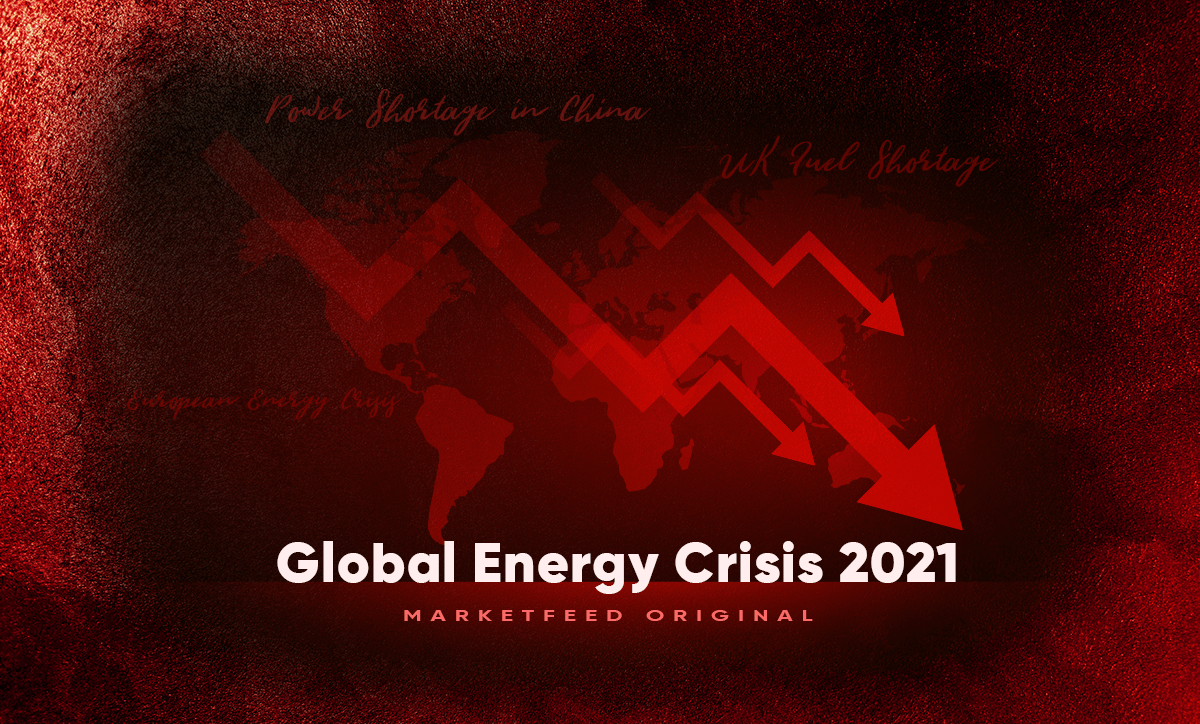
Global Energy Crisis 2021: Can it Impact India?

For years, the world has been glorifying renewable energy or green energy. Many climate change accords have been signed, and countries have capped their carbon emission limits. However, the propensity towards ‘green energy’ seems to have left the globe in an energy crisis. The crisis that seems to have spread from Europe through Asia can have repercussions on other countries as well. In this article, we discuss the whole global energy crisis and its impact on India and other countries.

What Is The Energy Crisis All About?

Power Shortage in China

China is facing an extreme power shortage. Factories have been asked to stay shut, and cities have been facing blackouts. Simply speaking, China is facing a power shortage because of one reason— a coal deficit. China relies on coal for 60% of its electricity. It mainly gets this coal from Australia. 

China’s relationship with Australia has been shaky over the past year, with both countries fighting a trade war. Amidst all this, Australia restricted the supply of coal to China. Now, China has been relying majorly on Australian coal to power its factories. When Australia stopped supplying coal, the prices of domestic coal shot up. If this was not enough, China decided to ‘crackdown’ and ‘improve’ its current coal mines so that they are safe and do not contribute vastly to carbon emissions. The crackdown on establishments giving out emissions comes amidst China’s goal of becoming a ‘carbon neutral’ country by 2060. 

In 2022, Beijing is set to host the Winter Olympics. The country has set the goal to hold a ‘green’ Winter Olympics to leave a legacy in low emission urban development. 

UK Fuel Shortage

The United Kingdom’s fuel crisis is pretty severe. The supply chain has halted completely, gas stations have dried up, and the supply of essential goods disrupted. The shortage of fuel could last a few more weeks before things fall in place. Both electricity and gas station bills are getting fatter by the day. The country has failed to produce enough natural gas to meet demand. UK’s renewable energy assets have been unable to meet production targets due to low winds in the North Sea. The country heavily relies on these renewable resources, and therefore, a shortage has impacted prices. The army has been kept on standby to keep the situation in check.

Another reason why the UK is not able to replenish its gas stations is the shortage of qualified truck drivers. Throughout COVID-19, the country has put trucking licenses on hold. Before Brexit, many truck drivers in the UK came from European countries. Post-Brexit, these drivers were required to obtain a work visa to operate in the UK. The country has decided to relax its visa rules and grant 10,000 temporary visas to truck drivers to meet its supply chain needs. UK’s Road Haulage Association (RHA) says that the country currently faces a shortage of 100,000 truck drivers in total. 

European Energy Crisis

Apart from the UK, natural gas prices across Europe are on fire with electricity bills almost doubled or tripled. What seems to be worrisome is the approaching winter. Some fear that Europe might not have enough natural gas to power Europe if the winter is too cold. Just like the UK, Europe’s ‘green transition’ seems to be taking a toll on energy prices. The phasing out of coal and a grave year for wind energy production has skyrocketed the demand for natural gas. 

Global Supply Chain Disruption

After the COVID-19 pandemic, China became one of the first economies to open up. Naturally, it bagged more export orders where factories decided to pump up production capacity, which led to rising demand for power. China could not keep up with the demand when it faced a shortage of its primary source of energy, coal.

Globally, the supply chain has been hammered for the past year. If the shipping container shortage wasn’t enough, China decided to shut down the world’s third busiest port, Ningbo Zhoushan, after detecting one COVID positive case. According to Russel Group, the port shutdown could cost $17 billion per month and increase further every month the shutdown persists.

The Port of Los Angeles is facing a ‘historic’ backlog of ships waiting to unload cargo. The normal waiting time for a ship used to be 0-1 day in total, which has now gone up to weeks. Ships are being forced to park in the waters and await their turn to docks while the port functions 24×7.

Impact on India 

Organization of the Petroleum Exporting Countries (OPEC) is a cartel of countries that controls the supply and price of oil across the world. The organization faced turbulence when UAE and Saudi Arabia locked horns on production issues. We at marketfeed covered the topic in a July 2021 issue. 

Moving on, OPEC’s supply constraints have impacted petrol prices globally, more so in India. The Indian government refuses to decrease excise duty on fuel, eating into the household incomes and contributing to inflation. Lower the savings, lower the investment. A global energy and supply chain crisis could seriously impact inflation in India, eating away household savings eventually affecting investments in India. With US Fed interest rate hikes around the corner, increasing costs could compel Indians to dilute their investments, ultimately impacting broader markets.

India’s automobile sector could face some heat as well. With winter approaching, China has started to cut down on production to meet overall power requirements until it mobilizes enough resources. China cutting down on electronic equipment and chip manufacturing could fire the pre-existing semiconductor crisis in the automobile sector. Just like the rest of the world, India is staring at a shortage of fossil fuels as well. It won’t be long before the crisis starts impacting our economy. The only way the world can get out of the crisis is through mutual co-operation and focussing on improving the global supply chain. 

Categories
Editorial

History of India’s Volatile Oil Prices and Taxes

Petrol and diesel prices have crossed Rs 100/litre across most cities in India. There are many reasons behind it like the petrol supply crunch and the OPEC+, UAE, and Saudi dispute. Another factor that has been eating into pockets of Indian citizens that goes unnoticed is how the government taxes oil. As an estimate, for every Rs 100 worth of petrol you buy, you are paying close to Rs 60 to central and state governments as tax. The figure keeps varying with time. Indians pay some of the highest taxes in the world on fuel. 

In this piece, we decode the history of petrol prices in India, how it stands in the world forum, and how the government acts on it.  

History Of Oil In India

India first struck oil in Assam in 1866. Oil production began in 1889 and the Assam Oil Company was set up in 1899 to oversee its production. As a British Colony, the oil discovered in India did not benefit our country directly, and the output was used to replenish British Troops in World War I and World War II. 

In 1928, the Asiatic Petroleum Company (a joint venture between Shell and Royal Dutch) allied with Burmah Oil Company. The joint venture was called Burmah-Shell Oil Storage and Distributing Company of India Limited. In 1976, Burmah Shell was taken over and nationalized by the Government Of India. It is now known as Bharat Petroleum Company Limited or BPCL.  

After 1947, India moved to a communist regime also known as License Raj. Just like any other country, India needed a big oil industry to be a superpower. Burmah Shell (now BPCL) and Oil India, two of the largest oil companies in the country, were still a joint venture with the British-owned Burmah Oil Company. In 1959, an act was passed which gave the state-owned Oil and Natural Gas Company (ONGC) the power to explore oil and develop resources in the field. The company struck gold when it took over Mumbai High, India’s first offshore oil field discovered in 1974. 

Post-1991, after the collapse of the USSR, the Indian economy was liberalized. This meant that oil became a rather freely traded commodity and could be impacted by global power and prices. Yet, the Government continued to regulate the prices of petrol and diesel till 2010.

Deregulation, Taxes, And More

Oil prices weren’t always so volatile. Till 2010, the Government would decide the baseline price of oil in India keeping room for oil marketing companies to earn profit. In 2010, then-PM Manmohan Singh decided to deregulate the price of petrol. In 2014, PM Narendra Modi decided to deregulate diesel. This meant that the fuel prices in India would change every 15 days in line with global crude oil prices. In 2017, the Government decided to change the fuel prices every day in line with global prices. 

In May 2020, the oil future prices became negative. Shouldn’t this have made oil prices in India a lot cheaper than they actually were? The central government took advantage of low oil prices and decided to hike excise duty on petrol and diesel. The Government saw the slump in oil prices as an advantage to add cash to the treasury. Essentially, petrol and diesel are cash cows for the government.

In India, petrol prices have consistently risen. Speaking with an estimate, petrol cost Rs 50/litre in 2010 in India and has now doubled up and crossed Rs 100/litre in 2020-21. On the other hand, fuel prices have been extremely volatile, sometimes high, sometimes low. There is no fixed trend in the recent decade 

So why have fuel prices in India consistently risen? Whenever oil prices decrease, the Government increases the excise duty. Conversely, whenever the oil prices increase, the Government decreases the excise duty, but only a little. The state governments tax petrol separately. Apart from global fuel prices, the answer to high fuel prices is bad taxation and policy regarding oil prices by the Government. 

So even if the prices go down, one continues to pay the same or even a higher price for petrol. This makes us ask, are fuel prices really deregulated in that case? 

Where Are Oil Prices Headed?

Oil prices hit all-time highs after UAE and Saudi had a disagreement at an OPEC+ meeting regarding production quotas. You can check out the article over here. To know how the Organization of the Petroleum Exporting Countries (OPEC) influences fuel prices, click here.

Coming back, the disagreement between UAE and Saudi led to inflated oil prices globally. The two came to an agreement and settled their vows. Oil prices started declining globally after that, but not in India. Minister of State for Finance Pankaj Chaudhary has said that the government is not deciding to cut down the excise duty anytime soon. The revenue generated by taxing petrol and diesel will help the Government conduct vaccination drives and run welfare programs. Long and short of it, one can’t expect a cut in excise duty anytime soon, one could have to watch global oil prices fall in order to see a change in Indian fuel prices. 

Categories
Editorial

Explained: OPEC+ Crisis, UAE-Saudi Clash Over Oil

While India’s petrol and diesel prices have crossed Rs 100/liter in most states, the top oil-producing nations are in the middle of a price war. The war is between OPEC+, UAE, and Saudi Arabia. In case you do not know what OPEC is we highly recommend you go through this piece on marketfeed on What is OPEC and How Does it Control Global Crude Prices?

Nevertheless, let me give you a brief about OPEC. OPEC stands for Organization of the Petroleum Exporting Countries. Established in the 1960s consisting of 13 of the world’s major oil-exporting nations. The purpose of the organization was to control the global supply of oil and its prices, thereby giving a fair price discovery to all member and non-member nations. 

OPEC+ or OPEC Plus was a cartel formed in 2016 by 10 other oil-producing nations excluded from OPEC, these were Azerbaijan, Bahrain, Brunei, Kazakhstan, Malaysia, Mexico, Oman, Russia, South Sudan, and Sudan. OPEC and OPEC Plus were later amalgamated and now work together making OPEC Plus a 23 member organization. 

The organization conducts meetings twice a year to establish specific quotas or targets for each member based on current supply and demand, as well as expectations of future supply and demand. The basic norm is that all member nations have to follow these quotas. Since most of OPEC Plus’ oil production comes from state-run oil companies, it is easy for officials to control output/supply.

The Clash

When the pandemic started, oil consumption went down, demand decreased and therefore oil prices fell. In fact, in the US, WTI oil futures prices went negative to -$37.63 a barrel. To protect these oil prices from falling further OPEC nations decided to cut production since it would reduce supply and prices would eventually rise. The OPEC countries formed a pact to cut oil production till April 2022. The plan worked well so far till the global crude oil price surpassed normalcy. In India, many states have reported petrol prices crossing Rs 100 a litre. The OPEC nations have now decided to meet and mitigate the issue of soaring oil prices. The natural thing to do would be to increase oil production. On 5th July, the member countries met at a video conference, but the meeting was called off after a spat between UAE and Saudi Arabia. 

Problem #1: UAE wants to produce more oil, Saudi disagrees

OPEC Plus allots a baseline quota to each nation. A country needs to keep up with its baseline quota of producing oil. Neither too much, nor too little. UAE has been allotted a baseline of 32 lakh barrels per day. UAE Energy Minister Suhail Al-Mazrouei said that the level is “totally unfair and unsustainable.” The UAE thinks it can produce more than the current baseline, it says that it can produce 38 lakh barrels per day. Obviously, more barrels produced would mean more money coming into the country. 

Energy Minister Al-Mazrouei believes that the country has ‘sacrificed’ a lot in terms of production capacity as compared to other members. Saudi Arabia on the other hand believes that THEY sacrificed more production capacity as compared to other countries. Astonishingly, Saudi is the LARGEST producer of oil amongst the OPEC Plus countries and in the world. 

Problem #2: Saudi says extend agreement date, UAE refutes

OPEC had signed an agreement for cutting oil production that was valid for two years ending April 2022. Saudi Arabia wants the agreement for oil cuts to be ‘extended’ by 6 months till the end of 2022.

Naturally, UAE would not be happy with the extension as they would lose an opportunity to earn some extra income given that they are focussing on increasing oil production.

The 18th OPEC Plus meeting was called off. This is not the first time that there has been a clash amongst OPEC nations. Last year, Saudi and Russia had a disagreement on cutting oil production where Russia refused to cut oil production, unlike other OPEC nations. There have been multiple instances where different countries conflicted on production and price. In most conflicts, Saudi has a role and seems to be the big brother of OPEC member nations.

Saudi and UAE are amidst a political cold war. Saudi had imposed trade restrictions on UAE. Any company operating in Saudi would be forced to set up their regional office in Saudi or face business restrictions. This would mean that companies operating in both countries would have to choose between the two. Saudi Arabia imposed travel restrictions to and from UAE the very next day the OPEC Plus dissension took place. 

How Does This Conflict Impact India?

India’s ex-Petroleum Minister Dharmendra Pradhan had locked horns in the international forum with Saudi Arabia. Pradhan had pressed OPEC to cut down on production curbs in other countries. He had stated the importance of the right petroleum prices for all-around economic development. 

India had filled its ‘strategic oil reserves’ when prices were rock bottom last year. These reserves would then be used to cushion oil prices whenever they soared. Saudi had also nudged India to use these reserves instead of pressing for reducing production curbs. So can India actually use these reserves to control oil prices? The answer is NO. These reserves are way too small to have an impact on oil price control. India is planning to double its strategic reserves in the near future. It is planning to privatize the whole initiative incentivizing private companies that set up strategic oil reserves 

India faces way too many problems right now. Uncertain monsoons, rising inflation, possible US interest rate cuts, and high petrol prices. If petroleum prices are not curbed, India can expect some really high inflation rates. Goods would become expensive and transportation costs would increase. The only option available then would be for the government to cut down on high taxes that it charges on petrol. It would be in the best interest of India for UAE and Saudi Arabia to settle their vows and come to an agreement.

Categories
Editorial

What is OPEC and How Does it Control Global Crude Prices?

Last year, the global demand for crude oil collapsed when almost all countries went into strict lockdowns amidst the Covid-19 pandemic. There was an excess supply of crude oil and a sharp decline in demand. We saw global crude prices plunge to record lows. This unfortunate situation was controlled by the coordinated efforts of the Organisation of the Petroleum Exporting Countries (OPEC) and its allies. They brought balance to global prices quite swiftly and with ease. In this article, learn more about OPEC and find out how it controls global crude oil prices.

What is OPEC? 

The Organization of the Petroleum Exporting Countries (OPEC) refers to a group of 13 of the world’s major oil-exporting nations. It was established in 1960 in Baghdad, Iraq. OPEC is essentially a cartel that manages the supply volumes of crude oil, thereby controlling oil prices in the global markets. The organisation uses various methods to ensure that oil rates are stabilised and price fluctuations are avoided

Iran, Iraq, Kuwait, Saudi Arabia, and Venezuela are the five founding members of OPEC. The other member countries include Libya, the United Arab Emirates (UAE), Algeria, Nigeria, Gabon, Angola, Equatorial Guinea, and Congo. The membership is open to any country that is a substantial exporter (or producer) of crude oil. OPEC protects the interests of its member nations and makes sure that they receive a steady flow of income from an uninterrupted supply of crude oil to other nations. The headquarters of the organization is in Vienna, Austria.

Over the past few years, OPEC has been working with other oil-producing nations such as Russia, Mexico, and Kazakhstan to coordinate production and support oil prices. While these countries do not wish to become a part of OPEC, they assist them in controlling the global supply of oil. This group consisting of OPEC and its allies are referred to as OPEC+.

How Does OPEC Control Oil Prices?

OPEC conducts meetings twice a year to establish specific quotas or targets for each member. Several ‘extraordinary’ meetings are also conducted throughout the year to address pressing issues. In these meetings, the production targets for each member country are assigned or adjusted based on current supply and demand, as well as expectations of future supply and demand. The basic norm is that all member nations have to follow these quotas. Since most of OPEC’s oil production comes from state-run oil companies, it is easy for officials to control output/supply.

According to estimates, ~79.4% of the world’s proven oil reserves are located in OPEC member countries. This gives them significant control over crude oil supply and prices in the global markets. If OPEC wishes to increase oil prices when there is sufficient demand, the production quotas can be lowered to limit supply. On the other hand, if they want to reduce oil prices, quotas can be raised to increase supply. (Both cases are based on the assumption that global oil demand remains constant).

Drawbacks of OPEC’s Quotas/Targets

The estimates for future supply and demand may not be accurate, especially when market conditions are uncertain or changing rapidly. Very often, there are significant lags in OPEC’s production target adjustments in response to market conditions. This can cause a severe impact on oil prices. Another major issue is that member nations repeatedly cheat on their quotas. They produce more oil than the target assigned to them. There are no provisions in place to punish these countries. When this happens, other nations often fight back by cheating on their respective quotas. 

OPEC is widely criticized for its dominance in the global markets. As a cartel, all member nations have a strong motive to keep oil prices as high as possible while maintaining their respective shares in the global market. They have been accused of anti-competitive practices, including profiteering by limiting supply. OPEC also deliberately creates crude oil surpluses to bring down prices.

OPEC vs the United States

In the past decade, many argue that OPEC’s ability to regulate oil prices has somewhat diminished. The United States has increased its domestic production of high-quality shale oil over the years, which has reduced overall demand for OPEC-produced oil. This has caused downward pressure on crude prices, even when global consumption has increased.

Recent Developments

In April 2020, OPEC agreed to a historic cut in overall oil production by 9.7 million barrels per day, as the coronavirus-induced lockdowns hit demand. The member countries largely complied with the limit in production and were able to quickly balance out the oversupplied global market. However, it was reported that several members such as Iraq and Nigeria did not commit to OPEC norms and started over-producing in May. Since there is no punishment or measures to tackle this issue, these countries were simply asked to produce less than their quota in the upcoming months.

Since the beginning of 2021, the demand for crude oil has been rising rapidly. Many countries have lifted their lockdown restrictions, and vaccination drives have been largely successful. People have begun to travel again, and industries have resumed production. As a result, oil prices have rallied by more than 30% since January. In a meeting held on June 1, OPEC and its allies (or OPEC+) agreed to gradually ease production cuts. Around 2.1 million barrels per day of supply will be brought back to the market between May and July.

Iran Causing Worries to Global Markets?

Several reports indicate that Iran (the fourth-largest producer of crude) has tens of millions of oil barrels on tankers that are waiting to go to prospective buyers. Countries such as China have been lining up to import this cheap oil from the Middle Eastern country. However, sanctions imposed by the United States restrict Iran from supplying or selling its crude oil to other nations. Iran, European Union, and the US are currently holding diplomatic talks to revive the 2015 nuclear deal, which could loosen restrictions on Iranian oil exports. If the talks are successful, Iran will supply large quantities of crude oil to net importers such as China and India. This could essentially bring down global oil prices.

Try to keep a track of OPEC meetings and important notifications published by them. You will be able to witness substantial changes or volatility in crude prices as a result of these vital discussions.

Categories
Editorial

Will Fuel Prices Come Down Soon?

As we know, petrol and diesel prices have been rising exponentially over the past month or so. The rate of petrol has crossed Rs 100 per litre-mark in the states of Rajasthan and Madhya Pradesh. When global crude oil prices declined heavily last year, all of us expected a reduction in fuel prices in our areas. However, our central and state governments used the opportunity to increase taxes. We saw a high surge in excise duty on petrol and diesel by Rs 10 per litre and Rs 13 per litre, respectively. And now, oil-producing nations are limiting their supply to energy-dependent nations (such as India). This is causing a further hike in prices. 

Will we see some form of relief in petrol and diesel prices in the days to come? Let us find out.

Breakdown of Petrol Price

On February 16, 2021, the price of petrol in Delhi stood at Rs 89.29 per litre. This is a growth of around 24% from the corresponding month last year. Let us take a look at how this particular amount is derived.

(Value Added Tax (VAT) differs from one state to another) Source: IOCL Official Website.

Thus, taxes imposed by the Centre and Delhi state government together constitute approximately 60% of the final retail petrol price. Amidst the Covid-19 pandemic, the government has been desperately trying to cover its vast expenses and foreign debts. It has been estimated that the hike in excise duties and cess on petrol and diesel would allow the Centre to raise ~Rs 1.6 lakh crore. In the end, it is all of us that face the brunt of very high fuel rates. Industries that are highly dependent on petrol and diesel for running their day-to-day operations would also begin to incur high costs. 

Will Fuel Prices Decline Soon?

As mentioned before, crude oil prices declined drastically in 2020. (It fell to almost ~$20 per barrel in April). This was primarily due to the lower demand for fuel amidst the Covid-related lockdowns around the world. India was facing one of the biggest economic contractions in its history. Our government should have focused on cutting taxes and putting more money into the hands of common citizens. However, in May 2020, the government increased central excise duties on petrol and diesel from Rs 20 per litre to Rs 33 per litre. During the same period, state taxes had also gone up by around 21%. Thus, normal consumers like you and I did not receive any benefit from the decline in crude oil prices. 

With global economies slowly recovering and people receiving vaccines, the rate of Brent crude oil has shown a sharp rise to $67 per barrel (as of Feb 25). However, our government has outrightly stated that it will not cut excise duty on crude oil. Earlier this month, Union Oil Minister Dharmendra Pradhan said that the Centre and state governments rely heavily on collections from taxes on crude oil “for meeting their developmental and welfare priorities”. Thus, the Centre is focusing on higher tax collections to achieve its revenue targets. The government has not addressed the common issues faced by the working-class population, who are facing huge difficulties due to the surge in petrol/diesel prices.

On the other hand, oil-producing nations (such as Saudi Arabia) have used the present opportunity to limit their supply and drive prices. This is likely to sustain until all nations join hands, conduct discussions, and come with a solution. India has urged the Organisation of the Petroleum Exporting Countries (OPEC) to bring an end to the regulation of crude oil production. When we take all these points into account, the prices of petrol and diesel are unlikely to decline anytime soon.

Conclusion

The rising fuel prices have severely impacted the middle-class and lower sections of Indian society, who were already hit by the Covid-19 pandemic. The situation is so bad in some areas that people are traveling extra miles to buy cheaper fuel or even smuggling it from neighbouring nations. From the food you order to the vegetables and fruits you buy, everything is likely to become costlier. It would trigger inflation, which could ultimately slow down India’s economic recovery. However, the fact remains that the consumption of petroleum is at an all-time high, despite the rise in retail prices. 

On a day when petrol price crossed the psychological barrier of Rs 100 per litre, Prime Minister Narendra Modi blamed the previous governments for not focusing on reducing India’s energy import dependence. Every aspect of this issue has led to a blame-game between the Centre, state governments, and oil marketing companies (OMCs). [OMCs such as Indian Oil Corporation, Hindustan Petroleum, Bharat Petroleum are now benefiting from higher margins] None of these parties are willing to take the first step towards bringing down the rates.

Finance Minister Nirmala Sitharaman has called for the Centre and state governments to conduct formal discussions to bring down the retail fuel price at a “reasonable level for consumers”. Let us look forward to seeing how the situation unfolds in the weeks to come.