Categories
Jargons

What are the Best Ways to Make Money From the Stock Market?

The stock market is where shares of public companies are bought and sold. A share represents ownership in a company, and shareholders are entitled to a portion of the company’s profits. People have different perspectives on the stock market. Some consider it a great method to generate wealth, while others perceive it as a risky financial gamble. We firmly believe that the stock market can serve as an incredible opportunity for wealth generation and passive income. You need to gain a deep understanding of how it works to make money from the stock market.

Making money from the stock market is not a walk in the park. While the potential for making money is high, it also has an equally high risk of making losses. In this article, we will take a closer look at a few of the ways by which one can make money from the stock market.

1. Investing in Index Funds or Exchange-Traded Funds (ETFs)

An index fund is a type of mutual fund that tries to replicate the returns made by a stock market index such as Nifty 50 by investing in the constituent stocks of that index. These funds are passively managed. This means that the fund manager invests your money in the same securities that constitute the index and in the same proportion. The portfolio composition will remain unchanged.

An Exchange Traded Fund (ETF) is a type of fund that tracks the performance of a certain basket of assets such as an index and can be traded on the stock exchange. Unlike mutual funds, ETFs have low transaction costs, can easily be traded through any broker, and requires very low minimum investment.

2. Investing in Blue-Chip Stocks or Dividend-Paying Stocks

Blue-chip stocks are stocks of large well-established companies with an impeccable reputation and track record of stable earnings and performance. They are fundamentally strong companies with very high market capitalisations. Investing in these stocks is an easy and low-risk way to make money from the stock market. 

Companies that make a profit may choose to share a portion of those profits with shareholders as dividends. As a shareholder, you will receive dividends based on the number of shares you own. Dividend payments can be quarterly, annually, or semi-annually. Investing in dividend-paying stocks can be a way to earn money from the stock market, as dividends provide returns in the form of cash to your bank account.

3. Investing in International Stocks or Emerging Market Funds

International funds are mutual funds that invest in the stocks of global multinational companies. Meanwhile, an emerging market fund is a fund that provides investors access to countries and regions that are undergoing economic transition. One can invest in such funds like any other mutual fund.

4. Investing in Initial Public Offerings (IPOs)

An Initial Public Offering (IPO) is a method by which a company raises equity capital from the public. Equity represents the ownership of a company. Once a company’s IPO is completed, its shares get listed in a stock exchange, i.e. BSE & NSE. You can invest in IPOs of fundamentally strong companies after thorough research. If the public response is positive, you also stand a chance to make money through listing gains. 

5. Trading in Options & Futures Contracts

Futures and options are derivative contracts that derive their value from an underlying asset. These underlying assets can be indices, equities, currencies, commodities, etc. Although derivative contracts were originally invented to hedge risk, it is popularly used as a speculative instrument these days. With the right knowledge and skill, it can be a great way to make money from the stock market. However, derivatives trading is considerably hard and requires practice and learning. This makes it unappealing for beginners.

6. Day Trading or Swing Trading

Day trading or intraday trading refers to the buying and selling of equities or derivatives in a day. For example, if you buy a stock at 10 AM after the market opens and sell the stock at 2 PM before the market closes, it is intraday trading. The trader exploits the small price movements in the stock to make a profit. Features such as short-selling and leverage help to enhance returns and make profits even in falling markets.

Swing trading is a style of trading in which the trader buys and holds the stock for two or more days to capture the short to medium-term price movements in the stock. The trader takes delivery of the stocks and no leverage will be available. Short selling is also not possible in equity swing trading.

7. Investing in Value Stocks or Growth Stocks Based on Market Trends

Value stocks and growth stocks represent different investment philosophies: value investing and growth investing. In value investing, the focus is on finding stocks with intrinsic values higher than their current market value. In growth investing, the emphasis is on companies with strong growth prospects, regardless of their current valuation. Value investors like Warren Buffet and Rakesh Jhunjhunwala are known for their approach to buying undervalued stocks. Growth investors prioritise companies with good fundamentals and growth potential even if their current market value is higher than their anticipated or calculated value.

8. Investing in Socially Responsible Stocks or Funds that Align with Your Value

Investing in socially responsible stocks or funds that align with your value is a way to make money from the stock market. Here, you support companies that are committed to social, environmental, and governance (ESG) principles, while seeking returns. You can start by defining your values and researching funds or stocks that align with those values. Then you can move to invest in these funds or stocks.

Powerful Investment Hacks:

1. Approach a Financial Advisor to Manage Your Portfolio

Seeking professional advice can be beneficial, especially if you’re new to investing or prefer a hands-off approach. A financial advisor can provide personalized guidance based on your risk tolerance, financial goals, and investment horizon. These professionals can help construct and manage a well-diversified portfolio while ensuring it aligns with your individual circumstances.

2. Avoid Common Mistakes Such as Emotional Investing, Overtrading

Always have a solid investment plan, diversify your portfolio, avoid overtrading and chasing hot stocks, manage your emotions, regularly review and evaluate your portfolio, and seek professional advice if needed. Discipline and mindfulness can increase your chances of achieving long-term investment success.

3. Learn Technical Analysis to Make Trading Decisions

Technical analysis is a technique that uses historical price and volume data to form analysis and forecast the direction of prices that can be used for decision-making. Technical analysis can be applied to securities in any freely traded market around the globe. Utilising technical analysis and charting can be a helpful tool for making trading decisions, especially for short-term traders who rely on technical indicators and price patterns.

4. Start SIPs

Systematic Investment Plans or SIPs are a smart and hassle-free way to invest in stocks. It. involves investing a fixed amount of money at regular intervals (monthly or quarterly) regardless of market conditions. Whether you’re a beginner or a seasoned investor, SIPs provide discipline, convenience, and the potential for long-term wealth creation. 

5. Analyse Financial Statements to Pick Stocks

Analysing financial statements and earnings is fundamental to stock picking. Consider reviewing financial health and performance, assessing profitability and growth prospects, and comparing with peers. Thorough research, considering economic and industry factors, and risk awareness are crucial. Fundamental analysis equips you with the right knowledge for analysing financial statements and company earnings.

In conclusion, making money from the stock market requires thorough research, planning, and risk management. Align your investments with your financial goals, risk tolerance, and time horizon, and regularly review and adjust your strategy. Start with small investments and gradually increase over time, staying informed about the market. A financial advisor can be valuable for beginners to avoid mistakes and make informed decisions.

Disclaimer: This article is only for educational purposes. Please do your own research before investing or trading in the stock market!


Categories
Market News Top 10 News

L&T to Build India’s Tallest Commercial Building in Mumbai – Top Indian Market Updates

Here are some of the major updates that could move the markets tomorrow:

Larsen & Toubro to construct India’s tallest commercial building in Mumbai

Larsen and Toubro (L&T) Construction has secured an order to construct commercial towers in Mumbai. The exact value of the projects has not been disclosed, but they fall within the range of Rs 1,000 crore to Rs 2,500 crore. One of the orders involves building the tallest commercial building in India, with a height of over 300.05 metres. The project includes four-level basements and two towers with 70 and 50 floors, totaling a built-up area of 3.4 million square feet.

Read more here.

Aditya Birla Group forays into branded jewellery retail business

Aditya Birla Group is entering the jewellery retail business with a Rs 5,000 crore investment. This is their third venture in two years, following paints and business to business (B2B) e-commerce. The new business, called ‘Novel Jewels Ltd’, will open big jewellery stores in India and feature their own jewellery brands.

Read more here.

GTPL Hathway plans capex of Rs 1400 crore over the next three years

GTPL Hathway plans to invest Rs 1,400 crore in the next three years in capital expenditure (capex). They will allocate around Rs 450-500 crore annually for capex. The investment will be evenly split between their cable TV and broadband businesses. In FY22, they spent Rs 468.5 crore on capex, with Rs 225 crore for broadband and the remainder for cable TV.

Read more here.

IPCA Labs undergoes crucial USFDA inspection at Ratlam facility amid import alert

The United States Food & Drugs Administration (USFDA) is currently inspecting IPCA Laboratories’ API facility in Ratlam. This inspection is important because the facility has been under import alert since FY15, affecting supplies to the US. Three major facilities of Ipca, including Ratlam, Silvassa, and Pithampur, are still under import alert. In April 2023, the USFDA inspected Ipca’s formulation facility in Silvassa, resulting in three observations.

Read more here.

JK Cement to buy 100% stake in Toshali Cements for Rs 157 crore

JK Cement Ltd announced its plan to acquire a 100% stake in Toshali Cements Private Ltd for Rs 157 crore. The company aims to expand its presence in the eastern region with this acquisition. The Board of Directors approved to sign a Share Purchase Agreement for the acquisition. Toshali currently operates two manufacturing units, one in Odisha with a clinker capacity of 0.33 MTPA and a grinding capacity of 0.198 MTPA.

Read more here.

KEC International receives two orders for train collision avoidance systems

KEC International has received two large orders worth Rs 600 crore for its Train Collision Avoidance System (TCAS) called Kavach. The recent tragic train collision in Odisha has highlighted the urgent need for TCAS implementation. With these orders in hand, the company anticipates more tenders and increased demand for their TCAS systems.

Read more here.

Sonata Software partners with SAP Commerce to drive digital innovation, e-commerce solutions

Sonata Software has partnered with SAP Commerce to drive digital innovation and support businesses. The collaboration aims to offer customized e-commerce solutions and seamless experiences to customers. Sonata Software will provide implementation, customisation, and maintenance services, including integration with third-party systems. The partnership will enable customers to benefit from storefront design, services across multiple channels, and ongoing support and maintenance.

Read more here.

Man Infra receives another redevelopment project in Mumbai’s Ghatkopar

Man Infraconstruction Ltd’s subsidiary MICL Creators LLP  has announced a new residential project in Ghatkopar East, Mumbai. By acquiring development rights from neighboring societies, the company will work on a total area of approximately 13 lakh square feet. The project is expected to be completed in the next 3.5 to 4 years, with a saleable carpet area of around 4 lakh square feet.

Read more here.

Bank Nifty weekly options contract to now expire on Fridays

The National Stock Exchange (NSE) has changed the weekly options expiry day for Nifty Bank contracts based on feedback. Starting from July 7, 2023, Nifty Bank’s weekly options contracts will expire on Fridays instead of Thursdays. If Friday is a trading holiday, the expiry will occur on the previous day. Monthly contracts will also expire on the last Friday of each month, except when it coincides with a trading holiday, in which case the expiry will be on the previous Thursday. Existing F&O contracts will have their expiry and maturity dates rescheduled to Fridays from July 6.

Read more here.

Categories
Jargons

Options Greeks: What is Theta?

Before you go through this article, we request you to go through the basic terms of Options. You can find it here. If you are learning about options, you have to be thorough with the knowledge of Option Greeks. It helps the trader to know how and why the price of the options changes. So let us learn about what theta is, known as an option seller’s friend and an option buyer’s worst enemy.

We will start this series by explaining one of the most important Option Greeks, which is the Theta or time decaying factor. Both Call and Put options lose value as the expiry date nears. The rate at which they lose value is called Theta. A Theta value of -2 indicates that the option premium will fall by Rs 2 each day which is passed. But why do the options lose value? Let’s find it out here.

Explaining Theta

How important is time? Does time have a cost? If yes, how will you associate a price with time? Before you read forward, take a minute and form your own opinion on these three questions.

Let’s look at an example. Imagine you want to become an established cricketer in the Indian team. How would that happen? You have to put in years of practice and learn many skills. You have to devote your time day in and day out to become a better cricketer. Still, there is no guarantee that if you decide to give 20 hours each day, you will be selected for the national team.

But, you will surely have a better chance of becoming a cricketer if you spend your time upskilling yourself rather than doing absolutely nothing in the field. Thus, the likelihood of you becoming a cricketer directly correlates with the time you put in. Similarly, you will be more confident about an exam if you have more days to study for it. Why? This is because you would feel that you have an ample amount of time to prepare for it. The longer the time for preparation, the more confident you will be.

This same logic is followed in the stock market as well. Suppose Nifty 50 is around 13,500. You have two options contracts among which you can buy anyone. Firstly, Nifty 14,000 Call Option which expires in 2 days. Secondly, Nifty 14,000 Call Option which expires in 20 days. Obviously, you will feel safe and confident in buying the second Call Option. Why? This is because more the time, the better the likelihood for the index to move up. In short, more time to expiry leads you to have a better chance of ending your position in profits.

Risk of an Option Seller

All the conversations we had above were from the perspective of an option buyer. Now, let’s switch our hats to that of Option sellers/writers. As an Options seller, you don’t want the Nifty to cross 14,000 in the above example. If Nifty crosses above 14,000 then you have to pay money to the option buyer. If Nifty remains below 14,000 points, you will get to retain the option premium you received from the buyer.

Out of the two Call Options, in which one do you feel the risk for you as an option seller is higher? Yes, it is the second one which is riskier. Nifty crossing 14,000 points in 2 days has a lower probability than it crossing that mark in 20 days. What do you want to compensate for this risk? Money! This concept in the world of finance is known as Time Risk. Options premium is always the summation of the intrinsic value of your option and the time value involved.

Option Premium = Time value + Intrinsic Value

Hence, one can easily draw a conclusion from this. If you are buying a call option with a farther expiry date, then you are obliged to pay a higher option premium for it. This higher option premium is paid to compensate for the Options Writers’ time risk.

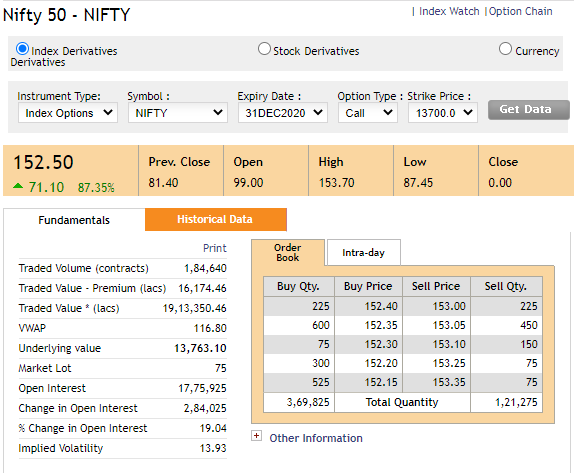
The chart below shows the Nifty option chart with a strike price of 13,700. The expiry date of this Call Option is 31st December 2020. The Option Premium which the buyer has to pay to the writer is Rs 152.50.

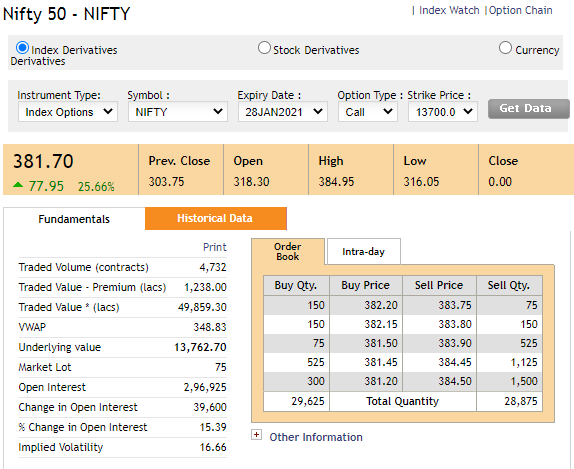
The second chart shows the Nifty Call Option with the same strike price but with a farther expiry date. The contract has to be closed on 28th January 2021. The Option Premium which the buyer has to pay to the writer is Rs 381.79. Between the two Call Options with the same price, an option buyer has to pay a higher option premium to the option seller/writer for the contract whose expiry date is farther.

Conclusion

As the option reaches closer to its expiry date, the time risk of the option seller/writer decreases. Due to this, the option premium loses some of its time value. Thus, decreasing the option premium which has to be paid to the option seller/writer.

Theta is considered very difficult to understand. But in reality, it is very easy. Just remember that time has an opportunity cost and that cost is reflected in Theta. Wait for the next chapter of this series to get a better idea of what Options Greeks are. Till then, happy trading!

Categories
Jargons

What are Options? Learn Basic Options Terms!

An option gives buyers/sellers the right to buy or sell a given quantity of an underlying asset on the expiry date at a specified price. It is a derivative instrument and derives value from the price of the underlying security or stock.

The option buyer has the right to exercise his position and can choose whether to buy or not to buy. The option seller is under obligation to sell and does not have a choice to not sell at the end of the contract if the buyer demands. 

Options contracts are always only available in lots, just like future contracts or Initial Public Offers.

Options are of two types: Call Option and Put Option. Both are described below.

Let us take the example of this option contract of TCS to describe further options terms.

1. Spot Price: The current market price of the underlying asset. The Spot Price in the above chart is Rs 3,090.65.

2. Strike Price: The price at which the option holder has the right to buy or sell the given quantities of the underlying asset at the expiry. It is the price at which the contract is made. The Strike Price in the above chart is Rs 3,100.

3. Call Option: It gives the buyer the right to buy a given quantity of an underlying asset on a pre-decided date at a pre-decided price. To obtain this position, the buyer has to pay the option premium to the seller/writer of the option.

In the Money (ITM) Call Options are those in which the spot price (current market price) is GREATER than the strike price.

Out of the Money (OTM) Call Options are those in which the spot price (current market price) is LESSER than the strike price.

4. Put Option: It gives the buyer of this option the right to sell a given quantity of an underlying asset on a pre-decided date at a pre-decided price.

In the Money (ITM)  Put Options are those in which the spot price (current market price) is LESSER than the strike price.

Out of the Money (OTM) Put Options are those in which the spot price (current market price) is GREATER than the strike price.

When the spot price is the same as Strike Price, it is called At the Money (ATM) option, for both calls and puts.

5. Option Premium: It is the amount the option buyer has to pay to the option seller/writer. After paying this premium, the buyer acquires a right whether he wants to exercise his/her position on the expiry date.

If he chooses not to exercise his right, the option premium stays with the option seller/writer. Similarly, an option seller has to put his entire margin in front as well, so that he would not walk out of the deal if he faces losses. The Option Premium in the above chart is Rs 97. The buyer has to put forward only the premium amount of Rs 97 multiplied by lot size, while the seller will have to put forward a 1-1.5 lakhs margin regardless of the strike price/lot size and stock/index.

Categories
Editorial

Binary Options Are A Scam!

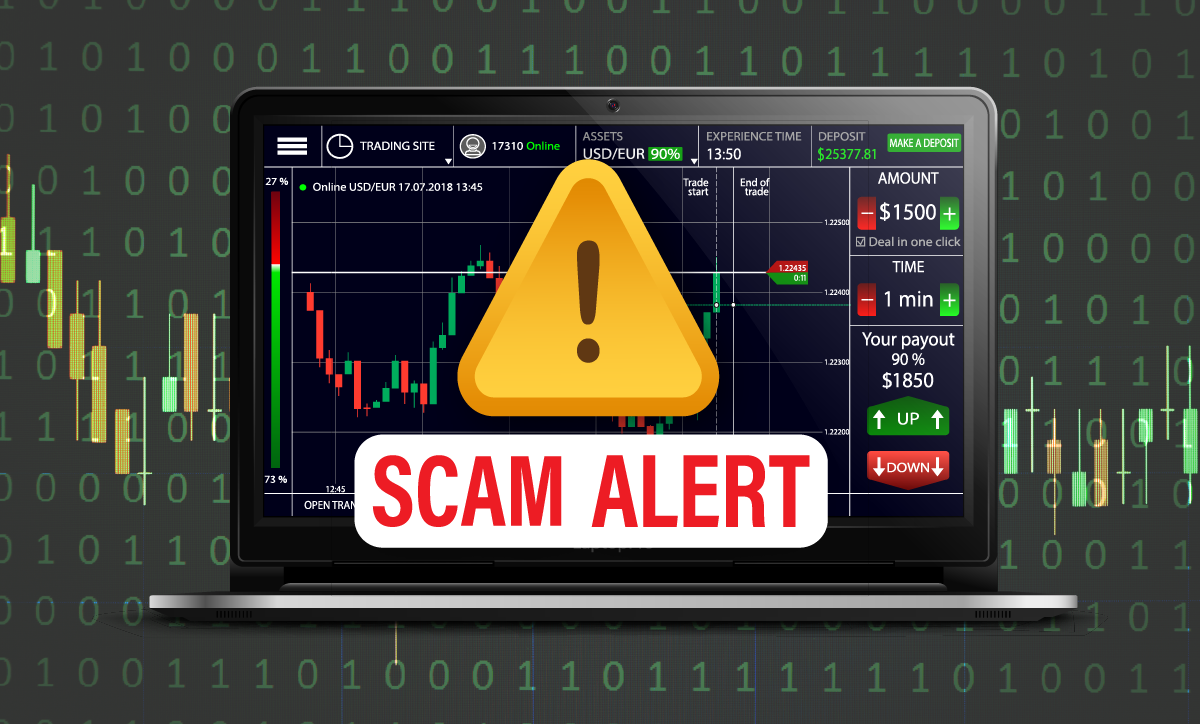
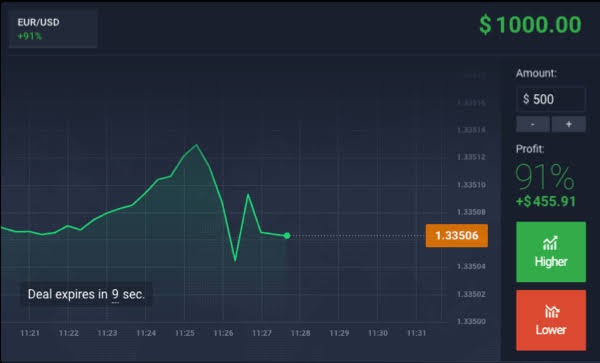
If you frequently browse YouTube, chances are that you might have come across ads that promote ‘Binary Options’. These ads look pretty authentic at the first. However, these ads turned out to be a menace. So much so, that YouTube decided to restrict any advertisement that promotes binary options. These ads promised clients a way to get rich quick while operating a scandalous operation in the underbelly. These ads look like something given below. 

Well, if one trades on these platforms, chances are they might be in for some trouble and lose quite some money, Let’s find out why. 

What Are Binary Options?

First, let us understand binary options in the simplest way possible. Binary options use a simple ‘Yes or No’ proposition. In binary options, an investor predicts or bets whether the price of scrip will go up or down. If the prediction is true, the user retains the original amount invested plus an additional bonus on top. However, if the prediction is wrong, the investor loses money. 

Most of these companies that operate in India operate from outside of India in tax-havens or countries where the securities laws are favorable to binary options. They offer a high margin amount going up to 1000%. This means that you can double the money with a 0.1% change in the price. Additionally, one can wipe out their entire capital in a 0.1% change in price. 

Binary options have managed to catch prey in financially less sound countries, countries with poor financial regulation and countries with poor financial laws. The developed and technologically advanced countries have duly taken note and banned them from being traded.

The Scam

  1. Binary options are generally run by private brokers or companies and NOT on stock exchanges, unlike regular options. This means that prices can be manipulated by the company and not the normal market forces. Binary options generally derive value from globally traded scrips like Oil, Gold, or Forex.
  2. Binary options are an all-or-nothing proposition. This means that either you make a lot of money, or you lose all of it in one go.
  3. In most cases, binary options brokers hold positions against that of their clients. This means that if you lose money, they make money. The odds are in the favour of the brokers since they are the ones who influence the option pricing.
  4. Binary options offered high profits initially to encourage users to invest more capital on their platform. Once the user had invested a good amount, they would lose all their capital at once since the operators manipulate the price.
  5. There has been frequent news of binary options brokers being arrested and being sentenced for up to 22 years.

Legalities of Binary Options

Binary options are not traded on BSE, NSE or any other exchange in India. SEBI forbids trading of binary options in Indian exchanges. One may however use foreign platforms to trade binary options. 

Trading in binary options is a sticky subject when it comes to the legalities of it. Trading in binary options is a violation of the Foriegn Exchange Management Act(FEMA). There are no companies with a physical setup in India that can offer binary options.

The European Union has banned binary options. In most developed countries, trading in binary options is banned, officially. The gambling like nature of binary options has forced countries to take strict action against participants.

Binary options have been restricted from advertising by Google Ads. However, miscreants have been exploiting India’s financial illiteracy with a greed for quick money and now have taken to partnering with online web-series and youtube channels to promote their business.

Binary Options may not be scandalous always, but the intent with which it is operated in almost all cases is dishonest. It is advisable to market participants that they refrain from trading binary options since it can land them in jail for violating FEMA act and also make them lose a lot of money to fraudulent means with not much legal remedies.