Categories
Editorial

Tata Elxsi: A Company you can trust for the Long-Term?

Tata has some big companies under its umbrella but one company that often goes under the radar of investors is Tata Elxsi. The IT company reported stellar results last week and reminded everyone why they should keep an eye on it.

Profile

Tata Elxsi is one of the world’s leading providers of design and technology services across industries. With the help of digital technologies such as IoT (Internet of Things), Cloud, Mobility, Virtual Reality and Artificial Intelligence, Tata Elxsi aims to develop products and services for their customers. All these applications will be used on a huge scale in future as we are all aware of how the world is quickly shifting towards Artificial Intelligence and Data Analytics.

The company started its business on 5th May 1989. Their work revolved around developing applications related to electronics and software. Today they have developed themselves as a premium engineering service provider, not only in India but worldwide. 

They serve a number of industries including automotive, home appliances, semiconductor, media, broadcast, communications, Rail and healthcare sector. They are involved in several activities in these industries. Research & strategy, design & development, test & validation, operate and automate are the main services that Tata Elxsi provides. 

Earlier the cars were just a medium to travel from one place to another. In today’s generation, a car fulfils this desire along with entertainment and upgraded experience. The new passenger cars are supported with digital dashboards which come along with different chat supports. 

The combination of digital technologies and analytics provides an even better experience for the passengers. Today’s car is not ‘just a car’. This was just one of the works which Tata Elxsi carried out in the automobile industries. AI and Virtual Reality will be pivotal in every sector in the future. Thus, the future business prospects of the company are huge which can benefit the long-term investors.

Stellar Q4 F21 results

Even amidst the pandemic, Tata Elxsi produced robust Q3 results this January but they have followed it with even better Q4 numbers. In the last quarter of FY21, Revenues from operations were recorded at Rs 518 crore, 18% higher year-on-year. Profit after tax was declared to increase by a stunning 40.3% YoY at Rs 115 crore. 

Not only this but even EBITDA margin and Net Margin were very strong at 32.4% and 21.9% respectively. This growth was powered by not only one sector but by all the sectors. Tata Elxsi’s largest division, Embedded Product Design (EPD), grew by a massive 14.6% as compared to last year. The Industrial Design and Visualization (IDV) segment also showed a robust increase of 9.1% in the same period. 

Not only these segments but transportation, Media and Communications also showed steady growth over last year. Since 2012, Tata Elxsi has consistently reported an increase in total revenues. For the first time in FY20, their profits decreased as compared to the previous year but it has come with an even stronger rebound in FY21. 

EPS or Earnings per shareholder is a metric on which we really stress upon. As a shareholder, it is important for us to see the trend of the EPS of a company. Except for FY20, Tata Elxsi’s EPS has increased every year. In the last five years, the company’s EPS has more than doubled from 28 to 59.11. In this period, their net income has grown by 5X (20.21%) times as compared to the industry average (4.5%). Overall, the company looks to have very solid fundamentals.

Reliable Future

The Covid-19 pandemic has put focus on the IT sector, especially on the cloud and AI companies. Tata Elxsi is getting strong backing from foreign institutions as well. In March 2020, FII’s had a 10.7% stake in the company. This holding increased to 12.06% by March 2021. Generally, increasing foreign institutional holding is considered a positive sign for any company. 

Similarly, the unexpected rise in data and content generation has further aided companies like Tata Elxsi to expand their business. In the last year, the company has given an impressive return of 284%. Tata Motors is considered one of the heavyweights in the Indian electric vehicle dream. 

Elxsi has experience in manufacturing design and engineering auto-related products. They help in designing cloud services and app frameworks for Smart TV and OTT platforms which again have grown massively. Even if there are short-term fluctuations in this stock, a long-term investor might look to hold on to it. Do you have this stock in your portfolio? What are your opinions and findings on Tata Elxsi? Do let us know in the comments section of the marketfeed app!

Categories
Editorial

What are New Umbrella Entities? Why are Tata to Reliance Interested in it?

As India moves towards building an extensive digital society, there is a requirement for multiple players to be involved. The RBI has run many experiments in the digital payments space in India, including licensing exclusive payments banks and setting up white-label ATMs. They have now come up with a new concept— New Umbrella Entities, which is set to revolutionise the payments industry. A large number of companies have reportedly applied for New Umbrella Entity licenses for payment systems. Let us have an understanding of what NUEs are.

The Current Scenario

You may be familiar with payment or settlement systems such as the Unified Payments Interface (UPI), Aadhaar Enabled Payment System (AEPS), RuPay, FASTag, etc. These are all managed and operated by an umbrella entity known as the National Payments Corporation of India or NPCI. It is a non-profit entity that is promoted by the Reserve Bank of India (RBI). The NPCI is owned and managed by a consortium of major banks, including State Bank of India, Punjab National Bank, Canara Bank, ICICI Bank, HDFC Bank, and many more. 

Recently, many prominent players in the payments space have indicated the various disadvantages or challenges faced by NPCI. It is now the only entity that manages all of the retail payment systems in our country. As more citizens are using online payment platforms, the volume of transactions conducted every day has risen exponentially. In February 2021, the NPCI admitted that they were facing structural and technical issues. According to reports, investors could not get mutual fund (MF) units they purchased on time due to a problem in the settlement system operated by the NPCI.

The RBI has now envisioned a plan to allow more private players to set up umbrella entities for payments systems. This would promote competition and lead to further development of the payments landscape and network in India.

What are New Umbrella Entities?

New Umbrella Entities (NUEs) will be a non-profit entity that will set-up, manage, and operate new payment systems such as ATMs and white-label Point-of-Sale (POS) systems. It also includes Aadhaar-based payments and remittance services. NUEs will develop the standards and technologies for these payment systems. They will operate clearing and settlement systems, identify and preserve the integrity of the system. These entities will also manage relevant risks such as settlement, credit, liquidity, and operational risks. 

NUEs will monitor retail payment system developments and related issues in India and internationally. This is to avoid shocks, fraudulent activities, and cyber threats that may adversely affect the financial systems and our economy as a whole.

Framework Related to NUEs

  • As per RBI guidelines, only those entities that are owned and controlled by Indian citizens (residents) can become promoters of NUEs. They should have at least 3 years of experience in the payments ecosystem. 
  • The umbrella entity should have a minimum paid-up capital of Rs 500 crore
  • The shareholding pattern should be diversified. Any entity holding more than 25% of the paid-up capital of an NUE will be deemed as a promoter.
  • No single promoter or promoter group should have more than 40% investment in the capital of the NUE.
  • A minimum net worth of Rs 300 crore should be maintained at all times.
  • An NUE should conform to the norms or regulations of corporate governance. The RBI retains the right to approve the appointment of directors and members of the board of an NUE. 
  • Foreign investment is allowed in NUEs as long as they comply with the existing government guidelines.

Recent Developments

The RBI had set a deadline of March 31, 2021, for firms to submit their applications for setting up New Umbrella Entities. As per reports, several Indian companies have tied up with major banks and tech companies to apply for NUEs. Reliance Industries, which has partnered with tech giants Facebook and Google, were planning to apply as a consortium. Other reports suggest that the Tata Group has partnered with HDFC Bank, Kotak Mahindra Bank, MasterCard, and Bharti Airtel. E-commerce platform Amazon.com, Inc. has tied up with Visa, ICICI Bank, Axis Bank, as well as fin-tech startups Bill Desk and PineLabs to obtain the NUE license. Also, Paytm and Ola have also reportedly joined hands to apply for the NUE. 

The primary aim of players that are planning to establish NUEs is to obtain a bigger share in India’s digital payments sector. According to RedSeer Consulting, the digital payments industry in India is expected to grow over three-fold to Rs 7,092 lakh crore by 2025. There is no doubt that more companies would want to obtain a piece of this highly promising market. Let us look forward to seeing which of these firms gets selected by RBI to launch NUEs, and how they disrupt or revolutionise the payments space.

Categories
Market News Top 10 News

SC Rules in Favour of Tata Group, Sets Aside NCLAT Order – Top Indian Market News

Supreme Court upholds Tata Sons’ decision to sack Cyrus Mistry as chairman

The Supreme Court (SC) on Friday upheld the Tata Group’s decision to sack Cyrus Mistry as chairman of the group.  A three-judge bench of SC, led by CJI Justice S A Bobde, set aside the National Company Law Appellate Tribunal (NCLAT) order that had reinstated Mistry on Tata Sons’ board and had termed current Chairman N Chandrasekaran’s appointment as ”illegal”. The SC also refused to entertain Shapoorji Pallonji Group’s plea for fair compensation of their equity shares in Tata Sons. 

Read more here.

JSW Steel pays Rs 19,350 to complete acquisition of Bhushan Power & Steel

JSW Steel, on Friday, paid Rs 19,350 crore to the financial creditors of Bhushan Power & Steel Ltd (BPSL) towards implementation of the resolution plan for acquiring the insolvent company. With this move, Sajjan Jindal-led JSW Steel has closed the acquisition of BPSL. This marks JSW Steel’s entry into mineral-rich eastern India, which has so far been dominated by Steel Authority of India Ltd (SAIL) and Tata Steel.

Read more here.

Bajaj Auto, Pierer Mobility to strengthen e-mobility cooperation

Bajaj Auto Limited said it is strengthening its strategic cooperation with Pierer Mobility AG for developing electric products in the two-wheeler sector. Both companies have decided to jointly explore zero tailpipe emissions, low maintenance, and long-lasting benefits of light electric vehicles (EVs) in urban settings and dense metropolitan areas. The first of these electric two-wheelers are set to hit the market in 2022.

Read more here

Barbeque Nation IPO subscribed 5.98 times on final day of bidding

The Rs 452-crore initial public offering (IPO) of Barbeque Nation Hospitality Limited was subscribed 5.98 times on the final day of bidding. The IPO has received bids for 2.99 crore equity shares against an offer size of 49.99 lakh shares. The portion reserved for retail investors was subscribed 13.13 times. The portion set aside for non-institutional investors (NIIs) saw a subscription of 3.1 times and that of qualified institutional buyers (QIBs) 5.11 times.

Godrej Properties sells over 275 flats worth Rs 475 crore at housing project in Noida

Godrej Properties Ltd said it has sold around 275 residences worth Rs 475 crore within one day at the launch of its housing project, Godrej Woods, in Noida. Located in Sector 43, Godrej Woods offers homes set amidst a lush green development with over 600 trees. The realty firm claims to have added 17 projects across five cities in the National Capital Region (NCR). Out of this, six projects have already been delivered.

Read more here.

M&M board approves consolidation of Mahindra Electric Mobility

The Board of Directors of Mahindra & Mahindra Ltd has granted in-principle approval for the consolidation of Mahindra Electric Mobility Ltd (MEML) into the company. The consolidation will categorize electric vehicle (EV) operations into two focused verticals— Last-Mile Mobility and Electric Vehicle Tech Centre. M&M said simplifying the structure will drive improvements through innovation, execution excellence, efficiencies, and economies of scale.

Read more here.

Tata Motors signs MoU with SBI for financing light commercial vehicles

Tata Motors has signed a three-year Memorandum of Understanding (MoU) with State Bank of India (SBI) to offer financial assistance for the purchase of the company’s range of small and light commercial vehicles. The collaboration with SBI will allow Tata Motors’ commercial vehicle (CV) customers to avail of loans in a hassle-free manner as well as access SBI’s unique technology-laden offerings.

Read more here.

Power Grid acquires Bikaner-II Bhiwadi Transco from PFC

Power Grid Corporation of India said it has acquired Bikaner-II Bhiwadi Transco Ltd (BBTL), from Power Finance Corporation (PFC). BBTL is the special purpose vehicle (SPV) to establish a transmission system strengthening scheme for evacuation of power from solar energy zones in Rajasthan. The transmission company was acquired for an aggregate value of about Rs 20.50 crore, including 10,000 equity shares at Rs 10 per share, along with its assets and liabilities.

Read more here.

Confidence Petroleum signs agreement with GAIL Gas to set up CNG stations in Bengaluru

Confidence Petroleum India Ltd has signed an agreement with GAIL Gas for setting up 100 compressed natural gas (CNG) stations in Bengaluru. The CNG stations will be set up on a Build-Operate (BO) basis over the next three years. This will significantly improve the accessibility of CNG auto fuel for cars, autorickshaws, buses, and heavy vehicles of Bengaluru.

Read more here.

Prestige Estates acquires 50% stake in JV partnership with DB Realty

Prestige Estate Projects, through its subsidiary- Prestige Falcon Realty Ventures, has invested through capital account contribution in Turf Estate Joint Venture LLP as a new partner with an equal share of profit/losses with DB Realty. The joint venture (JV) firm aims to develop a 2.6 million sq. ft. commercial project in Worli, Mumbai. The project would consist of two office towers.

Read more here.

Categories
Editorial

Can Tata’s Trent Be The Next Retail King?

The Indian retail sector is witnessing rapid growth with a higher disposable income amongst citizens and changing consumer tastes and preferences. We can see domestic and global players such as Reliance Industries, Amazon, and Walmart entering into heavy competition to obtain more customers. These firms have primarily focused on revolutionising our country’s e-commerce space, which has proved to work in their favour. Trent is Tata’s shot at this market.

The Tata Group, one of the largest business houses in the world, has been trying to expand and develop its retail segment as well. At a time when most companies have already made their mark in online retailing, it feels that the Tata Group is too late to enter the field. However, they have focused on improving its wide network of physical retail stores that come under its wholly-owned subsidiary, Trent Limited. Let us take a closer look at the company and its performance.

Trent – Company Profile

Trent Limited operates a chain of retail stores primarily under the Westside brand in India. It was incorporated in 1998 and is headquartered in Mumbai. The company’s Westside stores provide a wide variety of apparel, footwear, lingerie, cosmetics, perfumes, accessories, and home furniture products.

  • Trent operates hypermarket and supermarket stores under the Star Market brand. It offers food and groceries, staple foods, beverages, health and beauty products, home furnishings, dairy and poultry products, and much more. 
  • Through its chain of Landmark stores, the company provides lifestyle products, including toys, music, books, stationery, gadgets, and sports merchandise. 
  • Further, Trent offers fashion apparel, footwear, and accessories under the Zudio brand. 
  • Through the Utsa brand, the company provides ethnic apparel, beauty products, and accessories.

As of March 31, 2020, the retail company operates around 169 Westside stores, 10 Hypermarket and 39 Star Market stores, and 80 Zudio stores. Trent also operates 4 Landmark stores and 2 Utsa stores. It has been able to expand these brands across all major towns and cities in India. Notably, Inditex Trent Retail India (a 51:49 joint venture between Trent and Spain-based Inditex SA) runs Zara stores in India.

Financial Performance

As we know, the retail sector in our country is highly competitive. Large players such as Avenue Supermart (DMart) and V-Mart have shown exponential growth and continue to dominate the retail space. Amidst heavy competition, Trent has been able to report a modest increase in revenues and profits through its diverse portfolio. Over the last 5 years, the company’s revenue has grown at a yearly rate of 6.59%, whereas the industry average stood at 19.21%. 

As we can see, Trent has shown very impressive growth in overall sales over the past 5 years. The company is also virtually debt-free and has been able to introduce effective cost-control measures. It has a Return on Capital Employed (ROCE) of 16.94%, which is at par with the market leaders. This means that for every Rs 100 worth of capital employed, Trent earns Rs 16.94 on it. The retail firm has been maintaining a healthy dividend payout of 39.15%. As of February 2021, Trent Ltd has obtained a market share of 18.48%.

Trent’s Q3 Performance

Amidst the Covid-19 pandemic and subsequent lockdowns, Trent faced significant losses. In the April-June quarter (Q1), The retail company’s revenues declined sharply by 87% on a year-on-year (YoY) basis. However, with the easing of restrictions and improving consumer sentiments, the company has witnessed an improvement in sales turnover. 

Trent Limited reported a 30.2% YoY jump in consolidated net profit to Rs 64.03 crore for the quarter ended December (Q3). Its consolidated revenue increased by 13.6% YoY to Rs 853.63 crore during the same period. The company had focused extensively on improving its digital presence. Thus, its online channel registered a high growth of 80% YoY in Q3. Westside revenues during the October-December quarter were up by 78%. This was also driven by huge demand during the festive season.

Noel Tata, the chairman of Trent Ltd, stated that the company’s store expansion plans are on track. The firm has plans to launch a significant number of stores across strategic locations in India.

Is Trent Limited Overvalued?

At ~Rs 24,100 crore, Trent has one of the largest market capitalisations in the retail sector of India.

1-Day chart of Trent Ltd. Source: TradingView

However, we can see that the stock is seen to be trading at 11.67 times its book value. [The book value of a company is equal to its total assets minus total liabilities]. The company’s Price-to-Earnings (PE) ratio stands at 192.04, which is very high when compared to its peers in the retail sector. A high PE ratio shows that investors are willing to pay a higher share price today due to better growth expectations in the future. All these factors tell us that Trent is overvalued. However, upon further analysis, it was interesting to find that almost all of its biggest competitors (such as Avenue Supermarts) are also overvalued. 

An investor who focuses on such strong revenue figures and growth (rather than looking at its value) will find the stock to be very favourable. 

The Way Ahead

From its highly-promising revenue and profit growth, Trent Limited seems to be a great bet for investors. This can be linked to the company’s progressive management, which has set adequate targets for the upcoming financial years. They have planned to open around 30-40 Westside stores and 80-100 Zudio stores every year. This is primarily because private label brands account for nearly 90-95% of Westside sales, and launching new stores in key areas is likely to improve sales margins. Also, the Landmark and Star Market stores tend to be unaffected by seasonal changes. The management is confident that these stores will continue to show strong growth by catering to the requirements of all types of customers.

Trent has also collaborated with other Tata Group companies to establish a unique or pleasurable customer experience. For example, they have launched Starbucks outlets (operated by Tata Consumer Products) in Westside stores. The company has announced plans to bring about more innovations in its wide network of physical stores. To adapt to the present market conditions, Trent will also focus on introducing a seamless online platform for its products. Due to this multi-fold approach to securing more customers, the future prospects of Trent remain to be very promising. It has the potential to become one of the largest retailers in the world.

Categories
Editorial

3 Reasons behind Tata Motors’ Rally!

Tata Motors has risen sharply in the previous two days. On 11th January 2020, it ended the day 11.36% higher. The next day, it went up by another 8%. For two consecutive days, it has been the top gainer in the Nifty 50 index. In just two days (11th & 12th January), shares of Tata Motors has risen from Rs 199.60 to Rs 237.80. On 13th January, it even touched Rs 252 which was last seen in September 2018. How amazing is that? This amazing rally forced us to analyse what is actually happening with Tata Motors. 

Rumours of Tata Motors – Tesla Deal 

Tesla is the biggest auto company in the world. In 2020, when all companies were suffering due to coronavirus effects, Tesla’s share rose by nearly $80 to more than $800. This unprecedented rally made Tesla’s CEO, Elon Musk, the richest person in the world with almost $200 billion net worth. You can read about it here. In October last year, Tesla Club India tweeted and asked when we can expect Tesla to come to India. Elon Musk replied, “Next year for sure.” You can view the tweet below.

The Union Minister of India, Nitin Gadkari, confirmed that the American electric vehicle company, Tesla, will be coming to India in the first half of 2021. MarketFeed did a complete analysis of Tesla coming to India. Click here to read about it. Since Monday morning, rumours in the market started flowing that Tesla may partner with Tata Motors to manufacture and sell their vehicles in India.

This was a big update to the Indian market. Tesla, being a massive company with the visionary CEO at their helm, might disrupt the electric vehicle market in India. Thus, investors do not want to lose any opportunity and started buying Tata Motors’ share in high quantities. This drove up Tata Motors’ share price from Rs 199 to Rs 220.65 in just one trading session!

By the evening that day, the news came out that Tata Motors has denied any such collaboration with Tesla. You can refer to CNBC-TV18’s tweet below.

https://twitter.com/CNBCTV18Live/status/1348596510179565568

Many expected that this might bring some correction in Tata Motors’ share price the next day. But, the opposite of that happened. Why? Find it below.

Jaguar Land Rover (JLR) Getting Back on Track?

Tata Motors Ltd.-owned Jaguar Land Rover has been giving huge losses to the company over the past few quarters. In fact, this was the segment due to which the numbers were often found to be reduced. Jaguar Land Rover (JLR) declared their results for the year 2020 on Monday (11th January). The market expected the results to be very poor but the numbers showed that the entity has recovered well from the impact of the pandemic. The new Land Rover Defender is also said to be having very good sales numbers.

Especially, the sales data coming from China is very encouraging. The company’s sales in China have increased by 20.2% (quarter-on-quarter) and 19.1% (year-on-year). Total sales for Jaguar Land Rover has risen by 13.1% as compared to the previous quarter. But, at the same time, it has slipped by 9% when compared from the previous year. 

The reduction in the sales number as compared to 2019 is mostly due to the lockdown induced by Covid-19. The demand fell to almost zero. Also, the manufacturing plants were forced to be shut. A dip in yearly sales was surely expected but back-to-back quarterly strong performance speaks volumes about their strong recovery.

One point to notice is that the sales in other regions are yet to get back to the pre-covid levels. In North America, Europe, the UK and Overseas the sales are down by 17.2%, 16.3%, 8.9% and 20% respectively when compared to that of 2019. But the quarterly results in all of these regions have been positive. In fact, sales in Europe, North America and Overseas have reported a rise of more than 20% each. The positive results flowing from one of the weaker segments has infused confidence in the investors.

Imminent Scrappage Policy Driving Optimism?

According to a few of the reports, long-awaiting vehicle scrappage policy might be a part of the Union Budget 2021-22. The final decision on this will be taken by the Finance Ministry and the Prime Minister’s Office (PMO). We had talked about this upcoming policy over two months ago, here. This policy states that commercial vehicles and private vehicles which are older than 15 and 20 years respectively will be considered for scrapping. The question is, how will it benefit the Indian automobile industry?

The auto sector of our nation is struggling to generate new demand in the market. Due to this, the sales of the companies were not increasing as they had expected. Also, the cost of production has increased because of regulation and BS-VI regulations. Vehicle Scrappage Policy, if implemented, will allow people to give their cars for scrap. Thus, the demand for new vehicles will increase in both the short and long term.

If this policy is so good, why has it taken years to be launched? This is because people will react or come forward to scrap their vehicle only if some incentives are offered to them. Without incentives, they will probably look to continue with the car they own for a few more years. This incentive has to be provided by the original equipment manufacturers (OEMs). But, this part of the deal was not reaching its conclusion between the government and the OEMs. Now, it looks like both the parties have agreed to some sort of deal. Thus, giving a green light the vehicle scrappage policy.

These are the main reasons why Tata Motors shares have rallied in the past week. FIIs non-stop buying in the cash market could also be a factor in the rally. What are your opinions on Tata Motors? Let us know in the comments section.

Categories
Trending

The $113 Billion Tata Group faces Tough Decisions Over Their Airlines

Tata Group’s two airlines – AirAsia India and Vistara, were struggling before the coronavirus pandemic. Tata Sons owns a 51% stake in each airline. 

“The Tata’s are caught between a rock and a hard place,” said Mukund Rajan, a former member of the group’s executive council who’s now the chairman of an investment advisory firm focused on the environment, social, and governance issues. “The only option to run a successful airline is to seek scale. This would require the Tatas to deploy significantly more capital than they have done this far. Absent ambition and scale, the prospects for success are probably very remote.”

The airline was founded by J.R.D. Tata, named as Tata Airlines in 1932. In 1953, the Government of India passed the Air Corporations Act and purchased a majority stake from Tata Sons. The company was renamed as Air India International Limited and the domestic services were transferred to Indian Airlines as a part of a restructuring.

In 1994, the group came up with an ambitious plan to start an airline with 100 planes in partnership with Singapore Airlines, but the government refused a foreign entrant, and the project was rejected. Later in the year 2000, Tata again teamed up with Singapore Air to bid for a stake in Air-India, but the plan was dropped due to political opposition. 

Tata Group is concentrating on making an airline work at any cost. Vistara and AirAsia India have never made money and have lost around $845 million (~Rs 8,450 lakhs), according to estimates from the Centre of Aviation. They have to make a decision on whether to sell the loss-making business or to further scale it up and make it a profitable one. 

Categories
Editorial

Can Tata Motors Win in India?

The Indian 4-wheeler industry is currently witnessing a steady recovery in sales. With lockdown restrictions being eased gradually, families across India are looking at the prospects of buying a car again. And the automobile companies are looking to seize this very opportunity with their amazing offers and discounts. And out of all these companies, analysts are reporting that Tata Motors is outperforming in domestic sales. But is this enough? Let us look at some of the new developments surrounding one of our favourite stocks, Tata Motors.

Brief Profile of Tata Motors

Tata Motors initially began as a truck manufacturer. They entered into the passenger vehicle segment in 1988. The initial growth of this company was only possible through the sheer determination and vision of the legend himself, Ratan Tata. Some of its very famous and widely sold cars in the ’90s such as Tata Indica, Tata Sumo, and later the Tata Nano were also built under his leadership.

The company also wanted to make its mark in the commercial vehicles industry and has been largely successful. Look around you, a reasonable number of trucks and buses on the road would be manufactured by Tata Motors. 

One of the biggest deals by Tata Motors was the acquisition of United Kingdom-based Jaguar-Land Rover (JLR) for $2.3 billion (now about Rs 17,000 crores) from Ford, in 2008.

Recently, the company has launched several widely popular cars such as the Tiago, Tigor, Hexa, Harrier, and Altroz. It has been exporting these cars to more than 125 countries. With all these new cars in the market, we would expect the company to perform quite well, right? However, the results have been very underwhelming. 

Fun Fact: Tata Indica was the first-ever car to be fully manufactured using India’s resources. The car was completely based on Indian technology and parts. Within two years since its inception, Indica occupied the number one spot in the Indian market.

Surprising Figures

Over the last few years, Tata Motors has been disappointing investors with poor financial performance. Even after the ambitious acquisition of JLR (who is bleeding money) and new car launches, Tata Motors has not been able to improve its sales growth. In fact, it is one of the biggest loss-making enterprises in the Tata Group of Companies. To understand these factors in-depth, let us look at some of the important figures:
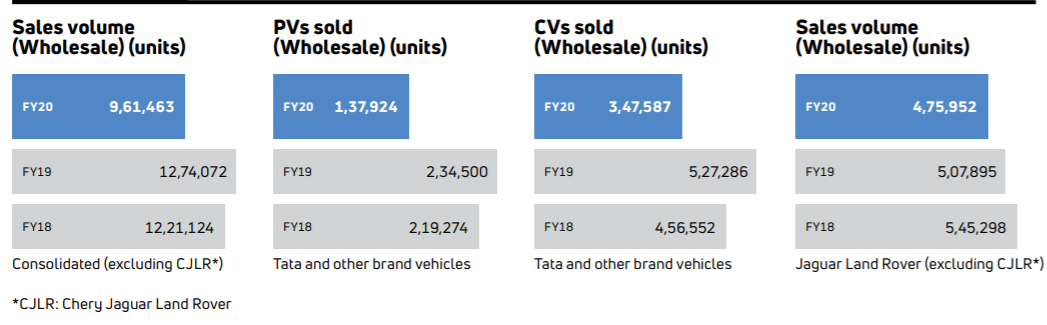
As we can see, the sales data reported by Tata Motors over the past 3 years does not seem to be very promising. In fact, the Covid-19 pandemic has caused a major impact on its production and sales activities during the current financial year as well. 

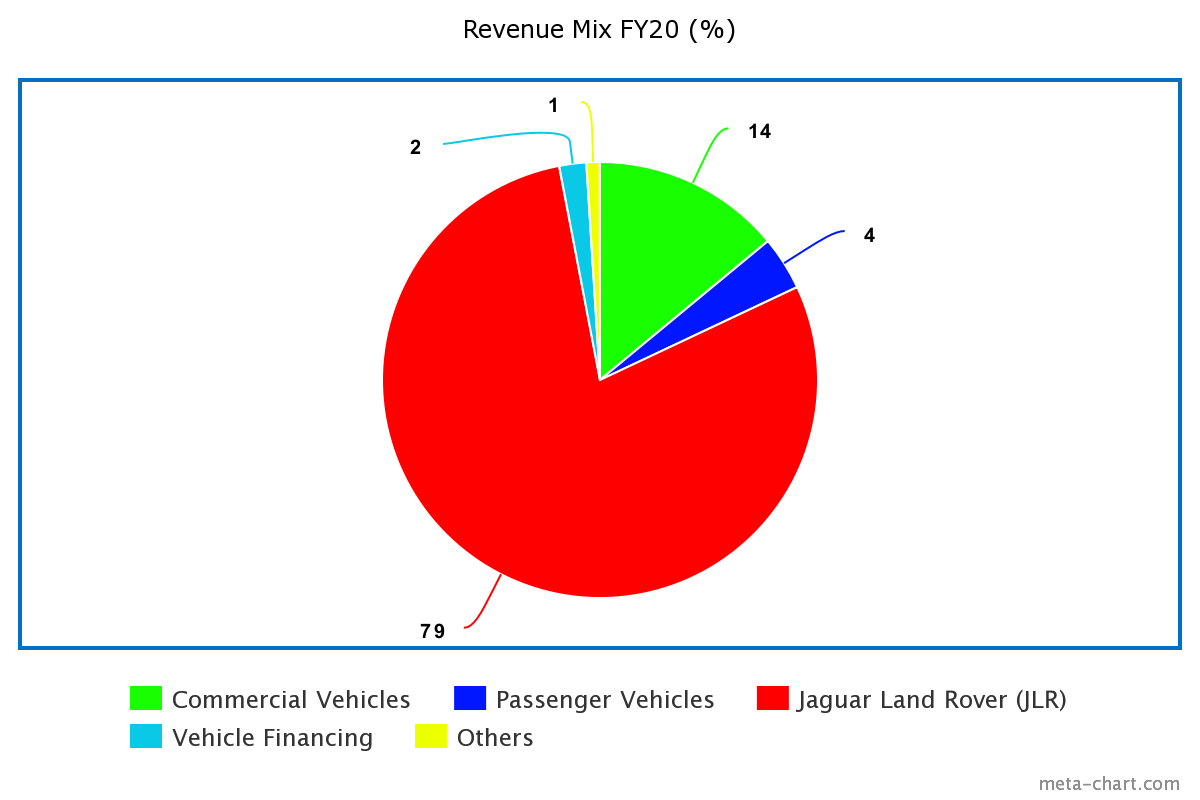
Chery Jaguar Land Rover is the company’s China operation and is a 50-50 partnership between JLR and Chinese state-owned automaker Chery. While the China operations are doing comparatively better, Jaguar Land Rover (JLR) has not been doing great over the last few years elsewhere. At the same time, they are carrying all the burden for Tata Motors, as JLR contributes 79% to the total revenue, as of FY20. The cars of both Jaguar and Land Rover have superior capabilities and are often used as official government cars in many countries. However, their legacy alone is unfortunately not able to sell more cars.

From the graph shown below, we can also understand how small the contribution of its Commercial Vehicles and Passenger Vehicles are. So Tata Harrier, Nexon, Altroz, and many other cars of Tata that you see on the road, contribute only a meagre 4% of Tata’s entire revenue! So no matter how many ever news articles you see about Tata Motors’ domestic sales improving, do not forget that it forms only a tiny fraction of the company’s revenue. 
Jaguar Land Rover. The Loss-Making Enterprise

Jaguar-Land Rover has been the parasite that is actually killing Tata Motors from the inside. The subsidiary of Tata Motors was affected by the impact of falling diesel sales, due to global pollution scandals. The uncertainty of the United Kingdom exiting from the European Union (Brexit) had also led to higher costs, falling sales, and production halts. In May 2019 (FY ’19-’20), JLR had reported a loss of £3.6 billion (~Rs 34,424 crores)! So, the subsidiary that was meant to push Tata Motors to greater heights, has been causing more harm for them.

Since 2017, China has become the biggest market for JLR. As we discussed earlier, the operations there are backed by a Chinese Government-owned entity, Chery. However, even with this support, the sale of vehicles that had been reported from the country had declined by more than 44%, within 2 years. This has caused a lot of panic inside the company, and Tata Motors is finally opening its eyes, and trying to focus on improving JLR’s financial position. 

The very deep losses of JLR have also affected their consolidated figures. Also, the full effects of the lockdown were seen only after the March results. So let us look at how they did between July and September this year. 

Q2 Performance in FY21

Tata Motors reported its Q2 results on 27th October 2020. The consolidated net loss increased to Rs 307.3 crore in the quarter ended September, as compared with a net loss of Rs 187.70 crore in Q2 of the previous year (FY ‘19-’20).  The revenue from operations declined by 18.19% year-on-year (YoY) to Rs 53,530 crore, from Rs 65,431.95 crore a year ago. Many experts have reported that the result has been far better than what was expected, even though the losses increased.

During the July-September quarter this year, the company has reported a growth in passenger vehicle sales by almost 162% YoY. Market share in the passenger vehicle segment has increased to 7.9%, but is still way behind Maruti Suzuki and Hyundai. The sales numbers for October have also increased 79% YoY but volumes are negligible compared to market leaders. The company themselves have attributed this growth to pent-up demand, wherein those people who did not buy cars during the lockdown (as they did not have to travel) are buying cars now. This cannot be considered as the organic growth of the company. Another important fact to be mentioned is that Tata Motors is the only carmaker to register a growth of 2.63% during April-September 2020. The car industry as a whole had fallen by 34% during the same period. This shows how the PV business is currently doing good.

Jaguar Land Rover has also made a strong recovery in Q2. It reported a 53.3% quarter-on-quarter (QoQ) growth in terms of sales. It has sold more than 1 lakh units during the quarter. The Chinese economy is doing well, and hence the company has also improved its sales in China. But the question remains- will they be able to maintain their recovery? 

New Developments

The Tata Group has been continuously aiming to improve its hold in the automobile sector in our country. We know that India’s passenger vehicle sector is dominated by Maruti Suzuki, which has more than 50% market share and is clearly the undisputed king. And even though Maruti Suzuki tries to portray itself as an Indian company, it is Tata and its subsidiaries who have been the Global Indian brand.

Earlier this year, the Board of Directors of Tata Motors had agreed to form a separate entity for its passenger vehicle (PV) business. Within one year, all the relevant assets, intellectual property, and employees would be transferred to this new entity. The production of electric cars will also become a priority for the company.

Following this, a major statement was made by Tata Motors on 25th October. The auto company announced that they are actively looking for a partner, for enhancing its passenger vehicle business. The collaboration will be aimed at reducing costs and improving business with new product launches. For this to become a reality, Tata Motors would require huge investments from outside the company. 

“The whole purpose of subsidiarisation is to actively look for a partner because this is a reality for all of us that a collaboration can unleash a bigger potential in the next decade which is going to see significant investments in new technologies and regulations,” –  Shailesh Chandra, Tata Motors President (Passenger Vehicles Business Unit).

High Hopes

From these new developments, we can see that Tata Motors is gearing up to redefine its position in the automobile industry. The company had announced the restructuring of its passenger vehicle segment almost 3 years ago. But now, concrete steps are being taken. It would take serious planning and execution to cover all losses that have been incurred. The passenger vehicle business would require a huge boost, but this can only be possible through adequate investments and huge collaborations. Through the proposed strategic partnership, Tata Motors would have to make sure that all resources are fully utilized. Also, do bear in mind that JLR is burning cash for the company. This is also the company that is supposed to provide the highest share of the revenue for Tata Motors. 

We do know that the auto industry can be very competitive. It would be very interesting to see how Tata Motors is executing its plans, and trying to bring a positive change to their sales figures. Will they be able to move up on the leaderboard of top car sales in India? Even if they lead in Indian markets, will this make a difference when JLR is still making losses?  Do not forget that Jaguar-Land Rover has always been a bad charm for the companies that owned it. Ford before Tata, and BMW before them. Coming to the conclusion, will Tata be better off cutting losses and selling Jaguar-Land Rover?  
Categories
Editorial

Can Tata Group be the King of Indian Retail?

The retail sector in our country is filled with a lot of companies that compete with each other to reach the top. And at a time when global players like Amazon and Walmart are competing for customers in India, it is no surprise that India’s biggest business houses would want to get into the scene too. 

During the Covid-19 lockdown, companies such as Reliance Retail, Amazon, and Walmart were preparing for the retail war ahead. The retail segment in India is anyway growing with the increasing population of the country. But what these huge companies want is a piece of the organized retail market in India, which is exploding as more and more young citizens are getting high paying jobs. More specifically, it is a race of giants to become the king of India’s booming e-commerce space.

Interestingly, there are reports flying around, about Tata Group’s plans to expand their online retail presence. Let us understand how Tata is preparing to up its game in this space, and find out if it is too little too late.

  1. Race to the Top
  2. The Super App
  3. Tata to acquire BigBasket?
  4. Tata Consumer Products expanding
  5. Will these plans be enough?

Race to the Top

Based on a report from the Indian Business Equity Foundation (IBEF), the retail industry in India is expected to reach Rs 76.87 lakh crore (USD 1.1 trillion) by 2020. We have seen that the Covid-19 pandemic had a devastating impact on the organized retail sector. However, the situation is projected to get better, as lockdown restrictions have now been lifted. Amazon.in, Reliance Industries, and Walmart have all shown how this particular sector is going to become a battleground in the months to come. 

Over the last few months, we keep hearing about the expansion of Mukesh Ambani’s Reliance Industries Limited (RIL) in the retail sector. Reliance Retail Ventures Limited (RRVL) has raised Rs 37,440 crore this year from private equity firms. Currently, it is the largest retail company in India. All these highly competitive factors could make it difficult for a company like Tata to expand and develop in this particular market. However, over the past few months, we have heard reports stating that Tata Group is not going to back down without a fight. They have come up with solutions to bring about more competition in the organized retail space. Let us look at a few of these:

The Super App

In August, Tata Group stated that it had plans to launch a ‘Super App’ to take on Reliance and Amazon. The app would be a one-stop destination for all of Tata’s products. We hope you can imagine the magnitude of this product. Tata Group sells salt to jewellery and everything in between, including cars and even trucks. Imagine using the Super App could be used by you to order a Fastrack watch, or maybe even to book a Tata Harrier SUV.

It is expected that the Super App will also merge services from food and grocery ordering to fashion, electronics, insurance, healthcare, and bill payments. Currently, the services can be found in Tata CLiQ and Croma for electronics, StarQuick for groceries, and streaming services in Tata Sky. The app is also set to have its own payment system, and the loss-making Tata Teleservices is said to be the one that could provide technical support and enterprise solutions.

The concept of a Super App can be seen from applications such as PayTM and PhonePe. When these apps started in India, they were just payment platforms. However, this model has seen massive growth in terms of the services that they provide, and the customers seem to be giving positive feedback for this new model.

Another report came up in September, stating that retail giant Walmart Inc, (who owns Flipkart and PhonePe) was in talks with Tata Group for a potential investment in the super app for up to $25 billion (~Rs 1.8 lakh crore). The app is likely to be launched between December and January, as a joint venture between the two companies.

Tata to acquire BigBasket?

On 15th October, reports were sent out by major publications stating that Tata Group was in talks to acquire BigBasket. The Bengaluru-based company is one of the best online grocery stores in India. The company delivers groceries in about 26 major cities and towns. As the Covid-19 pandemic hit our country and people were stuck at home, the demand for these online services has seen an all-time high. The company is backed by China’s Alibaba Group, and has reported a valuation of nearly $1.2 billion (~Rs 8,809 crore) as of March. Last month, BigBasket said that the number of new users on its platform had increased by 84%, as compared with the pre-Covid levels. On 25th May, BigBasket had appointed financial services companies Goldman Sachs and Morgan Stanley to help raise funds, and are now looking to increase their valuation to $2 billion (~Rs 14,682 crore). A business valuation is a process of determining the total economic value of a whole business or a company, and raising the valuation would help them sell stake, and raise more funds.

Another report which has come up in the past few weeks is that Tata Group has also made plans to acquire IndiaMart InterMesh Ltd, a business-to-business (B2B) marketplace. It is an e-commerce company that sells to normal consumers and to other small businesses. Basically, the company helps Indian manufacturers to connect with buyers. IndiaMart’s shares have surged almost 142% this year, giving it a market value of about Rs 14,682 crore. According to their website, IndiaMart says it controls almost 60% of the Indian online B2B market, providing a platform for small and medium enterprises. The point to be noted is that Flipkart and Amazon have been expanding their B2B presence as well. You can read about it here. Through this acquisition, the Tata Group would be able to obtain a major hold of the online e-commerce retail market in India.

Tata Consumer Products

The new CEO of Tata Consumer Products Limited (TATACONSUM), Sunil D’Souza, has announced plans to transform the company as the new face of Tata Group’s fast-moving consumer goods (FMCG) company. TATACONSUM had been formed recently through the merger of Tata Global Beverages and Tata Chemicals.

TATACONSUM is also planning to contribute to Tata Group’s ultimate goal to strengthen its retail presence. Currently, the firm’s products include Tata Tea, Tetley, and Tata Salt, and also has a joint venture with Starbucks Corporation in India. In September, they made a non-binding bid for the vending machine business of Coffee Day Enterprises Ltd. Coffee Day is one of the largest coffee chains in India, and has over 60,000 vending machines across malls, public spaces, and schools in India. This could help TATACONSUM obtain more access to the premium coffee platform in India, along with the help of Starbucks.

The company has also declared plans to bring about changes to its entire sales and distribution system. In order to double its reach to customers, they are creating a more direct, active, and digitized system. During the beginning of the financial year, Tata Consumer Products also bought out partner PepsiCo’s stake in NourishCo Beverages Limited, whose products include Himalayan mineral water. This has been seen as an aggressive move by the company. We can see that this trend of acquisitions would largely have a positive impact on the growth of the company.

We see that the shares of Tata Consumer have so far increased 52% this year, thus giving them a market value of about Rs 44,046 crore.

Will these plans be enough?

Through a series of acquisitions, expansion of Tata Consumer Products, and through investments in its new Super App, the Tata Group will be able to compete against India’s retail giants. But, a question arises here-  Is the Tata Group too late to improve on its retail presence? Except for a few companies like Tata Consultancy Services, most of the other subsidiary companies of Tata Group are making huge losses. If the integration of all these new expansion plans is precisely calculated and achieved, the retail business of the Tata Group of Companies will be able to bring in better returns. In order to make a mark on the organized retail sector in India, companies would have to go all out and play the best strategies. 

All eyes are focused on how the Tata Group is planning to execute these huge plans. Will the Super App be as great as it sounds? Let us wait and watch for the results.