Categories
Jargons

Which are the Highest Dividend Paying Stocks in India?

A dividend is a payment made by a company to its shareholders out of its earnings or accumulated profits. Listed companies usually pay dividends in cash and are an additional source of income for shareholders. They also issue dividends as additional shares of stock or other forms of property. Dividends serve as a way for companies to reward shareholders for their investments. However, companies are not legally bound to pay dividends. All companies can choose to issue dividends at their own discretion. In this article, we will examine the top dividend-paying stocks in India.

Why Should You Invest in Dividend Paying Stocks?

Passive Income

Dividends can be an excellent source of passive income. Passive income refers to earnings that require minimal effort or ongoing involvement of the investor. Dividend payments fit this definition because once you invest in dividend-paying stocks, you can receive regular income without actively working for it.

Regular Cash Flow

Dividend payments are often made quarterly or annually. This regularity provides a predictable income stream. Additionally, since companies pay dividends in cash, there will be a regular cash flow.

Increased Total Return

Dividend income can contribute to the total return of an investment. Total return refers to an investment’s overall profit or loss over a specific period. It considers both capital appreciation and any other income from the investment, such as dividends. When you reinvest dividends in the company’s shares, it can supercharge the total return through compounding.

Cushioning Market Volatility

Dividend-paying stocks can act as a cushion during market downturns. Even if the stock price temporarily declines, investors still receive dividend payments, which can help offset potential losses. This dividend income can provide stability to your portfolio and reduce the impact of market volatility.

Indicator of Financial Health

Companies that consistently pay dividends often exhibit stability and predictability in their financial performance. These companies are typically well-established, generate steady profits, and have a history of sharing their earnings with shareholders. Dividend payments can reassure investors of the company’s financial health and stability.

Factors to Consider Before Investing in Dividend-paying Companies

Not all companies that pay dividends are good. Before choosing a company to invest in, you should consider different factors. A few of them are listed below:

Dividend History

A company that has paid consistent dividends over the years tends to continue paying dividends in the future. Examine the company’s dividend payment history. Look for companies with a history of paying dividends consistently over a significant period. Consider whether the dividends have been maintained or increased over time. A stable or growing dividend history indicates the company’s commitment to rewarding shareholders.

Dividend Yield Ratio

The dividend yield ratio of a share is the ratio of the annual dividend per share to the share’s market price. It evaluates the dividend amount relative to the stock price. A higher dividend yield may indicate a potentially attractive income-generating opportunity. However, the dividend yield ratio is dynamic, as the value ratio changes with the stock price. It is essential to compare the yield with industry peers and assess its sustainability.

Dividend Payout Ratio

The dividend payout ratio represents the proportion of earnings paid out as dividends. A lower payout ratio indicates that the company retains a sizeable portion of its earnings for reinvestment or future growth, which can be positive for long-term stability. On the other hand, a high payout ratio may indicate that the company is distributing a significant portion of its profits, potentially limiting its ability to invest in growth opportunities or withstand economic downturns.

Payout Ratio = Dividends Per Share/Earnings Per Share × 100

Payout Ratio = Dividends per share/Free Cash Flow Per Share × 100

Company’s Financial Health

Look into the company’s financial health by reviewing its financial statements, including revenue growth, profitability, debt levels, and cash flow. A company with robust financials and a healthy balance sheet holds a solid position to sustain and potentially increase dividend payments.

Growth Prospects

Consider the company’s growth prospects and future earnings potential. While dividends provide income, assessing whether the company can grow its earnings over time is essential. Sustainable dividend payments often align with a company’s ability to generate consistent profits and reinvest in its business for future growth.

Economic and Market Conditions

Evaluate the broader economic and market conditions. Some industries, such as utilities or consumer staples, tend to have more stable cash flows. They are better positioned to maintain dividend payments during economic downturns. Consider the impact of economic factors, interest rates, and market volatility on the company’s ability to sustain its dividend payments.

Valuation

Assess the company’s valuation relative to its peers and its historical valuation. A company with an attractive valuation may provide an opportunity for capital appreciation in addition to dividend income. However, be cautious of excessively high dividend yields that may signal 

underlying risks.

Best Highest Dividend Paying Stocks In India

Given below are a few of the best highest-dividend paying stocks in India:

No.NameSector
1InfosysInformation Technology
2Hindustan UnileverFMCG
3ITCFMCG
4Oil & Natural Gas CorpEnergy
5HDFC BankFinancial

Infosys Ltd

Infosys Ltd is engaged in consulting, technology, outsourcing, and next-generation digital services. The IT company’s core services include application management services, proprietary application development services, independent validation solutions, product engineering & management, infrastructure management services, traditional enterprise application implementation, and support & integration services. Its products and platforms include Finacle, Panaya, Skava, and LEAP.

The company offers services to enterprises in the financial services & insurance, manufacturing, retail, consumer goods, logistics, energy, communication, telecom, and media sectors. Infosys has grown into the 2nd largest information technology company in India behind TCS.
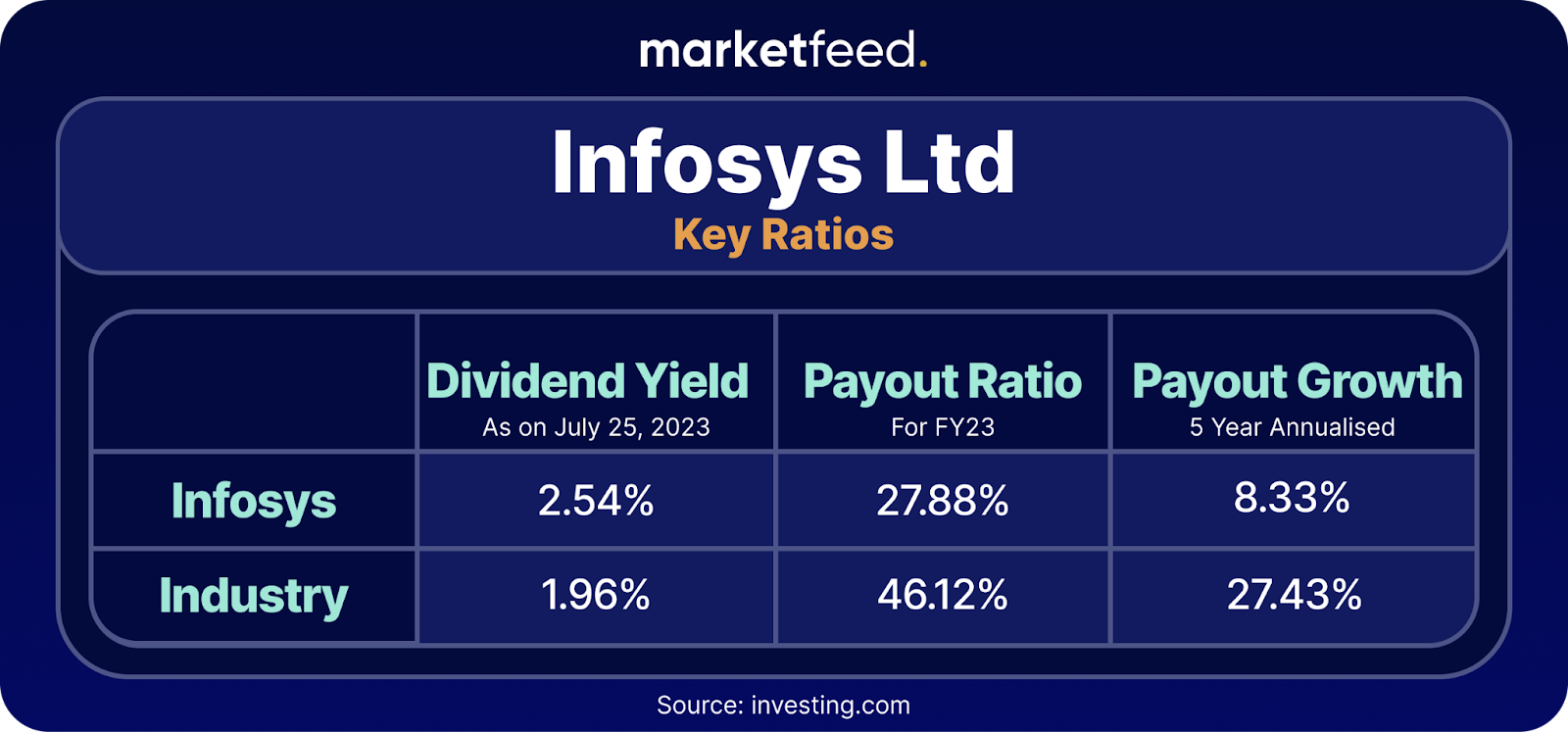
Infosys - Highest Dividend Paying Stock

Hindustan Unilever Ltd

Hindustan Unilever Ltd is a consumer staples company. It manufactures and sells food, home care, personal care, and refreshment products in India and internationally. The company operates through Home Care, Beauty & Personal Care, Foods & Refreshments, and other segments. 

The Home Care segment engages in detergent bars and powders, detergent liquids, scourers, water business, purifiers business, etc. The Beauty & Personal Care segment provides oral, skin, and hair care products; soaps, deodorants, talcum powder, color cosmetics, salon services, etc. The Foods & Refreshment segment sells fruit-based products, soups, tea, coffee, health food drinks, ice-creams, and frozen desserts. 

The company is also involved in job work, real estate, and discharge trust activities. Hindustan Unilever is a subsidiary of Unilever Plc.
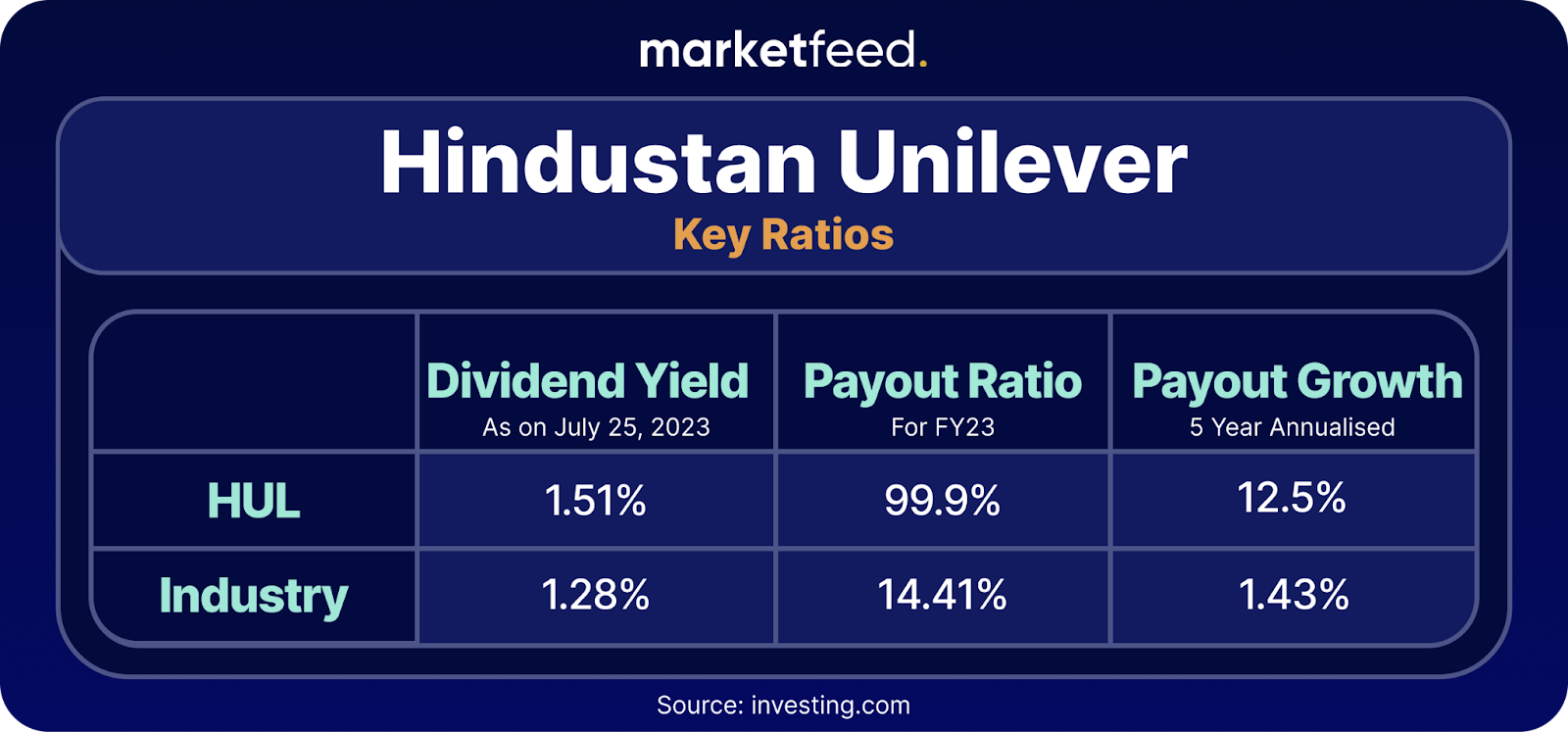
Hindustan Unilever - Dividend paying stock

ITC Ltd

ITC Ltd is a consumer staples company. The company operates through four segments: FMCG (fast-moving consumer goods), Hotels, Paperboards, Paper and Packaging, and Agri-Business. 

Cigarettes, branded packaged foods, education & stationery products, personal care products, safety matches, agarbattis, and apparel forms its FMCG business. The company operates a chain of over 100 hotels across India. Its Agri Business segment includes agri commodities such as soya, spices, coffee, and leaf tobacco. ITC owns and operates brands such as Aashirvaad, Bingo!, Candyman, Fiama, Vivel, Classmate, Superia, Engage, Mangaldeep, Aim, and Homelites.

ITC also offers information technology services and branded residences. 
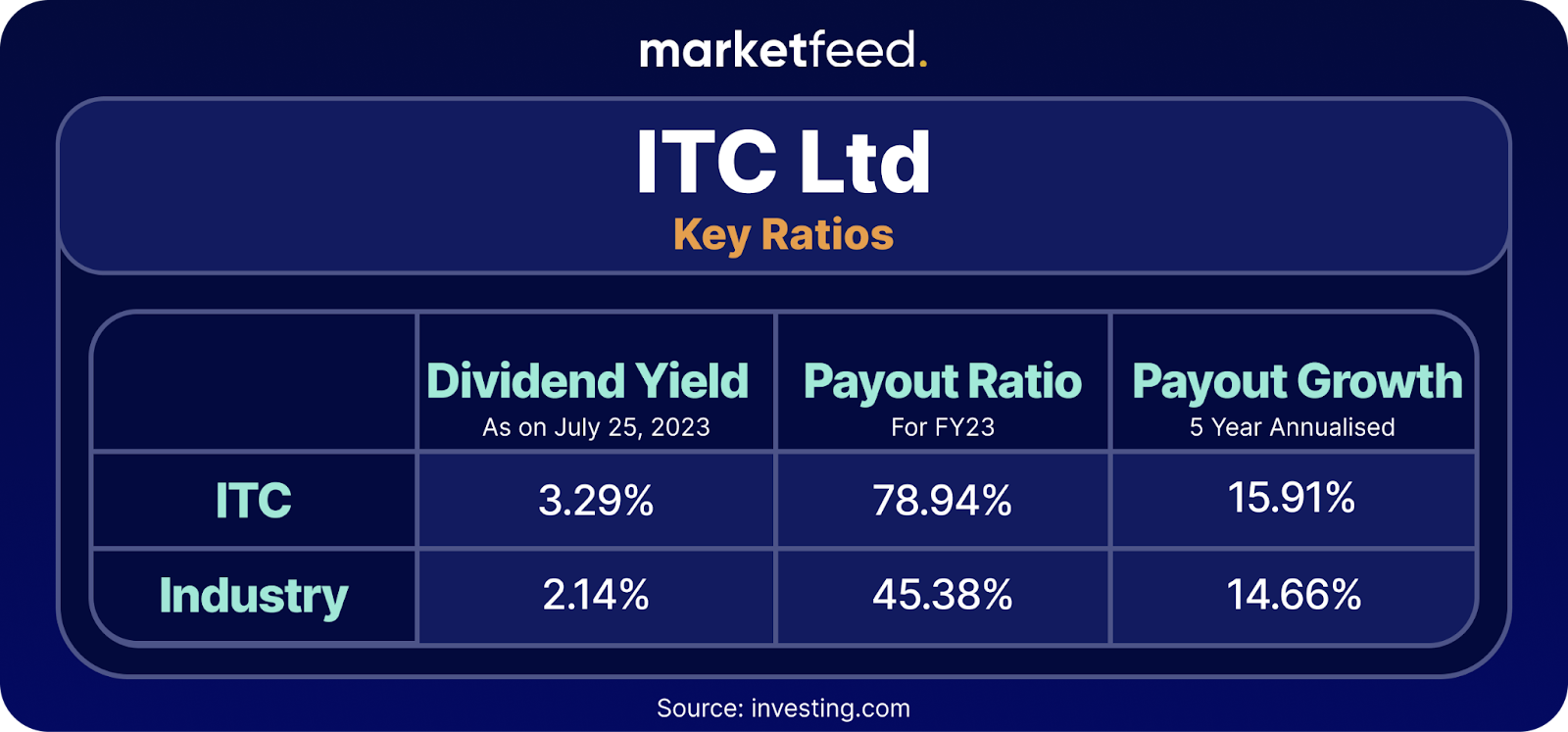
ITC - highest dividend paying stock

Oil & Natural Gas Corporation Ltd

Oil and Natural Gas Corporation (ONGC) Ltd is the largest producer of crude oil and natural gas in India. The primary activities of the company include exploration, development, and production of crude oil, natural gas, and value-added products. ONGC has two business segments— Exploration and Production and Refining and Marketing. 

ONGC contributes nearly 71% to India’s total production of crude oil. The crude extracted by the company is used as raw material by downstream companies such as Indian Oil Corp. (IOCL), BPCL, and HPCL. Moreover, ONGC contributes ~63% to the total gas production in our country.

Mangalore Refinery and Petrochemicals Ltd, ONGC Videsh Ltd, and Petronet MHB Ltd are its subsidiaries.
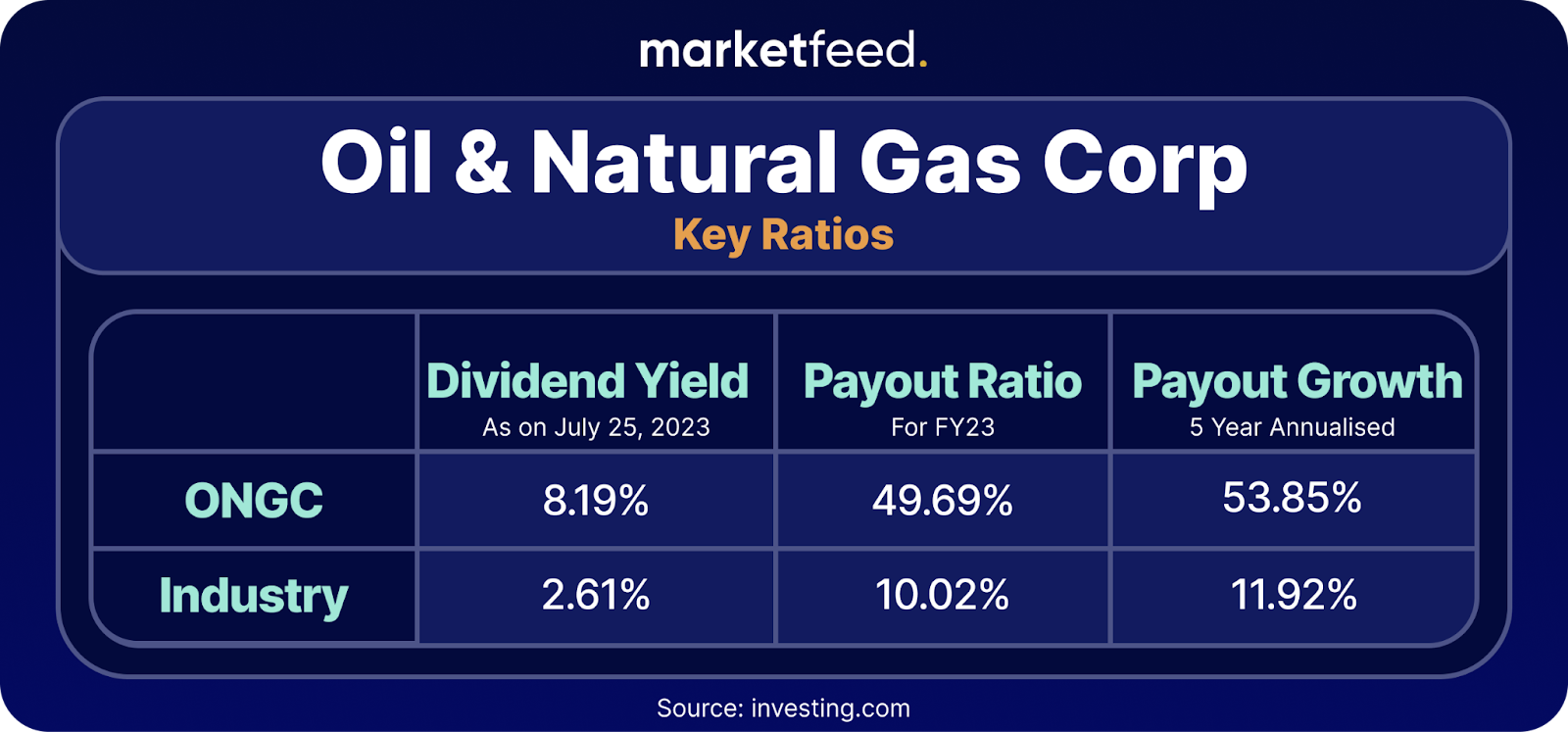
ONGC - Highest Dividend Paying Stock

HDFC Bank

HDFC Bank Ltd is the largest private sector bank in India. It offers a comprehensive range of banking and financial services, including retail banking, wholesale banking, and treasury operations. The company is also the market leader in the credit card business in India. As of 31 March 2023, the bank’s distribution network was at 7,821 branches across 3,203 cities.
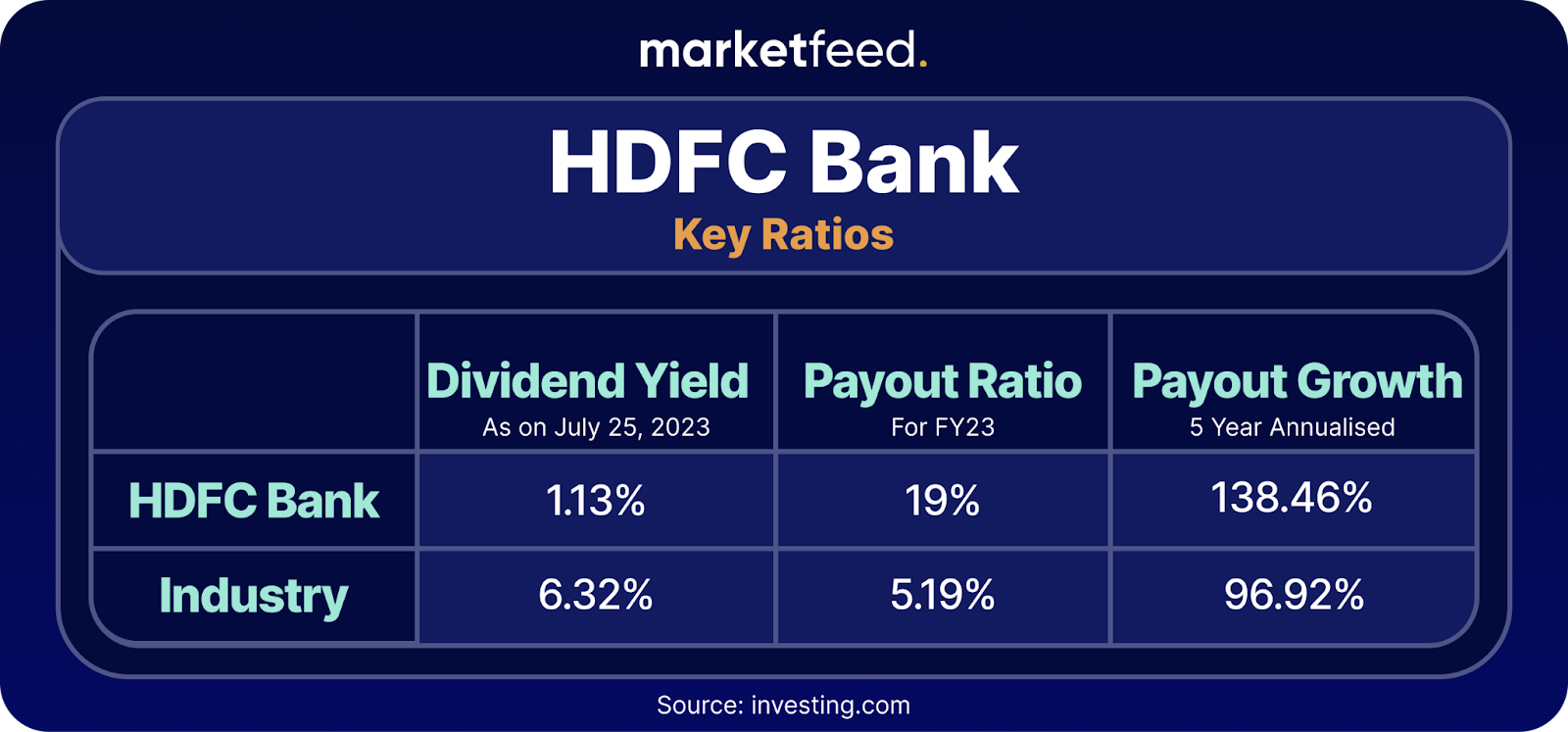
HDFC Bank - Dividend Stocks in India

In conclusion, investing in dividend-paying stocks can create additional income, supercharging long-term wealth creation. While investing, it is crucial to look beyond the absolute dividend values and consider other factors such as payout ratios. This investing style is best suitable for people who need regular cash flow!

Disclaimer: The stocks mentioned in the article are solely for educational purposes. Please do your own research before investing.

Categories
Daily Market Feed Pre Market Report

Results Season Craziness! Can Reliance Save NIFTY? – Pre Market Analysis

Here are some of the major updates that could move the markets today:

Stocks

Infosys reported a profit of Rs 5,945 crore for the quarter, down 3 percent QoQ and cut revenue expectations for the whole financial year. Infy ADR dropped -8.41% in the U.S.

Hindustan Unilever registered an 8% YoY increase in profit at Rs 2,472 crore for the quarter ended June FY24, with growth in all key segments.

Larsen & Toubro said the board of directors will meet on July 25 to consider the buyback of shares

Jio Financial Services(JFL), a subsidiary of Reliance Industries, has been valued at Rs 1.66 lakh crore following an hour-long special trading session at ₹261.85/share. The combined price of is higher than expected.

Major results today: Reliance Industries, HDFC Life, Dodla, DLF, JSW Steel, Ultratech Cement.

What to Expect Today?

NIFTY opened with flat at 19,831 and initially moved down. Being the weekly expiry, index saw volatility but bounced back strongly from 19,760. After this, an intense 230 point rally took NIFTY up to the close at 19,979, up by 146 points or 0.74%. 

BANK NIFTY opened with a small gap-up at 45,725 and looked much more strong. It slowly moved up in the afternoon, but gave a breakout above the all-time high. The index closed at 46,186, up by 517 points or 1.13%.

The general US markets closed mixed, as tech stocks pushed NASDAQ down 2%. The European markets closed higher.

The Asian markets are trading mixed.

The U.S. Futures are trading flat.

GIFT NIFTY is trading down at 19,866, after Infy’s fall.

All the factors combined indicate a gap-down opening.

NIFTY has supports at 19,820, 19,765, 19,740 and 19,725. We can expect resistances at 19,900 and 19,950.

BANK NIFTY has supports at 46,000, 45,900 and 45,800. Resistances are at 46,253, 46,300, and 46,500.

NIFTY has the highest call OI build-up at 20,000. The highest put OI build-up is at 19,800. 

BANK NIFTY has the highest call OI build-up at in the money 46,000. The highest put OI build-up is also at 46,000.

Foreign Institutional Investors net-bought shares worth Rs 3,370 crores. Domestic Institutional Investors net-sold shares worth Rs 193 crores.

INDIA VIX is at 11.78.

Bank Nifty showed consistent strength throughout the day, and once it broke the all-time high gave multiple bursts of strength. Both indices closed at fresh all-time highs. Reliance saw a net positive move after the demerger.

The best moves are the ones without any news or reason. And the time for the looks to have temporarily ended in NIFTY with the starting of results season.

Expect a gap-down opening in NIFTY with Infosys volatility. And expect intraday volatility from Reliance results. If both stocks start moving down, NIFTY would see strong good pull-back towards 19,750 zones.

Bank Nifty option chain remains interesting. With a huge straddle buildup at 46,000, OI indicates that further rally is not optimal. But a breakout, and short-covering can only be expected if another round of fireworks push it above 46,700, which is quite far away.

ICICI Bank, Kotak Mahindra Bank and Yes Bank will be in focus ahead of their results tomorrow.

With it being the monthly expiry series, we can expect some calm before the storm next Thursday. The fresh all-time high made yesterday near 20,000 might be defended till then.

I will watch 19,845 on the downside in NIFTY. 19,920 can be watched on the upside.

Make sure that you tune in to The Stock Market Show at 7 PM on our YouTube channel. Follow us on the marketfeed app’s Signal section to get real-time updates from the market. All the best for the day!

Categories
Market News Top 10 News

Jio Financial Services’ Shares List at Rs 261.85 Per Share – Top Indian Market Updates

Here are some of the major updates that could move the markets tomorrow:

Jio Financial Services’ shares list at ₹261.85 per share

The shares of Jio Financial Services (JFSL), the demerged NBFC unit of Reliance Industries, got listed at ₹261.85 per share on the NSE today. This was much higher than brokerage estimates of up to ₹190. Stock exchanges BSE and NSE conducted a special pre-open trading session this morning from 9 am to 9:45 am in which the market price of the demerged entity was calculated.

Read more here.

Infosys Q1 Results: Net profit rises 11% YoY to ₹5,945 crore

Infosys reported a 10% YoY rise in consolidated net profit to ₹5,945 crore for the quarter ended June (Q1 FY24). The IT major’s revenue from operations stood at ₹37,933 crore, up 10% YoY. Infosys has revised its full-year revenue growth outlook, lowering it to 1-3.5% from the initial estimate of 4-7% due to a challenging economic environment.

Read more here.

PVR Inox plans to add two more superplexes this year

PVR INOX Ltd is looking to add two more superplexes this year as part of plans to expand its large format offering. The company opened its new 12-screen superplex in Bengaluru, taking its total to 158 screens in 25 cinemas in the city. Superplexes or cinema halls with 10 or more screens offer a range of formats and experiences under one roof in mega malls with large floor areas.

Read more here.

Havells India Q1 Results: Net profit rises 18% YoY to ₹287 crore

Havell India Ltd reported an 18% YoY increase in consolidated net profit to ₹287.07 crore for the quarter ended June (Q1 FY24). The total revenue for the quarter rose 14% YoY to ₹4,833.8 crore. EBITDA stood at ₹402 crore in Q1, up 11% YoY. The company witnessed sluggish consumer demand, and unseasonal rains impacted sales of its cooling products.

Read more here.

Govt announces re-bidding under PLI for advanced chemistry cell manufacturing

The Central government announced the re-bidding of production-linked incentives (PLUs) for 20 GWh Advanced Chemistry Cell manufacturing— India’s Rs 18,100-crore programme to boost local battery cell production. The Ministry of Heavy Industries (MHI) will facilitate a stakeholder consultation with industry representatives on July 24, 2023, for their inputs and suggestions before the start of the re-bidding process of the remaining 20 GWh capacity.

Read more here.

HUL Q1 Results: Net profit rises 7% YoY to ₹2,472 crore

Hindustan Unilever Ltd (HUL) reported a 7% YoY increase in consolidated net profit to ₹2,556 crore for the quarter ended June (Q1 FY24). Its total income rose 6.2% YoY to ₹15,679 crore in Q1. The FMCG company’s total expenses during the quarter came at ₹12,167 crore, up 5.5% YoY.

Read more here.

India’s oil & gas import bill contracts 33% YoY in Q1 as prices drop

According to data from the Oil Ministry, India’s oil and gas import bill contracted by 33% YoY to $35 billion in the April-June quarter (Q1) as prices sharply dropped. Crude oil worth $31.4 billion was imported during Q1 FY24, lower than $48.1 billion in the same period last year. The volume of oil imports marginally reduced to 60.1 million metric tonnes (MMT) in the first quarter from 60.7 MMT in the same period last year.

Read more here.

HCL Tech, Schneider Electric to develop sustainability solutions for data centres in APAC

HCL Technologies will partner with Schneider Electric to develop carbon-efficient solutions for data centres in the Asia-Pacific (APAC) region. Both companies will jointly explore innovations in sustainability and deliver converged IT-OT (information technology-operational technology) solutions to help clients meet regulatory compliances and accelerate decarbonisation programs in the APAC region.

Read more here.

IndiaMart Q1 results: Net profit rises 77% to ₹83 crore

IndiaMart InterMesh Ltd reported a 77% YoY rise in consolidated net profit to ₹83 crore for the quarter ended June (Q1 FY24). Its revenue from operations rose 26% YoY to ₹2,821 crore during the same period. Total expenses during the quarter stood at Rs 2,144 crore, up 28% YoY. The company’s board has approved the buyback of 12.5 lakh shares worth up to ₹500 crore at ₹4,000 per share. 

Read more here.

Categories
Daily Market Feed Pre Market Report

Crazy OI in Nifty! Short Covering Loading? Pre Market Analysis

Here are some of the major updates that could move the markets today:

Stocks

Tata Communications reported a 30% fall in net profit at Rs 382 crore for the first quarter ended June. Revenue from operations, however, jumped 11% to Rs 4,771 crore.

Shares of  HUL, Infosys, Havells, and United Spirits will be in focus today as the companies will announce their first quarter results today.

Federal Bank has launched a QIP (qualified institutional placement) issue and fixed Rs 132.59 as the floor price.

What to Expect Today?

NIFTY opened with a gap-up at 19,810 and moved up. The index saw a down-move and there was a recovery in the second half leading to a volatile day. NF closed at 19,833, up by 84 points or 0.42%. 

BANK NIFTY opened with a gap-up at 45,650 and traded in a range of 200 points. There was an up-move at 3 PM and the index closed at 45,670, up by 258 points or 0.57%.

IT moved up by 1.06%. 

The US markets closed in the green. The European markets closed mixed with DAX closing flat and FTSE rallying.

The Asian markets are trading mixed.

The U.S. Futures and European futures are trading mixed.

GIFT NIFTY is trading at 19,835.

All the factors combined indicate a flat opening.

NIFTY has supports at 19,820, 19,765, 19,740 and 19,725. We can expect resistances at 19,850, 19,900 and 19,950.

BANK NIFTY has supports at 45,485, 45,430 and 45,280. Resistances are at 45,715, 45,750, 45,800 and 46,000.

NIFTY has the highest call OI build-up at 20,000. The highest put OI build-up is at 19,800. 

BANK NIFTY has the highest call OI build-up at 46,000. The highest put OI build-up is at 45,500.

Foreign Institutional Investors net-bought shares worth Rs 1,200 crores. Domestic Institutional Investors also net-bought shares worth 2,100 crores.

INDIA VIX is at 11.6.

Though Bank Nifty was range bounded and did not see a strong 3 PM rally, unlike Nifty, the index outperformed Nifty. Reliance saw a big move before the demerger.

There will be a special session to decide the post-merger price of Reliance. Reliance will start trading only after 10 AM. We can expect Jio Financial Services to be listed in the market in four months.

Watch 1674 and 1688 in HDFC Bank. The IT giants consolidated after a fall in the morning. 

Look at the call OI build-up at 19,850 CE in Nifty. It is so huge despite being a strike just 17 points away from the spot. Imagine the magnitude of short covering that could happen if that level is broken.

In case that happens, see where BN can rally to. The index has been suppressed by the option sellers leading to a range-bound day. A move out of the zone could be a big one.

No major data are coming out this week. Let us focus on the Reliance demerger. UK CPI came out slightly better than the estimates.

I will watch 19,765 on the downside in NIFTY. 19,850 can be watched on the upside.

Make sure that you tune in to The Stock Market Show at 7 PM on our YoutTube channel ‘marketfeed by Sharique Samsudheen’. Follow us on the marketfeed app’s Signal section to get real-time updates from the market. All the best for the day!

Categories
Jargons

Which are the Top FMCG Stocks in India?

Products that are sold quickly and at relatively low cost are known as fast-moving consumer goods (FMCG). Another name for such products is consumer packaged goods. FMCGs have a limited shelf life due to high consumer demand (such as for soft drinks and confections) or perishability (such as for meat, dairy products, and baked goods). The top three sectors of this business are Food & Beverages (19%), Healthcare (31%), and Household & Personal Care (50%), respectively. In this article, explore the top FMCG stocks in India!

An Overview of the FMCG Industry

India’s FMCG industry is the biggest in the world. It is estimated that the FMCG sector accounts for around 15% of India’s gross domestic product (GDP) and employs more than 1 crore people. Consumer electronics, food, personal care products, home goods, over-the-counter medications, and other items are all included in this industry. The FMCG industry is optimistic about at least 20% growth in 2023 after ‘exponential growth’ in 2022:

  • Favourable government policies, a growing rural market and young population, and the expansion of e-commerce platforms are some of the sector’s main development factors.
  • India has a middle-class population that is greater than the population of the USA, making it a country that no FMCG company can afford to ignore.  The FMCG market keeps expanding as more and more people begin to climb the economic ladder and the general public obtains access to the benefits of economic progress. 
  • More importantly, India’s population is getting more consumerist with growing disposable income. Government efforts to broaden financial inclusion and provide social safety nets have further contributed to this. 
  • The FMCG market in India is expected to increase at a CAGR of 14.9% to reach $220 billion by 2025, from $110 billion in 2020. 

Top FMCG Stocks in India:

S. No.Stocks5-Year Returns
1Hindustan Unilever Ltd. 62%
2ITC Ltd.72%
3. Nestle India Ltd. 123%
4Britannia Industries Ltd. 61%
5Varun Beverages Ltd.696%
(Figures are as of July 17, 2023. Past performance is no guarantee of future results)

1. Hindustan Unilever Ltd (HUL)

Home care, beauty & personal care, and foods & refreshment are Hindustan Unilever Ltd’s three main FMCG business sectors. The company sells its products largely in India and has manufacturing plants all across the nation. With over 40 brands available across 12 distinct categories, including personal care, fabric care, skincare, hair care, oral care, deodorants, cosmetics goods, beverages, ice cream, frozen desserts, and water filters, HUL is an important part of millions of Indians’ lives. Dove, Lifebuoy, Knorr, and Pears Soap are a few of their brands. Home care brings in 34% of the company’s income, followed by beauty and personal care (44%) and food & drink (19%). HUL has also forayed into the health and wellbeing segment through two strategic investments.

Over the last 5 years, the company’s revenue has grown at a CAGR of 9.35%, while profits have a CAGR of 14.6%. The company is nearly debt free and has a healthy dividend payout ratio of 99.9%. The stock has moved up 62% over the past five years. 

2. ITC Ltd

Established in 1910, ITC is the biggest cigarette producer and retailer in the nation. The five business divisions that ITC now works in are FMCG Cigarettes, FMCG Others, Hotels, Paperboards, Paper and Packaging, and Agri-Business. Aashirvaad, Sunfeast, Yippee!, Bingo!, B Natural, ITC Master Chef, Fabelle, Sunbean, and Fiama are among ITC’s top FMCG brands. Additionally, it has added frozen food items, ghee, dairy products, and premium chocolates to its collection of branded packaged meals. ITC is known for assuring precise production and packaging quality. They have a wide variety of distribution outlets in India and have gained access to the remotest of locations through a variety of stores. It is anticipated that ITC will increase its involvement in the eastern market for spices due to its most recent acquisition of Sunrise Foods Pvt Ltd. 

The company is nearly debt free and has been maintaining a debt payout of 92%. Over the past five years, the revenue had a CAGR of 7% and net income has had a CAGR of 8%. The company has delivered a poor sales growth of 10% over the past five years. ITC stock has given a decent return of 72% over the past 5 years. 

3. Nestle India Ltd. 

Nestle India Ltd. is a dominant company in the Indian FMCG market with a strong market presence in the majority of its product categories. The business, which sells various goods under the Maggi brand is a trendsetter in the food service industry. In terms of dairy and nourishment products (96% in infant cereals), drinks (Nescafe 51%), processed foods (Instant Pasta Maggi -69%), kitchen aids (Nestle everyday 44%), and confectionery (63%). The company markets its products under the EVERYDAY, NESCAFE, NESTEA, Maggi, KitKat, Munch, Nestle, POLO, Bar-One, Milkmaid, Milkybar, Alpino, and Eclairs brands, among others.

Nestle India’s revenue has given a CAGR of 11.5% over the past 5 years while the net income has grown at a CAGR of 14%. The company has maintained a healthy dividend payout of about 91%. However, it has delivered poor sales growth of 11.0% over the past five years. The company’s stock has jumped 123% over the past five years. 

4. Britannia Industries Ltd. 

Britannia Industries has a rich 100-year history. It is one of the major leaders in the Indian biscuit industry with a market share of more than one-third in terms of value. The company’s portfolio has a good proportion of each of the seven varieties of biscuits it produces, including glucose, Marie, cookies, crackers, cream, milk, and health. Additionally, the company’s whole product line includes recognisable trademarks including Milk Bikis, Tiger, Marie, and Good Day. 

Over the past five years, revenue and net income have seen a decent CAGR of 9.3% and 11.5%, respectively. Despite maintaining a high dividend distribution of 123%, the company’s growth in sales over the previous five years was just 10.5%. Britannia’s shares have risen 61% in 5 years. 

5. Varun Beverages Ltd.

Varun Beverages Ltd (VBL) is engaged in the manufacturing, sales, and distribution of PepsiCo’s beverages in pre-defined territories in India. The company is PepsiCo India’s second-largest international franchisee (after the United States) for carbonated soft drinks and non-carbonated beverages. VBL is a part of the RJ Corp group, a commercial conglomerate with holdings in quick-service restaurants, dairy products, and healthcare. Some of the key brands sold under VBL include Pepsi, Mirinda, Mountain Dew, Seven-Up, etc. In addition, the company offers its products in Nepal, Sri Lanka, Morocco, Zimbabwe, Zambia, and Mozambique.

The company has reported an impressive revenue CAGR of 27% and a net income CAGR of 48% over the past 5 years. It has delivered good profit growth of 49.2% CAGR over the last 5 years. It has been maintaining a healthy dividend payout of 17.5%. However, promoter holding has decreased by about 4% over the last 3 years. The stock has given a spectacular return of 696% in the past 5 years.

Other Top FMCG Stocks in India:

  • Marico
  • Dabur India
  • Godrej Consumer Products
  • Colgate Palmolive
  • Tata Consumer Products
  • Jyothy Labs

In conclusion, India’s FMCG market is expanding quickly. Consumers are increasingly choosy and willing to pay more money for high-quality goods than low-quality ones. The FMCG market has expanded as a result of the rising demand for branded goods. It has grown faster in rural India than in urban India as a result of the expanding number of FMCG startups. The semi-urban and rural sectors are also experiencing rapid growth for these publicly listed FMCG firms in India. This makes FMCG one of the strongest sectors with very high potential. And now you know which are the top FMCG stocks in India you could invest in!

Disclaimer: The stocks mentioned in the article are solely for educational purposes. Please do your own research before investing.

Categories
Market News Top 10 News

HUL’s Profit Rises 12% YoY in Q3 – Top Indian Market Updates

Here are some of the major updates that could move the markets tomorrow:

HUL Q3 Results: Net profit rises 12% YoY to ₹2,505 crore

Hindustan Unilever Ltd (HUL) reported an 11.6% year-on-year (YoY) increase in net profit to ₹2,505 crore for the quarter ended December (Q3 FY23). Its revenue from operations rose 16% YoY to ₹14,986 crore during the same period. This revenue growth was largely driven by Beauty & Personal Care (up 10%) and Home Care segments (up 32%). HUL said its royalty and central services fees to Unilever Plc will increase from 2.65% to 3.45% over three years.

Read more here.

BHEL secures ₹300 crore order to modernise 2 units at Ukai plant

Bharat Heavy Electricals Ltd (BHEL) has secured an order worth ₹300 crore to renovate and modernise (R&M) steam turbines at Ukai thermal power station in Gujarat. BHEL is also the Original Equipment Manufacturer (OEM) of these turbine sets, which have been successfully operating for nearly 40 years. BHEL will not only extend the life and reliability of the two units at the plant but will also improve the efficiency levels of the turbines.

Read more here.

AU Small Finance Bank Q3 Results: Net profit rises 30% YoY to ₹392 crore

AU Small Finance Bank (SFB) reported a 30% YoY increase in net profit to ₹392.82 crore for the quarter ended December (Q3 FY23). The net interest income (NII) rose 41% YoY to ₹1,153 crore during the same period. The gross non-performing assets (GNPA) ratio improved from 2.6% in Q3 FY22 to 1.81% in Q3 FY23. The bank’s operating profit stood at ₹555 crore in Q3 FY23, up 21.17% YoY.

Read more here.

Maharashtra govt. approves M&M’s proposal to set up ₹10,000Cr EV plant in Pune

The Maharashtra govt. has approved Mahindra & Mahindra’s proposal to set up a ₹10,000-crore electric vehicle (EV) plant in Pune under the state’s industrial promotion scheme for EVs. The automaker will make this investment over 7-8 years for setting up the manufacturing facility, development, and production of its upcoming Born Electric Vehicles (BEVs). These models will include the e-SUVs under M&M’s iconic brand XUV.

Read more here.

Havells India Q3 Results: Net profit falls 7% YoY to ₹283 crore

Havells India Ltd reported a 7.2% YoY decline in net profit to ₹283.54 crore for the quarter ended December (Q3 FY23). Its revenue from operations rose 12.8% YoY to ₹4,119.71 crore during the same period. Revenue from the cable business stood at ₹1,412 crore in Q3, up 17% YoY. The company’s board has declared an interim dividend of ₹3 per share.

Read more here.

Alembic Pharma gets tentative USFDA approval for blood cancer treatment drug 

Alembic Pharmaceuticals Ltd has received tentative approval from the US Food & Drug Administration (USFDA) for Acalabrutinib Capsules. The capsule is used to treat mantle cell lymphoma (MCL) in adults who have received at least one previous treatment for their cancer. MCL is a type of blood cancer that affects white blood cells. As per IQVIA data, Acalabrutinib Capsules had an estimated market size of $1.5 billion in the US for the 12 months ended Sept 2022.

Read more here.

L&T Tech Services Q3 Results: Net profit rises 22% YoY to ₹303 crore

L&T Technology Services Ltd reported a 22% YoY increase in net profit to ₹303.6 crore for the quarter ended December (Q3 FY23). The company’s revenue from operations rose 21.4% YoY to ₹2,048.6 crore during the same period. LTTS had 5 deal wins above $10M in total contract value (TCV). Airbus named the company as a strategic partner during the quarter.

Read more here.

PVR Q3 Results: Net profit at ₹16 crore

Multiplex operator PVR Limited reported a net profit of ₹16.15 crore for the quarter ended December (Q3 FY23). It posted a net loss of ₹10.18 crore in the corresponding quarter last year (Q3 FY22). PVR’s revenue from operations rose 53.17% YoY to ₹940.69 crore in Q3 FY23. The company witnessed a sharp bounce back in profits on the back of strong content performance (high-grossing movies).

Read more here.

Bombardier selects TCS as strategic partner for faster digital transformation

Canadian aerospace manufacturer Bombardier has selected Tata Consultancy Services (TCS) as a strategic partner to accelerate its digital transformation and drive innovation. TCS will help Bombardier drive its organisation-wide IT and digital transformation that aims to enhance agility. It will modernise the aviation leader’s legacy systems that support its engineering, manufacturing, aftermarket services, and defence activities.

Read more here.

Asian Paints Q3 Results: Net profit rises 6% YoY to ₹1,073 crore

Asian Paints reported a 6% YoY increase in consolidated net profit to ₹1,073 crore for the quarter ended December (Q3 FY23). The company’s revenue from operations rose 1.3% YoY to ₹8,636.74 crore during the same period. The extended monsoon in October affected retail sales during the peak festival season, but demand picked up in November and December. International sales increased 2.1% YoY to ₹778.82 crore in Q3.

Read more here.

Sun Pharma to acquire US-based Concert for $576 million

Sun Pharmaceutical Industries Ltd will acquire U.S.-based Concert Pharmaceuticals for $576 million to gain access to an experimental drug for treating patchy baldness. Concert’s lead candidate, deuruxolitinib, is being evaluated as a treatment for the autoimmune condition alopecia areata, which results in patchy hair loss.

Read more here.

Categories
Market News Top 10 News

Reliance Industries Posts Q2 Results – Top Indian Market Updates

Here are some of the major updates that could move the markets on Monday:

RIL Q2 Results: Net profit flat at ₹13,656 crore

Reliance Industries Ltd (RIL) reported a 0.17% YoY (or 24% QoQ) decline in consolidated net profit to ₹13,656 crore for the quarter ended Sept (Q2 FY23). Its revenue from operations rose 33.7% YoY to ₹2.32 lakh crore during the same period. RIL’s revenues from the oil-to-chemicals (O2C) business increased by 33% to ₹1.41 lakh crore.

Reliance Jio’s net profit increased by 28% YoY to ₹4,518 crore in Q2. The telecom major’s revenue from operations rose 20% YoY to ₹22,521 crore.

Read more here.

CIL starts 17 more first-mile connectivity projects worth Rs 11,000 crore

State-owned Coal India Ltd (CIL) has started 17 more first-mile connectivity projects worth ₹11,000 crore under the third phase. First-mile connectivity (FMC) refers to the transportation of coal from pitheads to dispatch points. CIL is preparing a rollout plan to float tenders for the latest projects by FY25, and the projects would be commissioned by FY27.

Read more here.

JSW Steel Q2 Results: Net loss at ₹915 crore

JSW Steel Ltd reported a consolidated net loss of ₹915 crore for the quarter ended Sept (Q2 FY23). It posted a net profit of ₹7,179 crore in Q2 FY22. Its revenue from operations rose 29% YoY to ₹41,778 crore in Q2 FY23. Total expenses stood at ₹43,354 crore in Q2, up 29% YoY. The company’s consolidated crude steel output fell 3% QoQ to 5.68 million tonnes (MT).

Read more here.

IEX trade volume falls 11% to 23.1 billion units in Q2

The total trade volume of the Indian Energy Exchange (IEX) fell over 11% to 23.1 billion units (BU) in the July-September quarter (Q2). The volume comprised 19.7 BU in the conventional power market, 1.5 BU in the green market segment, and 1.9 BU in the Renewable Energy Certificates (REC) market. The average Day Ahead Market prices increased to ₹5.40 per unit during Q2 FY23, compared to ₹4.14 in Q2 FY22.

Read more here.

Bajaj Finserv Q2 Results: Net profit rises 39% YoY to ₹1,557 crore

Bajaj Finserv Ltd reported a 39% YoY increase in consolidated net profit to ₹1,557 crore for the quarter ended Sept (Q2 FY23). Its total income grew 16% YoY to ₹20,803 crore during the same period. Total expenses rose 8.7% YoY to ₹16,545.23 crore. Its subsidiary, Bajaj Finance, recorded its highest-ever quarterly consolidated profit of ₹2,781 crore in Q2, up 88% YoY.

Read more here.

Ramkrishna Forgings secures export order worth ₹121.5 crore

Ramkrishna Forgings Ltd received a long-term supply contract worth ₹121.5 crore for two electric vehicle components from a Swedish original equipment manufacturer (OEM). This is the company’s third order in nearly two months. Last week, it received an order worth ₹131.50 crore from a Tier-1 axle maker for a component used in North American heavy commercial vehicles (HCVs).

Read more here.

IDBI Bank Q2 Results: Net profit rises 46% YoY to ₹828 crore

IDBI Bank reported a 46% YoY increase in net profit to ₹828.09 crore for the quarter ended Sept (Q2 FY23). Its net interest income (NII) rose 48% YoY to ₹2,738 crore during the same period. The gross non-performing assets ratio (GNPA) improved to 16.51% in Q2, compared to 19.9% in Q1. The bank’s provisions rose 77% YoY to ₹1,380 crore in Q2 FY23.

Read more here.

HAL concludes contract with Indian Air Force for indigenous trainer aircraft

The Indian Air Force and Hindustan Aeronautics Ltd (HAL) concluded a contract for 70 HTT-40 indigenous trainer aircraft worth Rs 6,800 crore. The aircraft has state-of-the-art contemporary systems and has been designed with pilot-friendly features. Prime Minister Narendra Modi unveiled HAL’s HTT-40 at the 12th DefExpo organised in Gujarat.

Read more here.

HUL Q2 Results: Net profit rises 20% YoY to ₹2,616 crore

Hindustan Unilever Ltd (HUL) reported a 19.6% YoY (or 14% QoQ) increase in net profit to ₹2,616 crore for the quarter ended Sept (Q2 FY23). Its revenue from operations rose 16% YoY to ₹14,751 crore during the same period. EBITDA stood at ₹3,479 crore, up 8% YoY. HUL’s board has declared an interim dividend of ₹17 per share.

Read more here.

UPL restructures business into four units

Fertiliser manufacturer UPL Ltd. will restructure its major businesses into four separate units to simplify the group structure. The company will transfer its crop protection business on a slump-sale basis to UPL Sustainable Agri Solutions. The global crop protection platform (excluding India) will be housed under UPL Ltd., Cayman. The seed business will be transferred to a new company named Advanta Enterprises Ltd. 

Read more here.

Ambuja Cements Q2 Results: Net profit falls 94% YoY to ₹51 crore

Ambuja Cements Ltd reported a 94.24% YoY decline in consolidated net profit to ₹51.3 crore in Q2, mainly due to rising fuel prices and related inflationary impact. Its revenue from operations rose 7.46% YoY to ₹7,143.17 crore during the same period. Total expenses stood at ₹7,179.9 crore in Q2, up 29.5% YoY.

Read more here.

Categories
Market News Top 10 News

Coal India Exploring Green Mining Tech – Top Indian Market Updates

Here are some of the major updates that could move the markets tomorrow:

Coal India exploring green mining technologies

Coal India Ltd is exploring the deployment of green mining technologies in its mines to minimise adverse environmental impact. The company aims to ramp up its underground (UG) production four-fold to 100 million tonnes (MTs) by FY 2030. UG output is environmentally clean, minimally invasive on land degradation, and society friendly. Around 70% of India’s coal reserves are favourable for UG mining.

Read more here.

PVR launches its first multiplex in Patiala

PVR Limited launched its first multiplex in Patiala, Punjab. The new multiplex is located on the Rajpura Highway, with a total seating capacity of 621 people. The company now has 63 screens in 12 properties in Punjab. In FY23, PVR launched 858 screens at 174 properties in 75 cities (India and Sri Lanka). 

Read more here.

Reliance considering buying out Revlon in US: Report

According to an ET Now report, Reliance Industries Ltd (RIL) may buy out Revlon Inc., days after the cosmetics giant filed for bankruptcy. The New York-based multinational company deals in cosmetics, skincare, fragrance, and personal care. Revlon failed to keep pace with changing tastes, and sales have fallen sharply over the past few years. It has been losing market share to big rivals like Procter & Gamble and newcomer cosmetic lines.

Read more here.

Jio adds 16.8 lakh subscribers in April; Bharti Airtel gains 8.1 lakh users

Reliance Jio Infocomm gained 16.8 lakh mobile subscribers in April 2022, taking its total user base to 40.5 crore. Bharti Airtel added 8.1 lakh users, and its total mobile subscriber count rose to 36.11 crore. Vodafone Idea lost nearly 15.7 lakh mobile subscribers during April. Data from the Telecom Regulatory Authority of India (TRAI) showed that India’s total wireless subscribers count increased marginally to 114.3 crore at the end of April 2022.

Read more here.

Delhivery announces ‘guaranteed’ same-day delivery across 15 cities in India

Delhivery Ltd has launched its ‘guaranteed’ same-day delivery (SDD) service in 15 cities across India. This new service will allow direct-to-consumer (D2C) brands to deliver their webstore orders on the day the order is received. Delhivery will partner with brands and identify fast-moving Stock Keeping Units (SKUs). These units will be stocked in warehouses within a city, close to the end consumer.

Read more here.

HUL, Wipro Enterprises get HC relief in case against USV

The Bombay High Court (HC) has restrained USV Pvt Ltd, the Indian distributor of German skincare brand Sebamed, from “disparaging” or “infringing” the brands owned by Hindustan Unilever Ltd (HUL) and Wipro Enterprises Pvt Ltd in any manner. In January 2021, HUL approached the HC, seeking its intervention to restrain USV from running ads that allegedly defamed its Lux, Pears, and Dove brands. Wipro Enterprises also petitioned the court on similar grounds with regard to its Santoor brand.

Read more here.

Aster DM to open 550-bed super specialty hospital in Trivandrum

Aster DM Healthcare Ltd has launched a 550-bed super-specialty hospital in Trivandrum, Kerala. The company will invest around Rs 500 crore for the entire project, with the first phase having a capacity of 350 beds. Phase-1 is expected to be operational by FY26. This would be the company’s 7th hospital in Kerala and the 16th in India.

Read more here.

HDFC Life to raise up to Rs 350 crore debt capital via bonds

HDFC Life Insurance Company’s board has approved a proposal to raise up to Rs 350 crore through the issuance of 3,500 non-convertible debentures (NCDs). The bonds will carry a coupon rate of 8.2% per annum. It will be listed on the wholesale debt market segment of the National Stock Exchange (NSE).

Read more here.

Deltatech Gaming files DRHP for Rs 550 crore IPO

Deltatech Gaming Ltd., a digitally native, technology-led gaming platform, has filed the Draft Red Herring Prospectus (DRHP) with market regulator SEBI to raise Rs 550 crore through an Initial Public Offering. The IPO comprises a fresh issue of equity shares worth up to Rs 300 crore and an offer-for-sale of Rs 250 crore by Delta Corp Ltd (promoter).

Read more here.

Categories
Market News Top 10 News

HUL Reports 9% YoY Rise in Net Profit in Q4 – Top Indian Market News

HUL Q4 Results: Net profit rises 9% YoY to Rs 2,327 crore

Hindustan Unilever Ltd (HUL) reported an 8.6% YoY increase in net profit to Rs 2,327 crore for the quarter ended March (Q4 FY22). Its revenue from operations rose 10.4% YoY to Rs 13,190 crore during the same period. The FMCG company’s home care segment grew 24% YoY in Q4, while its foods & refreshment segment grew 5%. HUL’s board has declared a dividend of Rs 19 per share.

Read more here.

NTPC partners with Energy Vault for gravity-based energy storage tech

NTPC Limited has signed a Memorandum of Understanding (MoU) with Switzerland-based Energy Vault Holdings, Inc. The two entities aim to deploy gravity-based energy storage technology and software solutions based on the outcome of a joint feasibility study. The technology also offers beneficial utilization of coal ash for manufacturing composite blocks for Energy Vault’s energy storage system.

In other news, NTPC will raise Rs 1,500 crore by issuing non-convertible debentures (NCDs) on a private placement basis on Friday. The proceeds will be utilised for funding capital expenditure and refinancing existing loans.

Read more here.

ONGC signs pact with Equinor for E&P, clean energy

Oil & Natural Gas Corporation (ONGC) signed a pact with Norwegian energy giant Equinor ASA for collaboration in oil and gas exploration and production as well as clean energy projects. The two entities will collaborate in the field of upstream oil and gas, midstream, marketing, and trading. They will also explore options in low carbon fuel, renewables, Carbon Capture Storage (CCS) solutions, etc.

Read more here.

IEX Q4 Results: Net profit rises 45% YoY to Rs 88 crore

Indian Energy Exchange (IEX) reported a 45% YoY increase in net profit to Rs 88 crore for the quarter ended March (Q4 FY22). Net profit rose 10% when compared to the previous quarter. Its revenue from operations rose 19% YoY to Rs 112 crore during the same period. EBITDA stood at Rs 95 crore, up 23% YoY. The company’s board has declared a final dividend of ₹1 per share.

Bajaj Auto Q4 Results: Net profit falls 2% YoY to Rs 1,526 crore

Bajaj Auto Ltd reported a 2% YoY decline in consolidated net profit to Rs 1,526 crore for the quarter ended March (Q4 FY22). Its revenue from operations fell 7% YoY (or 11.35% QoQ) to Rs 7,974.84 crore during the same period. Bajaj Auto sold 3,89,155 units domestically in Q4, registering a 27% YoY decline. The company’s board has declared a dividend of Rs 140 per share.

Read more here.

Lupin partners with Yabao to market pediatric formulations in China

Lupin Ltd has partnered with Yabao Pharmaceutical Co. Inc. to meet the growing demand for quality drugs with pediatric formulations in the Chinese market. The latest Chinese pediatric pharma market report indicates that the market for pediatric drugs in China was pegged at ~$33 billion in 2021, growing at a rate of 9.23%. Yabao is a leading pharma company with fully integrated development, manufacturing, and commercialization in China.

Read more here.

Mahindra Logistics Q4 Results: Net profit falls 9% YoY to Rs 11 crore

Mahindra Logistics Ltd reported a 9% YoY decline in net profit to Rs 11 crore for the quarter ended March (Q4 FY22). Net profit jumped 119% when compared to the previous quarter. Its revenue from operations rose ~10% YoY to Rs 1,073 crore during the same period. EBITDA stood at Rs 54.96 crore, up 19% YoY. Mahindra Logistics’ board has declared a dividend of Rs 2 per share.

Read more here.

TVS Motor partners with Rapido to expand hyperlocal mobility

TVS Motor Company has announced a strategic partnership with Bengaluru-based on-demand delivery and mobility platform Rapido. The two entities will collaborate by leveraging synergies of their respective businesses in India’s fast-moving mobility market. The partnership will cover two-wheeler and three-wheeler vehicles. It will also extend across internal combustion engine (ICE) and electric vehicle (EV) segments.

Read more here.

Bharti Airtel acquires 7% stake in NaaS startup Cnergee Technologies

Bharti Airtel has acquired a 7% stake in Navi Mumbai-based cloud-based networking solutions provider Cnergee Technologies. This move will enable Airtel to sharpen its Network as a Service (NaaS) proposition for Small & Medium Businesses (SMBs) looking to accelerate their shift to cloud-based applications. Cnergee Technologies has developed a range of 5G-ready software tools for NaaS that can be deployed at scale.

Read more here.

Centre offers higher fertilizer subsidy for Kharif season

The Central government has announced nutrient-based subsidy rates for phosphatic and potassic fertilizers for the upcoming Kharif crop season. The new subsidy rates translate to over a 50% YoY increase in the subsidy given per bag of fertilizer. The higher fertilizer subsidies will help farmers cushion the impact of rising global prices. The Union Cabinet also approved the construction of the 540 megawatts (MW) Kwar Hydro Electric project in Jammu & Kashmir. 

Read more here.

HDFC AMC Q4 Results: Net profit rises 8.7% YoY to Rs 343.5 crore

HDFC Asset Management Company (AMC) reported an 8.7% YoY increase in net profit to Rs 343.55 crore for the quarter ended March (Q4 FY22). Net profit fell 5% when compared to the previous quarter. Its total income rose 6.5% YoY to Rs 580.93 crore during the same period. HDFC AMC’s board has declared a dividend of Rs 42 per share.

Read more here.

Categories
Editorial

How Has Inflation Impacted The FMCG Sector?

The Russia-Ukrainian crisis, rising fuel prices, and global interest rate hikes have fueled inflation. Many sectors of the worldwide economy are impacted by it. One such is the FMCG or Fast Moving Consumer Good sector.

In a December 2021 issue, we discussed the WPI-CPI divergence and how inflation wasn’t reflecting on retail prices. While manufacturers continued to produce goods, there wasn’t sufficient demand YET among consumers. Businesses had not yet started passing on the burden of inflation to consumers. The FMCG companies cannot sustain any longer and have now decided to hike prices and pass on the responsibility of inflation to consumers. In this piece, we discuss the outlook of the FMCG sector and the impact of inflation on it. 

Effects of Inflation 

Central banks across the globe have started hiking interest rates. Most are following a contractionary monetary policy, meaning they have started taking money out of the economy. If the tapering of liquidity impacts personal income, it could restrict consumers from spending, eventually stalling economic growth and causing a considerable output gap. 

High prices could mean the following for FMCG companies:

  • Lower Profit Margins
  • High Cost of Transportation/Supply Chain
  • Increased Cost of Storing 
  • Reduction In Volumes of Goods Sold 

Where do we see the impact of inflation around us? For the first time since 2007, the price of a matchbox has doubled from Rs 1 to Rs 2. Even the iconic, Maggi Noodles are now dearer by Rs 3 for a pack of Rs 140 gm. India has a long battle to fight against inflation.

How is Dalal Street Reacting To It? 

The NIFTY FMCG, a benchmark index consisting of the top four FMCG Companies,  was fueled by the COVID bull run till September 2021. The index has stalled ever since then, sliding by 12-15% since it hit an all-time high of 40,426. The market has been on a downtrend, and the reason is apparent. It is dimming investor sentiment due to inflationary pressures on the FMCG sector. 

Varun Beverages, Colgate-Palmolive, Proctor & Gamble (PGGH), and ITC have been the top gainers for the quarter, seeing around 4-16% gain in share price in the last three months. Top FMCG Players like Hindustan Unilever, Jubilant Foodworks, Bajaj Consumer Care, and Nestle India lost anywhere between 9-21% in share price in the last three months. 

The Way Ahead 

According to the latest reports, FMCG companies have decided to hike prices by around 10-15%. One can eventually expect the prices to go down with time. With events that folded after the COVID-19 pandemic, inflation was imaginable. 

There is one interesting paradigm that we can see in India’s case. India’s exports are at an all-time high, crossing $400 billion. Even the USD to INR conversion rate is fluctuating at higher levels. This means that we could make more in rupee terms for every commodity that we export. India hasn’t yet started to take advantage of the global shortage of certain commodities. If Indian FMCGs managed to tune the exports to get better realization and higher gross margins, they could use the surplus from exports to adjust domestic prices to improve domestic volumes. However, this remains a possibility until domestic FMCG companies act on it. 

Do you think FMCG stocks are likely to perform better in the coming months? Let us know in the comment section available in the marketfeed app

Categories
Market News Top 10 News

HUL’s Net Profit Rises 17% YoY in Q3 – Top Indian Market News

HUL Q3 Results: Net profit rises 17% YoY to Rs 2,243 crore

Hindustan Unilever Ltd reported a 16.76% YoY increase in net profit to Rs 2,243 crore for the quarter ended December (Q3 FY22). Net profit rose 5% when compared to the previous quarter. Its revenue from operations rose 10.23% YoY to Rs 13,183 crore during the same period. EBITDA stood at Rs 3,279 crore, up 15% YoY. HUL’s home care segment grew 23% YoY, while its beauty & personal care segment grew 7% YoY in Q3. 

Read more here.

Asian Paints Q3 Results: Net profit falls 18% YoY to Rs 1,016  crore

Asian Paints Ltd reported an 18% YoY decline in consolidated net profit to Rs 1,015.69 crore for the quarter ended December (Q3 FY22). Its revenue from operations rose 25.6% YoY to Rs 8,527.24 crore during the same period. The rise in raw input costs offset the benefits of price hikes. The company’s paint business grew 25.4% YoY to Rs 8,319.4 crore. Its domestic decorative business registered an 18% volume growth in Q3.

Read more here.

Delhi HC restrains HFCL for manufacturing multitube cable as STL claims patent

The Delhi High Court has restrained Himachal Futuristic Communications Ltd (HFCL) and its subsidiaries for allegedly manufacturing and selling optic fibre cable based on Sterlite Technologies Ltd’s (STL) multitube technology in a patent infringement case. HFCL has initiated required legal actions to get the restrain order vacated and also for the cancellation of the subject patent.

Read more here.

Cyient Q3 Results: Net profit rises 38% YoY to Rs 132 crore

Cyient Ltd reported a 38% YoY increase in net profit to Rs 131.8 crore for the quarter ended December (Q3 FY22). Net profit rose 13.84% when compared to the previous quarter. Its revenue from operations rose 13.3% YoY (or 6.5% QoQ) to Rs 1,183.4 crore during the same period. The digital solutions company registered a 5% QoQ increase in EBITDA to Rs 163.2 crore in Q3.

Read more here

Natco Pharma signs pact with MPP to sell Molnupiravir capsules

Natco Pharma Ltd has signed a non-exclusive license agreement with the Medicines Patent Pool (MPP), Switzerland, to manufacture and sell Molnupiravir capsules. The capsules will be sold under the brand name MOLNUNAT for treatment of Covid-19 infection in patients who have a high risk of progression of the disease, including hospitalisation or death. 

Read more here.

Havells Q3 Results: Net profit falls 12% YoY to Rs 305 crore

Havells India Ltd reported a 12.6% YoY decline in consolidated net profit to Rs 305.82 crore for the quarter ended December (Q3 FY22). Net profit rose 1.13% when compared to the previous quarter. Its revenue from operations rose 15% YoY to Rs 3,664.2 crore during the same period. The company’s earnings before interest, tax, depreciation, and amortisation (EBITDA) fell 13.4% YoY at Rs 440 crore.

Read more here.

Vedanta to create $10 billion fund to bid for BPCL stake, other assets

Vedanta Resources Ltd plans to create a $10 billion (~Rs 74,395 crore) fund to bid for assets, including the Indian government’s stake in Bharat Petroleum Corp Ltd (BPCL). The government is seeking to privatise state-run BPCL by selling its ~53% stake in the firm (worth over $6 billion). The fund will be made up of its own resources and outside investment. Vedanta may also finance the BPCL acquisition through debt.

Read more here.

Bajaj Finserv Q3 Results: Net profit falls 3% YoY to Rs 1,256 crore

Bajaj Finserv Ltd reported a 2.63% YoY decline in consolidated net profit to Rs 1,256 crore for the quarter ended December (Q3 FY22). Its revenue from operations rose 10.21% YoY to Rs 17,589 crore during the same period. The company’s expenses increased by 29% YoY to Rs 899 crore in Q3. Bajaj Finserv’s assets under management (AUM) grew 26% YoY to Rs 1,81,250 crore.

Read more here.

Larsen &Toubro dispatches coke drums to Mexico

Larsen & Toubro Ltd’s (L&T) heavy engineering arm has dispatched six of the world’s largest coke drums, weighing 658 tonnes, each to Mexico. The drums were manufactured at L&T’s state-of-the-art Heavy Engineering Complex located at Hazira near Surat. It will be used for a refinery project by PTI Infraestructura de Desarrollo, a subsidiary of the Mexico’s state-owned oil company PEMEX (Petróleos Mexicanos).

Read more here.

Independent directors of PTC Financial Services resign citing governance issues

All three independent directors of PTC Financial Services Ltd resigned on Wednesday, citing corporate governance lapses. They have flagged serious concerns on the conduct of the management of PFS India Ltd (the parent company), led by managing director and CEO Pawan Singh. They also referred to the issues regarding a Rs 125 crore-bridge loan given to NSL Nagapatnam Power and Infratech Pvt Ltd, besides alleging that no action has been taken on certain corporate governance issues.

Read more here.

PNB Housing Q3 Results: Net profit falls 19% YoY to Rs 188 crore

PNB Housing Finance Ltd reported a 19% YoY decline in net profit to Rs 188 crore for the quarter ended December (Q3 FY22). Its net interest income (NII) fell 26% YoY to Rs 439 crore during the same period. The gross non-performing assets (GNPA) ratio stood at 7.64% in Q3 FY22, compared to 5.94% in Q2 FY22.

Read more here.

Categories
Jargons

What are Blue Chip Stocks?

You may have come across many social media posts or videos of stock market experts encouraging everyone to invest in blue chip stocks. Whether you’re a beginner or an experienced investor, it’s always a good idea to hold blue chip stocks in your investment portfolio. In this article, we will discuss what blue-chip stocks are, their characteristics, and a few related topics.

What are Blue Chip Stocks?

Blue-chip stocks are shares of well-established, financially stable, and reputable companies that have a history of delivering consistent performance. These companies are typically leaders in their respective industries. The term “blue chip” was originally derived from poker, where blue chips have the highest value.

Blue Chip companies are also known for paying out regular dividends to their shareholders over time. Most of them generate stable returns for investors and are known to have much lower downside risk in times of recessions, inflation, and economic downturns.

For example, State Bank of India (SBI) is a blue-chip public sector banking company.

Characteristics of Blue Chip Stocks

Blue-chip stocks are known for their reliability and stability in the stock market. They are so reliable that these stocks have a considerably high weightage in stock market indices. Here are some of the characteristics of blue-chip stocks:

1. Financial Stability

Blue-chip companies are financially strong and reliable. They have healthy balance sheets, stable revenue streams, and strong cash flows. This makes them less likely to face financial distress or bankruptcy.

2. Market Leaders or Dominants

Blue-chip companies are often leaders in their respective industries or sectors. They have a dominant market position and a competitive advantage over their rivals.

For eg, HDFC Bank is a leader in the banking sector, while TCS and Infosys are leaders in the Information Technology (IT) Sector.

3. Longevity

Bluechip companies have a history of operating successfully for many years, sometimes even for decades or centuries. These companies have demonstrated their ability to adapt to changing market conditions, including recessions.

4. Dividend Payments

Since blue-chip companies are financially strong and have stable cashflows, they usually pay regular dividends. Therefore, blue chip stocks can create a passive income stream for investors.

5. Low Volatility

Volatility refers to the rate at which the price of a stock increases and decreases. High volatility represents high risk. Blue chip stocks tend to have low volatility and are considered low-risk investments. They are less prone to sharp price fluctuations in the market.

6. Large Market Capitalisation

A company’s market capitalisation is used to evaluate and rank its size and value in the stock market. Blue-chip companies have a high market cap. You can calculate the market cap of a company by multiplying its current stock price by the number of outstanding shares.

7. Brand Value

The majority of the blue-chip companies have well-known brands and distinguished products. Customers typically choose products with more brand value than those with none. For eg, ITC Ltd and Hindustan Unilever Ltd operate FMCG brands that are preferred by many customers across India.

8. Global Operations

Many blue-chip companies have a global footprint. They conduct business and generate revenue from various regions around the world. This global diversification can help mitigate risks associated with regional economic fluctuations.

9. Resilience in Economic Downturns

Blue-chip companies can withstand recessions and economic downturns. Although the business of these companies will be affected, it will not be as severe as that of smaller companies. Their financial strength and brand value contribute heavily to this characteristic.

Long-Term Growth Potential

Blue chip stocks are considered safe investments due to their exceptionally strong financial health and stability. They may have survived difficult challenges and market cycles over the years. These companies are market leaders and well-positioned in the market. Although they will be stable, they might not have the potential to provide investors with multibagger returns as they are already established companies.

However, this does not mean that blue-chip companies will never fail. The collapse of Lehman Brothers and General Motors in the 2008 Economic Recession is proof that even the seemingly strongest companies might fail under extreme stress.

Blue Chip Companies in India

Some well-known examples of blue-chip stocks include:

  1. Reliance Industries – India’s largest business group; has interests in energy, petrochemicals, natural gas, retail, telecom, mass media, and financial services.
  2. Tata Consultancy Services (TCS) – A multinational information technology services and consulting company.
  3. HDFC Bank – India’s largest private sector bank.
  4. Infosys Ltd – A multinational information technology company.
  5. Hindustan Unilever Ltd – A British-owned Indian consumer goods company.
  6. Coal India – A central public sector undertaking under the ownership of the Indian Govt’s Ministry of Coal.
  7. Wipro Ltd – A multinational corporation that provides information technology, consultant and business process services.
  8. Maruti Suzuki – Market leader in India’s passenger vehicles segment.

Blue Chip Stocks vs. Growth Stocks

Blue-Chip StocksGrowth Stocks
Shows stability and resilience during economic crisisHigh growth potential
Market leadership and dominanceLow market share (the company is in the growth stage)
Diversified revenue streamsMay only have a single line of products
Regular dividendsLimited or no dividends
Strong financial performanceFinancials may be focused on development and not stability
Long investment horizonShort investment horizon

Why Invest in Blue-Chip stocks?

The stock market can be volatile it can unexpectedly show some drastic movements in either direction. Thus, it is advisable to invest a decent portion of your capital in blue-chip stocks. A few of the reasons why you should invest in blue-chip stocks are given below:

  • Helps in reducing risk because blue chip firms endure economic downturns. 
  • Can create a passive income source as most blue-chip stocks pay dividends regularly.
  • They help diversify your portfolio by reducing risk.
  • The unsystematic risk (risks affecting a whole sector) in these stocks is very low.
  • They can give very high returns during favourable economic conditions.
  • As these stocks are well-known to people, liquidity in these stocks is very high. That means they can be bought and sold whenever you want at a fair price.
  • Blue-chip stocks are a robust and safe pick for long-term investment.

Evaluating Blue Chip Stocks

Evaluating blue chip stocks is similar to how you would analyse any company. One must know fundamental analysis and also the knowledge on how to apply them effectively. The basic framework on how to analyse these companies is as follows:

1. Identify the Stocks – select stocks with high market capitalisation.

2. Understand the Business

3. Ensure Quality

4. Check Valuation

5. Make a Decision

You can read our detailed article on how to identify quality stocks for the long term here.

Blue Chip Indices

In the Indian stock market, the benchmark indices of National Stock Exchange (NSE) and Bombay Stock Exchange (BSE) can be used to evaluate the performance of blue-chip stocks. Nifty50 is the benchmark index of NSE, while Sensex is the benchmark index of BSE.

The Nifty50 constitutes the top 50 companies from various sectors with high market cap listed on the NSE (along with other eligibility criteria). Sensex constitutes one of the top 30 stocks listed on the BSE and has similar selection criteria. You can easily track the performance of blue-chip stocks using these indices.

Blue-chip stocks represent some of the most established and reliable companies in the stock market. They are characterised by financial stability, market leadership, and a history of consistent performance. While they may not provide rapid growth, they are known for their resilience and ability to generate long-term returns. Investing in such stocks can be a wise choice for those seeking stability and income in their investment portfolios.