Categories
Jargons

What are Technical Indicators: Definitions and Types?

Becoming an amazing trader requires mastering price action and technical indicators. This article provides a basic understanding of technical indicators, including what they are, how to plot them, the different types available, and some tips on how to use them effectively.

When it comes to trading, there are three different groups of traders with different approaches to trading. The first group uses only price action, the second group uses only technical indicators and the last group uses both price action and technical indicators.

The debate of price action vs indicators has been going on for a really long time. However, you must find your balance between the two of them to find high-probability trades and make money.

What is a Technical Indicator?

Technical indicators are mathematical tools or calculations derived from a security’s historical price and volume data. It includes intelligent analysis of the historical price and volume data to predict future price movement, which can be done in two ways: price action-based method and through technical indicators.

Technical indicators are more advanced than price action methods as they use mathematical calculations to make predictions about a stock’s future movement. For example, using the average of a player’s historical performance to predict their future performance is similar to using technical indicators to predict future price movements.

Types of Technical Indicators

types of technical indicator | marketfeed

Technical indicators can be classified into three main categories based on:

(1) Where they are plotted

Indicators are categorised into two groups based on their placement on a chart:

    • Overlays are plotted over the price in a chart. For example, Moving averages and Bollinger bands are overlays.
    • Underlays are plotted below the price in a chart. For example, RSI and Stochastics are underlays.
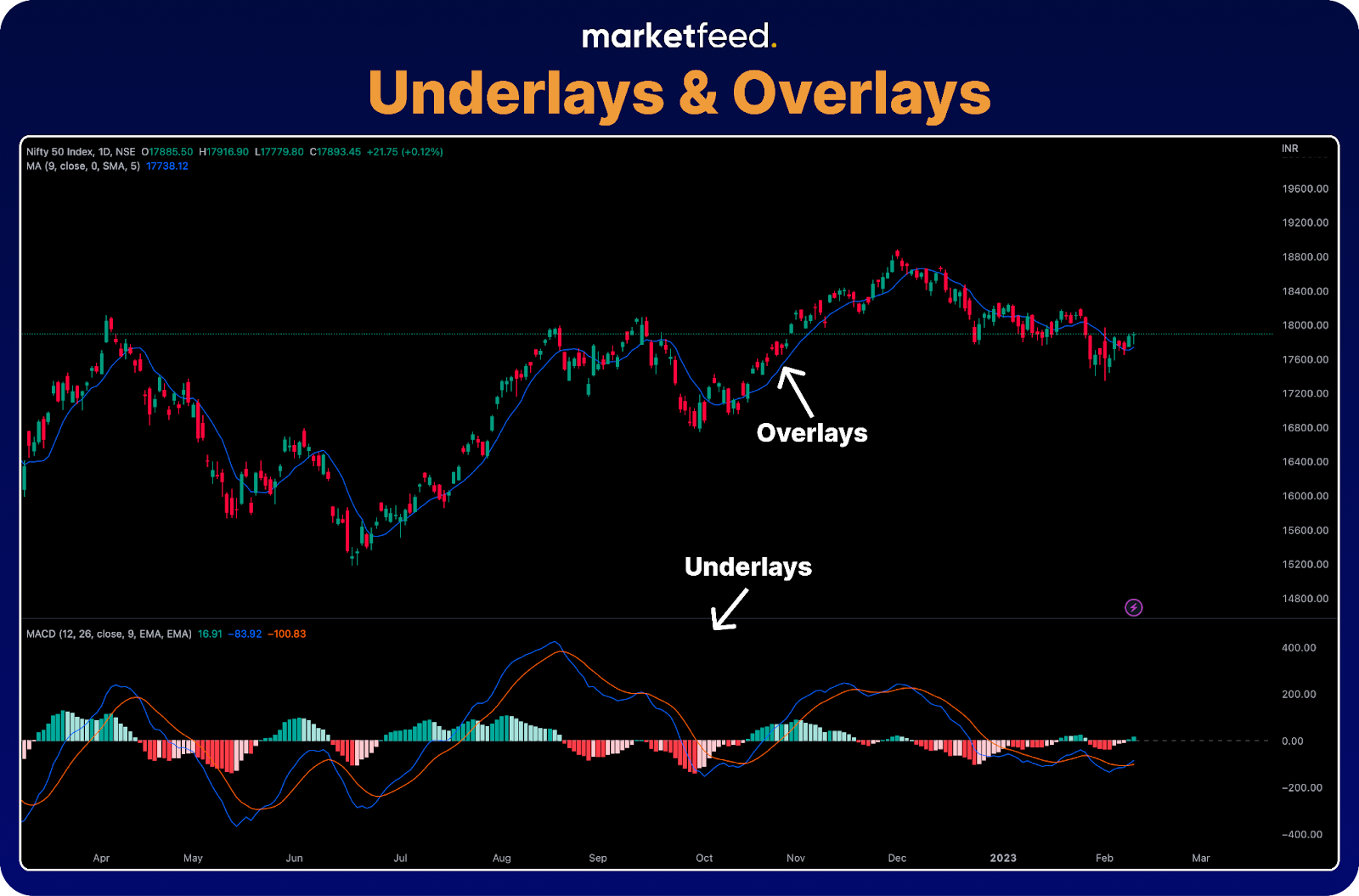
    underlays & overlays - technical indicators | marketfeed

    In the above chart,

    • The moving average indicator has been plotted on the price, thus making it an overlay.
    • The MACD indicator has been plotted under the price chart, thus making it an underlay.

    (2) When do they indicate

    Indicators are separated into two groups based on when they indicate:

    • Lagging indicators give signals after a trend or reversal has started. They follow the price action and are used for confirming trends or reversals. For example, Moving averages and Bollinger bands are lagging indicators.
    • Leading indicators give signals even before the trend/movement has begun. For example, RSI and Stochastics are leading indicators.

    (3) What do they indicate?

    Indicators are separated into four groups based on when they indicate:

    • Trend indicators are used to confirm the trend and measure the direction and strength of the trend. For example, Moving averages and MACD.
    • Momentum indicators are used to determine the strength or weakness of the price movement. For example, Stochastics and RSI.
    • Volatility indicators measure the price range and the periods of high and low volatility. For example, ATR and Bollinger bands.
    • Volume indicators measure trend strength & confirm it with the help of volume. Trends are stronger when volume indicators give confirmation. For example, volume chart and OBV.

    How to Access Indicators?

    In TradingView

    • Click on the indicators menu on the top panel to open the indicators search bar.
    • Search the required indicator and select it.
    • The indicator will be plotted on the chart.
    access indicators - technical indicators | marketfeed

    You can also hide/unhide indicators by clicking on the eye button next to the indicator name on the top left side of the chart under the scrip name. This is helpful as you can hide/unhide indicators depending on your trading setup and don’t have to remove and add an indicator every time you need it.

    Things to Keep in Mind While Using Technical Indicators

    • In reality, there are no perfect indicators when it comes to trading. 
    • Traders need to find a combination of technical indicators that work for them in their analysis. 
    • Overusing indicators and relying solely on them can lead to a cluttered chart and inaccurate analysis. 
    • Different indicators may work well for different stocks or indices, so it’s important to understand what works best for each security and situation. 
    • It’s crucial to understand that indicators will not give a true understanding of the market and that price action analysis should also be incorporated.

    In this article, we covered the basics of technical indicators! These indicators act as insightful guides for traders, helping them navigate the dynamic landscape of market trends and potential reversals. As you venture into the world of stocks, let these tools be your allies, providing valuable signals to enhance your trading strategy. Happy trading!

    Categories
    Jargons

    What are Blue Chip Stocks?

    You may have come across many social media posts or videos of stock market experts encouraging everyone to invest in blue chip stocks. Whether you’re a beginner or an experienced investor, it’s always a good idea to hold blue chip stocks in your investment portfolio. In this article, we will discuss what blue-chip stocks are, their characteristics, and a few related topics.

    What are Blue Chip Stocks?

    Blue-chip stocks are shares of well-established, financially stable, and reputable companies that have a history of delivering consistent performance. These companies are typically leaders in their respective industries. The term “blue chip” was originally derived from poker, where blue chips have the highest value.

    Blue Chip companies are also known for paying out regular dividends to their shareholders over time. Most of them generate stable returns for investors and are known to have much lower downside risk in times of recessions, inflation, and economic downturns.

    For example, State Bank of India (SBI) is a blue-chip public sector banking company.

    Characteristics of Blue Chip Stocks

    Blue-chip stocks are known for their reliability and stability in the stock market. They are so reliable that these stocks have a considerably high weightage in stock market indices. Here are some of the characteristics of blue-chip stocks:

    1. Financial Stability

    Blue-chip companies are financially strong and reliable. They have healthy balance sheets, stable revenue streams, and strong cash flows. This makes them less likely to face financial distress or bankruptcy.

    2. Market Leaders or Dominants

    Blue-chip companies are often leaders in their respective industries or sectors. They have a dominant market position and a competitive advantage over their rivals.

    For eg, HDFC Bank is a leader in the banking sector, while TCS and Infosys are leaders in the Information Technology (IT) Sector.

    3. Longevity

    Bluechip companies have a history of operating successfully for many years, sometimes even for decades or centuries. These companies have demonstrated their ability to adapt to changing market conditions, including recessions.

    4. Dividend Payments

    Since blue-chip companies are financially strong and have stable cashflows, they usually pay regular dividends. Therefore, blue chip stocks can create a passive income stream for investors.

    5. Low Volatility

    Volatility refers to the rate at which the price of a stock increases and decreases. High volatility represents high risk. Blue chip stocks tend to have low volatility and are considered low-risk investments. They are less prone to sharp price fluctuations in the market.

    6. Large Market Capitalisation

    A company’s market capitalisation is used to evaluate and rank its size and value in the stock market. Blue-chip companies have a high market cap. You can calculate the market cap of a company by multiplying its current stock price by the number of outstanding shares.

    7. Brand Value

    The majority of the blue-chip companies have well-known brands and distinguished products. Customers typically choose products with more brand value than those with none. For eg, ITC Ltd and Hindustan Unilever Ltd operate FMCG brands that are preferred by many customers across India.

    8. Global Operations

    Many blue-chip companies have a global footprint. They conduct business and generate revenue from various regions around the world. This global diversification can help mitigate risks associated with regional economic fluctuations.

    9. Resilience in Economic Downturns

    Blue-chip companies can withstand recessions and economic downturns. Although the business of these companies will be affected, it will not be as severe as that of smaller companies. Their financial strength and brand value contribute heavily to this characteristic.

    Long-Term Growth Potential

    Blue chip stocks are considered safe investments due to their exceptionally strong financial health and stability. They may have survived difficult challenges and market cycles over the years. These companies are market leaders and well-positioned in the market. Although they will be stable, they might not have the potential to provide investors with multibagger returns as they are already established companies.

    However, this does not mean that blue-chip companies will never fail. The collapse of Lehman Brothers and General Motors in the 2008 Economic Recession is proof that even the seemingly strongest companies might fail under extreme stress.

    Blue Chip Companies in India

    Some well-known examples of blue-chip stocks include:

    1. Reliance Industries – India’s largest business group; has interests in energy, petrochemicals, natural gas, retail, telecom, mass media, and financial services.
    2. Tata Consultancy Services (TCS) – A multinational information technology services and consulting company.
    3. HDFC Bank – India’s largest private sector bank.
    4. Infosys Ltd – A multinational information technology company.
    5. Hindustan Unilever Ltd – A British-owned Indian consumer goods company.
    6. Coal India – A central public sector undertaking under the ownership of the Indian Govt’s Ministry of Coal.
    7. Wipro Ltd – A multinational corporation that provides information technology, consultant and business process services.
    8. Maruti Suzuki – Market leader in India’s passenger vehicles segment.

    Blue Chip Stocks vs. Growth Stocks

    Blue-Chip StocksGrowth Stocks
    Shows stability and resilience during economic crisisHigh growth potential
    Market leadership and dominanceLow market share (the company is in the growth stage)
    Diversified revenue streamsMay only have a single line of products
    Regular dividendsLimited or no dividends
    Strong financial performanceFinancials may be focused on development and not stability
    Long investment horizonShort investment horizon

    Why Invest in Blue-Chip stocks?

    The stock market can be volatile it can unexpectedly show some drastic movements in either direction. Thus, it is advisable to invest a decent portion of your capital in blue-chip stocks. A few of the reasons why you should invest in blue-chip stocks are given below:

    • Helps in reducing risk because blue chip firms endure economic downturns. 
    • Can create a passive income source as most blue-chip stocks pay dividends regularly.
    • They help diversify your portfolio by reducing risk.
    • The unsystematic risk (risks affecting a whole sector) in these stocks is very low.
    • They can give very high returns during favourable economic conditions.
    • As these stocks are well-known to people, liquidity in these stocks is very high. That means they can be bought and sold whenever you want at a fair price.
    • Blue-chip stocks are a robust and safe pick for long-term investment.

    Evaluating Blue Chip Stocks

    Evaluating blue chip stocks is similar to how you would analyse any company. One must know fundamental analysis and also the knowledge on how to apply them effectively. The basic framework on how to analyse these companies is as follows:

    1. Identify the Stocks – select stocks with high market capitalisation.

    2. Understand the Business

    3. Ensure Quality

    4. Check Valuation

    5. Make a Decision

    You can read our detailed article on how to identify quality stocks for the long term here.

    Blue Chip Indices

    In the Indian stock market, the benchmark indices of National Stock Exchange (NSE) and Bombay Stock Exchange (BSE) can be used to evaluate the performance of blue-chip stocks. Nifty50 is the benchmark index of NSE, while Sensex is the benchmark index of BSE.

    The Nifty50 constitutes the top 50 companies from various sectors with high market cap listed on the NSE (along with other eligibility criteria). Sensex constitutes one of the top 30 stocks listed on the BSE and has similar selection criteria. You can easily track the performance of blue-chip stocks using these indices.

    Blue-chip stocks represent some of the most established and reliable companies in the stock market. They are characterised by financial stability, market leadership, and a history of consistent performance. While they may not provide rapid growth, they are known for their resilience and ability to generate long-term returns. Investing in such stocks can be a wise choice for those seeking stability and income in their investment portfolios.