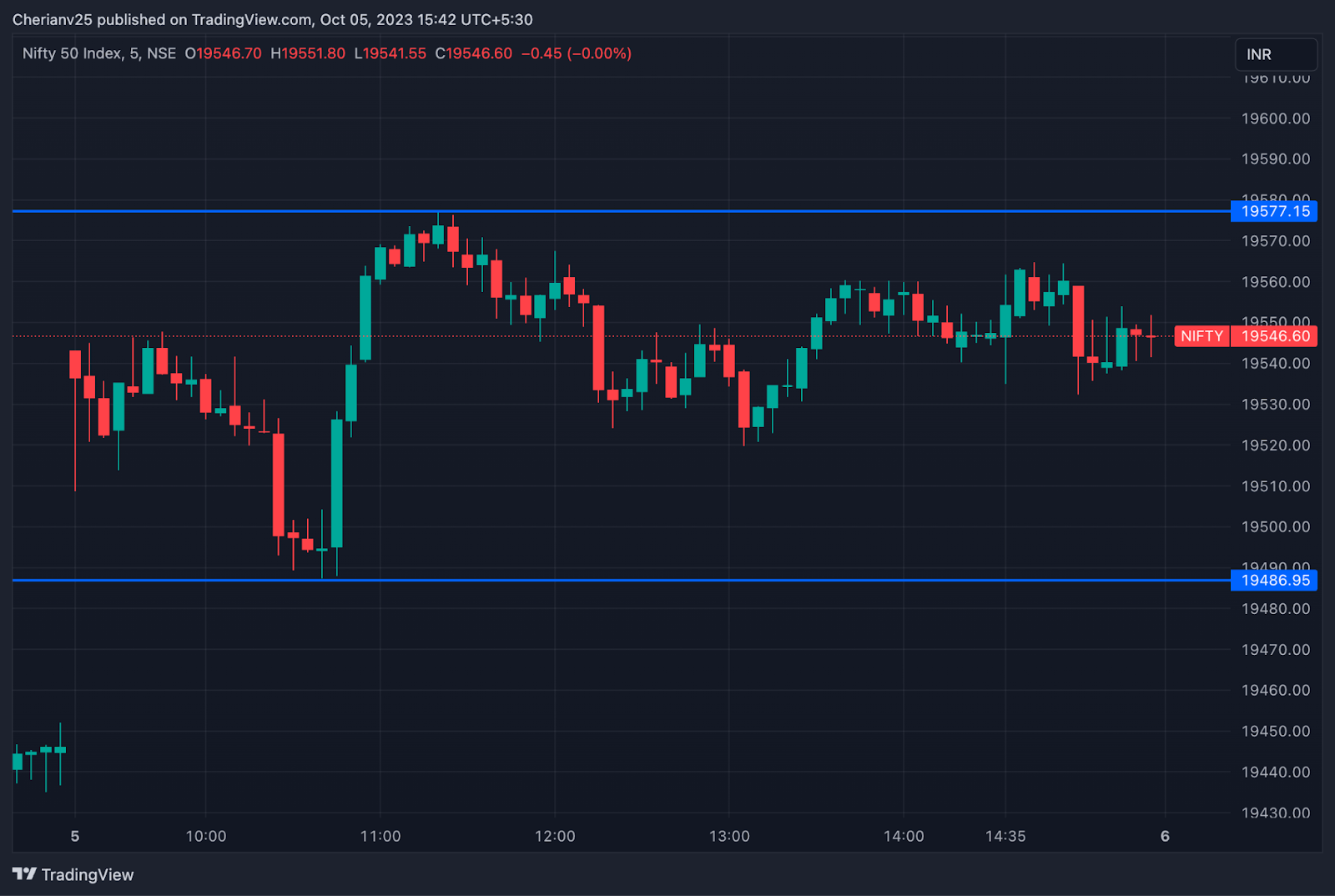
NIFTY started the day at 19,521 with a gap-up of 85 points. After an initial consolidation, the index fell sharply to hit the day’s low at 19,485 levels. From there, Nifty moved up 90 points with strength to near 19,580. It consolidated in a 60-point range for the remaining part of the day. Niftyclosed at 19,545, up by 109 points or 0.56%.
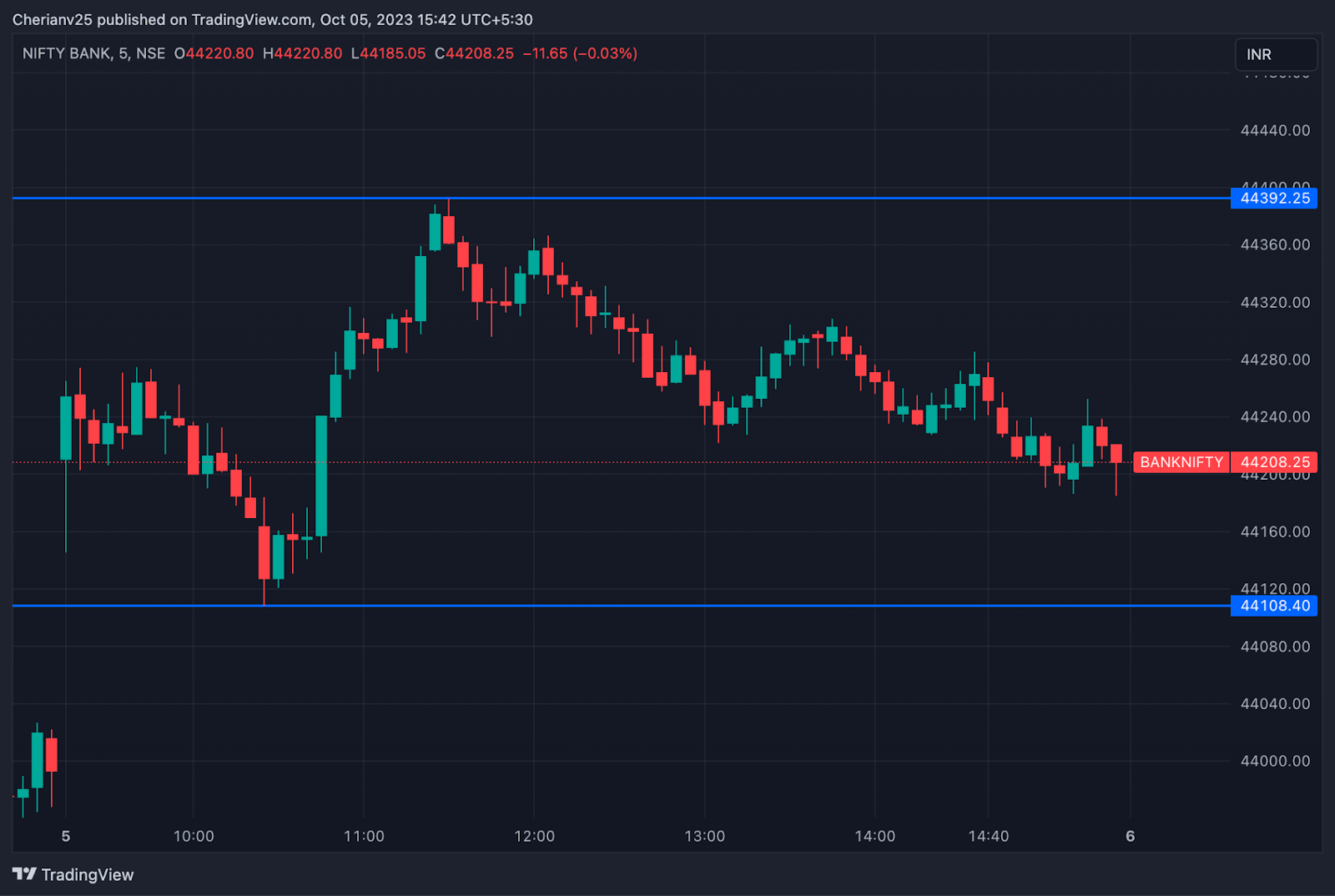
BANK NIFTY (BNF) started the day at 44,181 with a gap-up of 217 points. After opening, the index fell gradually to hit 44,110 levels. From there, Bank Nifty rose sharply by 285 points to hit 44,390 levels (day’s high). Then, it slowly fell over 205 points from the day’s high, making lower-lows along the way. BNF closed at 44,213, up by 249 points or 0.57%.
All indices except Nifty PSU Bank (-0.51%), Nifty Pharma (-0.3%), Nifty Metal (-0.25%), and Nifty FMCG (-0.1%) closed in the green. Nifty Media (+1.58%) moved up the most.
Major Asian markets closed in the green (Japan’s Nikkei rose 1.7%). European markets are currently trading mixed.
Today’s Moves
L&T (+2.06%) was NIFTY50’s top gainer. The company’s Buildings & Factories segment secured several ‘large’ projects across various business units.
Infibeam Avenues (+13.2%) broke its 2-day losing streak and surged up to 14% on the back of strong volumes.
Shares of Sobha (+6.48%) moved up after the company recorded sales worth ₹1,723.8 crore in Q2 FY24, a growth of 48.1% YoY.
PowerGrid (-1.26%) was NIFTY50’s top loser.
Marico (-4.9%) fell sharply after the company said its consolidated revenue in Q2 FY24 would be lower due to price correction and forex impact.
Markets Ahead
Continuous net selling from FIIs is causing a lot of pressure in the Indian market. Nifty opened in the green and continued in the green zone. This might be a reflection of weekly expiry and cannot be considered an indication of reversal in the market.
But you can keep your faith in Nifty’s 19,250 zone, which can trigger fresh buying in equities. Also, you can mark the 19,520 level as short-term and intraday support.
Yesterday’s hammer formation in Nifty is slightly invalid now because the index couldn’t form a connecting green candle today.
RBI’s interest rate decision will be announced tomorrow at 10 AM.
Question of the day: Why do you think Trent Limited has two brands (Zudio and Westside) in the same market segment?
How did Nifty expiry go? Are you in net profit or loss? Let us know in the comments below!
Please tune in to The Stock Market Show at 7 PM on our YouTube channel!
You may have come across many social media posts or videos of stock market experts encouraging everyone to invest in blue chip stocks. Whether you’re a beginner or an experienced investor, it’s always a good idea to hold blue chip stocks in your investment portfolio. In this article, we will discuss what blue-chip stocks are, their characteristics, and a few related topics.
What are Blue Chip Stocks?
Blue-chip stocks are shares of well-established, financially stable, and reputable companies that have a history of delivering consistent performance. These companies are typically leaders in their respective industries. The term “blue chip” was originally derived from poker, where blue chips have the highest value.
Blue Chip companies are also known for paying out regular dividends to their shareholders over time. Most of them generate stable returns for investors and are known to have much lower downside risk in times of recessions, inflation, and economic downturns.
For example, State Bank of India (SBI) is a blue-chip public sector banking company.
Characteristics of Blue Chip Stocks
Blue-chip stocks are known for their reliability and stability in the stock market. They are so reliable that these stocks have a considerably high weightage in stock market indices. Here are some of the characteristics of blue-chip stocks:
1. Financial Stability
Blue-chip companies are financially strong and reliable. They have healthy balance sheets, stable revenue streams, and strong cash flows. This makes them less likely to face financial distress or bankruptcy.
2. Market Leaders or Dominants
Blue-chip companies are often leaders in their respective industries or sectors. They have a dominant market position and a competitive advantage over their rivals.
For eg, HDFC Bank is a leader in the banking sector, while TCS and Infosys are leaders in the Information Technology (IT) Sector.
3. Longevity
Bluechip companies have a history of operating successfully for many years, sometimes even for decades or centuries. These companies have demonstrated their ability to adapt to changing market conditions, including recessions.
4. Dividend Payments
Since blue-chip companies are financially strong and have stable cashflows, they usually pay regular dividends. Therefore, blue chip stocks can create a passive income stream for investors.
5. Low Volatility
Volatility refers to the rate at which the price of a stock increases and decreases. High volatility represents high risk. Blue chip stocks tend to have low volatility and are considered low-risk investments. They are less prone to sharp price fluctuations in the market.
6. Large Market Capitalisation
A company’s market capitalisation is used to evaluate and rank its size and value in the stock market. Blue-chip companies have a high market cap. You can calculate the market cap of a company by multiplying its current stock price by the number of outstanding shares.
7. Brand Value
The majority of the blue-chip companies have well-known brands and distinguished products. Customers typically choose products with more brand value than those with none. For eg, ITC Ltd and Hindustan Unilever Ltd operate FMCG brands that are preferred by many customers across India.
8. Global Operations
Many blue-chip companies have a global footprint. They conduct business and generate revenue from various regions around the world. This global diversification can help mitigate risks associated with regional economic fluctuations.
9. Resilience in Economic Downturns
Blue-chip companies can withstand recessions and economic downturns. Although the business of these companies will be affected, it will not be as severe as that of smaller companies. Their financial strength and brand value contribute heavily to this characteristic.
Long-Term Growth Potential
Blue chip stocks are considered safe investments due to their exceptionally strong financial health and stability. They may have survived difficult challenges and market cycles over the years. These companies are market leaders and well-positioned in the market. Although they will be stable, they might not have the potential to provide investors with multibagger returns as they are already established companies.
However, this does not mean that blue-chip companies will never fail. The collapse of Lehman Brothers and General Motors in the 2008 Economic Recession is proof that even the seemingly strongest companies might fail under extreme stress.
Blue Chip Companies in India
Some well-known examples of blue-chip stocks include:
Reliance Industries – India’s largest business group; has interests in energy, petrochemicals, natural gas, retail, telecom, mass media, and financial services.
Tata Consultancy Services (TCS) – A multinational information technology services and consulting company.
HDFC Bank – India’s largest private sector bank.
Infosys Ltd – A multinational information technology company.
Hindustan Unilever Ltd – A British-owned Indian consumer goods company.
Coal India – A central public sector undertaking under the ownership of the Indian Govt’s Ministry of Coal.
Wipro Ltd – A multinational corporation that provides information technology, consultant and business process services.
Maruti Suzuki – Market leader in India’s passenger vehicles segment.
Blue Chip Stocks vs. Growth Stocks
Blue-Chip Stocks
Growth Stocks
Shows stability and resilience during economic crisis
High growth potential
Market leadership and dominance
Low market share (the company is in the growth stage)
Diversified revenue streams
May only have a single line of products
Regular dividends
Limited or no dividends
Strong financial performance
Financials may be focused on development and not stability
Long investment horizon
Short investment horizon
Why Invest in Blue-Chip stocks?
The stock market can be volatile— it can unexpectedly show some drastic movements in either direction. Thus, it is advisable to invest a decent portion of your capital in blue-chip stocks. A few of the reasons why you should invest in blue-chip stocks are given below:
Helps in reducing risk because blue chip firms endure economic downturns.
Can create a passive income source as most blue-chip stocks pay dividends regularly.
They help diversify your portfolio by reducing risk.
The unsystematic risk (risks affecting a whole sector) in these stocks is very low.
They can give very high returns during favourable economic conditions.
As these stocks are well-known to people, liquidity in these stocks is very high. That means they can be bought and sold whenever you want at a fair price.
Blue-chip stocks are a robust and safe pick for long-term investment.
Evaluating Blue Chip Stocks
Evaluating blue chip stocks is similar to how you would analyse any company. One must know fundamental analysis and also the knowledge on how to apply them effectively. The basic framework on how to analyse these companies is as follows:
1. Identify the Stocks – select stocks with high market capitalisation.
2. Understand the Business
3. Ensure Quality
4. Check Valuation
5. Make a Decision
You can read our detailed article on how to identify quality stocks for the long term here.
Blue Chip Indices
In the Indian stock market, the benchmark indices of National Stock Exchange (NSE) and Bombay Stock Exchange (BSE) can be used to evaluate the performance of blue-chip stocks. Nifty50 is the benchmark index of NSE, while Sensex is the benchmark index of BSE.
The Nifty50 constitutes the top 50 companies from various sectors with high market cap listed on the NSE (along with other eligibility criteria). Sensex constitutes one of the top 30 stocks listed on the BSE and has similar selection criteria. You can easily track the performance of blue-chip stocks using these indices.
Blue-chip stocks represent some of the most established and reliable companies in the stock market. They are characterised by financial stability, market leadership, and a history of consistent performance. While they may not provide rapid growth, they are known for their resilience and ability to generate long-term returns. Investing in such stocks can be a wise choice for those seeking stability and income in their investment portfolios.
On 20th January, NIFTY closed at 14,644 points. The next day, it opened with a gap-up at 14,730 points. Just like us, you would have also expected NIFTY to cross the major mark of 15,000 points this week itself.
Startlingly, the next four trading sessions have been completely dominated by the bears. On 28th January, NIFTY closed at 13,819 points. Look at the chart below to understand how the trend has completely reversed in the last five candles. All of the last five candles have created lower lows (as shown by the yellow line). This tells us that the sentiments in the market are pretty bearish.
Within five trading days, NIFTY has lost more than 900 points! What is causing this amazing fall in the market? How have things changed suddenly in the market? When the market is falling so freely, you cannot attribute just one reason. There has to be a cumulative effect which is dragging down the market. Let’s dig deeper and understand why the markets are actually falling!
From 17th November 2020 to 21st January 2021, FIIs turned into a net seller for just two trading days. These days were 21st December 2020 and 6th January 2021. The net selling quantity in both of these days was pretty low as well (Rs 323 crore and Rs 483 crore respectively).
All this while, FIIs were pumping a huge amount of money into the Indian equity market. Why? The interest rate in many markets is almost 0%. This means, even if you borrow the money, you don’t have to pay a lot of interest. The FIIs are borrowing money and investing in the equity market. When the market goes higher they will start booking their profits. They will pay their liabilities and enjoy the profits they have earned. Very simple, right? It is the retail investors who get trapped in this cycle. He is unaware of when to exit and in the bullish market, he expects his portfolio to turn even greener.
The tides have changed significantly now. In three continuous trading sessions, FIIs have pulled out a lot of money. On 22nd, 25th and 27th January, FIIs have been a net seller for Rs 635 crore, Rs 765 crore and Rs 1,688 crore respectively. This is still very less compared to how much they have been buying in the last many weeks. We have been saying that FIIs have been on an unimaginable buying spree over the last few months. Is that rally finally over now?
Retailers have also been part of the ride, and many booked profits in the peak.
Global Markets Running out of Steam?
Dow Jones reached 31,188 points on 20th January 2021. Since then, it has lost almost 1000 points in just one week. FTSE 100 is an index of England’s stock market. The index crossed 6,850 points on 8th January 2021 but has fallen to 6,550 points as of 28th January. A similar pattern can be observed with DAX, a German stock index. The index lost more than 500 points in the last 12 trading sessions.
As explained above, the low-interest rates prevailing in a low economy helped institutions to borrow money and invest in the stock market. This high liquidity generated a lot of bullishness in the global market as they kept on rallying on. In the last few months, we also heard several vaccines coming out claiming that they are the effective cure of Covid-19. The vaccination program has also started on a large scale in many countries. Not much attention is given to that now. So, are the global markets falling just because they are out of all the good news?
We have institutions booking profits, and then panic selling in the markets by retailers.
Fun fact: The inauguration of Joe Biden as the 46th president of the United States of America took place on January 20, 2021. Markets falling steeply after that date is just a coincidence, right?
Farmers’ Protest
For more than 50 days, thousands of farmers are protesting on the outskirts of Delhi. On 26th January, when the nation was watching the famous parade on India Gate, we heard some really hurtful news. There was a large violent clash between the Delhi police and the farmers. The stills from Red Fort, one of the most prominent monuments of India, was highly embarrassing.
Many people even compared this to the agitation seen at the US Capitol a few days back. The violent and disturbing event which unfolded sent negative impressions to the investors. They try to stay away from the market which is facing unrest and invest in other markets. This is a common behaviour of all the investors. Will you invest in a country which is dealing with a lot of internal conflicts? No. We wonder if this is the reason why FIIs sold worth Rs 1,688 crore on 27th January.
The Upcoming Union Budget
India’s Union Budget for 2021-22 is set to unveil on 1st February 2021. Many analysts claim that this is one of the most important budgets in recent times due to Covid-19’s financial impacts. All eyes will be on the Financial Minister, Nirmala Sithariman, as she delivers her all-important speech after two days.
Big events like elections or budget announcements are quite unpredictable. These events can cause huge volatility in the market. Thus, many of the investors try to stay away from the market these days. With the market reaching its all-time high, many investors would have taken the safe route to book their profits and move out of the market. If the budget sounds positive to their ears, we can expect the market to make a come back.
Remember to hold only fundamentally strong stocks in your portfolio, companies which you understand well. Maintaining stop losses on stocks you hold is also not a bad idea. Book profits from the random stocks in your holdings and reinvest in good stocks a bit at a time, not altogether.
Do you think there is any more reason why NIFTY is falling? Let us know in the comments section of the marketfeed app.
The last week of October began with a rocky start. On Monday, we saw that Nifty 50 was down by 162.60 points (or 1.36%), and closed at 11,767.75. The fall in Reliance Industries (RIL), decline in the auto sector, and the imposition of lockdown in Spain were three major reasons that caused a sharp fall in Nifty. Click here for our detailed post-market report for Monday. To make matters worse, the European and US market was down by 3% and 2%, respectively. Investors were asked to be very cautious while entering into a trade on Tuesday.
However, in a surprising turn of events, Nifty went up by 1.03% on Tuesday. Against all odds, Nifty saw a rise of 121.65 points, and closed at 11,889. Let us have a detailed understanding of one major reason as to why there was a great recovery in our Indian market.
The MSCI Index
On Tuesday, most of us did not get a chance to go through a major report that was published in the afternoon. However, the stocks mentioned in this report were the ones that showed a great performance in our markets. The report had details about Morgan Stanley’s Emerging Market Index.
Morgan Stanley Capitals International (MSCI Inc.) is one of the largest investment banks and financial services companies in the world. The US-based firm is a major index provider and publishes three major indexes. An index usually measures or tracks the performance of a group of assets or securities.
Coming back to the point, the report mentioned that Morgan Stanley is going to restructure or reorganize its Emerging Market Index. What this meant was that India’s weightage in this highly important index would be increased to 8.7%, from the current level of 8.1%. Ultimately, this would result in an additional indirect inflow of about $2.5 billion (~Rs 18,430 crore) to the Indian securities that are included in the index. According to Morgan Stanley, the major companies such as Asian Paints, Bajaj Finance, Britannia, L&T, and Nestle India would highly benefit from this change. These companies could see an increase in investment by approximately $200 million (~Rs 1,474 crores).
How Does this Process Work?
In order to understand this process more clearly, we shall look at an example. In India, we have the Nifty 50 index which includes Nestle India Limited. At a point in time, a major financial company or analyst might say that the weightage of Nestle is going to be increased in the Nifty index. Mutual funds and Exchange Traded Funds (ETFs) who are tracking this index will start pouring more funds into the stock. This confidence from big players will also make small retailers invest more money into the company. Eventually, the share prices of Nestle would have a high chance of increasing. This is exactly one of the major reasons as to why there was a rise in Nifty on Tuesday.
Top Gainers on Tuesday
Kotak Bank – 11.70%
Nestle India – 5.97%
Asian Paints – 5.69%
Bajaj Finance – 4.38%
Almost all the top gainers are companies that were listed on the report of Morgan Stanley. Certain financial analysts have also stated that companies such as Apollo Hospitals, LIC Housing Finance, Ipca Laboratories, and Kotak Bank may also be included in the MSCI indices.
Do bear in mind that the original results of the MSCI Emerging Market Index would be announced on November 11. It would also include the list of stocks that would be added, along with the changes in its weightage. These changes would finally be effective from 1st December 2020. So the point is that even the funds have not actually flowed into these stocks, the positive sentiment around them is what pushed them up.
An important takeaway from this would be to carefully go through relevant market news. Very specific and highly important news (such as this report from a giant like Morgan Stanley) would have a huge impact on how markets perform on a specific day. It is also encouraging to understand how our Indian companies are performing, and would help us achieve handsome profits in the long term and win in the stock market.
Update on November 11:
The revisions to the MSCI Emerging Markets Index was announced on November 11. The following table shows the list of stocks that are added, and the stocks that have been excluded from the standard index.