Categories
Jargons

What is Term Insurance & Why Should You Get One?

As the new year approaches, we thought it was vital to discuss a financial product you should consider buying. Our lives are so unpredictable, and it’s essential to have some form of financial protection. You may be the sole breadwinner in your family and constantly worry about the financial impact if something unfortunate happens to you. That’s where a Term Insurance policy comes in handy!

What is Term Insurance?

Term Insurance is a type of life insurance that provides financial protection for a fixed period of time. If the policyholder suddenly passes away during this period, their family members (or nominees) will receive a death benefit. Term insurance is a relatively low-cost way to ensure your family’s financial security if something were to happen to you.

A 20-something-year-old healthy individual can essentially secure a cover of up to ₹1 crore for his dependents for the next 25+ years if he pays a fixed, minimal amount (even less than ₹500) every month to a reputable insurance company.

However, unlike whole life insurance, term insurance does not provide maturity benefits. The insurance company will not pay a lump-sum amount when your term insurance policy matures.

Why Should You Consider Term Insurance?

Here are some of the advantages of term insurance:

  • Term insurance offers much higher coverage for a smaller premium than traditional or market-linked life insurance policies. [A premium is a specific amount a policyholder has to pay periodically (monthly or yearly) to maintain their insurance coverage.]
  • It offers financial security for your loved ones. In the unfortunate event of your death, your family may face a financial burden of funeral costs, unpaid debts, and other expenses. A term insurance policy can cover these expenses and ensure that your loved ones are not left in financial trouble.
  • If you are the primary breadwinner in your family, it means your income contributes significantly to the family’s financial stability. If you become seriously ill or injured and are unable to work, term insurance can help your family maintain their standard of living.
  • You can select optional riders (or extra policy provisions) to increase the standard term insurance benefits. For example, you can add a critical illness rider or plan if you’ve been diagnosed with a serious illness.
  • You can also save money on taxes! The premium you pay for a term life insurance policy can be deducted (up to ₹1.5 lakh) under Section 80C of the Income Tax Act. A deduction of up to ₹25,000 is also available under Section 80D on premiums paid for term plans with a critical illness cover option. More importantly, the death benefit received under the term insurance policy is tax-exempt under Section 10(10D). 

Types of Term Insurance

A single plan cannot accommodate everyone’s requirements given the changing periods and circumstances. As a result, there are many term plans you must take into account while making financial plans or goals.

Level Term 

Level-term plans are the most fundamental and straightforward type of term life insurance. The sum assured selected at the start of the policy remains the same throughout the policy term. In the event that the policyholder dies, the nominees or beneficiaries will get the death benefit.

Increasing Term Insurance


Under this term plan, the coverage amount chosen at the start of the policy increases every year by a specific amount. A term plan with expanding coverage is beneficial in keeping up with inflation since it makes sure the family has enough money to survive. The premium for such plans is relatively higher because the policyholder has the opportunity to enhance the sum guaranteed.

Return of Premium Term Insurance 

It is a type of insurance plan where, if you outlive the policy term, you get back all the premiums you paid. It’s like getting your money back if nothing unfortunate happens during the coverage period. You are eligible to use this option only if you haven’t filed any claims throughout the policy’s term.

Decreasing Term Insurance

In this type of policy, the sum guaranteed is reduced at a certain pace as the policyholder becomes older. It is based on the assumption that as people age, their financial liabilities might decrease, and they might not need as much coverage. It’s a suitable choice if you have loans or a mortgage that you expect to pay off in the near future.

Convertible Term Insurance Plan 

A convertible term insurance plan is a policy that can be changed into another kind of insurance plan at a later time. You might choose this kind of term plan if you anticipate a change in your financial priorities in the upcoming years. For instance, you can choose a term plan that can be changed into a whole life insurance plan.

How Does Term Insurance Work?

  • Firstly, you’ll have to examine factors like the net income of your family, the number of dependents, loan EMIs, and all lifestyle expenses. As a general thumb rule, an ideal term insurance cover should be 10-20 times more than your family’s net annual income! Your insurance should be adequate to cover both the present and future demands of your dependents.
  • The policy term (or the period for which your term insurance policy remains active) can be from 5 years to 99 years. The sum assured can be from ₹20 lakhs to up to ₹5 crore. [Sum assured is the fixed amount paid to the nominee in the unfortunate event of the policyholder’s death.]
  • When you buy a term insurance product, you’ll have to pay a small fee (or premium) every year. The premium for term insurance will be lower the earlier you purchase it. So if you need a cheap life insurance policy, start when you’re young and healthy.
  • The insurance company pays out a large sum to the policyholder’s family (nominee) in the event of their death.
  • In case the policyholder outlives the term plan, nothing is paid out. So look for term insurance policies that allow you to extend your coverage or convert it to a permanent life insurance policy.

Tips to Select Best Term Insurance in India

Assess Life and Financial Situation

Consider your age, financial situation, and the duration of coverage needed to determine the right term insurance policy for you. Assess your financial responsibilities and dependents to choose an appropriate coverage amount.

Evaluate Lifestyle Needs

Understand your spending habits and standard of living to estimate the required life coverage. Ensure that your loved ones can maintain their lifestyle even in your absence.

Analyze Income

Assess your income and financial obligations to determine a practical life cover amount. Avoid overburdening your finances by choosing a coverage level that aligns with your income.

Consider Existing Liabilities

Take into account any outstanding debts and liabilities, such as loans, that need to be covered by the policy. Ensure that the policy term and coverage amount are sufficient to protect your dependents from financial burdens.

Customize with Riders

Explore additional riders, such as critical illness, accidental death, or waiver of premium, to enhance your term insurance policy’s coverage. Understand the available riders and choose ones that suit your specific needs.

Check Claim Settlement Ratio

Evaluate the insurer’s claim settlement ratio, which indicates the percentage of successfully paid claims compared to the total received. Consider insurers with a higher ratio as they demonstrate a better track record of fulfilling claims promptly.

Remember, it’s important to carefully research and compare different term insurance policies and providers before making a decision.

How Much Term Insurance Do You Need? 

Term insurance coverage differs from person to person depending on factors including income, way of life, costs, debt, and more. You ought to get coverage that is around 10 to 12 times your gross yearly income if you are under the age of 55. Such a sum can be adequate to meet future needs and counter inflation.

You can increase your base coverage with riders for a negligible rise in the premium. These add-ons offer additional payments for unforeseen events like accidental death, critical illness, permanent disability, etc.

What are Tax Benefits of Term Insurance? 

  • You can deduct up to ₹1.5 lakh from the premium you pay for your term plan under Section 80C of the Income Tax Act of 1961.
  • A deduction of up to ₹25,000 is also available under Section 80D on premiums paid for term plans with a critical illness cover option.
  • The death benefit received under the term insurance policy is tax-exempt under Section 10(10D)

Term insurance is an important financial tool that can offer peace of mind to you and your loved ones. By choosing the right policy, you can provide your family with the financial support they need during difficult times. You can compare and buy term insurance policies from any popular insurance aggregator platform in India!

Categories
Editorial

Life Insurance Corporation of India (LIC) IPO: All You Need to Know

The biggest initial public offering (IPO) in the history of the Indian stock market is here! Life Insurance Corporation of India has launched its IPO today— May 4. The Central Government aims to raise up to Rs 21,000 crore by divesting a 3.5% stake in the country’s largest life insurer. In this article, learn all about LIC and its IPO.

Company Profile – Life Insurance Corporation of India Ltd

Life Insurance Corporation of India was formed on September 1, 1956, by merging and nationalizing 245 private life insurance companies in India. It offers unit-linked insurance products, saving insurance products, term insurance products, health insurance, and annuity & pension products. LIC is currently the largest entity in the Indian insurance space, with a market share of above 61.6% in terms of premiums

They also hold a 61.4% market share in terms of new business premiums (NBS) and a 71.8% market share based on the number of individual policies issued. [NBS is the premium acquired from new policies during a particular year.] More importantly, LIC is the fifth-largest insurer in the world in terms of gross written premiums (GWP).

LIC is a trusted brand in our country and has a customer-centric business model. It has been a security net for Indians. Over the years, the company has harnessed technological capabilities to support policyholders and drive operational efficiencies. 

Fact Sheet:

LIC’s total assets under management (AUM) stood at a whopping Rs 40.1 lakh crore as of December 31, 2021 (Q3 FY22). Interestingly, this figure is more than 3.2 times the total AUM of all private life insurers in India. It is more than 1.1 times the AUM of the entire Indian mutual fund industry’s AUM!

The company has a strong omnichannel distribution network, consisting of over 0.13 crore agents, 2,128 micro insurance agents, and 215 alternative channels. LIC operates through an extensive network of 2,048 branches and 1,559 satellite offices. [A satellite office is a branch of a larger company that is physically separate from the organization’s main office.] The insurer also operates in the UAE, Singapore, Fiji, Mauritius, Qatar, and the United Kingdom. 

The embedded value (EV) of LIC was estimated at Rs 5.4 lakh crore as of Q3 FY22. The EV of a life insurance company is the sum of the adjusted net asset value (NAV) and the present value of future profits. It is essentially the industry standard for valuing an insurance company. As per reports, the market valuation of LIC could be around 3-4 times the EV.

LIC is also the biggest player in India’s equity markets. As of Dec 31, 2021, its investments in listed shares represented ~4% of the total market capitalization of NSE! 

About the IPO

Life Insurance Corporation’s public issue opens on May 4 and closes on May 9. The company has fixed Rs 902-949 per share as the price band for the IPO.

The IPO is entirely an offer for sale (OFS) of 22.13 crore equity shares by the promoter (Government of India), aggregating to Rs 21,008.48 crore. Individual investors can bid for a minimum of 15 equity shares (1 lot) and in multiples of 15 shares thereafter. You will need a minimum of Rs 14,235 (at the cut-off price) to apply for this IPO. The maximum number of shares that can be applied by a retail investor is 210 equity shares (14 lots).

The government has announced a discount of Rs 60 per share for policyholders and Rs 45 for employees.

If you are a LIC policyholder and wish to apply for the IPO:

  1. Your PAN must be updated in LIC’s records.
  2. The PAN used for LIC policies has to be the same as that registered with your broker account.

The primary objective of the IPO is to provide an exit strategy (or liquidity) for LIC’s promoters. The company aims to achieve the benefits of listing the equity shares on NSE and BSE. The total promoter holding in LIC will decline from 100% to 96.5% post the IPO.

Financial Performance

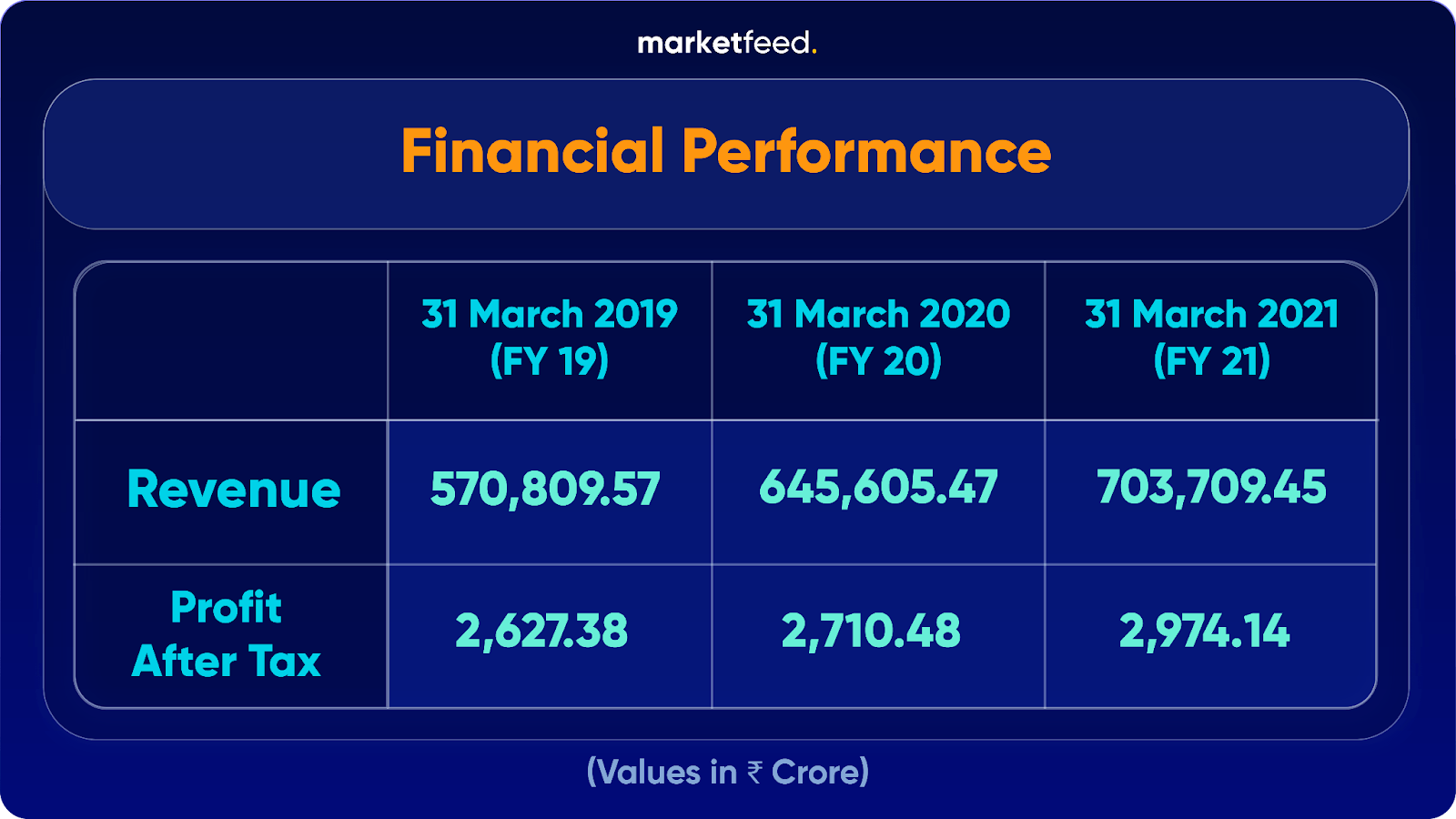
LIC has posted strong growth in revenue and profits from FY 2019-21. The company’s total income increased by 9% YoY to Rs. 7,03,732.43 crore in fiscal 2021. It was due to higher net earned premiums and investment income. Meanwhile, net profit rose 9.73% YoY to Rs 2,974.14 crore in FY21. The net profit on sale/redemption of policyholders’ investments jumped 105% YoY to Rs 39,809.61 crore during the same period. 

The gross written premium (GWP) increased at a CAGR of 9.21% on a consolidated basis between FY19 and FY21. [GWP is the total premium an insurer writes during a specific period before deductions like reinsurance and ceding commissions.] Moreover, LIC’s 13-month persistency ratio increased from 66% in FY19 to 67% in FY21. This suggests growth in policyholders who renewed their policies.

It has an investment of Rs 38.4 lakh crore towards policyholders’ funds and is debt-free as of Dec 31.

Risk Factors

  • The ongoing Covid-19 pandemic could adversely affect LIC’s business aspects like agents’ abilities to sell products and increased expenses due to changes in mortality and investment portfolio.
  • The insurance industry is highly competitive. The company will be directly competing with leading private entities such as SBI Life, HDFC Life, and ICICI Prudential once it gets listed.
  • Volatility in capital markets, loss of customer confidence in the insurance industry, or a decline in customers’ financial positions could severely affect LIC’s overall performance.
  • Any unfavourable publicity concerning the insurance giant can harm its brand name and reputation.
  • The inability to retain and recruit individual agents at a reasonable cost and time could adversely impact LIC as individual agents procure most individual new business premiums.

IPO Details in a Nutshell

The book-running lead managers for the public issue are Axis Capital, Kotak Mahindra Capital, BofA Securities, Goldman Sachs (India), J.P. Morgan, etc. LIC filed the Red Herring Prospectus (RHP) for its IPO on April 26. You can read it here. Out of the total offer, 50% is reserved for Qualified Institutional Buyers (QIBs), 15% for Non-Institutional Investors (NIIs), and 35% for retail investors.

Ahead of the IPO, LIC raised a massive Rs 5,627 crore from 123 anchor investors! The anchor investor portion of the IPO was also oversubscribed.

Conclusion

Insurance is not too popular in India, especially when it comes to life insurance. Only a marginal portion of the country holds life insurance. The total insurance coverage in India stood at a mere 3.76% in 2019. There can be a massive scale of development in this sector. Amidst the Covid-19 pandemic, the awareness towards securing insurance policies has increased. Whether it be health insurance or life insurance, more people are actively looking for the best products that can safeguard their future. Thus, LIC can capitalise on the high growth opportunities in the Indian life insurance sector. 

LIC’s maiden offer is expected to help the central government meet its disinvestment target of Rs 78,000 crore for FY22.

LIC’s IPO shares are trading at a premium of Rs 63 in the grey market. Before applying to this IPO, we will wait to see if the portion reserved for institutional investors gets oversubscribed. As always, consider the risks associated with the company and come to your own conclusion.

What are your views on LIC’s IPO? Will you be applying for it? Let us know in the comments section of the marketfeed app.

Categories
Jargons

What are Unit-Linked Insurance Plans (ULIPs)?

Buying an insurance plan/policy is essential to make yourself financially secure to face any unexpected or sudden problems in life. It provides a cover against any sudden loss. But did you know that there’s a financial product that combines insurance and investment benefits in a single plan? Unit-Linked Insurance Plans (ULIPs) provide a mix of both life insurance and investment. Insurance companies offer ULIPs so that their clients can get life cover and also reap the benefits of investing in equity and debt funds. It creates a habit of regular and disciplined savings.

ULIPs vs Traditional Insurance Plans 

Traditional insurance plans focus solely on providing life insurance coverage. On the other hand, ULIPs have an investment component and allow the policyholder to have some control over the investment allocation within the policy. They provide a combination of wealth creation and life insurance benefits. This makes ULIPs popular among individuals looking for protection and investment opportunities in a single package.

Here are a few notable differences between ULIPs and traditional insurance plans:

ULIPsTraditional Insurance
PurposeInsurance cover along with investment benefits.Insurance cover only
ObjectiveLong-term plans that offer insurance and investment benefit.To avail fixed returns in the long term.
Return on InvestmentVariable returns as it is equity-linkedGuaranteed returns as the investment in risky instruments are low
Lock-in Period3-5 yearsLocked till maturity
SIPAvailableUnavailable
How is your money utilised?The premium payment towards ULIP goes towards meeting the expenses, insurance cover and equity mutual fund.The premium payment towards Traditional insurance plans goes towards expenses, insurance cover and low-risk instruments.

How Do ULIPs Work?

ULIPs work by combining insurance coverage with investment opportunities. Here’s a simplified explanation of how ULIPs typically work:

1. Premium Payment

When you buy and hold a ULIP policy, you’ll have to make regular premium payments. A part of this premium is utilized to provide life insurance coverage. The remaining amount is pooled with the money received from other policyholders and then invested in equity, debt, or even hybrid funds. [A hybrid or balanced fund is a financial instrument that invests in a mix of both equity and debt segments in a specific ratio].

2. Insurance Component

A portion of the premium gets allocated towards providing life insurance coverage. In the event of the policyholder’s demise during the policy term, the nominee will receive a death benefit.

3. Investment Component

The remaining premium gets invested in various investment funds, such as equity, debt, or balanced funds. Policyholders can choose the funds based on their risk appetite and investment goals. A professional fund manager looks after the investments made by all policyholders.

ULIPs give investors the option to switch between equity and debt funds based on market conditions and their risk-taking capacity. The gains from such schemes will be taxed the same way as most mutual funds are taxed

4. Unit Allocation

The insurance company will utilise the investment component of the premium to purchase units in the chosen investment funds. The number of units allocated depends on the prevailing unit price at the investment time.

5. Fund Performance

The value of the units invested fluctuates with the performance of the underlying investment funds. If the funds perform well, the unit value increases, potentially leading to higher returns.

6. Flexibility

ULIPs typically offer flexibility in managing investments. Policyholders can switch between different funds based on their changing investment preferences. Some ULIPs also allow partial withdrawals or top-ups to the investment amount.

7. Charges

ULIPs involve charges such as premium allocation charges, policy administration charges, and fund management charges. These charges get deducted from the premium before it allocates insurance coverage and investments. 

8. Policy Term and Maturity

ULIPs have a defined policy term. On maturity, the policyholder receives the maturity benefit, which is the current value of the investment units. The performance of the chosen funds influences the value of this amount.

Advantages of Investing in ULIPs

ULIPs offer several advantages to policyholders. Here are some key benefits of ULIPs:

1. Insurance Coverage

ULIPs provide life insurance coverage, ensuring financial protection for the policyholder’s family in the event of an untimely demise.

2. Investment Opportunities

ULIPs allow policyholders to invest in a variety of funds, such as equity, debt, or balanced funds. This provides the potential for wealth creation and capital appreciation over the long term.

3. Flexibility

ULIPs offer flexibility in managing investments. Policyholders can switch between different funds based on market conditions or their changing investment objectives. Some ULIPs also provide options for partial withdrawals or additional contributions.

4. Goal-based Investing

ULIPs enable policyholders to align their investments with specific financial goals, such as education, retirement, or wealth accumulation. The investment flexibility allows for customised strategies based on individual objectives.

5. Tax Benefits

ULIPs offer tax benefits under Section 80C of the Income Tax Act in India. Policyholders can claim deductions on the premium paid, subject to specified limits. Additionally, the maturity proceeds are tax-free under Section 10D, subject to certain conditions.

6. Wealth Transfer

ULIPs provide an efficient means of transferring wealth to the nominee(s) in the event of the policyholder’s demise. The death benefit received by the nominee is generally tax-free and can provide financial stability to the family.

Risks and Challenges of Investing in ULIPs

Investing in ULIPs comes with certain risks and challenges:

1. Market Risk

ULIPs are subject to market fluctuations. The value of the investment units can rise or fall based on the performance of the underlying investment funds. Poor market conditions may result in lower returns or even capital loss.

2. Investment Risk

The policyholder bears the investment risk in ULIPs. If the chosen investment funds do not perform well, it can affect the overall returns. The performance is dependent on various factors such as market conditions, economic stability, and fund management.

3. Charges and Fees

ULIPs involve various charges, which can impact the overall returns. It’s essential to understand and consider these charges before investing.

4. Lock-in Period

ULIPs typically have a lock-in period, which means that the policyholder cannot withdraw or surrender the policy before a certain period. Early withdrawal may attract penalties and impact the investment value.

5. Insurance Costs

A portion of the premium paid towards ULIPs gets allocated for insurance coverage. The insurance costs can be higher compared to standalone term insurance plans. It’s necessary to understand whether the insurance component adequately meets your coverage needs.

6. Surrender Charges

If the policyholder decides to surrender or exit the ULIP before the lock-in period, surrender charges may apply. These charges can impact the final payout or surrender value of the policy.

Before investing in ULIPs, individuals should carefully assess their investment objectives, and risk tolerance, and understand the terms and conditions of the policy. It’s advisable to review the performance of the chosen funds regularly and seek professional advice if needed.

How to Choose the Right ULIP?

When selecting a Unit-Linked Insurance Plan, it’s important to consider the following factors;

1. Investment Objectives

Determine your investment goals, whether they are long-term wealth accumulation, retirement planning, education funding, or any other specific financial objective. Aligning the ULIP with your investment objectives is crucial.

2. Risk Appetite

Assess your risk tolerance level. ULIPs offer different investment fund options with varying risk profiles, such as equity funds (higher risk), debt funds (lower risk), or balanced funds (moderate risk). Choose funds that match your risk appetite.

3. Fund Performance

Evaluate the historical performance of the investment funds offered within the ULIP. Analyse factors such as consistency, returns generated over different market cycles, and the fund manager’s track record. Consider funds that have delivered favourable returns over a reasonable period.

4. Charges and Fees

Understand the various charges associated with the ULIP. Compare the charges across different ULIPs to ensure they are reasonable and do not significantly impact your investment returns.

5. Flexibility

Assess the flexibility offered by the ULIP. Look for features such as the ability to switch between funds, make partial withdrawals, or increase/decrease the sum assured as per your changing needs.

6. Transparency

Evaluate the transparency of the ULIP provider. Ensure that you have access to regular updates on fund performance, policy-related documents, and information on charges and fees.

7. Insurance Coverage

Assess the adequacy of the insurance component of the ULIP. Consider factors such as the sum assured, riders (additional coverage options), and the policy’s ability to meet your insurance needs.

8. Company Reputation

Research the reputation and credibility of the insurance company offering the ULIP. Look for financial strength, claim settlement records, customer service, and reviews from existing policyholders. Choose a reputable and reliable insurer.

9. Policy Term and Lock-in Period

Evaluate the policy term and lock-in period of the ULIP. Longer policy terms provide more time for potential investment growth, while the lock-in period ensures commitment to the investment. Understand the implications of early withdrawals or surrenders.

10. Seek Professional Advice

Consider consulting a financial advisor or insurance expert who can provide personalised guidance based on your financial situation, goals, and risk profile. They can help you navigate the complexities of ULIPs and choose the most suitable option.

Tax Benefits of ULIPs

Interestingly, investments made in ULIPs can be used to claim a tax deduction of up to ₹1.5 lakh under Section 80C of the Income Tax Act. The returns from the policy are also exempt from taxation on maturity (up to Rs 2.5 lakh) under Section 10 (10D) of the IT Act. If the ULIP investor dies during the term of the ULIP, their nominee will be entitled to the death benefit specified in the ULIP policy, and the amount received on death is exempt from tax.

Lock-in Period & Charges of ULIPs

ULIPs come with a mandatory lock-in period of five years. It means that you can withdraw your ULIP policy only after five years from the date of investment. There are no provisions to make a premature exit. After five years, you can redeem the full amount. Since ULIPs are a combination of a life insurance policy and a mutual fund (which are long-term investments), it is advised that one should hold a ULIP policy for 15 years or more.

When a person subscribes to a ULIP, the insurer levies a charge for insurance protection upon his death and to cover other expenses. This is known as the mortality charge. It is usually deducted along with other charges before investing the policyholder’s money.

The expense ratio (or annual maintenance charge levied by fund managers) is mostly in the range of 1.05-2.25%. 

Disclaimer: Before investing in a ULIP, do proper research on the product and analyze all the charges levied.

Categories
Jargons

What are the Key Ratios Related to Life Insurance?

Life insurance serves as a vital tool in safeguarding your family’s financial well-being when you’re not around. In this article, we will explore the concept of life insurance in detail. We’ll also take a closer look at some key ratios related to life insurance. These ratios help us understand the financial strength of insurance companies and evaluate their operations in a more refined manner.

What is Life Insurance?

Life insurance is a contract between an insurer (insurance company) and the insured (policyholder). When the insured person passes away, the insurer pays a sum of money to one or more named beneficiaries of the insured person. The policyholder has to pay insurance premiums during their lifetime. You can pay the insurance premiums upfront as a lump sum or in recurring payments over time, usually monthly and yearly.

Types of Life Insurance Policies

The two most common types of life insurance policies are:

1. Term Life Insurance Policy

Term Insurance is a type of life insurance that provides financial protection for a fixed period of time. If the policyholder suddenly passes away during this period, their family members (or nominees) will receive a death benefit. Term insurance is a relatively low-cost way to ensure your family’s financial security if something were to happen to you.

A 20-year-old healthy individual can secure a cover of up to ₹1 crore for his dependents for the next 25+ years if he pays a fixed, minimal amount (even less than ₹500) every month to a reputable insurance company. However, unlike whole life insurance, term insurance does not provide maturity benefits. The insurance company will not pay a lump-sum amount when your term insurance policy matures.

2. Permanent Life Insurance Policy

A Permanent Life Insurance Policy offers coverage for your entire lifetime, as long as you continue to pay the premiums. When you purchase a permanent life insurance policy, a portion of your premium payments go toward the cost of insurance, while the remaining portion is invested by the insurance company. Over time, the cash value of your policy grows, and you can access this cash value through policy loans or withdrawals while you’re alive. It provides a death benefit to your beneficiaries when you pass away.

Key Ratios Related to Life Insurance

A life insurance policy is only as good as the financial strength of an insurer. You can use the following key ratios to analyse the financial strength of an insurance company.

1. Persistency Ratio

This ratio helps you understand how persistent customers have been in renewing their coverage year after year. This tells about its customers’ loyalty and whether they have been paying their premium without default. We can judge if the company has been delivering product quality over the years using this metric. It is measured at regular intervals like the 13th month, 25th month, 37th month and 61st month. A higher persistency ratio of any company tells you that it has been able to contain a large pool of satisfied clients.

We calculate Persistency Ratio as the ratio of the number of total policies sold to the number of policies renewed at a given time. The closer the ratio is to 1, the better. The persistency ratio will never be lower than 1.

persistency ratio formula

For example, if a company issues 100 policies, but only 80 of those policies get renewed, then the persistency ratio will be 100:80.

2. Claim Settlement Ratio

Claim Settlement Ratio is one of the most important ratios that one should look into before buying insurance. It tells what percentage of the total claims filed by the customers have been settled by the organisation. People prefer insurance companies that settle claims quickly and pay out the benefits, rather than those that take a long time to do so. The higher the claim settlement ratio, the better.

claim settlement ratio formula

The claim settlement ratio is typically calculated on a yearly basis.

3. Solvency Ratio

Solvency Ratio tells whether an insurance company has the money to settle all claims at liquidation. According to the Insurance Regulatory and Development Authority of India (IRDAI), every insurance entity needs to maintain a minimum solvency margin of 1.5 or 150%. Higher solvency ratios indicate more capability of paying insurance claims during uncertain times which gives more confidence to an insured person.

solvency ratio formula

4. Loss Ratio

Loss Ratio is a measurement of a company’s loss during a certain year. It shows the total amount of claims dispensed as a percentage of the total premium earned in that year. An increasing loss ratio tells that the company is in a situation of disbursing more payments, but is not able to earn premiums at a similarly high rate. Thus, a higher loss ratio indicates financial trouble for the company.

loss ratio formula

5. Expense Ratio

In the insurance Industry, the expense ratio is a profitability measure. It is calculated by dividing the expenses associated with acquiring, underwriting, and servicing premiums by the net premium earned. The expenses can include advertising, employee wages, and commissions for the sales force. The expense ratio signifies an insurance company’s efficiency before factoring in claims on its policies and investment gains or losses. It offers a clear view of how well an insurer manages its overheads and operational costs in relation to the revenue generated from premiums.

expense ratio

6. Combined Ratio

The combined ratio is also a measure of profitability to measure an insurer’s performance in its daily operations. It is calculated by taking the sum of incurred losses and expenses and then dividing them by the earned premium. The combined ratio measures the money flowing out of an insurance company as dividends, expenses and losses. Losses indicate the insurer’s discipline in underwriting policies. A ratio below 100% indicates that the company is making an underwriting profit, while a ratio above 100% means that it is paying out more money in claims than premium receipts.

combined ratio

7. Investment Yield Ratio

This ratio measures the average return on the company’s invested assets before and after capital gains and losses. Both realized and unrealized capital gains are considered while calculating the investment yield (including capital gains).

investment yield ratio

8. Premium Growth Ratio

The premium growth ratio indicates growth in the business undertaken by the insurance company. This ratio is calculated by dividing the difference between the gross premium written (GPW) in the current and previous years by the GPW in the previous year. [GPW is the total amount of premiums an insurance company receives from policyholders for their insurance policies. It’s like the total bill customers pay to the insurance company for coverage.]

premium growth ratio

In conclusion, key ratios related to life insurance offer valuable insights into the financial health, risk management practices, and overall performance of life insurance companies. From the solvency ratio that assesses an insurer’s stability to the expense and loss ratios that reveal its operational efficiency and claims handling capabilities, these metrics serve as vital tools for making informed decisions in the complex world of life insurance.

Categories
Editorial

Indian Life Insurance Industry: Three Key Stocks

Insurance is not too popular in India. Especially, when it comes to life insurance, a marginal proportion of the country holds life insurance. Covid-19 will be bringing some radical changes to our society including an increase in number of individuals taking insurance. Unfortunately, many families have seen their breadwinners dying due to this cruel disease and it has left them with no or little source of income. 

It is at this point life insurance comes as a light of hope in everyone’s life. A typical life insurance agreement involves an insuree (customer) and the insurer (insurance company). This agreement asks the insurer to deposit regular premiums to the insurer in order to receive a lump sum amount at the death event of the insured person.

Life insurance involves paying today to receive benefits at the later stage of life. Many people are not able to invest in something like life insurance where they have to wait for decades to receive benefits. However, one should not ignore how important this policy can be. The Indian Millennials are understanding its value and this gives us the hope that the Indian insurance industry can grow massively in the long term.

We published a jargon where we mentioned the four key ratios related to the Insurance industry. Check out this article here. These metrics are the key to any insurance company as it tells how lucrative an option that organisation is for the customers. 

The Indian insurance industry is still dominated by the Life Insurance Corporation of India (LIC), with a market share of over 60%. The remaining market is shared by many private companies. Let’s take a look at the top three private companies in this sector which are listed on the Indian stock market. These organisations are the front-runners to get the benefit of the huge potential this industry holds.

HDFC Standard Life

HDFC Life Insurance Company was established in 2000 and is one of the companies under the arm of HDFC Limited. It is present with the partnership of Standard Life Aberdeen, a global investment company. It offers a range of individual and group insurance solutions that attracts various customers. 

As of FY21, the company had 36 individual and 12 group products in its portfolio. It operates through over 400 branches and many other distribution points. Currently, it has a market share of 11.25%, the second-highest by a private player in this industry. 

Financials

In the last five years, HDFC Life has seen its net income growing at an astounding rate of 10.56% against the industry average of -0.71%. In terms of life insurance companies, it has the highest market capitalization with Rs 1,43,410.19 crore (as of 20th June 2021). The company recorded an increase of 18% in premium earned in FY21 as compared to FY20. Their net income grew by 4.5% from Rs 1,297 crore to Rs 1,360 crore in the same time period. Their EPS has seen an increase from Rs 4.44 in FY17 to Rs 6.74 in FY21.

SBI Life

SBI Life is the biggest private player in the Indian life insurance industry in terms of market share with 16.76%. It was incorporated in 2000. As the name suggests, it comes from the house of SBI which is the largest commercial bank in terms of assets, deposits, branches and customers. SBI Life has 947 offices with a network of about 1,70,096 agents. From December 19 to December 20, the FIIs held a stake of around 25-26% but this has been boosted in the latest March quarter to 30.51%. This shows that even the FIIs are bullish about the company’s progress and the efforts they are putting in.

Financials

The company saw a robust 23% increase in net premium earned in the last year. During the same period, their net income noticed a meagre increase of 2.3% to Rs 1,455 crore from Rs 1,422 crore. The EPS of the company also shows that this company is reliable for investment purposes. In FY17, the EPS of the company was Rs 9.55 which increased to Rs 14.56 in FY21. SBI Life has a strong free cash flow of Rs 19,209.53 crore in FY20 which was recorded to be Rs 8,376.65 crore in FY17. The fundamentals are quite healthy, signally that if the industry keeps on moving in the right direction, SBI Life will surely benefit.

ICICI Pru Life

Just like the other two companies above, ICICI Prudential Life started its operation in the year 2000 in a partnership between ICICI Bank Limited and Prudential Corporation Holdings Limited. They are known for their high-quality assets with 96% of their fixed income in sovereign or AAA-rated assets. They also distribute their products through individual agents, corporate agents, banks, brokers and other sources.

Financials

Unlike the other two companies, the net income of ICICI Prudential Life fell in FY21 even after an improvement in revenues generated. For FY20, the net income was declared to be Rs 1,066 crore which fell to Rs 956.15 crore in FY21. In fact, there has been a decrease in net income every year since FY17. In that year, it was recorded to be Rs 1,650 crore which has been declining each year. This has heavily impacted market share which has shrunk to 8.54%. With profits going downwards, EPS has fallen steeply as well. It was Rs 11.73 in FY17, the highest among the private players. In FY21, it was recorded to be Rs 6.66.

Conclusion

The total insurance coverage in India was recorded to be just 3.76% in 2019. This shows that there can be a massive scale of development in this sector. After the Covid-19 pandemic, the awareness towards insurance has massively increased. 

Whether it is health insurance or life insurance, more people are actively looking for the best products that can safeguard their future. Having a long-term vision with these shares can be beneficial if the companies keep on operating on the right path. 

Do let us know about your expectations with the Indian insurance industry in the comments section of the marketfeed application below.

Categories
Jargons

Term Plan vs Endowment Plan vs ULIPs

What are Term Plans?

This is one of the oldest plans in the insurance industry. Term Plans only offer death benefits and no maturity benefits. If the policy expires and the insuree is still alive, then no benefits would be received by him/her. This plan provides pure financial protection to the family members of the policyholder. Premiums demanded in term plans are generally lesser than endowment plans or ULIP-linked plans.

What are Endowment Plans?

Just like a term plan, endowment plans offer a death benefit. But unlike term plans, these plans also offer some maturity benefits if the person insured is alive after the expiry date of the policy. These plans do not offer any investment portfolio but guarantee returns to the insured person or his family. The premium that is to be paid to the company is higher than what is paid in a term plan. A person can avail loans against his/her endowment plan. So, an endowment plan offers both ‘life + investment’ protection.

What are ULIPs?

Unit linked Insurance plans or ULIPs are a combination of insurance + investment. It is a perfect example of a hybrid model that offers both, life protection and the option to earn money via a good investment strategy. An individual insured under this policy will pay the premium which will be bifurcated into two parts.

One part of the premium is set aside for the insured person’s life insurance, while the other part is invested in the stock market. ULIPs are very flexible because they allow you to alter the proportional allocation of your investment and life insurance as per your wish.