Categories
Editorial

Understanding SEBI’s New Rules on Options Trading in India

In recent months, there has been much anticipation surrounding SEBI’s new regulations on options trading. Retail traders and market participants have been eager to understand how these changes will impact the overall trading activity in our country. In this article, we’ll break down SEBI’s latest announcements, covering the major updates and their effects on traders. Let’s dive deep into SEBI’s official circular and explore what this means for the future of options trading in India.

The Context: SEBI’s Objective Behind the Changes

SEBI’s primary goal with these changes is to improve market liquidity and help investors manage their risks better. This is particularly crucial as retail participation in index options has surged over the past few years, leading to increased speculation and volatility (especially around expiry dates). SEBI is trying to control two things in general:

1. High inflow of retail money into index options
2. Hyperactivity around expiry days, leading to volatility

Six Key Changes in Options Trading

On October 1, 2024, the market regulator revealed a comprehensive set of new rules that would reshape the options trading environment in India. SEBI’s announcement introduced six key changes that will significantly affect options traders, both buyers and sellers. Let’s go through each of these changes and what they mean for the market:

1. Increased Contract Size for Index Derivatives

One of the most impactful changes is the increase in the contract size for index derivatives. Currently, the contract size for index options ranges from ₹5-10 lakhs. [This is calculated by multiplying the current value of NIFTY, say 25,000, by the lot size – 25]. SEBI has mandated that this range be increased to ₹15-20 lakh. This means the lot size for Nifty futures and options (F&O) contracts will be increased to ~60 to meet this new requirement! So will the case for the contracts of other popular indices.

This change significantly increases the entry barrier for both option buyers and sellers. For option buyers, if they were previously required to pay ₹625 to enter a contract, they will now need to pay around ₹1,625. Similarly, option sellers will face higher margin requirements—potentially tripling their current margins. For instance, if an Iron Condor strategy previously required ₹50,000 in margin, it may now require ₹1.5 lakh.

While this could make the market safer by discouraging reckless speculation, it also poses challenges for smaller retail traders who may struggle to meet the new margin requirements.

2. Rationalisation of Weekly Index Derivatives Products

Currently, exchanges like NSE and BSE offer multiple weekly expiries for index options, which has contributed to increased speculation and volatility. To curb excessive speculation, SEBI has decided that each exchange (NSE and BSE) can only offer weekly derivatives contracts for one of its benchmark indices. Going forward, NSE can only offer weekly expiry for the Nifty 50 index or Bank Nifty, not for both. Similarly, BSE will be able to offer weekly expiry for either Sensex or BankEx. All other indices will only have monthly expiry.

This reduction in weekly expiries is expected to lower speculation and bring more stability to the market.

3. Upfront Collection of Option Premium

SEBI is also implementing a new rule that requires brokers to collect the full option premium upfront from buyers. Currently, some brokers allow traders to use leverage through cover orders, which reduces the upfront cost of purchasing options. For example, if a trader sets a stop loss at ₹90 for a ₹100 option, they may only be required to pay the maximum potential loss instead of the full premium. Under the new rule, all option premiums must be collected upfront, eliminating the possibility of using leverage to reduce upfront costs.

This change primarily affects traders using brokers that allow leveraged positions. Most discount brokers already collect full premiums upfront, so this rule may not impact all traders. However, those using cover orders to reduce entry costs will now need to pay the full premium, which could make some strategies less attractive.

4. Increase in Tail Risk Coverage on Expiry Day

To control the heightened volatility seen on options expiry days, SEBI has introduced an additional margin requirement, called the “extreme loss margin.” This will increase the margin requirements for option sellers by 2% on expiry days. For instance, if you were previously required to put up ₹10 lakh as margin, you will now need ₹10.2 lakh.

While this rule may not significantly affect overall market liquidity, it aims to reduce the risks associated with large, sudden price movements on expiry days.

5. Intraday Monitoring of Position Limits

Currently, SEBI monitors position limits for index derivatives at the end of each trading day. This ensures that no single broker exceeds a certain percentage of the total open interest (OI) in the market. The new rule introduces intraday monitoring, where brokers’ positions will be checked at four random intervals throughout the day.

This change could be problematic for traders who rely on real-time market movements, as it may prevent them from entering trades if their broker exceeds the market-wide position limit. However, the rule won’t be implemented until April 2025, giving brokers time to adjust.

6. Removal of Calendar Spread Treatment on Expiry Day

The final rule removes the margin benefit for calendar spreads on expiry days. A calendar spread involves holding both long and short positions in contracts of different expiries. Previously, traders received a margin benefit for these positions on expiry day, but this will no longer be the case.

This rule may discourage traders from using calendar spreads, especially on expiry days. While this change targets a specific group of traders, it may reduce the attractiveness of certain trading strategies.

When Will SEBI’s New Rules on Options Trading be Implemented?

The implementation of these changes will occur in phases. The first two significant changes regarding contract size and weekly expiries are set to take effect on November 20, 2023. Other changes, such as the removal of calendar spread treatment, will be implemented by February 1, 2025. This staggered approach allows brokers and traders time to adjust to the new regulations.

new rules on options trading - SEBI | marketfeed

Our Thoughts on SEBI’s New Rules:

Now that we’ve covered the changes, let’s dive into the potential advantages and disadvantages of SEBI’s new rules:

Disadvantages: Potential Challenges for Retail Traders

One of the main concerns is that the increased margin requirements could push retail traders towards other speculative instruments like fantasy gaming apps or even crypto trading. They may seek out markets with lower entry barriers, which come with their own set of risks.

Additionally, option buyers may start shifting towards out-of-the-money (OTM) options, which are cheaper but carry a lower probability of success. This could lead to a rise in speculative behaviour and reduced profitability for retail traders.

Advantages: A More Stable and Less Volatile Market

On the positive side, these changes are likely to bring more stability to the market. By increasing the contract size and reducing the number of weekly expiries, SEBI aims to lower market volatility, especially on expiry days. This could lead to more natural price movements and reduce the likelihood of manipulation.

The equity cash segment may also see increased volumes, as traders shift away from options and into equities. This could result in a more balanced and liquid market overall.

Finally, the new rules may discourage reckless speculation, particularly on live trading platforms and YouTube, where high-risk strategies have been increasingly promoted. With higher margins and stricter monitoring, the market is likely to become less prone to manipulative practices.

Conclusion

SEBI’s new rules represent a significant shift in the Indian options trading landscape. While the intention behind these changes is to enhance market stability and protect investors, they also pose challenges, particularly for retail traders.

For traders, it’s essential to stay informed about these changes and adjust their strategies accordingly. As the implementation dates approach, we can expect further discussions and debates within the financial community. But the long-term effects of these changes will ultimately depend on how traders and brokers adapt!

Watch the entire explainer video on YouTube: End of Small Option Traders in India? SEBI’s New Rules on Indian Stock Market!

To read SEBI’s circular issued on Oct 1, 2024, click here here!
Categories
Editorial

SEBI’s Proposed Changes for Options Trading: What Indian Traders NEED to Know

The recent consultation paper released by the Securities & Exchange Board of India (SEBI) has raised significant concerns among options traders. It highlights seven crucial changes that would impact the way options trading is conducted in India. In this article, we’ll break down SEBI’s proposals, why they were introduced, and how these changes could impact option buyers, option sellers, and even non-directional traders.

Why Did SEBI Release This Consultation Paper?

The consultation paper has emerged as a response to perceived challenges in the Indian options trading market. SEBI’s main motivation is to improve market liquidity and help investors manage risks more effectively. This stems from the growing concern regarding substantial losses incurred by retail investors last year, amounting to a staggering ₹50,000 crore! The big winners were mostly high-frequency traders (HFTs) and algo traders.

The consultation paper aims to curb risky behaviours in index options trading, especially around expiry days when volatility spikes. By addressing these issues, SEBI hopes to create a more stable and balanced market for all participants!

The 7 Major Proposals by SEBI

1. Rationalisation of Strike Prices

SEBI observed that many traders are placing bets on far out-of-the-money (OTM) options, speculating on prices 5-6% away from the current market price or index level. This practice poses significant risks, particularly in volatile market conditions

[Far out-of-the-money (OTM) options are options with a strike price significantly higher (for calls) or lower (for puts) than the current market price of the asset. These options have a lower chance of being profitable by expiration, but they are cheaper to buy.]

SEBI’s Proposal: Strike prices will remain uniform only within a 4% range of the current spot/market price, with wider intervals beyond this range. 

[A strike price is the set price at which you can buy or sell an option. It’s the price agreed upon in advance for exercising the option, regardless of the market price.]

While SEBI’s intention is clear, they haven’t considered the role of implied volatility during market events like budget announcements or global conflicts. A rigid 4% rule could leave traders without adequate hedging options, especially in volatile markets.

2. Upfront Collection of Option Premiums from Buyers

SEBI suggests enforcing the upfront collection of premiums from option buyers. This is already a common practice among many brokers, and we find no significant issues with this proposal.

SEBI needs to provide more clarity to avoid confusing traders with the procedural changes.

[Premiums are upfront costs paid to the option seller for the right to buy (in a call option) or sell (in a put option) an asset at a specific strike price. The premium is essentially the price of the option contract.]

3. Removal of Calendar Spread Benefits on Expiry Day

SEBI noted that calendar spread traders face liquidity and basis risks, especially on expiry days. This happens because hedging strategies don’t work effectively when the market moves rapidly close to expiry.

(Basis risk is when the value of a trade doesn’t match exactly with the value of what it’s supposed to protect or track. This mismatch can cause gains or losses that weren’t expected)

SEBI’s Proposal: Removal of the margin benefit for calendar spreads on expiry days.

We believe this change penalizes experienced traders who use calendar spreads responsibly. SEBI should instead focus on cases with high basis risk or low liquidity, rather than implementing a blanket rule.

4. Intraday Monitoring of Market-Wide Position Limits

SEBI wants to monitor the 15% open interest (OI) limit for brokers on a real-time basis, not just at the end of the day. This could mean that a broker’s OI limit may be hit during the day, preventing traders from placing additional trades.

This could be a major disruption for serious traders. Imagine being unable to trade because your broker hits the OI limit midday! SEBI should ensure there are safety mechanisms in place to avoid such trading blockages.

[Open Interest (OI) is the total number of active, unsettled options or futures contracts in the market, showing market activity.]

5. Increasing Contract Size for Options Trading

SEBI proposes increasing the minimum contract size for derivatives from ₹5-10 lakh to ₹20-30 lakh. This would be a phased approach.

This will make hedging too expensive for smaller investors, pushing many option sellers out of the market. SEBI’s goal is to protect retail investors, but this proposal could force them into riskier positions or discourage participation altogether.

6. Margin Requirements for Retail Traders

SEBI is considering changing the way margin requirements are calculated for retail traders, especially around high-risk trading days such as expiry days.

While margin regulations are necessary to control risk, SEBI should carefully balance the requirements to ensure that retail traders can still participate without being forced into excessively leveraged or dangerous trades.

7. Hyperactivity Around Expiry Days

SEBI is concerned about the surge in trading activity on Wednesdays and Thursdays, when Bank Nifty and Nifty contracts expire. This creates excessive volatility.

SEBI’s Proposal: SEBI is considering measures to reduce speculative trading around expiry days to manage this volatility.

While reducing hyperactivity may reduce volatility, it could also limit legitimate trading opportunities. SEBI needs to be cautious in ensuring that the measures taken do not inadvertently stifle liquidity in the market.

Our Final Thoughts

In conclusion, the premise for the SEBI’s consultation paper is completely valid. However, the series of proposals presented could significantly impact option trading in India. The implementation requires careful consideration to avoid unintended consequences that could further disadvantage retail traders. It is essential for traders to remain informed and engaged in discussions about these changes to ensure their voices are heard.

As the trading landscape evolves, staying ahead of regulatory changes will be crucial for success. Traders are encouraged to read the consultation paper thoroughly, understand its implications, and provide feedback to SEBI, fostering a more balanced trading environment.

Watch: Option Traders are in Trouble!? Our Response to SEBI Consultation Paper | marketfeed

Categories
Editorial

The Ultimate Guide to Improving Your CIBIL Score in India

Your CIBIL score is a crucial factor that determines your creditworthiness when applying for loans, credit cards, or any other form of credit in India. A good CIBIL score can make a world of difference when it comes to the interest rates you’re offered and the chances of getting your loan approved. In this guide, we’ll break down how your CIBIL score is calculated, what factors influence it, and actionable tips you can follow to improve it in as little as 30 days.

What is a CIBIL Score?

A CIBIL score is a three-digit number that represents your creditworthiness based on your credit history. This score typically ranges from 300 to 900, with higher scores indicating a better credit profile. Banks and financial institutions rely heavily on your CIBIL score when determining whether to approve a loan or credit card application. A score above 750 is generally considered good, and a score closer to 900 increases your chances of getting approved for loans at lower interest rates.

CIBIL score | marketfeed

Why is Your CIBIL Score Important?

Your CIBIL score acts like a financial report card, much like the report cards you received in school. But instead of judging academic performance, it evaluates how responsibly you manage credit. When you apply for any loan—be it a personal loan, home loan, or even a credit card—the first thing a lender will do is check your CIBIL score. The higher your score, the more favourable terms you’ll receive. On the other hand, if your score is low, you may face higher interest rates or even loan rejection.

How is Your CIBIL Score Calculated?

Understanding the factors that affect your CIBIL score is key to improving it. There are four main components, each contributing a different weightage (%) to your overall score:

1. Payment History (30%)

Your payment history is one of the most important factors that affect your CIBIL score. It records how promptly you’ve paid your credit card bills, EMIs, and any other loan repayments. Missing even a single payment can lower your score significantly, as lenders view this as a sign of unreliability.

Tip: Always pay your bills on time. Setting up automated payments or reminders can help you avoid missing any deadlines.

2. Credit Exposure (25%)

Credit exposure refers to the total amount of credit you have used in proportion to your available credit limit. If you’re borrowing more than you can reasonably repay, banks will see you as a high-risk customer, negatively affecting your score. This may result in stricter lending terms in the future, including higher interest rates or lower credit limits.

Tip: Maintain a credit utilisation ratio below 30%. For instance, if your credit limit is ₹1 lakh, try to spend no more than ₹30,000. If you consistently spend close to your limit, consider requesting a credit limit increase or applying for additional credit cards to improve your credit utilisation ratio.

3. Credit Type and Duration (25%)

This factor looks at the types of loans you’ve taken—secured or unsecured—and how long you’ve had them. Secured loans (like home or gold loans) are backed by collateral, which makes them less risky for lenders. If you can’t repay the loan, the lender can take the collateral as payment. Meanwhile, unsecured loans, like personal loans or credit cards, are riskier. They are approved based on your creditworthiness and promise to repay. Having too many unsecured loans can lower your score.

Credit duration refers to the length of time you’ve been managing credit accounts. A longer credit history suggests that you’ve been responsible with credit for an extended period. This indicates to lenders that you’re a reliable borrower.

Tip: Keep your older credit accounts active, as they positively impact your score by showing a longer credit history.

4. Number of Credit Inquiries (20%)

Every time you apply for a loan or credit card, the lender makes a “hard inquiry” into your credit report, which can slightly lower your score. Too many hard inquiries in a short period can make you appear desperate for credit, which negatively affects your score.

Tip: Limit the number of credit applications you make and avoid unnecessary inquiries. You can monitor your score through soft inquiries, which don’t impact your credit score. Use platforms like Paytm, CRED, or Google Pay to check your score without it affecting your report.

    How to Improve Your CIBIL Score?

    Now that you know the factors affecting your CIBIL score, let’s look at some actionable tips to improve it quickly.

    1. Pay Your Bills On Time
    Late payments can severely impact your credit score. Set up reminders or auto-debits to ensure you’re never late with payments.

    2. Limit Your Credit Utilisation
    Try to keep your credit utilisation ratio below 30%. If you’re close to maxing out your credit cards, consider asking for a credit limit increase or applying for another card to spread out your expenses. However, if you’re prone to overspending, it’s better to reduce your spending before considering this option.

    3. Avoid Unnecessary Loans
    Don’t apply for loans or credit cards unless absolutely necessary. Each application triggers a hard inquiry, which can lower your score. Be strategic about when and how often you apply for credit.

    4. Don’t Close Old Credit Cards
    Closing an old credit card might seem like a good idea, but it can reduce the average age of your credit history, which can negatively affect your score. Keep your oldest cards active to maintain a healthy credit history.

    5. Take Secured Loans
    Secured loans, like gold loans or home loans, are considered less risky by lenders. They can improve your credit score more than unsecured loans like personal loans or credit cards.

      Bonus Hacks to Boost Your CIBIL Score

      If you’re looking to improve your CIBIL score quickly, here are two additional hacks:

      • FD-Backed Credit Cards:
        You can get a credit card backed by a Fixed Deposit (FD) in your name. Banks will offer a credit limit of up to 80% of your FD amount. Using this card responsibly and paying off your bills on time will improve your score.
      • Credit Piggybacking:
        If you’re just starting to build your credit history, you can improve your score by “piggybacking” on someone else’s good credit. For instance, if a parent or guardian applies for a loan with you as a guarantor, your score will benefit from their creditworthiness. This is commonly seen with education loans but can also work for credit cards.

      Final Thoughts

      Improving your CIBIL score may take time, but following these tips will ensure steady progress. Keep a close eye on your credit report, pay off debts on time, and manage your credit utilisation to maintain a healthy financial profile. Checking your credit score regularly (through free services) will help you stay on top of your credit health!

      By taking these steps, you’ll be well on your way to boosting your CIBIL score and securing better financial opportunities in the future.

      Categories
      Editorial

      Uncovering the Truth About Penny Stocks in India

      When you browse through social media, you might come across ads promising quick wealth through penny stocks. These ads claim that buying such shares for as little as ₹10 can make you a millionaire overnight. But is this too good to be true? In this article, we will dive into what penny stocks are, the risks associated with them, common myths, and how you can navigate this high-risk investment landscape.

      What are Penny Stocks?

      Penny stocks are generally understood as stocks with low prices and small market capitalisation. [Market cap is the total value of a company’s shares. It’s calculated by multiplying the number of outstanding shares by the current share price.] In India, a penny stock is often classified as one priced under ₹20 with a market cap of less than ₹100 crores. This means that even though a stock might have a very low price, such as Vodafone Idea or Yes Bank, they are not considered penny stocks because of their high market capitalisation.

      The core concept of penny stocks is that they have both a low share price and a small market cap. This makes them attractive to investors who believe they can get in at a low price and potentially ride the stock up to huge gains.

      Why are People Investing in Penny Stocks?

      Penny stocks tempt investors with the idea of making a lot of money with very little capital. Many people are drawn to these stocks after seeing ads on platforms like Instagram or through tips from Telegram groups. The idea is simple: If a stock is trading at ₹10, and it grows to ₹100, that’s a 10x return on investment.

      However, most people do not invest in penny stocks based on in-depth fundamental analysis. Instead, they are swayed by social media hype and the hope that these low-priced stocks will one day become large-cap giants like Titan or Reliance.

      Myths About Penny Stocks

      Here are some of the most common misconceptions surrounding penny stocks:

      1. Today’s Large-Cap Stocks Were Once Penny Stocks

      A common myth is that today’s large-cap companies, like Titan, were once penny stocks. This is not accurate. Most of the large companies in India listed with a market cap of at least ₹5,000 crores or more. The companies that do go public today generally have a substantial market cap before listing. So it’s incorrect to believe that every large-cap company started as a penny stock.

      2. Low Price Equals Easy Gains

      Another myth is that it’s easier for a ₹1 stock to double to ₹2 than for a ₹1,000 stock to double to ₹2,000. While both moves represent a 100% increase, the assumption that it’s easier for the lower-priced stock to grow is flawed. Stock prices reflect a company’s market cap, liquidity, and fundamental health. Penny stocks can move due to manipulation, but that doesn’t mean they are guaranteed to deliver consistent returns.

      3. Technical Analysis Works Well with Penny Stocks

      Many believe that technical analysis (reading charts, identifying patterns, and predicting future price movements) can help them navigate penny stocks. While this might hold true for highly liquid large-cap stocks, penny stocks are easily manipulated due to their low liquidity. This means technical analysis often fails in these low-cap environments.

      What are the Risks of Investing in Penny Stocks?

      Investing in penny stocks comes with significant risks that every investor should be aware of.

      1. Manipulation

      Due to their low liquidity and market cap, penny stocks are easily manipulated. Operators with large capital can buy significant quantities of the stock, drive up the price, and then sell at the peak. This could leave retail investors with steep losses. This tactic, known as “pump and dump,” is common in the penny stock world. Be wary of any penny stock with volatile price movements and no solid business fundamentals to back up those changes.

      2. Liquidity Issues

      Liquidity is a major concern with penny stocks. When there’s low liquidity, the gap between the price people are willing to buy at (bid) and the price people want to sell at (ask) can be quite large. For instance, a stock listed at ₹15 might have a seller asking for ₹18. If you place a market order, you might end up buying at ₹18 instead of ₹15. Likewise, when you try to sell, the price buyers are offering might be lower than the current price, which could cause you to lose money.

      3. Lower Regulatory Oversight

      Smaller companies often face less regulatory scrutiny. This allows for “cooking the books” or manipulating financial statements to show false profits. These fraudulent practices can inflate stock prices temporarily. But once the manipulation is exposed, the stock can crash, leading to heavy losses for investors.

      4. Lack of Long-Term Viability

      Many penny stocks lack the strong fundamentals that larger companies possess. Most of them don’t have proven business models, solid management, or consistent profits. Investing in these stocks can be like buying a lottery ticket—while there’s a chance for massive gains, the more likely outcome is losing your investment.

      How to Screen Penny Stocks?

      If you’re interested in exploring penny stocks, one way to find potential winners is by using stock screeners like screener.in. By applying filters such as a market cap under ₹100 crores and a stock price under ₹20, you can narrow down the options.

      To reduce your risk, add criteria for sales growth (over 50% in the last three years) and profit growth (over 30% in the last three years). Out of hundreds of penny stocks, only a handful will meet these conditions. And even these stocks may not necessarily be good investments, as manipulation and low liquidity can still be issues.

      Important Points to Remember While Investing in Penny Stocks

      1. Research is Crucial: Just because a stock is cheap doesn’t mean it’s a good investment. Perform fundamental analysis by looking at the company’s business model, financial health, management quality, and promoter holding.
      2. Risk Management: Never invest more than 1% of your total portfolio in penny stocks. Even if one of these stocks gives you 100x returns, you’ll still see a significant impact on your portfolio. But if the stock crashes, your losses will be limited.
      3. Stay Away from Tips and Ads: Most penny stock recommendations on Telegram groups or Instagram ads are traps. These promotions often lead to manipulation, where operators pump up the stock price and then dump it, leaving retail investors with losses.

      Also read: ‘Free Stock Tips’ on SMS/Telegram and How it Can Trap You

      Conclusion

      Penny stocks are a high-risk investment that should be approached with caution. While there is the potential for high returns, the reality is that most penny stocks are volatile, easily manipulated, and lack the fundamentals needed for long-term growth. If you choose to invest, ensure you have a solid understanding of the risks and use proper risk management strategies to protect your capital!

      Watch the full video on this topic on marketfeed’s YouTube channel: ₹10 to ₹1000 Multibagger Penny Stocks | Truth Behind Penny Stocks

      Categories
      Editorial

      Understanding Options Trading: Risks, Opportunities, and Insights

      Options traders are not a rare breed in India. According to a recent SEBI report, there are over 92 lakh options traders, just in the index options segment. However, a shocking statistic looms over the market: 90% of traders lose money, with more than ₹50,000 crore lost last year! To put that into perspective, the amount lost surpasses the total budget of the Mumbai Metro Rail Project. This raises a critical question—is options trading the right choice for you?

      In this article, we’ll break down:
      1. What options trading is and how it’s being practised today
      2. Why options trading is often considered a risky practice
      3. Whether options trading is suitable for you

      What is Options Trading?

      At its core, an option is a financial derivative product that gives the buyer the right, but not the obligation, to buy or sell an underlying asset at a specified price before a certain date. It was initially created as a hedging tool, designed to protect investors from unexpected market movements. Let’s look at an example of hedging:

      Imagine you have a large investment in mutual funds tied to NIFTY50 stocks, and you suspect the market might crash soon. To protect your portfolio, you could buy a put option. A put option increases in value when the market falls, acting like insurance for your investments. So if the market drops, the gains from the put option can help offset your losses.

      [A put option gives the buyer the right to sell an asset at a specific price before a certain date, typically used when the buyer expects the asset’s price to fall]

      Unfortunately, many traders today don’t use options for hedging but for speculative purposes. They aim to profit from price movements in the market. They buy call options when they think the market will go up and buy put options when they expect a decline. While this speculative approach may seem straightforward, it often leads to significant financial losses for traders, especially those who lack experience.

      Why Do So Many Traders Lose Money in Options Trading?

      The harsh reality is that most traders are unprepared for the complexities of options trading. Despite being regulated by SEBI, options trading is seen as a risky venture. The truth is, options trading can be dangerous if you approach it without the right knowledge and mindset. Here are three major reasons why options trading can be considered a “bad product” for many traders:

      1. Low Entry Barrier

      One of the biggest issues with options trading in India is the incredibly low entry barrier. You can start trading options with just ₹1,000, which makes it accessible to virtually anyone. Stories of auto drivers or college students trading options on their phones have become common. But this accessibility is a double-edged sword.

      Imagine if anyone could drive a supercar in India without a license. The result would be chaos. Similarly, inexperienced traders jump into options trading without proper education, training, or strategy, leading to massive losses. In contrast, in countries like the U.S., traders need to meet strict criteria before they can engage in serious options trading. This includes having a net worth of $1 million or more and a min. of $25,000 in the trading account at all times!

      We believe that SEBI should try to introduce such criteria and increase the entry barrier into the Indian derivatives market! This could protect less experienced investors from significant financial losses.

      2. Not a Zero-Sum Game

      Options trading is often described as a “zero-sum game,” meaning one trader’s profit is another trader’s loss. But the reality is even worse. With high brokerage fees, taxes, and regulatory charges, options trading in India becomes a negative-sum game. Even if you win trades, a significant portion of your profits gets eaten up by these charges.

      For example, let’s say you make ₹1,000 in profit from a trade. After paying brokerage fees, taxes, and other charges, your actual gain might be significantly lower—perhaps even turning into a loss. This is one of the lesser-known reasons why so many traders struggle to make consistent profits in options trading.

      3. Rampant Scams and Mis-selling

      Another critical issue in the Indian options market is the prevalence of scams and mis-selling. Many fraudulent actors sell “get-rich-quick” schemes, offering trading tips or strategies that promise to turn small investments into massive returns. These scammers often operate on social media platforms like Telegram, luring people with false promises. SEBI has attempted to regulate this space, but scamsters are still finding ways to trick people into losing money.

      But Is Options Trading Really All That Bad?

      Traders who approach the market with caution and knowledge will be able to make profits. Trading can be more convenient than owning & operating a business if you have the right skill set! Let’s see the various advantages of options trading:

      1. Flexibility

      Options trading allows for significant flexibility. You can trade from the comfort of your own home or from anywhere in the world. All you need is a stable internet connection and access to a broker.

      2. Scalability

      You can start with a modest capital (say, ₹10,000) and gradually scale up to larger amounts as you gain experience. The market has enough liquidity to absorb even large trades, so you can grow your capital over time.

      3. Lower Fixed Costs

      Unlike many business ventures that require significant overhead costs like rent and salaries, options trading carries no fixed costs. You can operate with minimal expenses, risking only the capital you choose to invest.

      Is Options Trading Right for You?

      So, is options trading right for you? It depends. While it offers advantages like scalability, flexibility, and low fixed costs, it’s essential to approach options trading with caution. It’s still a legitimate way to make money. But without the right skills, mindset, and understanding of the market, you risk joining the 90% of traders who lose money.

      If you’re serious about options trading, consider the following:

      1. Educate Yourself: Before you start, learn about the market, strategies, and the risks involved. Don’t jump in without proper preparation.

      2. Start Small: Don’t invest large sums of money in the beginning. Start with a small amount and scale up gradually as you gain experience. That being said, you will need a huge capital to make enough returns to make options trading a full-time career.

      3. Be Cautious of Scams: Stay away from tipsters and scammers who promise quick returns. Stick to legitimate sources of information and avoid “get-rich-quick” schemes.

      Final Thoughts

      Options trading is not inherently a bad product, but it requires a responsible and informed approach. It can be a profitable avenue in the market for those who approach it with caution, knowledge, and a well-defined strategy. As the market continues to evolve, so too should the strategies and mindsets of those who participate in it. If you believe you possess the right mindset and skill set, options trading may offer an exciting opportunity to explore!

      Remember to do thorough research, seek guidance when needed, and continuously educate yourself to navigate the ever-changing landscape of options trading!

      Watch the full video on this topic on marketfeed’s YouTube channel: Options Trading: Hidden Risk or Money Minting Opportunity?

      Categories
      Editorial

      5 Critical Mistakes SIP Investors Must Avoid

      Investing through Systematic Investment Plans (SIPs) can be a powerful way to grow your wealth over time. However, many investors unknowingly make mistakes that can severely limit their returns. These mistakes often allow brokers or banks to benefit at your expense, leaving you with lower profits than expected. In this article, we’ll explore five common mistakes SIP investors make and how to avoid them. Learn how to maximise your profits and safeguard your financial future!

      1. Choosing Regular Mutual Funds Over Direct Mutual Funds

      One of the most common mistakes investors make is not understanding the difference between regular and direct mutual funds. Regular mutual funds involve a middleman—often an agent or broker—who takes a commission on your investments. This commission can range from 1% to 1.5% or even higher, depending on the mutual fund scheme. Over time, this seemingly small percentage can have a massive impact on your returns.

      For example, if you invest ₹10,000 every month in a regular mutual fund with a CAGR (Compound Annual Growth Rate) of 22.8%, your returns after 20 years could amount to ₹4.63 crores. However, if you had chosen a direct mutual fund with a slightly higher CAGR of 24.6%, your returns would have increased to ₹6.33 crores— a difference of ₹2 crores!

      Solution: Always opt for direct mutual funds when possible. You can easily switch from regular to direct funds by stopping your regular SIPs and starting new ones with direct funds. While there may be a small tax implication, the long-term benefits are worth it.

      How to Identify Regular and Direct Mutual Funds?

      When investing, look for clear indicators on the mutual fund’s platform. Most reputable mutual fund houses will display both regular and direct options. If you’re approached by a bank or broker, they will likely recommend regular funds. If you prefer to manage your investments independently, opt for direct mutual funds to enhance your returns.

      2. Selecting IDCW Mutual Funds Instead of Growth Plans

      Another common mistake is choosing Income Distribution cum Capital Withdrawal (IDCW) mutual funds instead of Growth Plans. IDCW funds distribute dividends to investors, which might seem attractive for those seeking regular income. However, this option can hinder the compounding benefits of your investment, ultimately reducing your long-term returns. In contrast, growth mutual funds reinvest profits back into the fund, allowing your investment to compound over time.

      For instance, an HDFC Flexi Cap mutual fund with an IDCW option might yield a 12% CAGR, whereas the same fund with a growth option could yield over 23% CAGR. The difference in returns can be substantial over time. Moreover, the taxation on IDCW could further reduce your net gains.

      Solution: Always choose the growth option if your goal is long-term wealth creation. This allows your returns to compound within the fund, leading to higher gains over time.

      3. Lack of Diversification: Investing Solely in Small-Cap Funds

      Diversification is a fundamental principle of investing that many SIP investors overlook. Investors often get swayed by the impressive returns of small-cap funds, leading them to allocate all their investments into these high-risk funds.

      While small-cap funds may have outperformed the market recently, they can also be highly volatile. Investing all your money in small caps without diversifying into large-cap or mid-cap funds exposes you to increased risk. During market downturns, small-cap funds often underperform, which can lead to significant losses.

      Solution: Diversify your investments across large-cap, mid-cap, small-cap, and flexi-cap funds. You can also consider a portfolio that includes various asset classes, such as gold and debt instruments. For example, gold often performs well during market crashes. This provides a safety net that can be leveraged when equity investments decline in value. This strategy allows you to capitalise on different market conditions and helps mitigate risks.

      Identifying Overlap in Mutual Funds

      Even when diversifying, it’s crucial to ensure that your funds are not investing in the same underlying stocks. Use platforms to check the fund’s holdings and understand their investment philosophy. If multiple funds have significant overlaps in their holdings, it reduces the effectiveness of your diversification strategy.

      4. Not Having an Emergency Fund

      Investing in SIPs without first establishing an emergency fund is a mistake that can jeopardise your financial goals. Life is unpredictable, and an unexpected event, such as job loss or a medical emergency, could force you to sell or liquidate your SIP investments prematurely. This could result in losses, as you may need to sell your holdings during a market downturn.

      Solution: Before starting any long-term investments, ensure you have an emergency fund in place. This fund should be easily accessible and sufficient to cover at least six months of living expenses. You can keep this fund in a high-interest savings account or a liquid mutual fund.

      5. Ignoring Health and Term Insurance

      Many individuals are eager to grow their wealth through SIPs but overlook the importance of protecting themselves and their families against unforeseen events. Health emergencies can arise at any time. Without proper insurance, you may be forced to dip into your investments to cover medical expenses.

      For instance, let’s say you’ve been investing ₹10,000 monthly in SIPs, targeting ₹6.33 crores over 20 years. However, a health emergency after five years forces you to withdraw from your SIPs, leaving you with only ₹11.8 lakhs—far below your goal.

      Solution: Ensure you have a comprehensive health insurance plan and a term insurance policy before committing to long-term SIP investments. If you have limited funds, it’s better to reduce your SIP contributions to allocate some funds towards insurance premiums. This safety net will protect your investments and help you stay on track to achieve your financial goals.

      Conclusion

      Investing in SIPs can be a rewarding strategy for wealth accumulation, but it’s essential to avoid common mistakes that can undermine your efforts. By understanding the differences between regular and direct mutual funds, choosing the right fund type, diversifying your investments, establishing an emergency fund, and securing adequate insurance, you can enhance your investment outcomes significantly.

      Take the time to review your current investment strategy and make necessary adjustments to avoid these mistakes. By doing so, you will not only protect your wealth but also maximise your potential returns over the long term. Start today by addressing these critical areas and watch your investments flourish!

      Watch the full video on marketfeed’s YouTube channel: SIP Mistakes to Avoid in 2024 | marketfeed

      Categories
      Editorial

      Understanding Momentum Investing: Riding the Wave for Profitable Returns

      Investing in the stock market can be a daunting task, especially with numerous complicated strategies and theories out there. A simple approach that has gained popularity among traders and investors is momentum investing. This strategy involves buying stocks that are on an upward trend and selling them when they reach a higher price. Unlike the traditional “buy low, sell high” mantra, momentum investing focuses on “buying high and selling higher.” In this article, we dive into why this strategy works and how you can implement it in your trading portfolio.

      What is Momentum Investing?

      Momentum investing, or “riding the wave,” capitalises on the psychological and technical factors that drive stock prices. The idea is simple: instead of trying to swim to the shore against the tide, ride the wave that takes you there. The key to momentum investing is understanding why stocks continue to rise after hitting new highs. It’s a strategy that involves buying stocks that are trending upward and selling them once they reach a higher price. By riding the wave of momentum, investors aim to maximise profits in a shorter timeframe.

      Imagine being a surfer riding a wave toward the shore. Instead of struggling against the current, you harness the power of the wave to propel you forward. Similarly, momentum investing allows traders to benefit from the prevailing market direction. The strategy is built on three core principles:

      1. Herd Mentality

      One of the primary reasons momentum investing works is due to herd mentality. When a stock’s price rises significantly, it often attracts the attention of retail investors. This phenomenon, commonly known as FOMO (Fear of Missing Out), drives more investors to buy into the stock. This further pushes its price upward. Headlines often highlight increased market participation during all-time highs, showcasing the surge of new investors.

      2. Technical Factors

      Technical analysis plays a crucial role in momentum investing. For instance, if a stock or index breaks through a significant resistance level, such as the Nifty 50 crossing 22,150, it can trigger a short squeeze. Short sellers, who have bet against the stock, may be forced to buy back shares to cover their losses, adding more buying pressure and driving the stock price even higher. This is similar to the infamous GameStop short squeeze, where retail investors caused a massive rally by buying up shares.

      3. Insider Activity

      Insider trading, though illegal, still occurs and can significantly impact stock prices. Insiders with privileged information may buy shares ahead of a positive announcement, causing the stock price to rise before the news becomes public. This early buying creates momentum, which can attract other investors who follow the price and volume data, unaware of the underlying reason for the price increase.

      Research Supporting Momentum Investing

      Numerous studies have shown that investing in stocks with positive momentum often yields better returns than buying stocks at 52-week lows. This trend can be attributed to the reasons mentioned above, where the market’s collective behaviour pushes the stock price higher. However, it’s essential to note that momentum investing can work both ways. The same factors that drive a stock up can also accelerate its decline, especially when the market turns bearish.

      Practical Examples

      To illustrate the effectiveness of momentum investing, let’s look at two prominent examples: SBI and HDFC Bank.

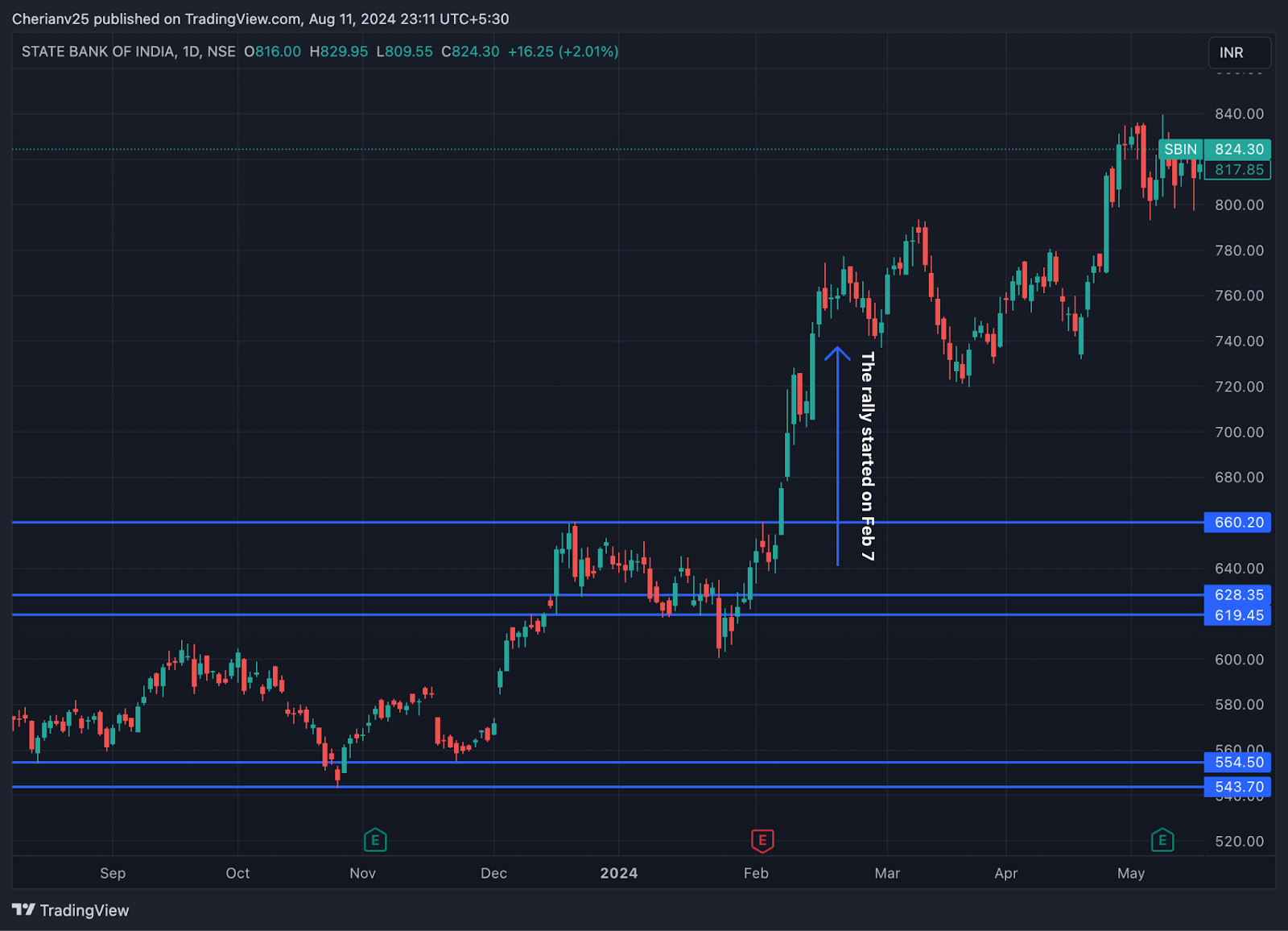
      1. SBI: On February 7, 2024, the stock broke its all-time high. Within 7-8 days, it delivered a return of 12.86%. This surge was fueled by the factors discussed earlier, showcasing the power of momentum in a bullish market.

      SBI stock chart - momentum investing | marketfeed

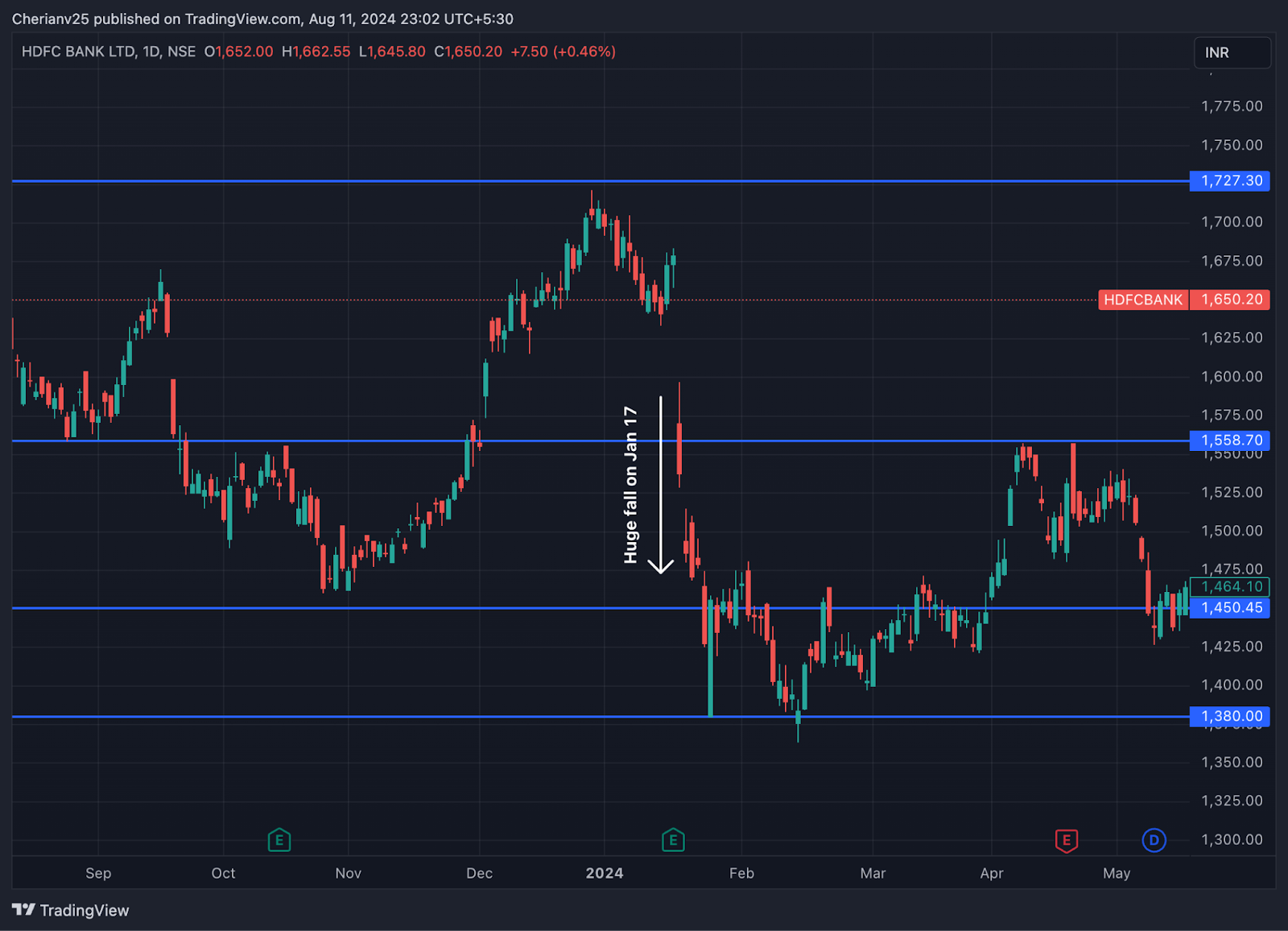
      2. HDFC Bank: In contrast, HDFC Bank experienced a breakdown, resulting in an 8% decline. This example highlights the risks associated with catching a “falling knife,” where buying into a declining stock can lead to further losses.

      HDFC Bank stock chart | marketfeed

      Sectoral Rotation and Momentum Investing

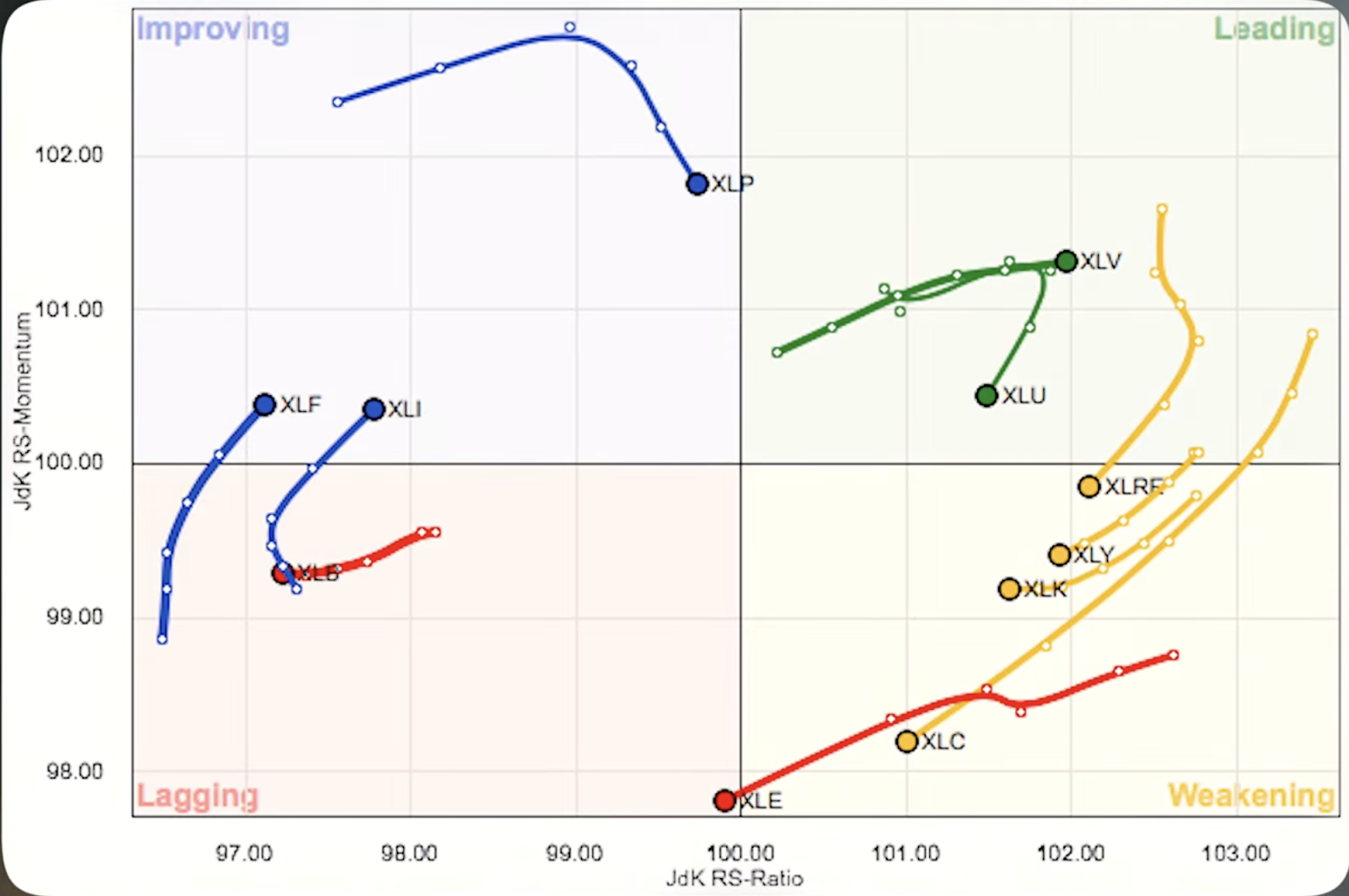
      Sectoral rotation involves shifting investments across different sectors based on their performance. The market can be divided into four quadrants: leading, weakening, lagging, and improving. Investors often debate whether to invest in leading sectors or chase lagging sectors for potential rebounds. For momentum investors, the focus is generally on stocks in the leading quadrant, as they are more likely to continue their upward trajectory.

      sectoral rotation - momentum investing | marketfeed
      Sectoral Rotation of Stock Markets – Quadrants

      How to Identify High-Momentum Stocks?

      To identify stocks with strong momentum, follow these steps:

      1. Look for unusually high price changes: Start by identifying stocks with significant price changes, typically 3-5% in a day (focus on Nifty 500 stocks, avoid micro-caps.). This change should not be due to news or result announcements, as these can be temporary.
      2. Check for high trading volume: Ensure that the stock has unusually high trading volume, indicating strong investor interest. Compare the volume on the day of the breakout with the average volume over the last several days.
      3. Breakout Confirmation: Confirm the breakout by analysing the stock’s chart patterns, such as trend lines or horizontal lines. Be cautious of fake breakouts and set appropriate stop-loss levels to mitigate risks.

      Simply add these filters on a stock screening platform (like screener.in) to identify momentum stocks.

      Limitations of Momentum Investing

      While momentum investing can be highly profitable, it does have its limitations. This strategy tends to work best in trending or bullish markets. In contrast, long-term consolidation phases can lead to false breakouts and increased risk.

      Here are some strong measures you can take to mitigate risks while momentum trading:

      • Set stop-loss orders to protect against downturns.
      • Monitor market conditions to identify trends.
      • Use daily candlesticks for short-term trades.
      • Apply weekly or monthly charts for longer-term analysis.
      • Avoid this strategy during periods of long-term consolidation

      Conclusion

      Momentum investing is a powerful strategy that can yield substantial returns in the short and medium term. Investors can make informed decisions by understanding the psychological and technical factors driving stock prices. Always remember to use screeners and implement robust risk management strategies to enhance the effectiveness of momentum investing!

      As you explore momentum investing, remember to stay updated on market trends and be prepared to adapt your strategies as conditions change. With careful analysis and a commitment to continuous learning, you can harness the power of momentum investing in your stock market journey!

      Watch: Momentum Investing Strategy using Price and Volume! | marketfeed

      Categories
      Editorial

      Unlocking the Potential of the Covered Call Strategy in India: A Step-by-Step Guide

      As an investor, you may be constantly looking out for strategies that offer consistent returns with manageable risks. One such strategy that offers a unique approach to generating income is the covered call strategy. It’s widely recognised globally, but not as popular in India. This approach could be particularly appealing to those who prefer a less hands-on investment method. In this article, we will dive into the covered call strategy, explain its mechanics, and explore its advantages and disadvantages.

      The Basics of a Call Option

      Before diving into the covered call strategy, it’s crucial to understand what a call option is. A call option is a financial contract that gives a buyer the right, but not the obligation, to buy an underlying asset (like a stock) at a predetermined price (strike price) within a specified time frame. For this right, the buyer pays a premium to the seller.

      Let’s look at a simple example. Imagine you’re interested in buying a used car. You negotiate with a seller and agree to pay a token amount to secure the right to buy the car at a specified price by the end of the month. This token amount is similar to the premium paid for a call option. If you decide to buy the car, you pay the agreed price. But if you choose not to, the seller keeps the token amount.

      In the stock market, when you purchase a call option for a stock, you are essentially paying for the right to buy that stock at a predetermined price within a specific timeframe. If the market price exceeds this strike price, you can exercise your option and purchase the stock at a lower price.

      The Covered Call Strategy Explained

      The covered call strategy involves owning shares of a fundamentally strong stock while simultaneously selling call options on that stock. This approach is similar to earning rental income from a property; just as a landlord collects rent from tenants, you can collect premiums from the options you sell.

      How to Deploy a Covered Call Strategy?

      1. Select a Stock: The first step in deploying a covered call strategy is to choose a fundamentally strong stock. For instance, HDFC Bank, a well-established Nifty 50 company, is an ideal candidate due to its robust fundamentals and steady growth potential.

      2. Buying the Stock: Purchase the stock in sufficient quantities to form at least one lot (e.g., 550 shares of HDFC Bank) at say ₹1,500 per share. This investment is similar to acquiring a commercial property.

      3. Selling Call Options: After buying the stock, sell call options on it. Going back to our example, we can sell HDFC Bank call options with a strike price of ₹1,700. This strike price is chosen based on the expectation that the stock will not exceed this price significantly within the option’s timeframe (there will be an expiry date for the contract).

      4. Generating Income: The premium received from selling call options acts as rental income. If the stock price remains below the strike price, the call options expire worthless, and you retain the premium. If the stock price exceeds the strike price, you sell the stock at the strike price, thus capping your profit but still securing a gain.

      When selling call options, suppose you receive a premium of ₹8 per share for a 1.5-month period. Over a year, this could amount to approximately ₹25,000 to ₹30,000 in premium income. This translates to an expected return on investment (ROI) of about 3.8% to 4% annually, a figure comparable to returns from traditional commercial real estate investments.

      Advantages of the Covered Call Strategy

      • Consistent Income: By selling call options regularly, you can generate consistent income from the premiums, similar to earning rent from a property.
      • Downside Protection: The premium income can offset potential losses if the stock price declines slightly.
      • Limited Risk: The primary risk is the opportunity cost of missing out on substantial gains if the stock price rises significantly above the strike price.
      • Long-Term Investment: The strategy encourages a long-term investment approach, holding fundamentally strong stocks that are likely to appreciate over time.

      Disadvantages of the Covered Call Strategy

      • Limited Upside Potential: Your profit is capped at the strike price of the sold call option. If the stock price soars, you miss out on higher gains.
      • Stock Selection: The success of this strategy hinges on selecting the right stock. Buying a stock at an overvalued price can lead to losses.
      • Capital Requirements: This strategy requires a significant initial investment to buy the necessary stock quantities.
      • Management Complexity: While the strategy reduces the need for constant monitoring, it requires understanding market conditions and adjusting positions accordingly.

      Investors must be aware of these risks and ensure they have a solid understanding of market conditions before implementing this strategy. Proper stock selection is crucial, as buying at a high price can significantly impact overall returns.

      Enhancing Returns with Margin Pledging

      One additional advantage is the ability to pledge the stock holdings to obtain margin (capital) for further trades. For instance, if you invest ₹8.25 lakhs in HDFC Bank shares, you can pledge these shares to get a margin for intraday or positional trades. This margin can be used to generate additional returns, enhancing the overall profitability of your investment.

      Conclusion

      The covered call strategy offers a unique blend of consistent income and long-term growth potential. This makes it an attractive option for investors seeking a stock market alternative to traditional rental income. By understanding the mechanics and carefully selecting stocks, investors can unlock significant value and generate steady returns with manageable risks.

      While there are risks involved, the potential for steady income and long-term capital appreciation makes this strategy worth considering. As with any investment strategy, it’s essential to conduct thorough research, understand market conditions, and consult with financial advisors if necessary.

      Whether you’re an experienced trader or a beginner looking to explore new avenues, the covered call strategy could be a valuable addition to your investment portfolio. With proper execution and management, it can help you achieve your financial goals while minimizing risk!

      Watch: Rental Income through Trading? Covered Call Trading Strategy Explained | marketfeed

      Categories
      Editorial

      How to Invest in US Stocks? A Guide for Indian Investors

      Investing in US stocks is become increasingly popular among Indian investors, especially the younger generation. Despite the Indian stock market’s impressive bull run over the past few years, many are drawn to the potential higher returns of prominent US stocks like Amazon, Tesla, and Nvidia. Unfortunately, many investment apps have high fees and complicated terms that can discourage people from using them. In this article, we will explore a low-cost and efficient way to invest in US stocks from India.

      Why Invest in US Markets?

      Here are four compelling reasons why you can consider investing in US stocks:

      1. Diversification

      Diversification is a fundamental investment strategy that involves spreading investments across various assets to reduce risk. When one asset class performs poorly, another may perform well, balancing your overall portfolio. For instance, when stock markets decline, commodities like gold often rise. The US and Indian markets have low correlation, meaning their performance is not closely tied. This lack of correlation opens opportunities for true diversification. If the Indian stock market underperforms, your US investments can potentially offset those losses.

      2. Currency Depreciation

      The performance of the Indian Rupee against the US dollar can significantly impact investment returns. For example, if you bought US dollars when the exchange rate was ₹70 and the rate increased to ₹84, your investment appreciates without any stock market gains. This currency strength can enhance your overall returns.

      3. Lower Volatility

      The US market is more mature and stable compared to the Indian market. This maturity results in lower daily volatility, making it a less risky investment option. However, do remember that no investment is entirely without risk!

      4. Better Valuations

      US stocks often have better valuations compared to Indian stocks. Price-to-earnings (P/E) ratios in the US are generally more favourable, providing more value for your investment. For example, many US-listed companies have lower P/E ratios than Indian companies, indicating better value potential.

      To learn more about P/E ratio, explore this article: How to Analyse Debt & Valuation of a Company?

      How to Start Investing in the US Stock Market from India?

      Many investors may wonder how to begin their investment journey in US stocks with minimal capital. Here’s a straightforward approach:

      Investing Through Mutual Funds

      One of the most effective ways to invest in US tech stocks is through mutual funds, specifically those focused on the NASDAQ index. The NASDAQ is renowned for its tech-heavy listings, including major players like Apple, Amazon, and Nvidia.

      Here are two mutual funds that are ideal options for investing in US markets:

      1. Motilal Oswal NASDAQ 100 Fund of Fund

      The Motilal Oswal NASDAQ 100 Fund of Fund is a popular choice for Indian investors. This fund invests in another mutual fund that directly targets NASDAQ-listed companies. Here are some key points:

      • CAGR Returns: The fund has delivered an impressive Compound Annual Growth Rate (CAGR) of around 25% over the last five years.
      • Expense Ratio: The expense ratio is relatively low, ensuring that you get more out of your investments.
      • Minimum Investment: You can start investing with as little as ₹500.
      • Performance: Over the last year, the fund has provided more than 30% returns, demonstrating the potential of US markets.

      2. ICICI Prudential NASDAQ 100 Index Fund

      This fund also invests in NASDAQ companies and offers similar benefits:

      • Returns: The fund has delivered a return of 29.21% over the last year.
      • Expense Ratio: The expense ratio is slightly higher at 0.52%, but still reasonable.
      • Portfolio: The fund invests in leading tech companies like Microsoft, Apple, Nvidia, and Amazon, in proportions that mirror the NASDAQ index.

      Other Options to Invest in US Stocks

      In addition to the NASDAQ-focused funds, you can consider the following options:

      • Motilal Oswal S&P 500 Index Fund: This fund invests in the S&P 500 index, which includes major US companies like Microsoft and Amazon. The investment ratios differ from those in NASDAQ funds, providing additional diversity.
      • Sector-Specific Funds: Explore funds that focus on specific sectors, such as technology or healthcare, to align with your investment strategy.

      How Much to Invest?

      While investing in US stocks can be beneficial, it’s essential to balance your portfolio. Moderation is key! A recommended strategy is to invest no more than 15-20% of your total portfolio in US stocks. This allocation provides diversification benefits while keeping the majority of your investments within familiar markets.

      Investing too heavily in foreign markets can expose you to risks you may not fully understand. While major US tech companies show strong growth potential, diversification is essential to safeguard your investments. Balancing your portfolio with a mix of domestic and international assets can lead to more stable long-term growth.

      Conclusion

      Investing in US markets offers numerous benefits, from diversification to access to leading technology companies. However, it’s vital to approach this opportunity with caution. Mutual funds provide a transparent and efficient means to invest, minimising risks associated with direct stock purchases.

      As you embark on your investment journey, remember to conduct thorough research and consider your risk tolerance. The US market presents a wealth of opportunities, but informed decisions are crucial for success. Share this guide with fellow investors to help them navigate the complexities of investing in US stocks.

      Stay informed, stay diversified, and enjoy the journey of investing in the global market!

      Categories
      Editorial

      Union Budget 2024-25: Key Priorities for Transforming India’s Future

      Finance Minister Smt. Nirmala Sitharaman presented the Union Budget for the financial year 2024-25 in Parliament on July 23, 2024. Let us take a look at some of the key highlights from the Budget presentation.

      The 9 priorities of the budget are: 

      1. Agriculture Transformation:

      The Indian govt aims to transform agricultural research and productivity. It will support the public and private sectors by introducing 109 high-yielding crop varieties and 32 new releases of horticulture. One crore farmers will be encouraged to take up natural farming based on certification and branding. There’s a proposal to establish 10,000 bio-input centers to create a national-level micro-fertilizer and pesticide manufacturing network. There will also be efforts to increase the production, storage, and marketing of oilseeds like mustard, sesame, soybean, and sunflower.

      Besides this, 400 districts and six crore farmers will be added to land registries, while Kisan Credit Cards will be enabled in five states. Shrimp production and exports will be increased under NABARD’s national cooperation policy.

      The Centre will allocate ₹1.52 lakh crore to the agriculture and allied sectors.

      Do look out for the stocks in the agriculture sector: UPL, Coromandel International, Rallis India, Avanti Feeds, Kaveri Seed Co, PI Industries, and Bayer CropScience.

      2. Employment and Skilling

      To meet the challenges on the employment front, the government has introduced three schemes:

      1. All first-time entries into jobs in every formal sector will be paid one month’s wages in advance— up to ₹ 15,000, subject to a total of 2.1 crore youth (Scheme A).

      2. Incentives will be provided directly to both employees and employers on a specified scale for their EPFO contribution in the first 4 years of employment. (Scheme B).

      3. The government will reimburse EPFO contributions of employers up to ₹3000 per month for 2 years for all new hires. – Expected to generate 50 lakh jobs (Scheme C).

      Measures that attempt to increase female workforce participation include the establishment of women’s hostels and specific programs for skilling. Over the next five years, 20 lakh youth will be skilled, with 1,000 training institutes upgraded. New courses will cater to emerging sectors, and loans up to ₹7.5 lakh will support 25,000 students annually.

      3. Human Justice and Regional Development

      Development initiatives have been planned under the Purvodiya program, with a focused attention on the eastern states like Bihar, Jharkhand, West Bengal, Odisha, and Andhra Pradesh. An investment of ₹26,000 crore in roadways and ₹21,400 crore in power projects will provide better connectivity through infrastructure projects. New airports and medical colleges will be established in Bihar. The govt will support the Polavaram irrigation project in Andhra Pradesh to ensure food security.

      4. Manufacturing and Services

      The govt has proposed to give special attention to Micro, Small & Medium Enterprises (MSMEs) through a ₹100 crore credit guarantee scheme, a new way of judging credit, and enhanced Mudra loans of up to ₹20 lakhs for those having repaid their loans earlier. An internship scheme associated with the PM package will offer one crore youth the opportunity to work in top companies for five years, with a stipend amount of ₹5,000 per month.

      Under the PPP (Public-Private Partnership) mode, rental housing schemes shall be developed for industrial workers. The shipping industry will benefit from the Critical Mineral Mission aligned with technology and skill in manpower development.

      5. Urban Development

      Growth in urban areas will be driven by developing cities as hubs with transit-oriented plans in 14 large cities. Housing needs for one crore members will be addressed with a ₹10 lakh crore investment. This is accompanied by initiatives for transparent rental markets and improved water supply & sanitation across 100 cities through bankable projects.

      6. Energy Security

      The PM Surya Ghar Muft Bijli Yojana will promote rooftop solar installations for one crore households. The govt has proposed to speed up policy implementation for pumped storage, nuclear R&D, and advanced thermal power plants. The govt will scale up energy audits in industrial clusters. A joint venture between NTPC and BHEL will set up a full-scale 800-megawatt (MW) commercial plant.

      Top energy-related stocks may include NTPC,  SJVN, NHPC, Tata Power, Adani Green Energy, Adani Power, Bharat Petroleum, Indian Oil Corporation, ONGC, and JSW Energy. 

      7. Infrastructure

      The Centre will spend ₹11.11 lakh crore on infrastructure in the next five years (which accounts for 3.4% of our GDP.) The state resource support for infra allocation is coming to a total of ₹1.5 lakh crore, including the 4th phase of Gram Sadak Yojana to improve rural connectivity. The Centre will launch Phase IV of Pradhan Mantri Gram Sadak Yojana (PMGSY) to provide all-weather connectivity to 25,000 rural habitations.

      Projects at Vishnupad and Mahabodhi temples in Bihar and Nalanda will boost tourism. Financial support for projects with an estimated cost of ₹11,500 crore such as the Kosi-Mechi intra-state link and 20 other ongoing and new schemes will be provided. The govt will provide assistance for flood management and related projects in Assam, Sikkim & Uttarakhand and reconstruction and rehabilitation in Himachal Pradesh.

      These are a few stocks to look out for in the Infrastructure sector: NBCC, HFCL, IRB Infra, PNC Infra, KNR Construction, PNC Infratech, RITES, Ahluwalia Contracts,  and Larsen & Toubro Ltd.

      8. Innovation and R&D

      This priority includes a National Research Fund with a funding pool of ₹1 lakh crore to incentivize innovation and a Space Economy Venture Capital Fund of ₹1,000 crore. The Central Govt will operationalise the Anusandhan National Research Fund to support basic research and prototype development.

      9. Reforms for the Next Generation

      The govt aims to introduce a new Economic Policy Framework to guide reforms focused on improving employment opportunities and sustaining high growth. This framework will boost productivity across land, labour, capital, and entrepreneurship by leveraging technology and collaboration between the Centre and states. The Centre will work on land-related reforms such as assigning Unique Land Parcel Identification Numbers (ULPIN) and digitising maps for rural areas. Urban areas will see digitisation of land records with GIS mapping. Meanwhile, the Jan Vishvas Bill 2.0 will emphasise digitisation and ease of doing business.

      What are the Updates on GST?

      • Medicine and Medical Equipment: GST rate cut for three more cancer medicines.
      • X-Ray Tubes: Revision in Basic Customs Duty (BCD) on certain items to help ‘Healthcare’.
      • Critical Minerals Reduction in Customs Duty on 25 minerals to make them more easily available for Medical use.
      • Marine Products, Leather and Textile BCD on real down filling materials from duck or goose reduced to aid these industries.
      • Precious Metals BCD on gold and silver reduced to 6% and platinum to 6.4% making them cheaper
      • Oxygen-Free Copper Abolition of BCD on Oxygen-Free Copper used in the manufacture of resistors and connectors to increase capacity.
      • Ammonium Nitrate: Hiked from 7.5% to 10% to control usage.
      • Plastics and PVC: Increased BCD to control environmental pollution.
      • Telecom Equipments: Increased BCD from 10% to 15% on certain items to encourage domestic manufacturing.

      Direct Tax Reforms in Union Budget 2024-25 & Other Updates

      • Standard Deduction for salaried employees: Increased from ₹50,000 to ₹75,000.
        [Standard deduction is a fixed amount of money that salaried individuals can subtract from their total income before calculating their taxes.]
      • Family Pension Deduction: Increased from ₹15,000 to ₹25,000.
      • Mutual Funds and Unit Trust of India (UTI): Abolished tax deducted at source (TDS) to attract investors.
      • Angel Tax: Abolished for all classes of investors to foster the growth of startups.
      • The Centre has proposed to remove the indexation benefit available for calculating any long-term capital gains (LTCG) presently available for property, gold and other unlisted assets (this will severely impact people who have invested in such assets as to sell during retirement). Meanwhile, the LTCG tax on immovable properties will fall from 20% to 12.5%. – Effective from July 23, 2024.

      [Indexation adjusts the purchase price of an asset to adjust for inflation, thus reducing the gains and ultimately tax liability.]

      Revised Tax Slabs – New Tax Regime

      Income RangeRate of Tax
      Up to ₹3 lakh per annumNil
      ₹3 lakh to ₹7 lakh per annum5%
      ₹7 lakh to ₹10 lakh per annum10%
      ₹10 lakh to ₹12 lakh per annum15%
      ₹12 lakh to ₹15 lakh per annum20%
      Above ₹15 lakh30%

      With the new tax slabs, salaried taxpayers can now save up to ₹17,500.

      Revised Tax Rates for Stock Market Participants

      1. Capital Gains Tax

      • Short-Term Capital Gains (STCG): The tax rate has been increased from 15% to 20%.
      • Long-Term Capital Gains (LTCG): The tax rate has been revised from 10% to 12.5%. The exemption limit of LTCG now stands at ₹1.25 lakh per annum.

      2. Securities Transaction Tax (STT)

      • With effect from Oct 1, STT on the sale of options will be increased from 0.0625% to 0.01% of the option premium.
      • STT on sale of futures futures will go up from 0.0125% to 0.02% of the price at which such futures are traded.

      The Way Ahead

      The Union Budget 2024-25 outlines strategies to boost India’s economic growth across key sectors. It focuses on agriculture, employment, infrastructure, and innovation to create a resilient and inclusive economy. Key initiatives include agricultural transformation, employment schemes, regional development (especially in eastern states), MSME support, urban development, and energy security measures. These efforts, along with investments in skilling and innovation, reinforce the ‘Make in India’ initiative and promote sustainable growth.

      Tax reforms, GST updates, and new policies aim to improve the business environment. While the plans are ambitious, their effective implementation will be crucial in shaping India’s economic future, driving growth, creating jobs, and enhancing societal well-being in the coming years.

      Now let’s look forward to seeing how these strategic plans are implemented! 

      Disclaimer: The stocks mentioned in the article are solely for educational purposes. Please do your own research before investing.

      Categories
      Editorial

      A Simple Guide to Effortless Share Transfers via CDSL Easiest [2024]

      As an investor, you’ve likely accumulated shares and mutual funds across multiple demat accounts. You could be using different brokers, opening new accounts for better services, or promotional offers. Managing this scattered portfolio can be a daunting task, but the good news is that you can now transfer your holdings from one demat account to another with ease. In this comprehensive guide, we’ll walk you through the updated process of transferring shares, stocks, and mutual funds using the CDSL Easiest platform.

      What is CDSL Easiest?

      Central Depository Services (India) Ltd (CDSL), India’s largest depository, offers a user-friendly platform called CDSL Easiest that streamlines the process of transferring your investments between demat accounts. Whether you’re consolidating your portfolio, gifting shares to loved ones, or simply reorganising your holdings, CDSL Easiest makes it a breeze to complete the transfer in just 10 minutes:

      Step 1: Create Your CDSL Easiest Account

      1. Visit the CDSL Easiest website and click on the “Register for Easiest” option. You’ll need to provide your DP ID and client ID, which you can find in the ‘Profile’ section of your broker’s website. The DP ID is the first eight digits and the client ID is the next eight digits of your Demat account number

      2. Once you’ve entered this information, you’ll receive an OTP to your registered mobile number and email address. Submit the OTP to verify your registration.

      3. Next, create a username, set a security question, and register the Demat account to which you want to transfer shares.

      Important note: Let’s say you’re transferring holdings from a Zerodha account to an IIFL Securities account. You will need to have a CDSL Easiest account in the name of the Zerodha account from which you are transferring.

      Step 2: Link Your Beneficiary Account

      A major update in 2024 is the mandatory step of linking the beneficiary account before transferring shares.

      1. Go to the “Transaction” tab, click on “BO Linking,” and set up the beneficiary account. Enter the Demat account number of the account you want to transfer shares into and your PAN number.

      2. You will receive an email from CDSL. Follow the instructions to confirm the beneficiary addition and complete the OTP verification process.

      Step 3: Transfer Your Shares

      Now that your CDSL Easiest account is set up and your beneficiary account is linked, it’s time to initiate the share transfer.

      1. After your account and beneficiary linking are approved (this can take up to 24 hours), log in to CDSL Easiest platform.

      2. To initiate the transfer, go to the “Transaction” tab, click on “Setup,” and select the “Bulk Setup” option.

      3. Select the current date or the next working market day as the execution date. Choose the account to transfer shares into and enter the ISIN (International Securities Identification Number) of the stocks you wish to transfer.

      4. Verify the transaction details, commit the transaction, and complete the OTP and transaction PIN verifications.

      Advantages of Using CDSL Easiest

      • The platform simplifies the share transfer process, eliminating the need for physical visits to the broker’s office.
      • There are no tax implications as you’re not selling or buying shares.
      • You can transfer shares as many times as needed.
      • Apart from a nominal stamp duty charge, there are no additional costs.

      Disadvantages of Using CDSL Easiest

      • After transferring shares, the average buying price of the shares will not be available, which can complicate tax filing.
      • Some brokers may take longer to approve the CDSL Easiest account. For instance, Zerodha may take up to 48 hours.
      • The portal may not work after 5 PM
      • While there is a new option for CDSL to NSDL transfers, its reliability is yet to be tested.

      Conclusion

      By leveraging the CDSL Easiest platform, you can now effortlessly consolidate your investment portfolio, transfer shares between accounts, and even gift stocks to your loved ones – all without the hassle of tax implications or complex paperwork. Follow the steps outlined in this guide, and you’ll be well on your way to a simplified and organised investment journey!

      Watch: Transfer Shares to any Account in Just 10 Minutes! | Demat to Demat Stock Transfer with CDSL – marketfeed

      Categories
      Editorial

      How to Add Nominee to Your Demat Account – marketfeed

      Adding a nominee to your Demat account is now mandatory! If you do not add a nominee by March 31, 2023, your Demat or trading account will get frozen. You won’t be able to make investments or place trades!

      So let’s see how to add a nominee for major brokers like Zerodha, Fyers, IIFL, Upstox, Angel One & Groww!

      ⚠️ You can choose to opt out of this entire process. But you’ll have to submit a no-nomination form with your broker.

      How to Add a Nominee on Zerodha?

      1. Log in to https://console.zerodha.com/account/nominee

      2. Click on “Add Nominee” (up to 3 nominees can be added).

      3. Enter the nominee details and upload an ID proof. You can also specify how your holdings/funds will be distributed to the nominees.

      4. Click on “Continue”.

      5. Click on Proceed to e-sign.

      6. Click on Sign Now.

      7. Accept the terms and conditions, enter the Aadhaar number of the account holder, and click on Send OTP.

      8. Enter the OTP and click on Verify OTP.

      How to Add Nominee on Fyers?

      1. Go to https://myaccount.fyers.in/Nominations

      3. Select the option ‘I wish to nominate’ (Select I do not wish to nominate to opt out).

      4. Enter the required Nominee details and click on ‘Submit.’

      5. Complete Aadhaar E-sign in the Digio pop-up. (Click on allow pop-up if asked).

      How to Add Nominee on IIFL?

      1. Log in to https://ttweb.indiainfoline.com/Trade/ClientProfileDetailed.aspx

      2. Click on “Nominee Details”

      3. Add all the necessary details and click “Proceed to E-sign”

      4. Complete verification with Aadhaar OTP.

      How to Add a Nominee on Upstox?

      1. Log in to https://account.upstox.com/nominee

      2. Click on “Add Nominee” and enter all details.

      3. Click on ‘Proceed for E-Sign’ and enter your Aadhar number.

      4. Next, enter the OTP received on the mobile number linked with Aadhar and complete the process.

      How to Add a Nominee on Angel One?

      1. Log in to Angel One’s web platform.

      2. Find the dropdown menu on the right-hand side, next to your Client ID. Click on “My Profile” to find the “Add-Nominee” option.

      3. Click on ‘Add Nominee’ and add details like name, date of birth, relationship, PAN and allocation %.

      4. Click on ‘Proceed for E-Sign’ and enter your Aadhar number.

      5. Next, enter the OTP received on the mobile number linked with Aadhar and complete the process.

      How to Add Nominee on Groww?

      1. Go to https://groww.in/user/profile/nominee-details

      2. On the ‘Add Nominee’ page, enter the nominee’s details as required.

      3. Click on ‘Finish with Aadhar E-Sign’. Please make sure you Sign using your own Aadhaar number, and not the nominee’s Aadhaar number.

      (You can add nominees online only once. Changing or adding new nominees requires an offline process).