Categories
Market News Top 10 News

Manufacturing PMI Hits 13-Month High in Dec – Top Indian Market Updates

Here are some of the major updates that could move the markets tomorrow:

India’s manufacturing PMI rises to 13-month high in Dec

India’s manufacturing sector recorded its sharpest growth in output in 13 months in December 2022. The S&P Global India Manufacturing Purchasing Managers’ Index (PMI) stood at 57.8 in December, compared to 55.7 in Nov. New orders rose at the fastest pace since February 2021 even though selling prices surged more than input costs for the first time in two and a half years.

PMI is a month-on-month calculation, and a value above 50 represents an expansion compared to the previous month.  

Read more here.

Auto sales data for Dec 2022: Highlights  

Maruti Suzuki India posted a 9% year-on-year (YoY) decline in total sales to 1.39 lakh units in December 2022. Sales of its compact vehicle segment fell 21.5% YoY to 67,267 units. Exports fell 2.2% YoY to 21,796 units.

Tata Motors Ltd registered a 10% YoY increase in total sales to 72,997 units in Dec. The automaker’s commercial vehicle sales fell 0.6% YoY to 33,949 units. Overall passenger vehicle sales rose 14% YoY to 40,407 units.

Mahindra & Mahindra’s passenger vehicle segment posted total sales of 28,445 units in Dec, an increase of 61% YoY. M&M’s tractor sales rose 27% YoY to 23,243 units. 

TVS Motor Company’s total sales stood at 2.28 lakh units in Dec, down 3% YoY. Meanwhile, Bajaj Auto’s sales fell 22% YoY to 2.81 lakh units.

Read more here.

India’s electricity consumption grows 11% to 121.19 BU in December

Power consumption in India grew 11% YoY to 121.19 billion units (BU) in December 2022. This indicates the sustained momentum of economic activities last month. Reports indicate that power consumption and demand will further increase in January due to the use of heating appliances (especially in the north) and a further improvement in economic activities.

Read more here.

SBI, ICICI Bank, HDFC Bank remain domestic systemically important banks: RBI

The Reserve Bank of India (RBI) said the State Bank of India, ICICI Bank, and HDFC Bank continue to be identified as Domestic Systemically Important Banks (D-SIBs). D-SIBs are interconnected entities whose failure can impact the whole financial system and create instability. The current update is based on the data collected from banks as of March 31, 2022, the RBI said.

Read more here.

CIL’s coal supply to power sector rises 11% to 433 MT in April-Dec

Coal India Ltd’s (CIL) coal supply to the power sector rose 11% YoY to 432.7 million tonnes (MT) in the April-December period of the current financial year (FY23). The supply to the non-power sector last month was 10.5 MT due to increased output. The company supplied close to 508 MT of coal to all-consuming segments in April- December, registering a growth of 5.4% YoY. CIL accounts for over 80% of India’s coal output.

Read more here.

Tea industry facing multiple challenges in wake of Covid pandemic: Experts

The tea industry in India is struggling with low prices and high input costs due to the damages caused by the Covid-19 pandemic. Production has also been declining from 1,390 million kg in 2019 to 1,258 million kg in 2020, 1,329 million kg in 2021, and 1,050 million kg till October 2022. Stakeholders within the industry are calling for more focus on quality and boosting exports. 

Read more here.

Recession will hit a third of the world in 2023, warns IMF chief

A third of the global economy will be in recession this year, said International Monetary Fund (IMF) chief Kristalina Georgieva. 2023 will be “tougher” than last year as the US, European Union (EU), and China will see their economies slow down, she added. Global growth is forecast to slow from 6% in 2021 to 3.2% in 2022 and 2.7% in 2023.

Read more here.

JSW Group plans to foray into EVs

JSW Group is considering a foray into the manufacturing of electric vehicles (EVs), said Group Chief Financing Officer Seshagiri Rao. The group is looking to manufacture four-wheelers. The EV manufacturing plan is being discussed actively at the group level, he said while revealing JSW Group’s aim to expand its presence into more sectors.

Read more here.

Dabur acquires a 51% stake in Badshah Masala

FMCG firm Dabur India has completed the acquisition of a 51% stake in Badshah Masala Private Ltd for Rs 587.52 crore.  Badshah Masala manufactures, markets, and exports ground spices, blended spices, and seasonings. Dabur will acquire the remaining 49% stake over the next five years.

Read more here.

PSP Projects emerges lowest bidder for ₹1,364 crore govt project

PSP Projects Ltd has emerged as the lowest bidder for a government project worth  ₹1,364.47 crore in Surat, Gujarat. The company will construct a high-rise office building for Surat Municipal Corporation. PSP Projects is a multi-disciplinary construction company that engages in industrial, institutional, and residential projects in India.

Read more here.

APL Apollo posts 50% growth in sales volume in Q3

Structural steel tube company APL Apollo Tubes Ltd. registered its highest quarterly sales volume of 6,05,049 tonnes in the quarter ended Dec (Q2 FY23), showing a 50% YoY growth. The sales volume for the first nine months of the current financial year rose by 35% to 16,30,120 tonnes. APL Apollo Tubes operates 11 manufacturing facilities with a total capacity of 2.6 million tonnes. 

Read more here.

Categories
Market News Top 10 News

Retail Inflation Eases to 5.88% in Nov – Top Indian Market Updates

Here are some of the major updates that could move the markets tomorrow:

India’s retail inflation eases to an 11-month low of 5.88% in Nov

India’s retail inflation (based on the Consumer Price Index or CPI) eased to an 11-month low of 5.88% in November on an annual basis. The figure came within the Reserve Bank of India’s (RBI) tolerance band for inflation of 2-6% for the first time this year. CPI stood at 6.77% in October. The decline can be attributed to a fall in food prices, which account for almost 40% of India’s CPI basket. Food inflation for November came in at 4.67%, compared to 7.01% in Oct. 

Meanwhile, India’s factory output (measured by the Index of Industrial Production or IIP) witnessed a (-)4% contraction in October 2022.

Read more here.

OnePlus partners with Reliance Jio for 5G

Reliance Jio has partnered with global technology brand OnePlus to bring in the evolutionary standalone (SA) 5G technology ecosystem in India. As a part of the collaboration, all the OnePlus 5G devices will be powered by Jio ‘True 5G’ technology. Currently, Reliance Jio is rolling out 5G SA in Delhi-NCR, Mumbai, Kolkata, Varanasi, Chennai, Bengaluru, Hyderabad, and Pune. 

Read more here.

India’s steel output grows 5% to 10.34 MT in Nov: SteelMint

According to SteelMint India, India’s crude steel output rose by about 5% YoY to 10.34 million tonnes (MT) in November 2022. SAIL, Tata Steel, JSW Steel, JSPL, AMNS India, and RINL produced 6.28 MT of steel, and the remaining 4.06 MT came from the secondary sector. The consumption of the alloy surged 13.42% to 9.66 MT in November, compared to 8.52 MT a year ago.

Read more here.

ONGC to invest ₹2,150 crores on drilling 53 exploratory wells in Andhra Pradesh

Oil & Natural Gas Corporation (ONGC) will invest ₹2,150 crores to drill 53 exploratory wells in Andhra Pradesh. It will carry out the exploration of 50 wells in the Krishna Godavari (KG) basin in East and West Godavari districts. Meanwhile, three drillings will be carried out in the Cuddapah basin in Kurnool, Anantapur, and YSR districts.

Read more here.

TCS faces lawsuit in the US for alleged discriminatory hiring practices

Tata Consultancy Services (TCS) is facing a class action civil rights lawsuit from a former employee in the US for discriminatory hiring practices. Shawn Katz has filed a lawsuit against TCS seeking relief for alleged discrimination based on race and national origin at the US District Court for the District of New Jersey. He alleged that the IT firm discriminates against non-South Asian and non-Indian applicants and employees.

Read more here.

Dalmia Bharat to acquire Jaypee Cement for ₹5,666 crore

Dalmia Bharat Ltd’s cement subsidiary will acquire the cement and power plants of Jaiprakash Associates Ltd for ₹5,666 crores. The assets include a cement manufacturing capacity of 9.4 million tonnes (MT), a clinker capacity of 6.7 MT, and thermal power plants of 280 megawatts (MW). The new plants will take Dalmia Cement’s cement manufacturing capacity from 35.9 million tonnes per annum (MTPA) at present to 46.3 MTPA.

Read more here.

All-India electricity demand may grow 7% to 1,480 BU in FY23: Icra

Electricity demand in India is expected to grow 7% year-on-year (YoY) to 1,480 billion units (BU) in the current financial year (FY23), according to rating agency Icra. In the previous financial year (FY22), the all-India power demand was at 1,380 BU. The estimates are based on the fact that all-India electricity demand increased 10.6% YoY in the first eight months of FY23 amidst a severe heat wave in the north and central India.

Read more here.

Glenmark Pharma gets warning letter from USFDA for lapses at Goa plant

Glenmark Pharmaceuticals Ltd has received a warning letter from the US Food & Drug Administration (USFDA) for manufacturing lapses (including failure to establish required laboratory control mechanisms) at its Goa-based manufacturing plant. The warning letter summarises significant violations of Current Good Manufacturing Practice (CGMP) regulations for finished pharmaceuticals. USFDA inspected the manufacturing facility from May 12, 2022, to May 20, 2022.

Read more here.

Macrotech Developers raises ₹3,547 crores via QIP

Macrotech Developers (Lodha) has raised around ₹3,547 crores from foreign and domestic institutional investors through a Qualified Institutional Placement (QIP). This was the largest QIP by any Indian corporate this year. Capital Group, UBS, Abu Dhabi Investment Authority, and Nomura have picked up over 7.2% stake in the real estate company.

Read more here.

Tata Group plans to open 100 small exclusive Apple stores: Report

According to an Economic Times report, the Tata Group aims to open small exclusive Apple stores across India. Apple is reportedly partnering with Tata-owned Infiniti Retail, which runs the Croma store chain, for the venture. Infiniti Retail will become an Apple franchisee partner. It intends to open 100 such outlets of 500-600 sq. ft. each at malls and high-street locations.

Read more here.

Categories
Editorial

Indian Energy Exchange (IEX) Shares Rise 50% in 6 Days: Analysis

India, just like the rest of the world, is in the middle of an energy crisis. Major cities are planning for blackouts if the supply of coal is not normalised. India is in a sticky situation. Fuel and food are expensive, and so is energy. Despite the grim economic situation, there is one very vibrant place, Dalal Street. The Indian stock market seems virtually unaffected by economic parameters. One stock, in particular, seems to be reaping the benefit of this energy crisis. It is the Indian Energy Exchange (IEX).

The Indian Energy Exchange (IEX) is a marketplace for trading energy-related entities. IEX is an electronic power trading marketplace for electricity corporations and boards to trade contracts related to energy. In simple terms, just like how individuals can trade in the stock market to gain profit, electricity corporations can trade on the IEX to increase profitability and have better price discovery. It is a place where participants can buy and sell energy through a double-sided closed auction process. 

In January 2021, we at marketfeed covered Indian Energy Exchange, extensively elaborating on their business model and financial analysis as well. Since then, the company’s share price has risen by almost ~250%! 

To read about the functioning of the Indian Energy Exchange, click here

Why Did IEX Rally So Much?

Necessity is the mother of invention. In the past few months, parts of India have been facing power shortages. There is a need for better price discovery in terms of power to make it affordable and accessible. There have been multiple factors that have driven the price of IEX in the last six months. The most recent rally was caused by the fact that the Supreme Court consented to allow the introduction of new market instruments for electricity trading. This move will pave the way for cheaper and accessible electricity while allowing power companies to hedge on it. 

After the Supreme Court hearing, the shares of Multi Commodity Exchange (MCX) rallied by 8.5% and Indian Energy Exchange (IEX) by 9.11% in a single trading session. 

In August 2021, the Power Ministry had allowed Tata Power and Adani Power to sell power on IEX. Around this period, the country had just recovered from a daunting second wave of COVID-19. Development and growth had taken place, and the energy demand had risen. This led to swelling electricity prices. The average prices for electricity on IEX were between Rs 6-7 per unit compared to Rs 3 per unit. To drive down these energy prices, the government had to loosen up the supply of electricity. 

Where Does IEX Stand?

IEX declared a total revenue of Rs 102 crore in June 2021, up 27% YoY from Rs 81 crore in the previous year. In the same period, the company declared a net profit of Rs 62.8 crore, seeing an increase of 49.23% YoY. The company has no debt or is not operated on credit. This saves it from default risk. 

On average, 6,000+ megawatts (MW) of electricity is traded daily on the exchange. The traded volume is growing at 32% CAGR. It has a consumer base of 4,000+ industries, 55+ distribution companies, 500+ generators, 1,500+ renewable energy generators. IEX has a monopoly in the energy trading business in India, covering 90% market share. The remaining being covered by Power Exchange India Limited (PXIL). 

Energy prices on the IEX are generally lower than in the open market. The average market clearing price per unit has been consistently decreasing on IEX. A decreasing clearing price means that more companies would flock to power exchanges for cheaper electricity. As energy prices get volatile in India, companies will have to look for an alternate energy source. IEX could act as a connecting web between these companies. 

From an investor’s perspective, all technical indicators suggest that the company is ‘overbought’. This shall not be a problem if the exchange maintains a proportionate profit in the future quarterly results. While IEX is in an excellent financial position, the current bull run in the market has managed to inflate share prices. As the Indian energy economy liberalizes and we see a spike in power trade, IEX has great growth potential.   

Update: The Indian Energy Exchange (IEX) has announced that the company’s board will meet on October 21, 2021, to discuss a bonus issue for its shareholders. The company’s share surged ~16% since market open after the announcement.

Categories
Editorial

Why You Should Look Into Power Distribution and Transmission Companies

Ever wondered about how the power sector in our country works? And what are the opportunities that lie in the industry? For the first time since the liberalization policy in 1991, India’s power sector is going to change for good, in a way that could benefit both consumers as well as power companies. The Finance Ministry is pushing for privatization and delicensing of the power sector which could change the way the power sector works in India.

The total installed capacity of power stations in India stood at 373.43 GW as of October 2020. The transmission lines in India are 4,98,651 km long. According to India Brand Equity Foundation (IBEF), between 2000 and 2020, the power sector attracted Rs 1.11 Lakh Crores in Foreign Direct Investment (FDI), which is close to 3% of the total Foreign Direct Investment(FDI) inflow in India.

Currently, the power distribution companies(Discoms), transmission companies(Transcos), and generation companies(Gencos) are distressed financially due to reduced electricity demand along with unfair pricing and power policy.

With the Budget 2021 and the Electricity Amendment Bill 2020, the power sector is in for a revolution. If the bill is passed in the parliament, it could change the face of the industry. In this piece, we explore how the power sector fairs in the stock market and the listed power companies that have a potentially good investment perspective.

The Companies in the Sector

Power Grid

With a market cap of Rs 96,496 crore, Power Grid is India’s largest state-owned power transmission company in India. It is classified as a Maharatna PSU.  It has an annual Return on Equity of 17%, which means that for every Rs 100 invested in the company, one makes another Rs 17 on it. The company has a Return on Capital Employed(ROCE) of 5.44% and Return on Asset(ROA) of 4.3% which means that it is utilizing its capital and infrastructure pretty efficiently. With 5G coming in and the rising electric vehicle market, the need for additional transmission grids are also likely to increase. Power Grid has also filed for an InvIT or an Infrastructure Investment Trust IPO. The IPO is likely to put the company in a favorable position in the markets

Adani Transmission Ltd

Adani Transmission Ltd is the subsidiary of the Adani Group. It is the largest power transmission company in India. Adani Transmission Ltd. has:

  •  A 27,000+ megavolt ampere of transmission capacity. 
  • 3,000,000+ distribution customers
  • 15,400 in transmission line length

Adani Group companies are almost intensively fuelled by debt, but it has a reputation of repaying and gaining a position with time. Adani Transmission over the years took huge debt burdens but managed to pay it back all in time. Most of its debt now is forex debt, which according to the company is cheaper than domestic loans. 

The company transmits electricity to Mumbai, the financial capital of India along with holding assets in 8 other major projects. Adani Transmission has returned 1131.5% in the last 5 years. This means that Rs 1 lakh invested would have turned into 11 lakhs in a period of 5 years, from 2016 to 2021. 

Torrent Power

Torrent Power is a power generation, transmission and distribution company based in India. Torrent’s stronghold is the state of Gujarat where it transmits and distributes electricity to major cities. Apart from Gujarat, the company holds its presence in Bhiwandi(Near Mumbai), Agra(Uttar Pradesh) and other cities in Maharashtra. It has a total generating capacity of 3191.6 MW.

Some electricity that is produced isn’t able to reach the right customers through transmission and distribution lines in case of theft, damage or heat dissipation. This is known as T&D Loss. Torrent Power’s T&D loss is one of the lowest in the country, which is ~4.5% as compared to India’s average T&D loss of 20%. This means that Torrent Power has the right technology, surveillance and assets to supply electricity seamlessly.

Speaking from a financial perspective, the company has constantly rising Profit After Tax(PAT) and Sales Volumes. Over the past 5 years, the company has returned 31.2% on investment. The company’s Return on Equity stands at 12.82% as compared to Industry ROE of 9.5%.

Torrent Power Adjusted Profit and Net Sales(Source:Edelweiss)

CESC or Calcutta Electric Supply Corporation Limited

CESC Ltd. is a power generation, transmission and distribution in and around the city of Kolkata and a few districts of West Bengal. Along with West Bengal, the company also holds generation and distribution businesses in Rajasthan and Maharashtra. 

The company did not fare well in the past 3-4 years, however, there have been recent changes in volumes. The sales volumes in West Bengal has crossed pre-COVID levels and their generation businesses in Rajasthan are likely to turn profitable pretty soon. Loses in the distribution business has reduced significantly. The company is likely to get a push with the Rs 3 Lakh crore stimulus package for electricity distribution companies. The company also offers one of the highest dividends to its shareholders in the power sector. Shares have gained 14.2% in the past 6 months since August 2020.

CESC Price Performance(Source: ICICIDirect)

Tata Power

Tata Power specializes in both generation and power supply. Close to 60% of Tata Power’s revenue comes from power generation, whereas the other 40% comes from transmission and distribution. Tata Power supplies electricity to the cities of Mumbai, Ajmer, and Delhi. It caters to around 26 lakh consumers in Mumbai and Delhi distribution areas, having close to 21,000 circuit kilometers in transmission and distribution grids. The company also holds ~10% market share in the rooftop solar(RTS) energy market in India.

During COVID-19 lockdown, like the rest of the sector, Tata Power too saw a reduction in transmission and distribution revenue segment. Tata Power has been focusing on reducing debt by selling non-core assets or assets that do not add to the core revenue of the company. It has managed to reduce close to ~14% of its debt in the past 1 year. The company’s debt to equity ratio has been decreasing constantly which signifies that the company has been cutting down on debt and catching up on equity in the company.

Privatisation and Delicensing of the power sector will indeed be a positive sign for Tata Power considering that it is the third largest power producing company in India.

IEX

The Indian Energy Exchange or IEX is an electronic power trading marketplace for electricity corporations and boards to trade contracts related to energy. In simple terms, just like how individuals can trade in the stock market to gain profit, electricity corporations can trade on the IEX to increase profitability and have better price discovery. All the three, i.e. Power Generation Companies(Gencos), transmission companies(Transcos) and Distribution Companies(Discoms) can trade on the IEX. IEX has recently seen a spike in volume due to volatility in electricity prices. marketfeed has dedicated two special articles on IEX.

To know more about how the company functions internally and the process of power trading, Click Here.

To know about, IEX as a stock to invest in, financial analysis, profitability and future prospects, Click Here. 

Budget 2021

Budget 2021 has received a positive response from the power sector. Finance Minister(FM) Nirmala Sitharaman allowed a much expected Rs 3 lakh crore to the power sector with the intention of reviving stressed discoms. The distribution of the fund will be over a period of 5 years. It will help in reducing losses and also improve efficiency along with increasing rural penetration. The FM also announced developing a framework for allowing the consumers to have their choice of electricity supplier. This will promote healthy competition and allow for healthy price discovery. 

The FM also announced the aspects of the Electricity(Amendment) Bill 2021, wherein the power sector will be ‘delicensed’ and thereby give smaller power companies a greater opportunity to expand. Apart from this, the government has also announced a Rs 2,606 crore allocation specifically for the solar power sector and also laid emphasis on shifting from using coal as a fuel to renewables.

Invest In Power

The Budget 2021 was indeed a historical one as it addressed a needed boost after the impact of COVID-19. It addressed not only the problems of the distressed power distribution companies but also hinted that the renewable energy sector is taking off. India currently is undergoing a coal crisis. Coal resources are being depleted and renewable energy is relatively more expensive. 

The Indian Power Sector is undergoing a major change, in a way that will change the market outlook for the first time in decades. The power policies in India are made in a way that politically benefits the governments of respective states. They are addressed to benefit the common man. This impacts the power companies as they are faced with reducing demand, falling profits, and increased costs. The power sector was given a ‘Negative Outlook’ by  ICRA, a renowned credit rating agency. Due to the COVID-19 pandemic, the demand for power took a fall and dented the power sector. 

The focus of power companies right now is to increase rural penetration, boost profits and achieve maximum efficiency. ‘Delicensing’ of the power sector will ensure less government intervention and increase cash flows for the power companies. India’s infrastructure boom, rising electric vehicle industry and the 5G revolution shall definitely enhance demand for the power sector. The future of the power sector is bright indeed.

Categories
Editorial

Company Analysis: Indian Energy Exchange

What is the Indian Energy Exchange?

The Indian Energy Exchange or IEX is an electronic power trading marketplace for electricity corporations and boards to trade contracts related to energy. In simple terms, just like how individuals can trade in the stock market to gain profit, electricity corporations can trade on the IEX to increase profitability and have better price discovery. It is a place where participants can buy and sell energy through a double-sided closed auction process. 

State Electricity Boards, power-producing companies, power transmission companies, and power traders that have a huge capital trade on IEX. IEX is one of the only two power exchanges apart from Power Exchange India Limited(PXIL).

The IEX started operations in 2008. The Central Electricity Regulation Commission(CERC) regulates the IEX, just like how SEBI regulates the NSE and BSE.

Financial Vitals of IEX

Share Performance

  • As of January 2021, the company’s share price has grown by ~38% since IPO and by ~94% in the past 1 year. The company’s share price has been less volatile but with consistent growth. It has a market cap of Rs. 7000 crore.

Growth in Net Profits/Revenue/Earnings

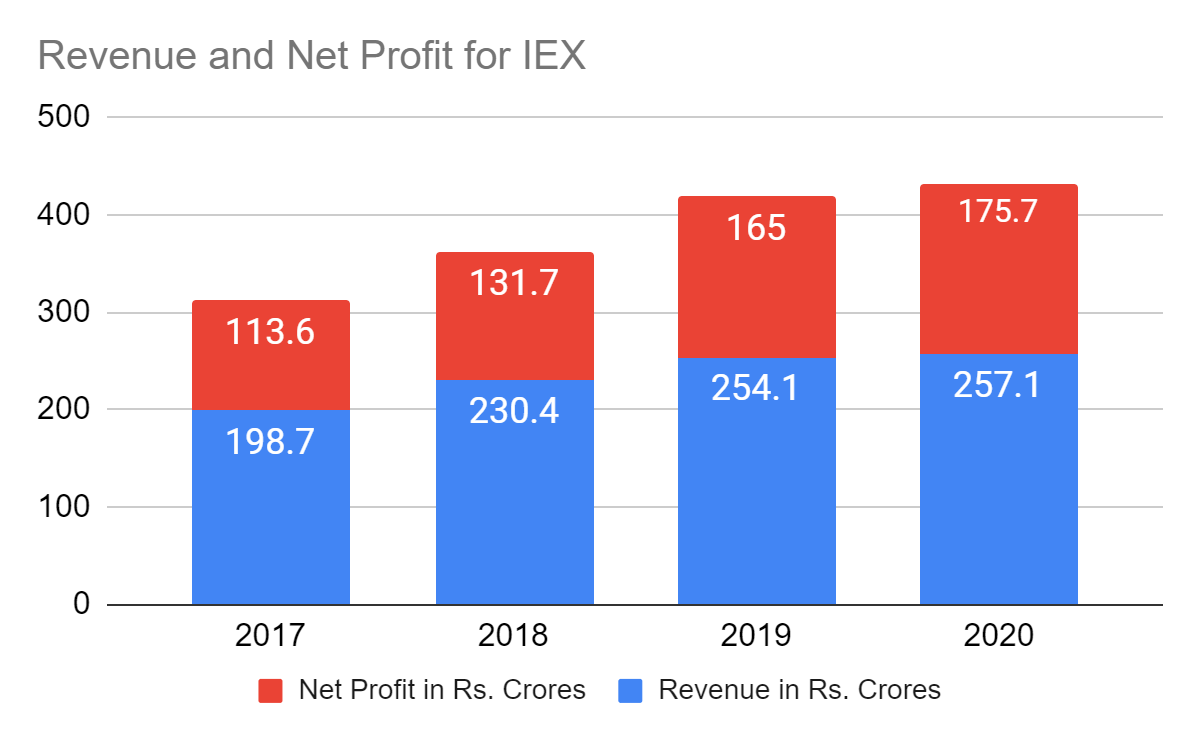
  • The company’s sales, revenue, and net profit have been growing constantly for the past 5 years. As demand for power increases, there will be an increase in power trading to find a better price for power.

Increasing Trading Volumes

  • On average, 6000+ MW of electricity is traded daily on the exchange. The traded volume is growing at 32% CAGR. It has a consumer base of 4000+ Industries, 55+ distribution companies, 500+ generators, and 1500+ renewable energy generators. The company has also seen increased trading volumes on the BSE and NSE.

Increasing ROE/EPS

  • For IEX, the Return on Equity(%) or ROE is ~45%. This means that for every Rs. 100 invested in the company, the investors earn close to Rs. 45 every year. The company’s price-to-earnings ratio or PE ratio has been declining constantly for the past few years. The fact that the company has excellent profitability and increasing revenue, it could probably mean that the company is undervalued and sees higher growth potential in the markets. 

Increasing FII/MF shareholding

  • The company has an increasing FII(Foreign Institutional Investors) shareholding in the company. In fact, it has doubled between September 2018 and September 2020. This shows that foreign investors are bullish on the idea of power trading in India and see a greater potential in IEX. Mutual Fund’s shareholding has also increased by 4.5 times in the past two years between 2018 and 2020.

No Debt

  • The company has no debt or is not operated on credit. This saves it from default risk. 

Decreasing Clearing Price

  • The clearing price is the price that companies pay to buy power after the bidding process is complete. The average market clearing price has gone from as high as Rs.3.38 per unit in July 2019 to as low as Rs. 2.35 per unit in June 2020. A decreasing clearing price means that more companies would flock to power exchanges for cheaper electricity.

Increasing Dependency on Green Energy Over Coal

As Governments push for environmental regulations and promote green energy, there is a greater incentive for companies to invest in them. Moreover, coal prices are pretty volatile citing quality concerns, regulation, and also the recent decision for Coal Mine Auction by the Government. Products like Energy Saving Certificates, Green TAM, and Renewable Energy Certificates on IEX will have a greater demand. 

Indian Gas Exchange

The Indian Gas Exchange or IGX is a subsidiary of IEX which is an exchange for trading in gas. It is India’s first electronic delivery-based gas exchange. It is regulated by the Petroleum and Natural Gas Regulatory Board. IGX currently offers trading in five contracts namely: Daily, Weekly, Weekday, Fortnightly, and Monthly. It has three physical setups, two in Gujarat and one in Andhra Pradesh. 

Electricity Amendment Bill

The Electricity Amendment Bill is a prospective bill that will enable power companies to retain greater profits. The bill also aims to prevent the high number of defaults in the energy sector, often by the state regulatory board themselves. The bill also addresses the weak financial health of power companies. It aims to privatize and centralize electricity transmission and distribution. The National Renewable Energy Policy also promotes the production and use of renewable energy throughout the country. 

IEX as a share to invest in hasn’t caught the eye of retail investors. The company’s price is supported by a good balance sheet and awaits a great future considering the recent developments in power policy and the shift of focus towards renewable energy. One should look out for future events like the Electricity Amendment Bill. A mix of all can ensure greater participation in the Indian Energy Exchange, thereby increasing trading volumes and cash flows for the companies.

To know more about how the exchange functions and the products it offers, click here.