Categories
Market News Top 10 News

India’s GDP Growth Accelerates to 7.8% in Q1 FY24 – Top Indian Market Updates

Here are some of the major updates that could move the markets tomorrow:

India’s GDP accelerates to a four-quarter high of 7.8% in Q1

According to the data from the National Statistical Office (NSO), India’s Gross Domestic Product (GDP) surged to a four-quarter high of 7.8% on an annual basis in the June quarter (Q1) of FY24. The growth can be attributed to central and state governments increasing capital expenditure (capex), stronger consumption demand and higher activities in the services sector. Meanwhile, the Reserve Bank of India (RBI) had predicted a growth rate of 8%.

Read more here.

Jio Fin Services to be removed from Sensex tomorrow

S&P BSE indices (including Sensex) will remove Jio Financial Services (JFSL) from its indices with effect from tomorrow, September 1. Jio Financial Services Ltd (JFSL) is a demerged non-banking financial services (NBFC) unit of Reliance Industries Ltd. The exchanges twice extended the removal of JFSL shares from the indices after the shares hit a lower circuit for four consecutive sessions post-listing.

Read more here.

Viacom 18 bags TV and digital rights for Indian cricket team’s home matches

Viacom18 has won BCCI media rights for ₹67.8 crore per match, outbidding Sony Pictures Networks India and Disney Star. The total value of the deal is ₹5,966 crore. The e-auction for the bilateral cricket media rights was held on Thursday. As per the tender released by the BCCI on August 2, the board had set a base price of ₹20 crore per match for Package A, which comprises the TV rights for the Indian subcontinent.

Read more here.

India’s Q1 fiscal deficit widens to Rs 6.06 lakh crore

According to Govt data, India’s fiscal deficit for Q1 FY24 has soared to ₹6.06 lakh crore, a significant increase from the ₹3.41 lakh crore recorded in the same period the previous year. The deficit stood at 20.5% of the Budget Estimates (BE) in the corresponding period of the financial year 2022-23. The fiscal deficit for Q1 now stands at approximately 33.9% of the projected ₹17.87 lakh crore target for the entire fiscal year.

Read more here.

Jupiter Wagons to enter EV market with electric commercial vehicles in early 2024

Jupiter Wagons’ entry into the electric vehicle (EV) market is set for early next year, marking a significant milestone in their diversification journey. Recognising the huge interest and demand for electric mobility solutions, the company is poised to leverage this opportunity by introducing electric commercial vehicles. Jupiter Wagons is engaged in the production of railway freight wagons, passenger coaches, wagon components, and cast manganese steel crossings & castings. 

Read more here.

Kotak Mahindra adds UPI interoperability feature to its Digital Rupee app

Kotak Mahindra Bank announced the introduction of a UPI interoperability feature on its Digital Rupee (e₹) application as a part of the RBI’s CBDC pilot project. Users will now be able to scan any QR code at merchants to make payments for groceries and daily expenses. As of today, the feature is live for Android users. It will empower customers to make payments on the existing UPI QR codes available at merchants.

Read more here.

Tata Power RE signs pact with Sanyo Special Steel Manufacturing to set up 28-MW solar plant

Tata Power Renewable Energy Limited (TPREL) has partnered with Sanyo Special Steel Manufacturing India Pvt Ltd (SSMI) to set up a 28.12-megawatt green energy plant in Maharashtra. TPREL an arm of Tata Power. The plant is expected to produce 61.875 million units (MUs) of electricity annually, which would meet the energy requirement of the steel manufacturing unit of SSMI.

Read more here.

JSW Group in talks with Chinese carmaker Leapmotor for EV tech: Report

JSW Group is in early talks with Chinese automaker Leapmotor to license technology to build electric vehicles in India. Under the technology licensing agreement, JSW would use Leapmotor’s platform to manufacture EVs in India under its own brand name. JSW is likely to use a single platform on which it can build at least three mid-sized sport-utility vehicles (SUVs).

Read more here.

Zydus Lifesciences gets USFDA approval for acne drug

Zydus Lifesciences has received final approval from the US Food & Drug Administration (USFDA) for Isotretinoin Tablets. The drug is used in the treatment of severe cystic acne. As per IQVIA MAT data for July 2023, the Isotretinoin Capsules USP had annual sales worth $165 million in the United States.

Read more here.

TCS extends contract with Athora Netherlands

Tata Consultancy Services (TCS) has expanded its long-standing partnership with Athora Netherlands (formerly VIVAT). The partnership is to help the Dutch life insurance and pension provider with a better IT operating model to enhance customer experience, operational resilience and business agility. This will be a multi-year deal for TCS. The company didn’t disclose the size or the tenure of the deal. 

Read more here.

Categories
Market News Top 10 News

India’s GDP Growth Slows to 4.4% in Q3 – Top Indian Market Updates

Here are some of the major updates that could move the markets tomorrow:

India’s GDP growth slows to 4.4% in Q3

India’s gross domestic product (GDP) for the October-December quarter (Q3 FY23) slowed down to 4.4%. The GDP had moderated to 6.3% in Q2 from 13.5% in Q1. GDP at Constant (2011-12) prices in Q3 2022-23 is estimated at ₹40.19 lakh crore in Q3, as against ₹38.51 lakh crore in Q3 2021-22. The Indian economy is expected to grow at 7% in FY23.

Read more here.

Geological Survey of India finds Gold Deposits in Odisha

Surveys from the Geological Survey of India (GSI) have found gold deposits in three districts of Odisha. State Steel and Mines Minister Prafulla Mallik said that the gold reserves were found in Deogarh, Keonjhar and Mayurbhanj.

Read more here.

SBI enters social loan market

State Bank of India has concluded a landmark $1 billion (~₹8,200 crore) syndicated social loan, making it the largest Environmental, Social, and Governance (ESG) loan raised by a commercial bank in the Asia Pacific market. The loan is of $500 million of the primary issue and an equal amount in greenshoe (or overallotment) option. It is also the first issue of such kind from the bank. 

Read more here.

IDFC, Federal Bank partner with Sa-Dhan on UPI123PAY

IDFC First and Federal Bank will partner with association of microfinance institutions Sa-Dhan and Delhi-based fintech solutions provider NextGen to promote digital payments by feature phone users. The banks will help in developing a new payment and collection system by using feature phones with the technological intervention being provided by them.

Read more here

India approves $3.9 billion hydropower project near China border

India has approved its largest-ever hydropower project in the mountainous northeastern region bordering China as it seeks to build renewable generation to meet rising power demand. The govt approved the estimated investment of $3.9 billion for the 2,880-megawatt Dibang project in Arunachal Pradesh. The project is estimated to take nine years to build.

Read more here.

India’s passenger vehicle sales to grow 9-10% in 2024: CRISIL

Rating agency CRISIL has forecast that India’s passenger vehicle sales are expected to grow about 9-10% in the next financial year (FY24), which is 20% more than the pre-pandemic levels. The forecast is owed to strong demand and easing chip shortages. India is currently the world’s fourth-largest car market.

Read more here.

Zydus Lifesciences receives USFDA approval to market generic drug

Zydus Lifesciences has received approval from the US Food & Drug Administration (USFDA) to market Apixaban tablets. The drug blocks the activity of certain clotting substances in the blood. It is used to lower the risk of stroke or a blood clot in people with a heart rhythm disorder called atrial fibrillation.

Read more here.

Indian Bank ties up with Toyota Kirloskar Motor to offer vehicle financing

Indian Bank has signed a pact with automaker Toyota Kirloskar Motor to offer vehicle financing options to its customers. The tie-up would offer various initiatives including 90% on-road funding with no processing fee, foreclosure, and party payment charges to prospective customers.

Read more here.

Bharti Airtel outpaces Jio in revenue market share growth in Q3

For the second time in a row, Bharti Airtel has grabbed more revenue market share (RMS) than Reliance Jio Infocomm in the third quarter of FY23. This is mainly due to the sharp hike in base prepaid rates Airtel took last November in Odisha and Haryana along with share gains in rural markets. Loss-making Vodafone Idea (Vi) continued to lose RMS share in Q3.

Read more here.

PNC Infratech bags ₹771 crore railway project in Haryana

PNC Infratech has secured a ₹771.46 crore railway project from the Haryana Orbital Rail Corporation Ltd. The scope of work includes construction design and construction of civil works at Sultanpur station in connection with the laying of a new double railway line. The construction is to be completed in 30 months.

Read more here.

MRF raises ₹150 crore through NCDs via private placement

MRF Ltd has raised ₹150 crore via non-convertible debentures (NCDs) on a private placement basis. The NCDs have been listed on the debt segment of the National Stock Exchange of India with effect from February 2023. The date of maturity of these debentures is February 24, 2026.

Read more here.

Categories
Market News Top 10 News

Adani Enterprises FPO Fully Subscribed on Final Day – Top Indian Market Updates

Here are some of the major updates that could move the markets tomorrow:

Adani Enterprises FPO fully subscribed on final day

The follow-on public offering (FPO) of Adani Enterprises Ltd secured bids for 50.85 million shares against an offer size of 45.5 million shares (representing a 1.12 times subscription) on the final day of bidding. Non-institutional investors (NIIs) put in bids for over three times the 96.16 lakh shares reserved for them. The 1.28 crore shares reserved for qualified institutional buyers (QIBs) were almost fully subscribed. The FPO received a muted response from retail investors.

Read more here.

India’s GDP growth to slow down to 6-6.8%: Economic Survey

According to the Economic Survey released by the government, India’s economic growth is forecast to be 6.5% in FY24, compared to 7% in the current financial year (FY23). The projection is broadly comparable to the estimates provided by multilateral agencies such as the World Bank, IMF, and RBI. Meanwhile, the govt has achieved 48% of its disinvestment target of ₹65,000 crore for FY23 as of Jan 18.

Read more here.

IOCL Q3 Results: Net profit falls 92% YoY to ₹442 crore

Indian Oil Corporation Ltd (IOCL) reported a 92% YoY decline in net profit to ₹442 crore for the quarter ended December (Q3 FY23). Its revenue from operations rose 22.7% YoY to ₹2.04 lakh crore during the same period. Total expenses increased 20.18% YoY to ₹2.29 lakh crore in Q3. Domestic sales volume rose by 10.22% YoY to 23.17 million metric tonnes (MMT), while export sales fell 27.71% YoY to 1.135 MMT.

Read more here.

Lupin gets tentative USFDA approval for DETAF tablets

Lupin Ltd has received tentative approval from the US Food & Drug Administration (USFDA) for its new drug application Dolutegravir, Emtricitabine, and Tenofovir Alafenamide (DETAF) tablets. DETAF is used to manage HIV infections and will be available for supplies to low and middle-income countries. The product will be manufactured at Lupin’s facility in Nagpur. 

Read more here.

UPL Q3 Results: Net profit rises 16% YoY to ₹1,087 crore

UPL Limited reported a 16% YoY decline in consolidated net profit to ₹1,087 crore for the quarter ended December (Q3 FY23). Its revenue from operations rose 21% YoY to ₹13,679 crore during the same period. EBITDA stood at ₹3,305 crore in Q3, up 14% YoY. In India, UPL saw healthy growth driven by strong traction in its seeds business, while the crop protection business saw flat growth.

Read more here.

Godrej Properties buys 89-acre land parcel in Khalapur

Godrej Properties Ltd has entered into an agreement for the outright purchase of an 89-acre land parcel in the Khalapur locality of Maharashtra’s Raigad district. The plot is estimated to have a development potential of around 1.9 million sq ft of saleable area consisting primarily of residential plotted development. It is in proximity to the Mumbai-Pune Expressway and offers good connectivity to Mumbai, Navi Mumbai, and Pune.

Read more here.

Sun Pharma Q3 Results: Net profit rises 5% YoY to ₹2,166 crore

Sun Pharmaceutical Industries Ltd reported a 5% YoY increase in consolidated net profit to ₹2,166 crore for the quarter ended December (Q3 FY23). The pharma company’s revenue from operations rose 14% YoY to ₹11,241 crore during the same period. Sun Pharma’s board has also declared an interim dividend of ₹7.50 per share. 

Read more here.

Hindustan Zinc to invest $1 billion to replace diesel-run mining vehicles with EVs

Hindustan Zinc Ltd (HZL) will invest $1 billion to convert around 900 diesel-run mining vehicles into battery-operated ones over the next five years. The company is steadily switching to electric vehicles for its underground mine operations. With the help of Finnish technology company Normet Group Oy, HZL has inducted battery-powered service equipment and utility vehicles into underground mining to help decarbonise and improve environmental sustainability in the mining industry.

Read more here.

Godrej Consumer Q3 Results: Net profit rises 3.5% YoY to ₹546 crore

Godrej Consumer Products Ltd reported a 3.5% YoY increase in consolidated net profit to ₹546.34 crore for the quarter ended December (Q3 FY23). Its revenue from operations rose 9% YoY to ₹3,598.92 crore during the same period. Its India business sales grew by 11% YoY to ₹1,975 crore and volumes rose 3% YoY. 

Read more here.

Income Tax Department conducts survey action against Cipla: Report

As per a CNBC-TV18 report, the Income Tax Department has carried out a survey action against drug major Cipla Ltd. The department is conducting the surprise action to check the balance sheets and other business documents of the pharma company as part of an alleged tax evasion investigation. 

Read more here.

India’s core sector growth at 3-month high of 7.4% in Dec

Production of eight infrastructure sectors rose at a three-month high of 7.4% in December 2022, compared to 4.1% in Dec 2021. The production of coal rose by 11.5%, fertiliser by 7.3%, steel by 9.2%, and electricity by 10% in Dec 2022 compared to a year ago. Crude oil production declined by 1.2% YoY in December 2022.

Read more here.

Categories
Market News Top 10 News

India’s GDP Grows 8.7% in FY22 – Top Indian Market Updates

Here are some of the major updates that could move the markets tomorrow:

India’s GDP growth slows to 4.1% in Q4; FY22 growth at 8.7%

India’s gross domestic product (GDP) in the January-March quarter (Q4 FY22) grew 4.1%. In the third quarter of FY22, GDP growth slowed to 5.4% from 8.5% in the second quarter and 20.3% in the first quarter. India’s economy had just begun to recover from the Covid-19 pandemic-induced slump when a rise in Omicron cases in January brought back restrictions.

The GDP growth in the financial year 2021-22 stood at 8.7%, compared to a contraction of 6.6% in FY21.

Read more here.

M&M raises auto, farm equipment biz capex by 27% till FY24

Mahindra & Mahindra Ltd has increased its mid-term capital expenditure for automotive and farm equipment business by 27% or Rs 3,400 crore to Rs 15,300 crore till FY24. The automaker aims to increase the capacity for its XUV700 and new models in the pipeline. The Rs 400 crore spike in capex for farm business will go into new plant expansion. 

Read more here.

NCC bags three orders worth Rs 6,388 cr in May

Construction firm NCC Limited secured three orders worth Rs 6,388 crores in May 2022. The company has received an order from Brihanmumbai Municipal Corporation for the design, build, operation & maintenance of the Malad Wastewater Treatment Facility under the Mumbai Sewage Disposal Project-II. It has received similar orders from other state government agencies.

Read more here.

CarTrade Tech partners with IDFC First Bank to offer financing solutions for used cars

CarTrade Tech Ltd has announced a strategic partnership with IDFC First Bank to offer easy and smart financing for used cars. The bank will become the preferred financier for customers purchasing used vehicles from CarWale abSure’s dealers with customised offerings to suit their needs. CarWale abSure is the used car platform of CarTrade Tech.

Defence Ministry signs Rs 2,971 crore deal with BDL

The Ministry of Defence has signed a deal with Bharat Dynamics Ltd (BDL) for the supply of Astra Mk-1 missiles for the Indian Air Force and Navy at the cost of Rs 2,971 crore. Astra Mk-1 is India’s first indigenous air-to-air missile. This project will act as a catalyst for the development of infrastructure and testing facilities at BDL.

Read more here.

Tata Elxsi partners with Lenovo to deliver XR solutions

Tata Elxsi has partnered with Lenovo to develop smart extended reality (XR) solutions for enterprise and engineering applications. Customers using Lenovo’s smart XR devices will benefit from end-to-end solutions and services from Tata Elxsi and Lenovo. The two entities will enable enterprises to deliver immersive digital transformation solutions.

Read more here.

ONGC sees crude oil production rising 11% by FY25

Oil & Natural Gas Corporation (ONGC) said its crude oil production will rise 11% and natural gas output will jump 25% after newer discoveries in the western and eastern offshore start producing. Crude oil production is expected to rise from 19.54 million tonnes (MT) in FY 2021-22 to 19.88 MT in FY23 and 21.58 MT in FY24. ONGC will spend Rs 31,000 crore from 2022 to 2025 on exploration campaigns throughout India.

Read more here.

Govt keeps fiscal deficit at 6.7% of GDP for FY22

The fiscal deficit for FY 2021-22 worked out to be 6.71% of the gross domestic product (GDP). The figure is lower than the 6.9% projected by the Ministry of Finance in the revised budget estimates. The fiscal deficit in the absolute terms was Rs 15,86,537 crore (provisional). The revenue deficit at the end of FY22 was 4.37%.

[Fiscal deficit is the difference between the total revenue and total expenditure of the government].

Read more here.

LIC makes Rs 42,000 crore equity gains in FY22

Life Insurance Corp of India (LIC) made Rs 42,000 crore of gains from equity investments in the financial year ended March 2022 (FY22), up 17% YoY. The company reported equity gains of Rs 36,000 crore in the previous year. LIC’s Managing Director Raj Kumar said the insurer will match the profitability of its private sector counterparts in the next five years.

Read more here.

Categories
Editorial

Bulls vs Bears: Is the Market Set to Fall Soon?

As we know, India is witnessing a devastating surge in Covid-19 infections. Our healthcare systems have collapsed, and the vaccination rate is extremely low. The strict localised lockdowns and curfews imposed across the country have led to disruptions in economic activities. The overall state of affairs in our country has become very grim.

So far, stock markets seem to be largely unaffected by the ground reality of our economic conditions. Nifty had even registered strong weekly gains despite major uncertainties or negative sentiments. In this article, we shall analyse major factors that threaten the economic recovery of our country. Let us also look at some of the factors that have made stock markets immune to the impact of the second wave. More importantly, will this sustain? 

Triple-Mutant Variant of Covid-19 in India

On May 10, the World Health Organisation (WHO) classified the highly contagious triple-mutant Covid-19 variant spreading in India as “a variant of concern”. This indicates that it has become a global health risk. The variant, known as ‘B.1.617’, has proved to spread more easily than the original virus. The WHO believes it is this variant that is driving the deadly second wave of the Covid-19 pandemic in India. Several reports indicate that the triple-mutant variant might not get detected by an RT-PCR test. Moreover, there is no concrete evidence that the current Covid-19 vaccines and medicines are effective against the deadly variant. 

However, vaccines help prevent people from getting really sick and from going to hospitals. It protects us from getting a serious illness from all types of Covid-19 variants. Thus, it is vital that all citizens get vaccinated as soon as possible.

Our country continues to record over 3 lakh daily infections, and our healthcare infrastructure is completely overwhelmed. According to data compiled by John Hopkins University, only ~2.52% of the entire population is fully vaccinated. These are truly worrying figures indeed. To curb the spread of the virus, almost all states of India are under total or partial lockdown.

Economic Indicators

India was on a great path towards economic recovery until the second wave of Covid-19 hit the country. While the Centre has not announced a nationwide lockdown, close to 98% of India is under some form of lockdown or strict curfew. As a result, economic conditions have been worsening gradually. Businesses are forced to be shut down. Lakhs of people are being admitted to hospitals across the country, and our healthcare system has been compromised. There are major disruptions in the supply of essential items, including medicines. Corporates have been diverting their industrial resources towards the production of medical oxygen. Many companies have temporarily shut down production, which would affect the livelihood of contract workers.

On May 11, rating agency Moody’s slashed India’s gross domestic product (GDP) forecast for the financial year 2021-22 (FY22) to 9.3% from the earlier projection of 13.7%. They have reported that the second wave of Covid-19 could slow the country’s near-term growth recovery.

There were several positive economic indicators such as strong GST revenue collections and exports in April. Manufacturing PMI for the month also remained stable at 55.5, which is in the expansion zone. Overall domestic vehicle sales declined 30% in April when compared to March. However, with strict lockdown restrictions, these figures are likely to come down further in May.

Strong Q4 Results and High Optimism

While most economic activities have been deeply affected by lockdowns, sentiments in the stock markets have remained confident and optimistic. Nifty had even shown healthy gains for four consecutive trading sessions (May 5-May 10). A primary reason for this could be due to strong Q4 results being posted by major companies. Many blue-chip companies posted better-than-expected results for the January-March quarter. Some of these firms are confident that their financial performance would improve even further in the upcoming quarters. Stock market participants have placed their bets on certain strong companies and are hoping that they will perform well in the future. Due to these factors, many investors have looked beyond the distressing Covid-19 crisis in India. We have seen many fundamentally strong stocks showing a rally before/after their Q4 FY21 results being announced.

On the other hand, prices of major commodities such as steel and copper have been surging due to high demand. Investors have been pumping huge amounts of money into companies in the metal sector due to the prospects of better returns in the future. This is why the Nifty Metal Index (and the stocks included in it) had rallied to record highs over the past month.

Boost from RBI

On May 5, the Reserve Bank of India (RBI) announced a series of measures that brought cheer to the stock markets. These were primarily aimed at supporting individuals and small businesses, as well as those entities in the healthcare sector. The central bank announced a Rs 50,000 crore Term Liquidity Facility to ease access to emergency health services. Banks would provide loans at low interest rates to essential services that are working to mitigate the Covid-19 pandemic. This includes vaccine and drug makers, testing labs, producers of medical oxygen, and hospitals. The RBI has also announced measures that boost lending to Micro, Small, and Medium Enterprises (MSMEs). 

Banks and financial institutions have also been allowed to modify and extend the moratorium period for loans under RBI’s Resolution Framework 1.0 for up to two years. This will help lenders to keep non-performing assets (NPAs) off their balance sheets for the time being. As per reports, banks will be protected against asset quality issues for the next 12-24 months.

Stocks in the banking and financial services sector showed strong gains after RBI Governor’s speech. The Nifty Bank index was up 2% on the same day. You can read our detailed coverage of the measures introduced by RBI here.

DIIs Showing Strength in the Market

Over the past month, Foreign Institutional Investors (FIIs) have been pulling out money from the Indian markets. This has been due to the negative sentiments regarding the sharp rise in Covid-19 cases in India. Most states have imposed strict lockdowns and curfews, which has ultimately impacted overall economic activity. Market experts have warned that if the situation persists, FIIs could continue to sell.

However, even though FIIs have been selling continuously, Nifty has not witnessed a significant fall. This is because Domestic Institutional Investors (DIIs) have helped the markets to stay afloat. They have continued to buy even as FIIs sell. While FIIs net sold shares worth Rs 12,039.43 crore in April 2021, DIIs net bought shares worth Rs 11,359.88 crore. Markets have been remaining in a tight range in May, with both FIIs and DIIs taking an opposite stance. 

Conclusion

The triple-mutant variant of the novel coronavirus formed in India poses a major threat to all economic activities. According to experts, our country is yet to witness a peak in daily cases. Lockdowns are likely to be extended in those states that have a higher positivity rate. We are going through highly uncertain times, and the situation is likely to become worse in the coming months. 

Stock markets do not like uncertainty, and the level of 15,000 continues to be a strong resistance in Nifty. Any positive sentiments shown by investors would ultimately depend on whether India’s Covid-19 infections decline. The rate of vaccinations would also have to improve significantly for businesses and industries to reopen. We would have to wait patiently to see if the measures introduced by RBI to support banks and essential services are implemented effectively. On the other hand, if DIIs also start selling (or book their profits), we could observe a fall in our markets. 

Let us look forward to seeing how the situation unfolds in the days to come. Until then, take safe trades after a deep analysis or understanding of the markets. Keep a close watch on global cues as well. On a more important note, make sure you stay safe and stay home.

Categories
Editorial

The Turkish Economy Is Facing A Neverending Crisis: Here’s Why

Turkey, a country with a population of just 8.2 crore people, has abundant natural resources. It is one of the most developed countries in the Mediterranean region and Middle-East. It has the 17th largest GDP in the world. As a country, Turkey prospered far better in the 21st Century than its neighbours. However, tables turned for Turkey after 2016. 

The Turkish Lira(TRY/₺) recently fell 15% against the dollar after Turkish President  Recep Tayyip Erdogan fired its central bank chief for “increasing interest rates,” something the President was totally opposed to. Earlier, Turkey had faced an economic and political crisis post-2016, a military coup, a financial crisis followed by the aftermath of the COVID-19 pandemic. In this piece, we summarize Turkey’s political and economic situation and what it means for the global markets.

Military Coup and The Debt Crisis

Turkey’s relationship with its current president has been pretty shaky since he was elected to office in 2014. A fraction of its military revolted against the Erdogan Government in 2016. It failed, and all involved were tried in court and sent to prison. Some were against the coup; some secretly supported it. Essentially, there was unrest in the country. The tension was because of social, economic, and political reasons put together. Turkey used to be one of the more economically and socially ‘liberal’ countries than its neighbors Syria, Iraq, Iran, and Armenia. President Erdogan was following a stricter and more ‘religious’ approach to governance

Meanwhile, Turkey was grappling with a private debt crisis in 2018. After the 2008 economic crisis, there was a lot of money flowing in the market since the United States had lowered interest rates and spurred the economy with a stimulus package. The emerging economies like India and Turkey benefited from it and ended up receiving tons of foreign investment. Investors preferred investing in emerging markets since they got a better rate of return than the US markets. Most of the investment and growth in Turkey were fuelled by debt. People borrowed money to set up businesses hoping they would flourish

Now there are three catches to the economic crisis,:

Catch #1: The US government had started rolling back its stimulus program and jacked up interest rates back at home. The foreign investors withdrew money from emerging markets to put them in domestic ones. This is known as Taper Tantrum. You can read more about Taper Tantrum over here.  

Catch #2: Remember, the growth in Turkey post-2008 was fuelled by foreign debt. Suddenly, the development stopped, and there was no money to pay back the foreign debt. The amount of Non-Performing Assets increased. There was a large current account deficit for Turkey. Meaning, Turkey was paying more for its imports than it was getting from its exports.

Catch #3: While foreign investment was coming in, inflation went up. Naturally, if people have more money in their hands, then they are likely to spend more. This would increase the overall price of goods due to increased demand. As inflation went up, the purchasing power of the Turkish Lira went down. This affected the ability of businesses to pay back foreign debt which was in a powerful currency denomination like the Euro or Dollar. 

In addition to this, there was political tension with Russia after it shot down a Russian fighter plane. Then there was a civil war in the neighbouring country Syria. The United States had jacked up duties on metal imports from Turkey. This kicked the value of Lira FURTHER DOWN. The price of the Lira has been pretty volatile since then.  

Current Scenario

President Erdogan follows a very ‘orthodox’ interest rate policy. He is against high interest rates as he believes that the concept of interest is against Islam and that lowering interest rates will fuel economic growth. He isn’t totally wrong. However, decreasing the interest rates also increases inflation, impacting the purchasing power of the Turkish Lira and its stance against the Dollar in the global markets. What did Erdogan want? Simple, to keep Interest rates as low as possible.

As stated by Erdogan in a public forum, he believes that increasing interest rates will increase inflation. This goes against commonly accepted basic economics.

Erdogan has an authoritarian style of governance. He doesn’t like anybody going against his ideals. Naci Agbal, the former central bank chief, successfully curbed inflation by following specific monetary measures and increasing interest rates. Naci Agbal’s appointment as central bank chief proved to be Golden for the Turkish Lira. Turkish Lira grew ~17% since his appointment in November 2020. Inflation came down, stock markets went up, and public sentiment was bullish.

However, Naci Agbal was going directly against the orders of Erdogan. He was eventually taken off his position by Erdogan which didn’t go down well with the market. Eventually, the Lira against the US Dollar fell back to where it came from. It tanked 15% as investors that were bullish on Lira were now selling it and buying Dollars and so the economic crisis continues. 

Does This Affect India?

India and Turkey had a bilateral trade of ~$9 billion as of 2019. Turkey imported goods and services worth ~$7.5 million from India. It mainly imported petroleum oils and oils obtained from bituminous minerals. India doesn’t extract or import crude oil but is a major exporter of processed/finished petroleum products, a portion of which it exports to Turkey as well. As Turkey’s purchasing power goes down, it might import less from India. That however keeps the value of the Indian rupee and the stock markets untouched. 

However, there is another aspect to this. Turkey and India both count as ‘Emerging Economies’. A spillover effect can impact other economies. As investors sell the Lira for the Dollar, the Indian Rupee might get swept away in the process. This can be an impact in the near future in case the situation gets worse. Lately, India hasn’t had the best of political and diplomatic relations with Turkey. A vibrant economic synergy between the two countries can be created provided the countries put aside their political differences. 

Categories
Market News Top 10 News

Economic Survey Projects India’s Real GDP Growth at 11% in FY22 – Top Indian Market News

Economic Survey projects India’s real GDP growth at 11% in FY 2021-22

The Finance Ministry’s Economic Survey projects that India’s real gross domestic product (GDP) would record a growth of 11% in the financial year 2021-22. The nominal GDP growth has been estimated at 15.4%, implying an assumption of 4.4% inflation during the year. The survey states that the fundamentals of the Indian economy remain strong. The gradual scaling back of lockdowns, along with the support of the Atmanirbhar Bharat Mission have placed the economy firmly on the path of revival. It further states that the economy would take two years to reach and go past pre-pandemic levels.

Read more here.

Tata Motors Q3 Results: Net profit rises 67% YoY to Rs 2,906 crore

Tata Motors reported a 67.2% YoY increase in consolidated net profit to Rs 2,906.45 crore for the quarter ended December (Q3). Its revenue rose 5.5% YoY to Rs 75,653.8 crore during the same period. The company’s largest subsidiary, Jaguar Land Rover, reported a profit before tax of £439 million (~Rs 4,394 crore), compared with £121 million (~Rs 1,211 crore) in the corresponding quarter last year. Tata Motors’ overall sales in India rose 24% YoY to 1.50 lakh units.

Read more here.

SSAB withdraws initial interest for Netherlands business: Tata Steel

Tata Steel on Friday confirmed that Swedish steel-maker SSAB AB has withdrawn its initial interest for its Netherlands business. In November 2020, Tata Steel had announced that it was in talks with SSAB on a potential sale of its Netherlands assets, including the Ijmuiden steel mill. Tata Steel said it is committed to finding a strategic resolution for its European portfolio. The company’s European works council said it expected the separation of Tata Steel’s Dutch and British operations to continue.

Read more here.

Cipla Q3 Results: Net profit jumps 113% YoY to Rs 748 crore

Cipla Limited reported a 113% YoY increase in net profit to Rs 748.1 crore for the quarter ended December (Q3). The drugmaker’s revenue rose 18% YoY to Rs 5,168.7 crore during the same period. The company’s sales in India grew 22% YoY to Rs 2,231 crore in Q3. Cipla’s board has approved a scheme of arrangement with two wholly-owned subsidiaries. The company will transfer its India-based US business into Cipla BioTec and transfer consumer business to Cipla Health.

Read more here.

Indian Oil Corp Q3 Results: Net profit rises 62% YoY to Rs 4,359 crore

Indian Oil Corporation Limited (IOCL) reported a 62.41% YoY increase in consolidated net profit to Rs 4,359.11 crore for the quarter ended December (Q3). Its revenue from operations rose 0.57% YoY to Rs 1.47 lakh crore during the same period. The state-owned company sold 21.425 million metric tonnes (MMT) of oil products in domestic markets in Q3. IOCL’s board has approved an interim dividend of Rs 7.50 per share. 

Read more here.

Manappuram Finance Q3 Results: Net profit rises 17% YoY to Rs 483 crore

Manappuram Finance Ltd reported a 16.64% YoY increase in consolidated net profit to Rs 483.19 crore for the quarter ended December (Q3). Its revenue from operations rose 14.46% YoY to Rs 1643.81 crore during the same period. Consolidated assets under management (AUM) grew by 14.70% YoY to Rs 27,642.48 crore in Q3. The company’s board has approved an interim dividend of Rs 0.65 per share.

Read more here.

Dr. Reddy’s Labs Q3 Results: Net profit at Rs 20 crore

Dr. Reddy’s Laboratories reported a consolidated net profit of Rs 19.8 crore for the quarter ended December (Q3). It had posted a net loss of Rs 527.4 crore in the corresponding quarter last year. The company’s consolidated revenue rose 12% YoY to Rs 4,930 crore in Q3 FY21. Dr. Reddy’s stated that it was progressing well on the Phase-3 clinical trials for the Sputnik-V vaccine in India.

Read more here.

Sun Pharma Q3 Results: Net profit jumps two-fold to Rs 1,852 crore

Sun Pharmaceuticals Ltd reported a two-fold YoY jump in consolidated net profit to Rs 1,852.5 crore for the quarter ended December (Q3). The drugmaker’s consolidated revenue rose 8% YoY to Rs 8,837 crore during the same period. Sun Pharma’s global specialty sales have continued to show an improving trend and have crossed pre-Covid levels. The company’s board has declared an interim dividend of Rs 5.50 per share.

Read more here.

IndusInd Bank Q3 Results: Net profit falls 36% to Rs 830 crore

IndusInd Bank Ltd reported a 36.5% YoY decline in net profit to Rs 830.39 crore for the quarter ended December (Q3). Net interest income (NII) rose 11% YoY to Rs 3,406 crore during the same period. The lender’s gross non-performing asset (NPA) ratio stood at 1.74%, compared with 2.21% in Q2 FY21. IndusInd Bank’s total provisions rose 77.6% YoY to Rs 1,853.52 crore in Q3.

Read more here.

L&T bags contract worth up to Rs 2,500 crore for Mumbai-Ahmedabad bullet train project 

Larsen & Toubro (L&T) has received a contract worth up to Rs 2,500 crore for Mumbai-Ahmedabad high-speed rail corridor project. The order is to procure, fabricate, assemble, paint, and transport 28 bridges. L&T said the project was secured through a consortium of L&T and IHI Infrastructure Systems (IIS) of Japan.

Read more here.

UPL Q3 Results: Net profit rises 13% YoY to Rs 794 crore

UPL Limited reported a 13% YoY increase in net profit to Rs 794 crore for the quarter ended December (Q3). Its revenue rose 3% YoY to Rs 9,126 crore during the same period. The company’s India business grew 21% YoY to Rs 906 crore, despite a market slowdown during the quarter. UPL also reported an exceptional loss of Rs 78 crore in Q3 for costs related to restructuring in Europe and provision written back related to litigation costs in North America.

Read more here.

Vedanta Q3 Results: Net profit rises 59% YoY to Rs 4,224 crore

Vedanta Ltd reported a 59% YoY increase in consolidated net profit to Rs 4,224 crore for the quarter ended December (Q3). Its revenue rose to Rs 23,621 crore, compared with Rs 22,007 crore in the corresponding quarter last year. The company’s strong performance in Q3 was mainly on account of increased commodity prices and better sales volumes in Zinc and Iron Ore businesses. Vedanta plans to reduce its debt by Rs 5,000 crore in the January-March quarter (Q4).

Read more here.

Categories
Editorial

India’s GDP Contracts 7.5%; Enters Technical Recession – All You Need to Know

Our country’s Gross Domestic Product (GDP) estimates for the period July-September (Q2) was published on 27th November 2020. GDP is the money value of all finished goods and services produced within a country during a specific period. We had all been patiently waiting for this data, to understand how India’s economy has recovered from its horrifying 23.9% contraction in the previous quarter. As we know, the main reason for this fall had been due to strict pan-India lockdowns amidst the Covid-19 pandemic. It had caused widespread disruption of all economic activities. 

However, as the lockdown restriction was gradually removed, we could see recovery in some major sectors. This has been confirmed with the recent GDP data as well. Let us look at the key highlights of the data released by the Ministry of Statistics and Programme Implementation.

Main Highlights

  • India’s Real GDP fell to 7.5% in the July-September quarter (Q2), compared to a contraction of 23.9% in the quarter ended June (Q1). Real GDP is the GDP that has been adjusted for yearly rise in prices.
  • With the economy shrinking for two consecutive quarters, the country has officially entered into a technical recession. 
Source: Ministry of Statistics and Programme Implementation.
  • GDP at current prices was estimated at Rs 47.22 lakh crore, showing a contraction of 4.0 percent.
  • In gross value added terms (GVA), the economy contracted 7% compared to a contraction of 22.8% last quarter.

Sector-Wise Results

We had already expected a great recovery in the manufacturing sector. There were multiple data sets from various analysts which showed that industrial activity in India had improved. This was mainly due to the removal of lockdown restrictions by the Government. The agriculture sector remains at a 3.4% growth rate. The growth of all other sectors remains to be on a decline. However, these sectors have narrowed their contraction, as compared to the results of the previous quarter. 

The table below shows the sector-wise growth of India’s economy over the previous quarters:

Source: BloombergQuint

Some Noteworthy Sectoral Growth Rates

  • The mining sector contracted 9.1% in Q2, as compared to a contraction of 23.3% in the last quarter.
  • Construction contracted 8.6% in Q2 compared to a drop of 50.3% in Q1.
  • Trade, hotel, transport, and communication fell15.6% compared to a contraction of 47% in the previous quarter.
  • Electricity and other public utilities grew 4.4%, against a contraction of 7% in Q1.

Performance of Core Industries in October 2020

The data from the Ministry of Commerce show that four out of eight core industries remained in contraction in October 2020. The eight core industries comprise nearly 40.27% of the weight of items included in the Index of Industrial Production (IIP). The IIP is an index that tracks manufacturing activity in different sectors of an economy. The total output of these core sectors has dropped by 2.5% in October. This has mainly been due to a sharp decline in the production of crude oil, natural gas, steel, and refinery products. Let us take a look at these 8 core industries:

Core IndustryGrowth in OctoberSeptember Data
Coal11.6%21.2%
Crude Oil-6.2%-6%
Natural Gas-8.6%10.6%
Refinery Products-17%-9.5%
Fertilizers  6.3%-0.3
Steel-2.7%2.8
Cement2.8%-3.5
Electricity10.5%4.8

India’s Expenditure During Q2

  • Private consumption contracted 11.3% in Q2, as compared to a drop of 26.7% in Q1. This refers to the money spent by all the people of our country. With the arrival of the festive season and the removal of lockdowns, most people have increased their spending. At the same time, many people have suffered a loss of income. Such individuals would have to increase their savings and limit their consumption activities.
  • Investments contracted 7.3%, as compared to a high fall of 47.1% in Q1. These are investments made by private players into local entities and businesses in India. Over the last few months, we have seen a series of investments and acquisitions being conducted in our country.
  • Government expenditure contracted 22.2% in Q2 after growing 16.4% in Q1. The expenditure made by the Government had increased in the previous quarter due to various stimulus packages being introduced due to the Covid-19 pandemic. The Atmanirbhar 3.0 package is yet to be released to certain specified sectors. This expenditure will be reflected in the GDP results of the next quarter.

The table below shows India’s expenditure patterns over the previous quarters:

Source: BloombergQuint

An Analysis of the Data

As mentioned before, India has officially entered into a technical recession. This is because our country’s GDP has declined for two consecutive quarters. This is the first time in 41 years that India has fallen into such a recession. But, do bear in mind that our country’s economy was already in a slowdown in 2018 and 2019. GDP figures had declined even before the Covid-19 pandemic had hit.

Now, the situation in our country looks quite promising. The economy has been able to recover from its deep fall in Q1. The festive season and removal of lockdowns have led to the creation of demand. The rural sector activities have constantly remained strong in the current financial year. Manufacturing or production activities have seen a very sharp recovery. Several indicators like car sales and services activity have also shown a great improvement over the past two months. 

Even before the GDP data had been released, the RBI Governor Shaktikanta Das was confident that the economic recovery was much stronger than expected. Our policymakers have also introduced a new stimulus package to provide support to specific sectors. We could see the allotted amounts being pumped into the selected sectors in the weeks to come. It would certainly increase demand and offer more employment opportunities. The government has also made proactive efforts to ensure that imports are reduced, and domestic production is given more importance. You can read more about it here.

However, certain economists believe that these positive signs may not be enough for India to remove its current position of recession. Historic data shows us that recessions last for a few quarters. Currently, it is believed that our country could come out of recession if the spread of Covid-19 is controlled.

Despite all odds, there is high optimism that India would see positive growth in the October-December quarter (Q3). In case a vaccine is launched in our country during the next few months, we might see a much speedy recovery. Let us wait and watch for the next result and hope for some major positive changes. 

Categories
Market News Top 10 News

Goldman Sachs Raises India’s GDP Forecast for FY21 – Top Indian Market News

Goldman Sachs raises India’s GDP forecast for 2020-21

Goldman Sachs has raised its GDP forecast for India to a 10.3% contraction, from the -14.8% it had projected in September. The global financial service provider has stated that it expects economic activity in the country to improve faster than anticipated. The firm has also stated that GDP growth is estimated at 13% in the next financial year (FY22).

Read more here.

Delhi plans to impose lockdown in potential Covid-19 hotspot markets

Delhi CM Arvind Kejriwal has sought power from the Central Government to impose lockdowns in those market areas which may emerge as Covid-19 hotspots. He stated that all government agencies are making double efforts to control the Covid-19 situation in the national capital. The Health Ministry has also warned that the effect of festivals on new cases may be seen in the coming weeks.

Read more here.

Pfizer sues AuroPharma, Dr. Reddy’s over generic version of cancer drug

Pfizer Inc. has filed a petition in a US court against Aurobindo Pharma Ltd and Dr. Reddy’s Laboratories Ltd. It has been alleged that both companies have separate plans to launch generic versions of Pfizer’s cancer drug Ibrance, before the expiration of its patent. Pfizer filed the possible patent infringement petition against both companies in the United States District Court in Delaware on two counts last week.

Read more here.

Lakshmi Vilas Bank brought under moratorium

Lakshmi Vilas Bank Ltd. has been brought under moratorium effective from 6 pm on November 17 until December 16, 2020. The payments to creditors have been capped at Rs 25,000 during the moratorium. As per a statement from the Central Government, borrowers can withdraw above Rs 25,000 only for unforeseen expenses including medical treatment and education. Meanwhile, the RBI has proposed the merger of Lakshmi Vilas Bank with DBS Bank India Limited (DBIL).

Read more here.

ONGC signs contracts for 7 blocks, Oil India wins 4 blocks

State-owned Oil and Natural Gas Corporation (ONGC) has signed contracts for seven oil and gas blocks in the country. Oil India Limited (OIL) has also signed contracts for acquiring four blocks. These 11 oil blocks have been awarded to both companies under the fifth bid round of the Open Acreage Licensing Policy (OALP) of the Indian Government. 

Read more here.

Industrial investments back to FY20 levels: Credit Suisse

Credit Suisse has stated that industrial investments in India are showing signs of recovery. Industrial investments had declined by 7% in the second quarter of FY21, but are now almost back to previous financial years’ levels. The firm has also retained its ‘Overweight’ stance on Larsen & Toubro (L&T), ABB, and Voltas. An overweight rating on a stock means that analysts expect the stock to outperform its industry in the market.

Read more here.

L&T delivers first launch hardware for Gaganyaan Mission

Larsen & Toubro said it has delivered the first launch hardware (a booster segment) for the Gaganyaan Launch Vehicle to ISRO, ahead of schedule. The booster segment will be used in the heavy rocket for launching India’s first manned mission into the earth’s lower orbit in 2021-2022. The segment was produced at L&T’s Powai Aerospace Manufacturing Facility, in Mumbai.

Read more here

Embassy REIT to acquire business park in Bengaluru for Rs 9,782 crore

Embassy Office Parks REIT announced that it has agreed to acquire Embassy TechVillage in Bengaluru from Embassy Group, Blackstone, and other investors. The cost of the acquisition has been estimated at Rs 9,782.4 crore. The proposed deal is subject to regulatory approvals. Embassy REIT is India’s first publicly-listed REIT (Real Estate Investment Trust). 

Read more here.

IIFL Finance raises Rs 100 crore via non-convertible debentures

IIFL Finance Ltd. announced that it has raised Rs 100 crore through the issuance of non-convertible debentures on a private placement basis. The company stated that the debentures will be listed on the Wholesale Debt Market segment of NSE. After this announcement, the share price of IIFL Finance hit the upper circuit of 20% in the afternoon session today.

Read more here.

NMDC hikes iron ore prices for second time in November

The National Mineral Development Corporation Ltd. (NMDC) has hiked prices of lump ore by approximately Rs 400 per tonne. It has also increased the price of fine ore by Rs 300 per tonne. This is the second price hike by the company in November 2020 because of iron ore supply constraints.

Read more here.

SSWL receives orders for over Rs 5.8 crore from the US &  Europe

Steel Strips Wheels Ltd. (SSWL) has received orders amounting to Rs 5.8 crore from the US and Europe markets. The company has confirmed that export orders of nearly 57,000 wheels will be executed in December 2020. The order will be fulfilled from its Chennai plant. The company also stated that it expects to obtain more orders from the same markets, as its business operations have picked up speed.

Categories
Market News Top 10 News

India’s GDP expected to contract by 9.6% in FY21 – Top Indian Market News

India’s GDP expected to contract by 9.6% in FY21: World Bank

India’s economy is expected to shrink by 9.6% in the current financial year (2020-21). The report comes from the World Bank’s half-yearly South Asia Focus update. Assuming that all Covid-19 restrictions are lifted by 2022, India’s growth rate is projected to bounce back to 5.4% in FY22. Gross Domestic Product (GDP) of the country had contracted by 23.9% in the first quarter of this financial year.

Read more here.

India rejects trial request for Sputnik-V Covid-19 vaccine

The Central Drug Standards Control Organisation (CDSCO), has rejected a proposal to conduct a direct Phase-3 clinical trial of the Russian Sputnik-V coronavirus vaccine in India. The proposal had been put forth by Dr. Reddy’s Laboratory, which has partnered with the Russian Direct Investment Fund (RDIF), for clinical trial and distribution of the vaccine in India. The regulatory body stated that the number of people who received the vaccine in Phase-1 was too less.

Read more here.

Amazon sends legal notice to Future Group over deal with Reliance Retail

USA-based Amazon.com, Inc. has served a legal notice to its Indian partner, Future Group. Kishore Biyani-led Future Group has been found violating a non-compete agreement, by entering into a Rs 24,713 crore contract with Mukesh Ambani’s Reliance Industries Limited (RIL). Future Group shares fell 5.4%, and Reliance shares saw a fall of 0.8% on Thursday.

Read more here.

Infosys to acquire US-based Blue Acorn iCi

IT services major Infosys said that it will acquire Blue Acorn iCi, a US-based data analytics company for a sum of $125 million (~ Rs 915 crore). The company stated that this acquisition will improve end-to-end customer experience offerings. The transaction will be undertaken by Infosys Nova Holdings LLC, a wholly-owned subsidiary of Infosys Ltd.

Read more here.

TCS surpasses Accenture to become the world’s most valuable IT services company

Tata Consultancy Services (TCS) has become the most-valuable IT company globally, after surpassing its rival, Accenture. TCS was valued at Rs 10.6 trillion, at the last closing share price of Rs 2,825. The company stated that its employees would get salary hikes. On Wednesday, TCS had also announced a share buyback plan of Rs 16,000 crore at Rs 3,000 per share.

Read more here.

Retail sales of passenger vehicles rise by 9.81% in September

Passenger vehicle (PV) retail sales showed a growth of 9.81% in September 2020. Total PV sales increased to 1,95,665 units from 1,78,189 units, in September 2019. Dealers are now anticipating a high growth rate period during the upcoming festive months in India.

Read more here.

Majesco announces plans for Rs 631 crore share buyback

Majesco, a smallcap IT firm, has announced a share buyback of Rs 631 crore, at a price of Rs 845 per share. A share buyback refers to when a company buys back its own shares from investors. The company is waiting for the necessary approvals for the share buyback, and expects it to be completed by December.

Read more here.

Lakshmi Vilas Bank gets an indicative non-binding offer from Clix Group

Lakshmi Vilas Bank, on Thursday, said that it has received an indicative non-binding offer from Clix Group. A non-binding offer is used as a sales process to establish a deal between the seller and the buyer, and the agreement is not legally binding. Last month, the Chief Executive and six other directors of the bank were voted out by shareholders. The bank has been struggling to raise capital for the last few years.

Read more here.

NTPC incorporates subsidiary for energy renewal business

State-owned National Thermal Power Corporation (NTPC), on Thursday, announced that it has incorporated a subsidiary for its renewable energy business. The subsidiary, known as NTPC Renewable Energy Ltd, has been incorporated with the Registrar of Companies, NCT of Delhi & Haryana. NTPC aims to generate 39 gigawatts (GW) of its overall power capacity from renewable energy sources by 2032.

Read more here.

Categories
Editorial

India’s GDP Contracts 23.9%. All you need to know

The National Statistical Office of India’s GDP(Gross Domestic Product) estimates and National Accounts for the period of April-June were published on 31st August 2020. Gross domestic product (GDP) is the money value of all finished goods and services made within a country during a specific period. Observers of the Indian economy keenly awaited the NSO GDP data because it would provide the first benchmark of the state of the Indian economy after the Covid-19 pandemic disrupted it and forced the country into widespread and repeated lockdowns. The highlights of the result were as follows:

  • India’s Real GDP (GDP adjusted for yearly rise in prices) contracted by 23.9% as compared to Q1 2019-20. It contracted from ₹35.35 lakh crore to ₹26.90 lakh crore. Real GVA or Value of Goods and Services Produced in the economy) contracted by 22.8%.
gdp, gdp data, gdp contraction, indian economy, indian economy covid lockdown, coronavirus lockdown, indian express news
  • Production of Coal reduced by 15%, and that of Crude Oil by 6.5%. The production of crude oil didn’t fall much since India imports crude oil from other countries. The production of cement reduced by 56.8%
Indicators of Production of Key Goods.
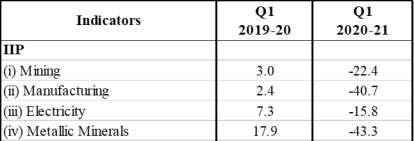
  • Industrial production (IIP) took a huge hit. The Metallic Minerals industry contracted by 43.3% followed by Manufacturing Industry at (-)40.7%. This was evident looking at the slumped metal consumption this quarter. Read More about India’s metal sector Here.
Index of Industrial Production(%)
  • The only industry in India with positive growth was Agriculture, Forestry and Fishing which was up by 3.4%. To read why the agriculture and other rural industries prospered during the lockdown, Click Here.
  • The Hospitality ( -50.3%) and Construction (-47%) industries were the most affected.
Gross Value Added By Different Industries.

Components of GDP

GDP(Y)= C + I + G + NX

The formula of GDP is as given above. Where:

  1. C = Consumption. Money spent by people or private expenses.
  2. I = Investment. The investment made by private players into local entities and businesses.
  3. G = Government. Government. Government expenditure or transfer payments such as education, healthcare, social protection.
  4. NX = Net Export (Export Minus Import)

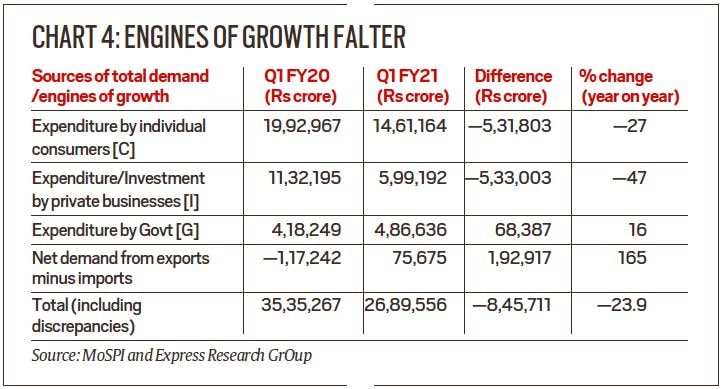
Lets understand how each of the four engines of GDP worked out this Quarter.

gdp, gdp data, gdp contraction, indian economy, indian economy covid lockdown, coronavirus lockdown, indian express news

The private consumption expenditure (C) fell 27%. Additionally, investments into businesses(I) also slumped by 47%. Government Expenditure increased by 16%. This is due to the Aid which the government had provided in the wake of the COVID-19 Pandemic.

The net exports increased by 165%, but is this a good thing? Generally, India’s imports are always more than its exports. Now, imports have fallen because India’s total demand has fallen as well, which is not good.

Conclusion

India’s contraction of GDP was unexpected. The GDP Growth estimate by World Bank was (-)4.5%.

According to the Centre for Monitoring Indian Economy (CMIE), salaried jobs suffered the biggest hit during the lockdown, with a total loss estimated stands at 18.9 million during the first quarter. Meanwhile, recovery in the second quarter has also not picked up as expected with various states announcing lockdowns due to rise in coronavirus cases in July and August.

When private consumption(C) falls sharply, businesses stop investing. Since both of these are voluntary decisions, there is no way to absolutely force people or businesses to spend more or indulge in expansionary economic activity. Lower interests in your Fixed Deposits and saving account is one way to try and make people spend money. Also, loans given out by banks have all-time low interests now to incentivise businesses to expand.

India is increasing Government Expenditure(G) with multiple PSUs announcing huge expansion projects. The second way out is Monetary policy. RBI has been involved recently in important Open Market Operations and Long Term Repo Operations(LTRO). Read more about it over here. Hopefully, these measures taken by the government will see quick reactions from the economy.