Categories
Editorial

What is smallcase?

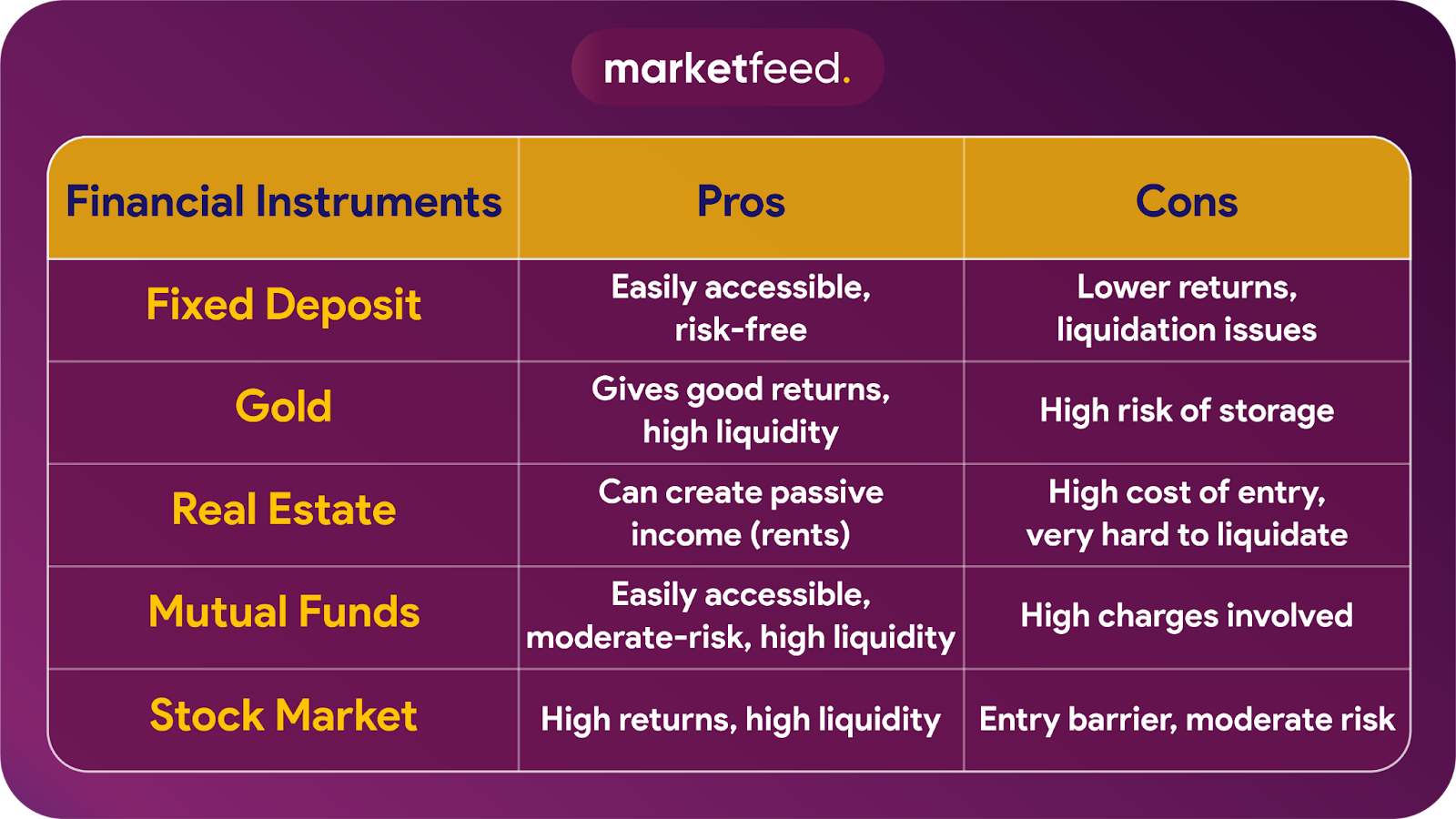
Here at marketfeed, we always promote the concept of long-term investments in the stock market. We believe that all individuals can achieve financial freedom by investing in fundamentally strong stocks over a long period. However, there are certain golden rules that one must follow to excel in this field. You must have a diversified portfolio, ie, own multiple stocks based on market segments and market capitalizations (small-cap, mid-cap, and large-cap). One must also start a Systematic Investment Plan (SIP), through which you can invest small amounts of money into stocks at regular intervals (usually every month). By investing passively, you will be able to gradually build your wealth.

In recent times, investing in the stock markets has become very easy and less time-consuming. Through a revolutionary platform called smallcase, one can easily invest their money in multiple stocks based on a well-defined idea or theme. In this article, learn more about smallcase and find out how it works.

What is smallcase?

smallcase is a simple investment platform that allows you to buy and sell stocks based on certain predefined combinations. It provides users with baskets of stocks (known as smallcases) that are based on certain ideas, strategies, or themes. This will be clear with the help of an example.

Suppose you believe in the idea that the future of mobility in India (and around the world) is electric. And, you wish to invest in those companies that would greatly benefit from the electric vehicle (EV) boom. If you want to passively invest in the stock market and do not have the necessary time to conduct a full-fledged analysis of the EV sector, you can simply select a smallcase known as ‘Electric Mobility’. This would include stocks of major battery manufacturers, auto components firms, power generation & transmission companies, automakers, etc. When you select this smallcase, your money gets invested in stocks of those companies that are expected to grow when there is growth in the EV space. 

As most of you are aware, stocks/equity has always delivered higher returns in the long run than other asset classes. Despite this, many people are still hesitant to invest in the stock market due to a variety of factors. The primary objective of smallcase is to help investors create a diversified portfolio of stocks for the long term so that their overall risks can be minimized. Owning multiple stocks will protect you from any rapid or unpredictable movement by a specific stock. The platform can be used by anyone who is looking to invest in Indian stocks or ETFs for the long term

How Does it Work?

You can easily access the smallcase mobile application or website using the credentials used for opening your broking account. [smallcase has partnered with almost all major brokerage platforms such as Zerodha, Upstox, IIFL Securities, 5paisa, etc] Once you are logged in, you can choose from a wide variety of smallcases that are based on different themes or strategies. smallcases are created and managed by professionals that are registered with the Securities and Exchange Board of India (SEBI). The companies (or stocks) included in all smallcases are thoroughly studied and analysed by these professionals. They would explain the reasoning behind the creation of the smallcase and specify the weightage of each stock. The Compounded Annual Growth Rate (CAGR) of every smallcase will be clearly mentioned.

For investing in a smallcase, funds will be used directly from your trading account (Kite, Upstox etc). smallcase is not connected to your bank account. One can either start a Systematic Investment Plan (SIP) or do a lump-sum investment (at one go). [The SIP amount would fluctuate based on market conditions.]

The amount that you have invested goes to different stocks, and you get direct delivery of those stocks in your Demat account. This means that you will have direct ownership of shares, just as in the case of buying individual stocks. The difference here is that with just one or two clicks, you are essentially placing orders for multiple stocks.

smallcase also gives you the option to add or remove stocks based on your own research. You can track the performance of each smallcase and analyse your portfolio. If there are dividends declared on any of the stocks in a smallcase, they will get credited to your bank account. There is no lock-in period, and you can exit a smallcase anytime. Since there is direct delivery of shares, you can sell or exit a particular stock of a smallcase from your brokerage platform whenever you want.

Rebalancing of Stocks in smallcase

The SEBI-registered professionals regularly review or monitor the stocks or ETFs of a smallcase. This is based on quarterly earnings and company news & updates. Most smallcases are rebalanced on a quarterly basis to ensure that the stocks included in them are the right choice for the underlying theme or strategy. If they feel that a stock is not performing up to expectations, they will remove it and add another one in its place.

When this rebalancing takes place, a notification will be sent to the users via email. You can review these changes and easily apply them through the platform. Thus, the stocks that got removed from the smallcase are sold, and the stocks which got added are bought.

Charges for smallcase

For all smallcases available on the platform, a one-time fee of Rs 100 + GST is applicable on the day of purchase. This amount is also applicable if you have created or customised a smallcase based on your own studies or preference. No extra charges will be applicable for further orders in the same smallcase.

  • Irrespective of the smallcase type, if you are investing less than Rs 4,000 on the date of purchase, you are charged only 2.5% of the amount invested + GST (18% on fees). That is, if you are investing Rs 2,000, then only Rs 50+GST will be charged instead of the standard Rs 100.
  • For the All Weather Investing and Smart Beta smallcases, there are no charges for buying and exit. However, there will be a fee of Rs. 50+GST that is applicable for any further order placed in these smallcases.

An important point to be noted is that all regular brokerage charges, taxes, or demat charges for buying and selling stocks will be applicable. (Kindly refer to all charges of your respective broking platforms before investing). On the day of purchasing a smallcase, these charges are automatically deducted from the funds in your trading/broking account. Any capital gains received from selling these shares will also be taxed as usual.

Conclusion

As you can see, smallcase is a very simple and relatively affordable platform that helps you stay invested in stocks (or direct equity) for the long term. The money that you wish to invest is spread across multiple stocks, which helps to minimise risks. All smallcases are explained in simple language, and you can easily track your investments. All Weather Investing and Top 100 Stocks are some of the most popular smallcases available at nominal rates.

The fact that smallcase is backed by brokerage firm Zerodha gives us a sense of safety and trust. At the same time, we would suggest our readers do their own research before investing in smallcases. One must always have a deep and proper understanding of how the market works. However, in the long run, platforms such as smallcase can definitely help you in your investment journey. 

You can learn more about the best investment options for beginners here. Explore smallcase. Also, you can check out some of the smallcases handpicked by our team here.

Happy Investing!

Categories
Editorial

Best Investment Options for Beginners

As of late, we have noticed that many of our readers are confused about how to start their investment journey. The primary motive behind investing your hard-earned income is to fight inflation or a general rise in the prices of goods. The purchasing power of cash in hand or your bank account continuously reduces with time. In order to beat inflation and achieve future goals, you need to invest your money in a variety of financial products.

Our primary mission here at marketfeed is to show the path for every individual to become financially independent. We help you make informed decisions in the beautiful world of finance. However, it is important that we start from the very basics and slowly work our way up. So, let us have a clear understanding of some of the best investment options that can help you achieve financial freedom.

Direct Equity

Direct equity means investing in stocks. When you buy stocks (or shares) of a listed company, you become part-owner of the firm (even though it’s a very tiny fraction). This means that you are directly investing in the company’s development and growth. In the long run, stock markets have always beaten inflation and have delivered higher returns than other asset classes. Thus, stocks are always ideal for long-term investments. To directly invest in shares or equity, you would need to open a Demat account.

However, investing in stocks contains a high level of risk. Stock markets are often very volatile, as a variety of factors (including interest rates, government policies, economic figures, company operations) influence the performance of stocks. You will have to actively manage your investments to limit losses. One needs to have a lot of patience and gain market knowledge to get sufficient returns. With time, you will learn how to pick the right stock and time your entry and exit. Target-oriented and well-researched stock market investments can definitely help you beat inflation.

Mutual Funds

If you are not comfortable with investing directly in stocks due to the risks involved, you can always invest in mutual funds. A mutual fund takes money (investments) from different individual and institutional investors who have a common investment objective. This pooled sum of money is managed by a professional fund manager, who invests in securities and assets to generate returns for investors. 

You can find equity, debt and hybrid mutual funds as a general classification. Equity mutual funds invest in stocks and equity-related instruments, while debt mutual funds invest in bonds and other debt instruments. Hybrid mutual funds invest in a mix of equity and debt instruments. There are various equity mutual funds based on market capitalization, tax-saving funds, sectoral funds, and much more. As per reports, the 5-year and 10-year returns of these equity fund categories were above 10% as of April 2021.

Mutual funds are a very attractive investment option as you do not have to spend much time and effort tracking them. Instead of investing a large sum of money all at once, you could start a Systematic Investment Plan (SIP) and invest small amounts of money periodically (usually every month) in mutual funds. They are very flexible, as you can begin and stop investing according to your convenience. However, one needs to conduct a proper analysis or study before investing in a particular mutual fund. Element of risk is also present as the returns are dependent on market movements.

Bonds

A bond is a fixed-income instrument issued by companies or even government entities to raise funds. Investors can lend their money to organisations in return for fixed yearly interest. At the time of maturity of the bond, you will receive the initial money you had invested and the interest offered on it. Nowadays, bonds offer fixed returns that are at least 2-3% higher than fixed deposits (FDs). Government bonds in India are an ideal investment option as it provides more than 7% guaranteed returns. 

Before investing in bonds, you need to consider and analyse important factors such as coupon rate (fixed interest that the bond pays annually), payment frequency (the number of times the interest is paid to the bondholder), maturity date, and credit rating. A higher-rated bond carries a higher level of safety of investment. AAA-rated bonds are the most secure.

Gold

Gold is one of the best asset classes that can be used to counter inflation. This is because the increase in gold prices and the returns from it have always been able to offset inflation in the past. According to the World Gold Council, for every 1% increase in inflation, there is a 2.6% rise in gold demand. This ultimately leads to an increase in gold prices. However, acquiring and holding gold in the form of jewellery has its own concerns such as safety and high cost.

An alternative way of owning gold is through paper gold or gold ETFs. These are units representing physical gold which may be in paper or dematerialised (electronic) form. One Gold ETF unit is equal to 1 gram of gold and is backed by physical gold of very high purity. The investments made in paper gold are less costly.

What are ETFs?

As the name suggests, an exchange-traded fund (ETF) is a fund that can be traded on the stock exchange. It is a method through which you can buy and sell a basket of assets without having to buy all the components individually. ETFs are managed by finance professionals who own certain underlying assets (such as stocks, bonds, currencies, and commodities). They design a fund to track the performance of these assets and then sell shares of these funds to investors.

ETFs are a great method to diversify your portfolio and manage risks. It is also a cost-effective method of investing and also offers several tax benefits.

Fixed Deposits, Recurring Deposits

Fixed Deposits (FDs) are an investment option offered by banks and financial institutions. It is something that most of us are familiar with. You deposit a lump sum of money for a fixed period and earn a predetermined rate of interest on it. The interest rate of FDs differs from one bank to another. However, the average rate of FDs in India is only 5-6%, which may be insufficient to beat inflation. FDs are favorable for those investors who wish to receive guaranteed, yet conservative returns.

Recurring Deposits (RDs) are a fixed-tenure investment option provided by banks and other institutions that allow individuals to invest a fixed amount every month for a pre-defined time period. The interest rate on RDs is determined by the institution offering them. RDs also offer complete capital protection as well as guaranteed returns.

Government Schemes

Public Provident Fund (PPF) is a long-term investment scheme provided by the Government of India (GoI) that has a lock-in period of 15 years. Currently, the annual rate of interest offered on PPF is 7.10%. The entire amount withdrawn at the end of the 15 years is entirely tax-free for the investor. You can also take loans and make partial withdrawals if certain conditions are met.

Employee Provident Fund (EPF) is a retirement-oriented investment scheme that helps salaried individuals. EPF deductions are a specific percentage of your salary every month, and the same amount is matched by the employer as well. This entire amount is pooled into your EPF corpus or account every month, and you receive interest on it. Currently, the annual rate of interest offered on EPF is 8.50%. At the time of maturity, the entire amount withdrawn from the EPF corpus is entirely tax-free.

The National Pension Scheme (NPS) is another tax-saving investment option offered by the Government of India. Anyone between the age of 18-65 years can make voluntary contributions to this scheme. Investors who subscribe to NPS will mandatorily stay locked in until their retirement and can earn better returns than PPF or EPF. Historically, NPS has delivered ~8-10% returns every year.

Real Estate

Investing in real estate is one of the best ways to diversify your portfolio. Since the value of a real estate property appreciates (or increases) with time, you can earn exponential returns on it. Acquiring a property and renting it out would be an ideal way to earn passive income. However, the location of the property is the most important factor that will determine its value and also the rental income that can be earned from it. In the case of residential properties, investors must always conduct a thorough study of home loan interest rates, offers provided by developers, and government regulations. Another important factor to consider is that real estate is highly illiquid. Properties cannot be sold off and converted into cash quickly.

If you don’t have adequate capital for acquiring real estate properties, you could always invest in a real estate investment trust or REIT. This is very similar to a mutual fund, wherein you can invest small amounts of money on certain income-generating assets and earn a good return from them. A REIT owns and operates several properties such as complexes, infrastructure projects, healthcare units, apartments, and more. The money pooled in from the REIT is used to manage these assets. And, the income derived from these properties or assets is shared among all investors (or unitholders) of the REIT.

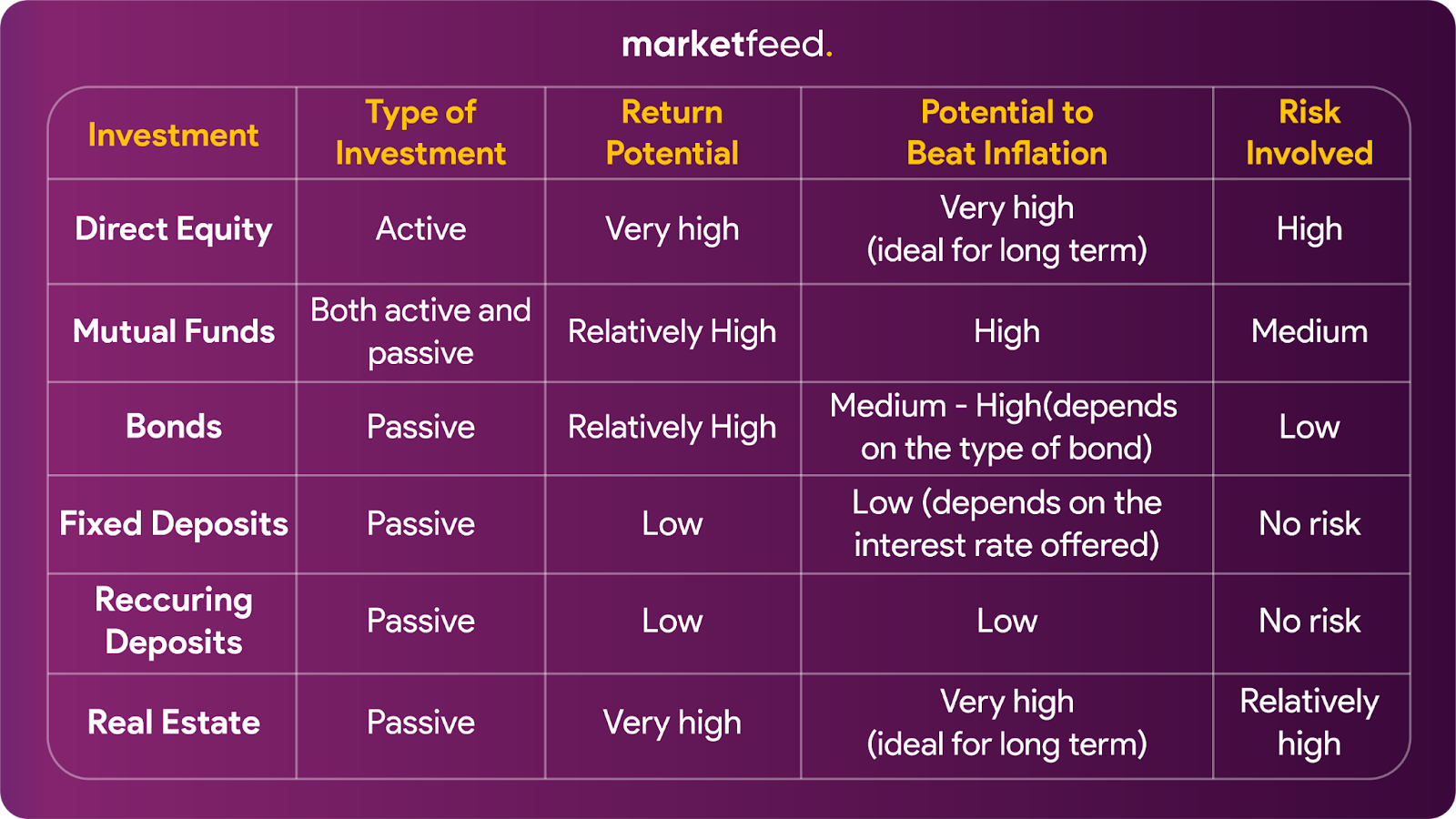
Types of Investments in a Nutshell

Conclusion

Now, you have an idea of how to grow your hard-earned income to beat inflation and lead a better life. However, it is up to you to figure out the right investment that fits your profile and financial goals. Start your investment journey only after carefully going through the risks and costs associated with each of them. Go for those investments that you clearly understand from your own research. At the same time, it is vital that you invest your money in different products and diversify your portfolio. More importantly, make sure you do not fall for scammy schemes that promise high returns in a short period. The sooner you start investing, the longer you will stay invested and earn higher returns.

Open a free Demat account –

Upstox
Zerodha

Happy Investing!