Categories
Editorial

How Adani Group Became India’s Largest Airport Operator

Adani Group is one of the biggest diversified conglomerates in India with a market cap of over ₹19.75 lakh crore. It has established a world-class transportation and utility infrastructure portfolio across our country. 

The group has spent the past few years expanding its businesses and even venturing into the data centers, cement, telecom, and media segments. It now owns India’s largest city-gas distributor, coal miner, private-sector port, and airport operator

Moreover, Adani’s airport business became the second-largest revenue generator for the group. In today’s article, we dive into how the Adani Group aims to transform India’s transit gateways into world-class destinations.

Adani Airport’s Origin

The Adani Group entered the airports industry in 2019 as part of its mission to become a recognised leader in the integrated infrastructure and transportation industries. The group is dedicated to providing travellers with the greatest airport infrastructure possible by delivering seamless and secure airport experiences.

Through Adani Airports Ltd (AAL), the group envisions redefining the city-airport relationship. It aims to build shared facilities that cater to the ever-evolving global travel, life, and work requirements. AAL is a 100% wholly-owned subsidiary of Adani Enterprises Ltd (AEL).

Source: AEL’s Investor Presentation

Adani Airport Holdings

Adani Airport Holdings is the airport management and operations subsidiary of the group. It holds controlling ownership in Mumbai International Airport Ltd (MIAL), which operates the Chhatrapati Shivaji Maharaj International Airport. It also holds a majority stake in Navi Mumbai International Airport (currently under construction). Additionally, the company has a 50-year lease on the international airports of Ahmedabad, Guwahati, Jaipur, Lucknow, Mangalore, and Thiruvananthapuram since January 2021. 

In February 2020, the company signed the Concession Agreement (CA) for three airports and subsequently commenced operations at Mangalore International Airport on October 31, 2020, Chaudhary Charan Singh International Airport (Lucknow) on November 2, 2020, and Sardar Vallabhbhai Patel International Airport (Ahmedabad) on Nov 7, 2020. Furthermore, it will operate, oversee, and expand each of the six airports for the next 50 years. 

Adani Airport’s Strong Growth 

Adani Enterprises Ltd’s (AEL) expansion and growth initiatives for its airports business are paying off! Its airport operations were the conglomerate’s second-highest revenue producer in the past financial year (FY22). 

The integrated resources management (IRM), solar, and mining businesses of the Adani Group are considered “established businesses”. Meanwhile, its airports segment is considered “emerging”. The airport business has grown substantially over the past year, contributing to strong revenue creation. However, the IRM division continues to contribute the most in terms of revenues and profits.

Financial Performance in FY22:

So far, the group has acquired management rights for at least eight airports, including four international and four regional airports. Together, these airports generated revenue of ₹1,165.58 crore in Q4 FY22, compared to ₹89.80 crore in Q4 of FY21. 

The airport business’ net profit stood at ₹75.37 crore in Q4 FY22. It incurred a loss of ₹87.78 crore in the same period last year (Q4 FY21).

As of Q4 FY22, Adani Airports Holdings’ total assets stood at ₹30,937.47 crore, compared to ₹2,062.23 in Q4 FY21. On the other hand, liabilities increased multifold to ₹8,266.30 crore in Q4 FY22, compared to ₹928.16 crore in Q4 FY21.

The group had to borrow huge funds to finance its airport projects.

Recent Developments 

  • AEL’s established businesses have been enhancing their performance, while new businesses like networked airport ecosystems, road & water infrastructure, and green data centres are expected to have a promising future. 
  • Out of the eight airports under AAL, at least seven are operational. Together, the airports handled 36.9 million passengers in FY22, accounting for at least 20% of the overall passenger traffic in India.
  • The company claimed that the next generation of its strategic business investments is centered around airport management and roads.
  • Adani Group is also aiming to build aerotropolises around airports. They plan to develop real estate projects alongside its airports in the country. These “aero cities” will include a variety of accommodations, conference centres, shopping, entertainment, healthcare facilities, logistics units, and business offices. The company is in preliminary talks with hospitality chains such as Marriott International, InterContinental Hotels Group (IHG), and Hilton for developing hotels under this plan. 
  • The company is looking to create ‘lifestyle destinations’ for customers both inside and outside the airport. Adani strives “to dominate the airports’ space with 300 million+ consumer base leveraging network effect and consumer mindset”.

Acquisitions:

  • Adani Airport Holdings acquired AirWorks, the oldest Maintenance, Repair, and Operations (MRO) firm in India, for an enterprise value of ₹400 crore. 
  • According to sources, the group is negotiating to buy a 30% share in a joint venture between US-based MRO provider AAR Corp. and Prajay Patel-owned Indamer Aviation. AAR holds 40% of the MRO business. The Adani Group is in negotiations to acquire half the stake held by Patel. 
  • The company is also poised to make a competitive offer for AI Engineering Services (AIESL), which is the MRO unit of Air India that the government is looking to sell in the first quarter of the next financial year (FY23).

Adani’s Mission 

From a college dropout to a business tycoon, Gautam Adani’s story is nothing short of remarkable. Adani Group, which focuses on large-scale infrastructure development in India, has established itself as the market leader in its transportation logistics and energy utility portfolio industries. 

Adani Group owes its success and leadership position to its core philosophy of ‘Nation Building’ driven by ‘Growth with Goodness’ – a guiding principle for sustainable growth. It is committed to increasing its environmental, social, and governance (ESG) footprint by realigning its businesses with an emphasis on climate protection. The group is also increasing community outreach based on the principles of sustainability, diversity, and shared values.

Adani is a prominent global infrastructure operator with a diversified portfolio of operations, including coal mining, coal trading, ports, power generation, multi-model logistics, renewable energy, and gas transmission and distribution. The group has long been renowned for its capacity for expansion and national-building aspirations. But will it continue to thrive or will it perish with the ‘emerging’ airport sector? 

Will a single entity be able to operate airports more efficiently or is there a danger of a monopoly arising in India’s airport space? Let us know your views in the comments section of the marketfeed app! 

Categories
Market News Top 10 News

Adani Group Gets SEBI Nod for Open Offer to Buy Stake in ACC, Ambuja – Top Indian Market Updates

Here are some of the major updates that could move the markets on Monday:

Adani Group gets SEBI nod for open offer to buy stake in ACC and Ambuja

The Adani Group has made offers of Rs 385 per share for Ambuja Cements and Rs 2,300 a share for ACC. The company intends to buy a 26% stake in both cement companies respectively for an amount totalling ~Rs 31,160 crores. Adani will acquire the stake from Holcim Ltd after it announced to buy a controlling stake in Holcim’s India businesses. 

Read more here.

IRCTC shares surge ~12% in two days after floating data monetisation tender

Indian Railway Catering & Tourism Corporation’s shares surged by nearly ~12% in the last two trading sessions after it floated a tender to hire a consultant to help it monetize its digital assets. The tender drew controversy as users questioned if IRCTC intended to sell private user data.

In response, IRCTC clarified as follows: “As a commercial entity, the company explores the business opportunities for new areas. As other business tenders, this tender has also been floated merely to appoint a consultant. The consultant will guide IRCTC and Indian Railways on monetization activities and advise on monetization value of Digital Assets by observing various Acts or laws, including IT Act 2000 and its amendments, User data privacy laws including GDPR (General Data Protection Regulation), and current Personal Data Protection Bill 2018 of India.”

Read more here

India’s inflation target breach for first time in six years

India’s inflation has breached the upper tolerance limit of 6% for three consecutive quarters for the first time in six years. The RBI has decided to call a meeting after October 12 to discuss a report to be submitted to the Union Government explaining the breach. The limit of the inflation target is fixed every five years jointly by the RBI and the Union Government. Currently, the upper limit is fixed at 6%, while the lower limit is at 2% until March 31, 2026. 

Read more here

Syrma SGS Technologies IPO: GMP jumps 28% ahead of listing 

Syrma SGS Technologies’ Rs 840 crore IPO got subscribed 32.61 times, whereas its retail portion was subscribed 5.53 times. The company’s shares are trading at a premium of 28% in the grey market, standing at Rs 35 per share. The tentative date for allotment of shares is August 23, 2022. 

Read more here

BSE’s market cap hits a new peak of Rs 283.5 lakh crore

Bombay Stock Exchange’s market cap has hit a new peak of Rs 283.5 lakh crore, with the SENSEX ending at 60,289 points at the day’s end. In January, the exchange had hit its last peak with a market cap of Rs 283.2 lakh crore. The rally in the previous two months is due to the net buying of Indian stocks by foreign portfolio investors

Read more here.

Government reviews windfall profit tax, RIL shares dip

On Thursday, the government increased the windfall profit tax on diesel exports to Rs. 7 per litre and reinstated a tax on jet fuel exports, although it decreased the tax on locally produced crude oil in line with softening rates. The tariff on domestic crude oil has been reduced from Rs 17,750 to Rs 13,000 per tonne.

Read more here.

Zomato-backed BlinkIt announces printout delivery to doorstep in 10 minutes

Zomato-owned quick delivery app Blinkit has started services to deliver printouts to your doorstep in just 10 minutes. Currently, the service is available in select areas of Delhi-NCR. It will charge an amount of ₹9 per page for black and white printouts, while ₹19 for colored. The service will now help users to get their documents printed and delivered quickly to their location by just uploading them on the Blinkit application

Read more here.

SBI shares dip after it sells KSK Mahanadi Power loan account to Aditya Birla ARC for Rs 1,622 crore

Aditya Birla ARC has purchased the KSK Mahanadi Power Company’s non-performing loan account from SBI for Rs 1,622 crore, taking an almost 58% haircut off the total outstanding balance in the process. As of April 2022, the total amount of loans still owed to the State Bank of India (SBI) by KSK Mahanadi Power Company was Rs 3,815.04 crore.

Read more here.

Categories
Market News Top 10 News

Rupee Hits 80 per US Dollar At Record Lowest – Top Indian Market Updates

Here are some of the major updates that could move the markets tomorrow:

Rupee Hits 80 per US Dollar At Record Lowest

On July 19, 2022, Tuesday, the Indian Rupee to US Dollar conversion rate hit a new record low at Rs 80 per US Dollar in the interbank spot exchange. The rising trade deficit, continuous outflow of foreign portfolio investors, and rising crude oil prices are some of the reasons that are said to have kept the rupee under pressure.

HDFC Life Q1 Results: Net profit rises 21% YoY to Rs 365 crore

HDFC Life Insurance Company Ltd reported a 21% YoY increase in net profit to Rs 365 crore for the quarter ended June (Q1 FY23). Total premium rose 21% YoY to Rs 9,396 crore during the same period. The first-year premium collection grew 27% to Rs 4,776 crore in Q1. The company’s subsidiary, HDFC Pension, crossed the Rs 30,000 crore assets under management (AUM) mark and has almost doubled its AUM in just 15 months.

Read more here.

SpiceJet launches 26 new domestic flights

SpiceJet Ltd has announced the launch of 26 new domestic flights. The airline will connect Nashik with Hyderabad and Delhi with Khajuraho under the UDAN scheme with new and additional flights starting July 22, 2022. The airline will also reduce direct flights to Nashik from Delhi, Hyderabad to Jammu, Mumbai to Guwahati, Varanasi to Ahmedabad, and Kolkata to Jabalpur. SpiceJet will deploy Boeing 737 and Q400 aircraft on these routes.

Read more here.

DLF aims to double retail presence in 4-5 years, building new malls

DLF Chairman Rajiv Singh said the company has initiated the development of new shopping malls and looks to double its retail portfolio in the next five years. At present, DLF has a retail footprint of 42 lakh square feet comprising eight properties, including malls and shopping centres mainly across Delhi-NCR. The company would also scale up the development of housing and office projects.

Read more here.

Indian Oil, NTPC form JV to set up a renewable energy-based power plant for refineries

NTPC Ltd has signed an agreement with Indian Oil Corporation Ltd (IOCL) to form a joint venture (JV) to meet the power requirements of IOCL’s refineries. Through this JV, Indian Oil plans to meet the additional power requirement of its refineries using round-the-clock renewable energy of up to 650 megawatts (MW) by Dec 2024. NTPC Green Energy Ltd (NGEL) will form the JV company to supply RE-RTC power to IOCLl.

Read more here.

HUL Q1 Results: Net Profit Up 11%

For the quarter ended June 30, 2022, Hindustan Unilever recorded an 11% increase in standalone net profit at Rs 2,289 crore as compared to Rs 2,061 crore in the same quarter last year. Revenue from operations increased by 19.48% YoY to Rs 14,016 crore from Rs 11,730 crore in the same quarter last year. Home Care delivered 30% growth driven by strong Fabric Wash and Household Care performance. Both categories grew in high double-digits with all parts of the portfolio performing well. 

Read more here.

Reliance Jio adds 31 lakh new mobile users in May; Bharti Airtel adds 10.27 lakh users

Reliance Jio Infocomm gained 31 lakh mobile subscribers in May 2022, taking its total user base to 40.97 crore. Bharti Airtel added 10.27 lakh users, and its total mobile subscriber count rose to 36.21 crore. Vodafone Idea lost nearly 7.59 lakh mobile subscribers during May, and its total subscriber base fell to 25.84 crore.

Read more here.

Russia defaults on LNG supplies to India. 

As a result of Russia’s retaliatory sanctions against one of the gas suppliers to India, at least five cargoes or shiploads of LNG have not been delivered by Russia to India. India’s GAIL Limited, a government-owned natural gas explorer and producer, has a long-term agreement to purchase 2.85 million tonnes of LNG a year from a Singapore-based subsidiary of Russian gas producer Gazprom.

Read more here.

Jio deposits the highest earnest money in the race for 5G Spectrum

Competing against Airtel, VI and Adani, Reliance Jio has deposited Rs 14,000 crore, with the DoT as earnest money deposit (EMD). An EMD is an amount that a buyer gives to the seller to show an inclination to successfully complete a deal. Adani Data Networks has deposited just Rs 100 crore, suggesting that the giant might buy spectrum only for airwaves in a few circles for the enterprise or limited use. Airtel and VI both deposited Rs 5,500 crore and Rs 2,200 crore, respectively. 

Read more here.

Categories
Market News Top 10 News

Gautam Adani Is Now The Richest Asian, Overtakes Ambani – Top Indian Market News

Gautam Adani is now the wealthiest Asian, overtakes Ambani

Gautam Adani, Chairperson of Adani Group, has overtaken Reliance Industries’ Mukesh Ambani as the richest Asian. According to Bloomberg Billionaire’s index, Gautam Adani is ranked #10, worth nearly $88.5 billion, just above Mukesh Ambani, who was ranked #11 at 87. Around a year ago, Gautam Adani had a net worth of $38.1 billion, less than half of his current net worth.

Read more here.

Airtel Q3 Results: Net profit falls 3% YoY to Rs 830 crore.

Bharti Airtel announced its quarterly results where the company’s consolidated net profit rose by 22%, to Rs 29,866 crore. Yet, the profit attributable to owners fell 3% to Rs 830 crore as against Rs 853 crore in the same quarter last year. The company’s total revenue rose by ~13% to Rs 29,866 crore against Rs 26,517 crore in the same period. Bharti Airtel’s Average Revenue Per User (ARPU) per month increased to Rs 163, as against Rs 146 in the same quarter last year.

Read more here.

IRCTC Q3 Results: Profit jumps ~3x to Rs 209 crore.

Indian Railway Catering and Tourism Corporation (IRCTC) has announced its quarterly results with a nearly three-fold jump in profits on a yearly basis (YoY). The company reported a Net Profit of Rs 209 crore this quarter against Rs 158.57 in the last quarter and Rs 78.08 crore in the same period last year. Revenue from operations was up ~141% to Rs 540.21 crore as against Rs 224.37 crore in the same period last year. IRCTC also declared an interim dividend of Rs 21 per share for FY 2021-22.

Read more here.

Adani Wilmar IPO debuts today, share price rallies ~18% 

Adani Wilmar, an FMCG company and a part of the Adani group, got listed on the exchanges today. The company opened up at a premium of nearly 13%. The day’s gain stood at 18%, where the price started from Rs 248 to Rs 270. Adani Wilmar is an FMCG company that offers kitchen commodities like edible oil, wheat flour, rice, pulses, and sugar.

Read more here.

Godrej & Boyce bag order worth Rs 550 crore.

Godrej and Boyce announced that the company’s power infrastructure and renewable energy business unit had secured orders worth Rs 550 crore. The order consists of 400kV new AIS substations, 220kV transmission lines, 220kV new GIS substations, and 220kV underground cables used in Transmission and Distribution.

Read more here.

RBI Monetary Policy meet begins today, Governor to announce policy resolution on Thursday.

The RBI Monetary Policy Committee meeting has begun today. It is responsible for fixing the benchmark interest rate in India. The RBI Governor Shaktikanta Das is likely to announce the policy on Thursday. A look at news ports all across shows that general market sentiment is that RBI might hike reverse repo rate and keep an accommodative stance.

Read more here.

Escorts Q3 Results: Net profit falls ~28%

Escorts announced its results for the third quarter for the FY 2021-22, where it reported a net profit of Rs 201.52 crore, down 28.19% from the previous year. The company’s revenue declined 2.97% YoY to Rs Rs 1,957.49 crore in Q3 FY22. As for sales volumes, Tractor volumes fell 19.8% YoY to 25,325 units in Q3 FY22 over Q3 FY21. Construction volumes were down 8.2% YoY, and Railway revenues grew 48.1% YoY in the same period. 


Read more here.

JSPL Q3 Results: Revenue up ~35%, net profit down ~33.5%

Jindal Steel and Power Ltd has announced its quarterly results where it reported a revenue of Rs 12,525 crore, up ~35% from the previous year. The company’s net profit declined by 33.5% to Rs 1,621.6 crore as against Rs 2440 crore posted in the same quarter last year. 

Read more here.

Huawei gets Rs 150 crore contract from Bharti Airtel

Chinese telecom giant Huawei has received a contract worth Rs 150 crore from Bharti Airtel for the maintenance and upkeep of its existing transmission network.

Read more here.

Categories
Editorial

Adani Group to Enter India’s EV Space?

The electric vehicle segment (EV) is gradually gaining momentum in India. During FY 2020-21, EVs accounted for just 1.3% of the total vehicles sold in our country. The figure is posed to rise in the coming years. Tata Motors, Hyundai, Mahindra Electric, MG Motor, and Ashok Leyland manufacture and sell some of the best electric cars and buses today. New-age tech companies such as Ather Energy and Ola Electric have also made a mark in the electric two-wheeler market. EVs are becoming more popular due to their environmental and economic benefits.

As part of its green energy roadmap, the Adani Group is making a strategic entry into the Indian EV market. In this article, we shall discuss how the Ahmedabad-based conglomerate plans to establish itself in the highly promising EV sector.

Adani Group’s EV Roadmap

  • The Adani Group has revealed plans to enter the electric vehicles (EV) segment. According to a report from the Times of India, a trademark has been registered for the name ‘Adani’ by S.B. Adani Family Trust. The trademark is proposed to be used for vehicles.
  • The group will set up a Research & Development (R&D) facility at Special Economic Zone (SEZ) in Mundra, Gujarat, for its electric mobility projects.
  • As per reports, the Adani Group will initially manufacture electric commercial vehicles, including coaches, buses, and trucks. These vehicles would be used for in-house requirements at Adani-owned airports and ports. This move will help them gather preliminary data for the further development of EVs.
  • The Adani Group is also preparing to manufacture batteries for electric vehicles and establish EV charging station infrastructure across India. 

Adani Group’s Wider Green Energy Push

The Adani Group has aligned its business strategies with PM Narendra Modi’s green energy targets. It had recently announced plans to invest $20 billion (~Rs 1.4 lakh crore) over the next ten years in solar, wind, green hydrogen, and energy infrastructure. The group also aims to triple the share of renewable power generation capacity in its total portfolio from the present 21% to 63%. 

Moreover, the business house will spend 75% of its planned capital expenditure (capex) until 2025 on green technologies. In October 2021, Adani Green Energy Ltd (AGEL) completed the acquisition of SB Energy India for $3.5 billion (~Rs 26,000 crore). SB Energy India was a joint venture between Japan-based SoftBank Group and India’s Bharti Group. It is the largest acquisition in the renewable energy sector in India so far.

Recently, the Adani Group set up a wholly-owned subsidiary, Adani New Industries Ltd (ANIL), to venture into new energy space. With a focus on green hydrogen and other products like wind turbines, solar modules, and batteries, the group aims to become the world’s largest renewable energy company!

The Way Ahead

The Indian EV market is still at its infancy stage. The shift to electric mobility will help our country achieve its green energy targets. It will require coordinated efforts from the government, automobile and auto component makers, chemical manufacturers, etc. Subsidies from state governments and the Fame II initiative have already led to high competition in the EV space. Moreover, the EV revolution requires a sizable investment in research and product development, especially when it comes to battery/charging infrastructure. 

The Adani Group aims to address this market with its deep pockets. The group’s entry into the EV business is another aspect of its net-zero emission goals. They will leverage the capabilities of each group company to manufacture cost-effective EVs in our country. This move would ultimately mean more competition in India’s EV space. Let us look forward to seeing how the conglomerate implements its strategic plans.

What are views on Adani Group’s foray into the EV sector? Let us know in the comments section of the marketfeed app.

Categories
Editorial

Why You Should Look Into Power Distribution and Transmission Companies

Ever wondered about how the power sector in our country works? And what are the opportunities that lie in the industry? For the first time since the liberalization policy in 1991, India’s power sector is going to change for good, in a way that could benefit both consumers as well as power companies. The Finance Ministry is pushing for privatization and delicensing of the power sector which could change the way the power sector works in India.

The total installed capacity of power stations in India stood at 373.43 GW as of October 2020. The transmission lines in India are 4,98,651 km long. According to India Brand Equity Foundation (IBEF), between 2000 and 2020, the power sector attracted Rs 1.11 Lakh Crores in Foreign Direct Investment (FDI), which is close to 3% of the total Foreign Direct Investment(FDI) inflow in India.

Currently, the power distribution companies(Discoms), transmission companies(Transcos), and generation companies(Gencos) are distressed financially due to reduced electricity demand along with unfair pricing and power policy.

With the Budget 2021 and the Electricity Amendment Bill 2020, the power sector is in for a revolution. If the bill is passed in the parliament, it could change the face of the industry. In this piece, we explore how the power sector fairs in the stock market and the listed power companies that have a potentially good investment perspective.

The Companies in the Sector

Power Grid

With a market cap of Rs 96,496 crore, Power Grid is India’s largest state-owned power transmission company in India. It is classified as a Maharatna PSU.  It has an annual Return on Equity of 17%, which means that for every Rs 100 invested in the company, one makes another Rs 17 on it. The company has a Return on Capital Employed(ROCE) of 5.44% and Return on Asset(ROA) of 4.3% which means that it is utilizing its capital and infrastructure pretty efficiently. With 5G coming in and the rising electric vehicle market, the need for additional transmission grids are also likely to increase. Power Grid has also filed for an InvIT or an Infrastructure Investment Trust IPO. The IPO is likely to put the company in a favorable position in the markets

Adani Transmission Ltd

Adani Transmission Ltd is the subsidiary of the Adani Group. It is the largest power transmission company in India. Adani Transmission Ltd. has:

  •  A 27,000+ megavolt ampere of transmission capacity. 
  • 3,000,000+ distribution customers
  • 15,400 in transmission line length

Adani Group companies are almost intensively fuelled by debt, but it has a reputation of repaying and gaining a position with time. Adani Transmission over the years took huge debt burdens but managed to pay it back all in time. Most of its debt now is forex debt, which according to the company is cheaper than domestic loans. 

The company transmits electricity to Mumbai, the financial capital of India along with holding assets in 8 other major projects. Adani Transmission has returned 1131.5% in the last 5 years. This means that Rs 1 lakh invested would have turned into 11 lakhs in a period of 5 years, from 2016 to 2021. 

Torrent Power

Torrent Power is a power generation, transmission and distribution company based in India. Torrent’s stronghold is the state of Gujarat where it transmits and distributes electricity to major cities. Apart from Gujarat, the company holds its presence in Bhiwandi(Near Mumbai), Agra(Uttar Pradesh) and other cities in Maharashtra. It has a total generating capacity of 3191.6 MW.

Some electricity that is produced isn’t able to reach the right customers through transmission and distribution lines in case of theft, damage or heat dissipation. This is known as T&D Loss. Torrent Power’s T&D loss is one of the lowest in the country, which is ~4.5% as compared to India’s average T&D loss of 20%. This means that Torrent Power has the right technology, surveillance and assets to supply electricity seamlessly.

Speaking from a financial perspective, the company has constantly rising Profit After Tax(PAT) and Sales Volumes. Over the past 5 years, the company has returned 31.2% on investment. The company’s Return on Equity stands at 12.82% as compared to Industry ROE of 9.5%.

Torrent Power Adjusted Profit and Net Sales(Source:Edelweiss)

CESC or Calcutta Electric Supply Corporation Limited

CESC Ltd. is a power generation, transmission and distribution in and around the city of Kolkata and a few districts of West Bengal. Along with West Bengal, the company also holds generation and distribution businesses in Rajasthan and Maharashtra. 

The company did not fare well in the past 3-4 years, however, there have been recent changes in volumes. The sales volumes in West Bengal has crossed pre-COVID levels and their generation businesses in Rajasthan are likely to turn profitable pretty soon. Loses in the distribution business has reduced significantly. The company is likely to get a push with the Rs 3 Lakh crore stimulus package for electricity distribution companies. The company also offers one of the highest dividends to its shareholders in the power sector. Shares have gained 14.2% in the past 6 months since August 2020.

CESC Price Performance(Source: ICICIDirect)

Tata Power

Tata Power specializes in both generation and power supply. Close to 60% of Tata Power’s revenue comes from power generation, whereas the other 40% comes from transmission and distribution. Tata Power supplies electricity to the cities of Mumbai, Ajmer, and Delhi. It caters to around 26 lakh consumers in Mumbai and Delhi distribution areas, having close to 21,000 circuit kilometers in transmission and distribution grids. The company also holds ~10% market share in the rooftop solar(RTS) energy market in India.

During COVID-19 lockdown, like the rest of the sector, Tata Power too saw a reduction in transmission and distribution revenue segment. Tata Power has been focusing on reducing debt by selling non-core assets or assets that do not add to the core revenue of the company. It has managed to reduce close to ~14% of its debt in the past 1 year. The company’s debt to equity ratio has been decreasing constantly which signifies that the company has been cutting down on debt and catching up on equity in the company.

Privatisation and Delicensing of the power sector will indeed be a positive sign for Tata Power considering that it is the third largest power producing company in India.

IEX

The Indian Energy Exchange or IEX is an electronic power trading marketplace for electricity corporations and boards to trade contracts related to energy. In simple terms, just like how individuals can trade in the stock market to gain profit, electricity corporations can trade on the IEX to increase profitability and have better price discovery. All the three, i.e. Power Generation Companies(Gencos), transmission companies(Transcos) and Distribution Companies(Discoms) can trade on the IEX. IEX has recently seen a spike in volume due to volatility in electricity prices. marketfeed has dedicated two special articles on IEX.

To know more about how the company functions internally and the process of power trading, Click Here.

To know about, IEX as a stock to invest in, financial analysis, profitability and future prospects, Click Here. 

Budget 2021

Budget 2021 has received a positive response from the power sector. Finance Minister(FM) Nirmala Sitharaman allowed a much expected Rs 3 lakh crore to the power sector with the intention of reviving stressed discoms. The distribution of the fund will be over a period of 5 years. It will help in reducing losses and also improve efficiency along with increasing rural penetration. The FM also announced developing a framework for allowing the consumers to have their choice of electricity supplier. This will promote healthy competition and allow for healthy price discovery. 

The FM also announced the aspects of the Electricity(Amendment) Bill 2021, wherein the power sector will be ‘delicensed’ and thereby give smaller power companies a greater opportunity to expand. Apart from this, the government has also announced a Rs 2,606 crore allocation specifically for the solar power sector and also laid emphasis on shifting from using coal as a fuel to renewables.

Invest In Power

The Budget 2021 was indeed a historical one as it addressed a needed boost after the impact of COVID-19. It addressed not only the problems of the distressed power distribution companies but also hinted that the renewable energy sector is taking off. India currently is undergoing a coal crisis. Coal resources are being depleted and renewable energy is relatively more expensive. 

The Indian Power Sector is undergoing a major change, in a way that will change the market outlook for the first time in decades. The power policies in India are made in a way that politically benefits the governments of respective states. They are addressed to benefit the common man. This impacts the power companies as they are faced with reducing demand, falling profits, and increased costs. The power sector was given a ‘Negative Outlook’ by  ICRA, a renowned credit rating agency. Due to the COVID-19 pandemic, the demand for power took a fall and dented the power sector. 

The focus of power companies right now is to increase rural penetration, boost profits and achieve maximum efficiency. ‘Delicensing’ of the power sector will ensure less government intervention and increase cash flows for the power companies. India’s infrastructure boom, rising electric vehicle industry and the 5G revolution shall definitely enhance demand for the power sector. The future of the power sector is bright indeed.

Categories
Editorial

Company Analysis: Indian Energy Exchange

What is the Indian Energy Exchange?

The Indian Energy Exchange or IEX is an electronic power trading marketplace for electricity corporations and boards to trade contracts related to energy. In simple terms, just like how individuals can trade in the stock market to gain profit, electricity corporations can trade on the IEX to increase profitability and have better price discovery. It is a place where participants can buy and sell energy through a double-sided closed auction process. 

State Electricity Boards, power-producing companies, power transmission companies, and power traders that have a huge capital trade on IEX. IEX is one of the only two power exchanges apart from Power Exchange India Limited(PXIL).

The IEX started operations in 2008. The Central Electricity Regulation Commission(CERC) regulates the IEX, just like how SEBI regulates the NSE and BSE.

Financial Vitals of IEX

Share Performance

  • As of January 2021, the company’s share price has grown by ~38% since IPO and by ~94% in the past 1 year. The company’s share price has been less volatile but with consistent growth. It has a market cap of Rs. 7000 crore.

Growth in Net Profits/Revenue/Earnings

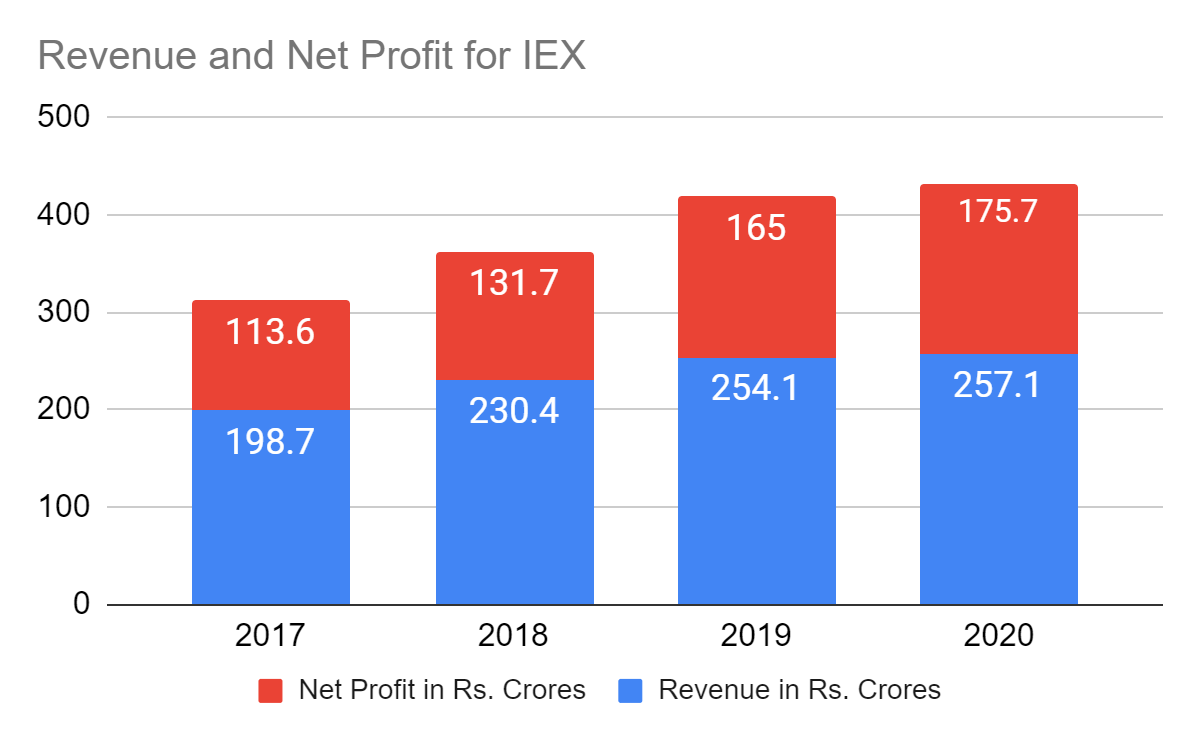
  • The company’s sales, revenue, and net profit have been growing constantly for the past 5 years. As demand for power increases, there will be an increase in power trading to find a better price for power.

Increasing Trading Volumes

  • On average, 6000+ MW of electricity is traded daily on the exchange. The traded volume is growing at 32% CAGR. It has a consumer base of 4000+ Industries, 55+ distribution companies, 500+ generators, and 1500+ renewable energy generators. The company has also seen increased trading volumes on the BSE and NSE.

Increasing ROE/EPS

  • For IEX, the Return on Equity(%) or ROE is ~45%. This means that for every Rs. 100 invested in the company, the investors earn close to Rs. 45 every year. The company’s price-to-earnings ratio or PE ratio has been declining constantly for the past few years. The fact that the company has excellent profitability and increasing revenue, it could probably mean that the company is undervalued and sees higher growth potential in the markets. 

Increasing FII/MF shareholding

  • The company has an increasing FII(Foreign Institutional Investors) shareholding in the company. In fact, it has doubled between September 2018 and September 2020. This shows that foreign investors are bullish on the idea of power trading in India and see a greater potential in IEX. Mutual Fund’s shareholding has also increased by 4.5 times in the past two years between 2018 and 2020.

No Debt

  • The company has no debt or is not operated on credit. This saves it from default risk. 

Decreasing Clearing Price

  • The clearing price is the price that companies pay to buy power after the bidding process is complete. The average market clearing price has gone from as high as Rs.3.38 per unit in July 2019 to as low as Rs. 2.35 per unit in June 2020. A decreasing clearing price means that more companies would flock to power exchanges for cheaper electricity.

Increasing Dependency on Green Energy Over Coal

As Governments push for environmental regulations and promote green energy, there is a greater incentive for companies to invest in them. Moreover, coal prices are pretty volatile citing quality concerns, regulation, and also the recent decision for Coal Mine Auction by the Government. Products like Energy Saving Certificates, Green TAM, and Renewable Energy Certificates on IEX will have a greater demand. 

Indian Gas Exchange

The Indian Gas Exchange or IGX is a subsidiary of IEX which is an exchange for trading in gas. It is India’s first electronic delivery-based gas exchange. It is regulated by the Petroleum and Natural Gas Regulatory Board. IGX currently offers trading in five contracts namely: Daily, Weekly, Weekday, Fortnightly, and Monthly. It has three physical setups, two in Gujarat and one in Andhra Pradesh. 

Electricity Amendment Bill

The Electricity Amendment Bill is a prospective bill that will enable power companies to retain greater profits. The bill also aims to prevent the high number of defaults in the energy sector, often by the state regulatory board themselves. The bill also addresses the weak financial health of power companies. It aims to privatize and centralize electricity transmission and distribution. The National Renewable Energy Policy also promotes the production and use of renewable energy throughout the country. 

IEX as a share to invest in hasn’t caught the eye of retail investors. The company’s price is supported by a good balance sheet and awaits a great future considering the recent developments in power policy and the shift of focus towards renewable energy. One should look out for future events like the Electricity Amendment Bill. A mix of all can ensure greater participation in the Indian Energy Exchange, thereby increasing trading volumes and cash flows for the companies.

To know more about how the exchange functions and the products it offers, click here.

Categories
Editorial

Is Adani Green Overpriced? The $6 Billion Trap for Retail Investors

Adani Green is a renewable energy company owned and operated by the Adani Group, headquartered in Ahmedabad, Gujarat. If you are a stock market participant, you may know it as the company whose shares just keep going up and up!

While Adani Group is generally infamous for its coal-related businesses, Adani Green’s projects include solar energy, wind energy, and hybrid solar-wind energy projects. Adani Green has a market capitalization of Rs 1.75 lakh crore. The company’s share price has risen by 1207% in one year’s time. This means that if you had invested Rs 1 lakh and a year back, you would have had Rs 13 lakhs in hand right now. That is a lot of money, considering that the company was listed only in the year 2018 and only 20% of its total projects are operational. This means only 20% of its commissioned solar and wind projects are generating electricity. Why did the share price rise so much? Is the share overpriced? Let’s jump right into it.

Why is Adani Green Share Going Up Endlessly?

Adani Green has managed to have a project portfolio of 14,000 GW/Gigawatts. It means that if all of his projects become operational they will generate 14 GigaWatts of electricity, which can realistically power up to 42 Lakh homes. 

In June 2020, SECI or Solar Energy Corporation of India had awarded Adani Green a bid to build an 8 GW solar project worth Rs 46,000 crore. This is by far the world’s largest solar power project. This is the main reason for the optimism towards Adani Green in the markets. This project will lead to the creation of 4 lakh direct and indirect jobs and a reduction of 900 million tonnes of CO2(which is a lot).

In October 2020, Adani in a joint venture with French-Multi National ‘Total SE’ acquired solar assets of Essel Group of 250 MW for Rs 1,632 crore. These projects are located in Punjab, Karnataka, and Uttar Pradesh. French power company ‘Total SE’ has invested Rs 3,370 crores to form a joint venture with Adani.

According to the latest report of global solar companies, Mercom Capital has ranked Adani Green as #1 globally in terms of power generation, operational, and contracted projects. Adani Green has set a target of 25GW of renewable projects by 2025.


Currently, Adani Green’s shares are driven by the prospects of future growth and the speculation of more power purchase agreements with state electricity companies, transmission, and distribution companies. Also, hope you understood that the massive 8GW project is almost half the market cap of the company.

Is Adani Green Overpriced?

It was recently discovered that Adani’s Rs 46,000 crores 8 GW project didn’t have a guaranteed power purchase agreement by SECI. This means that SECI wasn’t obliged to buy power from Adani Green’s 8GW solar project as was speculated earlier. Instead, SECI would ‘facilitate’ in getting bidders for the solar project. This leaves the 8 GW solar project in a bit of a dilemma. 

Generally, Adani’s companies are highly leveraged or fuelled by debt/loan. Adani Green has a net debt of Rs 13,362 crores. Such high debt isn’t reflecting in its earnings for now. The company has been posting losses consistently. Its debt to equity ratio of 9.85 is considered pretty high as compared to its peers This high debt has added a risk factor to Adani Green. A debt to equity ratio of 1.0 would mean that both the lenders and shareholders of the company are on an equal footing.

Let us consider two more ratios to assess the valuation of the company. The Price to Earnings ratio or P/E ratio and the Price to Book Value ratio or the P/B Ratio. These values compare the price of the share to respective parameters to check if the valuation is fair. According to tickertape, the PE ratio of Adani Green is -7715.1 as compared to an industry average of 16.19. The difference is huge and indicates that the company has an obscenely expensive valuation. 

The company’s PB Ratio is 77.51 as compared to the industry average of 1.81. The book value of a company is the company’s assets minus its liabilities. Price to book value ratio is used to compare a company with its peers. Once again, the PB ratio is unnaturally higher than its competitors.

An expensive evaluation doesn’t always mean that the shares of the company are going to fall or that the company is performing badly. It just increases the risk and volatility involved. It also represents a positive sentiment in the market in favor of the company and that the investors have certain expectations from the company which might be met or not be met. Adani Green has definitely been in the good books of many investors, hitting the upper circuit constantly. 


Let’s take the example of Jio. Reliance Jio had taken MASSIVE amounts of debt and offered obscenely cheap tariffs to its users while it focused on capturing the market. There were speculations on whether Jio would be able to pay back the amount. Fast forward to June 2020, Jio has become net debt-free alongside parent company Reliance. Given the high amount of debt that Adani Green possesses, the company might just be a risky investment, but not a bad one. Adani Green has recorded a profit in the last 4 out of 5 quarters.

At present, the share price of Adani Green is overvalued, and therefore a huge fall in prices can trap retail investors. It is advised that retail investors do their research and keep an eye on how Adani Green manages to complete its commissioned projects, find a suitable buyer for the big projects and, at the same time reduce its debt burden. Also, remember that even completed projects are not being utilised to its full capacity. Is the management neglecting the company and its future?

Categories
Editorial

Australians are Protesting Adani, Here’s Why.

The Adani Group is an Indian multinational conglomerate that deals in Petroleum, Gas, Power, Green Energy, Infrastructure, etc. The group led by industrialist Gautam Adani has been in a stir in the past for tax evasion, charges of corruption, and environmental degradation. Moreover, Australians are hating on Adani, protesting, and trying to stop him from operating there. Let’s find out why.

  1. What is Adani Doing in Australia?
  2. Why do the Australians Not Want Adani?

What is Adani Doing in Australia?

The Adani group in Australia is working on the following:

  • Carmichael Rail Project, a 200 km rail project, which will be used for passenger and freight transport, mostly coal from the Carmichael Coal Mine.
  • Running two major solar power plants with a total capacity of 194 Mega Watts.
  • The Abbot Point Terminal, which is a cargo handling shipyard on the coast of Queensland.
  • Lastly, The Carmichael Coal Mine Project, which the center of all the controversies and protests in Australia.

Adani took an opportunity to learn the politics of Queensland. As the elections neared, Adani set sail. It got the politicians of the Australian Labor party to convince the citizens about how unlocking the Carmichael Coal Mine can lead to economic development in the area. Adani and its lobbyist held public meetings to convince the locals on how India’s demand for coal can fuel fortune for Queensland.

The Carmichael Coal Mine project is expected to cost A$2 Billion(Australian Dollars) and close to 2000 jobs in the region. Moreover, both the state and federal governments at the time had even given subsidies to fuel the Carmichael coal mine and railway line project.

These are the major projects being handled by Adani, in Australia. But clearly the locals are not happy with the company’s proceedings. Let us see why!

Why Do Australians Not Want Adani?

The Carmichael Coal Mine Project is the reason why there are mass protests against Adani. According to the website www.stopadani.com, the reasons for the protest against the coal mine project and Adani is as follows:

  • It allows more than 500 coal ships to travel through the Great Barrier Reef World Heritage Area every year for 60 years. Coal being a pollutant could damage the reef and aquatic life.
  • They get access to 270 billion liters of Queensland’s precious groundwater for 60 years, for free.
  • It adds 4.6 billion tonnes of carbon pollution to our atmosphere.
  • The coal project unlocks the Galilee Basin, a 2.47 lakh square kilometer thermal coal basin, which is primarily untouched ecologically.

These are not the only reasons however, these are simply environmental risks associated with the project. There is more as to why the Australians do not want Adani in the country and that is Adani’s bad reputation.

Speculations suggest that there is a political motive of the Australian Labor Party behind it. However, Adani doesn’t have clean hands either, a website called AdaniFiles, states that this could be a dodgy setup for dodging taxes linking Adani’s Australia project and his offshore assets in the Cayman Islands.

Adani has been fined by Australia’s regulators for misinformation. Additionally, Adani is a part of controversies such as the Belekeri Port Scandal, 2011 Mumbai Oil Spill Case, Zambia KCM Pollution Case, Jharkhand Land Grabbing Case, and other countless legal and regulatory battles. Adani’s massive lobbying and contacts with the Indian government has given him a clean cheat for most of its wrongdoings.

Adani was caught up in the news for hiring a private investigator to spy on a nine-year-old girl. Yes, imagine this. How much more creepy can this company be? She is the daughter of an environmental activist who was a part of protests against Adani in Australia.

This is what the Australians fear. Adani’s disregard for regulatory authorities and the environment. They fear that Adani might commit an economic, environmental, and/or financial atrocity and get away with it.

To know more about why Australians are protesting against Adani along with the legal and regulatory developments, You can visit:

https://twitter.com/stopadani/status/1332198282588655621

Even though the website names are funny and catchy, the topics discussed and the fight are indeed serious. The Adani Group is creating problems in India, as well. We can observe how this rapidly growing company continues to make problems everywhere it goes. Next day, we can also talk about the current protests in Goa, and how Adani is involved there too!

Categories
Market News

Adani Power Q1 Results: Net Loss At Rs 682.5 crore

Adani Power came out with its results recording a Net Loss standing at Rs 682 crore as compared to Rs 1,312.9 crore. in the quarter ending March 20′ decreasing Net Loss by 49%(QoQ).

Q1 FY21Q4 FY20Q1 FY20QoQ%YoY%
Revenue5,356.26,327.68,014.5-15.35-33.17
Net Profit/Loss-682.5-1,312.9-263.448.02-159.19
Amount in Rupees Crores

Adani Power Limited is the power business subsidiary of Indian conglomerate Adani Group with head office at Ahmedabad. The company is India’s largest private thermal power producer, with a capacity of 12,450 MW.

The average Plant Load Factor(Capacity Utilisation) of 51% in Q1 FY 2020-21 vs 78% in Q1 FY 2019-20. The PLF is lower due to the decline in power
demand following the announcement of a nationwide lockdown to combat COVID-19
. Consolidated Units sold for the quarter are 12.7 BU, as compared to the Q1 FY20 sales the volume of 16.5 BU.

The Future

The Madhya Pradesh Electricity Regulatory Commission has approved a 1.23 MegaWatt Power Supply Agreement (PSA) with the company’s wholly-owned subsidiary, Pench Thermal Energy (MP) Ltd. and MP Power Management Company Ltd. The power to be supplied under this PSA will be supplied by a 1.32 MW power-plant to be set up in Madhya Pradesh under a Design, Build, Finance, Own. and Operate basis.

Adani Power Ltd. has also signed a definitive agreement to acquire a 49% stake in Odisha Power Generation Corporation Ltd. (OPGC) from the affiliates of AES Corporation, a US-based energy company. The deal is estimated to be an INR equivalent of $135 million. The company seems ready make a recovery once the COVID situation normalises.

You can read the official result over here.

Categories
Market News

Adani Gas Q1 Results: Net Profit drops 42%

Adani Gas Ltd, reported a 42% drop in Net Profit as sales volume were impacted due to the lockdown. Net Profit of Rs. 46.33 Crore was declared for the quarter ending June 20′. Total Income dropped from 502.05 on June 19′ to 214.94 June 20′ which is a reduction of 57%(YoY). EBITDA stood at INR 86 Cr vs. Q1 FY20 EBITDA of INR 146 Cr

Q1 FY21Q4 FY20Q1 FY20QoQ%YoY%
Revenue214.94502.09489.71-57%-55.9%
Net Profit/Loss46.33122.0779.27-62.04%-41%

Gas sales volumes dropped to 64 million standard cubic meters(MMSCM) in the first quarter of fiscal year beginning April 2020, from 137 MMSCM in the same period a year back.

Piped Natural Gas and Compress Natural Gas Consumption

With continued lockdown of 69 days in Q1FY21, Adani Gas witnessed volume impact of 53% as compared to Q1 FY20. There was a progressive rebound in volumes as compared to the pre-COVID situation and exit volume as on 30th June 2020 had already reached at 1.25 MMSCMD as compared to 1.60 MMSCMD for the month of Mar’20. The operational performance of the business continues to be recovering in a phased manner towards Pre COVID level.