Algo trading has revolutionised financial markets by enabling the execution of complex strategies with greater precision and speed. In this article, we’ll break down the essential components of a simple algo trading system. We’ll explore the tools and platforms that work together to create a seamless trading ecosystem. Get an in-depth understanding of building and optimising your algo trading setup!
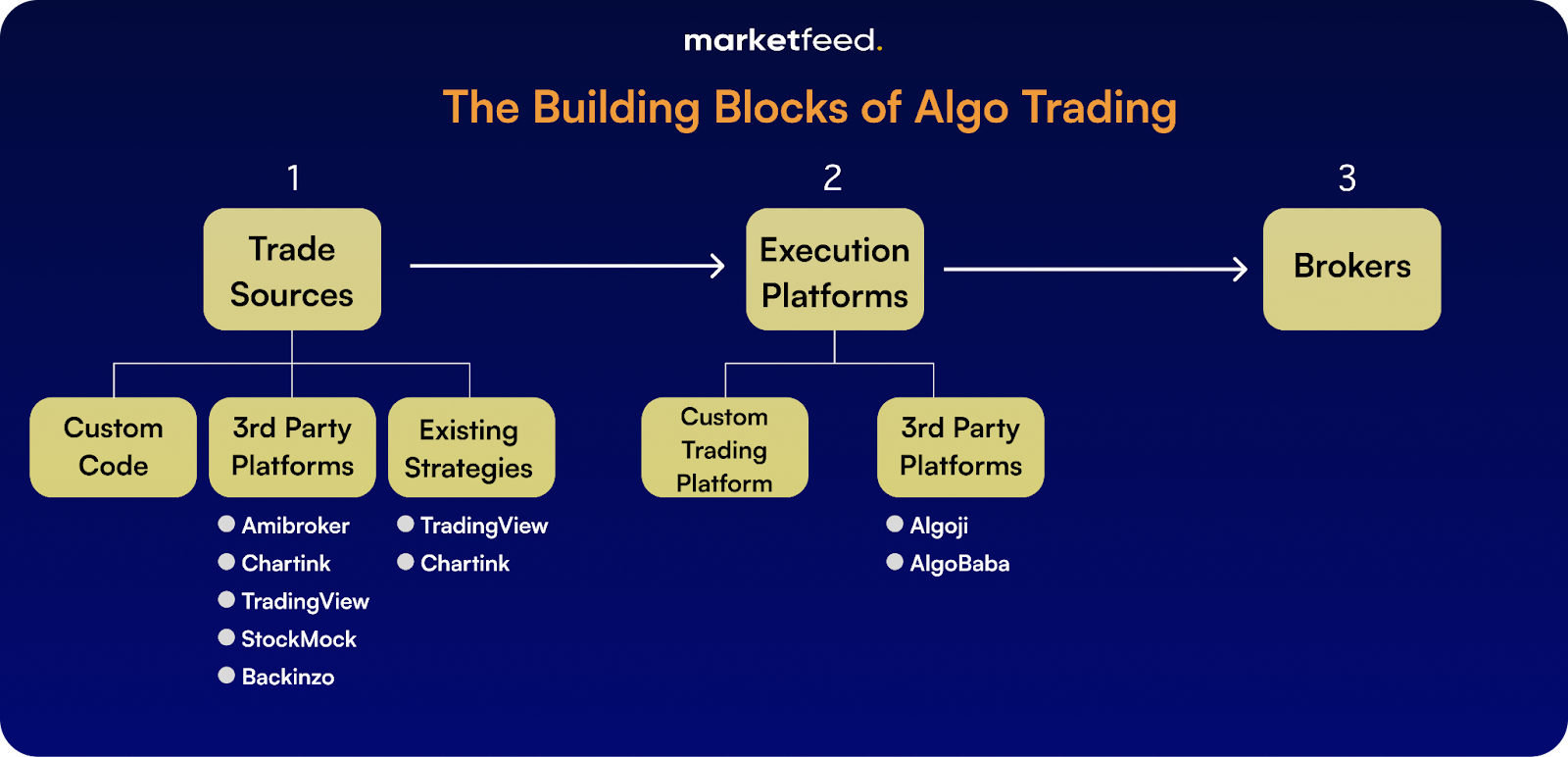
The Building Blocks of Algo Trading
This image represents significant components of an algo trading system, categorising them into three broad parts: trade sources, execution platforms, and brokers.
1. Trade Sources:
An algo trading system must be backed by dependabledata sources and trading signals. These resources provide important data and insights that enable traders to construct algo trading strategies, backtest them, and run them efficiently. In this stage, traders can have three approaches: custom code, custom strategies on third-party platforms, and using pre-built strategies available on these platforms. Let’s explore these approaches in depth:
Custom Code:
First, using fully custom code offers maximum flexibility. Traders can code highly tailored strategies that closely conform to their trading goals using programming languages like Python. Everything from the smallest detail of data processing to the execution will be under one’s control. However, this approach requires a good deal of programming knowledge and expertise in financial markets.
Developing Custom Strategies on Third-Party Platforms:
Secondly, some traders like to develop their custom strategies on third-party platforms. These offer powerful tools and interfaces for creating and testing trading algorithms. Some of them are:
Amibroker: It’s a comprehensive desktop-based software designed for stock analysis and algo trading. The platform offers extensive customisation in technical analysis and strategy development.
Chartink: With its easy-to-use interface and a wide array of technical indicators, Chartink assists traders in creating and scanning for specific trading setups without having to write code.
TradingView: Intended for those traders who would like to code their strategies in the Pine Script and share them with the global community. The platform offers basic backtesting facilities.
StockMock: It is designed especially for backtesting any option strategy and provides a user-friendly interface to test trade ideas.
Backinzo: This all-in-one solution offers flexible backtesting and seamless integration with most data providers, making it the ideal choice for traders seeking detailed and accurate evaluations of their trading strategies.
Algotest: AlgoTest makes it easier for retail traders by including many pre-built strategies and easy-to-use tools, allowing them to go through the entire backtesting process.
Use Existing Strategies from Third-Party Platforms
Many traders opt to use existing strategies on third-party platforms. This can save time and reduce the complexity of developing a strategy from scratch. Platforms like Chartink and Tradingview offer a wide range of pre-built algorithms that can be adopted or customised to fit specific trading goals.
Each approach offers distinct advantages, allowing traders to build, test, and execute strategies that can thrive in competitive markets. You can choose either approach based on your expertise, resources, and objectives.
2. Execution Platforms:
After developing and perfecting a trading strategy, the next crucial step is execution. This is where execution platforms come in, effectively connecting strategy development with the actual execution of trades on the exchange.
One of the main ways to achieve this is by developing and coding a personal trading execution platform. In this way, one exercises maximum control and personalisation, and any trader can tailor the execution process to their liking. A trader who codes his execution logic can optimise for speed and minimise slippage. They can ensure trading strategies are executed precisely as intended. However, creating a custom execution platform is quite a resource and expertise-intensive. So this would be more suitable for advanced traders or big financial institutions that have teams of in-house developers.
Alternatively, many traders opt for third-party execution platforms that simplify things and lighten the technical burden. Platforms like AlgoJi and AlgoBaba offer robust execution capabilities without asking traders to build it all from scratch:
AlgoJi: Offers advanced execution tools and analytics, making it ideal for traders who need precision and performance in executing complex strategies.
AlgoBaba: AlgoBaba bridges the gap between strategy development and execution. It enables traders to automate their trades with minimal setup. By using their execution platform “STOXXO”, traders can automate their strategies quickly and efficiently with a user-friendly interface and smooth broker integration.
3. Brokers:
A broker plays a crucial role in providing direct access to the markets and executing trades. When choosing a broker, it’s important to pick one with strong API capabilities. This allows smooth integration with your algo trading system, ensuring efficient and reliable trade execution.
[An API is a set of protocols and tools that enable the software to interact with and place orders on different trading platforms, exchanges, or brokers.]
A broker’s API acts as the medium between your strategy and the markets. A well-designed API enables real-time communication with the broker’s platform, ensuring fast and precise trade execution. This is crucial because delays or errors during execution can lead to missed opportunities or unexpected losses. Choosing a broker with a strong API ensures a reliable trading system, even in the most volatile market conditions.
A broker with strong API support provides detailed documentation, examples, and technical assistance, making it easier to set up and maintain your algo trading system. This reduces the time and effort needed for integration, allowing you to focus on refining your trading models rather than dealing with technical issues. For success in algo trading, it’s essential to partner with a broker committed to API performance and support.
Conclusion
While having a great strategy is important, success isn’t guaranteed by this single aspect of algo trading. Good data quality and low latency (responses with minimal delay) are essential in building trading algorithms. Ensuring compliance with regulations and proper reporting will help avoid legal complications. A solid system with backup servers minimises downtime and keeps trades running smoothly. You’ll also need to continuously optimise your strategy since markets are changing constantly, and adapting will keep you profitable. Use a prominent cybersecurity solution to protect your private algorithms and safeguard trading systems.
Building a successful algo trading system requires a careful blend of strategy, technology, and compliance. By integrating reliable data sources, choosing the right execution platforms, and partnering with a broker that offers strong API support, traders can create a strong algo trading system. As you navigate the world of algo trading, these foundational elements will help you maintain an edge, adapt to changes, and achieve sustained profitability!
Have you ever wondered what the stock market is and how it works? If yes, you’re not alone. The stock market can seem confusing and intimidating for people who don’t know how it works. But don’t worry! In this article, we shall learn what the stock market is, how it works, and who market participants are.
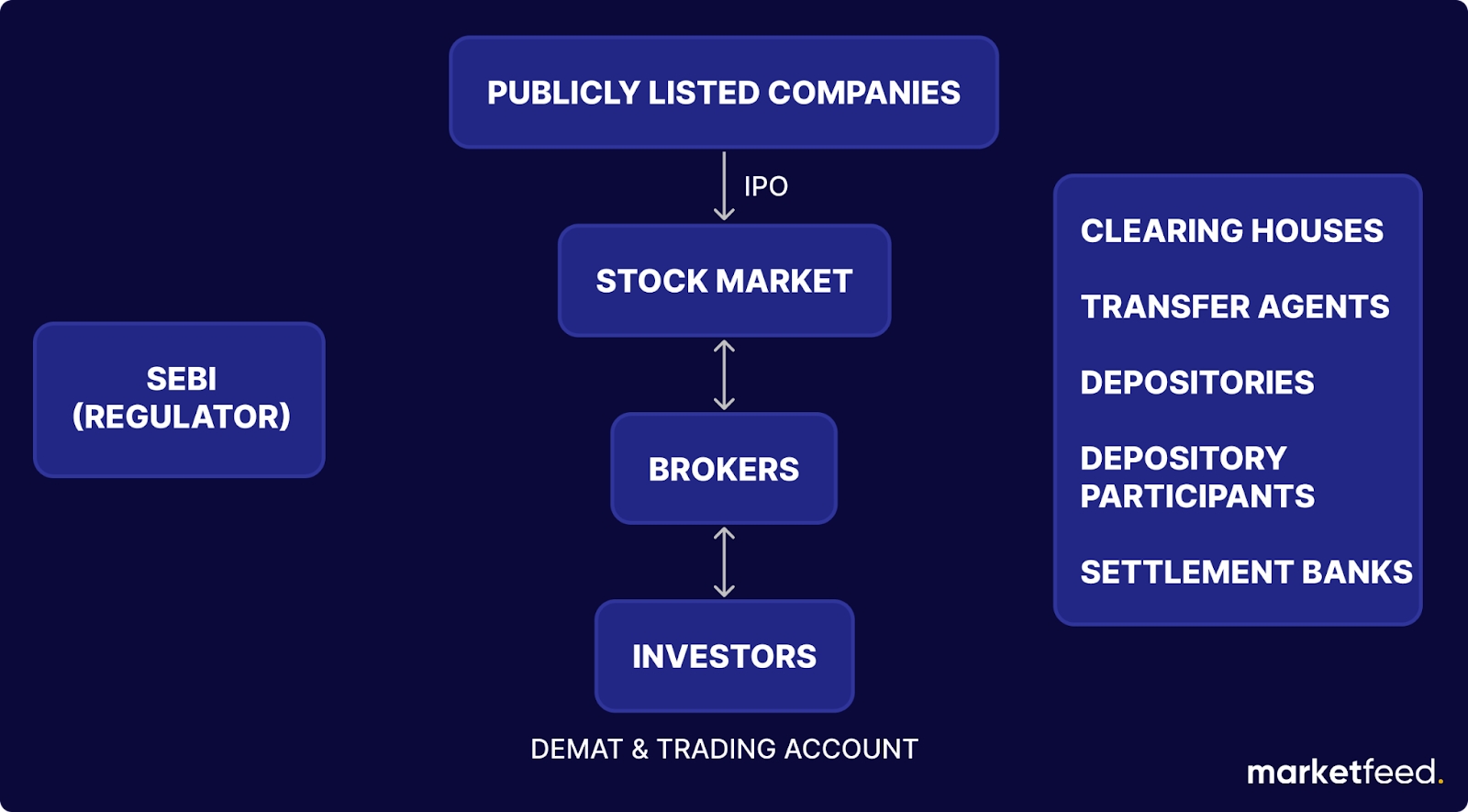
Given below are the different participants in the stock market. We’ll understand more about them through a story.
Let’s Look at a Story!
Mr. Jignesh, an owner of a renowned supermarket in Bengaluru, has been successfully running his business for the past ten years. The supermarket has been generating decent revenue and is highly profitable. His business also has goodwill (proprietary or intellectual property and brand recognition). When it comes to business, there are two things you must understand:
Ownership of a Business Jignesh completely owns and runs the supermarket, and the profit is not shared with anyone else.
Valuation of a Business Anything and everything has a value attached to it, even a business. The business has been generating income for Jignesh for the past ten years, so it is valuable. The valuation of a business is the economic value of how much a person has to pay to acquire 100% of the business from him. Let’s assume that the supermarket is valued at ₹1 crore.
Since Jignesh is growing old, he feels he doesn’t want to work as much as he did and is looking for a partner to operate the business in return for 50% of the ownership of his business. He decided to share his business with a partner, Ms. Riya.
What are Shares?
Shares represent units of ownership of a company. A shareholder is entitled to a part of the profit that the company generates.
The ownership of Jignesh’s supermarket was divided into 1000 equal shares. The value of each share can be mathematically expressed as:
Value of 1 Share = Total Valuation / Total Number of Shares
= 1,00,00,000 / 1000
= ₹10,000 per share.
Riya agreed to acquire 500 shares (50%) of the supermarket in consideration of the value of those shares in Cash.
Valuation = Total Number of Shares x Value of Each Share
Riya paid ₹50,00,000 to Jignesh, and they both became partners in the supermarket business.
A few years later, the business expanded with several profitable outlets across Bengaluru. Now, Jignesh and Riya want to open 200 more stores nationwide, for which they need a large amount of capital. The easiest way to get funding or capital is by taking out a loan from a bank and using the business’ assets as collateral. However, this carries the risk of falling into a debt trap. If they are unable to repay the loan for some reason, the assets will be seized by the bank to recover the loan. Jignesh and Rita did not want to deal with these issues.
An alternative would be to find more people who are interested in becoming part-owners of the business across Bengaluru. Even then, they may not be able to find enough people to do so. At this point, Jignesh becomes aware of the stock market. If they convert their company into a Public Limited company, they can raise capital from thousands of investors across India and other countries. The process of issuing shares to the public to raise capital for a business is known as an Initial Public Offering (IPO).
What is the Stock Market?
A stock market is a place where shares of publicly listed companies are traded. It is a physical place or institution where shares are bought and sold.
So Why Do Companies Go Public?
To Raise Capital: The company can gather funds for many objectives, such as paying liabilities (loans) and funding its future expansion projects.
Reward Founders & Early Investors: The founders and early investors of a company hold a good portion of the shares in their entity. They can sell these shares to the public and the proceeds go directly to them rather than to the company. It can be considered as a reward for all the time and effort they put in to build the company from the ground up. So going public can give them an early exit.
What are Stock Exchanges?
A stock exchange is a financial institution where different participants come together to buy and sell securities(shares). It provides the infrastructure for these activities. The term Stock Market is an umbrella term for a collection of Stock Exchanges.
The two major Stock Exchanges in India are:
Bombay Stock Exchange (BSE)
National Stock Exchange (NSE)
BSE is older than NSE, which explains why more companies are listed on the BSE than NSE.
Coming back to the story, Jignesh’s company had a total of 1000 shares, out of which they decided to issue 15% of the shares to the public. Thus, 150 shares are being offered to the public.
1000 x 15% = 150
How Many Shares Will a Company Have? Who Decides That?
A company’s promoters can decide how many shares it should have. Some firms may have thousands of shares, while others may have lakhs or even crores of shares.
For example, the valuation of Jignesh’s company was ₹1 crore in the beginning. But the business has grown over the years, and now the valuation stands at ₹2 crores, bringing the value of each share to ₹20,000.
Why do Investors Exist? What are their Objectives?
The two main objectives of investors are:
1. Capital Appreciation – When a company grows, the price of its shares increases. If investors buy the shares of a company when the prices are low and sell them when the prices increase, they can make good profits via capital appreciation.
2. Earn Dividends – When a company makes profits every year from its operations, it distributes a portion of the profits to shareholders as dividends. However, it is not necessary for them to declare dividends every year. It’s the company’s choice whether to issue dividends or not. The company may fully retain its profits for future capital needs or may give out a part of the profit and retain the rest.
In short, the objective of a public limited company is to raise capital for its funding needs and the investors’ objective is to grow their money. But the real question is, how does the stock market fit into this?
Why do Stock Markets Exist?
The stock market provides an avenue for a public company to raise capital from investors in consideration of shares. Investors will be able to grow their savings and wealth through capital appreciation and dividends. The stock market is the facilitator for the two parties.
What are Primary Market and Secondary Market?
The stock market is divided into two:
1. Primary Markets It is a market wherein a firm issues securities/shares to investors directly (via an initial public offering or IPO). These sale proceeds go directly to the issuer to finance their capital requirements.
2. Secondary Markets It is the market where previously issued securities are bought and sold among investors. These sale proceeds go to the person who holds the securities.
In our story, many people wanted to buy shares of his company after the IPO. However, the company does not issue any more shares as the IPO is already done. So these new investors can only buy the shares from those already holding them.
When such transactions happen between investors in the secondary markets, the price of the share gets updated. If an existing shareholder sells the stock to another person for ₹20,100, the price of all the shares of the company gets updated to ₹20,100. Consequently, the net worth of the shareholders increases as the price of the shares they hold increases.
Who Decides the Price of a Stock?
The two reasons which decide the price of a stock are:
Company’s Actual Valuation: A company’s value fluctuates as the revenue, profit, and goodwill change. The future prospects of the company also contribute to the valuation. If the revenue and profits go down, the valuation may also decrease, which causes the share price to drop. However, if the revenue and profit increase, the valuation could also rise.
Demand & Supply: The market forces of supply and demand also play an important role in deciding the share price. If the demand for the stock increases, then its price also increases since supply is limited. If the demand for the stock decreases, then its price also decreases since the supply is the same. Demand for the stock depends upon market sentiments, which refers to the overall attitude of investors toward the company. If the market sentiment is positive, then the demand for the stock will be high, thus driving the stock price up. Demand for the stock will be less if the market sentiment is negative.
Why Do Stock Prices Fluctuate Every Second?
The Last Traded Price (LTP) refers to the price at which the previous share transaction took place. The stock market has lakhs of participants, and transactions happen every second. If a person sells a stock for ₹150, then the LTP at the time will be ₹150. The very next second, if a stock is sold for ₹149, then the LTP changes to ₹149. This is the reason why stock prices fluctuate every second.
Who are Brokers?
If you want to buy a stock, you cannot do it directly from the stock market. We have to approach a stockbroker, and the broker will transact on our behalf. A broker is an intermediary that facilitates transactions in the stock market. If you want to buy a stock, your broker will find a seller in the stock market on your instruction and facilitate the transaction between you and the seller.
Before technology evolved, an investor had to physically visit the broker’s office and instruct them to buy the stock. The broker would then physically go around the stock market, find a seller, and conduct the transaction. But now, technology has evolved, and transactions can be conducted via our phones. Brokers are accessible on computers and smartphones, and investing & trading are as easy as ever.
It is absolutely necessary to have an account with a broker to participate in the stock market. As intelligent stock market participants, we must have multiple broking accounts for different purposes. We can use one account for our long-term investing activities and another one for trading. Successful traders use multiple broking accounts for different trading strategies.
How Does a Broker Work?
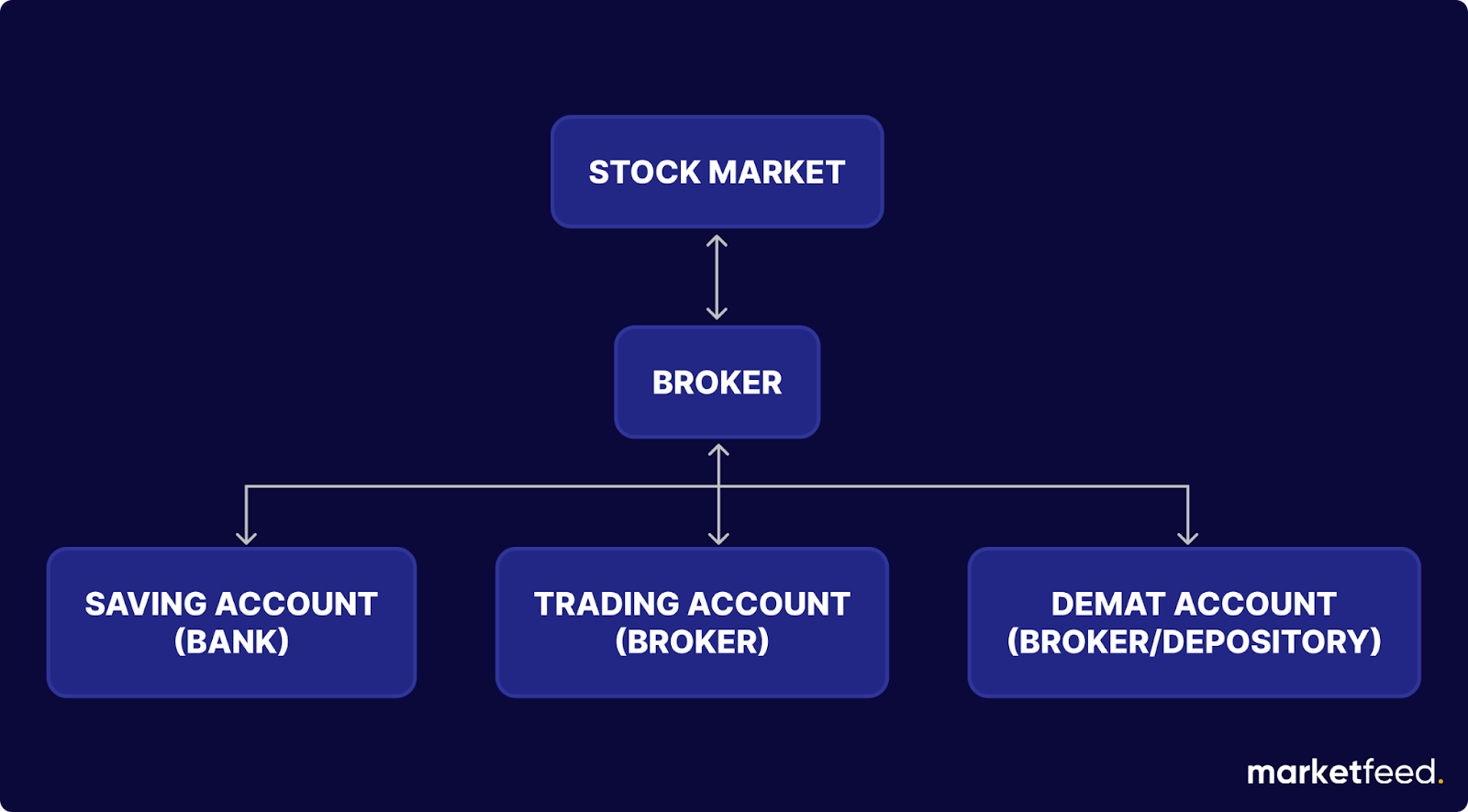
There are two accounts that we open with a broker. Even though they are two separate accounts serving different purposes, both of them come in a bundle.
1. Demat Account A Demat account or dematerialisation account allows you to hold your shares in an electronic format. It converts the physical shares into an electronic form, therefore dematerialising them. Demat accounts are maintained under depositories.
Earlier, the proof of ownership of shares, bonds, or debentures was in the form of physical share certificates. However, this system had many drawbacks, such as the risk of losing the certificate, fire hazards, getting wet, or even a mismatch in the signatures.
2. Trading Account A trading account acts as an interface between the investor’s bank savings account and a broker. For the broker to conduct trading activities on our behalf, they need money. We transfer the money we have in our savings account to a trading account with which the broker then conducts trading activities. Money can be transferred using net banking or UPI.
If we want to buy a stock, we instruct the broker to buy the stock, and the broker uses the money we have in our trading account to conduct the transaction. Similarly, when we sell a stock, the proceeds of the sale come directly into the trading account.
An Illustration to Understand How Demat & Trading Account Works
Arun wants to buy a share of Mahindra & Mahindra (M&M) from the stock market. The first step that Arun should take is to open a Demat and trading account. Arun opens a Demat & trading account with a leading broker and deposits money into his trading account by transferring from his bank savings account via UPI.
When the market opened at 9:15 AM, Arun placed an order with his broker to buy 1 quantity of M&M stock. The market price of M&M at the time was ₹1000. His trading account was debited ₹1000 by the broker to finance the transaction. Apart from this, a small amount was deducted as taxes and charges.
Even though the transaction was completed, the stock will only be transferred into his Demat account after T+1 days, which means he will receive the stock in his Demat account on the next working day.
While selecting brokers, we should choose the brokers that satisfy our various investing and trading needs. YOu can open a Demat and trading account using the links given below:
(Full disclosure: These are affiliate links. Do use the links if you wish to support us at no extra cost. ❤️)
Click here for step-by-step instructions on how to open a Demat and trading account.
What are Depositories?
If your shares are held by the broker, there is a risk of the broker running away with the shares they have. As a remedy, all Demat accounts are maintained by depositories. A depository is an institution that acts as a custodian of Demat accounts and shares. A Demat account is opened by a depository participant, who acts as an intermediary between the depository and investors.
There are two depositories in India, which are governed by the Government of India:
1. CDSL – Central Depository Services Limited 2. NSDL – National Securities Depository Limited
Who are the Other Facilitators?
The other facilitators part from brokers, depositories, and depository participants are:
Clearing Houses – It is an intermediary between buyers and sellers of financial instruments. It is an agency or separate corporation of a futures exchange responsible for settling trading accounts, clearing trades, collecting and maintaining margin monies, regulating delivery, and reporting trading data.
Transfer Agents – A transfer agent keeps records of who owns a publicly traded company’s stocks and bonds. They also ensure investors receive dividends on time.
Settlement Banks – It refers to a customer’s bank where payments or transactions are finally settled and cleared for customer use.
What is a Market Regulator?
The Indian stock market is a place where transactions worth lakhs of crores of rupees take place. The Securities and Exchange Board of India (SEBI) is a regulatory authority established under the SEBI Act 1992. It’s the principal regulator for stock exchanges in India. SEBI’s primary functions include protecting investor interests and promoting and regulating the Indian securities markets. It is a government organisation. SEBI exists as the watchdog to make sure nothing wrong is happening in such a massive money-involved ecosystem.
Throughout the article, we discussed the various participants in the stock market and how they all work together in the stock market. We’ve also understood the basics of what the stock market is, who its participants are, and how it works!