Categories
Editorial

Is Elon Musk’s Acquisition of Twitter a Mistake?

Twitter has been all over the news lately. It’s a widely popular platform for political leaders to address citizens and celebrities to update their fans. Twitter has even become the common man’s public grievance centre. You can simply share anything under the sun (well, sort of). A Tweet can start worldwide movements or stir up controversy. Nearly 330 million people use the platform every month!

Since March, the company has been under the pressure of a hostile takeover by the world’s richest person— Elon Musk! The Tesla CEO’s $44 billion acquisition is now on hold. Meanwhile, Twitter’s shares have crashed ~30% over the past month.

In this article, we discuss why the social media platform is in high demand. Are Twitter’s financials so impressive that Musk saw a huge business opportunity? Or is there any other intention for making it a private enterprise?

Twitter – Financial Analysis

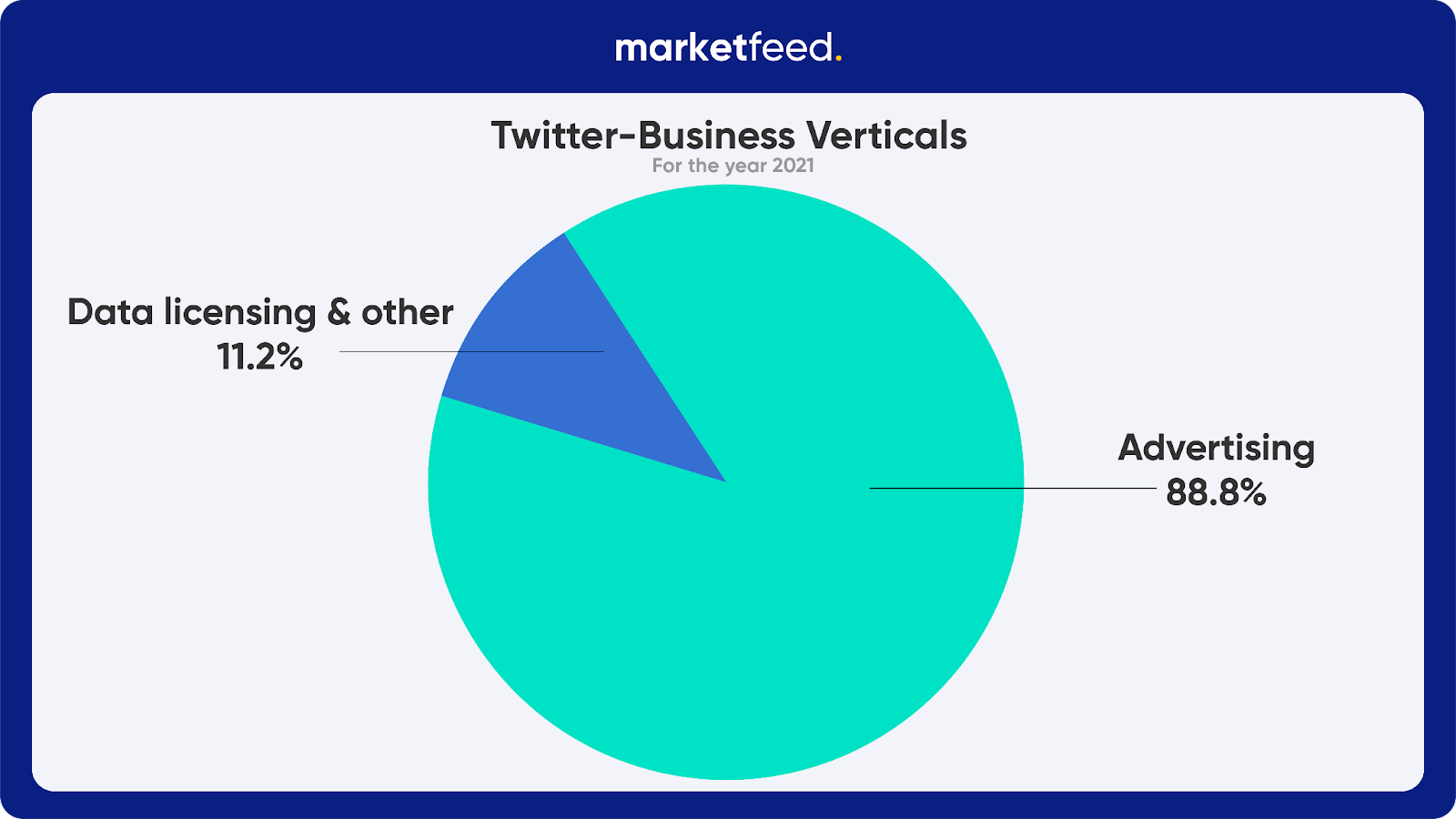
Twitter was established way back in 2006. Since then, the company operates through two business verticals:

Advertising: The platform allows brands, influencers, and companies to promote their products to a target audience. With 38 million monetizable daily active users (mDAU), Twitter is a perfect platform to create a digital presence and an active community for advertisers. Advertisement can be done in 3 ways:

1. Promoted tweets: Twitter recommends promoted tweets to users according to their interests. Advertisers can find their target audience with the help of analytical records on Twitter.

2. Promoted Accounts: Twitter recommends certain profiles under a “Who to follow” tab. It may also contain the accounts of advertisers.

3. Promoting a trending topic: Twitter helps to categorize tweets into a topic with the help of hashtags. Promoting these hashtags will help advertisers reach the audience who follow them.

Data licensing: Data is the new oil. Companies can directly analyse and learn the behaviour of users through their usage data. Twitter provides paid access to its data bank for various companies to analyse. However, over the past few years, Twitter has had no growth in this segment. It has only generated ~$500 million per year, contributing 11% to the total revenue.
Profitability

Let us now look at the profitability metrics of the company: 
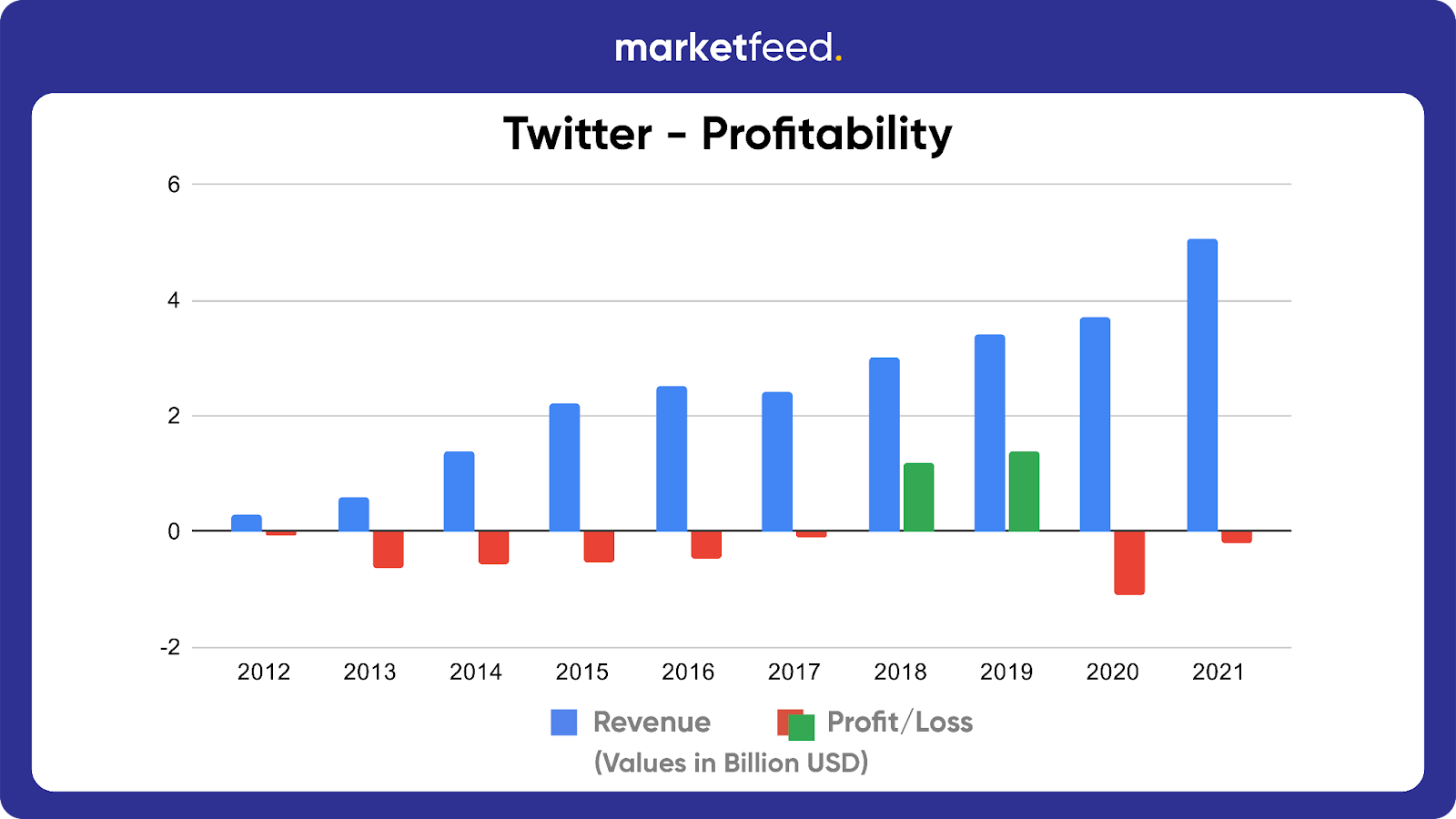
Over the past decade, Twitter was only profitable twice. Meanwhile, revenue has increased at a CAGR of 36%. 

After the pandemic, many companies drastically reduced their advertising budgets, which has affected Twitter’s profitability.

Since advertising is the backbone of Twitter, the company can only flourish if more users join the platform. Let us look at the current user base of Twitter:
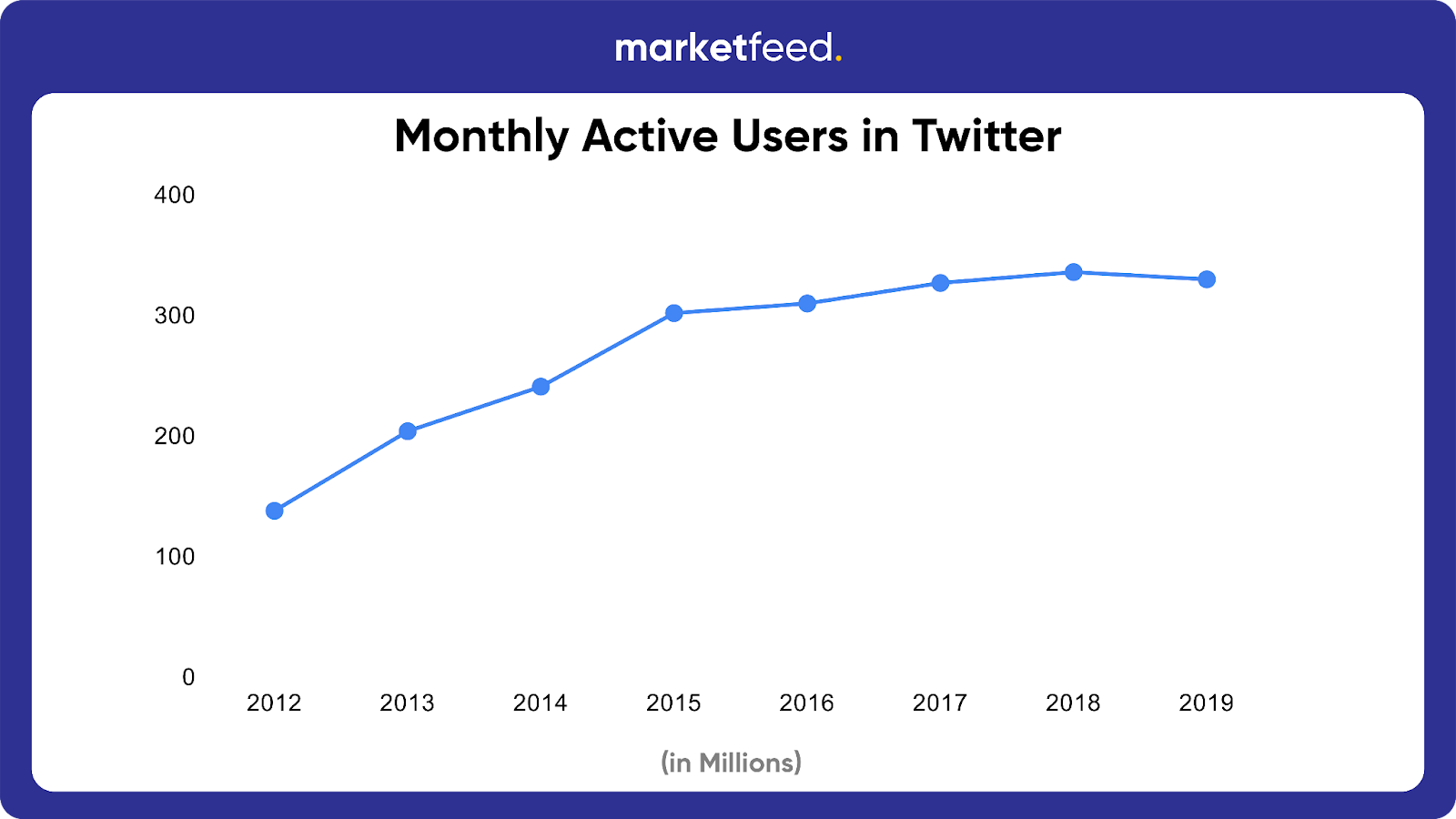
Till 2015-16, there was an excellent addition in the number of users on the platform. However, in 2016, Twitter was not able to attract more users. Critics stated that Twitter may have reached its saturation point in its userbase.

Interestingly, analysing Twitter’s user base with those of other social media platforms tells us another story:
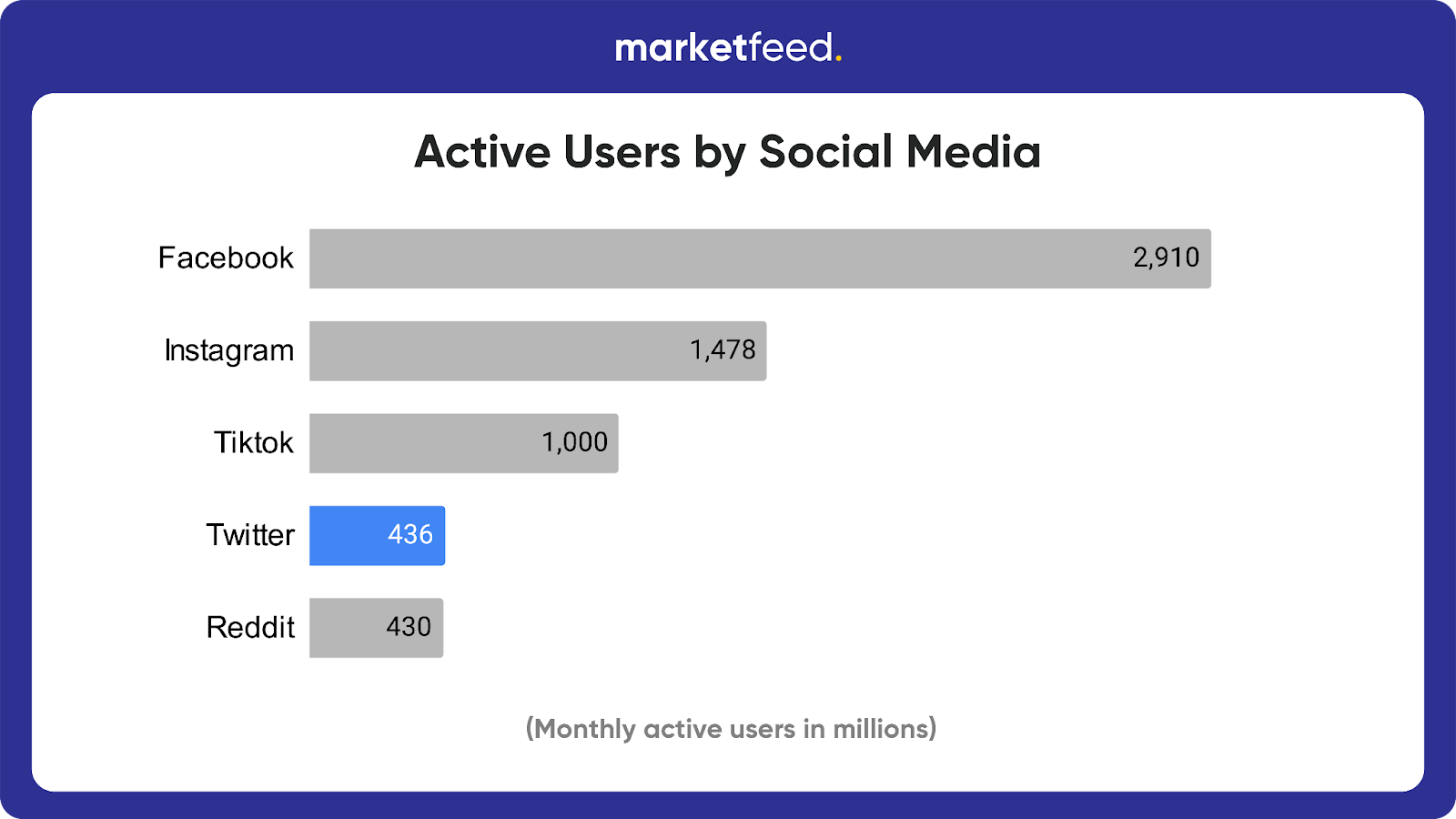
Although Twitter has its own unique features, considering the other social media platforms like Facebook, and Instagram which also try to engage users with posts, photos, news, etc. This tells us that Twitter needs to attract more users to engage which will help them to be financially stable.

The Future of Twitter

Twitter is a well-known marketing engine among marketers, journalists, celebrities, and brands. Unfortunately, the platform is failing to retain its users. The arrival of social media platforms such as TikTok and Snapchat has severely affected them.

Ideally, Twitter cannot become a subscription-based platform where users pay monthly fees to read tweets. Such a move fundamentally violates the very existence of the platform.

Twitter has to remain a free platform and essentially introduce add-on paid features. Let us take a look at the acquisitions made by Twitter:

  • Spaces: A live audio platform competing with Clubhouse.
  • Revue: A newsletter provider
  • Sphere: A group chat app. It provides conversations around similar topics.

Catering to the audio, newsletter, and chat markets could improve Twitter’s financial performance.

Twitter & Musk: A New Begininng?

On March 14, Tesla CEO and billionaire Elon Musk bought a 9% stake in Twitter, becoming its largest shareholder. Fast-forward to April 14, Musk offered to buy 100% of the company for a whopping $44 billion at $54.23 per share! Twitter’s shares are trading at ~$38.29 at the time of writing.

Twitter’s board initially considered this hostile takeover as a threat to the company and its values. Thus, it introduced a Poison Pill Policy. It gives existing shareholders the right to purchase additional stocks at a discount if any individual or a group tries to acquire more than 15% of the company. If Elon Musk tries to acquire more than 15% of Twitter, all other shareholders will be provided new shares at great discounts. This move will dilute Musk’s holding in the company, and further acquisition of shares will be expensive.

On April 26, Twitter confirmed the takeover by Elon Musk for $44 billion. The all-cash deal is expected to be completed later this year. Musk will borrow $12.5 billion from banks by pledging his Tesla shares as collateral. He will receive $13 billion as loans from major banks, but this will be transferred to Twitter’s books (also called a leveraged buyout). Musk will spend an additional $21 billion to purchase shares of Twitter.

Musk commented that his acquisition is not merely about increasing the company’s profits. He wants to improve the platform as a whole and promote free speech. He aims to introduce an “Edit” button to modify published tweets and also Spambots to detect fake accounts. Elon Musk has also suggested that Twitter’s algorithm should be open source, giving users more options to arrange their feeds.

Cold Feet?

Last week, Elon Musk tweeted that his deal to buy Twitter is temporarily on hold. He has requested details on the volume of spam and fake accounts on the platform. In an SEC filing, Twitter had claimed that it has fewer than 5% fake accounts. But according to Musk’s calculations, there are nearly 4 times more spam/fake accounts than Twitter’s estimates! He said his initial offer was based on the company’s exchange filings being accurate.

Is Musk trying to get a cheaper deal or will he completely walk away from it? Has he realised that Twitter simply isn’t worth it?

What are your views on Twitter and its current situation? Let us know in the comments section of the marketfeed app!

Categories
Editorial

Why Did The Cryptocurrency Markets Crash? What Next?

Cryptocurrencies have crashed. This time in a manner never seen before. The last time we saw Bitcoin was down ~32%, Ethereum down by ~40%, and Dogecoin down by ~41%. 

The crash has wiped out nearly USD 1 trillion of investor wealth globally. That is nearly Rs 73 lakh crore to speak in Indian Rupee(INR) terms. Let’s dig right into what caused the global crypto market to crash and find out how investors around the world perceive the future of cryptocurrencies.

Why Did The Crypto Market Crash?

To summarize, the crash happened because of a bunch of tweets by Elon Musk, and restrictions by China on cryptocurrencies.

  • Over the last year, cryptocurrencies all around the world were having a ball. Bitcoin gained more than ~400%, Ethereum gained ~1300%, Dogecoin came into the picture and doubled in less than a month. Other small-time cryptos came into the picture with Initial Coin Offerings, which is the crypto version of an IPO. Throughout the period, cryptos around the world gained clout on social media and some volatility in the markets. Major institutional investment firms started investing in Bitcoin. The bull run was never-ending, while the crypto prices refused to correct themselves. This seemingly never-ending bull run induced fear in the market which led to frequent ups and downs. 
  • Speaking of Elon Musk, who has been in the news for the popularity of a popular meme-based cryptocurrency, Dogecoin. While Musk made some tweets on Dogecoin, the price of the meme coin went skyrocketing until his appearance in the US talk show Saturday Night Live. Then, his comments on the coin sent Dogecoin crashing. Musk was publicly supportive of cryptocurrencies and continues to be so.

    Musk’s company Tesla Motors even had a sizable investment in Bitcoin. Tesla has announced that they were going to start accepting payment in Bitcoin but later changed their position. According to Musk, Bitcoin mining requires electricity which mostly comes from fossil fuels. This might be unsustainable for the environment. A series of tweets by Musk and Tesla’s decision to not accept Bitcoin payments contributed to the crash. All this information about high energy consumption was previously known as well.
  • Now coming to the major reason behind the crash. China has always moved its policy towards restricting cryptocurrencies in the country. The People’s Bank of China, National Internet Finance Association of China, the China Banking Association, and the Payment and Clearing Association of China released a joint statement restricting the trade of cryptocurrencies almost completely. The directive said that companies offering crypto-related information, saving or pledging services stood banned. Additionally, any company offering crypto-related trading, insurance, and derivatives services would also be banned. China had previously almost completely banned crypto mining along with Initial Coin Offerings(ICOs) in 2017. 

What is surprising about China’s lockdown on cryptocurrency is that almost a month ago People’s Bank of China Deputy Governor, Li Bo had given a progressive statement on cryptocurrencies as an ‘investment alternative’. The associations responsible for the ban, justify the move by stating that cryptocurrencies are risky due to the volatility.

Exit Or Stay?

Cryptocurrency like any other traded security has the strategy of ‘Buy The Dip’, in which a trader accumulates cryptocurrencies after a fall in price. This is what would happen soon after the crypto crash, as is the case with any other traded security. 

Zerodha Co-Founder Nikhil Kamath tweeted on the crash saying “Averaging down or buying more of an asset, be it stock or crypto, as the price keeps going down and hoping that the price bounces to recover losses or make profits faster is a common behaviour among retail investors. While it is tempting to average down, the odds of this strategy working are significantly low in the long run.” He went on in saying, “I have zero knowledge or exposure to Crypto, but the rules for investing are the same: Reduce % exposure if the risk is high, & don’t Average down.

There is also a high chance that institutions will rethink their exposure to cryptocurrency as the high volatility continues.

The crypto market right now is in chaos, from Tesla not accepting Bitcoins, to China restricting cryptocurrency trade and operations. In a market like this, one should neither be too optimistic nor be too pessimistic, one should stick to the fundamental rules of trading. Which in this case would be reducing exposure to cryptocurrencies as they get riskier and increasing it only as they get more stable. In case a majority of your portfolio is just cryptos, all it would take is one crash to wipe out a significant portion of your wealth, so give rebalancing a thought.

Categories
Editorial

Dogecoin: The Story and Lessons from Rise to Fall

Dogecoin is a familiar name in the meme world and the cryptocurrency market. It is an alt-coin or an alternative coin. However, its humorous purview shouldn’t be taken for granted. After all, the meme cryptocurrency is worth more than the auto-manufacturer Honda. Backed by Elon Musk, the currency is bigger than his own company, SpaceX. Just a while ago, the combined market capitalization of Dogecoin was more than that of Infosys. A 33-year-old in the USA invested all his savings in Dogecoin almost instantly became a millionaire after a good bull run in the currency. So is the currency a joke? Or is it not? Let us explore the journey of Dogecoin.

The Journey Of Dogecoin

It was the year 2013, a spiral of innovative memes had hit the social media market. One such meme was of the ‘Shiba Inu’, a Japanese breed of dog. The dogecoin is designed to have the face of the Shiba Inu dog on it. 

The Dogecoin Design and the Original Meme Picture.

It was around this time when an engineer at IBM, Billy Markus from Portland, Oregon decided to come up with a ‘fun’ alternative to the famous cryptocurrency, Bitcoin. He created the design and the website which was then noticed by Adobe engineer Jackson Palmer who contacted Markus and they joined hands to create the protocol for Dogecoin. Dogecoin wasn’t intended to be taken seriously.

Dogecoin wasn’t the only other alternative cryptocurrencies available at the time. Litecoin, Namecoin, Peercoin, Luckycoin were some others to name a few. Dogecoin is quite different from the rest in terms of its concept, protocol, technology, value, and mining. For Bitcoin, a maximum of 21 million Bitcoins can be mined. It is estimated that the limit will be reached somewhere around the year 2140. As of May 7, 2021, Dogecoin has a market capitalization of $99.3 Billion, which is higher than almost all of India’s Nifty 50 companies. 

Price Action Over The Years

Till January 2021, Doge was like any other not-so-big cryptocurrency in the market. It picked in discussion group forums like Reddit and Discord. One day in January, Elon Musk, the founder of companies like Tesla and SpaceX put out a tweet with a single word, ‘Doge’. Dogecoin gained some chatter on discussion forums like Reddit. The chairman of WallStreetBets, which was also responsible for the GameStop Short Squeeze Fiasco earlier, tweeted “Has Doge ever been to a dollar?”. What followed was a massive ~99% increase in the value of Dogecoin by early May 2021. What followed was a number of tweets made by Elon Musk just patronizing Dogecoin. Every time he did, the price of the cryptocurrency saw a fluctuation. Soon Dogecoin for its humorous tweets made by Elon Musk and some other influencers became a centre of memes and jokes.

Dogecoin In Feb-May 2021(Source: CoinMarketCap)

Doge And Other Coins, Are They Safe?

Bitcoin, the of the first cryptocurrencies to come into existence, is quite different from Dogecoin. Dogecoin has an unlimited supply. Bitcoin on the other hand has a fixed supply of 21 million bitcoins. The limited supply of Bitcoin causes an inflationary effect that leads to an increase in price. A sustainable price rise is not possible in Dogecoin, supply almost always replenishes demand. Bitcoin is backed by solid technology, unlike Dogecoin. In 2013-14, there were a series of cyberattacks on Dogecoin wallets and users where they lost almost 21 million coins to the theft. However, members of the Dogecoin community came together, chipped in, and donated the lost amount to the respective individuals.

Should You Invest In Dogecoin?

A simple answer, no. It is an extremely risky asset. Predicting the price movement of Dogecoin is a very difficult task. It might be a short-term investment option, but definitely not good for a long-term investment. The crypto is controlled by very few entities like popularity, memes, statements by Elon Musk, etc. Close to 90% of the cryptocurrencies are controlled by 99 cryptocurrency wallets, meaning there is a high concentration of the asset. 

Prices of cryptocurrencies like Bitcoin and Ethereum are impacted by different indicators like price action, halving period, volume, and other technical indicators. Dogecoin on the other hand is impacted by how funny it is. As silly as it sounds, Dogecoin has seen rallies only after it is patronized by influencers on social media. Elon Musk was to appear on the famous American talk show Saturday Night Live(SNL). People were expecting Elon Musk to ‘hype’ the alt-coin. Instead, Elon Musk joked about it and called Dogecoin a “hustle”. The price of Dogecoin slumped shortly after the show. Essentially, a single person was controlling the value of the coin which is actually dangerous for an investor.

It is advised that a person researches and gets to know the basics of trading, technical analysis, and fundamental analysis of cryptocurrencies before trading them. 

Categories
Editorial

Elon Musk – The World’s Richest Person

It’s official. According to the Bloomberg Billionaires Index, Elon Musk is the richest person in the world. His total worth has increased to $194.8 billion, surpassing Jeff Bezos’ net worth of $185 billion. There are two indexes in the world which are the most important to calculate a person’s net worth. One is the Bloomberg Billionaires Index and the other is the Forbes Richest People List.

Even though the numbers are staggering, it does not mean that Elon Musk has $190 billion in his bank account in the form of cash. The number is the summation of the total worth of assets, shares and all the other investments. At the start of the year, Elon Musk was not even one of the likely individuals who could top the list inside in just one year. So, how did Elon Musk get to the top of the chart? Let’s find out.

Elon Musk’s Journey to Becoming the Richest Person

One of the biggest reasons behind Elon Musk’s rise is Tesla’s unprecedented rally in 2020. Tesla’s stock has rallied at a break-neck speed last year. It has surged by more than 700% in one year alone. To give you a perspective, Tesla’s stock was traded at just $88.60(adjusted for 5:1 stock split) on 3rd January 2020. Today, on 8th January 2020, it is being traded at an astonishing $880.02. Assume that you had invested Rs 6,424 to buy one share of Tesla on 3rd January 2020. Today, that small investment would have been worth Rs 64,240. How stunning is that, right? Elon Musk holds 20% of the total shares of Tesla. The stock’s recent outburst in the prominent reason that Musk is now declared as the world’s richest person. 

The truth is, Tesla, is an automobile company but not “just a normal automobile company.” Elon Musk and his team at Tesla build revolutionary automobiles. They are one of the biggest companies in the world which leverage technology to the fullest and manufacture products which no one can really imagine!

Most of the success of Tesla hinged on its electric vehicle car ‘Model-3’, which was their most affordable car yet. Their business model is very unique. Elon Musk states “The strategy of Tesla is to enter at the high end of the market, where customers are prepared to pay a premium, and then drive down market as fast as possible to higher unit volume and lower prices with each successive model.” 

Tesla turned into a profit-making company only in 2018. Before that, they were unable to produce a high volume of cars. Thus, their cost of production was always very high. After the launch of Model 3, Tesla managed to produce 5,000 cars in a week. This is where they achieved their break-even point. That quarter, they reported $312 million in profits. Since then, the company has never looked back. 

Elon Musk’s Performance-Based Bonus Package

Big companies reward you for good performances. This is what happened with Elon Musk as well. Just that, rewards awarded to him are something which no CEO has ever been offered! Musk set 10 lofty ambitions with Tesla. If he reaches those goals and sustains the company’s performance, he will get a total of $56 billion worth of stock options over 10 years. Musk has already achieved 4 out of 10 goals inside two years. This has helped him earn $11.8 billion already. 

His first payout came when Tesla’s six-month trailing average market capitalization surpassed $100 billion. He was rewarded with 1.69 million Tesla shares at $350 each. Musk profited around $750 million from this first payout. Tesla awarded him with his second payout after just 1.5 months when the company’s value increased by $50 billion more. He instantly exercised all the stock options provided to him, thus, earning a profit of $2.1 Billion.

Tesla’s unstoppable rally meant that Musk will receive another 8.44 million stock options. They were valued at $2.9 billion. Tesla’s CEO got his fourth tranche of bonus in October last year. He received another 8.44 million stock options which were valued at $3 billion again. It’s quite clear that if Tesla can sustain this unique rally, Elon Musk’s net worth will increase by many more billions.

Tesla’s Dominance

Visionary, charismatic, imaginative, creative, leader. All of these terms describe who Elon Musk is. And, this vision and imagination are what he has imparted to Tesla. The recent rally took their market capitalization to over $830 billion. This had aided the company to enter into the prestigious S&P 500 index. This index measures the performance of 500 large companies listed on stock exchanges in the United States. Not only have they entered, but Tesla has become the biggest company ever to join the S&P 500. The previous biggest entrant to this index was Berkshire Hathaway. Tesla joined the S&P 500 at three times the value of Berkshire Hathaway.

The following chart shows the market capitalization of Tesla with respect to the biggest automakers around the globe. 

Source: Author’s own creation

All of these factors have played a huge role in making Elon Musk the richest person in the world. Many analysts believe that Tesla is highly overvalued. That might be true as well. But what we understand here is, Elon Musk is selling dreams and people back him to fulfil those dreams! And the hidden gems in Musk’s arsenal, including SpaceX and Boring Company are yet to go public. When they do go public, he will be getting a lot richer. Will Elon Musk be the world’s first-ever trillionaire?

Categories
Editorial

Will Tesla Come to India Soon?

Tesla Inc, the world’s largest electric car manufacturer, has shown massive growth since its very inception. The company has created a revolution through its unique ecosystem and has made electric vehicles popular. It has been able to expand to more than 40 countries around the world. Tesla, which has a market cap of more than $560 billion, is all set to debut on the S&P 500 Index on December 21. 

Over the last few years, the potential buyers and fans of Tesla have been eagerly waiting for the company to make a grand entry into India. In October, Elon Musk had even sent a tweet saying that Tesla would begin its India operations in 2021! However, there are many hurdles that our country needs to overcome to make this a reality. Let us learn more about Tesla and the reasons why India could be a difficult market for the company to enter.

Company Profile – Tesla Inc.

Way back in 2003, two individuals by the name of Martin Eberhard and Marc Tarpenning had the vision of creating a car company. At the same time, these individuals were committed to making a difference and saving the environment. They believed that electric vehicles (EV) would be the future of commuting. And thus, they created Tesla Motors. The company was named after visionary scientist, Nikola Tesla.

Soon after the launch of the company, Elon Musk joined Tesla in 2004, after investing $6.3 million. With brilliant engineers and support from Musk, they began their venture towards disrupting the EV sector. They entered into a partnership with the UK-based Lotus Cars and launched the Tesla Roadster in 2008. This was an amazing achievement by the company, as it was one of the first electric cars which had a perfect blend of style and high-performance. It could go from 0-100 mph in 3.2 seconds. They were able to introduce the technology that would facilitate long-distance travel on a single charge. Tesla launched its own electric motors, transmission, and high-powered batteries. 

The Tesla Models

In 2012, they introduced the Tesla Model S, which was the first luxury electric sedan on the market. However, the cost of both the Roadster and Model S was more than $1 million. With the intention of introducing slightly affordable cars, they launched new versions of the Model S. The P90D can go from 0 to 60 mph in just 2.8 seconds! The highly popular Model X, which has stylish ‘falcon wings’, was introduced in 2015. One of the company’s most popular and widely sold cars is the Model 3, which was launched in the US market in 2017. Last year, they also launched the Model Y. The Tesla Cybertruck is scheduled to be released in late 2021.

Tesla = Undefeatable?

You may know them for their high performance and longer battery life, but all these cars are also loaded with amazing features. They have the Autopilot mode, Ludicrous mode, summon feature, and all cars come with frequent software updates. Over the last 2 years, Tesla’s Model 3 has been the best-selling electric car in the world. The company has also announced plans to provide customization services to Tesla cars (including the Cybertruck) for its customers.

They have the largest chain of fast-charging stations – ‘The Supercharger’. They operate more than 16,000 Supercharger charging points globally. With the necessity to expand and supply more Tesla batteries, they have built 4 Gigafactories. These factories have a total area of 5.3 million sq ft and are located in the US, China, and Germany. This is exactly why Tesla has very little competition and remains at the top of EV manufacturers of the world. In 2019, Tesla stood in the first position in terms of global sales. The total sales during the year hit a record high of 367,820 units. 

Why Hasn’t Tesla Entered India Yet?

Recently, hundreds of Tesla fans in India tweeted at Elon Musk and asked him when Tesla would begin its operations in India. Here is what Musk tweeted in response:

This is big news not just for the people waiting to get their hands on a luxury electric car like Tesla, but also for the entire electric vehicles (EV) industry in India. However, there are several issues that we need to address:

Government Policies

Through his tweets, Elon Musk has addressed concerns regarding the current policies surrounding EV charging stations and high imports of car parts in India. The import tax structure in our country is very high. For cars that cost more than $40,000 (Rs 30 lakh), import tax is 100%. It is 60% for cars that cost less than $40,000 (Rs 30 lakh). When the cost is so high, Indians will refrain from buying Tesla cars. 

Fun fact: As of now, only a handful of people such as Mukesh Ambani (of course!) and 2 Bollywood actors own a Tesla in India.

It should be noted that companies such as Tesla usually fund the construction of its factories with the sales revenue from the country where the factory is going to be built. With the high import tax and no sales, Tesla would refrain from building a factory in India.

Norway is the best example of a country that has introduced policies to promote the use of electric vehicles. The people who own EVs in Norway do not have to pay registration fees or tolls. They get free parking and free charging facilities. Most importantly, the government ensures that such citizens receive a tax deduction on their income. This has been the main reason why Norway is the biggest market for Tesla.

Affordability

Let us look at a scenario. The average income of a person in our country is $2,338 or Rs 1.72 lakh per annum. The Tesla Model 3, which is their most sold car globally, has a base price of $39,990. On conversion, the car will cost Rs 29.48 lakh in India. Do bear in mind that this is their cheapest car. It would take an average Indian would take more than 16 years to save up enough to buy a Tesla. And, this is after ignoring basic expenses such as rent, food, transportation, phone bill, etc.

In developed countries such as America (wherein the average income is 17 times higher than that of India), people will find it much easier to buy Tesla’s cars. Also, the main highlight is that the cost of charging EV’s are very cheap.

Infrastructure

  • The most important infrastructure that is required for the Electric Vehicles is charging stations. According to government estimates, India currently has around 250 charging stations. It has been estimated that our country would require more than 1 lakh stations to meet the charging requirement of electric cars. This means that the electric car manufacturers themselves will have to invest money and build a strong network of EV charging stations.
  • The sales figures for electric cars in India show a very sad state. India has barely sold 8,000 electric cars in the last 2 years. This also discourages companies such as Tesla to even think about entering the Indian market.
  • The Autopilot feature in Tesla cars is specifically designed to ensure smooth and safe travel. It includes advanced features such as traffic-aware cruise, lane-centering, self-parking, automatic lane changes, and much more. Tesla’s Autopilot and summon features would not make any sense in our country, where you know that roads are filled with potholes. The roads are very narrow and crowded with people and other vehicles. Also, the Indian government currently does not allow self-driving cars to ply on Indian roads.

Hope for a Better Future

As we can see, there are major challenges that we need to collectively overcome to ensure that electric vehicles in India receive a massive boost. Thankfully, our Government has started to come up with multiple green initiatives to promote the use of EVs in India. In November 2020, the Government stated that it will provide the infrastructure to set up around 69,000 electric vehicle charging stations across India. Many Indian automobile manufacturers (such as Tata Motors) have partnered with state governments to set up similar infrastructure as well.

The Delhi State Government has introduced an Electric Vehicle Policy to boost the sales and use of EVs, to decrease the pollution crisis in the city. The people who buy any type of electric vehicle are provided with benefits or subsidies. Currently, EV buyers are also exempted from paying road tax and registration fees. Policies like this will have to be made popular in all states of India. Indian citizens must also try to cultivate the mentality of buying EVs and reducing pollution levels.

There is high optimism that such initiatives will help in creating a major demand for EVs. Many EV startups in India are planning to launch their products soon. Tata’s Nexon EV sales has crossed the 2,000 unit sales mark last week, and this is very encouraging. After seeing the potential market size in India, manufacturers may gain confidence to increasing EV sales.

Even with all these policies and infrastructure in place, it would definitely be interesting to see how Tesla would enter the Indian market. Things will look more promising in case the company decides to establish one of their Gigafactories in India. However, will it be worth the wait? Will an average Indian be able to secure his dream and own a Tesla car in the near future? Only time will tell.