Categories
Market News Top 10 News

Trading Halted on NSE For 4 Hours Due to Technical Glitch – Top Indian Market News

Trading halted on NSE due to technical glitch

Trading across all segments was halted for almost four hours today by the National Stock Exchange (NSE) due to a technical glitch. The exchange had received communication from both its telecom providers about issues with their links. Trading was halted between 11:40 am and 3:30 pm. At around 3:25 pm, an extension of the trading day till 5 pm was announced, with a pre-open session at 3:30 pm. 

Market regulator SEBI has advised NSE to carry out a detailed root cause analysis of the ‘trading halt’ witnessed today. It has also asked NSE to explain the reasons for trading not migrating to the disaster recovery site.

Read more here.

Centre lifts embargo on grant of govt businesses to private banks

Finance Minister Nirmala Sitharman announced that the Centre has lifted the embargo on grant of government businesses to private banks. She stated that all banks can now be “equal partners in development of the Indian economy.” Private sector banks can now carry out government-related banking transactions such as taxes and other revenue payment facilities, pension payments, and small savings schemes.  

Read more here.

Cabinet approves Rs 15,000 crore PLI scheme for pharma sector

The Union Cabinet has approved a production-linked incentive (PLI) scheme for the pharmaceutical sector for over a period of eight years (FY21-FY29). This scheme would bring in an investment of Rs 15,000 crore to the sector. It is expected to promote the production of high-value pharma products in the country and increase the value addition in exports. The government seeks to generate 20,000 direct jobs through this PLI scheme.

The Cabinet has also cleared a PLI scheme worth Rs 7,350 crore to boost the manufacturing of laptops, tablets, PCs, and servers. 

Read more here.

Dilip Buildcon declared lowest bidder for projects worth Rs 2,439 crore

Dilip Buildcon Limited has been declared as the lowest (L1) bidder for two Hybrid Annuity Mode (HAM) projects worth Rs 2,439 crore. The projects consist of four-laning two sections of the Bangalore-Chennai Expressway. The tenders were floated by the National Highways Authority of India (NHAI) under the state-sponsored Bharatmala Parioyojana project. 

Read more here.

Bharti Airtel enters advertising business, launches ‘Airtel Ads’

Bharti Airtel has announced its entry into India’s $10 billion (~Rs 72,328 crore) advertising industry with its latest platform ‘Airtel Ads’. The telecom company stated that Airtel Ads would allow brands to curate consent-based and safe campaigns for its subscribers. Airtel Ads has already enabled campaigns for more than 100 brands across categories like FMCG, banking, financial services & insurance (BFSI), digital startups, etc. 

Read more here.

Aditya Birla Fashion announces strategic partnership with designer Tarun Tahiliani

Aditya Birla Fashion and Retail Ltd (ABFRL) has announced a strategic partnership with ace designer Tarun Tahiliani to form a new entity that will launch a contemporary men’s ethnic wear brand. ABFRL will hold an 80% stake in the new entity, while Tarun Tahiliani will hold the remaining 20%. ABFRL stated that the new brand will offer a range of high-quality celebration wear for men at accessible price points.

Read more here.

Bosch to invest Rs 800 crore to upgrade Bengaluru facility to fully AIoT-enabled campus

Germany-based Bosch Group will invest Rs 800 crore to upgrade its existing campus in Bengaluru to a fully artificial intelligence of things (AIoT)-enabled ‘smart campus’. The campus is likely to house the second-highest number of Bosch employees in the world. The 75-acre campus is expected to be inaugurated in June 2022.

Read more here.

Granules India receives USFDA approval for migraine drug

Granules India has received approval from the US Food and Drug Administration (USFDA) for its Abbreviated New Drug Application (ANDA) for Acetaminophen, Aspirin, and Caffeine (triple-combination product) tablets. The drug is indicated for treating migraines. The product will be manufactured at the company’s Hyderabad facility and is expected to be launched shortly.

Read more here.

Axis Bank’s subsidiary to acquire broking accounts of Karvy

Axis Securities, a subisdiary of Axis Bank, has emerged as the successful bidder for trading accounts (or broking accounts) held by Karvy Stock Broking Ltd with NSE, BSE, and Metropolitan Stock Exchange (MSE). The transfer of trading accounts is subject to the remittance of the bid amount and submission of necessary documents. Once the process is complete, the customer base of Axis Securities will increase from 2.5 million to over 3.6 million.

Read more here.

Heranba Industries IPO subscribed 2.74 times on second day of bidding

The Rs 625-crore initial public offering (IPO) of Heranba Industries was subscribed 2.74 times on the second day of bidding. The issue received bids for 1.91 crore equity shares against an offer size of 69.81 lakh shares. The portion reserved for retail investors was subscribed 4.53 times. The portion set aside for non-institutional investors (NIIs) witnessed a subscription of 87%, while that of qualified institutional buyers (QIB) 1.01 times.

Read more here.

RBI Governor raises ‘major concerns’ about cryptocurrencies

The Reserve Bank of India (RBI) said it is concerned that cryptocurrencies may impact the financial stability of the Indian economy. In the past, RBI had expressed concerns on digital currencies related to issues ranging from money laundering to funding terrorists. RBI Governor Shaktikanta Das said that they have communicated these concerns to the government. The Centre is planning to introduce a bill in Parliament to prohibit companies and individuals from dealing in cryptocurrencies. The government is also creating a framework for an official digital currency.

Read more here.

Categories
Market News Top 10 News

Cabinet Approves PLI Scheme Worth Rs 12,195 crore for Telecom Sector – Top Indian Market News

Cabinet approves PLI scheme worth Rs 12,195 crore for telecom sector

The Union Cabinet has approved a production-linked incentive (PLI) scheme worth Rs 12,195 crore for telecom and network equipment manufacturing. The scheme will cover core transmission equipment, 4G/5G next-generation radio access network and wireless equipment. It will also cover customer premise equipment (CPE), Internet of Things (IoT) access devices, and enterprise equipment such as switches and routers. The PLI scheme on telecom products will be implemented from April 1, 2021.

The government expects that the scheme will lead to enhanced production of more than Rs 2,44,200 crore of telecom equipment in India and exports worth Rs 1,95,360 crore. The latest PLI scheme is also expected to create 40,000 new jobs and generate around Rs 17,000 crore worth of tax revenue in the next 5 years.

Read more here.

Bharti Airtel to acquire 20% stake from Warburg Pincus in its DTH arm for Rs 3,126 crore

Bharti Airtel Limited said it will acquire Warburg Pincus affiliate’s 20% equity stake in its DTH arm- Bharti Telemedia- for Rs 3,126 crore. The telecom company will issue 3.6 crore equity shares at Rs 600 per share and pay up to Rs 1,037.8 crore in cash to acquire the stake. The transaction is a part of Bharti Airtel’s strategy to align the shareholding of its customer-facing products, services, and businesses under the same holding group. 

Read more here.

Power Grid declared successful bidder under TBCB for two projects

Power Grid Corporation of India has been declared as the successful bidder under Tariff Based Competitive Bidding (TBCB) to establish two projects on a build, own, and maintain basis. The first project includes the establishment of a 765kV D/C transmission line and associated substation extension works in Rajasthan and Uttar Pradesh. The second project includes the establishment of a 400/220kV Substation and substation extension works in Rajasthan.

Read more here.

KEC International secures orders worth Rs 1,681 crore

KEC International Ltd has received orders worth Rs 1,681 crore across its various business segments. The company’s transmission & distribution (T&D) business has secured orders of Rs 1,287 crore for T&D projects from Power Grid Corporation (PGCIL) and other customers in India, SAARC, and the Americas. Its civil business has received an order of Rs 254 crore for infrastructure works in the water pipeline segment in India.

Read more here.

GMM Pfaudler acquires majority stake in Pfaudler Group

GMM Pfauder announced that it has completed the transaction to acquire a majority stake of its parent company, the Pfaudler Group, from private equity firm Deutsche Beteiligungs AG Fund VI. With this acquisition, GMM has become the ultimate holding company of the Pfaudler Group. The entire business of Pfaudler will be consolidated into GMM. The combined revenue of the entity is estimated to be around Rs 2,000 crore.

Read more here.

Dish TV India, promoters settle cases of alleged disclosure lapses

Dish TV India Limited and its promoters—  Direct Media Distribution Ventures Pvt Ltd (DMDVPL) and World Crest Advisors (WCA) LLP— have settled cases with SEBI regarding alleged disclosure lapses. The concerned entities have paid nearly Rs 45 lakh as settlement charges.

In other news, Dish TV India’s board has approved the raising of Rs 1,000 crore through the issue of securities. 

Read more here.

Phillips Carbon Black commissions two specialty black lines in Gujarat

Phillips Carbon Black Ltd announced that it has commissioned two specialty black lines at Palej, Gujarat. The black lines will enable the production of a wide range of specialty black products totaling about 32,000 metric tonnes per annum (MTPA) to cater to the growing needs of its customers. [Carbon black is used as a reinforcing agent in tires. It is also used for printing, as coating for electric wires, etc]

Nureca IPO subscribed 40 times on final day of bidding

The Rs 100-crore initial public offering (IPO) of Nureca Ltd was subscribed 39.93 times on the final day of bidding. The issue has received bids for 5.59 crore equity shares, as against an offer size of 14.01 lakh shares. The portion reserved for retail investors was subscribed 166.65 times, while that of employees was subscribed 4.82 times. The portion set aside for non-institutional investors (NIIs) witnessed a subscription of 31.59 times. The reserved portion for qualified institutional buyers (QIBs) was subscribed 3.1 times.

Read more here.

Finolex Cables launches RPVC conduits and fittings

Finolex Cables has launched a new range of RPVC (Rigid Polyvinyl Chloride) conduits and fittings. [A conduit is a tube used to protect and route electrical wiring in a building or structure] The conduits are made of high-impact-resistant materials, which make them safe to use across varied environmental conditions. It will be manufactured at the company’s Goa plant. Finolex will also offer commonly used fittings such as junction boxes, bends, and inspection bends.

Read more here.

RailTel IPO subscribed 6.65 times on second day of bidding

The Rs 819-crore initial public offering (IPO) of RailTel Corporation of India was subscribed 6.65 times on the second day of bidding. The issue has received bids for 40.64 crore equity shares, as against an offer size of 6.11 crore shares. The portion reserved for retail investors was subscribed 10.54 times, while that of employees was subscribed 1.85 times. The portion set aside for non-institutional investors (NIIs) witnessed a subscription of 2.63 times. The reserved portion for qualified institutional buyers (QIBs) was subscribed 2.96 times.

To know more about the IPO, click here

Categories
Editorial

The PLI Scheme – All You Need to Know

One of the most important strategies to improve the economic growth of a country is to promote domestic production and become self-reliant. This is exactly what our Indian Government has been aiming for. The policies such as Make in India and the Atmanirbhar Bharat Abhiyan are prime examples of this. On November 11, the Union Cabinet announced the approval of a Production Linked Incentive (PLI) Scheme for 10 key sectors. This scheme would help to further strengthen the foundation of India’s path towards self-reliance.

Here at marketfeed, we always make sure to fulfill our promises and provide you with the best insights about such important events. Let us understand what this scheme is all about, and which sectors are included in it.

What is the PLI Scheme?

The Production Linked Incentive (PLI) scheme is a relatively new concept that was introduced in India earlier this year. The Government believed that it was time to initiate concrete steps to boost domestic manufacturing and cut down on huge import bills. Through the PLI scheme, companies would be provided with certain incentives to scale up production activities in India. It has three main objectives:

  1. To encourage foreign companies to set up their production activities in India. When this happens, we could see more foreign investments coming into our country.
  2. To provide support towards the existing domestic companies to expand their manufacturing units.
  3. To ensure that more employment opportunities are provided to Indian citizens in the manufacturing sector.

The PLI Scheme for Electronics Manufacturing

This scheme has become an absolute game-changer. Let us find out how our country adopted it initially. In April 2020, the Government introduced a PLI scheme worth Rs 40,000 crore for large-scale electronics manufacturing. The main aim of this particular scheme was to boost domestic manufacturing of mobile phones in India. The eligible companies were promised an incentive of 4%- 6% on incremental sales of goods that were manufactured in our country. This incentive would be applicable for 5 years. 

A total of 22 companies applied for the PLI scheme in August. And, three of these firms were contract manufacturers for Apple iPhones. We could also see that the share price of companies that had applied for the scheme (for eg, Dixon Technologies) had seen a surge during those periods.

According to Ravi Shankar Prasad, the Minister of Electronics and Information Technology, production worth Rs 11.5 lakh crore and exports valuing Rs 7 crore is expected over the next 5 years. It is very reassuring to learn that this scheme had received quite an overwhelming response from companies around the globe. It has become such a huge success.

The Latest PLI Scheme

In the notification made on November 11, the Government stated that it will offer incentives to an additional 10 vital sectors. The Union Cabinet has approved Production Linked Incentive Scheme worth up to Rs 1.45 lakh crore, for a period of 5 years. 

This would ensure that necessary support is provided to make India a global manufacturing hub, and create more jobs in the economy. The domestic companies would get the necessary push to cater to the local demand. The policy has been strategically targeted to very important sectors and would make Indian goods more competitive.

We can also state that the scheme has come at a very perfect time, in relation to the present global scenario. Most companies around the world are planning to shift their manufacturing operations from China. India could grab this opportunity and transform India into one of the best manufacturing centers in the world. The scheme would accelerate the existing plans of foreign companies that were considering to invest in India.

Which Sectors are Included in the PLI Scheme?

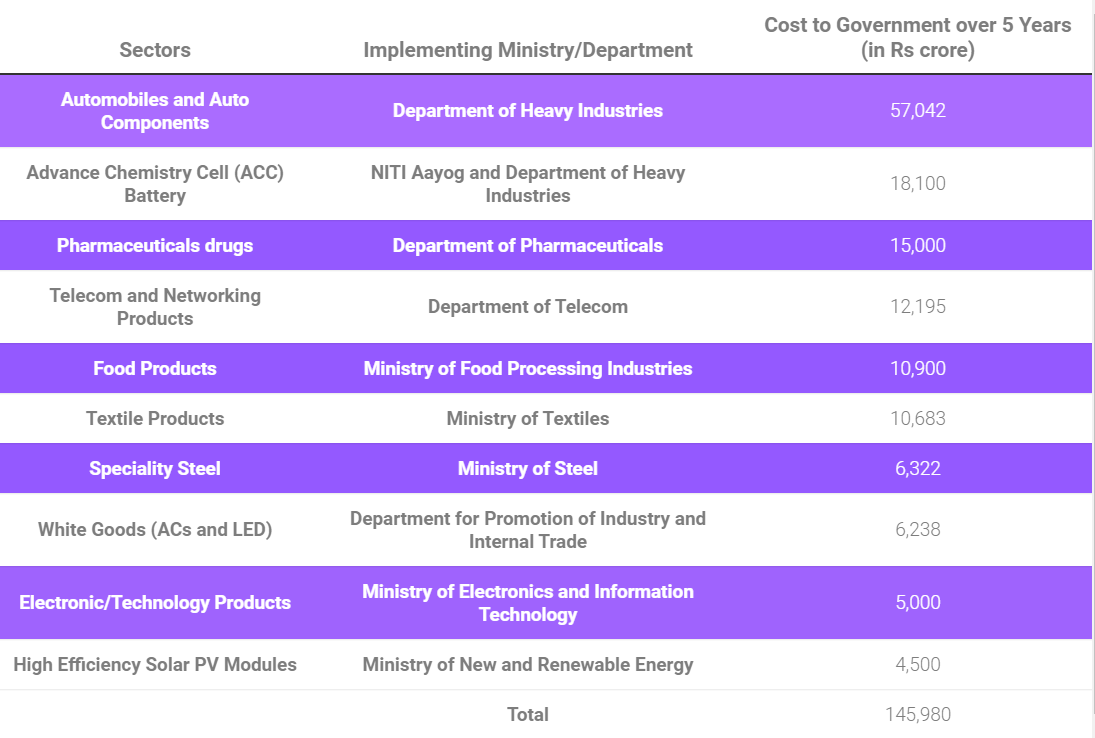
Given below is a table that shows the 10 sectors that will come under the PLI scheme, and the amount allocated to each sector.

Source: BloombergQuint

As we can see, the automobile and auto components sector has been allocated the highest amount in the PLI scheme. This would definitely help the sector to become a large exporter, and reduce import dependence. It has also been ensured that an amount of Rs 18,100 crore has been allocated for advanced chemical cell batteries. This would provide a major boost to the production of electric vehicles, as batteries are a key component of it. 

As per a statement from the Finance Minister, Smt. Nirmala Sitharaman, speciality steel in India could become a potential champion in the country’s exports. Hence, an amount of Rs 6,322 crore has been allocated for incentivizing its production as well.

Similarly, eight other sectors will be provided with sufficient incentives to completely improve the overall manufacturing capacity in India.

India and PLI

India has definitely received a massive Diwali gift from the government. If this scheme goes through precise planning and execution, it could become one of the most vital initiatives that have been adopted in our country. Our producers would certainly get the push to cater to the domestic demand, and foreign firms would be encouraged to invest heavily in India. The citizens of India would obtain more employment opportunities as well. It is a win-win situation for all the parties that would be involved!

At the same time, we would urge our readers to follow the latest updates surrounding this scheme. We could see listed companies applying to get the benefit of these incentives, and ramping up their production activities in India. This would certainly become a factor for many stocks to rally. We would also keep an updated list of the specific stocks that have been selected for the PLI scheme. Let us look forward to a positive outcome and see our country grow into one of the best manufacturing hubs in the world.

Categories
Market News Top 10 News

Cabinet Approves PLI Scheme Worth Rs 2 lakh crore for 10 Sectors – Top Indian Market News

Cabinet approves PLI scheme worth Rs 2 lakh crore for 10 sectors

The Union Cabinet has approved Production Linked Incentive (PLI) scheme worth up to Rs 2 lakh crore for 10 key sectors, for the next 5 years. The scheme will provide a boost to India’s manufacturing capabilities and improve exports. The sectors that will get the benefit of the PLI scheme include telecom, automobile, pharmaceuticals, electronic products, and speciality steel.

Read more here.

Aurobindo Pharma Q2 Results: Net Profit rises 25% YoY to Rs 805 crore

Aurobindo Pharma Ltd. reported a 25% year-on-year (YoY) increase in net profit to Rs 805 crore, for the quarter ended September (Q2). The drug-maker posted a 15% YoY increase in revenue to Rs 6,377 crore, during the same period. Before the results were declared, the share price of Auro Pharma jumped 7.02% and closed at Rs 814.45 on the NSE today.

Coal India Q2 Results: Net Profit falls 16% YoY to Rs 2,948 crore

Coal India Limited reported a 16.31% year-on-year (YoY) decline in consolidated net profit to Rs 2,948.12 crore, for the quarter ended September (Q2). The company’s revenue from operations increased by 3.78% YoY to Rs 21,153.07 crore, during the same period. The Board of Directors of Coal India has approved an interim dividend of Rs 7.50 per share. 

Read more here.

SpiceJet Q2 Results: Net Loss narrows to Rs 113 crore

SpiceJet Limited reported that its net loss has reduced to Rs 112.59 crore, for the quarter ended September (Q2). The company had posted a loss of Rs 462.58 crore in Q2 of the previous financial year. The airline’s total revenue from operations declined by 62.92% YoY to Rs 1,054.98 crore in Q2 FY21. SpiceJet has stated that they are focusing on further expansion of its cargo business.

Read more here.

Passenger vehicle wholesale up 14% in October: SIAM

The total domestic sale of passenger vehicles in India increased by 14.19% YoY to 3,10,294 units in October. The sale of two-wheelers was up by 17% YoY to 20 lakh units, during the same month. The data has been compiled by the Society of Indian Automobile Manufacturers (SIAM).

Read more here.

Godrej Industries Q2 Results: Net Profit declines 45% YoY to Rs 205 crore

Godrej Industries Ltd. reported a 44.84% year-on-year (YoY) decline in consolidated net profit to Rs 205.33 crore, for the quarter ended September (Q2). The company’s revenue from operations declined by 9.22% YoY to Rs 2,386.29 crore, during the same period. The company has posted a sharp rebound from Q1, but are yet to recover to pre-Covid levels.

Read more here.

L&T Construction wins RRTS order in Uttar Pradesh

The construction arm of Larsen & Toubro (L&T) has secured significant contracts, including a Regional Rapid Transit System (RRTS) order in Uttar Pradesh. L&T would provide its services to execute the new high-speed rail project in the Delhi-Ghaziabad-Meerut Corridor. The company’s Power Transmission & Distribution segment has won a set of orders in the international market as well.

Read more here.

KPIT Technologies wins strategic deal with BMW Group

The share price of KPIT Technologies jumped 8% on Wednesday after it won a strategic large deal with BMW Group. The automotive software company will provide its services to design and enhance BMW’s combined charging electronics program. The deal with BMW will be spread across 5 years.

Read more here.

Indiabulls Housing Q2 Results: Net Profit falls 54% YoY to Rs 323 crore

Indiabulls Housing Finance Ltd. reported a 54% year-on-year (YoY) decline in consolidated net profit to Rs 323.20 crore, for the quarter ended September (Q2). The company’s total income declined by 25.9% YoY to Rs 2,581 crore, during the same period. The Haryana-based mortgage lender has also stated that they are back on track to disburse Rs 1,000 crore through a co-lending model in 2020-21.

Read more here.

LIC Housing Finance Q2 Results: Net Profit rises 3% YoY to Rs 790 crore

LIC Housing Finance Ltd. reported a 3% year-on-year (YoY) increase in net profit to Rs 789.67 crore, for the quarter ended September (Q2). The company’s total income grew marginally to Rs 4,987.64 crore, during the same period. The company, promoted by the country’s largest insurer LIC, is mainly engaged in providing loans for the purchase or construction of residential houses.

Read more here.

Categories
Market News

Production-Linked Incentive (PLI) – A boost for electronics sector?

Manufacturing will be key to India’s success. Why do we say this? India has a huge population and a large chunk of them require a job to survive. When we see the growth of China, it’s not because of the digital transformation they are into now. Their growth is because of a solid and robust manufacturing sector. This secondary sector arranged the way for their working population to find jobs and drive the country’s growth.

India has certainly missed the stepping stone of making a robust secondary sector and relied directly on the tertiary sector to support the economy’s growth. Now, the tides are changing. The “Atmanirbhar” mission is on the heads of the national government and they have come out with a scheme which can boost their mobile manufacturing sector altogether.

The Production-Linked Investment Scheme

To make India a global electronics manufacturing hub, the national government has rolled out a ₹41,000 crore Production-Linked Incentive (PLI) scheme.

According to this initiative, a financial incentive of 4%-6% will be given to electronics companies that manufacture mobile phones and other electronic components. 22 companies, including the likes of Wistron, Samsung, Micromax, Foxconn, Lava, etc, have already applied for this incentive program. The shortlisted companies will have to take 2019-’20 as a base year and produce more goods in the next five years. The more incremental sales you generate, the higher the financial incentive you receive. 

The total ₹41,000 crore scheme is distributed under the five years. Year 1 – Rs 5,334 crore, Year 2 – Rs 8,064 crore, Year 3 – Rs 8,425 crore, Year 4 – Rs 11,488 crore and Year 5 – Rs 7,640 crore. Any reason for this uptrend? This is done so that the jobs created are for long-term and no company can take benefit by producing more only one year.

“We have introduced the PLI scheme for five years to boost local production. Besides this, we have received commitments to make mobile phone and parts worth Rs 11.5 lakh crore.” – Union Minister for Information Technology and Communications Ravi Shankar Prasad. 

Why now?

The US trade war and then the COVID-19 mystery, both has put Chinese administration under scrutiny in the eyes of the world. All the political and social situations are going to leave a heavy impact on business, and major companies are looking to shift their manufacturing facilities out of China. Resources like land and labour leaves India as the best option for these companies to shift to. The question is, can India make use of opportunity and become the world’s factory?

Why is the government rolling out incentives for manufacturing companies? Creation of jobs. The secondary sector needs a boost. India has a huge labour force (49.42 crore as of 2018). According to estimates, more than 12 lakh people will get employment due to this scheme. Out of this, 3 lakh people will receive direct employment and more than 9 lakh will receive indirect employment.

What will be the long-term impact?

A huge supply of labourers will cut down any manufacturer’s cost of producing their goods. This will help the company drive down prices of their products, and hence attract more customers. Production within Indian boundaries will cut down the cost of imports, thus reducing the import bill. On the other hand, more employment will generate more income for the nation. This will drive the Gross Domestic Product (GDP) of India, higher. Clearly, a win-win situation for all parties involved.