Categories
Editorial

Life Insurance Corporation of India (LIC) IPO: All You Need to Know

The biggest initial public offering (IPO) in the history of the Indian stock market is here! Life Insurance Corporation of India has launched its IPO today— May 4. The Central Government aims to raise up to Rs 21,000 crore by divesting a 3.5% stake in the country’s largest life insurer. In this article, learn all about LIC and its IPO.

Company Profile – Life Insurance Corporation of India Ltd

Life Insurance Corporation of India was formed on September 1, 1956, by merging and nationalizing 245 private life insurance companies in India. It offers unit-linked insurance products, saving insurance products, term insurance products, health insurance, and annuity & pension products. LIC is currently the largest entity in the Indian insurance space, with a market share of above 61.6% in terms of premiums

They also hold a 61.4% market share in terms of new business premiums (NBS) and a 71.8% market share based on the number of individual policies issued. [NBS is the premium acquired from new policies during a particular year.] More importantly, LIC is the fifth-largest insurer in the world in terms of gross written premiums (GWP).

LIC is a trusted brand in our country and has a customer-centric business model. It has been a security net for Indians. Over the years, the company has harnessed technological capabilities to support policyholders and drive operational efficiencies. 

Fact Sheet:

LIC’s total assets under management (AUM) stood at a whopping Rs 40.1 lakh crore as of December 31, 2021 (Q3 FY22). Interestingly, this figure is more than 3.2 times the total AUM of all private life insurers in India. It is more than 1.1 times the AUM of the entire Indian mutual fund industry’s AUM!

The company has a strong omnichannel distribution network, consisting of over 0.13 crore agents, 2,128 micro insurance agents, and 215 alternative channels. LIC operates through an extensive network of 2,048 branches and 1,559 satellite offices. [A satellite office is a branch of a larger company that is physically separate from the organization’s main office.] The insurer also operates in the UAE, Singapore, Fiji, Mauritius, Qatar, and the United Kingdom. 

The embedded value (EV) of LIC was estimated at Rs 5.4 lakh crore as of Q3 FY22. The EV of a life insurance company is the sum of the adjusted net asset value (NAV) and the present value of future profits. It is essentially the industry standard for valuing an insurance company. As per reports, the market valuation of LIC could be around 3-4 times the EV.

LIC is also the biggest player in India’s equity markets. As of Dec 31, 2021, its investments in listed shares represented ~4% of the total market capitalization of NSE! 

About the IPO

Life Insurance Corporation’s public issue opens on May 4 and closes on May 9. The company has fixed Rs 902-949 per share as the price band for the IPO.

The IPO is entirely an offer for sale (OFS) of 22.13 crore equity shares by the promoter (Government of India), aggregating to Rs 21,008.48 crore. Individual investors can bid for a minimum of 15 equity shares (1 lot) and in multiples of 15 shares thereafter. You will need a minimum of Rs 14,235 (at the cut-off price) to apply for this IPO. The maximum number of shares that can be applied by a retail investor is 210 equity shares (14 lots).

The government has announced a discount of Rs 60 per share for policyholders and Rs 45 for employees.

If you are a LIC policyholder and wish to apply for the IPO:

  1. Your PAN must be updated in LIC’s records.
  2. The PAN used for LIC policies has to be the same as that registered with your broker account.

The primary objective of the IPO is to provide an exit strategy (or liquidity) for LIC’s promoters. The company aims to achieve the benefits of listing the equity shares on NSE and BSE. The total promoter holding in LIC will decline from 100% to 96.5% post the IPO.

Financial Performance
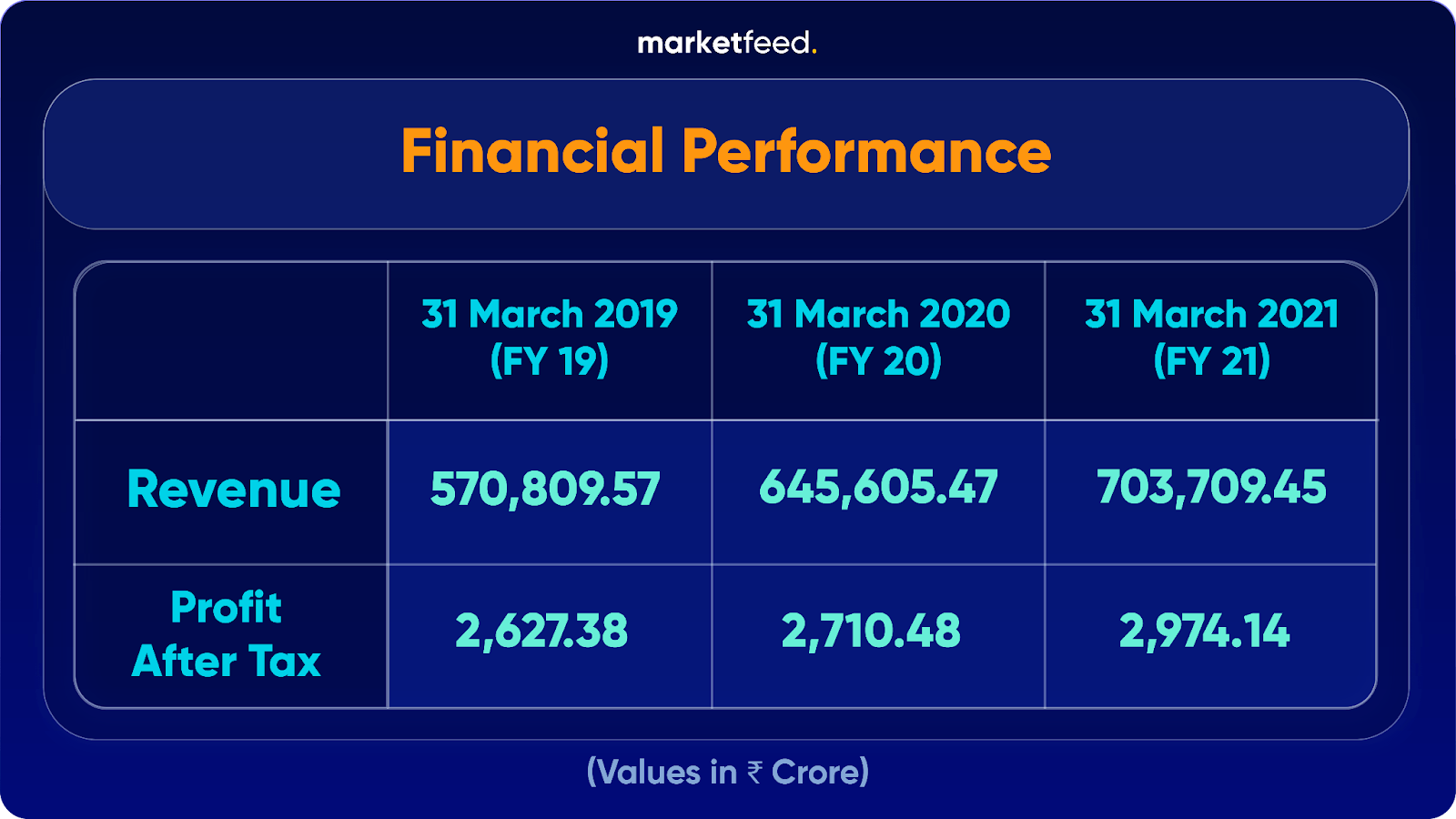
LIC has posted strong growth in revenue and profits from FY 2019-21. The company’s total income increased by 9% YoY to Rs. 7,03,732.43 crore in fiscal 2021. It was due to higher net earned premiums and investment income. Meanwhile, net profit rose 9.73% YoY to Rs 2,974.14 crore in FY21. The net profit on sale/redemption of policyholders’ investments jumped 105% YoY to Rs 39,809.61 crore during the same period. 

The gross written premium (GWP) increased at a CAGR of 9.21% on a consolidated basis between FY19 and FY21. [GWP is the total premium an insurer writes during a specific period before deductions like reinsurance and ceding commissions.] Moreover, LIC’s 13-month persistency ratio increased from 66% in FY19 to 67% in FY21. This suggests growth in policyholders who renewed their policies.

It has an investment of Rs 38.4 lakh crore towards policyholders’ funds and is debt-free as of Dec 31.

Risk Factors

  • The ongoing Covid-19 pandemic could adversely affect LIC’s business aspects like agents’ abilities to sell products and increased expenses due to changes in mortality and investment portfolio.
  • The insurance industry is highly competitive. The company will be directly competing with leading private entities such as SBI Life, HDFC Life, and ICICI Prudential once it gets listed.
  • Volatility in capital markets, loss of customer confidence in the insurance industry, or a decline in customers’ financial positions could severely affect LIC’s overall performance.
  • Any unfavourable publicity concerning the insurance giant can harm its brand name and reputation.
  • The inability to retain and recruit individual agents at a reasonable cost and time could adversely impact LIC as individual agents procure most individual new business premiums.

IPO Details in a Nutshell

The book-running lead managers for the public issue are Axis Capital, Kotak Mahindra Capital, BofA Securities, Goldman Sachs (India), J.P. Morgan, etc. LIC filed the Red Herring Prospectus (RHP) for its IPO on April 26. You can read it here. Out of the total offer, 50% is reserved for Qualified Institutional Buyers (QIBs), 15% for Non-Institutional Investors (NIIs), and 35% for retail investors.

Ahead of the IPO, LIC raised a massive Rs 5,627 crore from 123 anchor investors! The anchor investor portion of the IPO was also oversubscribed.

Conclusion

Insurance is not too popular in India, especially when it comes to life insurance. Only a marginal portion of the country holds life insurance. The total insurance coverage in India stood at a mere 3.76% in 2019. There can be a massive scale of development in this sector. Amidst the Covid-19 pandemic, the awareness towards securing insurance policies has increased. Whether it be health insurance or life insurance, more people are actively looking for the best products that can safeguard their future. Thus, LIC can capitalise on the high growth opportunities in the Indian life insurance sector. 

LIC’s maiden offer is expected to help the central government meet its disinvestment target of Rs 78,000 crore for FY22.

LIC’s IPO shares are trading at a premium of Rs 63 in the grey market. Before applying to this IPO, we will wait to see if the portion reserved for institutional investors gets oversubscribed. As always, consider the risks associated with the company and come to your own conclusion.

What are your views on LIC’s IPO? Will you be applying for it? Let us know in the comments section of the marketfeed app.
Categories
Market News Top 10 News

Maruti Suzuki Reports 58% YoY Rise in Q4 Net Profit – Top Indian Market News

Maruti Suzuki Q4 Results: Net profit rises 58% YoY to Rs 1,839 crore 

Maruti Suzuki India Ltd (MSIL) reported a 58% YoY increase in net profit to Rs 1,839 crore for the quarter ended March (Q4 FY22). Its revenue from operations rose 11% YoY to Rs 25,514 crore during the same period. The automaker sold 4,88,830 vehicles in Q4, registering a 0.7% YoY decline. Lower sales promotion costs helped MSIL outweigh the impact of high raw material costs and global semiconductor shortages.

Read more here.

IRDAI hikes exposure limit for insurers in BFSI sector to 30%

The Insurance Regulatory and Development Authority of India (IRDAI) has permitted insurers to have exposure to financial and insurance activities up to 30% of their investment assets. This move will give insurance companies more flexibility to invest and could help improve returns. IRDAI has also proposed rationalisation and standardised administration of group health policies.

Read more here.

IndusInd Bank Q4 Results: Net profit rises 55% YoY to Rs 1,361  crore

IndusInd Bank reported a 55.3% YoY increase in consolidated net profit to Rs 1,361 crore for the quarter ended March (Q4 FY22). Its net interest income (NII) rose 13% YoY (or 5% QoQ) to Rs 7,860 crore during the same period. [NII is the difference between the interest income a bank earns on loans and the interest it pays depositors.] The bank’s provisions and contingencies declined by 21.5% YoY to Rs 1,464 crore in Q4.

Read more here.

UltraTech Cement Q4 Results: Net profit rises 47% YoY to Rs 2,614 crore

UltraTech Cement Ltd reported a 47% YoY increase in net profit to Rs 2,613.75 crore for the quarter ended March (Q4 FY22). Its revenue from operations rose 9.45% YoY to Rs 15,767.28 crore during the same period. Sales volumes fell 0.3% YoY to 27.69 million tonnes (MT) in Q4. The cement manufacturer’s board has declared a dividend of Rs 38 per equity share. 

Read more here.

IDBI Bank privatisation process on: DIPAM Secretary

DIPAM Secretary Tuhin Kanta Pandey said IDBI Bank’s privatisation process is on, and the quantum of stake sale will be decided after the roadshow is complete. The government may decide to sell its entire stake in one go or in tranches depending on the investors’ response. The Indian government holds a 45.48% stake in the bank, while LIC holds a 49.24% stake.

Read more here.

Wipro Q4 Results: Net profit rises 4% YoY to Rs 3,092 crore

Wipro Limited reported a 4% YoY increase in consolidated net profit to Rs 3,092 crore for the quarter ended March (Q4 FY22). Its revenue from operations rose 28% YoY to Rs 20,860 crore during the same period. The IT company closed 37 large deals resulting in a total contract value (TCV) of over $2.3 billion in FY22.

Read more here.

Tata Motors unveils Avinya concept EV

Tata Motors has unveiled a new electric SUV Concept named “Avinya” based on its latest Pure EV third-generation architecture. The concept promises more than 500 km range on a single charge cycle. It could come with dual electric motors, each powering one axle and sending power to all four wheels. The automaker aims to introduce the new EV by 2025.

Read more here.

SBI Cards Q4 Results: Net profit jumps 231% YoY to Rs 581 crore

SBI Cards & Payment Services Ltd reported a 231% YoY jump in consolidated net profit to Rs 581 crore for the quarter ended March (Q4 FY22). Its revenue from operations rose 22.91% YoY to Rs 2,319 crore during the same period. Earnings before credit costs increased by 25% YoY to Rs 1,172 crore in Q4. Total operating costs stood at Rs 1,577 crore, up 23% YoY.

Read more here.

PVR to bring opera-inspired auditorium concept Oma Cinema to India

PVR Cinemas has entered into an exclusive partnership with Oma Cinemas to roll out opera house-inspired cinemas in India. Oma Cinemas is a premium auditorium concept created by noted French architect Pierre Chican. Its unique tiered balconies (or pods) provide viewers with a sociable cinema experience while enjoying a perfect view of the screen.

Read more here.

Varroc Engineering to sell Europe, Americas 4-wheeler lighting business for $631 million

Varroc Engineering Ltd will sell its four-wheeler lighting system operations in the Americas and Europe to France’s Compagnie Plastic Omnium for $630.96 million. The company will continue to operate its China joint venture and its other businesses in countries such as Italy, Vietnam, Poland, and Romania. The divestment is part of its strategy to focus on the two-wheeler sector globally and electric vehicle product lines.

Categories
Editorial

Campus Activewear Ltd IPO: All You Need to Know

Leading sports & athleisure footwear manufacturer Campus Activewear Ltd has launched its three-day initial public offering. In this article, we analyse the company and its IPO.

Company Profile – Campus Activewear Ltd

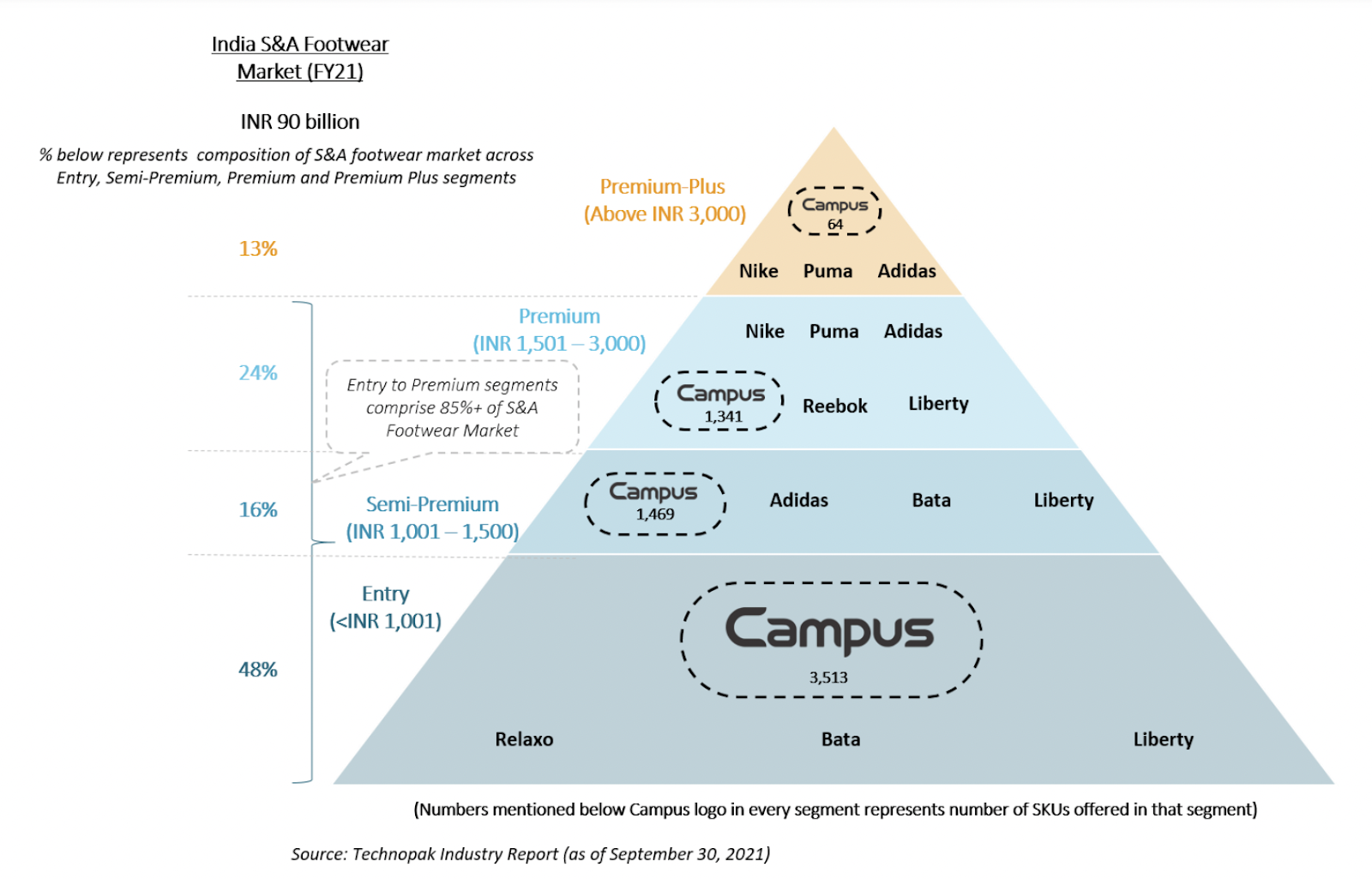
Campus Activewear Ltd (CAL) is the largest sports and athleisure footwear brand in India in terms of value and volume as of FY21. Incorporated in 2005, the company manufactures and distributes a wide range of running shoes, walking shoes, casual shoes, floaters, slippers, flip-flops, and sandals. It offers multiple choices across styles and colour palettes. Their products target different price points, geographical locations, and demographics. As of Dec 31, 2021 (Q3 FY21), CAL sold 1,433 active styles of footwear for men, 241 styles for women, and 485 styles for children.

Interestingly, CAL’s products cover 85% of the addressable market of shoes with a price range of Rs 500-3,500 a pair. It sold 1.3 crore pairs in FY21 and 1.36 crore pairs during the nine months ended Dec 2021

The company owns and operates five manufacturing facilities across India, with an installed annual capacity of 2.88 crore pairs as of Q3 FY21. It has strong in-house manufacturing and assembling capabilities. CAL’s retail operations are carried out through offline stores and online channels (Flipkart, Myntra). They have a network of over 425 distributors and ~19,200 retailers across 664 cities in India

CAL secured a ~17% market share in the branded sports & athleisure (S&A) footwear industry in India in the financial year 2020-21 (FY21). The company aims to emerge as the most preferred sports and athleisure brand in India and touch the daily active lifestyle of every citizen. 

About the IPO

Campus Activewear Ltd’s public issue opens on April 26 and closes on April 28. The company has fixed Rs 278-292 per share as the price band for the IPO.

The IPO is entirely an offer for sale (OFS) of 4.79 crore equity shares by promoters and early investors, aggregating to Rs 1,400.14 crore. Individual investors can bid for a minimum of 51 equity shares (1 lot) and in multiples of 51 shares thereafter. You will need a minimum of Rs 14,892 (at the cut-off price) to apply for this IPO. The maximum number of shares that can be applied by a retail investor is 663 equity shares (13 lots).

The primary objective of the IPO is to provide an exit strategy (or liquidity) for CAL’s promoters. The company aims to achieve the benefits of listing the equity shares on NSE and BSE. The total promoter holding in Campus Activewear will decline from 78.21% to 74.1% post the IPO.

Financial Performance

*FY19FY20FY21
Total Assets505.55719.22684.75
Total Income596.69734.11715.08
Profit After Tax38.662.3626.86
(Values in Rs crore)

Campus Activewear Ltd posted a 57% year-on-year (YoY) decline in net profit to Rs 26.86 in FY21. Its revenue declined 2.6% YoY to Rs 715.08 crore during the same period. The temporary shutdown of CAL’s manufacturing facilities during the Covid-19 pandemic adversely affected its gross margins. It incurred higher staff welfare with payments during a period with no production and for nearly five months.

However, the company posted impressive results for the nine months ended December 2021 (9M FY22). They reported a 403% YoY jump in net profit to Rs 84.80 crore, while revenue grew 93% YoY to Rs 841.8 crore. EBITDA surged 204% YoY to Rs 165.2 crore in 9M FY22. The average selling price per pair came higher at Rs 615 during the same period, compared to Rs 533 in 9M FY21. Their total borrowings stood at Rs 174.1 crore as of December.

CAL is back on track and ready for bright prospects with rising demands for its products in Tier-1 and Tier-2 cities.  

Risk Factors

  • Campus Activewear Ltd is reliant on its trade distribution and direct-to-consumer (D2C) channels for a majority of its sales. Any disruptions in the operations of these channels or the inability to expand/grow them may adversely affect sales and cash flows.
  • The sports and athleisure footwear industry is extremely competitive. The failure to compete effectively or develop successful products will affect CAL’s business and financial condition.
  • The company’s sales will be severely affected if they are unable to anticipate popular trends and consumer preferences.
  • CAL often experiences moderate fluctuations in its average selling price (ASP) based on seasonality. Historically, revenues in the first and second quarters have been lower when compared to those in the third and fourth quarters.
  • Any disruptions in warehousing and logistics will severely impact the company’s overall business.
  • Pricing pressure from customers could affect gross margin, profitability, and the ability to increase prices.

IPO Details in a Nutshell

IPO DateApril 26, 2022 – April 28, 2022
Issue TypeBook Built Issue IPO
Face ValueRs 5 per equity share
IPO PriceRs 278 to Rs 292 per equity share
Lot Size51 shares (1 lot)
Issue SizeAggregating up to Rs 1,400.14 crore
Offer for Sale (goes to promoters)Aggregating up to Rs 1,400.14 crore
Listing AtNSE, BSE

The book-running lead managers of the public issue are JM Financial, BofA Securities, CLSA India, and Kotak Mahindra Capital. CAL filed the Red Herring Prospectus (RHP) for its IPO on April 18. You can read it here. Out of the total offer, 50% is reserved for Qualified Institutional Buyers (QIBs), 15% for Non-Institutional Investors (NIIs), and 35% for retail investors.

Conclusion

According to a Technopak report, the sports & athleisure (S&A) footwear market is expected to grow at a CAGR of 21% to Rs 22,000 crore! Many are now focusing on improving their general health and well-being. Campus Activewear’s products cover a large portion of our country’s S&A footwear market at various price points. The company’s in-house manufacturing and assembly capabilities allow them to ensure all-round availability and quality of products.  

However, the market is dominated by international brands like Nike, Addidas, Puma, and much more. CAL also faces competition from Indian brands such as Bata India, Relaxo Footwear, Metro Brands, etc. It will be difficult for the company to grow and expand in any pricing segment of the S&A footwear market.

Source: Campus Activewear RHP

CAL’s IPO shares are trading at a premium of Rs 100 in the grey market. So far, the portion reserved for NIIs has been subscribed 3.37 times and that of retail investors 3.2 times. As always, consider the risks associated with the company and come to your own conclusion.

What are your views on Campus Activewear Ltd’s IPO? Will you be applying for it? Let us know in the comments section of the marketfeed app.
Categories
Editorial

Meet the Top 10 Richest Indians!

A recent report from Forbes showed that the total number of billionaires in India rose to a record 166 in the financial year 2021-22 (FY22). The combined net worth of these billionaires grew 26% to 750 billion! Their business empires have played a significant role in the economic growth of our nation. In this article, meet the top 10 richest Indians!

Gautam Adani

Gautam Adani, chairman of the Adani Group, has a net worth of $122.3 Billion (~Rs 9.31 lakh crore). With a meteoric rise in shares of group firms, Adani’s wealth grew by Rs 6,000 crore every week over the past year! He is currently the sixth richest person in the world!

The Adani Group has interests in the infrastructure, logistics, power generation & transmission, and real estate sectors via Adani Enterprises, Adani Ports, Adani Green Energy, Adani Transmission, and other group firms. The group also operates some of the major airports in our country. Adani has announced plans to become the world’s largest producer of green energy. They will invest up to $20 billion in renewable energy projects over the next decade.

Mukesh Ambani

Mukesh Ambani is the chairman of Reliance Industries Ltd (RIL), India’s largest company. RIL’s subsidiaries are involved mainly in petrochemicals, oil & gas, telecom (Jio Platforms), and retail (Reliance Retail). Reliance is also pivoting into green energy. The company aims to invest $80 billion over the next 10-15 years in renewable energy.

With a net worth of $98 Billion (~Rs 7.46 lakh crore), Ambani is the 10th richest person in the world!

Shiv Nadar

Shiv Nadar co-founded HCL Technologies, one of India’s largest IT companies. He is also known for his philanthropic activities. In July 2020, Nadar stepped down as chairman of HCL Technologies, handing over the position to his daughter, Roshni Nadar Malhotra. He is currently the Chairman Emeritus and strategic advisor of HCL Tech.

Shiv Nadar’s net worth stands at $28 Billion (~Rs 2.12 lakh crore). 

Cyrus Poonawalla

Also known as the ‘Vaccine King’, Cyrus Poonawalla is the world’s richest billionaire in the healthcare industry. His company, Serum Institute of India (SII), manufactured the Covishield vaccine last year. SII produces over 1.5 billion doses of vaccines per annum, including those for measles, polio, and flu. Poonawalla’s assets include a majority stake in listed financial services firm Poonawalla Fincorp.

Cyrus Poonawalla’s net worth stands at $26 Billion (~Rs 1.98 lakh crore).

Radhakishan Damani

Veteran investor and founder of Avenue Supermarts (popularly known as DMart), Radhakishan Damani has a net worth of $20 Billion (Rs 1.52 lakh crore). His company operates over 250 DMart stores across India. Also known as the ‘Retail King’, Damani holds stakes in VST Industries, India Cements, and Tata Trent.

Savitri Jindal & Family

The Jindal Group is chaired by Savitri Jindal, widow of founder Om Prakash Jindal. Their four sons run the business empire now. The conglomerate has interests in mining, power, industrial gases, cement, and steel manufacturing. The group’s listed firms include Jindal Steel & Power, Jindal Steel, JSW Steel, and JSW Energy.

Savitri Jindal and her family have a net worth of nearly $20 Billion (~1.52 lakh crore).

Lakshmi Mittal

Lakshmi Mittal serves as the executive chairman of ArcelorMittal, one of the world’s largest steel and mining companies in terms of output. The company operates steel manufacturing units in 17 countries. Even though he is based out of London, Mittal holds an Indian passport. His net worth stands at $18 Billion (~Rs 1.37 lakh crore).

Kumar Mangalam Birla & Family

Kumar Birla is the fourth generation head of the Aditya Birla Group. The group companies include UltraTech Cement, Hindalco, Aditya Birla Fashion & Retail, Aditya Birla Capital, and even the failed Idea Cellular. Birla’s net worth stands at $17 Billion (Rs 1.29 lakh crore).

Dilip Shanghvi 

Dilip Shanghvi founded Sun Pharmaceutical Industries, one of India’s most valuable pharma companies having significant sales across the world. He grew Sun Pharma through a series of acquisitions, including the 2014 purchase of rival Ranbaxy Laboratories for $4 billion. He has personally invested in renewable energy and oil & gas projects. His net worth stands at $16.2 Billion (~Rs 1.23 crore).

Uday Kotak

Uday Kotak is the executive vice-chairman and managing director of Kotak Mahindra Bank. His company is now among India’s top four banks in the private sector. The company offers banking products and financial services for corporate and retail customers in the areas of personal finance, investment banking, life insurance, and wealth management. Kotak’s net worth stands at $14.7 Billion (Rs 1.12 lakh crore).

Source: Forbes Real-Time Billionaires List (as of 13/4/2022)

Categories
Editorial

How Asian Paints Used Innovative Tech to Drive Growth

With a remarkable 80-year-old legacy, Asian Paints Ltd is one of the biggest names in the global paint industry. It is double the size of any other paint company in India. The group operates in 15 countries and has 26 paint manufacturing facilities in the world, servicing customers in over 60 countries! The company’s business growth has been astronomical as a result of the forward-looking and innovative mindset of its founders.

In this article, we discuss how Asian Paints adopted digital innovations to become one of the fastest-growing companies in India.

Humble Beginnings

In 1942, Champalal Choksey, Chimanlal Choksi, Surykant Dani, and Arvind Vakil set up “Asian Oil and Paint Company” out of a small garage in Mumbai. The Second World War, Quit India Movement, and Japan’s attack on Burma (now Myanmar) prompted the British Empire to impose a temporary ban on imports, especially oil. The four individuals wanted to address this dire situation and turn it to their advantage. 

They were one of the first companies to distribute paint in tiny packets, rather than selling them in tins. This innovative packaging method simplified and accelerated their distribution process. By 1952, Asian Oil & Paint Company registered an annual turnover of Rs 23 crore! It launched trendy marketing campaigns that changed perspectives surrounding painting as a lifestyle choice. The company became Asian Paints (India) Pvt. Ltd in 1965 and later a public company in 1973. By then, it had become India’s leading paints manufacturer.

Initially, paints were sold through wholesalers or distributors who took ~20% of the margins. Asian Paints decided to cut all wholesale channels and started to sell their products directly to consumers through tens of thousands of retail dealers. 

Focus on Digital Transformation

In 1970, Asian Paints bought a mainframe computer for Rs 8 crore, becoming India’s first private company to own one. Most Indians had no clue what computers were or what it was capable of during that time. The company began to improve its services with computer assistance. They digitised inventory and billing management, which helped save time and costs. Asian Paints started using computerized color matching in the mid-1970s. They also trained employees to use personal computers in the 1980s and established a customer care helpline in the 1990s. The company was truly far ahead of its time!

The paint company used information technology (IT) systems for manufacturing, order processing, and supply chain. They centralised the order-taking process into a single corporate call center to increase efficiency and customer service. Even storage and retrieval systems were automated in 2008. For more than 50 years, Asian Paints has been collecting data on the colour, size, and quantity of paints purchased all over India. They continue to store proprietary data on paint demand for each neighbourhood in our country. 

Recently, the company implemented state-of-the-art automatic truck-loading systems in the two new plants at Mysuru and Visakhapatnam. They also use advanced artificial intelligence (AI) and machine learning (ML) software/algorithms to constantly improve the overall demand forecast. It has ultimately helped Asian Paints to provide better customer service. The company has executed its digital vision with utmost focus.

Massive Growth

As a result of its digital initiatives, extensive distribution network, and consumer-centric approach, Asian Paints has been a market leader in paints since the 1970s. Currently, it commands a market share of nearly 42% in the domestic paint market. Based on data derived from consumer preferences, the company expanded its product portfolio from paints to decorative coating. Asian Paints is now present in the home improvement & decor segment and has even added furniture and lighting solutions to its portfolio. They also diversified into chemical products used in the paint manufacturing process. 

By leveraging data analytics, Asian Paints can accurately forecast demand for each of its products. The company can easily identify what product will be required at a particular place on a specific date with more than 90% accuracy! Thus, the company delivers paints to 70,000+ registered dealers nearly 3-4 times a day! On any particular day, the stock gets sold off within just three hours, and new batches keep arriving at fixed periods. The entire distribution process is fully automated and seamless. 

As per reports, Asian Paints could be one of the only companies in the world whose revenue has grown by ~20% per annum for over 60 years! Its business essentially doubles itself every three years. While most manufacturers or FMCG firms lose 30-45% of the maximum retail price as channel costs, Asian Paints spends just 3% on distribution. A truly impressive feat!

What are your views on Asian Paints? Have you invested in the company? Let us know in the comments section of the marketfeed app.

Categories
Editorial

RBI Monetary Policy Committee Meeting: Major Highlights

The Reserve Bank of India’s six-member Monetary Policy Committee (MPC) held its first meeting of the new financial year (FY23). Here are the key takeaways from RBI Governor Shaktikantha Das’ conference held today:

  • The MPC has decided to keep the repo rate unchanged at 4% for the eleventh consecutive time. Repo rate is the interest rate at which a central bank (like RBI) lends money to all the other banks in the country.
  • The committee has also decided to keep the reverse repo rate unchanged at 3.35%. Reverse repo rate is the interest rate at which commercial banks lend money to the central bank.
  • The RBI Governor said the MPC had voted unanimously to maintain the accommodative stance. It means the central bank is prepared to inject more money into the economy to boost growth.
  • The RBI will focus on withdrawal of the accommodative stance to ensure that inflation remains within the target of 2-6%. It aims to withdraw excess liquidity over a multi-year period.
  • The RBI has restored the Liquidity Adjustment Facility (LAF) corridor with standing facilities— one to absorb liquidity and the other to inject liquidity. The Standing Deposit Facility (SDF) rate will be 3.75% to reduce/absorb excess liquidity. The Marginal Standing Facility (MSF) rate stands at 4.25% to pump more money into the economy.
  • Meanwhile, the RBI has cut India’s real gross domestic product (GDP) growth projection to 7.2% for FY23. It had earlier projected GDP growth at 7.8%.
  • The consumer price inflation (CPI) for FY23 is projected at 5.7% (from the earlier projection of 4.5%). The break-up of projected inflation is as follows: 
  • The effect of Russia’s invasion of Ukraine has added to the rise in inflation. It has also caused a downside pressure on economic growth. However, Domestic economic activity continues to show recovery even as contact-intensive services remain below pre-pandemic levels. Investment activities may gain traction with improved business confidence, credit growth, and favorable financing conditions. The economy is supported comfortably by large foreign exchange (forex) reserves.
Categories
Editorial

Shares of HDFC Bank, HDFC Surge on Merger Plans. Know More About it Here!

Today, shares of HDFC Bank jumped nearly 11% to Rs 1,683, while that of HDFC surged 14% to Rs 2,800! The Board of Directors of mortgage lender Housing Development Finance Corporation Ltd (HDFC) has approved the merger of the company with HDFC Bank.

  • The share exchange ratio for the amalgamation will be 42 equity shares (of the face value of Re 1 each) of HDFC Bank for every 25 equity shares (of the face value of Rs 2) of HDFC Limited.
  • Post the transaction, existing shareholders of HDFC Limited will own 41% of HDFC Bank. The subsidiaries and associate firms of HDFC will also shift to the bank. HDFC, India’s leading housing finance company, has total assets under management (AUM) of Rs 5.26 lakh crore. Its market cap stands at Rs 4.44 lakh crore.
  • Shares held by HDFC in the lender will be extinguished, making HDFC Bank a full-fledged public company.
  • HDFC Bank will now offer mortgages as a core product to its customers. The lender will also offer new credit and deposit products. For the uninitiated, a mortgage is an agreement between a person and a lender to buy or refinance a home without having to pay all the cash upfront. This agreement gives lenders the legal right to repossess a property if a person fails to meet the terms of the mortgage. With interest rates expected to rise in the upcoming quarters, this merger reduces the cost of funding for HDFC.

Impact of the Merger

As per HDFC’s exchange filing, the proposed merger will help leverage and create meaningful value for various stakeholders. It is expected to benefit from increased scale, comprehensive product offering, and the ability to drive synergies across revenue opportunities. The merger will also help to reduce HDFC Bank’s proportion of exposure to unsecured loans. HDFC Bank will gain access to building a sizeable home loan portfolio, thus increasing the size of their overall loan books.

The merger also has the potential to attract a 7-8% increase in participation from foreign investors.

Based on the market capitalisation of HDFC and HDFC Bank as of April 1, the market value of the merged entity will be ~Rs 12.8 lakh crore. It is likely to be the third-largest company in India, after Reliance Industries Ltd and Tata Consultancy Services (TCS). 

The merger is expected to be completed by the second or third quarter of the next financial year (FY24). The scheme of amalgamation is subject to the approval of the Reserve Bank of India, Securities & Exchange Board of India, and other regulatory authorities.

Categories
Editorial

What is Happening Between SEBI and Ruchi Soya?

The share price of Ruchi Soya Industries Ltd has been highly volatile lately. The Patanjali-owned company’s Follow on Public Offer (FPO) has come under the scanner of India’s stock market regulator. In this article, we discuss the recent developments surrounding Ruchi Soya’s FPO and why SEBI has taken strict action against the FMCG firm.

Ruchi Soya Industries – A Brief Profile

Ruchi Soya Industries Ltd (RSIL) is a fast-moving consumer goods (FMCG) company that has evolved as an integrated player in India’s edible oil sector. It also produces and markets textured soya protein, honey, atta, biscuits, noodles, and wellness products. The company owns and operates numerous palm plantations across our country.

Over a decade ago, Ruchi Soya started facing massive hurdles due to high input costs and low margins. The company was competing with cheap imports, and its seed extraction business was failing. Moreover, they used to offer generous credit terms to customers, which they ultimately could not retrieve. RSIL faced an unfortunate debt crisis to the tune of Rs 9,000 crore! 

In 2017, a consortium of banks dragged RSIL to the bankruptcy court. The lenders agreed to resolve the bankruptcy proceedings by selling Ruchi Soya to another FMCG firm. This is when Baba Ramdev’s Patanjali Ayurved Group stepped in. They acquired a ~99% stake in RSIL and settled ~Rs 4,000 crore in dues.

The FPO

As per SEBI’s current shareholding norms, Patanjali has to bring down its stake in Ruchi Soya to 75%. Earlier this month, Ruchi Soya announced the launch of a Follow on Public Offer (FPO) to raise Rs 4,300 crore and bring down Patanjali’s (promoter) stake to 81%. The company fixed Rs 615-650 as the price band for the FPO. Through this offer, RSIL will introduce new shares to the public and dilute its current shareholding pattern. 

The offer opened on March 24 and received an overall subscription of 3.59 times as of March 28. During this period, SEBI noticed that unsolicited SMSes were being circulated amongst Patanjali’s customers:

The market regulator said the content of the SMS appeared to be misleading and fraudulent. It directed Patanjali and the lead managers of the FPO to issue a notice to all investors in the form of advertisements to caution them about the circulation of such messages. Ruchi Soya claimed the messages were not issued by them or by any of their directors, promoters, or group companies.

Special Window to Withdraw Bids

To highlight their non-tolerance policy on such affairs, SEBI instructed RSIL to offer investors a special window to cancel their bids in the FPO! A notice was sent to all applicants that submitted bids, informing them about a window till March 30 to withdraw their bids. As per reports, foreign portfolio investors (FPIs) have cancelled 97% of bids during the two-day withdrawal period. However, demand from high net-worth individuals (HNIs) and small retail investors saw only a minor pullback. Many would have come under pressure and felt subscribing to the FPO would now be a risky bet. 

The overall subscription of the FPO declined from 3.6 times to 3.4 times on March 30. The finalisation of the basis for allocation of new shares will be declared on April 5. Will those who have been allotted new shares lose money? Or will the news surrounding RSIL and its FPO simply die down? Let us look forward to seeing how the situation unfolds in the days to come. 

Have you invested in Ruchi Soya Industries or applied for its FPO? Let us know in the comments section of the marketfeed app.

Categories
Editorial

The RP-Sanjiv Goenka Group: Origin & Businesses

The RP-Sanjiv Goenka Group (RPSG) is one of the largest diversified business groups in India. Since its formation nearly 11 years ago, the group has expanded into business segments such as power generation, carbon black, FMCG, information technology, infrastructure, media & entertainment, and much more. RPSG has established a direct presence in more than 35 countries. The group’s rapid growth and expansion can be attributed to the efforts and vision of its top-class family management. 

In this article, we take a look into the brief history of the RP-Sanjiv Goenka Group and learn more about their businesses.

Brief History of the Goenka Family

The RPSG Group was established in its current form in 2011. However, the Goenka family’s renowned history in Indian business dates back to nearly two centuries. In the early 1800s, the family was involved in the jute and tea sectors. After India’s independence in 1947, they ventured into the manufacturing sector after acquiring Octavius Steel from a company moving out of the country.

In the 1960s, Keshav Prasad Goenka transitioned the group’s business from trading to industry acquisitions in textiles, power, cables, and engineering. He then split his business empire amongst his three sons— Rama Prasad, Jagadish Prasad, and Gouri Prasad. Rama Prasad Goenka established RPG Enterprises in 1979. The entity started acquiring leading companies in the pharmaceutical, retail, power transmission & distribution, and entertainment industries.

In 2010, the group’s businesses were divided between Rama Prasad Goenka’s sons, Harsh and Sanjiv. Thus, the RP-Sanjiv Goenka Group was founded in July 2011 with Dr. Sanjiv Goenka as its chairman. Meanwhile, Harsh Goenka is the chairman of RPG Enterprises, the parent company of CEAT (tyre manufacturer), KEC International Ltd, and Zensar Technologies.

Listed Companies of RPSG Group

PCBL Limited (Formerly Phillips Carbon Black Ltd)

PCBL Limited manufactures and sells carbon black in India and across the globe. The Kolkata-based company offers various carbon black grades to the rubber industry under the ‘Orient Black’ brand. They also manufacture specialty blacks for applications like food contact plastics, fibers, wire & cables, films, adhesives, batteries, and paints under the ‘Royale Black’ brand.

Moreover, PCBL generates and distributes electricity from the tail gas recovered from carbon black production. The company has a total power generation capacity of 84 megawatts (MW).

CESC Limited

CESC Ltd is an integrated electric utility company. It generates, transmits, and distributes electricity primarily in West Bengal. The company owns and operates three thermal power plants as well. CESC serves ~2.9 million domestic, industrial, and commercial users within 567 square kms of Kolkata and Howrah. It has made Kolkata free of load shedding and brought in fault-free supply, quick response to local power outages, and swift redressal of customer grievances.

Saregama India Ltd

Saregama India Ltd (SIL) is engaged in the business of sound recording and publishing. The company’s music segment manufactures and sells music storage devices such as carvaans (music players with pre-loaded songs), music cards, and digital versatile discs. They produce, sell, telecast, and broadcast films, TV serials, and pre-recorded programs. The Mumbai-based company also publishes OPEN, a weekly current affairs magazine. 

Firstsource Solutions Ltd

Firstsource Solutions Ltd (FSL) is a leading provider of customized business process management (BPM) services in India and across the globe. The company primarily caters to the banking & financial services, healthcare, communications, and media industries. Their ‘Digital First, Digital Now’ approach helps corporations strengthen operations and business models. They have established long-term partnerships with over 100 leading global brands, including several Fortune 500 and FTSE 100 companies. FSL has employed over 28,000 people across the US, UK, India, and Philippines. 

Spencer’s Retail Ltd

Spencer’s Retail operates a chain of multi-format retail stores across India. It provides a wide range of quality products across categories such as food, personal care, fashion, home essentials, and electronics. The company also offers products under its own brands, such as Smart Choice, Tasty Wonders, and Clean Home. Currently, Spencer’s operates ~120 stores, including 37 hypermarkets in over 35 cities in India. 

Other Group Companies & Brands

In 2017, the RPSG Group entered the fast-moving consumer goods (FMCG) segment with Too Yumm!, a healthier snacking alternative. (You may have seen its eye-catching ads starring Virat Kohli). The FMCG business consolidated further with the acquisition of Apricot Foods, which sells packaged snacks under the ‘Evita’ brand. RPSG group is also present in the quick-service restaurant (QSR) space with Waffle Wallah, Bombay Toastee, and Biryani Battuta.

The group established RPSG Ventures in 2018. It is a consumer venture capital fund for innovative business-to-consumer (B2C) startups. They also made a strategic acquisition of Nature’s Basket, a retail chain well-known for its diverse portfolio of gourmet food. The company offers a wide range of organic food and imported ingredients. Interestingly, the RPSG Group is highly active in the Indian sports industry as well. It holds a majority stake in the iconic Mohun Bagan Athletic Club of Kolkata and Lucknow Super Giants, an IPL team. Over the last decade, the group has forayed into renewable energy options. It has set up wind and solar energy plants across Gujarat, Madhya Pradesh, Rajasthan, and Tamil Nadu.  

With a rich heritage, the $4 billion (revenue) RPSG Group has now become one of the most respected business conglomerates in India. Let us look forward to seeing how they execute future plans and expand further.

Categories
Editorial

India’s Top Upstream & Downstream Oil Companies: An Analysis

The oil and gas industry is one of the eight core industries in India. It has a powerful influence on all vital sections of our economy. Based on their operations and position in the supply chain for crude oil and its products, oil companies can be mainly divided into two: Upstream & Downstream. From exploration and production of oil to refinement and distribution, these companies play a crucial role in India’s economic growth.

In this article, learn about the major upstream and downstream oil companies of India.

What are Upstream Oil Companies?

The upstream segment is responsible for finding and producing crude oil and natural gas. This includes searching for potential oil fields, drilling exploratory wells, and examining whether they have the potential to deliver a sizable amount of oil. The companies involved in this segment also recover crude oil and natural gas to the surface. Such entities are also known as Exploration and Production (E&P) companies. They are heavily dependent on research and development (R&D) activities. The members of E&P companies include geologists, scientists, engineers, and seismic experts.

Modern oil exploration relies on geological surveys conducted using electronic equipment and artificial intelligence (AI). Mechanical drilling and fracking equipment has become more advanced and efficient over the past few years.

Oil & Natural Gas Corporation (ONGC)

Oil and Natural Gas Corporation (ONGC) Ltd is the largest producer of crude oil and natural gas in India. Its operations are primarily centered around the extraction of oil. The company accounts for ~71% of India’s total crude oil production

ONGC operates nearly 105 oil drilling rigs and 74 workover (portable) rigs. It owns more than 11,000 km of oil pipelines across India. Downstream oil companies such as Indian Oil Corp. (IOCL), BPCL, and HPCL use the crude extracted by ONGC as their raw material.

The Government of India (GoI) holds a majority stake (60.4%) in the company. ONGC comes under the administrative control of the Ministry of Petroleum & Natural Gas. You can learn more about the energy giant here.

Oil India Limited (OIL)

State-owned Oil India Ltd explores, develops, and produces crude oil and natural gas in India and internationally. The company operates 1,157 kilometers of cross-country crude oil pipelines. It also owns 13 drilling rigs, 14 work-over rigs, and 10 crude oil pumping stations in Assam, West Bengal, and Bihar.

OIL has participating interests in New Exploration Licensing Policy (NELP) blocks in Mahanadi Offshore, Mumbai Deepwater, and Krishna Godavari Deepwater. It is also involved in various offshore projects in Libya, the United States, Nigeria, Sudan, Venezuela, etc.

Reliance Industries Ltd

Reliance Petroleum, a subsidiary of RIL, is one of the major private players in the Indian upstream oil market. It operates two prominent oil rigs in the Bay of Bengal— Dhirubhai Deepwater (DD) KG-1 and DD KG-2. Reliance Industries also owns the largest refinery in the world— the Jamnagar oil refinery. It has the capacity to produce 1.97 lakh cubic meters of crude oil every day!

Larsen & Toubro Ltd

The leading engineering and construction company works on several projects that deal with the extraction of oil and its processing. L&T also offers critical equipment and systems for oil & gas projects. The company’s hydrocarbon business caters to the entire hydrocarbon value chain, including oil & gas processing, petroleum refining, chemicals & petrochemicals.

BP Plc

BP Plc is a British multinational oil and gas company headquartered in London. In 2020, the company formed an Indian joint venture (JV) with Reliance Industries Ltd. Operating under the “Jio-bp” brand, the JV aims to become a leading player in India’s fuel and mobility markets.

What are Downstream Oil Companies?

Downstream oil companies are involved in the refining, manufacturing, and marketing of petroleum products. This segment consists of oil refineries, petrochemical plants, and fuel distributors/retailers. They offer products such as petrol, diesel, natural gas, jet fuel, synthetic rubber, plastics, pesticides, pharmaceutical ingredients, and much more. Thus, downstream oil companies oversee the critical final steps of refining and converting crude oil into final products, which are then sold to end-consumers.

Indian Oil Corporation Ltd (IOCL)

IOCL is engaged in the refining, transportation, research & development, and marketing of petroleum products in India. Its products include petrol, diesel, lubricants, greases, aviation fuel, industrial fuels, and marine oils. The state-owned company operates 11 refineries across India, ~15,000 km of crude oil & gas pipelines, and 7 foreign subsidiaries. IOCL holds a 32% market share in the downstream oil industry.

Hindustan Petroleum Corporation Ltd (HPCL)

HPCL, a subsidiary of ONGC Ltd, refines and markets petroleum products in India and across the globe. The company offers petrol, diesel, kerosene, liquefied petroleum gas (LPG), naphtha lubricants, greases, and aviation turbine fuel. It also markets and exports bitumen, jet and marine fuel, marine lubes. 

As of March 2021, HPCL’s operating network consisted of 18,634 retail outlets, 6,192 LPG distributors, 46 aviation service facilities, and 41 oil & gas terminals. The company owns two refineries in Mumbai and Visakhapatnam. HPCL has secured a market share of 25% in the downstream oil sector.

Bharat Petroleum Corporation Ltd (BPCL)

BPCL refines crude oil and markets petroleum products in India. It has a network of ~15,402 fuel stations that sell petrol, diesel, automotive liquefied petroleum gas (LPG), and compressed natural gas. The company also offers automotive engine oils, gear oils, greases, and jet fuel to airlines. BPCL operates oil refineries in Mumbai, Bina (Madhya Pradesh), Numaligarh, and Kochi. They operate 2,241 km of multi-product pipelines. 

BPCL has a ~24% market share in India’s downstream oil sector.

The Way Ahead

Global crude oil prices have touched the roof amidst Russia’s invasion of Ukraine. There is a notable surge in demand, and the supply chains have broken. The oil market will face its biggest supply crisis in decades until the Organization of Petroleum Exporting Countries (OPEC) boosts production. A further increase in oil prices can push prices of essential commodities to higher levels.

Meanwhile, OPEC has projected that India’s demand for oil will double from current levels to ~11 million barrels per day by 2045. Due to the increasing demand for petroleum products, the Indian government has introduced various policies and subsidies to support upstream and downstream oil companies. It has even allowed 100% foreign direct investment (FDI) in upstream and private sector refining projects.

However, most oil companies mentioned above are now making a slow transition to renewable energy options. Crude oil, hydrocarbon, natural gas, and other fossil fuels are limited in nature. Such resources have been depleting rapidly in recent years. In the future, there will be a time when oil becomes scarce. India has pledged to decrease the carbon emission concentration in its GDP by 33%-35% by 2030 from the levels of 2005. The government also aims to double the country’s consumption of renewable energy to 20% by 2025.

Large oil companies are investing heavily in green energy projects and electric charging infrastructure to help India achieve these ambitious targets. Let us look forward to seeing how they execute their strategic plans.

Categories
Editorial

Why is Paytm’s Share Crash Continuing?

Things have gone from bad to worse for One97 Communications Ltd, the parent company of digital payments platform Paytm. The company’s shares have plunged over 70% since it got listed on the Indian stock markets in November, and investors have lost a ton of money. The stock hit a 52-week low of Rs 560.10 on March 21. In today’s article, we analyze the reasons behind the latest fall of Paytm’s shares.

The Story

On March 11, the Reserve Bank of India (RBI) directed Paytm Payments Bank (PPB) to stop onboarding new customers with immediate effect. The central bank cited serious supervisory concerns observed in PPB. However, it did not provide any specific details of misconduct.

RBI also directed PPB to appoint an audit firm to conduct a comprehensive audit of its IT system. “Onboarding of new customers by Paytm Payments Bank Ltd will be subject to specific permission to be granted by RBI after reviewing the report of the IT auditors,” said the RBI. Following this news, Paytm’s shares fell up to 13% last Monday.

In a statement, Paytm Payments Bank said it was working with RBI to address the concerns. “We shall notify when we recommence the opening of new accounts after obtaining RBI approval,” it said. The digital payments firm believes the ban will not have an adverse impact on its overall business.

Sadly, this is not the first time Paytm is facing action from the banking regulator. In 2018, RBI made certain observations on the process Paytm followed to attract new users, especially with Know-Your-Customer (KYC) norms. The company was found guilty of violating KYC rules. Last year, Paytm received a show-cause notice from RBI for submitting false information concerning the transfer of its Bharat Bill Payment business to PPB. The central bank imposed a monetary penalty of Rs 1 crore on the company. 

The Bloomberg Report

On March 14, Bloomberg came out with a serious allegation against Paytm. It reported that RBI acted against Paytm Payments Bank as it had allegedly allowed data to flow to servers in China, which violates the Indian government’s data privacy rules. As we know, India and China have not been on the best of terms lately.

PPB is a joint venture between Paytm and its founder Vijay Shekhar Sharma. Moreover, China’s Alibaba Group Holding and Jack Ma’s Ant Group own shares in Paytm. The Bloomberg report stated that annual inspections made by India’s central bank found that Paytm’s servers were sharing sensitive information with China-based entities that indirectly own a stake in PPB.

Paytm was quick to deny the reports. It claimed that the Bloomberg report was false and sensationalist. “Paytm Payments Bank is proud to be a completely homegrown bank, fully compliant with RBI’s directions on data localisation. All of the bank’s data resides within India,” the company said in a statement.

What Next?

Paytm had launched a Rs 18,300 crore initial public offering (IPO) in November 2021. Unfortunately, the stock has been on a free fall since it got listed. It has crashed over 70% from the IPO price of Rs 2,150. Paytm’s valuation, which stood at Rs 1.4 lakh crore at the time of the IPO, has eroded significantly to ~Rs 41,000 crore! The company was highly overvalued, especially when the path to profitability was unclear. Various analysts have termed Paytm’s business model as problematic as it generates very low revenue for every dollar spent on marketing. Here at marketfeed, we had posted an in-depth analysis on why Paytm’s IPO was a flop show. You can read it here.

According to an ET report, PPB will now submit several names as potential audit candidates to the RBI. The banking regulator will finalize the terms of reference based on its findings that include a series of lapses in meeting KYC norms. PPB had reportedly onboarded thousands of customers without following the official KYC process. The RBI’s regulatory order has come as a severe blow to Paytm’s plans of transforming itself into a small finance bank (SFB). Now, they may have to wait a bit longer to apply for an SFB license from the RBI. 

Paytm’s shares are still under pressure. Macquarie’s analyst has reduced its target price to Rs 450! We can expect the stock to be in the red zone till the company reports some positive developments. Paytm is notorious for dabbling in numerous business lines, and it has become difficult for them to work out a solid business model. A high level of competition in the fintech space is also weighing down on Paytm’s operations. It is advised that retail investors perform thorough research and take due caution before making investment decisions.

Categories
Jargons

Understanding the Different Types of Cryptocurrencies

Cryptocurrencies have become extremely popular across the globe over the past few years. Multiple crypto exchanges have sprung up in India, making it easier for you and me to invest or trade in the tens of thousands of cryptocurrencies available today. However, it is vital that we understand the various categories of cryptos and their features before investing in them. In this article, we shall discuss different types of cryptocurrencies. 

What is Bitcoin?

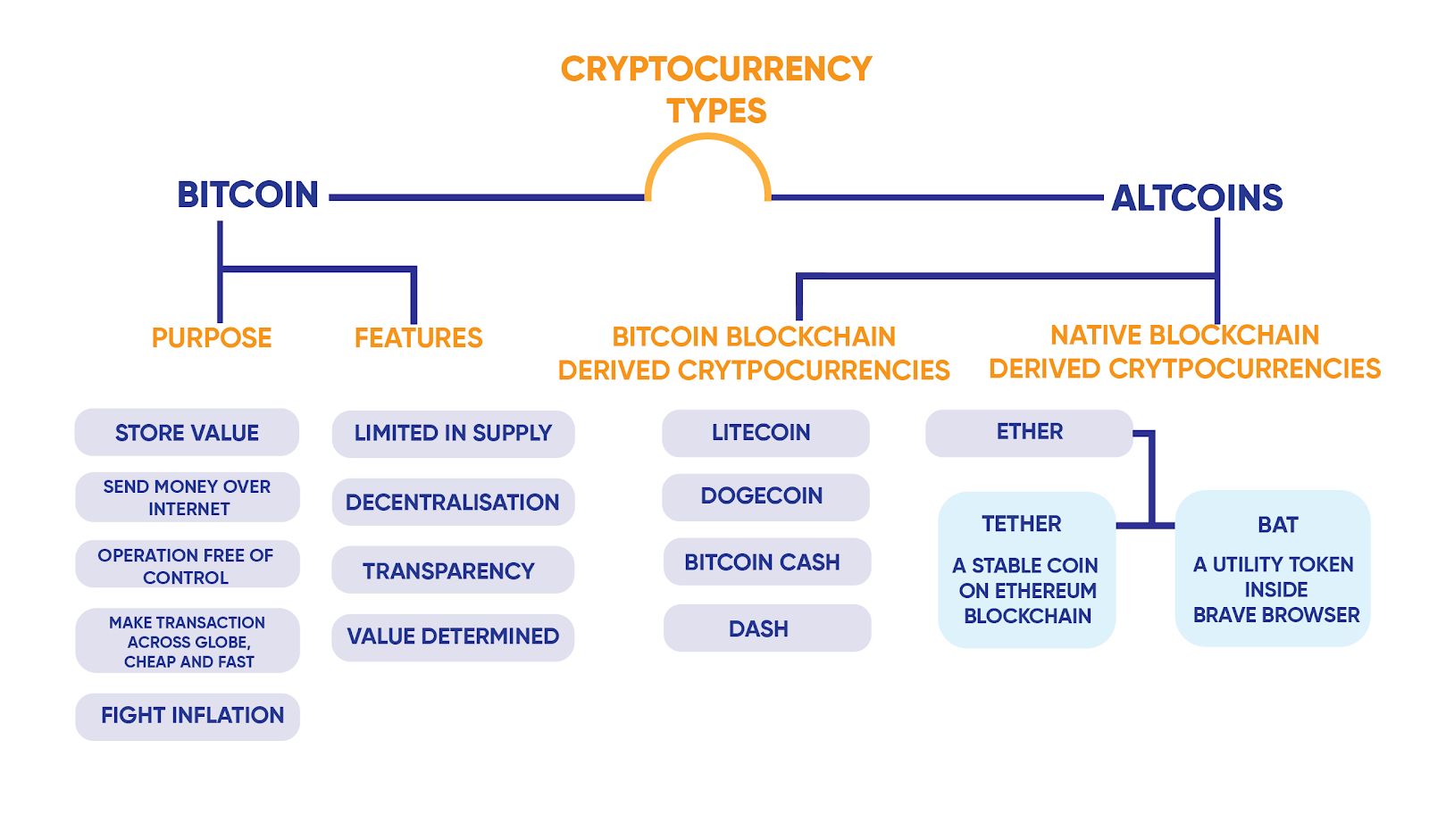
Bitcoin is a digital currency that provides secure global transactions quickly and without third-party manipulations. It was created to address the inefficiencies in global financial systems. Unlike normal currencies, Bitcoin is not issued by any government, and banks do not manage accounts or validate transactions. It is based on a cryptographic system that uses certain codes and numbers to keep information safe and secure.

Bitcoin is created, distributed, traded, and stored with the use of a decentralized ledger system known as a blockchain. It can be considered as records of transactions kept on a secure computer network. Moreover, Bitcoins are generally stored in digital wallets that allow users to manage and trade their coins. We recommend that you go through this detailed article to learn more about Bitcoin, blockchain technology, and how it works.

Bitcoins are currently accepted as a means of payment for products sold or services provided. It also offers lower transaction fees compared to traditional online payment mechanisms. However, the value of Bitcoin has been extremely volatile over the past few years. 

What are Altcoins?

Altcoins or Alternative Coins is a term used to describe all cryptocurrencies other than Bitcoin. These coins also use blockchain technology that allows secure peer-to-peer transactions. Altcoins were built on the success of Bitcoin by slightly changing the rules to appeal to different types of users. They essentially solve the inefficiencies of Bitcoin. For example, an altcoin known as Litecoin was created to address issues related to scalability, higher transaction time & charges, and environmental concerns of Bitcoin.

Another example of an altcoin is Ether. Ethereum (the technology behind Ether) was created based on the idea that blockchain tech can be used to create applications that go beyond just enabling a digital currency. 

There are more than 10,000 altcoins in existence today. New altcoins will keep emerging as a result of innovation and technological advancements.

Cryptocurrency as a Form of Currency

Cryptos that are used solely as a currency fall under this category. Examples include Bitcoin, Litecoin, Shiba Inu, and Dogecoin. Various companies and even countries around the world accept some of these digital currencies for conducting transactions. However, the high volatility of Bitcoin and other popular cryptocurrencies makes it unsuitable for everyday use by the public. 

What are Stablecoins?

Stablecoins are a class of cryptocurrencies backed by reserve assets (cash or commodity). It attempts to offer price stability while ensuring all basic features or benefits of cryptocurrencies. Stablecoins also provides instant processing and security of payments. For example, each Tether (USDT) is pegged to (or backed by) 1 US Dollar. If you hold Tether, an equivalent amount of US Dollar is stored in a reserve. Since fiat currencies are pegged to an underlying asset such as gold or foreign exchange reserves, their valuations remain free from wild movements.

Another example of a stablecoin is PAX Gold, a digital token backed by physical gold. Currently, one PAXG is nearly 30 grams. 

What are Utility Tokens?

While coins are built and run on their own blockchain and operate as currency, tokens are programmable assets that work on other cryptos’ blockchains. Utility tokens are those used for a specific purpose or use-case, generally for spending within a particular blockchain ecosystem. These tokens allow their holders to access a company’s product or service. 

For example, Basic Attention Token (BAT) is a utility token of Brave, a free and open-source web browser developed by Brave Software, Inc. BAT was created to improve the security and efficiency of digital advertising through blockchain technology. It tracks the time and attention of media consumers on websites using the Brave browser. BAT aims to efficiently distribute advertising money between advertisers, publishers, and readers of online marketing content and ads.

Ether is another utility token used to facilitate transactions under Ethereum’s blockchain network.

What are Security/Equity Tokens?

Any company that works with blockchain technology or projects can raise funds via an Initial Coin Offering (ICO). It is similar to an initial public offering (IPO), wherein a firm raises funds by selling its shares to the public. A blockchain-based company can issue a whitepaper, outlining details of its projects, future plans, and issue size. Interested investors can apply to an ICO and receive a new cryptocurrency token issued by the company. This token may have some utility in using the product or service the company is offering. Or, it may simply represent a stake in the company or project.

What are Asset Tokens?

Asset tokens are a type of cryptocurrency backed by a real asset. Any asset, agreement, or contract between parties can be settled using crypto. An example of an asset token is Non-Fungible Tokens or NFTs. These are tokens that exist on a blockchain and cannot be replicated. NFTs can be used to represent ownership of unique items, including art, images, videos, collectibles, and even real estate. However, buying an NFT of an image or art does not mean the buyer gets the copyright of the underlying item. Unlike most digital items that can be endlessly reproduced, each NFT has a unique digital signature— meaning it is one of a kind.

New types of cryptocurrencies will continue to emerge as companies adapt and innovate upon the blockchain technology Bitcoin was built on to launch their own platforms and currencies. You can head over to CoinMarketCap to view a comprehensive list of the different types of cryptocurrencies.