Categories
Market News Top 10 News

Retail Inflation at 7.01% in June – Top Indian Market Updates

Here are some of the major updates that could move the markets tomorrow:

Retail inflation at 7.01% in June

Retail inflation in India (measured by the Consumer Price Index) eased to 7.01% in June, compared to 7.04% in May. The overall inflation in food items stood at 7.75% in June, compared to 7.97% in the preceding month. Fuel and light inflation climbed to 10.39% in June in contrast to 9.54% in May. The downward trend in inflation can also be attributed to excise duty cuts on petrol and diesel, along with imposed restrictions on food exports.

Read more here.

HCL Tech Q1 Results: Net profit rises 2.4% YoY to Rs 3,283 crore

HCL Technologies Ltd reported a 2.4% YoY increase in consolidated net profit to Rs 3,283 crore for the quarter ended June (Q1 FY23). Its revenue from operations grew 16.92% YoY to Rs 23,464 crore during the same period. The company secured new deals worth $2,054 million in Q1, up 23.4% YoY. The IT firm’s board has declared a dividend of Rs 10 per share.

Read more here.

Ramco Systems deploys its Aviation Suite for Air Asia Company

Ramco Systems Ltd has deployed its Aviation M&E MRO Suite V5.9 at Air Asia Company (AACL), thereby automating and digitally transforming its business processes. AACL is Taiwan’s first privately-owned aircraft maintenance company. The Aviation Suite has modules for production planning, commercials, maintenance execution, and supply chain management.

Read more here.

NMDC cuts iron ore price amid weak demand

State-owned NMDC Limited cut prices of lump ore and fines by Rs 500 a tonne each amid a weak demand environment. The company has fixed the prices of lump ore at Rs 3,900 per tonne and fines at Rs 2,810 a tonne. Under the Ministry of Steel, NMDC contributes around 17% to the country’s annual iron ore output.

Read more here.

Banks to report mark-to-market losses of Rs 13,000 crore on rising bond yields: Report

As per a report by rating agency Icra, rising bond yields will force banks to report mark-to-market losses of up to Rs 13,000 crore on their investment portfolios in the April-June quarter (Q1 FY23). Mark-to-market losses occur when financial instruments held by firms are valued at the current market value, which is lower than the price paid to acquire them. The report further states that profits will moderate for the quarter. However, improved loan growth and operating profits will ensure that the banks’ revenues remain “steady” for FY23

Read more here.

RVNL-led consortium secures LoA for Rs 1,845 crore project

Rail Vikas Nigam Ltd (RVNL) announced that the RVNL-SP Singla Constructions consortium has secured a Letter of Acceptance (LoA) from the National Highways Authority of India (NHAI) for a road project in Himachal Pradesh. The project involves four-laning of NH-5 from Kaithlighat to Shakral Village in Himachal Pradesh. The total cost of the project is estimated at Rs 1,844.77 crore.

Read more here.

Adani Data Networks to participate in spectrum auctions

The Adani Group has applied to participate in the 5G auctions through its unit Adani Data Networks (a subsidiary of Adani Enterprises Ltd). Adani Data Networks is also undergoing the process to acquire a ‘Unified License with Authorisation of Access Services’ in specific areas. The conglomerate said it is not looking at a consumer mobility play and wants to acquire spectrum to create a private network to support its businesses (airports, data centres, etc).

Read more here.

Bosch to invest over Rs 200 crore in next five years in India

Bosch Ltd has announced plans to invest over Rs 200 crore in advanced automotive technologies and digital mobility space over the next five years. The company is also optimistic about having double-digit growth in FY23 over the previous financial year. Bosch will support Indian automakers through system expertise and participate in partnerships to become a major player in the electrification ecosystem.

Read more here.

Delta Corp Q1 Results: Net profit at Rs 57 crore

Delta Corp Ltd reported a consolidated net profit of Rs 57.13 crore for the quarter ended June (Q1 FY23). The company had posted a net loss of Rs 28.93 crore in the corresponding quarter last year (Q1 FY22). Its revenue from operations grew 35% YoY to Rs 250.27 crore in Q1 FY23. Delta Corp is an Indian gaming and hospitality corporation that owns and operates casinos and hotels under several brands.

Categories
Editorial

Why RBL Bank’s Share Price is Down 60% this Year?

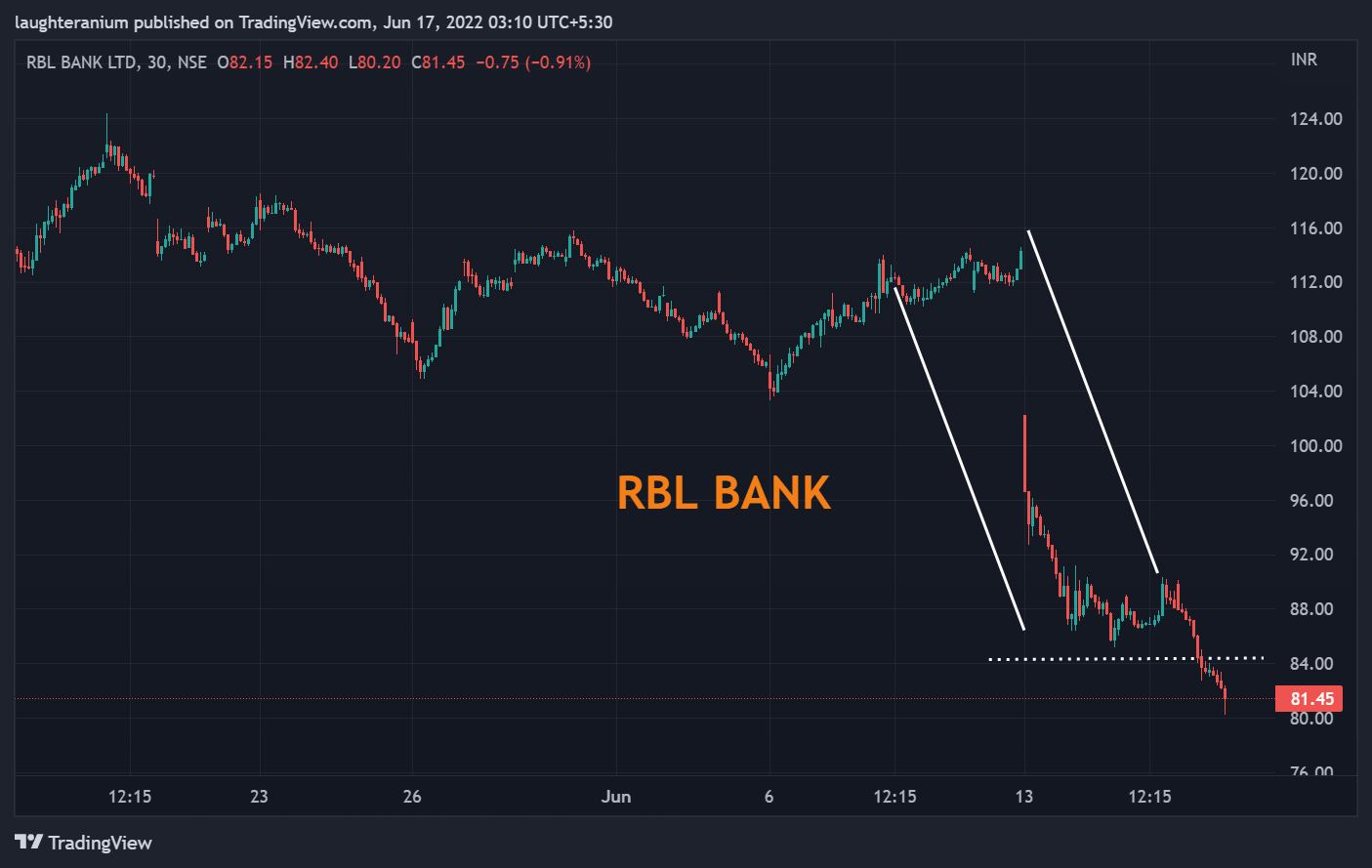
RBL Bank’s share price has tanked by nearly 60% in a year and ~30% in the second week of June! The bank’s top-level management, financials, and asset quality are being questioned. In this piece, we figure out what led to the price crash and if India’s central bank could possibly recover RBL Bank’s damaged share price while improving its financials and asset quality. 

Reshuffle Gone Wrong?

The #1 reason for the crash is due to a major management reshuffle. On June 10, 2022, R. Subramaniakumar was appointed as Managing Director and CEO of RBL Bank. His appointment came after the sudden and unexpected resignation of MD and CEO Vishwavir Ahuja. 

R. Subramaniakumar’s 40-year career started with Punjab National Bank (PNB) in 1980. He headed Business Transformation at PNB for three years and took over the Digital, HR, MSME, Retail, and Overseas operations. 

He was an Executive Director at Indian Bank and Indian Overseas Bank. Subramaniakumar also held the position of MD & CEO of Indian Overseas Bank. He was an Administrator at Dewan Housing Finance Corporation Ltd (DHFL) and achieved its resolution.

What stung the investors was Mr. Subramaniakumar’s association with DHFL. Over the past few years, the housing finance company has been in the news for all the wrong reasons. Regulatory and administrative authorities like SEBI, Enforcement Directorate, CBI, Maharashtra Police, and others are investigating the fraudulent activities committed by the Wadhwan Family that owns and runs DHFL. DHFL is currently undergoing insolvency proceedings under the Insolvency and Bankruptcy Code (IBC).

Bad Finances and Asset Quality. What Lies Ahead?

As of FY22, RBL’s Gross non-performing assets (NPA) stood at 4.4%, while Net NPA stood at 2.1%. Over the last five years, the bank’s Gross NPA was up 3.2%+, while Net NPA rose by 0.66%+. The bank’s Return on Asset (RoA) and Return on Equity (RoE) have tumbled into negative for the first time. For FY21-22, the RoA was -0.07% while its RoE was -0.59%. With negative cash flows and declining deposits, the lender also recorded its first loss of (-)Rs 74.7 crore for FY22. 

After the news was announced, RBL’s shares tanked ~7% on the same day. While the stock has lost ~62% of its value in one year, ~30% was lost in the last two weeks. Declining asset quality, combined with a perceived leadership crisis, could have led to such a steep drop in share price. Investors could see hope if and when the newly appointed CEO and MD focus on improving the bank’s asset quality, cashflows, and overall deposits. 

What are your views on RBL Bank and its current situation? Let us know in the comments section of the marketfeed app.

Categories
Editorial

CMS Info Systems Ltd IPO: All You Need to Know

CMS Info Systems Ltd, a cash management and payment solutions company, has launched its three-day initial public offering (IPO) yesterday— Dec 21. In this article, learn more about the company’s business model and its IPO.

Company Profile – CMS Info Systems Ltd

CMS Info Systems Ltd (CMS) is India’s largest cash management company based on the number of ATM points and the number of retail pick-up points (as of FY21). It installs, maintains, and manages assets and technology solutions on an end-to-end outsourced basis for banks and financial institutions. The company also caters to organised retail and e-commerce firms in India.

In FY21, CMS’ total currency throughput stood at Rs 9,15,886 crore. Currency throughput is the total value of cash passing through all its ATM and retail cash management businesses. The company has a pan-India fleet of 3,965 cash vans and a network of 238 branches and offices as of August 31, 2021.

Business Segments:

  • Cash Management Segment: This includes end-to-end ATM replenishment services, cash pick-up & delivery, network cash management & verification services, and cash-in-transit services for banks. The company derives ~66.74% of its revenue from operations from this segment (as of August 2021).
  • Managed Services: This segment includes banking automation product sales, deployment, and associated annual maintenance. It also offers common control systems and software solutions, including multi-vendor, security, and automation software solutions. The segment accounts for 30.64% of the company’s total revenue. CMS has an order book of Rs 2,000 crore to be executed over the next 5-7 years.
  • Others: CMS Info Systems provides end-to-end financial cards issuance and management services for banks. They also offer card personalisation services.

About the IPO

CMS Info Systems’ public issue opens on December 21 and closes on December 23. The company has fixed Rs 200-216 per share as the price band for the IPO.

The IPO is entirely an offer for sale (OFS) of 5.09 crore equity shares by promoters and early investors, aggregating to Rs 1,100 crore. Individual investors can bid for a minimum of 69 equity shares (1 lot) and in multiples of 69 shares thereafter. You will need a minimum of Rs 14,904 (at the cut-off price) to apply for this IPO. The maximum number of shares that can be applied by a retail investor is 897 equity shares (13 lots).

The main objective of the IPO is to provide an exit strategy (or liquidity) to CMS’ promoters (Sion Investment Holdings). The company aims to achieve the benefits of listing the equity shares on NSE and BSE. The total promoter holding in the company will decline from 100% to 65.59% post the IPO.

Financial Performance

CMS Info Systems has posted a consistent increase in net profit over the past three financial years. The company suffered a minor decline in revenue in FY21 due to the Covid-19 pandemic. EBITDA increased to Rs 293.6 crore in FY21, compared to Rs 253.89 crore in FY20. For the first five months of FY22, it registered a net profit of Rs 84.4 crore and a revenue of Rs 629.72 crore. The revenue derived from its top five customers stood at 57.01% as of August 31, 2021.

They reported positive operating cash flow during the last three years. The company is also virtually debt-free.

Risk Factors

  • A decline in the availability or use of cash as the predominant mode of payment in India can have a severe impact on the company’s business and financial condition.
  • CMS’ business has significant expenses in relation to employee benefits, cash vans, and transportation. An increase in these expenses could affect its ability to offer competitive prices or maintain profitability.
  • They derive a substantial portion of the total revenue from a limited number of clients. The loss of any of its key customers or a decline in business from them could adversely affect the company’s reputation and cash flows.
  • CMS Info Systems’ business is exposed to operational risks (such as third-party fraud, embezzlement by employees, armed robbery, etc) for which it has incurred and might continue to incur risk costs and penalties. 
  • The failure of its information technology systems could have an adverse impact on its overall operations.
  • Any adverse developments concerning Indian banks that affect their demand for cash management services or utilisation of ATMs could harm CMS Info Systems’ financial performance.

IPO Details in a Nutshell

The book-running lead managers to the public issue are Axis Capital, DAM Capital Advisors, JM Financial Consultants, and Jefferies India. CMS Info Systems Ltd had filed the Red Herring Prospectus (RHP) for its IPO on December 14. You can read it here. Out of the total offer, 50% is reserved for Qualified Institutional Buyers (QIBs), 15% for Non-Institutional Investors (NIIs), and 35% for retail investors.

Ahead of the IPO, CMS Info Systems raised Rs 330 crore from anchor investors. The marquee investors include Goldman Sachs, BNP Paribas Arbitrage, SBI Life Insurance, ICICI Prudential Mutual Fund (MF), SBI MF, etc.

Conclusion

CMS Info Systems has a strong product portfolio and long-standing customer relationships. It has an integrated business platform that offers a wide range of tailor-made products and services. As per a Frost & Sullivan report, the market for cash management services stood at Rs 8,500 crore in FY21. It is estimated to reach a market size of Rs 21,400 crore by FY27, growing at a CAGR of 16.6%. Being the largest player in the industry, CMS Info Systems is well-positioned to scale further.

However, the company’s business model primarily depends on cash being the predominant mode of payment in India. As we know, our country is witnessing a shift to cashless payment methods with the adoption of UPI and other systems. As an investor of CMS, you will need to keep an eye on the trend in digital transactions and their impact on the cash management business in the long term. 

The company has not received much interest in the grey market. CMS’ IPO shares are trading at a premium of just Rs 30 in the unofficial market. Before applying to this IPO, we will wait to see if the portion reserved for institutional investors gets oversubscribed. As always, consider the risks associated with the company and come to your own conclusion.

What are your views on this IPO? Will you be applying for it? Let us know in the comments section of the marketfeed app.

Categories
Editorial

Federal Bank’s Stellar Q2 Performance: Analysis

Federal Bank declared its financial results for the July-September quarter (Q2 FY22) on October 22. There was high demand for the stock in Dalal Street on the same day and surged ~8%. During the same period, ace investor Rakesh Jhunjhunwala added 2 crore shares of Federal Bank (~1% of the total equity share capital) to his portfolio. Currently, his holding value in the bank is ~Rs 750 crore.

In this article, let us analyse the recent financial performance of the bank and compare it with that of its peers.

Federal Bank’s Q2 Results

The bank’s Net Interest Income (NII) increased 7% year-on-year (YoY) and 4% quarter-on-quarter (QoQ) to Rs 1,479 crore in Q2. NII is the difference between the interest income received on loans and the interest paid to depositors. Meanwhile, Net Interest Margin (NIM) improved to 3.2%. For every Rs 100 issued as a loan, the lender can generate Rs 3.2 as an income after paying interest on deposits.

The net profit of the bank increased 49% YoY and 25% QoQ to Rs 460 crore. The increase in profits can be attributed to increasing NII and a decrease in the provisions made for bad loans.

Net Non-Performing Assets (NNPAs) are the loans given out by the lender that fails to generate interest. Thus, if the bank does not manage the NPA wisely, it can eat up the profits of the bank.

Here, we can see the trend of Net NPA. Even though the current position is greater than that of the previous year, its decline across the previous quarters is a good sign. Federal Bank has an NNPA of 1.12%, meaning that for every Rs 100 given out as a loan, Rs 1.12 turns as NPA.

Comparison with Peers

For any sector, analysing a company along with its peers gives us a clear picture. Let us compare and analyse Federal Bank with the top-performing banks in India.

Net Interest Margin

Net Interest Margin (NIM) is a measure of a bank’s net interest income (NII) to its assets. A higher NIM is always appreciable. 

Although Federal Bank has a lower NIM, the metric increasing over the quarters is a good sign.

Non Performing Assets 

A loan becomes a Non-Performing Asset (NPA) when it fails to generate income for the bank. Net NPA shows the percentage of money given out as a loan that cannot be retrieved by a bank. Thus, a very low NPA is preferable for a bank.

Federal Bank has higher NPAs than its peers. Fortunately, the decline of bad loans across the years is a good sign. Even though the other banks have reported higher NPAs over the previous quarters, Federal Bank was able to reduce the same. 

CASA Ratio

Current Account – Saving Account (CASA) are deposits that provide relatively low interest. If a bank has a high CASA Ratio, it means that the bank’s expenses are low. If a bank has a lower CASA ratio, expenses will be high and it will affect Net Interest Margin (NIM).

Federal Bank has a CASA Ratio of 36%. It means that for every Rs 100 deposited in an account, only Rs 36 belongs to CASA. Here, the CASA of Federal Bank is relatively lower compared to other banks. Therefore, picking up CASA is essential for the lender to gain a better income.

Valuation

For investors, it is always a key strategy to buy a stock when it is cheaply available. Let us look at one of the valuation ratios— the price to Earnings (PE) ratio.

As we can see, Federal Bank has a very low PE ratio compared to industry leaders. A PE ratio of 11 says that investors are ready to pay Rs 11 for every Rs 1 generated as profit by the company. PE stands at above 20 for every other bank, which makes Federal Bank cheaply available.

Conclusion

Federal Bank is a midcap stock with a market capitalization of Rs ~22,000 crore. We have compared the lender with the top-performing large-cap banks for our analysis. Hence, we can state that the bank has a long way to go in certain metrics. 

In the past year, the stock has outperformed the BANKNIFTY index by ~34%. The recent quarter results have beaten all street estimates and various brokerage houses have given a major upside for the stock.

Looking at the financial performance, a decreasing NPA and an increasing CASA will unlock better profitability for the bank.

Federal Bank is a professionally run company with no promoters. The 3-year extension of Mr. Shyam Srinivasan as MD & CEO of the bank by the Reserve Bank of India (RBI) will ensure that current operations and future projects will be given more focus and importance.

Have you added Federal Bank to your portfolio? Let us know in the comment section of the marketfeed mobile app.

Categories
Editorial

Will a Bad Bank Save India’s Banking Sector?

The Central government has come up with a vital measure to tackle the looming bad loans crisis in India’s banking sector. They have established a bad bank to take over bad debts worth Rs 2 lakh crore from public sector banks. There has been a lot of hype regarding the institution lately. In today’s article, we discuss the concept of a bad bank and how it could reduce the burden of India’s banking industry.

The Rising NPA Crisis in India

Banks are the backbone of any modern economy. They provide the necessary credit (loans) to empower citizens and develop core sectors of the country. As we know, lenders earn income through the interest they receive on loans. Thus, banks need to recover their loans (along with interest) on time to run their core business. 

Unfortunately, India has been facing a severe crisis with respect to bad loans for a while now. Non-performing assets (NPAs) or bad loans have increased multifold across all prominent banks in India over the past decade in the aftermath of the global financial crisis (2007-’08). [NPAs are those assets on which interest has not been received for at least three months]. Simply put, individuals and businesses are unable to pay back their loans due to unfavourable economic conditions. The situation has deteriorated further amidst the Covid-19 pandemic. 

Once unpaid loans start piling up, banks and other financial institutions would face losses. They won’t be in a position to extend new loans. Outside investors will not be willing to infuse money into such institutions. Ultimately, small businesses will suffer as they cannot borrow essential capital at reasonable interest rates. 

According to a report from the Reserve Bank of India (RBI), the total value of bad loans in the Indian banking system stood at Rs 8.35 lakh crore as of March 2021! And this figure excludes NPAs of private sector banks. The volumes of NPAs are not only large but also fragmented across various lenders. These stressed assets have been sitting on the financial books of state-owned banks. This essentially means that the Centre has been continuously using taxpayer money to re-capitalise and support them.

What is a Bad Bank? How Does it Work?

To tackle this serious issue, Finance Minister Nirmala announced the creation of the National Asset Reconstruction Company Ltd (NARCL) or a “bad bank” in her Budget speech for 2021-22. This entity will take the form of an asset reconstruction company (ARC). It will adopt bad debts of public sector banks (typically below their book values). This measure will help the Indian banking sector to get rid of a large sum of NPAs. 

All poorly performing loans will be moved to the NARCL. Thus, commercial banks will be left with loans that are likely to be paid in full. As the balance sheets will be cleaned up, outside investors might be willing to infuse some cash into such banks. When a bank receives more capital, it can increase its reserves and extend new loans.

Important Facts on NARCL

  • The NARCL aims to acquire total stressed assets worth up to Rs 2 lakh crore from the lenders’ balance sheets. The process will be completed in phases based on the framework and regulations of the RBI.
  • The NARCL will be supported by the India Debt Resolution Company Ltd (IDRCL). This entity will manage the acquired assets (bad loans) and allow market professionals to add value to them. It will essentially recover the NPAs. The IDRCL is nothing but an asset management company (AMC).
  • Upon resolution, the bad bank will pay up to 15% of the agreed value for cash loans to the banks. The remaining 85% would be government-guaranteed security receipts (SRs). On Sept 15, the Cabinet approved a government guarantee of up to Rs 30,600 crore to back SRs to be issued by NARCL.
  • Public sector banks will hold a 51% stake in NARCL and a 49% stake in IDRCL. The remaining stake in both entities will be held by private-sector lenders. The State Bank of India, Union Bank of India, and Punjab National Bank have picked up over 12% stake each in NARCL. Indian Bank has acquired 13.27% in the proposed bad bank.

Conclusion 

Bad banks are not a new concept. The first bad bank in the world was created way back in 1988 by US-based Mellon Bank to hold its stressed assets. Following its success, bad banks became a widely recognised model in several countries such as Finland, Sweden, Indonesia, and Belgium. However, such a measure has been unsuccessful in countries such as China, Mexico, and Italy due to improper planning and execution.

On Sept 4, the RBI granted a license to the Rs 6,000 crore NARCL. This move will kickstart the operations of the bad bank. The creation of the NARCL and IRDCL would help accelerate the resolution process of NPAs. Banks in our country will benefit from improvement in the value of NPAs through the IRDCL. However, a crucial challenge would be to sell the stressed assets to prospective buyers to resolve the crisis. Even if the stressed assets fail to be resold in the market (or if they are sold at a discount when compared to their fair market values), banks can invoke the government guarantee to make up for any shortfalls. 

The removal of a large sum of toxic loans from the lenders’ balance sheets will allow them to expand their lending activities. It would also free up the funds that had been allocated for addressing losses associated with NPAs. More funds will be available to cater to the productive sectors of their lending businesses. The bad bank will also bring an improvement in the valuation of PSU banks and enhance their ability to raise capital. 

Banks in our country will have to collectively move towards better resolution of NPAs. There is hope that NARCL will finally be able to alleviate the bad loan crisis in India. What are your views on the proposed bad bank? Let us know in the comments section of the marketfeed app.

Categories
Editorial

Citigroup’s Retail Exit: Explained

The world-renowned Citigroup Inc. has decided to exit its retail business in India and 12 other countries across Asia, Europe, Middle East, and Africa. This marks the withdrawal of one of the oldest foreign banking firms in our country— Citibank. Let us dive into the details surrounding this move.

The Story

On April 15, 2021, US-based Citigroup announced plans to shut its retail banking business— including credit cards, savings bank accounts, and personal loans— in India. The company has also decided to exit consumer banking operations in Australia, Bahrain, China, Indonesia, South Korea, Malaysia, the Philippines, Poland, Russia, Taiwan, Thailand, and Vietnam.

The group will now turn its focus on consumer banking in four major wealth centres or hubs— Singapore, Hong Kong, the United Arab Emirates (UAE), and London. This move is part of an ongoing review of Citigroup’s strategy by Jane Fraser, the current Chief Executive Officer (CEO). The company’s objective will be to capture the strong growth and attractive returns that are offered through wealth-management businesses from the hubs mentioned above. It will continue to offer products in those markets to customers of its institutional clients’ group, which houses the private bank, cash-management arm, and investment banking and trading business.

Citigroup in India

Citigroup began its operations in India more than 119 years ago. Their retail operations (Citibank) have been around since 1985. They were the early pioneers of introducing credit cards and ATMs in our country. It is interesting to note that Citibank had 30 lakh customers, 12 lakh bank accounts, and 35 branches as of March 2020. Moreover, they had reported a strong deposit base of 1.5 lakh crore and had issued over 22 lakh credit cards by the end of FY 2020-2021. The bank claimed a 6% market share of retail credit card spends in the country. When compared to other foreign banks, Citi India had one of the highest value of total assets at Rs 2.99 lakh crore.

Despite these figures, Citigroup has realised that it can no longer carry on with its retail banking operations in India.

Major Reasons Behind the Exit

  • Citigroup has realised that its capital, investment dollars, and other resources should be employed for high-return opportunities in wealth management. Providing banking services to a large number of small retail clients requires a lot of capital, time, and other resources. Thus, Citi believes that it can efficiently utilise its current expertise and resources to tap the high potential of offering financial services to a few multinational corporations. 
  • The Covid-19 pandemic had caused widespread disruption in the financial sector. It had forced large institutions such as Citi to analyse their operational performance in global markets and realign their strategies. They began to realise that not everyone could build a localised retail model (especially in India). Citigroup’s strategy to exit the retail business in 13 countries is based on reducing high operational costs and protecting profitability.
  • The US-based company said it is exiting retail operations in those areas where it has not been able to scale up. In India, the company had been facing stiff competition primarily from domestic players such as the State Bank of India (SBI). For comparison, Citibank has a mere 35 retail branches in the country, while SBI has around 24,000. As mentioned before, Citigroup is not willing to use a large portion of its resources to increase market share or scale operations in this highly competitive space.

The Way Ahead

According to a statement by Citibank, its operations in India (including bank accounts, fixed deposits, and credit cards) will not be impacted. There will not be any immediate change in normal banking operations. Customers of the bank will be informed way in advance about future proceedings in order to avoid all complications. They have also ensured that its employees will not be laid off and its branches won’t be closed. Moreover, Citigroup will continue to operate its institutional business in India.

As per reports, Citigroup plans to sell its retail business in India (Citibank India) in several phases. The group will first seek regulatory approvals from the Reserve Bank of India (RBI) to start the exit process. Domestic lenders such as Kotak Mahindra Bank, Axis Bank, and IDFC First Bank are reportedly strong contenders to acquire Citibank’s retail or commercial banking business. Singapore-based DBS Bank might also be a likely buyer due to its deep pockets and ambitious plans to expand in India. Let us look forward to seeing how the situation unfolds in the near future.

Categories
Editorial

Ex-RBI Governor’s Warning on RBI Report Explained

By now, most of our readers would have thoroughly understood the recommendations of the RBI’s Internal Working Group Report. marketfeed had prepared a detailed article on it. You can read it here. One major suggestion put forth by the group was that large NBFCs could be converted into banks if they follow specific criteria. However, our former RBI Governor Raghuram Rajan has stated that allowing corporate entry into banking is a ‘very bad idea’. Global financial analysts also have similar concerns about India’s banking sector. Let us find out why.

Inputs from a LinkedIn Post 

On 23rd November, the former RBI Governor Raghuram Rajan and Deputy Governor Viral Acharya posted a joint article on LinkedIn. They have questioned the Internal Working Group’s recommendation to allow industrial or corporate houses to promote banks in India. An important question mentioned in the article is “Why now? Have we learnt something which allows us to override all the prior cautions on allowing industrial houses into banking?”.

Let us look at why they are worried about this particular suggestion:

Risky Lending Activities 

According to the former heads of our central bank, a corporate entity can get funds very easily from its in-house bank (the bank which they own). These funds could be diverted or used for other activities. It would become very difficult for regulators to find faults in such lending activities. In case the corporate entity fails to repay its loans, things would become highly problematic. Also, the information shared on failed loans by the Indian banking system is not accurate. The banks also seem to cover up or conceal the information from regulators.

An example of risky lending can be attributed to the case of Yes Bank. The information regarding failed loans remained to be concealed for a long time. The private bank had to be rescued by the RBI, with the help of funding from large domestic banks. Just recently, Lakshmi Vilas Bank was similarly bailed out.

They have also stated that the RBI would sometimes be under political or economic pressures. This would force them to ‘loosen their grip’ in the financial sector. Rules and regulations would become very lenient. Ultimately, a few financial companies would have the chance to expand their businesses. These entities would also raise funds through loans to support their growth. Ultimately, such transactions would impose more risk on India’s financial system.

The Concentration of Power

The article also stated that allowing large private players to set up banks would lead to the concentration of economic and political power in certain entities. “Even if the banking licenses are allotted fairly, it will give undue advantage to large business houses that already have the initial capital that has to be put up.”

According to Rajan and Acharya, most of the corporate firms have political connections. These connections will help the large entities to have an incentive to obtain a banking license. This will lead to an increase in the importance of more ‘money power’ in Indian politics. 

Why Bring up Such a Recommendation Now?

The economists have come with two main reasons as to why private corporations need to get full-fledged banking licenses at this point in time.

  • The Indian Government is looking for more private players to bid for its public sector banks. As we know, most of the public sector units in our country are being privatized, and public sector lenders would be next in line. However, the former RBI officials have stated that this move would be “foolish”. They have argued that certain public sector banks have been under poor management over the years. Things would become even more difficult if these banks come under a highly complicated structure of ownership by large corporate houses.
  • Rajan and Acharya have also stated that the recommendations would prove to be beneficial for a chosen few. There could be certain industrial or corporate houses that hold payments bank licenses. And, they would be looking forward to transforming it into a universal bank.

Concerns from S&P Global Ratings

S&P Global Ratings is an American credit rating agency and a division of S&P Global. It publishes financial research and analysis on stocks, bonds, and commodities. They have also said that allowing corporate ownership of Indian banks would be highly risky.

“The RBI will face challenges in supervising non-financial sector entities, and supervisory resources could be further strained at a time the health of India’s financial sector is weak,” – S&P Global Ratings in a statement made on November 23.

The credit rating agencies’ concerns are very similar to that of Raghuram Rajan’s and Viral Acharya’s. They have further stated that corporate ownership of banks raises the risk of intergroup lending and diversion of funds. As per their analysis, the performance of new banks set up in India over the past three decades has been mixed. Of the 14 new universal bank licenses issued by the RBI since 1993, Global Trust Bank and Yes Bank Ltd. had to be bailed out by government-owned banks. 

S&P Global Ratings has also stated that the conversion of NBFCs into banks will be very complex and difficult. It will also incur additional costs for these financial companies.

Conclusion

As we can see, many prominent figures and agencies have come forward to express their views on corporate entry into banking. These are very valid and relevant facts that have now questioned the objective or aim of the Internal Working Group’s Report. However, do bear in mind that the report only contains suggestions. The RBI, through further discussions and deliberations, has the final say in whether the inputs are to be implemented or not. 

Let us look forward to seeing if the RBI reviews the concerns from its former head, and also from financial agencies or analysts. Do keep a close watch on the NBFC and banking stocks in the days to come.