Categories
Jargons

What are Active Income and Passive Income?

“If you don’t find a way to make money while you sleep, you will work until you die” – Veteran investor Warren Buffett. But what does he mean when he says, ‘Make money while you sleep’? In this article, we will explore the concepts of passive and active income, their differences, and a few ways to earn a passive income.

What is Passive Income?

Passive income is what you earn when you don’t actively work or put forth constant effort on a task/job. It includes regular earnings from a source other than your employer. Simply put, it is an income source that will make you money while you sleep. 

Examples of Passive Income:

Returns from stock/mutual fund investments, dividends, rental income, royalties from book sales, and YouTube revenue are the best examples of passive income.

What is Active Income?

Income earned by performing a service or work actively is termed active income. All the income sources that require persistent work and effort are active income sources.

Examples of Active Income:

The best examples are salaries, wages, and commissions earned from jobs and professions.

How to Earn Active Income?

The most traditional and popular method of earning active income is through full-time jobs. The skills, knowledge, and expertise you have in an area get used for the job. A professional job requires a college degree, while a non-professional job does not. You can look for job openings online on platforms such as Linkedin or in newspapers.

You can also earn an active income by offering freelancing services such as writing, video editing, coding, designing, etc.

What is the Difference Between Active and Passive Income?

  • Active and passive income are two types of income sources that differ only in terms of effort and time spent to earn them
  • An active income can only be earned by devoting a significant part of your time and effectively applying your skills or expertise. 
  • In contrast, passive income eliminates the need for active involvement after the initial effort. However, periodic maintenance and upkeep are required for some passive income sources.

Why is Passive Income Important?

“Passive income” has become one of the most trending topics over the past few years. But why is there so much hype around it? Its rising popularity can be attributed to people’s desire to make extra money without too much effort. A few reasons why you should have a passive income are discussed below:

1. Beat Inflation

Inflation is the increase in the general price level of goods and services in the economy. It eats away the purchasing power of money. With a passive income, you earn more money which can be used to meet expenses comfortably during periods of rising inflation.

2. Financial Freedom

Financial freedom is a desirable condition of having enough money in your bank account to cover your expenses without having to work, run a business, or rely on others. Having a passive income can improve your chances of financial freedom as the extra income can be invested in the long term.

3. Reduced Stress

The inability to pay bills and meet expenses is one of the leading causes of stress and anxiety. By sourcing extra funds through passive income, you will be left with more money that can be used to meet expenses comfortably and on time.

Passive income can give you more freedom and flexibility to pursue personal interests and goals. Spending quality time with family and friends, travelling, and exploring new hobbies can become a reality as passive income sources can reduce work hours.

4. Diversification

Passive income helps you diversify your income streams. Not having a backup source of income will greatly affect you if something happens to your primary income. It will also give you additional income hence increasing your purchasing power.

5. Early Retirement

Multiple passive income sources can create higher surplus funds that can be invested for the long term, which can mean early retirement. Reliable passive income sources can also contribute to retirement income.

Pros and Cons of Active and Passive Income

ProsCons
Active IncomeReliable, consistent income, career advancementRequires more time & energy, limited earning potential, lack of flexibility
Passive IncomeFlexibility, unlimited earning potential, diversification, financial independenceHigh initial investment, inconsistent & unpredictable income.

Importance of Diversifying Income Streams

As the saying goes, “Don’t put all your eggs in one basket.” Relying on a single source of income is not financially intelligent. If the single income source is to stop, you might be in big trouble. Multiple passive income sources will cushion you during financial adversities and help maintain financial stability.

For example, a large number of companies went out of business and many lost their jobs during the pandemic. If they had a source of passive income, the layoff wouldn’t have affected them much.

This is why diversification of income streams is crucial.

Myths About Passive Income

Here are a few myths and misconceptions about passive income sources:

1. Passive Income is Always Reliable

Some types of passive income are unreliable. For example, stock dividends might fall during an economic crisis as the companies’ profits might reduce. Rental income may also decline if the property is mismanaged or not maintained properly.

2. Passive Income Requires Huge Initial Capital

While a few passive income sources require high investments, plenty of options do not. Buying and renting out a property requires high initial investment and maintenance costs while starting an online blog or course can be done at minimal costs.

3. Passive Income is a Get-Rich-Quick Scheme

Passive income is not a get-rich-quick scheme. It requires patience, hard work, and dedication to create a sustainable and reliable source of income.

4. Passive Income is “Completly Passive”

Although passive income needs less work than active income sources, it still requires periodic maintenance and review to sustain and grow the income stream.

Mistakes to Avoid When Pursuing Passive Income

Below are a few tips that you should follow when pursuing passive income to increase your chances of success:

1. Perform Due Diligence

Before committing to any passive income streams, thoroughly research the available options and understand the risks involved. Due diligence can minimize the risks associated with passive income investments and increase your chances of success. It’s important to be patient and take the time to thoroughly evaluate any investment opportunity before committing your funds.

2. Diversify Income Streams

Diversification is crucial when it comes to passive income. Investing all your money in a single source can be risky as it increases your exposure to potential losses. So you’ll need to allocate your money across various financial instruments or industries.

3. Maintain Risk to Reward

High-reward passive income sources can be attractive, but they often come with the same level of risk. It is essential to balance the risk to reward when selecting passive income streams.

4. Don’t Underestimate the Effort Involved

Even passive income streams require some effort and maintenance. Being realistic about the time and effort required to manage your investments and income sources.

How Much Money Can You Make From Passive Income?

The major drawback of active income is scalability and earning potential. Even though it has a higher earning potential in the short-term, passive income sources can earn you more in the long term and possibly in the short term too. The amount of money that you can make from passive income sources depends on several factors such as the type of income stream, the amount invested, the scale of operations, and performance level.

Passive income sources such as trading and real-estate business can generate huge returns if you have sufficient capital and the right strategies.

Future Trends and Opportunities in Passive Income

In the era of digitization and technology, there are lots of opportunities for earning a passive income. Web3 and Artificial Intelligence (AI) have opened up earning opportunities like never before. It is clear that the future will be technology intensive. Therefore, future trends and opportunities lie in tech and related areas.

In conclusion, there are two kinds of income sources: active and passive. While passive income is generated through investments and doesn’t require constant attention or effort, active income involves exchanging time and effort for money. 

Both types of income have advantages and disadvantages, but passive income offers greater flexibility, scalability, and the potential for more significant long-term returns. However, it requires careful planning, research, and a willingness to accept some level of risk. Ultimately, multiple sources of passive income are what we should strive for. You can achieve a more stable financial future by using your active income to invest in passive income streams!


Categories
Jargons

Who are Domestic Institutional Investors (DIIs)?

Domestic Institutional Investors or DIIs are key players in the Indian stock market. These financial institutions, ranging from mutual funds to insurance companies and pension funds, have significant influence over the stock market. In this article, we explain who these institutional investors are and the different types of DIIs. We will also discuss the role of DIIs in the Indian stock market.

Who are Domestic Institutional Investors?

DIIs are large institutions based in India such as mutual funds, insurance companies, pension funds, and banks & other financial institutions. They pool money from different sources to invest in various securities. For example, an insurance company invests the premiums collected from its policyholders on different assets. Life Insurance Corporation (LIC) is an insurance company that is a DII.

 Since these organisations invest people’s money, they have a fiduciary relationship with their investors. DIIs perform due diligence while making investment decisions. They don’t invest in stocks and other securities that are unsafe. Therefore, a DIIs investment in a company shows its conviction in that company’s future prospects.

Analysing the shareholding pattern of DIIs in companies is a part of fundamental analysis. If these institutional investors hold a significant stake in a company, it is a positive sign. Furthermore, the investment trend in these companies also says a lot about it. A decrease in the shareholding over months or years means they are selling their investment in the company. This either means that the company has limited upside potential or the risk has increased.

Types of Domestic Institutional Investors:

Below are a few of the different types of Domestic Institutional Investors:

Mutual Funds

A mutual fund takes money (investments) from different individuals and entities who have a common investment objective. This pooled sum of money is managed by a professional fund manager, who invests in securities and assets to generate returns for investors. Investors buy units in the mutual fund. A unit represents proportional ownership. Experienced professionals manage the funds and make investment decisions on behalf of the investors.

According to the risk appetite of the investment scheme, they broadly invest in equity (comparatively riskier), gold, and fixed-income securities (bonds, debts).

Let us look at the top mutual fund houses in India by Assets Under Management (AUM). AUM refers to the total market value of the investments made by a fund house:

Fund HouseAUM
SBI Mutual Fund₹7.1 lakh crore
ICICI Prudential Mutual Fund₹5.1 lakh crore
HDFC Mutual Fund₹4.37 lakh crore
Nippon India Mutual Fund₹2.87 lakh crore
Kotak Mahindra Mutual Fund₹2.84 lakh crore
(As of March 2023)

Insurance Companies

An insurance policy is an agreement between the insuree (customer) and the insurer (insurance company). According to this contract, the insured person has to pay regular premiums to the insurance company.  There are multiple insurance options from life insurance to health, automobile, electronics, etc. In case of any claim by the insuree, the company will provide them with a lump sum amount within the policy limit. In order to hedge this risk, the insurance company pools in the premiums collected from clients and invest in various financial instruments.

Life Insurance Corporation of India (LIC) has a massive 50%+ market share in the life insurance segment. It is one of the largest DIIs in India.

InsurerAUM
LIC₹43.97 lakh crore
SBI Life₹3.07 lakh crore
ICICI Prudential Life₹2.6 lakh crore
HDFC Life₹2.5 lakh crore
Max Life₹1.06 lakh crore
(As of March 2023)

Pension Funds

Pension schemes are offered to citizens to create a hassle-free retirement life with a sufficient corpus. An individual pays a fixed amount during their working life and will receive a monthly pension post-retirement.

Since these schemes are market-linked products, a fund manager will pool money and invest in multiple financial assets.

National Pension Scheme (NPS),  Public Provident Fund (PPF), and Employees Provident Fund Organisation (EPFO) are some of the pension funds.

Banks & Other Financial Institutions

Banks and Non-Banking Financial Institutions (NBFCs) also participate in investments for their long-term goals. They primarily invest in government securities and corporate bonds as they are low-risk, fixed-return investment vehicles.

Difference Between DIIs and FIIs

Foreign institutional investors (FIIs) are those investors or funds who make investments in assets located in nations other than their own. FIIs can include hedge funds, insurance companies, pension funds, investment banks, and mutual funds of foreign countries and can aid in the growth of our economy. FIIs are also known as Foreign Portfolio Investors or FPIs.

All FIIs in India must register with the Securities and Exchange Board of India (SEBI) to participate in the market. To learn more about FII’s, click here!

The differences between FIIs and DIIs are:

FIIsDIIs
FIIs are not residents of the country they invest in.DIIs reside in the country in which they invest in.
FIIs can only invest up to 24% of the entire paid-in capital of the company.DII ownership is not subject to such restrictions. 
FIIs own around 21% of the companies that comprise the Nifty 500.DIIs own approximately 14% of all shares in the Nifty 500 companies.
FIIs generally invest with a short to medium-term horizon in mindDIIs generally make long-term investments
Categories
Jargons

What are the Key Ratios Related to Life Insurance?

Life insurance serves as a vital tool in safeguarding your family’s financial well-being when you’re not around. In this article, we will explore the concept of life insurance in detail. We’ll also take a closer look at some key ratios related to life insurance. These ratios help us understand the financial strength of insurance companies and evaluate their operations in a more refined manner.

What is Life Insurance?

Life insurance is a contract between an insurer (insurance company) and the insured (policyholder). When the insured person passes away, the insurer pays a sum of money to one or more named beneficiaries of the insured person. The policyholder has to pay insurance premiums during their lifetime. You can pay the insurance premiums upfront as a lump sum or in recurring payments over time, usually monthly and yearly.

Types of Life Insurance Policies

The two most common types of life insurance policies are:

1. Term Life Insurance Policy

Term Insurance is a type of life insurance that provides financial protection for a fixed period of time. If the policyholder suddenly passes away during this period, their family members (or nominees) will receive a death benefit. Term insurance is a relatively low-cost way to ensure your family’s financial security if something were to happen to you.

A 20-year-old healthy individual can secure a cover of up to ₹1 crore for his dependents for the next 25+ years if he pays a fixed, minimal amount (even less than ₹500) every month to a reputable insurance company. However, unlike whole life insurance, term insurance does not provide maturity benefits. The insurance company will not pay a lump-sum amount when your term insurance policy matures.

2. Permanent Life Insurance Policy

A Permanent Life Insurance Policy offers coverage for your entire lifetime, as long as you continue to pay the premiums. When you purchase a permanent life insurance policy, a portion of your premium payments go toward the cost of insurance, while the remaining portion is invested by the insurance company. Over time, the cash value of your policy grows, and you can access this cash value through policy loans or withdrawals while you’re alive. It provides a death benefit to your beneficiaries when you pass away.

Key Ratios Related to Life Insurance

A life insurance policy is only as good as the financial strength of an insurer. You can use the following key ratios to analyse the financial strength of an insurance company.

1. Persistency Ratio

This ratio helps you understand how persistent customers have been in renewing their coverage year after year. This tells about its customers’ loyalty and whether they have been paying their premium without default. We can judge if the company has been delivering product quality over the years using this metric. It is measured at regular intervals like the 13th month, 25th month, 37th month and 61st month. A higher persistency ratio of any company tells you that it has been able to contain a large pool of satisfied clients.

We calculate Persistency Ratio as the ratio of the number of total policies sold to the number of policies renewed at a given time. The closer the ratio is to 1, the better. The persistency ratio will never be lower than 1.

persistency ratio formula

For example, if a company issues 100 policies, but only 80 of those policies get renewed, then the persistency ratio will be 100:80.

2. Claim Settlement Ratio

Claim Settlement Ratio is one of the most important ratios that one should look into before buying insurance. It tells what percentage of the total claims filed by the customers have been settled by the organisation. People prefer insurance companies that settle claims quickly and pay out the benefits, rather than those that take a long time to do so. The higher the claim settlement ratio, the better.

claim settlement ratio formula

The claim settlement ratio is typically calculated on a yearly basis.

3. Solvency Ratio

Solvency Ratio tells whether an insurance company has the money to settle all claims at liquidation. According to the Insurance Regulatory and Development Authority of India (IRDAI), every insurance entity needs to maintain a minimum solvency margin of 1.5 or 150%. Higher solvency ratios indicate more capability of paying insurance claims during uncertain times which gives more confidence to an insured person.

solvency ratio formula

4. Loss Ratio

Loss Ratio is a measurement of a company’s loss during a certain year. It shows the total amount of claims dispensed as a percentage of the total premium earned in that year. An increasing loss ratio tells that the company is in a situation of disbursing more payments, but is not able to earn premiums at a similarly high rate. Thus, a higher loss ratio indicates financial trouble for the company.

loss ratio formula

5. Expense Ratio

In the insurance Industry, the expense ratio is a profitability measure. It is calculated by dividing the expenses associated with acquiring, underwriting, and servicing premiums by the net premium earned. The expenses can include advertising, employee wages, and commissions for the sales force. The expense ratio signifies an insurance company’s efficiency before factoring in claims on its policies and investment gains or losses. It offers a clear view of how well an insurer manages its overheads and operational costs in relation to the revenue generated from premiums.

expense ratio

6. Combined Ratio

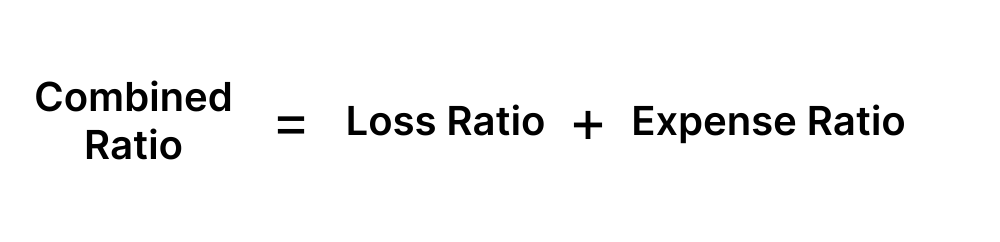
The combined ratio is also a measure of profitability to measure an insurer’s performance in its daily operations. It is calculated by taking the sum of incurred losses and expenses and then dividing them by the earned premium. The combined ratio measures the money flowing out of an insurance company as dividends, expenses and losses. Losses indicate the insurer’s discipline in underwriting policies. A ratio below 100% indicates that the company is making an underwriting profit, while a ratio above 100% means that it is paying out more money in claims than premium receipts.

combined ratio

7. Investment Yield Ratio

This ratio measures the average return on the company’s invested assets before and after capital gains and losses. Both realized and unrealized capital gains are considered while calculating the investment yield (including capital gains).

investment yield ratio

8. Premium Growth Ratio

The premium growth ratio indicates growth in the business undertaken by the insurance company. This ratio is calculated by dividing the difference between the gross premium written (GPW) in the current and previous years by the GPW in the previous year. [GPW is the total amount of premiums an insurance company receives from policyholders for their insurance policies. It’s like the total bill customers pay to the insurance company for coverage.]

premium growth ratio

In conclusion, key ratios related to life insurance offer valuable insights into the financial health, risk management practices, and overall performance of life insurance companies. From the solvency ratio that assesses an insurer’s stability to the expense and loss ratios that reveal its operational efficiency and claims handling capabilities, these metrics serve as vital tools for making informed decisions in the complex world of life insurance.

Categories
Jargons

What are Blue Chip Stocks?

You may have come across many social media posts or videos of stock market experts encouraging everyone to invest in blue chip stocks. Whether you’re a beginner or an experienced investor, it’s always a good idea to hold blue chip stocks in your investment portfolio. In this article, we will discuss what blue-chip stocks are, their characteristics, and a few related topics.

What are Blue Chip Stocks?

Blue-chip stocks are shares of well-established, financially stable, and reputable companies that have a history of delivering consistent performance. These companies are typically leaders in their respective industries. The term “blue chip” was originally derived from poker, where blue chips have the highest value.

Blue Chip companies are also known for paying out regular dividends to their shareholders over time. Most of them generate stable returns for investors and are known to have much lower downside risk in times of recessions, inflation, and economic downturns.

For example, State Bank of India (SBI) is a blue-chip public sector banking company.

Characteristics of Blue Chip Stocks

Blue-chip stocks are known for their reliability and stability in the stock market. They are so reliable that these stocks have a considerably high weightage in stock market indices. Here are some of the characteristics of blue-chip stocks:

1. Financial Stability

Blue-chip companies are financially strong and reliable. They have healthy balance sheets, stable revenue streams, and strong cash flows. This makes them less likely to face financial distress or bankruptcy.

2. Market Leaders or Dominants

Blue-chip companies are often leaders in their respective industries or sectors. They have a dominant market position and a competitive advantage over their rivals.

For eg, HDFC Bank is a leader in the banking sector, while TCS and Infosys are leaders in the Information Technology (IT) Sector.

3. Longevity

Bluechip companies have a history of operating successfully for many years, sometimes even for decades or centuries. These companies have demonstrated their ability to adapt to changing market conditions, including recessions.

4. Dividend Payments

Since blue-chip companies are financially strong and have stable cashflows, they usually pay regular dividends. Therefore, blue chip stocks can create a passive income stream for investors.

5. Low Volatility

Volatility refers to the rate at which the price of a stock increases and decreases. High volatility represents high risk. Blue chip stocks tend to have low volatility and are considered low-risk investments. They are less prone to sharp price fluctuations in the market.

6. Large Market Capitalisation

A company’s market capitalisation is used to evaluate and rank its size and value in the stock market. Blue-chip companies have a high market cap. You can calculate the market cap of a company by multiplying its current stock price by the number of outstanding shares.

7. Brand Value

The majority of the blue-chip companies have well-known brands and distinguished products. Customers typically choose products with more brand value than those with none. For eg, ITC Ltd and Hindustan Unilever Ltd operate FMCG brands that are preferred by many customers across India.

8. Global Operations

Many blue-chip companies have a global footprint. They conduct business and generate revenue from various regions around the world. This global diversification can help mitigate risks associated with regional economic fluctuations.

9. Resilience in Economic Downturns

Blue-chip companies can withstand recessions and economic downturns. Although the business of these companies will be affected, it will not be as severe as that of smaller companies. Their financial strength and brand value contribute heavily to this characteristic.

Long-Term Growth Potential

Blue chip stocks are considered safe investments due to their exceptionally strong financial health and stability. They may have survived difficult challenges and market cycles over the years. These companies are market leaders and well-positioned in the market. Although they will be stable, they might not have the potential to provide investors with multibagger returns as they are already established companies.

However, this does not mean that blue-chip companies will never fail. The collapse of Lehman Brothers and General Motors in the 2008 Economic Recession is proof that even the seemingly strongest companies might fail under extreme stress.

Blue Chip Companies in India

Some well-known examples of blue-chip stocks include:

  1. Reliance Industries – India’s largest business group; has interests in energy, petrochemicals, natural gas, retail, telecom, mass media, and financial services.
  2. Tata Consultancy Services (TCS) – A multinational information technology services and consulting company.
  3. HDFC Bank – India’s largest private sector bank.
  4. Infosys Ltd – A multinational information technology company.
  5. Hindustan Unilever Ltd – A British-owned Indian consumer goods company.
  6. Coal India – A central public sector undertaking under the ownership of the Indian Govt’s Ministry of Coal.
  7. Wipro Ltd – A multinational corporation that provides information technology, consultant and business process services.
  8. Maruti Suzuki – Market leader in India’s passenger vehicles segment.

Blue Chip Stocks vs. Growth Stocks

Blue-Chip StocksGrowth Stocks
Shows stability and resilience during economic crisisHigh growth potential
Market leadership and dominanceLow market share (the company is in the growth stage)
Diversified revenue streamsMay only have a single line of products
Regular dividendsLimited or no dividends
Strong financial performanceFinancials may be focused on development and not stability
Long investment horizonShort investment horizon

Why Invest in Blue-Chip stocks?

The stock market can be volatile it can unexpectedly show some drastic movements in either direction. Thus, it is advisable to invest a decent portion of your capital in blue-chip stocks. A few of the reasons why you should invest in blue-chip stocks are given below:

  • Helps in reducing risk because blue chip firms endure economic downturns. 
  • Can create a passive income source as most blue-chip stocks pay dividends regularly.
  • They help diversify your portfolio by reducing risk.
  • The unsystematic risk (risks affecting a whole sector) in these stocks is very low.
  • They can give very high returns during favourable economic conditions.
  • As these stocks are well-known to people, liquidity in these stocks is very high. That means they can be bought and sold whenever you want at a fair price.
  • Blue-chip stocks are a robust and safe pick for long-term investment.

Evaluating Blue Chip Stocks

Evaluating blue chip stocks is similar to how you would analyse any company. One must know fundamental analysis and also the knowledge on how to apply them effectively. The basic framework on how to analyse these companies is as follows:

1. Identify the Stocks – select stocks with high market capitalisation.

2. Understand the Business

3. Ensure Quality

4. Check Valuation

5. Make a Decision

You can read our detailed article on how to identify quality stocks for the long term here.

Blue Chip Indices

In the Indian stock market, the benchmark indices of National Stock Exchange (NSE) and Bombay Stock Exchange (BSE) can be used to evaluate the performance of blue-chip stocks. Nifty50 is the benchmark index of NSE, while Sensex is the benchmark index of BSE.

The Nifty50 constitutes the top 50 companies from various sectors with high market cap listed on the NSE (along with other eligibility criteria). Sensex constitutes one of the top 30 stocks listed on the BSE and has similar selection criteria. You can easily track the performance of blue-chip stocks using these indices.

Blue-chip stocks represent some of the most established and reliable companies in the stock market. They are characterised by financial stability, market leadership, and a history of consistent performance. While they may not provide rapid growth, they are known for their resilience and ability to generate long-term returns. Investing in such stocks can be a wise choice for those seeking stability and income in their investment portfolios.

Categories
Jargons

Options Greeks: What is Theta?

Before you go through this article, we request you to go through the basic terms of Options. You can find it here. If you are learning about options, you have to be thorough with the knowledge of Option Greeks. It helps the trader to know how and why the price of the options changes. So let us learn about what theta is, known as an option seller’s friend and an option buyer’s worst enemy.

We will start this series by explaining one of the most important Option Greeks, which is the Theta or time decaying factor. Both Call and Put options lose value as the expiry date nears. The rate at which they lose value is called Theta. A Theta value of -2 indicates that the option premium will fall by Rs 2 each day which is passed. But why do the options lose value? Let’s find it out here.

Explaining Theta

How important is time? Does time have a cost? If yes, how will you associate a price with time? Before you read forward, take a minute and form your own opinion on these three questions.

Let’s look at an example. Imagine you want to become an established cricketer in the Indian team. How would that happen? You have to put in years of practice and learn many skills. You have to devote your time day in and day out to become a better cricketer. Still, there is no guarantee that if you decide to give 20 hours each day, you will be selected for the national team.

But, you will surely have a better chance of becoming a cricketer if you spend your time upskilling yourself rather than doing absolutely nothing in the field. Thus, the likelihood of you becoming a cricketer directly correlates with the time you put in. Similarly, you will be more confident about an exam if you have more days to study for it. Why? This is because you would feel that you have an ample amount of time to prepare for it. The longer the time for preparation, the more confident you will be.

This same logic is followed in the stock market as well. Suppose Nifty 50 is around 13,500. You have two options contracts among which you can buy anyone. Firstly, Nifty 14,000 Call Option which expires in 2 days. Secondly, Nifty 14,000 Call Option which expires in 20 days. Obviously, you will feel safe and confident in buying the second Call Option. Why? This is because more the time, the better the likelihood for the index to move up. In short, more time to expiry leads you to have a better chance of ending your position in profits.

Risk of an Option Seller

All the conversations we had above were from the perspective of an option buyer. Now, let’s switch our hats to that of Option sellers/writers. As an Options seller, you don’t want the Nifty to cross 14,000 in the above example. If Nifty crosses above 14,000 then you have to pay money to the option buyer. If Nifty remains below 14,000 points, you will get to retain the option premium you received from the buyer.

Out of the two Call Options, in which one do you feel the risk for you as an option seller is higher? Yes, it is the second one which is riskier. Nifty crossing 14,000 points in 2 days has a lower probability than it crossing that mark in 20 days. What do you want to compensate for this risk? Money! This concept in the world of finance is known as Time Risk. Options premium is always the summation of the intrinsic value of your option and the time value involved.

Option Premium = Time value + Intrinsic Value

Hence, one can easily draw a conclusion from this. If you are buying a call option with a farther expiry date, then you are obliged to pay a higher option premium for it. This higher option premium is paid to compensate for the Options Writers’ time risk.

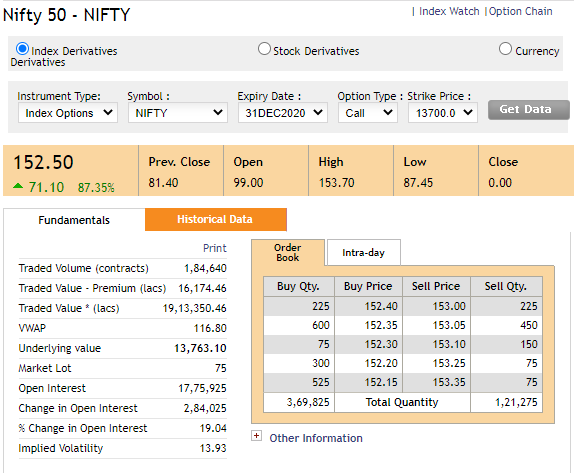
The chart below shows the Nifty option chart with a strike price of 13,700. The expiry date of this Call Option is 31st December 2020. The Option Premium which the buyer has to pay to the writer is Rs 152.50.

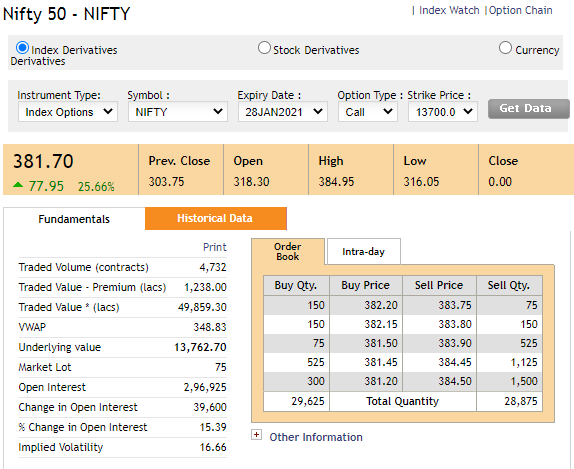
The second chart shows the Nifty Call Option with the same strike price but with a farther expiry date. The contract has to be closed on 28th January 2021. The Option Premium which the buyer has to pay to the writer is Rs 381.79. Between the two Call Options with the same price, an option buyer has to pay a higher option premium to the option seller/writer for the contract whose expiry date is farther.

Conclusion

As the option reaches closer to its expiry date, the time risk of the option seller/writer decreases. Due to this, the option premium loses some of its time value. Thus, decreasing the option premium which has to be paid to the option seller/writer.

Theta is considered very difficult to understand. But in reality, it is very easy. Just remember that time has an opportunity cost and that cost is reflected in Theta. Wait for the next chapter of this series to get a better idea of what Options Greeks are. Till then, happy trading!

Categories
Jargons

What are Block Deals in the Stock Market?

You would have often seen the term ‘block deal’ used in our articles. But, are you aware of what it really means? Let’s clear all the doubts one set for all!

Block Deals

A block deal is said to be a trade where more than 5,00,000 shares or shares worth more than Rs 10 crore of a particular company are traded. This should happen as a part of a single transaction. The deal cannot be squared off as we do with our intraday positions. Once done, it cannot be reversed. The price at which this is done should be between +1% to -1% of the current market price or the previous day’s closing price. 

Also, the broker has to inform the exchange of any kind of block deals. The details which have to be passed on to the exchange include the following: 

  • Name of the scrip. 
  • Name of the clients (Buyer & Seller).
  • The number of shares bought or sold.
  • The traded price at which the deal is done.

Stock exchanges are bound to inform the public about the deal with all the details on the same day after market hours. Generally, HNIs (high net worth individuals), mutual funds, financial institutions, insurance companies, banks, venture capitalists and foreign institutional investors (FIIs) are the participants of these block deals. To learn more about FIIs, click here. Promoters of the company can also use this window to buy or sell a major chunk of their share.

Block Deal Timings

As a block deal involves a large number of shares, it is important to allot a particular time slot. Otherwise, a surprising block deal at any time can increase volatility in the market. The exchange has made two slots for any type of block deal to take place.

  • Morning Window (First Session): 08:45 AM to 09:00 AM
  • Afternoon Window (Second Session): 02:05 PM to 2:20 PM
Categories
Jargons

What is Insolvency? How Do Companies Go Bankrupt?

We often come across reports of companies being declared bankrupt or ‘insolvent’. We also see large investment firms or business groups entering into tough competition to acquire these insolvent companies. Recently, Piramal Capital acquired debt-ridden DHFL for Rs 34,250 crore! Let us have a detailed understanding of what insolvency means and look into the insolvency procedure followed in India.

What is Insolvency?

At some point in time, a company or an individual may not be in a position to pay off their debt or other financial obligations. This may be due to a variety of factors such as a sharp decline in revenue (or income), increase in competition, poor market conditions, bad financial management, lack of proper budgeting, high debt, and failure of debt recovery procedures. The state of being unable to make repayment of debts by a person or company is known as insolvency. Those entities that are in a state of insolvency are said to be insolvent. In most cases, the insolvent company or person has to convert their assets into cash to pay off their lenders.

Types of Insolvency

1. Cash-flow insolvency – This is when a person or a company has enough assets to pay what is owed, but does not have an appropriate form of payment. For example, a person (the debtor) may own a large house or other valuable properties, but may not have enough liquid assets to pay his debts when it falls due. [A liquid asset is anything that can be converted into cash easily, within a very short period of time. Eg- cash, stocks, savings account in banks, etc]

2. Balance sheet insolvency – This is when a person or a company does not have enough assets to pay all of their debts. In most cases, these entities might enter bankruptcy, which is a legal process through which they may seek relief from some or all of their debts. Once a loss is accepted by all creditors (or lenders), the parties would negotiate and resolve the situation.

The Insolvency & Bankruptcy Code, 2016

Until 2015, an insolvency resolution in India took an average of 4.5 years to complete. There were constant delays in court proceedings and a lack of clarity. The entities involved in these cases used to incur very high legal costs. Thus, Indian lawmakers wanted to introduce a more structured and time-bound procedure for completing the entire insolvency process. 

The Insolvency and Bankruptcy Code (IBC) was brought into effect in 2016. It is the one-stop solution for resolving insolvency cases in a very economical manner. The code protects the interests of small investors and makes the process of doing business more efficient. The IBC has over 255 sections and 11 Schedules.  When a default in repayment occurs, creditors (lenders) gain control over the debtor’s assets and must make decisions to resolve insolvency within a 180-day period. The code also provides a framework for creditors and debtors to have detailed discussions on how to resolve the issue.

Insolvency Procedure

Let’s say a company- ABC- is in a poor financial state and is unable to pay off large debts. The lenders of the firm submit a plea for insolvency to the National Company Law Tribunal (NCLT). The NCLT is the adjudicating authority for insolvency proceedings in the case of corporate entities. It looks into the financial records and information provided by the lenders of ABC and must reject/accept their plea within 14 days.

  • If the plea is accepted, the tribunal has to appoint an Interim Resolution Professional (IRP), who will draft a resolution plan for ABC within 180 days (this can be further extended by 90 days).
  • A resolution plan is a proposal that seeks to resolve the company’s insolvency by finding methods to pay off creditors. During this period, the Board of Directors of ABC will be suspended. The promoters do not have a say in the management of the company.
  • The IRP will manage ABC’s assets and provide information to its creditors and assist them in decision-making.
  • The insolvency professional forms a committee of creditors (CoC) who lent money to ABC. The CoC will decide the future of the outstanding debt owed to them. They may choose to revive ABC’s debt by changing the repayment schedule or by selling (liquidating) the assets of the company.

In case the Corporate Insolvency Resolution Procedure (CIRP) fails to revive the company within 180 days, the liquidation process is initiated. This means that all of ABC’s assets will be converted into cash through auctions or direct acquisitions. Proceeds from the sale of these assets will be distributed to the creditors, priority shareholders of ABC, and equity shareholders. The IRP will also receive remuneration for his contribution to the insolvency proceedings.

A Recent Example

Dewan Housing Finance Corporation Ltd (DHFL) was the first financing company in India to go through insolvency proceedings. It had been facing liquidity issues (cash crunch) and had defaulted on loans. Upon further investigation by the Enforcement Directorate (ED), it was found that DHFL had diverted thousands of crores illegally. In November 2019, the Reserve Bank of India (RBI) filed for an insolvency proceeding to be initiated against DHFL. The financial creditors of DHFL submitted claims worth Rs 86,892 crores against the company! The share price of DHFL, which was trading at ~Rs 600 levels in 2018, fell to Rs 15 within a year

The Committee of Creditors (CoC) of DHFL failed to formulate a resolution plan within 180 days. It was decided that the financing company and its assets would be put up for auction. In October 2020, several reports stated that Adani Group, Piramal Enterprises, US-based Oaktree, and Hong Kong’s SC Lowy had placed bids for acquiring DHFL. After months of negotiations and counter-bidding, Piramal Capital emerged as the successful owner of DHFL.

Now, you may wonder why these firms had shown interest in acquiring a company that was poorly managed and involved in illegal activities. The main factor is the cost of the acquisition. Buying a company in the same industry is often time-consuming and expensive. When these investment firms and large corporations want to expand, it is easier and more economical to acquire distressed companies at very discounted prices. Moreover, Piramal took a risk and found value in the DHFL brand- which has a great hold in semi-urban and rural markets. 

Categories
Jargons

Term Plan vs Endowment Plan vs ULIPs

What are Term Plans?

This is one of the oldest plans in the insurance industry. Term Plans only offer death benefits and no maturity benefits. If the policy expires and the insuree is still alive, then no benefits would be received by him/her. This plan provides pure financial protection to the family members of the policyholder. Premiums demanded in term plans are generally lesser than endowment plans or ULIP-linked plans.

What are Endowment Plans?

Just like a term plan, endowment plans offer a death benefit. But unlike term plans, these plans also offer some maturity benefits if the person insured is alive after the expiry date of the policy. These plans do not offer any investment portfolio but guarantee returns to the insured person or his family. The premium that is to be paid to the company is higher than what is paid in a term plan. A person can avail loans against his/her endowment plan. So, an endowment plan offers both ‘life + investment’ protection.

What are ULIPs?

Unit linked Insurance plans or ULIPs are a combination of insurance + investment. It is a perfect example of a hybrid model that offers both, life protection and the option to earn money via a good investment strategy. An individual insured under this policy will pay the premium which will be bifurcated into two parts.

One part of the premium is set aside for the insured person’s life insurance, while the other part is invested in the stock market. ULIPs are very flexible because they allow you to alter the proportional allocation of your investment and life insurance as per your wish.

Categories
Jargons

What are Derivatives

Derivatives are a type of contract between two or more parties whose value is based on an underlying financial asset. The underlying assets can be stocks, bonds, indices, currencies or commodities like gold, silver, oil, natural gas and many more.
Derivatives where created to manage the risk which is associated with the underlying asset. They can be used as speculating tool (high risk high reward) or Hedging (mitigating risk). There are three types of market participants in a derivatives scenario,

1. Hedger: A person who uses derivative instrument to reduce the risk in volatility of price changes in the underlying asset.
2. Speculators: They are willing to bear the risk and have a high-risk profile in order to obtain high rewards.
3. Arbitrageurs: They simultaneously enter into two or more markets to take an advantage of discrepancies between asset prices in those markets. Their margins are very low compared to other participants.
There are 4 broad type of derivative instruments: Forwards (OTC), Futures (Standardised), Options and Swaps.

Forwards – A forward contract is a customizable derivative contract between two parties to buy or sell an asset at a specific price on a specific future date. They do not trade on centralised exchanges and thus classified as Over-the-Counter (OTC) instruments.

Futures – A futures contract is a legally-binding agreement to buy or sell a standardised asset on a specific date or during a specific month. It is facilitated through an exchange and the contracts are standardised.

Options – An option contract is an agreement between two parties to facilitate a potential transaction to buy or sell an asset at a predetermined price on a predetermined future date. Buying an option offers the right, but not the obligation to purchase or sell the underlying asset.

Categories
Jargons

What is Credit Risk?

Amongst numerous types of risks an organisation faces, Credit Risk is the risk of default that a lender (organisation or an individual) faces when the counterparty fails to meet the terms of financial obligations. It is the possibility of losing the owed principle and interest amount, which will result in increased costs. It is calculated on the basis of the overall ability of the buyer to repay the loan. Generally, the higher the Credit Risk, the higher is the interest rate demanded by the entity for lending its capital.
Consumer Credit Risk can be measured by the 5 C’s of Credit Risk. Generally used by banks for lending out a loan and screening the loan application, NBFC and other financial services firms also use this to determine the risk associated with issuing a loan and estimating the credit-worthiness of a borrower.

1. Capacity – Measures a borrower’s ability to repay a loan by comparing income against recurring debts. It addresses the question, “Can the borrower generate adequate cash in order to repay the loans?”

2. Capital – It refers to the net worth or equity of a business or an individual. It suggests that the borrower adequately capitalised within industry standards to withstand unexpected loss.

3. Conditions – The economic, industry, and market environment can change the state of the borrower or the state of the economy. Is the borrower flexible enough to adapt?

4. Character – Moral integrity of credit applicant and whether the borrower is likely to give his/her best efforts to honouring credit obligation.

5. Collateral – Existence of assets (i.e. inventory, accounts receivable) that may be pledged by borrowing firm as security for credit extended.


Categories
Jargons

What is Dividend Yield?

Dividend Yield is a financial ratio that tells how much a company pays out in dividends each year in comparison to its stock price. It measures the cash dividend paid out to the shareholders relative to the market price of the share.

Understand Dividend Yield

Company has shareholders whose primary interest to earn income, either in the form of capital appreciation or dividends. Thus, to keep its shareholders happy, the company tends to pay dividends to its shareholders. This dividend is generally paid from the portion of profit which the company earns. The rest of the amount left which is not distributed goes into the retained earnings. Mature companies are the most likely to pay dividends.

Thus, it is a metric which tells about how much the shareholders are earning from their investment in a certain company. Higher the dividend yield, better it is for the shareholder.

Example

Suppose a company ABC has a stock price of Rs. 100 and announces a dividend of Rs. 5. Then dividend yield would be,

Dividend Yield = Cash Dividend per share / Market Price per share * 100

DY = (5/100)*100 = 5%