Categories
Editorial

A Beginner’s Guide to Mutual Fund Investments

Legendary investor Warren Buffett’s famous quote, “Be fearful when others are greedy and be greedy when others are fearful,” often resonates in investing. This philosophy highlights the importance of investing wisely, especially when others are uncertain or scared. The Indian mutual fund market has seen an impressive surge in retail investments, with a net inflow of ₹41,877 crores in October alone (up 22% month-on-month), despite the stock market witnessing a significant drop of over 6%. This spike in mutual fund investments shows growing confidence among Indian retail investors, who are taking advantage of market volatility.

In this article, we will explore mutual funds, the different types of mutual funds, and key metrics you should consider before investing in them. By the end of this guide, you will have a better understanding of how to approach mutual fund investments and make informed decisions.

What are Mutual Funds?

A mutual fund is a pool of money collected from various investors to invest in a diversified portfolio of securities like stocks, bonds, and other financial instruments. Instead of investing directly in individual stocks, investors contribute money to a mutual fund, which is then managed by professionals. The aim is to generate returns for the investors, who receive profits based on the performance of the fund. In India, mutual funds are run by reputed financial players like SBI, HDFC, UTI AMC, etc.

The Securities and Exchange Board of India (SEBI) tightly regulates mutual funds to protect investors, making them a trustworthy option despite inherent market risks.

Understanding Mutual Fund Categories

1. Equity Mutual Funds:

These funds invest primarily in stocks/equities (like Reliance, HDFC Bank, etc). This category is popular among retail investors who seek higher returns over the long term. The returns can be substantial when the market performs well. However, they come with higher risk, as the stock market can be volatile.

2. Debt or Liquid Mutual Funds:

These funds invest in fixed-income securities such as corporate bonds, government bonds, and money market instruments. Debt mutual funds are typically safer than equity funds and are a popular choice among investors who want to park their surplus cash. These funds generally provide stable but lower returns compared to equity funds, making them suitable for conservative investors.

3. Balanced or Hybrid Funds:

Balanced funds invest in a combination of equities, bonds, and sometimes commodities like gold. These funds aim to provide the best of both worlds: growth potential from equities and stability from debt instruments.

While balanced funds can be a good option for beginners, investors looking for higher returns may prefer to focus more on equity funds once they understand the basics of investing.

How to Invest in Different Mutual Funds?

  • Long-term goals (e.g., buying a house): High equity allocation for better returns over decades.
  • Short-term goals (e.g., a foreign trip): Focus on debt funds for stability.
  • Balanced Funds: For beginners with no specific goals, offering simplicity and diversity.

Thumb Rule:

  • Long-term = higher equity allocation.
  • Short-term/emergency = higher debt allocation.

Active vs Passive Mutual Funds

Mutual funds can be broadly categorized into two types based on their investment approach: active mutual funds and passive mutual funds. Here’s a breakdown:

1. Active Mutual Funds

Active mutual funds are managed by professional fund managers who actively make decisions about which stocks or securities to buy, hold, or sell. Their goal is to outperform a specific benchmark or index by leveraging market insights, research, and expertise.

Example: A large-cap equity fund aiming to outperform the Nifty50 Index.

2. Passive Mutual Funds

Passive mutual funds, often called index funds or exchange-traded funds (ETFs), aim to replicate the performance of a specific market index rather than beat it. They invest in the same securities in the same proportions as the underlying index.

Example: An index fund that tracks the Nifty50 or Sensex.

How to Choose an Active Mutual Fund?

When investing in mutual funds, it’s crucial to assess key factors that determine the fund’s performance. Here are five key ratios and metrics that will help you choose the best mutual fund:

1. Rolling Returns: This metric measures the fund’s performance over different periods, helping you understand its consistency. Look for funds with strong rolling returns over 3 years, ideally 30% or more.

2. Alpha: Alpha represents the percentage by which the fund outperforms its benchmark index. A positive alpha indicates that the fund manager is adding value by selecting the right stocks. Look for funds with an alpha of at least 2%, meaning the fund is outperforming its benchmark by this margin.

3. Sharpe Ratio: This ratio measures the risk-adjusted returns of a fund. It compares the return of the fund with the risk-free return (such as government bonds). A Sharpe ratio of more than 1 is considered good because it means the fund is delivering decent returns for the level of risk taken.

4. Assets Under Management (AUM): AUM refers to the total market value of the assets managed by the fund. A higher AUM can indicate a stable, trusted fund with significant investor interest. However, a very high AUM may affect the fund’s ability to generate returns, especially in smaller-cap stocks.

5. Percentage Away from All-Time High: This metric indicates how much the fund has fallen from its peak. While investing in a fund that has recently dipped might seem like a good deal, it’s essential to evaluate the reasons behind the drop. Look for funds that have a reasonable distance from their all-time high and aren’t in a downtrend due to poor management or strategy.

    Practical Application: Using Screening Tools

    To simplify the process of selecting mutual funds, investors can use online tools like TickerTape. TickerTape allows you to filter mutual funds based on the above metrics, helping you narrow down your choices. You can analyze funds in different categories (like small-cap, mid-cap, or large-cap) and make informed decisions based on their performance metrics.

    For example, if you’re looking for a small-cap mutual fund, you can apply the following filters:

    • Rolling returns of at least 30% over 3 years
    • Alpha greater than 2%
    • Sharpe ratio of more than 1
    • AUM above 5,000 crores

    By using these parameters, you can shortlist funds that meet your investment objectives and risk profile.

    Check out the filtered Google Sheet of mutual funds derived from the formula given above: https://marketfeed.me/mutualfundlist

    Conclusion

    Mutual fund investing can be a smart way to build wealth over time, especially for those who are new to the stock market. By understanding the different types of mutual funds and applying key metrics like rolling returns, alpha, and Sharpe ratio, you can make informed decisions and build a diversified portfolio. Remember to tailor your investments to your financial goals—whether it’s a long-term objective like retirement or a short-term goal like funding a vacation.

    The Indian mutual fund market is growing rapidly, and by making the right choices, you can benefit from the wealth of opportunities available. Always do thorough research and, if necessary, consult a financial advisor to ensure your investments align with your goals and risk tolerance.

    Disclaimer: Mutual fund investments are subject to market risks. Please do your own research or talk to a registered investment advisor/profession before investing in mutual funds.

    Categories
    Editorial

    Understanding SEBI’s New Rules on Options Trading in India

    In recent months, there has been much anticipation surrounding SEBI’s new regulations on options trading. Retail traders and market participants have been eager to understand how these changes will impact the overall trading activity in our country. In this article, we’ll break down SEBI’s latest announcements, covering the major updates and their effects on traders. Let’s dive deep into SEBI’s official circular and explore what this means for the future of options trading in India.

    The Context: SEBI’s Objective Behind the Changes

    SEBI’s primary goal with these changes is to improve market liquidity and help investors manage their risks better. This is particularly crucial as retail participation in index options has surged over the past few years, leading to increased speculation and volatility (especially around expiry dates). SEBI is trying to control two things in general:

    1. High inflow of retail money into index options
    2. Hyperactivity around expiry days, leading to volatility

    Six Key Changes in Options Trading

    On October 1, 2024, the market regulator revealed a comprehensive set of new rules that would reshape the options trading environment in India. SEBI’s announcement introduced six key changes that will significantly affect options traders, both buyers and sellers. Let’s go through each of these changes and what they mean for the market:

    1. Increased Contract Size for Index Derivatives

    One of the most impactful changes is the increase in the contract size for index derivatives. Currently, the contract size for index options ranges from ₹5-10 lakhs. [This is calculated by multiplying the current value of NIFTY, say 25,000, by the lot size – 25]. SEBI has mandated that this range be increased to ₹15-20 lakh. This means the lot size for Nifty futures and options (F&O) contracts will be increased to ~60 to meet this new requirement! So will the case for the contracts of other popular indices.

    This change significantly increases the entry barrier for both option buyers and sellers. For option buyers, if they were previously required to pay ₹625 to enter a contract, they will now need to pay around ₹1,625. Similarly, option sellers will face higher margin requirements—potentially tripling their current margins. For instance, if an Iron Condor strategy previously required ₹50,000 in margin, it may now require ₹1.5 lakh.

    While this could make the market safer by discouraging reckless speculation, it also poses challenges for smaller retail traders who may struggle to meet the new margin requirements.

    2. Rationalisation of Weekly Index Derivatives Products

    Currently, exchanges like NSE and BSE offer multiple weekly expiries for index options, which has contributed to increased speculation and volatility. To curb excessive speculation, SEBI has decided that each exchange (NSE and BSE) can only offer weekly derivatives contracts for one of its benchmark indices. Going forward, NSE can only offer weekly expiry for the Nifty 50 index or Bank Nifty, not for both. Similarly, BSE will be able to offer weekly expiry for either Sensex or BankEx. All other indices will only have monthly expiry.

    This reduction in weekly expiries is expected to lower speculation and bring more stability to the market.

    3. Upfront Collection of Option Premium

    SEBI is also implementing a new rule that requires brokers to collect the full option premium upfront from buyers. Currently, some brokers allow traders to use leverage through cover orders, which reduces the upfront cost of purchasing options. For example, if a trader sets a stop loss at ₹90 for a ₹100 option, they may only be required to pay the maximum potential loss instead of the full premium. Under the new rule, all option premiums must be collected upfront, eliminating the possibility of using leverage to reduce upfront costs.

    This change primarily affects traders using brokers that allow leveraged positions. Most discount brokers already collect full premiums upfront, so this rule may not impact all traders. However, those using cover orders to reduce entry costs will now need to pay the full premium, which could make some strategies less attractive.

    4. Increase in Tail Risk Coverage on Expiry Day

    To control the heightened volatility seen on options expiry days, SEBI has introduced an additional margin requirement, called the “extreme loss margin.” This will increase the margin requirements for option sellers by 2% on expiry days. For instance, if you were previously required to put up ₹10 lakh as margin, you will now need ₹10.2 lakh.

    While this rule may not significantly affect overall market liquidity, it aims to reduce the risks associated with large, sudden price movements on expiry days.

    5. Intraday Monitoring of Position Limits

    Currently, SEBI monitors position limits for index derivatives at the end of each trading day. This ensures that no single broker exceeds a certain percentage of the total open interest (OI) in the market. The new rule introduces intraday monitoring, where brokers’ positions will be checked at four random intervals throughout the day.

    This change could be problematic for traders who rely on real-time market movements, as it may prevent them from entering trades if their broker exceeds the market-wide position limit. However, the rule won’t be implemented until April 2025, giving brokers time to adjust.

    6. Removal of Calendar Spread Treatment on Expiry Day

    The final rule removes the margin benefit for calendar spreads on expiry days. A calendar spread involves holding both long and short positions in contracts of different expiries. Previously, traders received a margin benefit for these positions on expiry day, but this will no longer be the case.

    This rule may discourage traders from using calendar spreads, especially on expiry days. While this change targets a specific group of traders, it may reduce the attractiveness of certain trading strategies.

    When Will SEBI’s New Rules on Options Trading be Implemented?

    The implementation of these changes will occur in phases. The first two significant changes regarding contract size and weekly expiries are set to take effect on November 20, 2023. Other changes, such as the removal of calendar spread treatment, will be implemented by February 1, 2025. This staggered approach allows brokers and traders time to adjust to the new regulations.

    new rules on options trading - SEBI | marketfeed

    Our Thoughts on SEBI’s New Rules:

    Now that we’ve covered the changes, let’s dive into the potential advantages and disadvantages of SEBI’s new rules:

    Disadvantages: Potential Challenges for Retail Traders

    One of the main concerns is that the increased margin requirements could push retail traders towards other speculative instruments like fantasy gaming apps or even crypto trading. They may seek out markets with lower entry barriers, which come with their own set of risks.

    Additionally, option buyers may start shifting towards out-of-the-money (OTM) options, which are cheaper but carry a lower probability of success. This could lead to a rise in speculative behaviour and reduced profitability for retail traders.

    Advantages: A More Stable and Less Volatile Market

    On the positive side, these changes are likely to bring more stability to the market. By increasing the contract size and reducing the number of weekly expiries, SEBI aims to lower market volatility, especially on expiry days. This could lead to more natural price movements and reduce the likelihood of manipulation.

    The equity cash segment may also see increased volumes, as traders shift away from options and into equities. This could result in a more balanced and liquid market overall.

    Finally, the new rules may discourage reckless speculation, particularly on live trading platforms and YouTube, where high-risk strategies have been increasingly promoted. With higher margins and stricter monitoring, the market is likely to become less prone to manipulative practices.

    Conclusion

    SEBI’s new rules represent a significant shift in the Indian options trading landscape. While the intention behind these changes is to enhance market stability and protect investors, they also pose challenges, particularly for retail traders.

    For traders, it’s essential to stay informed about these changes and adjust their strategies accordingly. As the implementation dates approach, we can expect further discussions and debates within the financial community. But the long-term effects of these changes will ultimately depend on how traders and brokers adapt!

    Watch the entire explainer video on YouTube: End of Small Option Traders in India? SEBI’s New Rules on Indian Stock Market!

    To read SEBI’s circular issued on Oct 1, 2024, click here here!

    Categories
    Editorial

    SEBI’s Proposed Changes for Options Trading: What Indian Traders NEED to Know

    The recent consultation paper released by the Securities & Exchange Board of India (SEBI) has raised significant concerns among options traders. It highlights seven crucial changes that would impact the way options trading is conducted in India. In this article, we’ll break down SEBI’s proposals, why they were introduced, and how these changes could impact option buyers, option sellers, and even non-directional traders.

    Why Did SEBI Release This Consultation Paper?

    The consultation paper has emerged as a response to perceived challenges in the Indian options trading market. SEBI’s main motivation is to improve market liquidity and help investors manage risks more effectively. This stems from the growing concern regarding substantial losses incurred by retail investors last year, amounting to a staggering ₹50,000 crore! The big winners were mostly high-frequency traders (HFTs) and algo traders.

    The consultation paper aims to curb risky behaviours in index options trading, especially around expiry days when volatility spikes. By addressing these issues, SEBI hopes to create a more stable and balanced market for all participants!

    The 7 Major Proposals by SEBI

    1. Rationalisation of Strike Prices

    SEBI observed that many traders are placing bets on far out-of-the-money (OTM) options, speculating on prices 5-6% away from the current market price or index level. This practice poses significant risks, particularly in volatile market conditions

    [Far out-of-the-money (OTM) options are options with a strike price significantly higher (for calls) or lower (for puts) than the current market price of the asset. These options have a lower chance of being profitable by expiration, but they are cheaper to buy.]

    SEBI’s Proposal: Strike prices will remain uniform only within a 4% range of the current spot/market price, with wider intervals beyond this range. 

    [A strike price is the set price at which you can buy or sell an option. It’s the price agreed upon in advance for exercising the option, regardless of the market price.]

    While SEBI’s intention is clear, they haven’t considered the role of implied volatility during market events like budget announcements or global conflicts. A rigid 4% rule could leave traders without adequate hedging options, especially in volatile markets.

    2. Upfront Collection of Option Premiums from Buyers

    SEBI suggests enforcing the upfront collection of premiums from option buyers. This is already a common practice among many brokers, and we find no significant issues with this proposal.

    SEBI needs to provide more clarity to avoid confusing traders with the procedural changes.

    [Premiums are upfront costs paid to the option seller for the right to buy (in a call option) or sell (in a put option) an asset at a specific strike price. The premium is essentially the price of the option contract.]

    3. Removal of Calendar Spread Benefits on Expiry Day

    SEBI noted that calendar spread traders face liquidity and basis risks, especially on expiry days. This happens because hedging strategies don’t work effectively when the market moves rapidly close to expiry.

    (Basis risk is when the value of a trade doesn’t match exactly with the value of what it’s supposed to protect or track. This mismatch can cause gains or losses that weren’t expected)

    SEBI’s Proposal: Removal of the margin benefit for calendar spreads on expiry days.

    We believe this change penalizes experienced traders who use calendar spreads responsibly. SEBI should instead focus on cases with high basis risk or low liquidity, rather than implementing a blanket rule.

    4. Intraday Monitoring of Market-Wide Position Limits

    SEBI wants to monitor the 15% open interest (OI) limit for brokers on a real-time basis, not just at the end of the day. This could mean that a broker’s OI limit may be hit during the day, preventing traders from placing additional trades.

    This could be a major disruption for serious traders. Imagine being unable to trade because your broker hits the OI limit midday! SEBI should ensure there are safety mechanisms in place to avoid such trading blockages.

    [Open Interest (OI) is the total number of active, unsettled options or futures contracts in the market, showing market activity.]

    5. Increasing Contract Size for Options Trading

    SEBI proposes increasing the minimum contract size for derivatives from ₹5-10 lakh to ₹20-30 lakh. This would be a phased approach.

    This will make hedging too expensive for smaller investors, pushing many option sellers out of the market. SEBI’s goal is to protect retail investors, but this proposal could force them into riskier positions or discourage participation altogether.

    6. Margin Requirements for Retail Traders

    SEBI is considering changing the way margin requirements are calculated for retail traders, especially around high-risk trading days such as expiry days.

    While margin regulations are necessary to control risk, SEBI should carefully balance the requirements to ensure that retail traders can still participate without being forced into excessively leveraged or dangerous trades.

    7. Hyperactivity Around Expiry Days

    SEBI is concerned about the surge in trading activity on Wednesdays and Thursdays, when Bank Nifty and Nifty contracts expire. This creates excessive volatility.

    SEBI’s Proposal: SEBI is considering measures to reduce speculative trading around expiry days to manage this volatility.

    While reducing hyperactivity may reduce volatility, it could also limit legitimate trading opportunities. SEBI needs to be cautious in ensuring that the measures taken do not inadvertently stifle liquidity in the market.

    Our Final Thoughts

    In conclusion, the premise for the SEBI’s consultation paper is completely valid. However, the series of proposals presented could significantly impact option trading in India. The implementation requires careful consideration to avoid unintended consequences that could further disadvantage retail traders. It is essential for traders to remain informed and engaged in discussions about these changes to ensure their voices are heard.

    As the trading landscape evolves, staying ahead of regulatory changes will be crucial for success. Traders are encouraged to read the consultation paper thoroughly, understand its implications, and provide feedback to SEBI, fostering a more balanced trading environment.

    Watch: Option Traders are in Trouble!? Our Response to SEBI Consultation Paper | marketfeed

    Categories
    Algo Trading

    What are SEBI’s Key Regulations on Algo Trading? 

    You may be an active trader or find many around you who trade in stocks or derivatives (F&O). Although it’s a great way to make an extra income and may sound very intriguing, trading consumes a lot of time and effort. Moreover, it’s a sad reality that 9 out of 10 Indian traders lose money!

    But imagine a world where you don’t have to learn complex techniques, spend hours looking for good trading opportunities and execute them manually. Instead, you use an automated system to strategise, place orders consistently, and monitor your trades in seconds! This is the magic of algorithmic (algo) trading, a seamless way to execute trades in the financial markets (stocks, futures & options, currencies, etc.). 

    Any trading strategy can be executed using pre-programmed ‘algos’, which contain instructions or criteria such as time, volume, and price. It’s fast, accurate, cost-effective, and helps avoid common issues manual traders face.

    In this article, we explore the key regulations surrounding algo trading in India.

    But First, Here’s a Brief History of Algo Trading:

    Algo trading was first introduced in the United States during the early 1970s with the arrival of electronic trading systems. And it quickly gained popularity! Now, algo trades account for nearly 60-70% of the total trade volume in the US.

    But what about India? Algo trading gained traction in our country in the late 2000s. Market regulator SEBI introduced algo trading in India through Direct Market Access (DMA) in 2008. Stock exchanges like NSE and BSE provide DMA as a facility that allows brokers to offer their clients direct access to the exchange’s trading system through the broker’s infrastructure. This allows clients to place orders directly into the exchange’s order book, leading to faster execution and fewer errors compared to manual order entry.

    Since then, it’s been mostly big financial institutions and High-Networth Individuals (HNIs) who have adopted algo trading in India. This is simply because the regulatory landscape surrounding algo trading only permitted these ‘big players’ to participate. Retail traders (individuals) in India couldn’t take part due to legal restrictions. However, we’ve been seeing a shift in this trend over the past few years! 

    Since 2019-20, many tech-savvy algo trading platforms have popped up as a result of technological advancements (especially with APIs – we will discuss this later in the article), and this has helped many retail traders participate in algo trading!

    Did you know? Algo trading strategies account for nearly 50-55% of the total trading volume in India, as per data from the Association of National Exchanges Members of India (ANMI)!

    What is SEBI? What Does It Do?

    Way back in 1992, the Indian Govt. established the Securities & Exchange Board of India (SEBI) to become the guardian of India’s securities markets. SEBI’s main job is to ensure that the markets work fairly and efficiently for everyone involved! Let’s take a look at what SEBI does:

    • Investor Protection: SEBI’s primary objective is to protect the investor’s interest in the market. It has introduced many regulations so that investors are safe and have every bit of information about their investments. 
    • Promote Regulations: SEBI frames and promotes regulations for market participants like investors, listed companies, and brokers to ensure fairness and transparency in the market.
    • Preventing Malpractices: SEBI detects and prevents malpractices like insider trading, market manipulation, and other scams in the Indian stock market. It holds the right to impose or penalise the violators.

      [Wait, what’s insider trading? It’s an illegal practice that involves trading a public company’s stock based on material, non-public information about the company. For example, if a company’s CFO leaks important information about the company to a friend who owns shares in that company, it’s insider trading. The friend could buy or sell shares based on information even before it is announced publicly.]
    • Education & Awareness: SEBI promotes investor education and awareness to enhance the financial literacy of Indian citizens. They conduct various meetings, seminars, and programs to educate people about the securities market, investment risks, and their rights & responsibilities.
    • Developing the Secondary Market: Investors can buy or sell shares or other securities with other investors in the secondary market.
      [For example- if a person wants to buy Reliance shares, he would purchase it from investors who already own the shares, rather than from the company itself]. It operates through established stock exchanges like NSE and BSE. SEBI has introduced reforms and initiatives to enhance liquidity, transparency, and efficiency in the secondary market.

    SEBI’s Current Regulations on Algo Trading in India (for big institutions)

    After SEBI permitted algo trading in 2008, certain brokerage firms, banks, or investment firms in India have used algos or high-frequency trading systems to generate profits for their clients (mostly HNIs or large corporations). In response to this development, SEBI has implemented a regulatory framework for these market participants:

    • Regular System Audits: All firms/platforms that offer algo trading services should subject their trading system to a system audit by an authorised body every 6 months [system audit refers to an evaluation of the trading systems used]. This ensures that the requirements prescribed by SEBI are effectively implemented or not.
    • Surveillance and Monitoring: To prevent market manipulation, stock exchanges are directed to take some safety measures like transaction monitoring, position limits, and pre-trade risk controls. These measures ensure effective surveillance and monitoring of the trades received through algo trading. Exchanges have to periodically review their measures to detect and investigate market manipulations.
    • Order-to-trade ratio (OTR): Order-to-trade ratio is the ratio of the total volume of all orders, modifications, and deletions. SEBI has framed some OTR limits to prevent bulk ordering by traders. Traders exceeding these limits on any trading day face penalties set by SEBI. You can read more about these penalties in this circular!
    • Co-location guidelines: SEBI has framed these guidelines to ensure equal access to the trading infrastructure, thereby enhancing equal opportunity in the market.

      [Co-location refers to a service provided by the stock exchanges which allows some brokers to keep their servers in the same building that houses the exchange.]

    What are SEBI’s Regulations on Algo Trading for Retail Traders?

    Over the past few years (primarily since 2019-20), there’s been a growing trend of retail traders participating in algo trading. This is because many brokers and algo trading platforms offer Application Programming Interface (APIs) to retail traders to deploy their trading strategies or execute trades effortlessly. An API is a set of protocols and tools that enable the software to interact with and place orders on different trading platforms, exchanges, or brokers. So anyone in India can use trading algorithms (no regulations or legislation that prohibit this practice).

    And here’s where we want to draw your attention! Interestingly, there are no real laws surrounding algo trading for retail traders in India (yet)! Without specific regulations, retail investors engaging in algo trading may lack proper safeguards and protections. Individual investors may face higher risks and potential losses because they often lack experience and resources.

    So SEBI has stepped in to save retail traders from unfair practices or scams in the Indian algo trading space! They came up with a consultation paper (issued on December 9, 2021) to take views and comments from various stakeholders, market intermediaries, and the public on the practice of algo trading done by retail traders/investors, including their use of API and automated trade execution tools.

    What is SEBI’s Proposed Framework for Algo Trading?

    • All orders originating via APIs should be treated as algo orders and subject to control by the respective stockbroker. Moreover, the stock exchange approving the algo must attach/tag a unique ‘Algo ID’ for such orders. 
    • Only those algos approved by the stock exchange (NSE, BSE) and have a unique Algo ID must be deployed. Brokers can also use suitable technological tools to check and prevent unauthorised altering of algos.
    • Algos developed must run on the servers of the exchange where they have complete control of client orders, confirmation, margin information etc. 
    • Stock brokers can provide in-house algo strategies developed by an approved vendor or they can source it from a third-party vendor. A formal agreement must be signed with each third-party vendor whose services are being availed. The exchange will provide no recognition to the third-party vendor providing the algo.
    • Two-factor authentication should be built into every system that provides access to an investor for any API/algo trade. The software used to create the strategies must be approved by the exchange.
    • Brokers must provide an annual system audit report on algorithm checks to the stock exchange. The format for the report will be provided by the stock exchange.  

    Simple Guidelines to Follow While Practicing Algo Trading in India

    Here are several guidelines you can follow if you participate in algo trading in India:

    • Choose a reputed broker or a reliable platform to deploy algo trading strategies.
    • Understand the key risks associated with algo trading – there could be technical failures, market volatility, and issues related to over-optimisation.
    • Use risk management tools like backtesting, stop-loss orders, portfolio diversification, position sizing etc.
    • Use two-factor authentication for all algo trading platforms to prevent unauthorised access and maintain security.
    • Stay disciplined, be patient, and seek professional advice whenever required. 

    Conclusion

    While we don’t know the exact timeline for SEBI’s new regulations on algo trading, we must stay alert and prepared for any potential changes. Algorithmic trading presents both opportunities and risks, and SEBI’s role is to maintain a balance between promoting innovation and preventing market volatility. At the moment, SEBI appears to be supportive of allowing individual investors to engage in algo trading.

    By following the market regulator’s existing and upcoming guidelines, retail traders and institutions practising algo trading can operate within the existing legal and ethical boundaries.

    SEBI focuses on maintaining the integrity of the market and keeping investors/traders safe and educated. They are constantly forming new guidelines and frameworks to ensure harmony in the market. So always stay up to date with regulatory developments (we’ll help you with this 😊). Also, implement risk management measures and maintain transparency while dabbling in algo trading!

    Related Articles:  Is Algo Trading Legal in India?


    Update:

    In February 2025, SEBI rolled out new regulations to streamline algo trading for retail investors in India. Dive into our in-depth article to understand the key changes and their impact:
    An Overview of SEBI’s New Rules on Algo Trading for Retail Investors.

    1. What is SEBI?

      The Securities & Exchange Board of India (SEBI) is the regulatory body established in 1992 to oversee and regulate India’s securities markets.

    2. Are there specific regulations for retail algo traders in India?

      Currently, there are no specific regulations for retail algo traders, but SEBI has proposed a framework to regulate this area.

    Categories
    Jargons

    What is the Stock Market? How Does it Work?

    Have you ever wondered what the stock market is and how it works? If yes, you’re not alone. The stock market can seem confusing and intimidating for people who don’t know how it works. But don’t worry! In this article, we shall learn what the stock market is, how it works, and who market participants are.

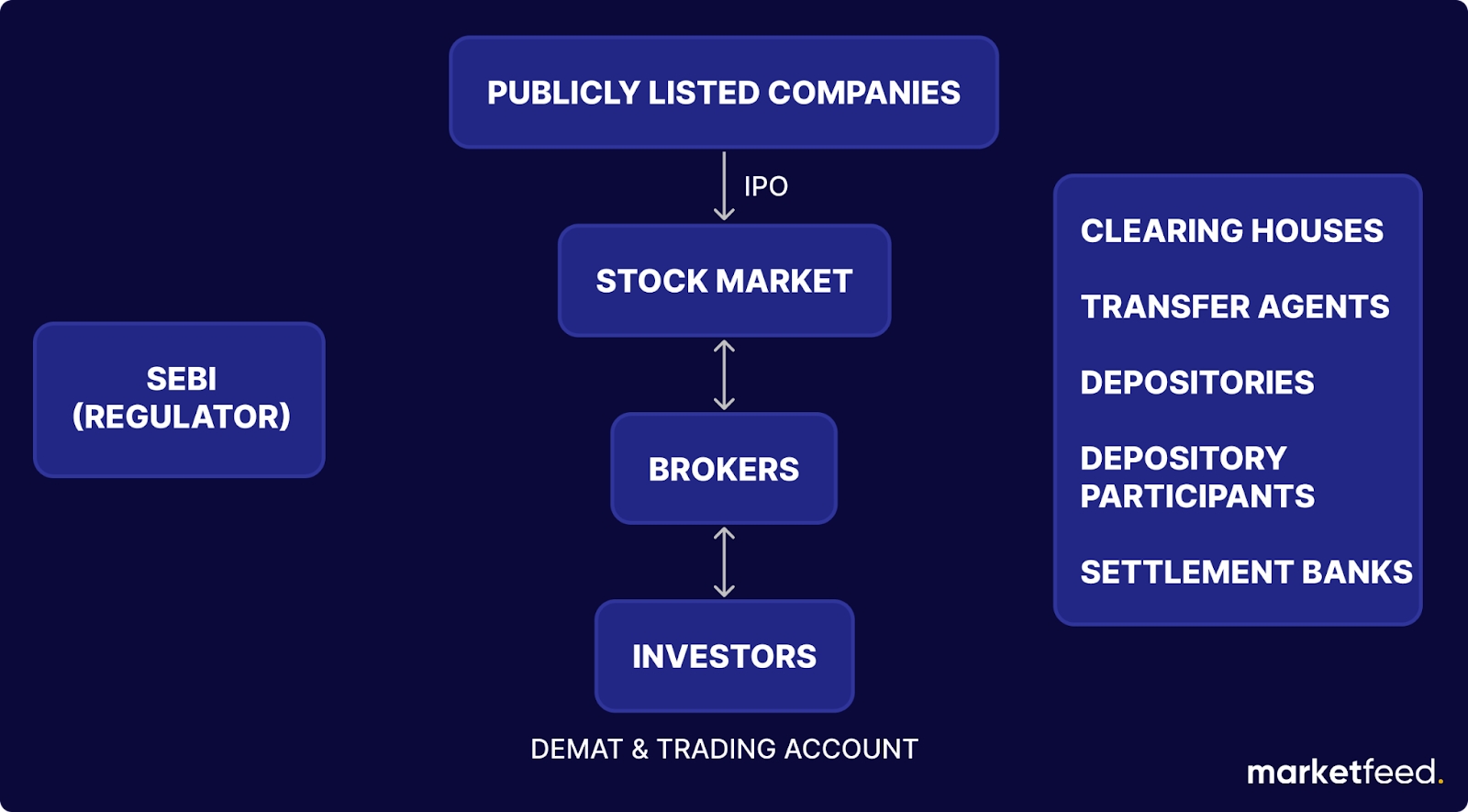
    Given below are the different participants in the stock market. We’ll understand more about them through a story.

    stock market participants | marketfeed

    Let’s Look at a Story!

    Mr. Jignesh, an owner of a renowned supermarket in Bengaluru, has been successfully running his business for the past ten years. The supermarket has been generating decent revenue and is highly profitable. His business also has goodwill (proprietary or intellectual property and brand recognition). When it comes to business, there are two things you must understand:

    • Ownership of a Business
      Jignesh completely owns and runs the supermarket, and the profit is not shared with anyone else.
    • Valuation of a Business
      Anything and everything has a value attached to it, even a business. The business has been generating income for Jignesh for the past ten years, so it is valuable. The valuation of a business is the economic value of how much a person has to pay to acquire 100% of the business from him. Let’s assume that the supermarket is valued at ₹1 crore.

      Since Jignesh is growing old, he feels he doesn’t want to work as much as he did and is looking for a partner to operate the business in return for 50% of the ownership of his business. He decided to share his business with a partner, Ms. Riya.

    What are Shares?

    Shares represent units of ownership of a company. A shareholder is entitled to a part of the profit that the company generates. 

    The ownership of Jignesh’s supermarket was divided into 1000 equal shares. The value of each share can be mathematically expressed as:

    Value of 1 Share = Total Valuation / Total Number of Shares

    = 1,00,00,000 / 1000

    = ₹10,000 per share.

    Riya agreed to acquire 500 shares (50%) of the supermarket in consideration of the value of those shares in Cash.

    Valuation = Total Number of Shares x Value of Each Share

    Riya paid ₹50,00,000 to Jignesh, and they both became partners in the supermarket business. 

    A few years later, the business expanded with several profitable outlets across Bengaluru. Now, Jignesh and Riya want to open 200 more stores nationwide, for which they need a large amount of capital. The easiest way to get funding or capital is by taking out a loan from a bank and using the business’ assets as collateral. However, this carries the risk of falling into a debt trap. If they are unable to repay the loan for some reason, the assets will be seized by the bank to recover the loan. Jignesh and Rita did not want to deal with these issues. 

    An alternative would be to find more people who are interested in becoming part-owners of the business across Bengaluru. Even then, they may not be able to find enough people to do so. At this point, Jignesh becomes aware of the stock market. If they convert their company into a Public Limited company, they can raise capital from thousands of investors across India and other countries. The process of issuing shares to the public to raise capital for a business is known as an Initial Public Offering (IPO).

    What is the Stock Market?

    A stock market is a place where shares of publicly listed companies are traded. It is a physical place or institution where shares are bought and sold.

    So Why Do Companies Go Public?

    • To Raise Capital: The company can gather funds for many objectives, such as paying liabilities (loans) and funding its future expansion projects.
    • Reward Founders & Early Investors: The founders and early investors of a company hold a good portion of the shares in their entity. They can sell these shares to the public and the proceeds go directly to them rather than to the company. It can be considered as a reward for all the time and effort they put in to build the company from the ground up. So going public can give them an early exit.

    What are Stock Exchanges?

    A stock exchange is a financial institution where different participants come together to buy and sell securities (shares). It provides the infrastructure for these activities. The term Stock Market is an umbrella term for a collection of Stock Exchanges.

    The two major Stock Exchanges in India are:

    • Bombay Stock Exchange (BSE)
    • National Stock Exchange (NSE)

    BSE is older than NSE, which explains why more companies are listed on the BSE than NSE. 

    Coming back to the story, Jignesh’s company had a total of 1000 shares, out of which they decided to issue 15% of the shares to the public. Thus, 150 shares are being offered to the public. 

    1000 x 15% = 150

    How Many Shares Will a Company Have? Who Decides That?

    A company’s promoters can decide how many shares it should have. Some firms may have thousands of shares, while others may have lakhs or even crores of shares. 

    For example, the valuation of Jignesh’s company was ₹1 crore in the beginning. But the business has grown over the years, and now the valuation stands at ₹2 crores, bringing the value of each share to ₹20,000. 

    Why do Investors Exist? What are their Objectives?

    The two main objectives of investors are:

    1. Capital Appreciation – When a company grows, the price of its shares increases. If investors buy the shares of a company when the prices are low and sell them when the prices increase, they can make good profits via capital appreciation.

    2. Earn Dividends – When a company makes profits every year from its operations, it distributes a portion of the profits to shareholders as dividends. However, it is not necessary for them to declare dividends every year. It’s the company’s choice whether to issue dividends or not. The company may fully retain its profits for future capital needs or may give out a part of the profit and retain the rest. 

    In short, the objective of a public limited company is to raise capital for its funding needs and the investors’ objective is to grow their money. But the real question is, how does the stock market fit into this?

    Why do Stock Markets Exist? 

    The stock market provides an avenue for a public company to raise capital from investors in consideration of shares. Investors will be able to grow their savings and wealth through capital appreciation and dividends. The stock market is the facilitator for the two parties. 

    What are Primary Market and Secondary Market?

    The stock market is divided into two:

    1. Primary Markets
    It is a market wherein a firm issues securities/shares to investors directly (via an initial public offering or IPO). These sale proceeds go directly to the issuer to finance their capital requirements.

    2. Secondary Markets
    It is the market where previously issued securities are bought and sold among investors. These sale proceeds go to the person who holds the securities. 

    In our story, many people wanted to buy shares of his company after the IPO. However, the company does not issue any more shares as the IPO is already done. So these new investors can only buy the shares from those already holding them. 

    When such transactions happen between investors in the secondary markets, the price of the share gets updated. If an existing shareholder sells the stock to another person for ₹20,100, the price of all the shares of the company gets updated to ₹20,100. Consequently, the net worth of the shareholders increases as the price of the shares they hold increases. 

    Who Decides the Price of a Stock?

    The two reasons which decide the price of a stock are:

    • Company’s Actual Valuation: A company’s value fluctuates as the revenue, profit, and goodwill change. The future prospects of the company also contribute to the valuation. If the revenue and profits go down, the valuation may also decrease, which causes the share price to drop. However, if the revenue and profit increase, the valuation could also rise.
    • Demand & Supply: The market forces of supply and demand also play an important role in deciding the share price. If the demand for the stock increases, then its price also increases since supply is limited. If the demand for the stock decreases, then its price also decreases since the supply is the same. Demand for the stock depends upon market sentiments, which refers to the overall attitude of investors toward the company. If the market sentiment is positive, then the demand for the stock will be high, thus driving the stock price up. Demand for the stock will be less if the market sentiment is negative. 

    Why Do Stock Prices Fluctuate Every Second?

    The Last Traded Price (LTP) refers to the price at which the previous share transaction took place. The stock market has lakhs of participants, and transactions happen every second. If a person sells a stock for ₹150, then the LTP at the time will be ₹150. The very next second, if a stock is sold for ₹149, then the LTP changes to ₹149. This is the reason why stock prices fluctuate every second.

    Who are Brokers?

    If you want to buy a stock, you cannot do it directly from the stock market. We have to approach a stockbroker, and the broker will transact on our behalf. A broker is an intermediary that facilitates transactions in the stock market. If you want to buy a stock, your broker will find a seller in the stock market on your instruction and facilitate the transaction between you and the seller. 

    Before technology evolved, an investor had to physically visit the broker’s office and instruct them to buy the stock. The broker would then physically go around the stock market, find a seller, and conduct the transaction. But now, technology has evolved, and transactions can be conducted via our phones. Brokers are accessible on computers and smartphones, and investing & trading are as easy as ever. 

    It is absolutely necessary to have an account with a broker to participate in the stock market. As intelligent stock market participants, we must have multiple broking accounts for different purposes. We can use one account for our long-term investing activities and another one for trading. Successful traders use multiple broking accounts for different trading strategies. 

    How Does a Broker Work?

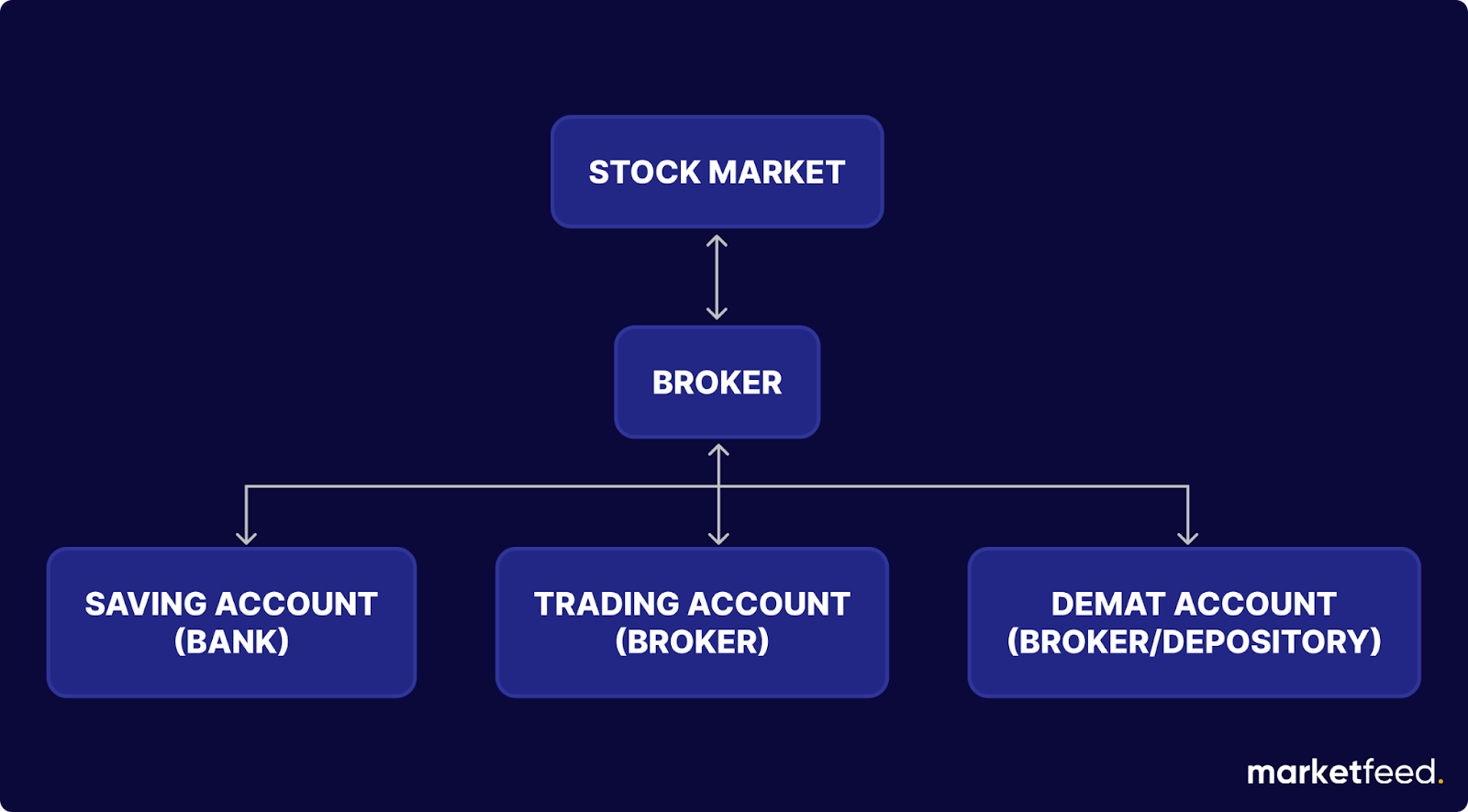
    how does a stock market broker work? | marketfeed

    There are two accounts that we open with a broker. Even though they are two separate accounts serving different purposes, both of them come in a bundle.

    1. Demat Account
    A Demat account or dematerialisation account allows you to hold your shares in an electronic format. It converts the physical shares into an electronic form, therefore dematerialising them. Demat accounts are maintained under depositories.

    Earlier, the proof of ownership of shares, bonds, or debentures was in the form of physical share certificates. However, this system had many drawbacks, such as the risk of losing the certificate, fire hazards, getting wet, or even a mismatch in the signatures. 

    2. Trading Account
    A trading account acts as an interface between the investor’s bank savings account and a broker. For the broker to conduct trading activities on our behalf, they need money. We transfer the money we have in our savings account to a trading account with which the broker then conducts trading activities. Money can be transferred using net banking or UPI.

    If we want to buy a stock, we instruct the broker to buy the stock, and the broker uses the money we have in our trading account to conduct the transaction. Similarly, when we sell a stock, the proceeds of the sale come directly into the trading account. 

    An Illustration to Understand How Demat & Trading Account Works

    • Arun wants to buy a share of Mahindra & Mahindra (M&M) from the stock market. The first step that Arun should take is to open a Demat and trading account. Arun opens a Demat & trading account with a leading broker and deposits money into his trading account by transferring from his bank savings account via UPI. 
    • When the market opened at 9:15 AM, Arun placed an order with his broker to buy 1 quantity of M&M stock. The market price of M&M at the time was ₹1000. His trading account was debited ₹1000 by the broker to finance the transaction. Apart from this, a small amount was deducted as taxes and charges. 
    • Even though the transaction was completed, the stock will only be transferred into his Demat account after T+1 days, which means he will receive the stock in his Demat account on the next working day. 

    While selecting brokers, we should choose the brokers that satisfy our various investing and trading needs. YOu can open a Demat and trading account using the links given below: 

    Fyers (FREE) – https://bit.ly/3tx3ZJx

    Zerodha – https://bit.ly/3AlErmb

    Upstox – https://bit.ly/3OUAJnR

    (Full disclosure: These are affiliate links. Do use the links if you wish to support us at no extra cost. ❤️)

    Click here for step-by-step instructions on how to open a Demat and trading account.

    What are Depositories?

    If your shares are held by the broker, there is a risk of the broker running away with the shares they have. As a remedy, all Demat accounts are maintained by depositories. A depository is an institution that acts as a custodian of Demat accounts and shares. A Demat account is opened by a depository participant, who acts as an intermediary between the depository and investors. 

    There are two depositories in India, which are governed by the Government of India: 

    1. CDSL – Central Depository Services Limited
    2. NSDL – National Securities Depository Limited

    what are depositories | marketfeed

    Who are the Other Facilitators?

    The other facilitators part from brokers, depositories, and depository participants are: 

    • Clearing Houses – It is an intermediary between buyers and sellers of financial instruments. It is an agency or separate corporation of a futures exchange responsible for settling trading accounts, clearing trades, collecting and maintaining margin monies, regulating delivery, and reporting trading data.
    • Transfer Agents – A transfer agent keeps records of who owns a publicly traded company’s stocks and bonds. They also ensure investors receive dividends on time.
    • Settlement Banks – It refers to a customer’s bank where payments or transactions are finally settled and cleared for customer use.

    What is a Market Regulator?

    The Indian stock market is a place where transactions worth lakhs of crores of rupees take place. The Securities and Exchange Board of India (SEBI) is a regulatory authority established under the SEBI Act 1992. It’s the principal regulator for stock exchanges in India. SEBI’s primary functions include protecting investor interests and promoting and regulating the Indian securities markets. It is a government organisation. SEBI exists as the watchdog to make sure nothing wrong is happening in such a massive money-involved ecosystem.

    Throughout the article, we discussed the various participants in the stock market and how they all work together in the stock market. We’ve also understood the basics of what the stock market is, who its participants are, and how it works!

    Categories
    Market News Top 10 News

    Jio Fin Services to be Excluded From NSE Indices – Top Indian Market Updates

    Here are some of the major updates that could move the markets tomorrow:

    Jio Financial Services to be excluded from NSE indices from Sept 7

    NSE Indices is set to remove Jio Financial Services Ltd (JFSL) from its Nifty indices. This move comes after JSFL stock failed to meet the price band criteria on two consecutive trading days. The exclusion from the NSE indices, including Nifty 50, Nifty 100, Nifty 200, Nifty 500, and others will become effective from September 7, 2023. JFSL’s inclusion in various NSE indices was announced earlier in July 2023 due to the demerger of the financial services business from Reliance Industries Ltd. 

    Read more here.

    Instant settlement of Indian stock market trades to come in by October 2024

    According to a Reuters report, the Securities and Exchange Board of India (SEBI) expects instant settlement of stock market trades to be implemented by October 2024. Currently, trades in India are settled in “T+1” or one day after the trades are initiated. Instant settlement would ensure trades are settled immediately. To start, SEBI would implement settlement within one hour of the trade, with instant settlement coming some months later.

    Read more here.

    Andhra Pradesh govt, SBI sign deal to establish 7,500 micro food processing units

    State Bank of India (SBI) and the Andhra Pradesh Food Processing Society (APFPS) have entered into an agreement to upgrade and support the establishment of at least 7,500 micro food processing units in the state. This agreement will be executed in the ongoing financial year (FY24) under the Prime Minister Formalisation of Micro Food Processing Enterprises (PMFME) scheme. SBI has already sanctioned over 500 loans under the PMFME scheme in FY23..

    Read more here.

    Bain approaches Dr Reddy’s Labs for joint Cipla bid

    Bain Capital has approached Dr Reddy’s Laboratories (DRL) to explore a joint bid to buy out the promoters of Cipla Ltd, the Hamied family. Last week, senior leadership from both sides met along with their advisors to discuss and formulate a strategy. DRL is believed to be evaluating the opportunity and countering the offer by Torrent Pharma, which is currently the sole Indian strategic investor who has bid for the promoter stake.

    Read more here.

    M&M signs sponsorship deal with Disney Star for ICC WC

    Mahindra & Mahindra (M&M) has signed a sponsorship deal with Disney Star for the upcoming ICC Cricket World Cup 2023. The World Cup will be played in India from October 5 to November 19. The association marks Mahindra’s most significant foray into sports sponsorships. As part of the deal, M&M has become the associate sponsor of Star Sports and a co-sponsor on the digital platform Disney+ Hotstar.

    Read more here.

    CBI arrests GAIL’s Executive Director and four others in bribery case

    The Central Bureau of Investigation (CBI) has arrested five people, including GAIL Executive Director KB Singh, in connection with an alleged bribery of ₹50 lakh. The agency is conducting searches at Delhi, Noida, Uttar Pradesh and Visakhapatnam. CBI alleged that Singh had demanded the bribe in exchange for favours in a GAIL project. GAIL is India’s leading natural gas transmission and marketing company.

    Read more here.

    Cipla acquires Actor Pharma for $49 million

    Cipla is set to acquire Actor Pharma with a view to expand its footprint in the South African market. Actor Pharma is a privately owned consumer health and generic medicine company. The acquisition will take place at a cost of ZAR900 million or $48.6 million. The transaction was executed through Cipla’s wholly-owned subsidiary in South Africa. The company signed a binding term-sheet with Actor Holdings to acquire 100% of the issued ordinary shares of Actor Pharma.

    Read more here.

    NBCC gets order worth Rs 2,000 crore from Kerala State Housing Board

    National Buildings Construction Corporation Ltd (NBCC) has received an order worth ₹2,000 crore from the Kerala State Housing Board (KSBH). The project entails the development of 17.9 acres of land parcel of Kerala State Housing Board at Marine Drive, Kochi, Kerala. The time period for the order execution is yet to be decided. 

    Read more here.

    Categories
    Market News Top 10 News

    Reliance AGM 2023: Highlights – Top Indian Market Updates

    Here are some of the major updates that could move the markets tomorrow:

    Reliance AGM 2023: Highlights

    Reliance Industries Chairman Mukesh Ambani made a range of important announcements, spanning from Jio True 5G to Jio Smart Home Services and changes in the company’s board structure, during the 46th Annual General Meeting (AGM) of the company.

    Jio Bharat Launch: Mukesh Ambani announced the introduction of the affordable Jio Bharat smartphone at just ₹999.

    Jio AirFiber Launch: Jio AirFiber will be launched on the occasion of Ganesh Chaturthi, on September 19.

    Smart Home: JioHome is a mobile app that enables you to navigate on your television connected to the Jio Set-top Box.

    Changes in Reliance Board: Mukesh Ambani confirmed that he will continue as Chairman and Managing Director for the upcoming five years. Nita Ambani has resigned from RIL’s board. Isha, Akash, and Anant Ambani joined the company’s board.

    Reliance Retail: Ambani welcomed the Qatar Investment Authority as a valued investor in Reliance Retail, who invested $ 1 billion for a 1% equity stake. This investment values Reliance Retail at ₹8.28 lakh crore.

    Jio Financial Services to enter the insurance space.

    Read more here.

    SEBI’s probe faults Adani group on disclosure rules

    An investigation of the Adani Group by the Securities and Exchange Board of India (SEBI) has uncovered violations of rules on disclosures by listed entities and limits on the holdings of offshore funds. SEBI launched the inquiry after U.S.-based Hindenburg Research raised governance concerns around the Adani Group. The conglomerate had denied wrongdoing in January. The Supreme Court, which is overseeing SEBI’s investigation of the Adani Group, will hear the matter on Tuesday.

    Read more here.

    Reliance Retail to take Campa brand global

    Reliance Retail will take its Campa brand global, starting with Asia and Africa. Campa, which competes with global cola makers Coca-Cola and PepsiCo in India, will be the first homegrown cola to be taken overseas. In April, Reliance Consumer Products Ltd (RCPL), the FMCG arm of Reliance Retail Ventures, entered into a strategic partnership with beverage can and filling company Ceylon Beverages to co-pack and manufacture Campa soft drinks.

    Read more here.

    Schaeffler India to fully acquire Koovers for Rs 142.4 crore

    Schaeffler India Ltd will fully acquire KRSV Innovative Auto Solutions Pvt Ltd for ₹142.4 crore. Bengaluru-based KRSV Innovative Auto Solutions (which operates under the brand Koovers) offers spare parts solutions to Indian aftermarket workshops via a B2B e-commerce platform. The transaction would be completed in the third quarter of CY 2023, subject to customary closing conditions. 

    Read more here.

    BPCL to spend $18.16 bn in oil, green energy over 5 years

    Bharat Petroleum Corp plans to invest $18.16 billion over five years to grow its oil business and expand its renewable energy portfolio as it aims for a 2040 net zero goal. The company has set a planned capex outlay of around $18.16 billion in the next five years, which will enable it to create long-term value for our stakeholders while preserving our planet for future generations.

    Read more here.

    Sterlite Power bags green energy transmission project in Rajasthan

    Sterlite Power has secured a green energy transmission order for Rajasthan Phase-III (20GW). The project includes the construction of a 350km 765Kv electricity transmission corridor. The project has three integral components — a 350 km 765kV transmission corridor connecting the renewable energy zone of Fatehgarh III to the substation at Beawar, construction of a 3000 MVA 765/400kV Substation at Beawar and the construction of two LILO lines, covering approximately 120 km.

    Read more here.

    TVS Motors to invest Rs 3,900 crore to boost green portfolio

    TVS Motors will invest ₹3,900 crore over the next four to five years to boost its green portfolio. The company is eyeing a larger share of business from global and electrics. The company counts broadening its relationship with BMW as one of the key pillars of its future vision. It will also aggressively pursue new product launches individually and also through its acquisitions, such as British motorcycle brand Norton Motorcycles, which it purchased in 2020 as well as the Swiss E-Mobility Group (SEMG).

    Read more here.

    Patel Engineering, JV bag Rs 3,637 crore contract from NHPC

    Patel Engineering Ltd (PEL) along with its joint venture (JV) partner have bagged a ₹3,637 crore order from NHPC in Arunachal Pradesh. PEL’s share in the contract is ₹1,818.56 crore. The partnership will be a 50:50 one and the contract includes the construction of headrace tunnels including intake, pressure shafts, penstocks, powerhouse and transformer cavern.

    Read more here.

    Glenmark recalls 1,200 bottles of generic hypertension drug in the US

    According to the US Food & Drug Administration (USFDA), Glenmark Pharmaceuticals is recalling 1,200 bottles of a generic drug, used to treat high blood pressure, in the American market due to a manufacturing issue. The New Jersey-based arm of the drug firm is recalling 1,200 bottles of Trandolapril and Verapamil Hydrochloride extended-release tablets. The affected lot has been manufactured at the pharma company’s Goa plant.

    Read more here.

    Venus Remedies gets marketing approval for anticoagulant drug in Saudi Arabia

    Venus Remedies has received approval to market Enoxaparin in pre-filled syringes in Saudi Arabia. The drug is used to prevent blood clots. The company has received the marketing approval Venus Remedies Ltd has an annual capacity for producing more than 50 lakh units of Enoxaparin. The company sold enoxaparin syringes estimated to be worth USD 7.8 billion in 2021. The market is expected to grow to USD 13.1 billion by 2031 at a 10-year compound annual growth rate (CAGR) of 5.4%.

    Read more here.

    Categories
    Market News Top 10 News

    India’s Retail Inflation Surges to 7.44% in July – Top Indian Market Updates

    Here are some of the major updates that could move the markets on Wednesday:

    India’s retail inflation surges to 7.44% in July

    India’s retail inflation (measured by the Consumer Price Index) surged 7.44% on an annual basis in July, compared to 4.81% in June. The consumer food price index (CFPI) rose from 4.49% in June to 11.51% in July. The sharp rise can be attributed to a steeper-than-expected increase in vegetable prices (especially tomatoes) over the past month.

    Read more here.

    ITC Q1 Results: Net profit rises 17.5% YoY to ₹4,902 crore

    ITC reported a 17.5% YoY rise in net profit to ₹4,902.74 crores for the quarter ended June (Q1 FY24); beating street estimates. Its revenue from operations fell 7.23% at ₹16,995.4 crore during the same period. EBITDA stood at ₹5,083 crore in Q1, up 10% YoY. Revenue from ITC’s core cigarette business grew 13% to ₹7,465.27 crore.

    In other news, ITC’s board has approved the scheme of arrangement for the demerger of its hotels business into a separate listed subsidiary. Shareholders of ITC will get 1 share in the demerged hotels business for every 10 shares held in the parent company.

    Read more here.

    Axis AMC launches private credit fund

    Axis Asset Management (the mutual fund arm of Axis Bank) has launched a private credit alternative investment fund (AIF) and is aiming to raise nearly ₹1,250 crore from investors. The private credit fund is part of Axis Mutual Fund’s alternative assets business, which includes late-stage private equity and real estate AIFs on the private markets side and portfolio management services and long-only equity AIFs on the public markets side.

    Read more here.

    Divi’s Labs Q1 Results: Net profit falls 49% YoY to ₹356 crore

    Divi’s Laboratories reported a 49% YoY decline in consolidated net profit to ₹356 crore for the quarter ended June (Q1 FY24). Its revenue from operations fell 21% YoY to ₹1,778 crore during the same period. Total expenses stood at ₹1,367 crore in Q1, down 8% YoY. 

    Read more here.

    SEBI seeks 15-day extension to complete probe in Adani-Hindenburg case

    The Securities and Exchange Board of India (SEBI) has requested the Supreme Court to grant 15 more days to conclude the investigation into allegations made by US short-seller Hindenburg Research against the Adani Group. SEBI has completed investigating 17 out of the 24 transactions it had taken up for probe. The regulator has sought more information from other regulators and foreign jurisdictions to plan a further course of action.

    Read more here.

    SpiceJet Q1 Results: Net profit at ₹198 crore

    SpiceJet Ltd reported a consolidated net profit of ₹197.64 crore for the quarter ended June (Q1 FY24). The airline reported a loss of ₹783.72 crore in Q1 FY23. its revenue from operations fell 19% YoY to ₹2,371.53 crore during the same period. The company’s profit was on the back of a 36% Yoy decline in total expenses to ₹2,069.24 crore in Q1.

    Read more here.

    Domestic air passenger traffic rises 25% in July

    According to the Directorate General of Civil Aviation (DGCA), India’s domestic air passenger traffic volume rose 25% year-on-year (YoY) to 1.21 crore passengers in July. IndiGo carried 76.75 lakh passengers, securing a market share of 63.4% during July. SpiceJet flew 5.04 lakh passengers in July, with a market share of 4.2%.

    Read more here.

    Ramkrishna Forgings secures $13.65 million order in North America

    Ramkrishna Forgings has secured a $13.65 million (~₹107 crore) order from clients in the North American region. The order is for the supply of rear axle and transmission components. The company said it is strategically expanding its footprint in North America and strengthening its position within the light vehicle sector.

    Read more here.

    Ashok Leyland to fully acquire OHM India

    Ashok Leyland will fully acquire OHM Global Mobility Pvt Ltd from OHM International Mobility Ltd. The automaker will invest ₹300 crore into the acquired entity. The acquisition is a part of the company’s EV strategy to engage in the business of e-Mobility as a Service (eMaaS). OHM India is envisaged to operate in transportation, logistics operation and management and eMaaS.

    Read more here.

    L&T secures contract to build international cricket stadium

    Larsen & Toubro (L&T) Construction has secured an order from the Uttar Pradesh Cricket Association to construct a cricket stadium in Varanasi on a Design & Build Turnkey basis. The scope of work for L&T includes the main ground as per ICC standards, display scoreboard, flood lights, corporate boxes, VIP lounges, office areas, broadcasting, press conference areas, kitchen & dining areas, and a practice ground.

    Read more here.

    Happy Independence Day to all our readers! 🇮🇳

    Categories
    Market News Top 10 News

    JSW Energy’s Net Profit Falls 48% YoY to Rs 290Cr in Q1 – Top Indian Market Updates

    JSW Energy Q1 Results: Net profit falls 48% YoY to Rs 290 crore

    JSW Energy reported a 48% YoY fall in consolidated net profit to ₹290 crore for the quarter ended June (Q1 FY24). Its revenue from operations fell 3.3% YoY to ₹2,927.85 crore. EBITDA rose 18% YoY to ₹1,307 crore during Q1. The revenue dropped as incremental revenue from the recently acquired assets of Mytrah Energy and renewable energy capacity additions was offset by lower realization in thermal operations amid a decline in coal prices.

    Read more here.

    Bandhan Bank Q1 Results: Net profit falls 19% YoY to Rs 721 crore

    Bandhan Bank reported a 19% YoY decline in net profit to ₹721 crore in Q1 FY24. The net interest income (NII) fell 0.91% YoY to ₹2,491 crore during the same period. The bank’s gross non-performing asset (NPA) declined to 6.76% against 7.25% in Q4 FY23. However, Net NPA was up from 1.92% in Q1 FY23 to 2.18% in Q1 FY24.

    Read more here.

    India’s exports decline by 22% in June amid global demand 

    According to the Ministry of Commerce, India’s exports in June witnessed a significant decline of 22% to USD 32.97 billion. In June last year, India’s exports stood at USD 42.28 billion. This drop can be primarily attributed to a slowdown in demand in global markets. Imports in June also experienced a decline of 17.48%, amounting to USD 53.10 billion.

    Read more here.

    Suzlon Energy bags new order for 100.8-MW wind power project from Everrenew Energy

    Suzlon Energy Ltd received a new order for developing a 100.8-MW wind power project for Everrenew Energy Private Ltd. The company will install 48 wind turbine generators (WTGs) of its S120-2.1 MW platform with a hybrid lattice tubular tower. The company will install it at Velliyanani Phase II in Karur district and Vengaimandalam in Trichy, Tamil Nadu. The project is expected to be commissioned in March 2024.

    Read more here.

    Nestle India to set up Rs 894-crore food processing unit in Odisha

    Nestle India Ltd received in-principle approval from the Industrial Promotion & Investment Corporation of Odisha Ltd (IPICOL) to set up a food processing unit in Mundaamba of Khordha district, Odisha. The food processing unit will come up at an investment of about ₹894.10 crores. The project is subject to the fulfilment of customary conditions by the company.

    Read more here.

    SEBI’s new disclosure norms for listed cos to take effect from Saturday

    Securities and Exchange Board of India (SEBI) has put in place a stricter timeline for the disclosure of material events or information by listed companies. The regulator has asked companies to disclose agreements entered into by shareholders, promoters, related parties, directors, key managerial personnel, and employees of the listed entity or of its subsidiary, which can impact the management and control of such firms to stock exchanges.

    Read more here.

    USFDA completes inspection of Gland Pharma’s Hyderabad facility, issues Form-483 with one observation

    Gland Pharma announced that the US Food and Drug Administration (USFDA) completed the inspection of its Dundigal facility in Hyderabad. The USFDA conducted a Good Manufacturing Practice (GMP) inspection at the Dundigal facility between July 3-14, 2023. Form 483 was issued along with one observation. The observations could be related to a pharma company’s facility, equipment, processes, products or employee practices.

    Read more here.

    GMR Power wins smart meter project in Uttar Pradesh

    GMR Power’s subsidiary, GMR Smart Electricity Distribution Pvt. Ltd (GSEDPL), received a Letter of Intent (LOI) from Purvanchal Vidyut Vitran Nigam Ltd and Dakshinanchal Vidyut Vitran Nigam Ltd. The company will implement smart metering projects in Varanasi, Azamgarh Zone, Prayagraj, Mirzapur Zone, and Dakshinanchal (Agra and Aligarh Zone) areas of Uttar Pradesh. GSEDPL will install, integrate and maintain 75.69 lakh smart meters in the given area. The project will be completed in 10 years.

    Read more here.

    Granules India’s foreign subsidiary gets USFDA approval for pain relief drug

    Granules India Ltd’s foreign arm has received approval from the USFDA for Acetaminophen and Ibuprofen tablets. These tablets are used for temporary relief of minor aches and pains due to headaches, toothache, backaches, menstrual cramps, muscular aches, and minor pain of arthritis. According to IRI multi-outlet market data, the bioequivalent drugs had combined sales of USD 70 million in the US for the most recent 12 months.

    Read more here.

    June WPI inflation in the negative territory for the third-straight month

    India’s wholesale inflation (based on WPI) declined to -4.12% in June from -3.48 in May. The Wholesale Price Index or WPI measures the change in prices of goods that wholesale businesses sell to and trade in bulk with other companies. The decline in the rate of inflation in June 2023 is primarily due to a fall in prices of mineral oils, food products, basic metals, crude petroleum and natural gas and textiles.

    Read more here.

    Tata Steel offers Rs 83 lakh funding for R&D projects in low carbon segment

    Tata Steel will fund research and development (R&D) projects in the low-carbon hydrogen segment under the partnership with British High Commission in India. As part of the ‘UK-India Hydrogen Partnership Sprint Series’, Tata Steel will grant 80,000 pounds (₹83 lakhs) funding for two innovative projects in the low-carbon hydrogen segment. The initiative is open to participants from India and the UK.

    Read more here.

    Categories
    Market News Top 10 News

    ZEEL, IndusInd Bank Settle Dispute Over Dues – Top Indian Market Updates

    Here are some of the major updates that could move the markets tomorrow:

    ZEEL, IndusInd Bank settle dispute over dues

    Zee Entertainment Enterprises Ltd (ZEEL) and IndusInd Bank have informed the National Company Law Appellate Tribunal (NCLAT) that the two companies have reached a settlement in relation to their payment dispute. IndusInd Bank said it would also withdraw its objection to ZEEL’s merger with a local unit of Japan’s Sony. In its plea, IndusInd Bank had claimed a default of Rs 83.08 crore against the media and entertainment firm

    Read more here.

    Tata Power proposes new 400 KV transmission corridor for Mumbai

    Tata Power has shared a proposal to set up a high voltage 400 KV line corridor for Mumbai with the state government and the state regulatory authority. This new transmission corridor will help meet the city’s growing electricity demand and enhance electricity distribution to as high as 15,000MW in future. If approved, this project could take four-five years and may cost around Rs 1,000 crore.

    In other news, Tata Power Solar Systems has secured an order worth ₹1,755 crore from NLC India to set up a 300 MW Domestic Content Requirement (DCR) based EPC project.

    Read more here.

    HFCL bags Rs 283 crore order from Gujarat Metro

    HFCL has secured a Rs 282.61 crore contract from Gujarat Metro Rail Corporation to deploy communication systems for Surat Metro Rail Project Phase-1. The company has to deploy the project within 90 days from the date of contract. HFCL has to provide warranty support for 110 weeks for the system that it will deploy.

    Read more here.

    JB Pharma bets big on chronic therapy for its growth aspirations

    JB Chemicals & Pharmaceuticals (JB Pharma) is eyeing possible acquisitions of brands and portfolios to get a foothold in the diabetes segment, said CEO Nikhil Chopra. He added that diabetes aligns with the cardiovascular segment, and building the portfolio organically may not be easy. JB Pharma has been investing in the chronic segment with a sharp focus on the cardiovascular segment through both acquisitions and new launches.

    Read more here.

    Granules India gets USFDA approval for generic gabapentin tablets

    Granules India Ltd has received approval from the US Food & Drug Administration (USFDA) for its generic gabapentin tablets. The drug is used to manage postherpetic neuralgia (a painful condition that affects the nerve fibers and skin) in adults. It is also used as adjunctive therapy in the treatment of partial-onset seizures. As per IQVIA data, Gabapentin tablets had sales of approx. $145 million in the US for the 12 months ended Jan 2023.

    Read more here.

    Govt launches 7th round of coal mine auctions

    Defence Minister Rajnath Singh launched the seventh round of auctions for the commercial mining of 106 coal blocks. 95 non-coking coal mines, 10 lignite mines, and one coking coal mine are being offered in the latest round of auction. The auction will be held online through a transparent two-stage process on the basis of percentage revenue share.

    Read more here.

    Netweb Tech files DRHP for IPO worth Rs 257 crore

    New Delhi-based server maker Netweb Technologies has filed a Draft Red Herring Prospectus (DRHP) with market regulator SEBI for an initial public offering (IPO). The company intends to raise Rs 257 crore through a fresh issue of shares. Promoters are also looking to sell about 85 lakh shares. Netweb Tech also provides private cloud, hyper-converged infrastructure, and AI enterprise workstation services.

    Read more here.

    Maruti Suzuki crosses 25 lakh units milestone of cumulative exports

    Maruti Suzuki India Ltd crossed the 25 lakh units milestone of cumulative exports since starting overseas shipments in 1986-87. The automaker currently exports to nearly 100 countries, including markets in Africa, Latin America, Asia, and the Middle East. Maruti Suzuki’s first big consignment of 500 cars was shipped to Hungary in September 1987.

    Read more here.

    Vedanta, HZL declare dividends 3 times their combined profitability

    Vedanta Ltd. and Hindustan Zinc Ltd. (HZL) have together declared dividends worth Rs 69,300 crore for the current financial year (FY23). The dividend announcements have come as the mining major looks to shore up funds to reduce its debt commitments. The dividend declared so far is nearly three times their combined profitability. A sum of the trailing 12-month profitability of Vedanta and HZL comes up to Rs 25,348 crore.

    Read more here.

    SEBI approves ASBA-like facility for secondary market

    The Securities & Exchange Board of India (SEBI) has approved a broad framework of Application Supported by Blocked Amount (ASBA)-like facility to be available to investors for secondary market trading. The facility is based on blocking funds for trading in the secondary market through UPI. The facility will be optional for both investors and stock brokers.

    Read more here.

    Tilaknagar Industries to buy 10% in Samsara Gin maker

    Tilaknagar Industries has agreed to buy a 10% stake in Spaceman Spirits Lab (SSLPL) for Rs 9.75 crore. The investment will be made through a combination of equity shares and compulsory convertible preference shares. Established in 2020, SSLPL owns Samsara gin. It had an annual turnover of Rs 2.7 crore during FY22.

    Read more here.

    Categories
    Market News Top 10 News

    Retail Inflation Eases to 5.72% in Dec – Top Indian Market Updates

    Here are some of the major updates that could move the markets tomorrow:

    Retail inflation eases to 5.72% in December

    India’s retail inflation, measured by the Consumer Price Index (CPI), eased to a one-year low of 5.72% in December 2022. CPI stood at 5.88% in November and 6.77% in October 2022. Food inflation came in at 4.19% in December, compared to 4.67% in Nov. Inflation in the fuel & light segment was 10.97% last month.

    Factory output, measured by the Index of Industrial Production (IIP), rose to a five-month high of 7.1% in Nov 2022. IIP had contracted (-)4% in Oct.

    Read more here.

    Infosys Q3 Results: Net profit rises 13% YoY to ₹6,586 crore

    Infosys Ltd reported a 13.4% year-on-year (YoY) increase in consolidated net profit to ₹6,586 crore for the quarter ended December (Q3 FY23). The IT company’s revenue from operations rose 20.2% YoY to ₹38,318 crore during the same period. It won deals worth $3.3 billion in Q3, the strongest in the last eight quarters. Infosys added 1,627 employees during the quarter.

    Read more here.

    Jio launches True 5G services in Ujjain

    Reliance Jio has set up its 5G services in Ujjain, Madhya Pradesh. With the launch, Jio has now become the first and the only operator in MP to launch 5G services across all prominent large cities in the state, including Bhopal, Indore, Gwalior, and Jabalpur. Users will be able to enjoy Unlimited 5G Data with up to 1 Gbps+ speed at no additional cost.

    Read more here.

    HCL Tech Q3 Results: Net profit rises 19% YoY to ₹4,096 crore

    HCL Technologies Ltd reported a 19% YoY (or 17% QoQ) increase in consolidated net profit to ₹4,096 crore for the quarter ended December (Q3 FY23). The IT company’s revenue from operations rose 19.5% YoY to ₹26,700 crore during the same period. The total contract value of new deal wins stood at $2.35 billion, up 10% YoY. HCL Tech’s board has approved an interim dividend of ₹10 per equity share. 

    Read more here.

    NCLT grants approval to PVR-Inox merger scheme

    The Mumbai bench of the National Company Law Tribunal (NCLT) has sanctioned the scheme of arrangement between cinema chains PVR and Inox Leisure. Once the NCLT issues the detailed order copy, the two companies will file it with regulatory authorities like the Registrar of Companies (RoC) and stock exchanges. The allotment of shares is likely to be completed in the next few weeks.

    Read more here.

    ONGC to rely more on advanced tech: Sushma Rawat

    Oil & Natural Gas Corporation (ONGC) will increase reliance on advanced technologies and tech-savvy younger minds to boost chances of making major discoveries, said Sushma Rawat (ONGC’s exploration chief). The company will acquire more exploration acreage and bring in new technologies to enhance the quality of seismic surveys and data interpretation. 

    Read more here.

    Zydus Lifesciences gets final USFDA approval for Brexpiprazole tablets

    Zydus Worldwide DMCC (a subsidiary of Zydus Lifesciences Ltd) has received final approval from the US Food & Drug Administration (USFDA) to market Brexpiprazole tablets. Brexpiprazole is an antipsychotic drug used along with antidepressants to treat major mental conditions like depression and schizophrenia. The drug will be manufactured at the group’s formulation facility at Ahmedabad Special Economic Zone (SEZ), Gujarat.

    Read more here.

    Apax Partners likely to sell 4.63% shares in Shriram Finance via block deal: Report

    According to a CNBC-TV18 report, private equity fund Apax Partners is planning to sell its shares in Shriram Finance Ltd via a block deal tomorrow. APAX’s subsidiary, Dynasty Acquisition, would sell up to 1.73 crore shares or 4.63% stake in the non-banking finance company (NBFC). The size of this deal is ₹2,250 crore.

    Read more here.

    SEBI allows exchanges to launch multiple contracts in same commodity

    The Securities and Exchange Board of India (SEBI) has allowed stock exchanges to launch multiple contracts in the same commodity to encourage broader participation of investors in the commodity derivatives market. Exchanges have been demanding multiple contracts on a single commodity to ensure that all market players across the value chain are catered to. Currently, all commodities (except gold, silver, and precious metals) have a single contract, which limits investors’ and traders’ participation.

    Read more here.

    Categories
    Market News Top 10 News

    Steel Prices Rise to 3-Month High in Jan – Top Indian Market Updates

    Here are some of the major updates that could move the markets tomorrow:

    Steel prices rise to 3-month high of ₹56,900 per tonne in Jan: SteelMint

    According to a SteelMint report, steel prices increased by 5% to hit a three-month high of ₹56,900 per tonne in January. Prices of coking coal have risen in January to $310 per tonne from $279 a tonne in December 2022. India remains dependent on imports to meet over 85% of its coking coal requirements.

    Read more here.

    Axis Bank enters into revised pact to acquire additional 7% stake in Max Life

    Axis Bank has entered into a revised agreement with Max Financial Services to acquire an additional 7% stake in Max Life Insurance at fair market value using discounted cash flow method. The revision in the agreement follows the guidance issued by the Insurance Regulatory and Development Authority (IRDAI) in October 2022. Discounted cash flow refers to the estimated value of an investment based on future cash flows.

    Read more here.

    Coal India subsidiary NCL to start M-Sand production

    Northern Coalfields Ltd (NCL), a subsidiary of Coal India Ltd, will soon start production of M-Sand, a material used for construction works. NCL will start production of M-Sand or Manufactured Sand for its Amlohri project in Madhya Pradesh.

    In other news, CIL has issued Letters of Acceptance for nine coal mining projects to be operationalised through the engagement of mine developers and operators. These 9 projects have a production capacity of around 127 million tonnes (MT).

    Read more here.

    NTPC produces 14.55 MT coal from captive mines in April-December

    State-owned NTPC’s coal production increased 51% year-on-year (YoY) from its captive mines to 14.55 million tonnes (MT) in April-December 2022. Its four operational coal mines have contributed to accomplishing the highest-ever monthly coal production of 22.83 lakh tonnes in December 2022. In the third quarter (Q3 FY23), NTPC produced 5.79 MT of coal and dispatched 5.42 MT to its power plants.

    Read more here.

    Glenmark Pharma launches generic version of diuretic Bumetanide injection

    Glenmark Pharmaceuticals Ltd’s US arm has launched its generic version of diuretic Bumetanide injection. Bumetanide is used to reduce extra fluid in the body (edema) caused by conditions like congestive heart failure, liver disease, and kidney disease. According to IQVIA sales data, the generic version of this injection achieved annual sales of approx. $16.5 million for the 12 months ended November 2022.

    Read more here.

    Non-promoter shareholders allowed to sell stake via OFS: Sebi

    The Securities and Exchange Board of India (SEBI) has modified the existing framework for conducting an offer for sale (OFS) of securities by companies by allowing non-promoter stakeholders to opt for the same. Until now, only promoter and promoter group entities were allowed to sell stakes through an OFS on the stock exchanges. The OFS mechanism will now be available to companies with a market capitalisation of ₹1,000 crore and above.

    Read more here.

    PSP Projects wins ₹1,344 crore order from Surat Municipal Corporation

    PSP Projects Ltd. has secured a government project worth Rs 1,344.01 crore from the Surat Municipal Corporation (SMC). The company will construct a state-of-the-art high-rise office building for SMC in Surat, Gujarat. With this latest order, the total order inflow of PSP Projects has increased to ₹3,292.59 crore in the current financial year (FY23). 

    Read more here.

    ​​Indian Overseas Bank revises interest rates up to 45 basis points

    Indian Overseas Bank (IOB) has revised interest rates on rupee retail term deposits up to 45 basis points (bps) with immediate effect. Depositors of the domestic, non-resident ordinary (NRO), and non-resident external (NRE) would receive interest rates up to 7.75% by opening term deposits for 444 days. The interest rate on foreign currency deposits has also increased by up to 100 bps.

    Read more here.

    Zydus Lifesciences gets final USFDA approval for Febuxostat tablet

    Zydus Lifesciences has received final approval from the United States Food & Drug Administration (USFDA) to market Febuxostat tablets. The tablets are prescribed for lowering or controlling high uric acid levels in patients suffering from gout (or severe arthritis). It will be produced at the pharma company’s formulation manufacturing facility at Moraiya, near Ahmedabad.

    Read more here.

    Adani-led group completes purchase of Israel’s Haifa Port

    A consortium led by India’s Adani Group has completed the purchase of Haifa Port in northern Israel for 4 billion shekels ($1.15 billion). Israel has been selling its state-owned ports and building new private docks to bring down costs and cut above-average waiting times for vessels to unload. The entry of the Shanghai International Port Group (SIPG) and the Adani-led group will likely boost Israel’s standing as a regional trade hub.

    Read more here.