Categories
Jargons

What is the Stock Market? How Does it Work?

Have you ever wondered what the stock market is and how it works? If yes, you’re not alone. The stock market can seem confusing and intimidating for people who don’t know how it works. But don’t worry! In this article, we shall learn what the stock market is, how it works, and who market participants are.

Given below are the different participants in the stock market. We’ll understand more about them through a story.
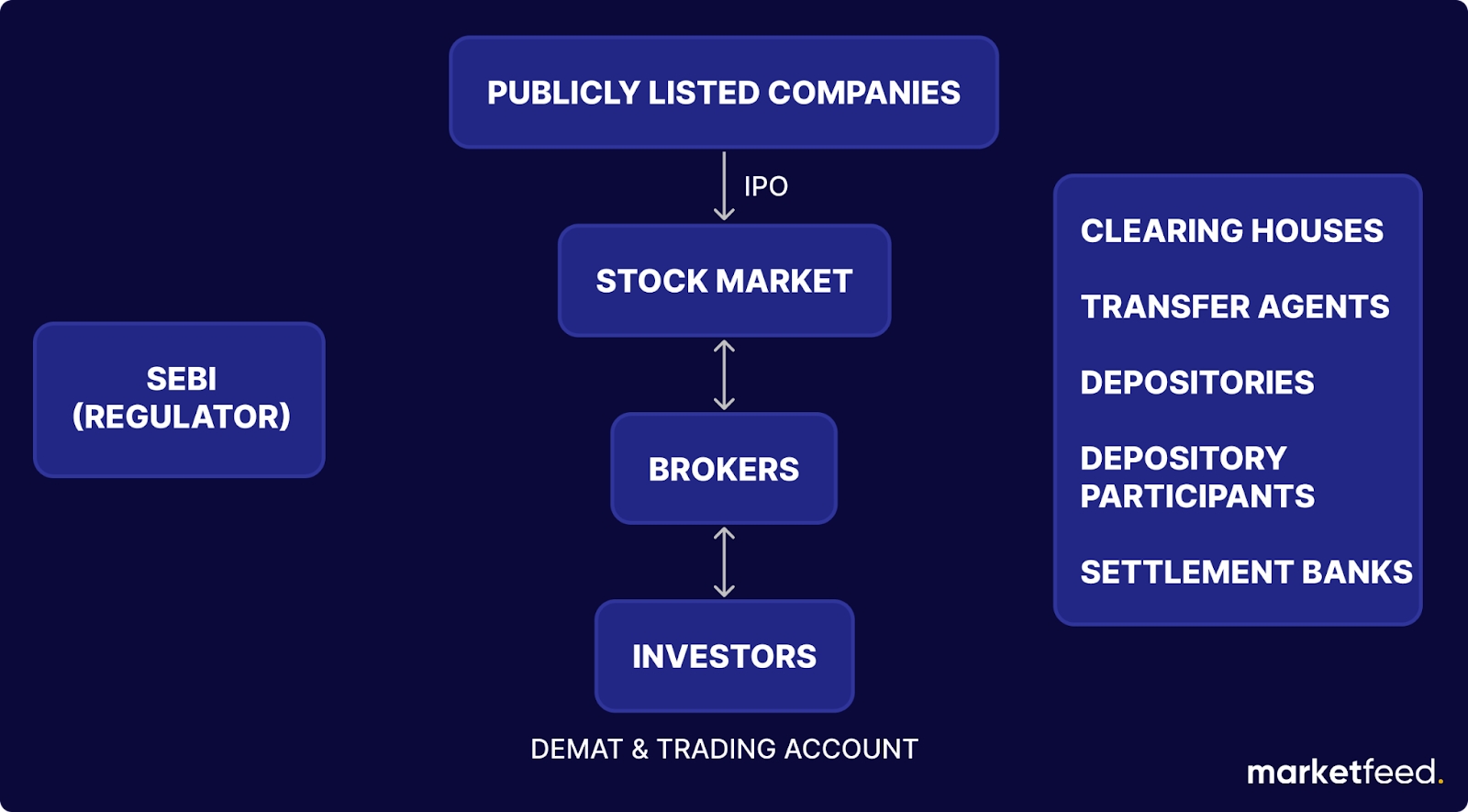
stock market participants | marketfeed

Let’s Look at a Story!

Mr. Jignesh, an owner of a renowned supermarket in Bengaluru, has been successfully running his business for the past ten years. The supermarket has been generating decent revenue and is highly profitable. His business also has goodwill (proprietary or intellectual property and brand recognition). When it comes to business, there are two things you must understand:

  • Ownership of a Business
    Jignesh completely owns and runs the supermarket, and the profit is not shared with anyone else.
  • Valuation of a Business
    Anything and everything has a value attached to it, even a business. The business has been generating income for Jignesh for the past ten years, so it is valuable. The valuation of a business is the economic value of how much a person has to pay to acquire 100% of the business from him. Let’s assume that the supermarket is valued at ₹1 crore.

    Since Jignesh is growing old, he feels he doesn’t want to work as much as he did and is looking for a partner to operate the business in return for 50% of the ownership of his business. He decided to share his business with a partner, Ms. Riya.

What are Shares?

Shares represent units of ownership of a company. A shareholder is entitled to a part of the profit that the company generates. 

The ownership of Jignesh’s supermarket was divided into 1000 equal shares. The value of each share can be mathematically expressed as:

Value of 1 Share = Total Valuation / Total Number of Shares

= 1,00,00,000 / 1000

= ₹10,000 per share.

Riya agreed to acquire 500 shares (50%) of the supermarket in consideration of the value of those shares in Cash.

Valuation = Total Number of Shares x Value of Each Share

Riya paid ₹50,00,000 to Jignesh, and they both became partners in the supermarket business. 

A few years later, the business expanded with several profitable outlets across Bengaluru. Now, Jignesh and Riya want to open 200 more stores nationwide, for which they need a large amount of capital. The easiest way to get funding or capital is by taking out a loan from a bank and using the business’ assets as collateral. However, this carries the risk of falling into a debt trap. If they are unable to repay the loan for some reason, the assets will be seized by the bank to recover the loan. Jignesh and Rita did not want to deal with these issues. 

An alternative would be to find more people who are interested in becoming part-owners of the business across Bengaluru. Even then, they may not be able to find enough people to do so. At this point, Jignesh becomes aware of the stock market. If they convert their company into a Public Limited company, they can raise capital from thousands of investors across India and other countries. The process of issuing shares to the public to raise capital for a business is known as an Initial Public Offering (IPO).

What is the Stock Market?

A stock market is a place where shares of publicly listed companies are traded. It is a physical place or institution where shares are bought and sold.

So Why Do Companies Go Public?

  • To Raise Capital: The company can gather funds for many objectives, such as paying liabilities (loans) and funding its future expansion projects.
  • Reward Founders & Early Investors: The founders and early investors of a company hold a good portion of the shares in their entity. They can sell these shares to the public and the proceeds go directly to them rather than to the company. It can be considered as a reward for all the time and effort they put in to build the company from the ground up. So going public can give them an early exit.

What are Stock Exchanges?

A stock exchange is a financial institution where different participants come together to buy and sell securities (shares). It provides the infrastructure for these activities. The term Stock Market is an umbrella term for a collection of Stock Exchanges.

The two major Stock Exchanges in India are:

  • Bombay Stock Exchange (BSE)
  • National Stock Exchange (NSE)

BSE is older than NSE, which explains why more companies are listed on the BSE than NSE. 

Coming back to the story, Jignesh’s company had a total of 1000 shares, out of which they decided to issue 15% of the shares to the public. Thus, 150 shares are being offered to the public. 

1000 x 15% = 150

How Many Shares Will a Company Have? Who Decides That?

A company’s promoters can decide how many shares it should have. Some firms may have thousands of shares, while others may have lakhs or even crores of shares. 

For example, the valuation of Jignesh’s company was ₹1 crore in the beginning. But the business has grown over the years, and now the valuation stands at ₹2 crores, bringing the value of each share to ₹20,000. 

Why do Investors Exist? What are their Objectives?

The two main objectives of investors are:

1. Capital Appreciation – When a company grows, the price of its shares increases. If investors buy the shares of a company when the prices are low and sell them when the prices increase, they can make good profits via capital appreciation.

2. Earn Dividends – When a company makes profits every year from its operations, it distributes a portion of the profits to shareholders as dividends. However, it is not necessary for them to declare dividends every year. It’s the company’s choice whether to issue dividends or not. The company may fully retain its profits for future capital needs or may give out a part of the profit and retain the rest. 

In short, the objective of a public limited company is to raise capital for its funding needs and the investors’ objective is to grow their money. But the real question is, how does the stock market fit into this?

Why do Stock Markets Exist? 

The stock market provides an avenue for a public company to raise capital from investors in consideration of shares. Investors will be able to grow their savings and wealth through capital appreciation and dividends. The stock market is the facilitator for the two parties. 

What are Primary Market and Secondary Market?

The stock market is divided into two:

1. Primary Markets
It is a market wherein a firm issues securities/shares to investors directly (via an initial public offering or IPO). These sale proceeds go directly to the issuer to finance their capital requirements.

2. Secondary Markets
It is the market where previously issued securities are bought and sold among investors. These sale proceeds go to the person who holds the securities. 

In our story, many people wanted to buy shares of his company after the IPO. However, the company does not issue any more shares as the IPO is already done. So these new investors can only buy the shares from those already holding them. 

When such transactions happen between investors in the secondary markets, the price of the share gets updated. If an existing shareholder sells the stock to another person for ₹20,100, the price of all the shares of the company gets updated to ₹20,100. Consequently, the net worth of the shareholders increases as the price of the shares they hold increases. 

Who Decides the Price of a Stock?

The two reasons which decide the price of a stock are:

  • Company’s Actual Valuation: A company’s value fluctuates as the revenue, profit, and goodwill change. The future prospects of the company also contribute to the valuation. If the revenue and profits go down, the valuation may also decrease, which causes the share price to drop. However, if the revenue and profit increase, the valuation could also rise.
  • Demand & Supply: The market forces of supply and demand also play an important role in deciding the share price. If the demand for the stock increases, then its price also increases since supply is limited. If the demand for the stock decreases, then its price also decreases since the supply is the same. Demand for the stock depends upon market sentiments, which refers to the overall attitude of investors toward the company. If the market sentiment is positive, then the demand for the stock will be high, thus driving the stock price up. Demand for the stock will be less if the market sentiment is negative. 

Why Do Stock Prices Fluctuate Every Second?

The Last Traded Price (LTP) refers to the price at which the previous share transaction took place. The stock market has lakhs of participants, and transactions happen every second. If a person sells a stock for ₹150, then the LTP at the time will be ₹150. The very next second, if a stock is sold for ₹149, then the LTP changes to ₹149. This is the reason why stock prices fluctuate every second.

Who are Brokers?

If you want to buy a stock, you cannot do it directly from the stock market. We have to approach a stockbroker, and the broker will transact on our behalf. A broker is an intermediary that facilitates transactions in the stock market. If you want to buy a stock, your broker will find a seller in the stock market on your instruction and facilitate the transaction between you and the seller. 

Before technology evolved, an investor had to physically visit the broker’s office and instruct them to buy the stock. The broker would then physically go around the stock market, find a seller, and conduct the transaction. But now, technology has evolved, and transactions can be conducted via our phones. Brokers are accessible on computers and smartphones, and investing & trading are as easy as ever. 

It is absolutely necessary to have an account with a broker to participate in the stock market. As intelligent stock market participants, we must have multiple broking accounts for different purposes. We can use one account for our long-term investing activities and another one for trading. Successful traders use multiple broking accounts for different trading strategies. 

How Does a Broker Work?
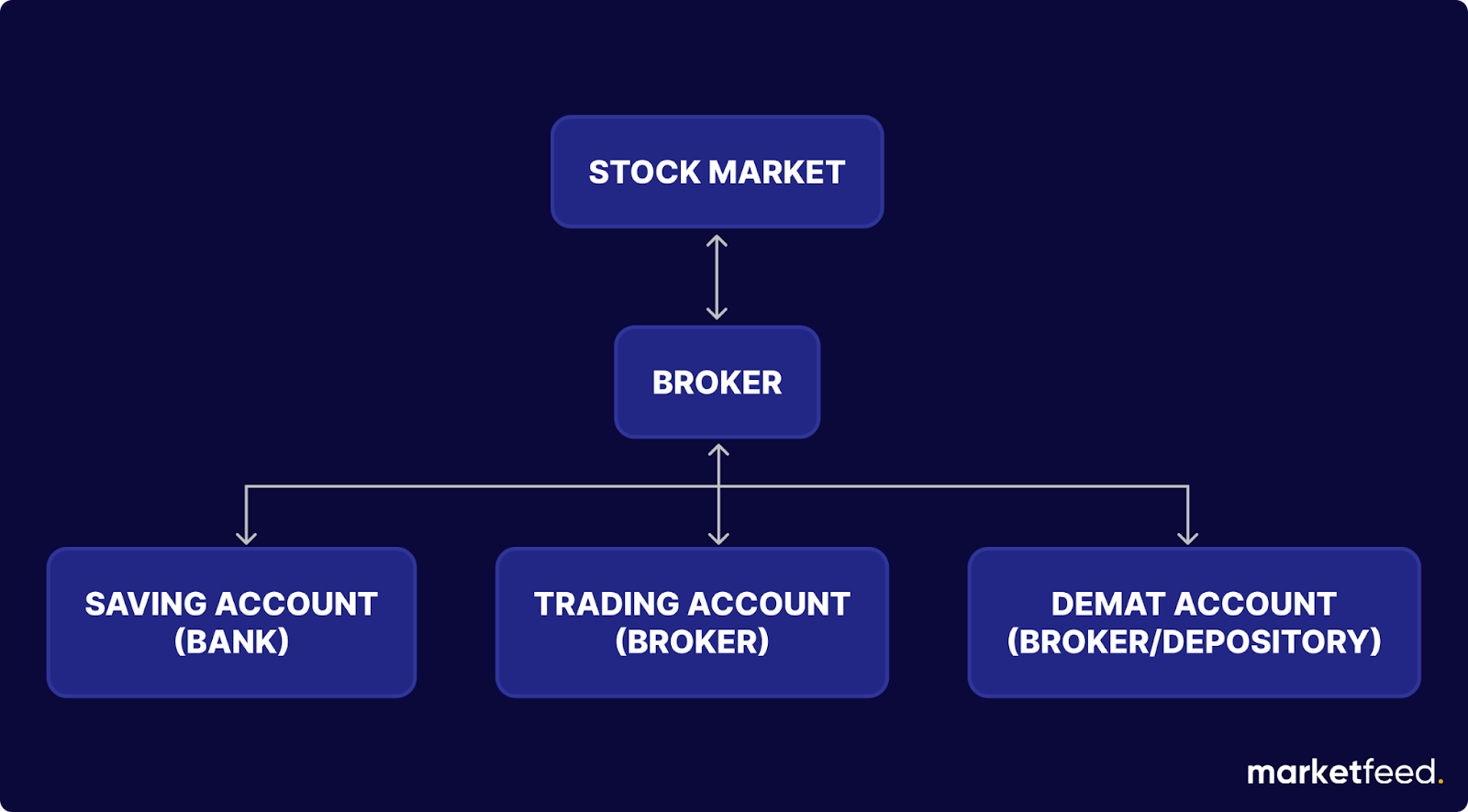
how does a stock market broker work? | marketfeed

There are two accounts that we open with a broker. Even though they are two separate accounts serving different purposes, both of them come in a bundle.

1. Demat Account
A Demat account or dematerialisation account allows you to hold your shares in an electronic format. It converts the physical shares into an electronic form, therefore dematerialising them. Demat accounts are maintained under depositories.

Earlier, the proof of ownership of shares, bonds, or debentures was in the form of physical share certificates. However, this system had many drawbacks, such as the risk of losing the certificate, fire hazards, getting wet, or even a mismatch in the signatures. 

2. Trading Account
A trading account acts as an interface between the investor’s bank savings account and a broker. For the broker to conduct trading activities on our behalf, they need money. We transfer the money we have in our savings account to a trading account with which the broker then conducts trading activities. Money can be transferred using net banking or UPI.

If we want to buy a stock, we instruct the broker to buy the stock, and the broker uses the money we have in our trading account to conduct the transaction. Similarly, when we sell a stock, the proceeds of the sale come directly into the trading account. 

An Illustration to Understand How Demat & Trading Account Works

  • Arun wants to buy a share of Mahindra & Mahindra (M&M) from the stock market. The first step that Arun should take is to open a Demat and trading account. Arun opens a Demat & trading account with a leading broker and deposits money into his trading account by transferring from his bank savings account via UPI. 
  • When the market opened at 9:15 AM, Arun placed an order with his broker to buy 1 quantity of M&M stock. The market price of M&M at the time was ₹1000. His trading account was debited ₹1000 by the broker to finance the transaction. Apart from this, a small amount was deducted as taxes and charges. 
  • Even though the transaction was completed, the stock will only be transferred into his Demat account after T+1 days, which means he will receive the stock in his Demat account on the next working day. 

While selecting brokers, we should choose the brokers that satisfy our various investing and trading needs. YOu can open a Demat and trading account using the links given below: 

Fyers (FREE) – https://bit.ly/3tx3ZJx

Zerodha – https://bit.ly/3AlErmb

Upstox – https://bit.ly/3OUAJnR

(Full disclosure: These are affiliate links. Do use the links if you wish to support us at no extra cost. ❤️)

Click here for step-by-step instructions on how to open a Demat and trading account.

What are Depositories?

If your shares are held by the broker, there is a risk of the broker running away with the shares they have. As a remedy, all Demat accounts are maintained by depositories. A depository is an institution that acts as a custodian of Demat accounts and shares. A Demat account is opened by a depository participant, who acts as an intermediary between the depository and investors. 

There are two depositories in India, which are governed by the Government of India: 

1. CDSL – Central Depository Services Limited
2. NSDL – National Securities Depository Limited
what are depositories | marketfeed

Who are the Other Facilitators?

The other facilitators part from brokers, depositories, and depository participants are: 

  • Clearing Houses – It is an intermediary between buyers and sellers of financial instruments. It is an agency or separate corporation of a futures exchange responsible for settling trading accounts, clearing trades, collecting and maintaining margin monies, regulating delivery, and reporting trading data.
  • Transfer Agents – A transfer agent keeps records of who owns a publicly traded company’s stocks and bonds. They also ensure investors receive dividends on time.
  • Settlement Banks – It refers to a customer’s bank where payments or transactions are finally settled and cleared for customer use.

What is a Market Regulator?

The Indian stock market is a place where transactions worth lakhs of crores of rupees take place. The Securities and Exchange Board of India (SEBI) is a regulatory authority established under the SEBI Act 1992. It’s the principal regulator for stock exchanges in India. SEBI’s primary functions include protecting investor interests and promoting and regulating the Indian securities markets. It is a government organisation. SEBI exists as the watchdog to make sure nothing wrong is happening in such a massive money-involved ecosystem.

Throughout the article, we discussed the various participants in the stock market and how they all work together in the stock market. We’ve also understood the basics of what the stock market is, who its participants are, and how it works!
Categories
Market News Top 10 News

NSE Plans Longer FnO Trading Hours – Top Indian Market Updates

Here are some of the major updates that could move the markets tomorrow:

NSE plans longer F&O trading hours

As per an Economic Times report, the National Stock Exchange (NSE) is finalising plans to extend trading hours for equity derivatives. The exchange proposes to launch an evening session, possibly between 6 PM and 9 PM. Market participants can continue trading F&O contracts after the regular session between 9:15 AM and 3:30 PM. NSE might consider extending this session to 11:30 PM at a later stage.

Read more here.

TCS expands partnership with Africa’s Standard Bank Group

Tata Consultancy Services (TCS) has expanded its partnership with Africa’s largest custodian, Standard Bank Group (SBG). SBG would centralise and standardise its custody and securities settlement operations in over 15 markets with the TCS BaNCS Global Securities Processing Platform. The platform has already been deployed in seven markets (including South Africa), and the others will be implemented by March 2024.

Read more here.

Serentica Renewables secures ₹3,000 crore in debt funding from REC

Serentica Renewables has raised ₹5,600 crore in funding from REC Ltd and Power Finance Corporation Ltd. It has raised ₹3,000 crore from REC and ₹2,600 crore in debt funding from PFC. This transaction is in line with REC’s expanding role in funding green projects and positioning itself as the focal agency for energy transition.

Read more here.

Strides Pharma to spin off contract development unit

Strides Pharma will spin off its contract development and manufacturing organisation (CDMO) and soft gelatin business into a new entity, OneSource. OneSource will list in the next 12-16 months and will have more than 1,200 employees. The new company is expected to deliver $180-200 million in revenue in the financial year 2024-25.

Read more here.

Godrej Properties sells 670 apartments worth ₹2,000Cr 

Godrej Properties has sold 670 apartments worth over ₹2,000 crore in its project, Godrej Tropical Isle, in Sector 146, Noida. The project was launched in August 2023, nine months after the purchase of a land parcel through an e-auction conducted by the Noida Authority in November 2022. This is Godrej Properties’ most successful launch in terms of the value and volume of sales achieved.

Read more here.

IHCL expands footprint in Sikkim

Indian Hotels Company Ltd (IHCL) is expanding its footprint in Sikkim, with the opening of Taj Guras Kutir Resort & Spa in Gangtok. The 69-key resort is spread over 14 acres. With the addition of this hotel, IHCL will have 11 hotels with three under development in North East India. This includes three hotels across the Taj, Vivanta and Ginger brands in Sikkim.

Read more here.

Indian Oil unveils hydrogen-run bus that emits just water

Indian Oil Corporation Ltd (IOCL) unveiled India’s first green hydrogen-powered bus that emits just water as it takes the lead in bringing out unrivalled tools to replace fossil fuels. IOCL will produce nearly 75 kg of hydrogen by splitting water using electricity from renewable sources. This hydrogen will be used to power two buses, which will ply across the National Capital Region (NCR) for trial runs.

Read more here.

IRCON executes contract worth ₹122 crore with Sri Lanka Railways

Ircon International Ltd (IRCON) has secured an order worth ₹122 crore ($14.89 million) from Sri Lanka Railways. The work includes designing, installing, testing, commissioning and certifying of signalling and telecommunication systems from Maho Junction to Anuradhapura, IRCON. This contract for the order was executed under the Indian Line of Credit on September 21.

Read more here.

Grasim Industries temporarily closes Century Rayon plant

A section of Grasim Industries Ltd’s Century Rayon plant at Shahad in Maharashtra has been closed temporarily after a government order. The Department of Industrial Safety and Health’s order came after a fatal explosion at the Century Rayon plant on Saturday, September 23. Two persons died in the explosion, while six others were injured.

Read more here.

Shree Cement board approves proposal to raise up to ₹700 crore via NCDs

Shree Cement Ltd’s board has approved a proposal to raise up to ₹700 crore through an issue of non-convertible debentures (NCD) on a private placement basis. The secured, rated redeemable and taxable NCDs with a base issue size of ₹350 crore and an option to retain oversubscription of up to ₹350 crore will be allotted on September 26, 2023. The issue will be at a face value of ₹1,00,000 each for cash at par.

Read more here.

Alkem Labs, Biosergen AB sign pact for invasive fungal diseases treatment

Alkem Laboratories has signed a co-development and license agreement with Biotech company Biosergen AB for BSG005. It is used for the treatment of severe and difficult-to-treat invasive fungal diseases. The partnership is for Phase II and Phase III trials of the drug. Alkem will be granted an exclusive license to market the drug in India.

Read more here.

Power Grid to raise up to ₹2,250 crore via bonds

Power Grid Corporation of India Ltd has approved raising up to ₹2,250 crore in its second tranche as part of its fundraising plans. The proceeds will be used to part finance the company’s capex requirements, to provide inter-corporate loans to its wholly-owned subsidiaries and joint ventures, and for general corporate purposes.

Read more here.

Categories
Jargons

What is The Difference Between NSE and BSE?

What is Stock Market?

A stock exchange plays a crucial role in facilitating the buying and selling of financial securities/instruments between investors and traders. The Bombay Stock Exchange (BSE) and National Stock Exchange (NSE) are the leading stock exchanges in the Indian market. These exchanges operate under the rules and regulations set by the Securities and Exchange Board of India (SEBI), an authoritative body dedicated to safeguarding investor interests and fostering the growth of the Indian stock market. Read on to learn more about the difference between NSE and BSE!

What is Bombay Stock Exchange (BSE)?

The Bombay Stock Exchange (BSE) was established way back in 1875. Located on Dalal Street, Mumbai, it is the oldest stock exchange in Asia. There are more than 5,400 companies listed on the BSE. Its benchmark index, the S&P BSE Sensex, is widely tracked by investors across the globe. The Sensex (Sensitive Index) tracks the performance of 30 of the largest and most actively traded stocks on the BSE. As of 2020, BSE is the 10th largest exchange in the world in terms of the cumulative market capitalisation of all companies listed on its platform.

What is National Stock Exchange (NSE)?

The National Stock Exchange (NSE) was incorporated in 1992. It is also located in Mumbai. NSE is ranked the third-largest stock exchange globally in terms of the total number of trades in equity shares. There are more than 1,600 companies listed on the NSE. It is the first exchange in India to implement electronic or screen-based trading. The Nifty 50 is NSE’s benchmark index that represents the weighted average of 50 of the largest companies listed on its platform.

What are the Differences Between NSE and BSE?

Both NSE and BSE provide a platform for companies to raise funds efficiently. The exchanges allow investors to trade in equities, currencies, debt instruments, derivatives (F&O), and mutual funds. Moreover, they provide services such as risk management, clearing and settlement, and investor education. 

Basis of DifferenceNSEBSE
BriefNational Stock Exchange is the biggest stock exchange marketplace in India. They introduced the fully automated, electronic, and screen-based trading system in India.BSE or Bombay Stock Exchange is the oldest and the first stock exchange, not just in India but in the whole of Asia. They offer high-speed trading for their customers.
Number of Companies ListedNSE has nearly 2100 companies listed on it.BSE has about 5300 companies listed on it.
Benchmark Indices NSE’s benchmark index is the Nifty 50, which is based on the market capitalization of top 50 companies. BSE’s benchmark index is the Sensex, which is calculated based on the market capitalization of 30 companies. 
Derivates ContractNSE has a higher market share in the derivatives market than BSE with a market share of about 94%.BSE has a comparatively lower market share in derivatives with nearly 6%. 
Liquidity Of all the Indian stock markets, NSE has the greatest average daily turnover for equity shares.Low liquidity in comparison to NSE.
Products Offered Equity, Mutual Funds, Exchange-Traded Funds, Corporate Bonds, Initial Public Offering (IPO), Offer for Sale, and also Equity, Currency, and Commodity Derivatives.Equity, Mutual Funds, Exchange-Traded Funds, Security Lending & Borrowing Schemes, Corporate Bonds, Initial Public Offering (IPO), Institutional Placement Program (IPP), Offer for Sale, and also Equity, Currency, and Commodity Derivatives.

Which is better, NSE or BSE? 

While we cannot state specifically which is better, the choice will ultimately depend on your investing and trading styles/preferences. NSE is the preferred exchange for intraday, swing, and derivatives trading due to high liquidity. If you are a long-term investor, it does not matter where you buy/sell shares. However, BSE gives access to more than 5,000 stocks across various sectors. There could be a minor difference in the prices of stocks in NSE and BSE. The costs related to investing and trading are similar for both exchanges.

In conclusion, the investor’s profile ultimately determines which stock exchange they choose among the NSE and BSE. The NSE may be preferred due to its bigger trading volume, cutting-edge technology, and wide range of product offerings, while the BSE offers advantages due to its historical relevance and several specialized markets. Investors should carefully choose which exchange best fits their profile by evaluating their investment objectives, risk tolerance, and specific needs.

Categories
Market News Top 10 News

NSE Scraps Plan to Shift Nifty Bank F&O Expiry to Friday – Top Indian Market Updates

Here are some of the major updates that could move the markets tomorrow:

NSE scraps plan to shift Nifty Bank F&O expiry to Friday

The National Stock Exchange (NSE) has canceled its plan to change the expiry of Nifty Bank derivative contracts from Thursday to Friday. The decision came after the Bombay Stock Exchange (BSE) shifted the expiry of Sensex and Bankex contracts to Friday. BSE expressed concerns that NSE’s move could impact the growth of Sensex/Bankex derivatives. In the interest of balanced market development and risk avoidance, BSE requested NSE to consider shifting the Bank Nifty expiry to a different day.

Read more here.

HDFC-HDFC Bank merger to be effective on July 1

HDFC is scheduled to merge with HDFC Bank on July 1, 2023. Both companies will hold separate board meetings on June 30, marking HDFC Ltd’s final board meeting. The stock delisting of HDFC will take effect from July 13. HDFC Bank will retain the branches, and the merger is expected to boost mortgage sales with an increase in applications. Employees under 60 will be retained without a salary cut as HDFC Bank requires their expertise in mortgages.

Read more here.

India’s current account deficit narrows to 0.2% of GDP in Q4: RBI

India’s current account deficit (CAD) in the January-March quarter of FY23 improved significantly to $1.3 billion, accounting for 0.2% of GDP. This positive outcome can be attributed to a reduced trade deficit and a notable increase in services exports. Compared to the previous quarter and the same period last year, the latest figures reflect a significant improvement in India’s balance of payments, according to the Reserve Bank of India (RBI).

Read more here.

Kotak arm invests Rs 450 crore in automobile components maker Viney Corp

Kotak Mahindra Bank’s subsidiary Kotak Strategic Situations India Fund II has invested ₹450 crores in automobile components company Viney Corporation. The investment aims to support Aggarwal’s acquisition of a majority stake in VCPL and revamp the company’s capital structure for future expansion and fundraising opportunities.

Read more here.

HAL announces 1:2 stock split

Hindustan Aeronautics Ltd (HAL) has received approval from its board to split the company’s equity shares in a 1:2 proportion. This means that each existing share will be divided into two shares. The split will result in the subdivision of one equity share of ₹10/- fully paid up into two equity shares of ₹5 each.

Read more here.

Tata Technologies IPO: SEBI approves the first public issue from Tatas in 20 years

Capital markets regulator SEBI has approved the IPO of Tata Technologies, marking the first public offering from the Tata group since TCS in 2004. Additionally, SBFC Finance and Gandhar Oil Refinery’s IPOs have also received approval. The shares of these three companies are planned to be listed on both the BSE and NSE. Tata Technologies is a subsidiary of Tata Motors. 

Read more here.

Sonata Software bags deal to build digital hub for Germany’s TUI Group in India

Sonata Software has partnered with TUI Group to establish a digital hub in India. The collaboration focuses on developing advanced digital solutions to enhance customer experience and operational efficiency. Marc Jennings, CIO of Analytics & Customer at TUI Group, expressed excitement about leveraging India’s talent pool to deliver exceptional travel experiences and fuel sustained growth.

Read more here.

SAT stays SEBI’s order debarring IIFL Securities from on boarding new clients

The Securities Appellate Tribunal (SAT) granted a stay on SEBI’s order, which barred IIFL Securities from acquiring new clients for 2 years. SEBI had imposed the ban last week, citing violations of code of conduct regulations. In response, IIFL Securities filed an appeal with the tribunal.

Read more here.

CCL Products to set up new plant in AP with Rs 400 cr investment

CCL Products (India) Ltd plans to establish a new manufacturing plant at Continental Coffee Park in Tirupati, Andhra Pradesh, with a ₹400 crore investment. Spanning 22 acres, the plant will have an annual capacity of 16,000 metric tonnes for spray-dried instant coffee production. The plant is scheduled to commence operations in the fourth quarter of this fiscal year, funded through internal accruals and a partial-term loan.

Read more here.

BPCL to shut half of Mumbai refinery for a month from Sept 21

Bharat Petroleum Corp intends to temporarily close down 50% of its crude processing capacity at the Mumbai refinery in western India from Sept. 21 for maintenance. The planned shutdown includes a 120,000 bpd crude unit, a fluid catalytic cracker, a continuous catalytic reformer, and a catalytic cracker. Additionally, a bitumen unit will be shut for 15 days starting from mid-August.

Read more here.

Adani Total Gas to build 1800 CNG stations in 7-10 years

Adani Total Gas Ltd (ATGL) plans to construct 1,800+ CNG stations in the next 7-10 years, as mentioned by Suresh P Manglani, CEO, of ATGL, in the FY23 annual report. ATGL is expanding nationwide and has a presence in 124 districts, including 19 additional areas through its joint venture with Indian Oil Adani Gas Private Limited (IOAGPL).

Read more here.

Categories
Market News Top 10 News

HPCL Bags Long-Term Contract From OPaL – Top Indian Market Updates

Here are some of the major updates that could move the markets tomorrow:

HPCL secures long-term contract from OPaL to supply 13.53 trillion Btu of Natural Gas

Hindustan Petroleum Corporation Ltd (HPCL) has secured a significant long-term contract from ONGC Petro Additions Ltd (OPaL) for the supply of Natural Gas. HPCL will supply 13.53 trillion Btu of natural gas to OPaL’s Mega Petrochemical Complex at Dahej from October 23 to May 26. OPaL, a joint venture of ONGC, GAIL, and GSPC, requires natural gas for its Captive Power Plant (CPP) to meet its power and steam requirements.

Read more here.

Ipca labs under pressure after USFDA closes inspection at Madhya Pradesh unit with 11 observations

Ipca Labs’ API manufacturing facility in Ratlam received 11 observations from the US Food & Drug Administration (USFDA) during an inspection from June 5 to June 13. The facility has been under a USFDA import alert since 2015, which means its products do not meet US standards and are prohibited from being sold in the US. Additionally, two other plants in SEZ Indore and Silvassa, manufacturing formulations, have also been under import alert since 2015.

Read more here.

Laurus Labs to launch novel gene therapy assets in India and other markets

Laurus Labs Ltd has entered into a Memorandum of Association (MoA) with the Indian Institute of Technology (IIT), Kanpur, to introduce innovative gene therapy assets in India and other markets. The company plans to license gene therapy assets and offer research grants for pre-clinical development. It will also provide funding for clinical trials and launch products in India and emerging markets. Additionally, Laurus Labs will establish a plant at IIT Kanpur’s Techno Park facility.

Read more here.

Grasim to begin construction of 1 lakh MT CPVC resin facility in Gujarat by late-2023

Grasim Industries has announced that the construction of a 1 lakh metric tonne Chlorinated Polyvinyl Chloride (CPVC) resin facility in Vilayat, Gujarat, will begin in late 2023. The company had previously agreed with Lubrizol Manufacturing India Pvt Ltd. to establish the plant, with the first phase scheduled for production in 2022. However, the project was delayed due to the Covid-19 pandemic and subsequent supply chain disruptions.

Read more here.

Reliance Industries resumes vessel operations at Sikka port

Reliance Industries has resumed vessel operations at the port of Sikka in Jamnagar, Gujarat, following the impact of cyclone Biparjoy. According to industry sources, any vessel can now enter the Gulf of Kutch and call the Sikka Ports & Terminals Ltd (STPL). Last week, the company restricted vessel entry at the port due to a lack of anchorage positions. Ship-tracking data showed that around 13-21 tankers were waiting to discharge crude oil at the port.

Read more here.

Tata Power lays out a capex of ₹12,000 crore this fiscal

Tata Power has announced plans to invest ₹12,000 crore in capital expenditure for the current financial year (FY23). This investment is double the amount spent in the previous year and will support the company’s growth targets. The funds will be allocated to various projects, including a 4 GW manufacturing plant, renewable energy projects, and transmission & distribution businesses in Odisha, Delhi, and Mumbai. Tata Power intends to finance these initiatives primarily through internal accruals and existing cash reserves.

Read more here.

Zydus Lifesciences gets USFDA nod for generic acne-treating drug

Zydus Lifesciences has received final approval from the USFDA for its generic antibiotic Minocycline Hydrochloride extended-release tablets. These tablets help treat moderate to severe acne in individuals aged 12 years and above. Zydus Lifesciences will manufacture the product at its formulation manufacturing facility in Moraiya, Ahmedabad. This approval allows the company to bring an affordable generic version of the medication to the market.

Read more here.

Government to sell 0.15% stake in Coal India to employees via OFS

The Government of India has announced its plan to sell a 0.15% stake (~92.44 lakh shares) in Coal India to eligible employees via Offer For Sale (OFS). The offer will be made at a price of ₹226.10 per share and will be open for subscription from June 21 to June 23, 2023. The government currently holds a 66.13% stake in Coal India, while the remaining shares are held publicly. 

Read more here.

IndiGo places order for 500 Airbus aircraft

IndiGo has received board approval to order 500 Airbus A320 Neo family aircraft. This makes it the single largest purchase agreement in commercial aviation history. With this order, IndiGo now has a total of 1,330 Airbus aircraft on order, solidifying its position as the world’s largest customer for the A320 Family. The deal is estimated to be valued at approximately $50 billion based on the most recent Airbus list prices.

Read more here.

SEBI bans IIFL Securities from taking new clients for 2 years

The Securities and Exchange Board of India (SEBI) has imposed a two-year ban on IIFL Securities Ltd from taking new clients as a stockbroker. The action was taken after a thematic inspection revealed that IIFL did not comply with the code of conduct for stockbrokers and violated regulations. SEBI found that IIFL failed to separate its funds from clients’ funds, misused credit balances, and wrongly designated client bank accounts.

Read more here.

NSE plans derivatives based on bond indexes

According to a CNBC-TV18 report, the National Stock Exchange is planning to offer derivatives based on its bond indexes. The NSE has already applied to the Securities Exchange Board of India (SEBI) for approval. It aims to launch the corporate debt product by September. It is also reportedly planning futures for government bond indexes.

Read more here.

Categories
Market News Top 10 News

Tata Motors to Hike Prices of Passenger Vehicles – Top Indian Market Updates

Here are some of the major updates that could move the markets on Monday:

Tata Motors to hike prices of passenger vehicles next month

Tata Motors will increase the prices of its passenger vehicles from May 1 to partially offset the increase in input costs. The weighted average increase will be 0.6% depending on the variant and model. This will be the second price hike by the automaker for its passenger vehicles after it initiated an average hike of 1.2% in February. 

Read more here.

NTPC to add more coal plants

NTPC Ltd plans to build more coal plants this year to meet the country’s growing energy demand, despite long-term decarbonization targets. The company is expected to award construction orders for approx 4.5 gigawatts of coal-fired capacity across 3 sites where it already operates power plants. NTPC also plans to increase its coal output from its own mines by 48% compared to the previous year.

In other news, NTPC is planning to raise funds through an initial public offering (IPO) for its green energy unit, NTPC Green Energy Ltd (NGEL), in FY23.

Read more here.

Zee Music inks multi-year global deals with YouTube, Meta

Zee Music Company (ZMC) has renewed its licensing agreement with YouTube and Meta, signing a three-year partnership with YouTube and a two-year partnership with Meta. This allows users to continue using Zee Music Company’s extensive catalogue of over 11,000 songs to create social experiences across YouTube, Facebook, and Instagram. Zee Music Company has already achieved over 290 billion views across its YouTube channels. ZMC is a subsidiary of Zee Entertainment Enterprises Ltd (ZEEL).

Read more here.

India’s forex reserves rise to $584.75 billion

India’s foreign exchange (forex) reserves increased by $6.30 billion to $584.75 billion for the week ended April 7, after declining by $329 million in the previous reporting week. The foreign currency assets increased by $4.74 billion to $514.431 billion for the week ended April 7. Gold reserves also rose by $1.49 billion to $46.69 billion. The country’s reserve position with the IMF also went up by $13 million to $5.17 billion in the reporting week. 

Read more here.

Muthoot Finance completes pre-payment of External Commercial Borrowings of $225 million

Muthoot Finance said it completed the pre-payment of External Commercial Borrowings (ECB) of $225 million on April 13. ECBs are commercial loans widely used by eligible resident entities who raise ECBs from recognised non-resident entities. Last week, the Kochi-headquartered company declared an interim dividend of Rs 22 per share for FY23. Muthoot Finance is an Indian financial corporation and the largest gold loan NBFC in India.

Read more here.

SBI keeps lending rates unchanged across tenures

State Bank of India (SBI) will keep the lending rates unchanged across tenures, effective April 15, 2023. Its 1-year Marginal Cost of Funds based Lending Rate (MCLR) remains unchanged at 8.50%. The MCLR is the minimum lending rate below which a bank is not permitted to lend. In February, SBI hiked its lending rates by 10 basis points (bps) across tenures.

Read more here.

Bodhi Tree cuts planned investment in Reliance JV Viacom18 by 70% to Rs 4,306 crore

Bodhi Tree has reduced its planned investment in Reliance Industries’ broadcast venture Viacom18 by 70% and will now pump in Rs 4,306 crore. In April 2022, Reliance Industries said that Qatar Investment Authority-backed Bodhi Tree would spend Rs 13,500 crore out of a planned Rs 15,145 crore investment in Viacom18. Bodhi Tree is a joint venture between James Murdoch and a former Star India executive.

Read more here.

NSE to introduce WTI crude oil, natural gas futures contracts from May 15

National Stock Exchange (NSE) will launch futures contracts on underlying WTI crude oil and natural gas in the commodity derivatives segment from May 15. This comes after the exchange received approval from markets regulator SEBI to launch the rupee-denominated Nymex WTI crude oil and natural gas futures contracts in its commodity derivatives segment. These contracts will expand NSE’s product offering in the energy basket and its overall commodity segment.

Read more here.

Vi showcases anti-phishing solution to TRAI, RBI & SEBI

Vodafone Idea (Vi) became the first telecom operator to showcase its anti-phishing solution to the Telecom Regulatory Authority of India (TRAI), the Reserve Bank of India, and the Securities & Exchange Board of India. The operator showed an accuracy rate of over 99%. This means that its artificial intelligence (AI)-based solution (developed by Tanla Platforms) is stopping phishing attempts through SMSes most of the time. 

Read more here.

Categories
Market News Top 10 News

SpiceJet’s Net Profit Jumps 161% YoY in Q3 – Top Indian Market Updates

Here are some of the major updates that could move the markets on Monday:

SpiceJet Q3 Results: Net profit jumps 161% YoY to ₹110 crore

SpiceJet Ltd reported a 161% YoY jump in consolidated net profit to ₹110 crore for the quarter ended December (Q3 FY23). Its revenue from operations rose 2.4% YoY to ₹2,317 crore in Q3. The average domestic load factor stood at 91% in Q3, the highest among all airlines in India. 

Read more here.

NSE subsidiary launches India’s first Municipal Bond Index

NSE Indices Ltd, a subsidiary of the National Stock Exchange (NSE) has launched the country’s first-ever municipal bond index. The index will track the performance of municipal bonds issued by Indian municipal corporations. At present, the index consists of 28 municipal bonds issued by 10 issuers. All of the present constituents have a credit rating in the AA category.

Read more here.

PVR opens Lucknow’s biggest 11-screen Superplex

PVR has opened 11 screen multiplex at Lulu Mall in Lucknow, Uttar Pradesh. The 11-screen Superplex will strengthen the company’s foothold in Uttar Pradesh with 158 screens in 32 properties and consolidate the nearly-merged entity’s presence in North India with 438 screens in 100 properties. With this launch, PVR-Inox now operates the largest multiplex network with 1,653 screens at 355 properties in 113 cities.

Read more here.

Vodafone Idea’s bank loans fall 43% in Q3

Vodafone Idea’s dues to banks and financial institutions fell almost 43% YoY to ₹13,190 crore for the quarter ended December 2022 (Q3 FY23). Its trade payables-reflecting arrears to vendors such as tower firm Indus Towers and network gear supplier Nokia rose around 5.3% in the same period to ₹14,728.6 crore. Vi is now prioritising only payments essential for the continuation of its operations.

Read more here.

Reliance Retail opens first freestanding Gap store in Mumbai

Reliance Retail announced the opening of the first freestanding Gap store in Mumbai. A freestanding store is a store on the street and not in a mall or a shopping centre. Through its partnership with Gap, Reliance Retail said it would bring Gap’s shopping experience to customers across India through a mix of exclusive brand stores, multi-brand store expressions, and digital commerce platforms.

Read more here.

ABB to invest ₹1,000 crore to expand manufacturing base in India

ABB India plans to expand the number of manufacturing facilities in India and will invest around Rs 1,000 crore over the next five years for the same. The company inaugurated its new factory in Nashik today, doubling its Gas Insulated Switchgear (GIS) production capacity. It will serve customers across various industries, including power distribution, smart cities, data centers, transport, etc.

Read more here.

Relief for ZEEL as NCLAT stays insolvency proceedings

The National Company Law Appellate Tribunal (NCLAT) today stayed insolvency proceedings against Zee Entertainment Enterprises Ltd (ZEEL). On Wednesday, the National Company Law Tribunal (NCLT) admitted an insolvency plea against ZEEL by private sector lender IndusInd Bank. The matter pertains to a default of ₹83 crore by Siti Networks, a sister company owned by Essel Group (or Zee Group).

Read more here.

Alkem Labs arm Enzene launches adalimumab biosimilar in India

Enzene Biosciences, a subsidiary of Alkem Laboratories, has begun commercial supplies of adalimumab biosimilar. The drug is used for treating autoimmune diseases like rheumatoid arthritis and ankylosis spondylitis. This is Enzene’s fourth biosimilar launch in the last eighteen months.

Read more here.

Categories
Market News Top 10 News

ONGC to Invest $2 Billion in Mumbai Offshore – Top Indian Market Updates

Here are some of the major updates that could move the markets tomorrow:

ONGC to invest $2 billion in Mumbai offshore to raise oil, gas output

Oil & Natural Gas Corporation (ONGC) is set to invest over $2 billion (₹16,500 crore) to drill a record 103 wells on its main gas-bearing asset in the Arabia Sea. The company plans to add 100 million tonnes to its overall production. ONGC has three main assets off the west coast– Mumbai High, Heera and Neelam, and Bassein and Satellite, which contributed the bulk of 21.7 million tonnes of oil and 21.68 billion cubic metres of gas it produced in 2021-22.

Read more here.

NSE gets SEBI approval to launch Social Stock Exchange as separate segment

The National Stock Exchange (NSE) has received final approval from the Securities & Exchange Board of India (Sebi) to set up a Social Stock Exchange (SSE) as a separate segment of the NSE. The SSE aims to provide a new avenue for social enterprises to finance social initiatives, give them visibility, and increase transparency in fund mobilization and utilisation by social enterprises.

Read more here.

ZEEL CEO challenges NCLT’s insolvency order before NCLAT

Zee Entertainment Enterprises Limited (ZEEL) MD & CEO Punit Goenka has moved the National Company Law Appellate Tribunal (NCLAT) seeking relief from the order passed by the National Company Law Tribunal (NCLT). The NCLT allowed IndusInd Bank’s plea to admit ZEEL under the Corporate Insolvency Resolution Process (CIRP) on Wednesday. The NCLAT hears appeals against the orders passed by NCLT.

Read more here.

Tata Motors seeks investors for stake in EV business

Tata Motors has begun discussions with sovereign wealth funds and private equity investors such as UAE-based Abu Dhabi Investment Authority (ADIA) and Mubadala Investment Company to sell a significant minority stake in its EV division. Tata Motors plans to raise up to $1 billion through the equity sale and will use the bulk of proceeds to retire a part of its outstanding debt.

Read more here.

Jio-BP to sell bio-CNG, compressed biogas

Jio-bp will shortly begin retailing compressed biogas (CBG) and bio-CNG (B-CNG), both of which can be used in place of compressed natural gas in CNG-powered vehicles. The company will retail CBG and B-CNG at its outlets in western India initially and later expand to other outlets. Jio-bp is a fuel retail joint venture between Reliance Industries and British oil major BP. 

Read more here.

Domestic oil demand growth to fall to 5% in FY24: Govt forecast

Domestic oil demand growth will slow to 5% in 2023-24 after a scorching expansion of nearly 10% in this financial year, said the Petroleum Planning and Analysis Cell (PPAC). India will consume 233.8 million metric tonnes (MMT) of refined products in 2023-24, compared to the estimated consumption of 222.9 MMT in the current financial year (FY23) according to the forecast.

Read more here.

ZEEL, Jio TV extend content partnership for two years

Zee Entertainment Enterprises Ltd (ZEEL) has renewed its content partnership with Jio Platforms-owned live TV aggregation app Jio TV for two more years. ZEEL’s suite of over 60 SD and HD channels will continue to be available on the Jio TV app. The company also distributes news broadcaster Zee Media’s channels. 

Read more here.

Adani Group invests $442 million in cash-strapped Sri Lanka

Sri Lanka’s Board of Investment has approved the commissioning of two wind power plants by Adani Green Energy Limited for a total of $442 million. According to Reuters, Adani Group officials are in Colombo to evaluate future projects, including a $700 million port terminal at Sri Lanka’s largest port. 

Read more here.

Infosys partners with Microsoft to accelerate enterprise cloud transformation

Infosys Ltd will partner with global tech giant Microsoft to accelerate the adoption of cloud solutions across the globe. The partnership will see Infosys onboard its set of cloud services, solutions, and platforms for enterprises to Microsoft’s various cloud-based platforms like Microsoft Azure. Microsoft’s cloud clients will also be able to take advantage of the Infosys Cobalt suite of solutions.

Read more here.

Thales picks L&T Technology Services for 5G-driven connectivity solutions

French IT major Thales has selected L&T Engineering Services Ltd. (LTTS) to offer 5 G-driven next-gen connectivity solutions for urban railway operators in collaboration with Qualcomm Technologies. The solution leverages LTTS’ chip-to-cloud expertise as well as a technology portfolio of connected IoT devices and 5G small cells based on Qualcomm Technologies.

Read more here.

Categories
Market News Top 10 News

Reliance Jio Rolls Out 5G Services in 20 Cities – Top Indian Market Updates

Here are some of the major updates that could move the markets tomorrow:

Reliance Jio rolls out 5G services in 20 more cities

Reliance Jio has expanded its 5G services to 20 more cities across 11 states and Union Territories. With the launch, Jio 5G services are now available in 277 cities. The new cities where Jio today launched its 5G services include Sivasagar, Bhagalpur, Mormugao, Diu, Gandhidham, Bokaro Steel City, Hazaribag, Raichur, Satna, Chandrapur, Faizabad, Firozabad, Muzaffarnagar.

Read more here.

NTPC Green Energy to raise up to Rs 9,000 crore term loan

NTPC’s subsidiary NTPC Green Energy Ltd (NGEL) has invited bids for rupee-denominated term loan of up to Rs 9,000 crore. NGEL intends to raise fresh debt and repay outstanding liability of Rs 8,200 crore towards NTPC by March 31, 2023, along with applicable interest costs. Funds to the tune of Rs 800 crore would be required for additional debt liability and balance capex payments of projects which are yet to achieve full commercial operations.

Read more here.

Lumax Auto Technologies signs pact to acquire majority stake in IAC International Automotive India

Lumax Auto Technologies signed an agreement to acquire a majority stake in IAC International Automotive India from the International Automotive Components (IAC) Group at an equity valuation of Rs 587 crore. As part of this deal, 75% of the stake will be bought through an acquisition vehicle at Rs 440 crore, which will be paid in cash funded by debt and internal accruals. 

Read more here.

HPCL switching from dollar to dirham & rouble to pay for Russian oil to avoid price cap issues

Hindustan Petroleum Corp Ltd (HPCL) is increasingly switching from dollar to dirham and rouble to pay for Russian oil to avoid trouble arising from the price cap imposed by the G-7 countries. HPCL is shifting to the currencies of the UAE and Russia following foreign banks’ refusal to process payments in dollars.

Read more here.

EV sales rise 28% in Q4 in India, mostly electric two-wheelers: Report

The sale of electric vehicles rose 28.86% quarter-on-quarter (QoQ) in Q4 2022 (October-December), according to the latest report of JMK research. The report claimed that a total of 3,57,248 EVs were sold in the quarter, the majority of which were electric two-wheelers. Nine electric two-wheeler models, six electric three-wheeler models, and five electric cars were launched in Q4

Read more here.

HPCL’s Rajasthan Refinery Project to be fully functional by 2024

Union Petroleum Minister Hardeep Puri said the HPCL Rajasthan Refinery Ltd (HRRL) project will be ready by January 2024 and fully functional by 2024. The project cost was Rs 43,000 crore in 2018 and now, it has gone up to Rs 72,000 due to cost escalation. The minister also said this refinery would bring down India’s import bill by Rs 26,000 crore.

Read more here.

NSE in preliminary discussions with market participants for extending trading hours

The National Stock Exchange (NSE) is in preliminary discussions with market participants regarding extending trading hours for equity derivative contracts. Exchanges are of the view that the current trading hours are pushing volumes offshore. The discussions are centered around extending trading hours for equity derivative contracts, which could potentially allow investors to react to global events faster.

Read more here.

Cyient partners with Thingtrax to enable manufacturers cut costs

Cyient Ltd. has entered into a partnership with Thingtrax to improve efficiency and cut costs for manufacturers. With the help of artificial intelligence-led data, the Cyient-Thingtrax partnership will enable manufacturers globally to improve their performance throughout the entire range of manufacturing operations.

Read more here.

Adani staff manipulated information, removed warnings on website: Wikipedia

Nearly a month after Hindenburg Research posted serious allegations against billionaire Gautam Adani, Wikipedia editors now said employees of the Adani Group have “almost certainly” manipulated Wikipedia entries with non-neutral PR versions. Short-seller Nate Anderson (founder of the Hindenburg Research) said the new article shows how Adani systematically manipulated its Wikipedia entries using sock puppet accounts and undisclosed paid editors.

Read more here.

Categories
Market News Top 10 News

JSW Steel’s Crude Steel Output Rises 31% in May – Top Indian Market Updates

Here are some of the major updates that could move the markets tomorrow:

JSW Steel crude steel production rises 31% in May

JSW Steel Ltd’s crude steel production (standalone) increased by 31% year-on-year (YoY) to 17.89 lakh tonnes in May. The production of flat-rolled products also expanded by 29% YoY to 12.84 lakh tonnes. The company’s production of long items stood at 3.86 lakh tonnes, up 25% YoY. Currently, JSW Steel has an installed annual crude steel capacity of 18 million tonnes in India.

Read more here.

Jio-bp to power Zomato’s 100% electric vehicle fleet

Jio-bp has entered into an agreement with Zomato Ltd to support the food delivery company’s commitment toward a 100% electronic fleet by 2030. The joint venture between Reliance Industries and UK-based bp will provide electric vehicle mobility services to Zomato. It will also offer access to Jio-bp pulse branded battery swapping stations for last-mile delivery.

Read more here.

UPL’s arm acquires 100% stake in Kudos Chemie

UPL Speciality Chemicals Ltd, a wholly-owned subsidiary of UPL Ltd, has acquired a 100% stake in Punjab-based Kudos Chemie Ltd. Kudos manufactures speciality chemicals used as ingredients in the beverages and pharmaceutical industries. It has a manufacturing facility near Chandigarh. UPL has paid Rs 40 crore as the total consideration for the acquisition.

Read more here.

SEBI issues demand notices to BSE, NSE in Karvy Stock Broking case

The Securities & Exchange Board of India (SEBI) has sent notices to stock exchanges BSE and NSE, asking them to pay over Rs 5 crore in a case related to Karvy Stock Broking Ltd (KSBL). It has warned of attachment of assets and bank accounts if they fail to make the payment within 15 days. In an order dated April 12, SEBI had imposed a penalty of Rs 3 crore on BSE and Rs 2 crore on NSE for failure on their part in detecting misuse of clients’ securities by KSBL.

Read more here.

Tata Power Solar commissions 66 MW project for Vibrant Energy

Tata Power Solar Systems Ltd (TPSSL) has commissioned a 66 megawatt (MW) EPC project for Vibrant Energy. The project is expected to generate up to 110,029 units of energy per year, resulting in a 9 lakh tonne reduction in carbon emissions. It covers 191 acres and includes 1,27,268 solar modules. TPSSL’s entire utility-scale solar project portfolio now stands at 9.7 gigawatt-peak (GWp).

Read more here.

Lupin opens first reference laboratory in Patna

Lupin Diagnostics, a subsidiary of Lupin Ltd, has opened its first regional reference laboratory in Patna, Bihar. The lab has the capabilities to conduct a broad spectrum of routine and specialized tests in the fields of molecular diagnostics, microbiology, hematology, immunology, and routine biochemistry. Lupin Diagnostics now operates through more than 280 centers across India.

Read more here.

Nazara Tech plans to invest and acquire more gaming studios in India and abroad

Nazara Technologies Ltd’s MD Nitish Mittersain said the company is planning to invest and acquire more gaming studios in India and abroad. It aims to scale up the premium business segment rapidly this year and next. Nazara Tech operates a gaming and sports media platform in India and internationally.

Read more here.

India’s trade deficit at $24.29 billion in May

India’s trade deficit widened to $24.29 billion in May 2022, compared to $6.53 billion a year ago. Total imports rose 62.83% YoY to $63.22 billion, while imports rose 20.55% YoY to $38.94 billion. Petroleum and crude oil imports surged 102.72% to $19.2 billion in May. Imports of coal and coke increased from $2 billion in May 2021 to $5.5 billion in May 2022.

Read more here.

Cabinet approves 5G spectrum auction

The Union Cabinet has approved a proposal of the Department of Telecommunications (DoT) to conduct a 5G spectrum auction. Spectrum will be assigned to successful bidders for providing 5G services to the public and enterprises. The government will auction a total of 72097.85 MHz spectrum with 20 years of validity by July end.

Read more here.

Categories
Editorial

The NSE Co-Location Scam, ‘Himalayan Yogi’ and More: Explained

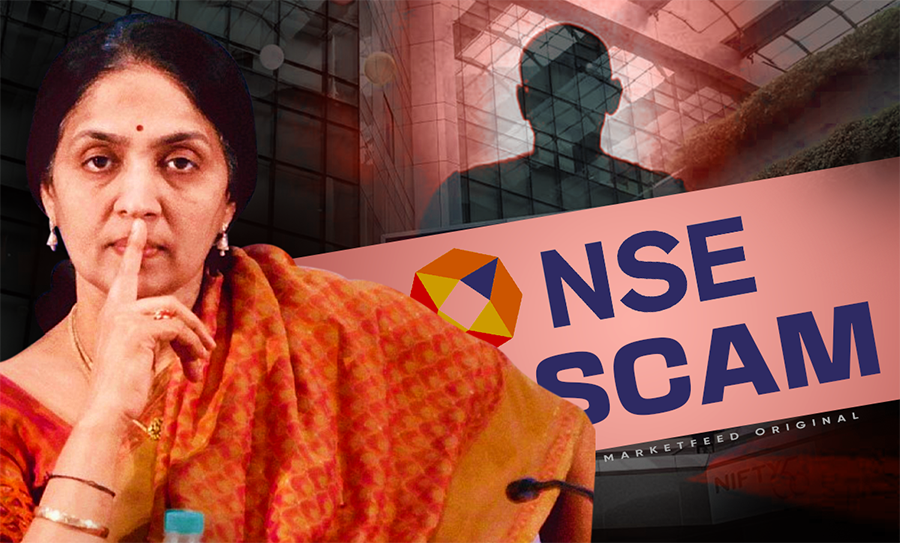
Earlier this week, former National Stock Exchange (NSE) chief Chitra Ramkrishna was taken into custody by the Central Bureau of Investigation (CBI) in a co-location scam case. She was arrested for taking vital management decisions under the influence of a ‘Himalayan Yogi’. According to sources, the Yogi was revealed to be Anand Subramanian, former Group Operating Officer (GOO), who was also arrested by the CBI. The scam involved as many as 62 brokers, advisories, traders, and employees of NSE.

In this article, learn all about the NSE co-location scam and recent developments surrounding it.

What is the Co-Location Scam?

Generally, brokers and proprietary traders have machines at their offices that are connected to a primary server at the National Stock Exchange. They place orders using these machines. However, as too many people traded on this server and technical glitches occurred, there was a delay in placing orders, which caused losses to brokers and proprietary trading firms.  

Thus, in 2009, the NSE started providing ‘co-location services’ to brokers for a fee. It allowed broking firms to place their servers within the premises of the National Stock Exchange for a premium. They could get precise price data, and orders could be placed faster. The brokers that availed co-location services had an advantage over those who did not and were able to generate massive profits. Most of these firms used algo or high-frequency trading (HFT), wherein computers buy and sell shares within seconds based on algorithms. A faster price feed allowed them to reap profit almost every day out of this.

Unfortunately, India’s market regulator SEBI decided to turn a blind eye to the regulation of NSE’s co-location services. It did not introduce any strict guidelines regarding these services. The co-location system is totally legal in India.

The Scam

There are two kinds of servers at NSE that process all trades: primary servers and backup secondary servers. Under co-location services, brokers’ servers were connected with a primary server. In the case of a technical glitch, they were connected with the backup servers.

Several brokerages tied up with the employees of NSE to know which secondary server would be switched on and when. These brokers would be the first ones to connect to the secondary server and later populate them. This action would cause the server to act slow for other brokers due to increased traffic. A trader who logged in to the NSE server with the least load first would get information related to buy/sell orders and order modifications first, compared to other traders who connect to the exchange server later. The orders of some ‘privileged’ players would get executed ahead of the rest of the market.

A firm called OPG Securities is alleged to have taken advantage of this system. Similarly, many were given preferential connections to the servers of NSE. AlphaGrep Securities, with the help of Sampark Infotainment, set up ‘dark-fiber’ links that connected NSE servers with their own. Moreover, senior management officials at NSE and even politicians had personal interests in these firms.

The Whistleblower

In 2015, a whistleblower named ‘Ken Fong’ from Singapore wrote to SEBI regarding irregularities in the co-location system in NSE. He also exposed information concerning the use of dark fiber lines. As time passed, the whistleblower wrote many such letters to SEBI and several media houses. As per reports, entities that had the advantage were making between Rs 50-100 crore cumulatively every day!

SEBI formed an Expert Committee (EC) for the preliminary investigation of these claims. Its Technical Advisory Committee (TAC) initiated a probe into the technical matters of the claim. Meanwhile, the NSE formed a Disciplinary Action Committee (DAC) to act against brokers involved in the scam. 

Deloitte, Ernst & Young, and the Indian School of Business were appointed to perform a forensic audit of the scam. The Income Tax Department and CBI also started investigating the co-location scam. In December 2016, NSE’s then CEO Chitra Ramakrishna and Vice Chairman Ravi Narain resigned. The exchange was ordered to pay close to Rs 1,300 crores in fines. Interestingly, NSE tried to recover the amount by imposing fines on brokers and firms involved in the scam.

Recent Developments

In January 2020, SEBI dropped charges on nine current and former officials of NSE, including ex-MD and CEO Ravi Narain. They argued that the accused cannot be held responsible for any misconduct or non-compliance in the ‘dark-fibre’ issue. However, SEBI levied fines on top management officials of NSE.

The CBI, who has been probing the co-location scam since May 2018, found that ex-CEO of NSE Chitra Ramkrishna shared classified information to a mysterious “Himalayan Yogi” via email. It was later reported that the yogi was Anand Subramanian, who served as Ramkrishna’s advisor between 2013 and 2015. Within the span of a few years, Subramanian saw his salary increase from Rs 15 lakh to Rs 4.21 crore!

After the scam was unearthed, SEBI introduced strict regulations to close loopholes and address concerns regarding algo trading and co-location facilities. This includes measures to make tick-by-tick price feed free of cost to all trading members. The market regulator has also asked exchanges to provide ‘managed co-location services’ via eligible vendors for ensuring low-cost services to all interested brokers. 

The market institutions that were established to support and protect retail investors/traders like you and me have turned out to be villains. Are the fines imposed by regulators enough to stop them? A lot of questions remain unanswered. What are your views on this scam? Let us know in the comments section of the marketfeed app.

Categories
Market News Top 10 News

Titan’s Net Profit Jumps 135% YoY in Q3 – Top Indian Market News

Titan Q3 Results: Net profit jumps 135% YoY to Rs 987 crore

Titan Company Ltd reported a 135% YoY jump in net profit to Rs 987 crore for the quarter ended December (Q3 FY22). Its revenue from operations rose 34.8% YoY to Rs 9,381 crore during the same period. The watches and wearables segment registered an income of Rs 708 crore, up 29% YoY. Titan’s eyewear business recorded revenue growth of 26% in Q3. Its jewellery business registered an income of Rs 8,563 crore, up 37% YoY.

Read more here.

Services PMI falls to 51.5 in January

India’s services sector activity fell further in January but remained in the expansion zone for the sixth-straight month. The IHS Markit India Services Purchasing Managers’ Index (PMI) stood at 51.5 in January, compared to 55.5 in December. PMI is a month-on-month calculation, and a value above 50 represents an expansion when compared to the previous month. New business rose at a noticeably slower rate in Jan amidst the third wave of the Covid-19 pandemic.

Read more here.

GAIL Q3 Results: Net profit jumps over two-fold to Rs 3,288 crore

GAIL reported a 121% YoY (or 15% QoQ) jump in net profit to Rs 3,288 crore for the quarter ended December (Q3 FY22). Its revenue from operations rose 67% YoY (or 19.8% QoQ) to Rs 25,776 crore during the same period. The operating profit from marketing natural gas stood at Rs 1,750 crore, compared to a loss of Rs 74 crore in Q3 FY21. The LPG and liquid hydrocarbons segment registered an operating profit of Rs 855 crore, up 202% YoY.

Read more here.

TCS to expand New Jersey operations, hire 1,000 employees

Tata Consultancy Services (TCS) will expand its operations in New Jersey by hiring nearly 1,000 additional employees by the end of 2023. The IT company aims to meet the growing needs of global customers to digitally transform their businesses. To grow its local IT talent pool for the state, TCS will expand the reach of its science, technology, engineering, and mathematics (STEM) and computer science education programs in New Jersey by 25%.

Read more here.

Tata Power signs pact with Apollo Tyres to deploy EV charging stations

Tata Power has partnered with Apollo Tyres Ltd to deploy electric vehicle (EV) charging stations to strengthen their green mobility commitments. The charging stations will be set up at Apollo Tyres’ commercial and passenger vehicle zones across India. Apart from the customers visiting the tyre retail outlets, the EV chargings stations would also be open for use by the general public.

Read more here.

Godrej Properties Q3 Results: Net profit jumps 171% YoY to Rs 39 crore

Godrej Properties Ltd (GPL) reported a 171.4% YoY jump in consolidated net profit to Rs 39.95 crore for the quarter ended December (Q3 FY22). Its revenue from operations rose 63.5% YoY to Rs 278.76 crore during the same period. EBITDA stood at Rs 115 crore in Q3, up 42% YoY. The real estate firm’s sales bookings rose 3.56% YoY to Rs 1,541 crore. 

In other news, GPL will invest Rs 400 crore to acquire a 10% stake in DB Realty. The company will also set up an equity platform with DB Realty that focuses on slum redevelopment projects in Mumbai.

Read more here.

Granules India gets USFDA approval for antidepressant drug

Granules India has received approval from the US Food & Drug Administration (USFDA) to market Bupropion Hydrochloride extended-release tablets. The drug is used as an antidepressant medication to treat major depressive disorder and seasonal affective disorder. As per IQVIA data, the total sale of the tablets during the twelve months ended December 2021 stood at $661 million.

Read more here.

Adani Power Q3 Results: Net profit at Rs 218 crore

Adani Power Ltd reported a consolidated net profit of Rs 218.49 crore for the quarter ended December (Q3 FY22). It had posted a net loss of Rs 288.74 crore in Q3 FY21 and a loss of Rs 230 crore in Q2 FY22. Its total income fell 21.2% YoY to Rs 5,593.58 crore in Q3 FY22. Total expenses declined by 26.22% YoY to Rs 5,389.24 crore during the same period. Adani Power’s capacity utilization was impacted in Q3 due to the shortage of domestic coal and high prices of imported coal.

Read more here.

Bosch to invest Rs 2,000 crore in India over next 5 years

The Bosch Group has announced plans to invest Rs 2,000 crore in India over the next five years. The investments would be primarily in advanced automotive technologies and digital mobility space. The German multinational engineering and technology company is celebrating a century of its presence in India. Over the next 5 years, Bosch India will invest over Rs 1,000 crore in the localisation of advanced automotive technologies and support Atmanirbhar Bharat.

Read more here.

ITC Q3 Results: Net profit rises 15% YoY to Rs 4,056 crore

ITC Limited reported a 15% YoY increase in consolidated net profit to Rs 4,056 crore for the quarter ended December (Q3 FY22). Its revenue from operations rose 30% YoY to Rs 18,365 crore during the same period. Revenue from its cigarette business grew 14% YoY to Rs 6,958 crore. The non-cigarette FMCG business revenues stood at Rs 4,099 crore, up 9% YoY. ITC’s board has declared an interim dividend of Rs 5.25 per share.

Read more here.