Categories
Editorial

How Will the US Elections Affect Stock Markets?

The much-awaited U.S. Presidential Election is all set to take place on 3rd November. Over the past few months, this is one major topic that has been discussed extensively. People from all over the world are eagerly waiting to learn about the election’s final result. Who will be the next powerful individual in the world? Will Donald Trump remain in the White House for another four years? Or, will ex-Vice President Joe Biden emerge victorious?

Looking from the point of view of stock markets, it is sure that there would be high volatility. Most investors are worried about the outcome of this election, as they believe that their returns could be affected. Let us look at some important facts surrounding the U.S elections. We shall also find out if it would cause an effect on the stock markets.

What Happens During the Election Period?

High Volatility

Stock market volatility would increase during the election period. In cases where the election is highly competitive or tight, historical data from financial analysts has shown that stock markets are likely to become highly volatile. We had seen this during the last US election in 2016. Hillary Clinton and Trump had faced a very tight election. 

In this particular case, the factor that affects stock markets are the economic policies that are proposed by the two major parties- the Democrats and the Republicans. Interestingly, a research paper from the University of Pennsylvania has stated that stock markets have delivered higher returns when Democrats were in power. However, this keeps changing with time.

When we analyze the general political views amongst American citizens, many believe that stock markets would perform better if Donald Trump is re-elected. This is because his economic policies involve very loose regulations and fewer taxes for corporations. On the other hand, Joe Biden has proposed to raise taxes and put more cash in the hand of normal citizens. This would not work in favour of large businesses. So, we need to understand how these policies will ultimately bring a positive or negative effect on the stock market.

Political Biases

Every individual would have their own political biases or opinions. In the US, many people have shown their support for the views of the Republican Party. Those who do not agree with their policies or views are supporting the Democratic Party. A person who aligns with a particular set of views would think that their parties’ win would be good for the economy and the stock market. In the short run, these opposing views between individuals can have an impact on stock prices.

We have to consider another important factor here. The stock market aggregates the expectations of all participants. Many individuals are not aligned with any political views. Due to this reason, historical data has also shown that the election process or political views have not caused any deep impact on the long-term performance of the stock market.

When we look at past records, market volatility begins to rise about 45 days before the election. The volatility seems to be at its peak within one week before the election date. This was evident during the current election year as well. Global markets had crashed in the last few weeks, due to the uncertainty in the US elections. However, the fall in stock markets was also due to European countries reintroducing lockdowns, as coronavirus cases have been rising rapidly. 

What Happens After the Election?

In order to understand this part, let us look at historical data from the United States Bank. For more than a century, data has shown that bonds or debt instruments have performed better- immediately after an election. Regardless of which individual or party competes in an election, people are likely to take fewer risks in the stock market. They would use bonds to improve the safety of their returns.

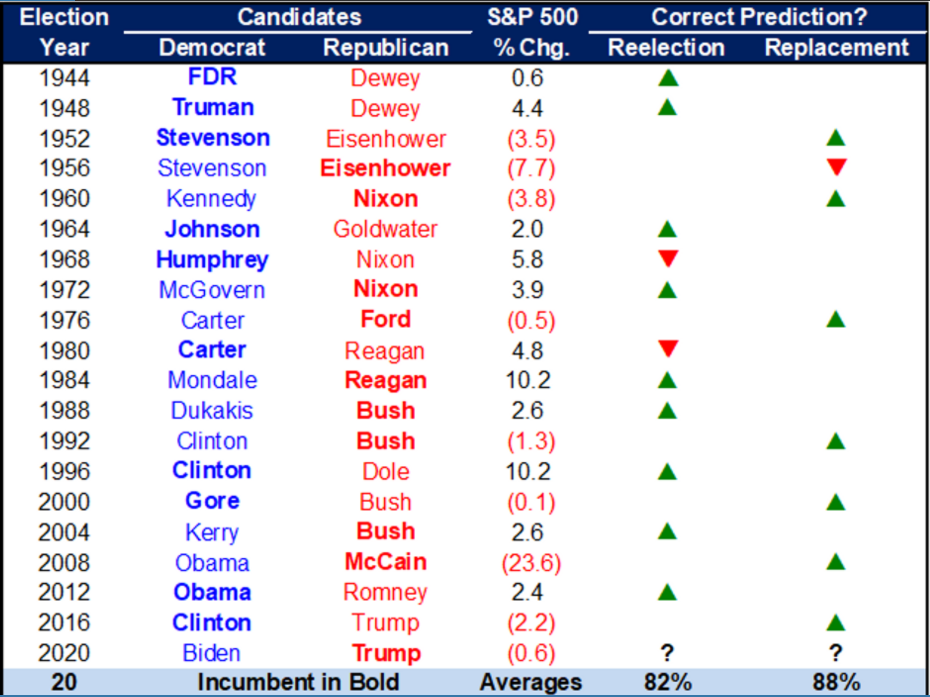
Another historical data from the U.S Bank shows the following: if a new political party gets elected to power, there is likely to be a 5% growth in the stock markets. In case the same political party gets to remain in office, there would be a stock market growth of 6.5%. Even if the markets go down, there would be a very rapid rebound or recovery. Let us see if this would turn out to be true after the highly anticipated election result of 2020. 

The table provided below shows how the S&P 500 Returns have changed when a new President was elected. The S&P 500 is an index that measures the stock performance of the 500 largest companies listed in American stock markets.
Important Facts about the US Election Day

The voting polls in all states open around 6 am. India is between 11-13 hours ahead of the United States. This means that by Tuesday night in India, around 96 million Americans would have already finished voting. 

Each state runs the election according to their own rules. Some states allow electronic voting methods, while most states use paper ballots. However, the actual counting of votes will not be finalized until weeks later. What happens on Election Night is that major US TV networks would “call” the election in favour of one of the candidates. This is based on the information from exit polls. An exit poll is an opinion poll of people leaving a polling station and asking how they voted. The estimated numbers from the exit polls are usually not contested, and the candidate projected to have lost concedes the election.

How Will This Affect Nifty?

Now, let us understand how our Indian stock markets could get affected. Donald Trump and Narendra Modi have had a love-hate relationship with each other. Trump definitely talks tough on India, regarding our sanctions and lack of action on climate change. He also calls PM Modi his friend, and welcomed our Prime Minister at rallies in the US. Another important fact is that he has imposed a lot of sanctions against China, which have acted as a boost to India’s long-term success. But still, his policies on tight restrictions for IT professionals and restrictive trade policies have not been favourable for India. President Trump may continue to face conflicts in securing a new economic stimulus, and this would not be good for the markets.

On the other hand, if Joe Biden becomes the next US President, many emerging economies could benefit (including India). With his equally tough stand on China, India is bound to benefit. His open approach to trade deals and inclusive plans on migration will greatly benefit Indian manufacturing, as well as IT sector. Biden’s clean-energy plan would deal a blow to the traditional petrochemical industry in America, and the subsequent price rises could help Indian manufacturers get better profits. But the change from fossil to green fuel is an inevitable, and necessary, future for our world. This is why huge corporations like Reliance, who have built their empire on oil, are planning to get into green energy. The big financial stimulus proposed by Team Biden will help push up US markets, along with global peers.

Under either President, Nifty will continue its uptrend in the long run.

Brace Yourself

From what we can understand, the US Presidential election, or any other political event, has very little impact on the share prices of large corporations. Regardless of who gets elected to power, the S&P 500 returns are fairly positive and do not go through big changes. This is even considering the possible tax increases proposed by Joe Biden on large corporations and wealthy individuals. Businesses will factor these increased taxes, and if Biden’s plan of reinvesting this extra tax revenue back to the economy then all will continue to be well and good in the long run.

At the same time, in case there are no clear winners in the election, or if there is any sort of complications arising, we could see a major fall in the global markets. If such a case happens, investors need to be careful. 

When we look at our very own Nifty 50, there have been some major signs of volatility due to global factors. What we can state is that the effects of the US election could be just a temporary issue. And, it would only last a week or so. The main concern we must all look into should be the rise in Covid-19 cases globally and the lockdown restrictions associated with it. We must understand that these are testing times, and market participants have to patiently wait and take safe actions so that losses can be reduced. Stay alert and always remember to follow the latest news!

Categories
Editorial Editorial of the Day

Why did Reliance Fall? In-Depth Q2 Results Analysis

Probably, the most eagerly awaited results came out late on Friday night. Mukesh Ambani led Reliance Industries reported a 15.05% year-on-year (YoY) drop in consolidated net profit at Rs 9,567 crore. This number was at Rs 11,262 crore for the corresponding quarter last year. The consolidated revenue from operations also fell by 24% to Rs 1,16,000 crore from Rs 1,53,000 crore reported a year ago.

Mukesh Ambani, Chairman and Managing Director of RIL, said: “We delivered strong overall operational and financial performance compared to the previous quarter with recovery in petrochemicals and retail segment and sustained growth in the digital services business. Domestic demand has sharply recovered across our O2C business and is now near the pre-Covid level for most products.”

Let’s have a deeper look at each segment.

Refining & Marketing (R&M)

Economic activity in the R&M segment was highly impacted by Covid-19. EBITDA fell by 50% YoY and 21% QoQ to Rs 3,002 crore. This was because the Gross refining margins (GRM) fell to $5.7/bbl from $9.4/bbl from the same quarter last year. (GRM refers to the earning on turning every barrel of crude oil into fuel.)

[Source: Quarterly Presentation] (Global oil demand growth)

Due to the easing of lockdown & preference for personal travel rising, demand for refined oil products like jet fuel saw an increase. The company is positive that the demand for fuels like gasoline and jet fuels will further increase in the third quarter. Even with lower margins, Reliance was able to outperform in the Asia Pacific and European refining margins in the challenging business environment. But with negative global sentiments in the oil market which leads to low GRM, the company might struggle in the longer run.

Reliance Jio

The telecom arm of Reliance reported another dominant result. Their market share in India’s mobile market reached 35.03%. Reliance Jio declared a 13% quarter-on-quarter (QoQ) and 185% year-on-year (YoY) rise in net profit. EBITDA rose by 8.7% QoQ to reach at Rs 7,971 crore.

Amidst the pandemic, Jio became the first mobile service provider to cross the 40-crore customer mark in India. According to the Telecom Regulatory Authority of India (TRAI), Jio added over 35 lakh subscribers which helped it cross the 40 crore mark. As of September 30, 2020, their total customer base stood at 40.56 crores which 1.8% higher than the previous quarter. Their total wireless traffic also grew by 1.5% and amassed to 1,442 crore GB.

ARPU or Average Revenue per User is an important metric for telecom companies. It helps them to get an idea of how much they are earning from a customer on an average. Jio’s ARPU touched Rs 145 per month this quarter. Last quarter, this metric was at Rs 140 per month. Also, there has been a constant uptrend in Jio’s ARPU from the past four quarters.

Q2FY20Q3FY20Q4FY20Q1FY21Q2FY21
120128130.6140.3145
(Jio’s ARPU in rupees over the quarters)

Without a doubt, Reliance Jio has been a constant driver for RIL as a whole. Thus, it tells how Reliance wants to position itself as a tech player in the future.

Reliance Retail

The retail segment of the company rebounded sharply in the second quarter after a huge slump in Q1 due to lockdown. Revenue from operations rose by 30% QoQ to reach at Rs 36,566 crore. Last quarter was marred by the shutdown of retail shops and fears of people venturing out of their home.

In Q1FY20, Reliance Retail reported an EBITDA of Rs 1,079 crores. This quarter, EBITDA has increased by a whopping 86% to Rs 2,006 crores. When compared to last year, the operating profit of the segment fell by 14% as normalcy is yet to be achieved during these COVID times. With easing restrictions, Reliance Retail was able to operate 85% of its stores. 

A huge jump in the revenue was noticed in the consumer electronics products. Revenue increased by 2X over the last quarter. The apparel segment of Reliance Retail also registered amazing growth. Revenue from Fashion & Lifestyle was almost at 3X over the previous quarter.

“Increased footfall and store openings have contributed to the rebound in retail revenues, with 85% of stores now open,” V. Srikanth, the joint chief financial officer of RIL. 

Apart from the results, RIL has seen some huge investments in their retail arm. Around 8% of the stake has been sold to prominent global investors like Silver Lake, General Atlantic, KKR, Mubadala and a few more. The total investment is amassed to Rs 37,710 crore. At the same time, Reliance Retail has acquired companies like Netmeds, Grab, Nowfloats, C-Square and Shopsense (Fynd).

Petrochemical

The petrochemical segment experienced a resurgence in the second quarter. EBITDA reported a rise of 35% QoQ to Rs 5,964. This is still significantly below than Rs 8,964 crore what the company recorded in the same quarter last year.

The overall increase in household spending helped the company to record a 17.8% growth in the total revenue. Q2’s segment revenue stood at Rs 29,665 crore as compared to Q1’s Rs 25,192 crore.

The sequential rise can be attributed to an increase in demand in the agriculture, auto and FMCG sector. The lockdown forced many labours to lose their jobs. This raised the presence of labours in the market, thus, driving the wages expectations lower. It helped the Indian textile industry to get cheaper labour and cut their cost of production.

To sum up

The company showed a strong rebound in its performance when compared to the previous quarter. Yet, it was below what they produced in the same quarter previous year. But that was expected due to Covid-19, right?

Reliance Jio performed better than what the market estimated. Reliance Retail also contributed to give a positive outlook to the market. Petrochemicals displayed a robust fight to give good numbers. But two of the core segments of the company, refining & marketing and oil & gas (upstream), have struggled for another quarter. Main reason? Lockdowns all over the world due to Covid-19.

On one hand, Covid-19 has raised the demand of digitalization which has aided the Jio segment. On the other side, the core business of Reliance, oil & gas continues to struggle. Reliance owns the largest refinery in the world in Jamnagar. It was their oil & gas business which helped them become what it is today. This quarter, the EBITDA through the oil & gas sector (upstream segment) was reported to be – Rs 194 crore. This is way below than Rs 128 crore EBITDA recorded in the same quarter previous year. This has led to some serious concerns on the oil & gas segment of Reliance.

A few days back, Mukesh Ambani displayed his desire to spearhead India’s fight towards renewable energy. How often have you heard a company dealing with crude oil talking about a move to renewable energy at such a massive scale? Mukesh Ambani insisted that shifting towards renewable energy does not mean leaving the oil & gas business completely. But, is it so easy to make such a large shift? You can read more about this here

Halloween Horror Show! Why Did Reliance Fall?

Halloween is celebrated each year on October 31. Seems like it came on 2nd November for Reliance. You can find how the market performed today here. Reliance’s share price fell by a massive 8.69% to close at Rs 1876. This fall of Rs 178.50 in one day took Reliance on their lowest share price in the past three months. What were the reasons behind such a fall that eroded more than Rs 1 lakh crore of market capitalization?

We can understand three possible reasons behind this. Firstly, negative sentiments due to holding off of Reliance-Future Retail deal. The big bull Amazon has insisted that the deal between the two cannot go ahead as it violates Future’s commitment towards them. Read about this war here. The deal with Future group has huge importance for Reliance to take the next step in the retail segment. If this deal collapses, the speed of growth for Reliance Retail in that sector will be hugely affected.

Secondly, unsatisfactory results. Reliance’s oil business is really struggling due to COVID-19. Demand for oil is struggling to revive. Yesterday, the UK government announced that the second wave of infections has been increasing rapidly. To contain the spread, the UK government has declared another four-week lockdown. Before them, Spain and France have also announced lockdowns in their country. With an increase in cases worldwide and no vaccine as of now, the oil & gas companies may find themselves in a very bad situation once again. 

Thirdly, profit booking kicking in. Reliance has been on a relentless upside rally from the past 7 months. With every major announcement of investment, Reliance has gone up rapidly. But this pattern stopped in the previous month when major investments in the Retail segment failed to boost up the price. Thus, there might be a feeling among the investors that Reliance won’t be going up so easily now.

With a subdued performance in a few segments this quarter, people might have just booked their profits rather than hoping that Mukesh Ambani can turn around again. Also, Rs 2,000, being a round number, was a very solid support for investors. As soon as the stock went below it, many stop losses would have been triggered which created a panic among the shareholders to sell the stock. 

There are also rumours floating around about Ambani’s health. While this has not been verified, stock prices may crash further if this is verified. It will be very interesting to see where Reliance goes from here. Any negative news will be forcing another big fall in its share price. But can Mukesh Ambani do his magic again?

Categories
Editorial

Can Tata Motors Win in India?

The Indian 4-wheeler industry is currently witnessing a steady recovery in sales. With lockdown restrictions being eased gradually, families across India are looking at the prospects of buying a car again. And the automobile companies are looking to seize this very opportunity with their amazing offers and discounts. And out of all these companies, analysts are reporting that Tata Motors is outperforming in domestic sales. But is this enough? Let us look at some of the new developments surrounding one of our favourite stocks, Tata Motors.

Brief Profile of Tata Motors

Tata Motors initially began as a truck manufacturer. They entered into the passenger vehicle segment in 1988. The initial growth of this company was only possible through the sheer determination and vision of the legend himself, Ratan Tata. Some of its very famous and widely sold cars in the ’90s such as Tata Indica, Tata Sumo, and later the Tata Nano were also built under his leadership.

The company also wanted to make its mark in the commercial vehicles industry and has been largely successful. Look around you, a reasonable number of trucks and buses on the road would be manufactured by Tata Motors. 

One of the biggest deals by Tata Motors was the acquisition of United Kingdom-based Jaguar-Land Rover (JLR) for $2.3 billion (now about Rs 17,000 crores) from Ford, in 2008.

Recently, the company has launched several widely popular cars such as the Tiago, Tigor, Hexa, Harrier, and Altroz. It has been exporting these cars to more than 125 countries. With all these new cars in the market, we would expect the company to perform quite well, right? However, the results have been very underwhelming. 

Fun Fact: Tata Indica was the first-ever car to be fully manufactured using India’s resources. The car was completely based on Indian technology and parts. Within two years since its inception, Indica occupied the number one spot in the Indian market.

Surprising Figures

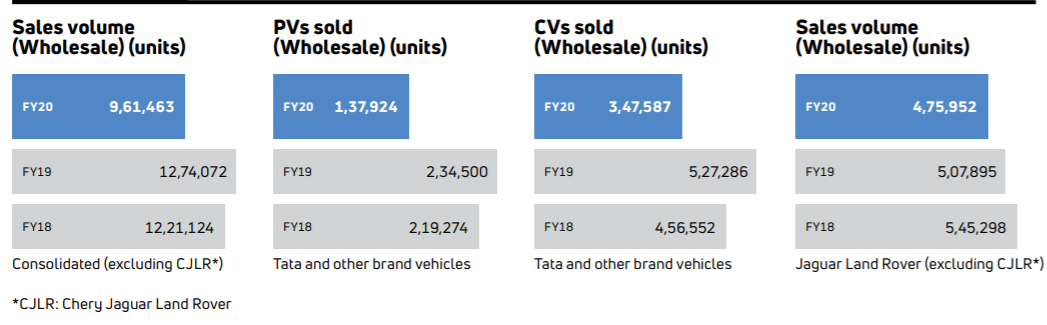
Over the last few years, Tata Motors has been disappointing investors with poor financial performance. Even after the ambitious acquisition of JLR (who is bleeding money) and new car launches, Tata Motors has not been able to improve its sales growth. In fact, it is one of the biggest loss-making enterprises in the Tata Group of Companies. To understand these factors in-depth, let us look at some of the important figures:

As we can see, the sales data reported by Tata Motors over the past 3 years does not seem to be very promising. In fact, the Covid-19 pandemic has caused a major impact on its production and sales activities during the current financial year as well. 

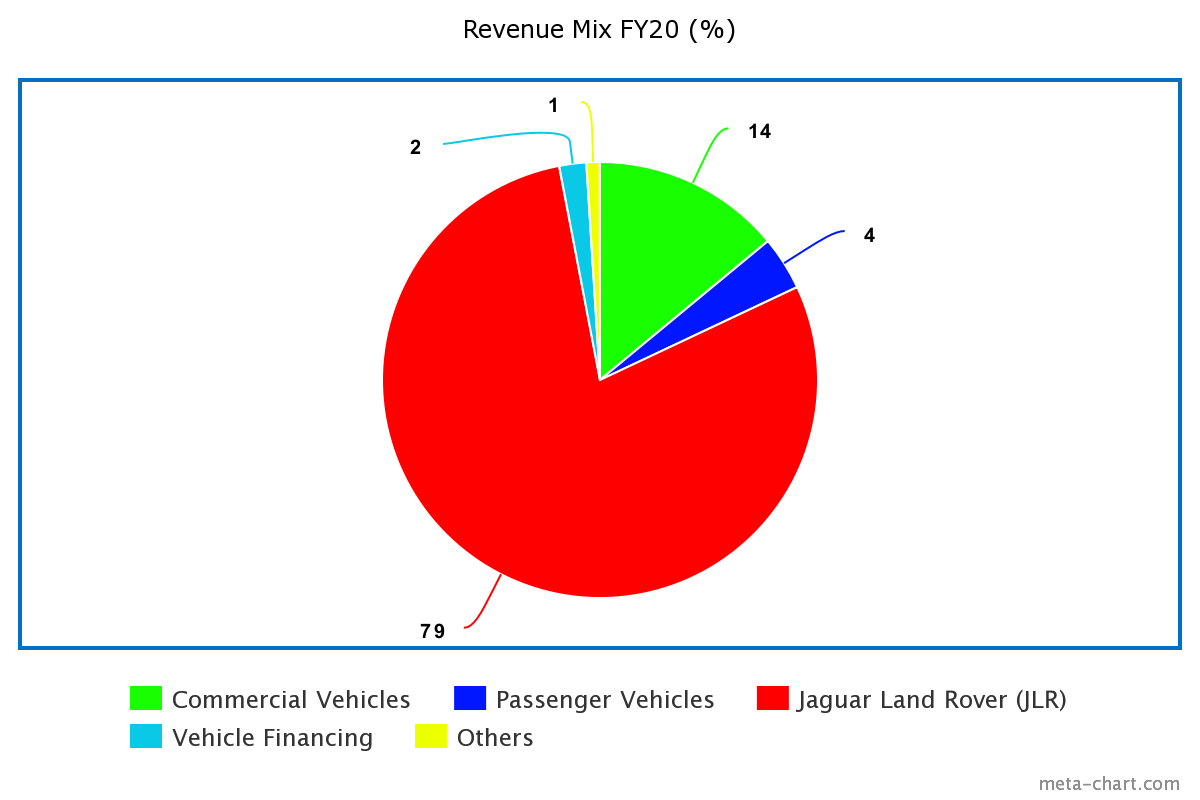
Chery Jaguar Land Rover is the company’s China operation and is a 50-50 partnership between JLR and Chinese state-owned automaker Chery. While the China operations are doing comparatively better, Jaguar Land Rover (JLR) has not been doing great over the last few years elsewhere. At the same time, they are carrying all the burden for Tata Motors, as JLR contributes 79% to the total revenue, as of FY20. The cars of both Jaguar and Land Rover have superior capabilities and are often used as official government cars in many countries. However, their legacy alone is unfortunately not able to sell more cars.

From the graph shown below, we can also understand how small the contribution of its Commercial Vehicles and Passenger Vehicles are. So Tata Harrier, Nexon, Altroz, and many other cars of Tata that you see on the road, contribute only a meagre 4% of Tata’s entire revenue! So no matter how many ever news articles you see about Tata Motors’ domestic sales improving, do not forget that it forms only a tiny fraction of the company’s revenue. 

Jaguar Land Rover. The Loss-Making Enterprise

Jaguar-Land Rover has been the parasite that is actually killing Tata Motors from the inside. The subsidiary of Tata Motors was affected by the impact of falling diesel sales, due to global pollution scandals. The uncertainty of the United Kingdom exiting from the European Union (Brexit) had also led to higher costs, falling sales, and production halts. In May 2019 (FY ’19-’20), JLR had reported a loss of £3.6 billion (~Rs 34,424 crores)! So, the subsidiary that was meant to push Tata Motors to greater heights, has been causing more harm for them.

Since 2017, China has become the biggest market for JLR. As we discussed earlier, the operations there are backed by a Chinese Government-owned entity, Chery. However, even with this support, the sale of vehicles that had been reported from the country had declined by more than 44%, within 2 years. This has caused a lot of panic inside the company, and Tata Motors is finally opening its eyes, and trying to focus on improving JLR’s financial position. 

The very deep losses of JLR have also affected their consolidated figures. Also, the full effects of the lockdown were seen only after the March results. So let us look at how they did between July and September this year. 

Q2 Performance in FY21

Tata Motors reported its Q2 results on 27th October 2020. The consolidated net loss increased to Rs 307.3 crore in the quarter ended September, as compared with a net loss of Rs 187.70 crore in Q2 of the previous year (FY ‘19-’20).  The revenue from operations declined by 18.19% year-on-year (YoY) to Rs 53,530 crore, from Rs 65,431.95 crore a year ago. Many experts have reported that the result has been far better than what was expected, even though the losses increased.

During the July-September quarter this year, the company has reported a growth in passenger vehicle sales by almost 162% YoY. Market share in the passenger vehicle segment has increased to 7.9%, but is still way behind Maruti Suzuki and Hyundai. The sales numbers for October have also increased 79% YoY but volumes are negligible compared to market leaders. The company themselves have attributed this growth to pent-up demand, wherein those people who did not buy cars during the lockdown (as they did not have to travel) are buying cars now. This cannot be considered as the organic growth of the company. Another important fact to be mentioned is that Tata Motors is the only carmaker to register a growth of 2.63% during April-September 2020. The car industry as a whole had fallen by 34% during the same period. This shows how the PV business is currently doing good.

Jaguar Land Rover has also made a strong recovery in Q2. It reported a 53.3% quarter-on-quarter (QoQ) growth in terms of sales. It has sold more than 1 lakh units during the quarter. The Chinese economy is doing well, and hence the company has also improved its sales in China. But the question remains- will they be able to maintain their recovery? 

New Developments

The Tata Group has been continuously aiming to improve its hold in the automobile sector in our country. We know that India’s passenger vehicle sector is dominated by Maruti Suzuki, which has more than 50% market share and is clearly the undisputed king. And even though Maruti Suzuki tries to portray itself as an Indian company, it is Tata and its subsidiaries who have been the Global Indian brand.

Earlier this year, the Board of Directors of Tata Motors had agreed to form a separate entity for its passenger vehicle (PV) business. Within one year, all the relevant assets, intellectual property, and employees would be transferred to this new entity. The production of electric cars will also become a priority for the company.

Following this, a major statement was made by Tata Motors on 25th October. The auto company announced that they are actively looking for a partner, for enhancing its passenger vehicle business. The collaboration will be aimed at reducing costs and improving business with new product launches. For this to become a reality, Tata Motors would require huge investments from outside the company. 

“The whole purpose of subsidiarisation is to actively look for a partner because this is a reality for all of us that a collaboration can unleash a bigger potential in the next decade which is going to see significant investments in new technologies and regulations,” –  Shailesh Chandra, Tata Motors President (Passenger Vehicles Business Unit).

High Hopes

From these new developments, we can see that Tata Motors is gearing up to redefine its position in the automobile industry. The company had announced the restructuring of its passenger vehicle segment almost 3 years ago. But now, concrete steps are being taken. It would take serious planning and execution to cover all losses that have been incurred. The passenger vehicle business would require a huge boost, but this can only be possible through adequate investments and huge collaborations. Through the proposed strategic partnership, Tata Motors would have to make sure that all resources are fully utilized. Also, do bear in mind that JLR is burning cash for the company. This is also the company that is supposed to provide the highest share of the revenue for Tata Motors. 

We do know that the auto industry can be very competitive. It would be very interesting to see how Tata Motors is executing its plans, and trying to bring a positive change to their sales figures. Will they be able to move up on the leaderboard of top car sales in India? Even if they lead in Indian markets, will this make a difference when JLR is still making losses?  Do not forget that Jaguar-Land Rover has always been a bad charm for the companies that owned it. Ford before Tata, and BMW before them. Coming to the conclusion, will Tata be better off cutting losses and selling Jaguar-Land Rover?  

Categories
Editorial

Reliance vs Amazon: The Future Retail War

India’s retail market is estimated to be worth Rs 60 lakh crores in FY 2019-20 and is expected to grow at a CAGR of 10% over the next 5 years to reach Rs 90 lakh crores by FY 2024-25. Reliance and Amazon are indulging in a serious war to capture this retail market in India.

Reliance and Amazon have been pursuing to buyout the cash-strapped Future Group, which owns retail brands like Big Bazaar, HyperCity, etc. This deal can give access to around 1,800 stores across Future Group’s brands and subsidiaries such as Big Bazaar, FBB, Easyday, Central, which are spread across 420 cities in India. 

Right after Reliance finalized its deal to acquire the Future Group for Rs 24,700 crores, Amazon opposed the deal and approached an international arbitration court to try and stall the deal. The court has given a temporary decision in favor of Amazon. A permanent injunction order is awaited. On the other hand, Reliance refuses to take a step back either. Let’s find out what the mess is all about. 

Why is Amazon Opposed to the Reliance-Future Deal?

After Reliance finalized its deal to acquire the Future Group, Amazon approached the Singapore International Arbitration Centre(SIAC) to appeal against Reliance for buying out Future Group. Amazon stated that this would be a violation of a contract that Future and Amazon had signed when Amazon had acquired a 49% stake in Future Coupons Limited, in November 2019. This acquisition gave Amazon a 3.58% stake indirectly in Future Retail Limited. 

Coming to the contract between the two companies, they had mutually agreed that Amazon would have an option to acquire all or a part of the Promoter’s Shareholding in Future Retail Limited in the near future, under certain circumstances. Additionally, Amazon would have the first right of offer. The Promoters had also agreed to not sell their stake to ‘specified persons’  and agreed to certain restrictions. We can get a smell of who the ‘specified persons’ might be. 

Amazon says that according to the contract it has the first right of refusal. This means that a company can buy a stake in Future Retail only after Amazon refuses to buy it in the first place. The interpretation of the contract is debatable. 

Is it a Retail War?

  • Reliance wishes to capture the e-commerce market through its brand JioMart(a subsidiary of Reliance Retail Ventures Ltd.), which was recently launched in January 2020. The company gained momentum during the COVID-19 lockdown. Amazon, on the other hand, wishes to acquire a better logistics, warehousing, and supply chain for its already existing e-commerce platform.
  • In January 2020, Future Retail and Amazon had ‘joined hands’ to ‘take-on’ Reliance’s JioMart.They were strategizing for a partnership and possibly an investment. The relationship between Amazon and Future was steady. Future saw hope in partnering with Amazon. However, Reliance offered to acquire the group for a lucrative amount which could prevent the company from going bust. The deal was too good to let go. Future Group jumped off Amazon’s Boat and got into Reliance’s Boat. At the same time, Reliance being an Indian entity faced no restrictions of Foreign Direct Investments(FDI), unlike Amazon.
  • Future Group might face insolvency and eventually shut shop: Arbitrations are long and lengthy, they aren’t as effective as litigation. Reliance has its own set of tricks up its sleeve. If the arbitration proceeding continues for long, Future Group won’t get the cash it needs. This means that it won’t be able to operate for long and eventually go bust. What would follow is a set of insolvency proceedings which would last long enough, such that neither Amazon nor Reliance would be able to acquire the assets. Since the assets would be auctioned off to pay back the debt that Future Group owes to its creditors. Essentially, this would be collateral damage. 
  • Amazon was in talks with Reliance to buy a 26% stake in Reliance Retail in August 2019. In September, there were unconfirmed reports that Amazon was in talks with Reliance to acquire a 40% stake in Reliance Retail for $20 Billion(1.4 Lakh Crores). The deals didn’t go through. The liquidity would have allowed Reliance to get rid of its huge debt. However, with foreign investments flowing in Reliance managed to go net-debt free without giving Amazon a piece of its cake.
  • Not just Retail, there’s more to it: Reliance, Amazon, and Flipkart, the three major competitors, are all arms out against each other. All three own a food retail license, All three have their own OTT platforms, All three have their own UPI/Wallet payment services. All three have an established fashion brand. There could be more than just Retail in the picture.

Who Wins, Who Loses?

Reliance is an old and home-grown company, with a strong lobbying ground and sources in the government. Amazon on the other hand is a relatively newer foreign company with not as much lobbying power as Reliance. Amazon might therefore face problems on FDI and regulation even if things run in its favor. Reliance and Future have both come out in support of the acquisition. Reliance has stated that ‘it intends to enforce its rights and complete the transaction in terms of the scheme and agreement with Future group without any delay’. Reliance and Future both want to go forward with the deal. 

Amazon faces a challenge since enforcement of emergency arbitration orders is contestable in the Indian court of law. Future Group or Reliance might approach the respective court and stall the interim order by SIAC. Whatever is the course of action needs to be taken fast, time is ticking.  

Categories
Editorial Editorial of the Day

How Kotak Bank made a Profit Jump of 26.3% for Q2 FY21 Result

Private sector lender Kotak Mahindra Bank Ltd, on Tuesday (26th October), came out with their results which defeated all the street estimates. They declared a 26.3% year-on-year (YoY) rise in standalone net profit for the September quarter 2021. Their Net Interest Income (NII) also gained 17% YoY for this quarter.

These are spectacular numbers. The previous week, HDFC Bank came out with 18% year-on-year (YoY) rise in net profits which gave birth to a lot of positive sentiments in the market. But, Kotak has left the number one bank behind and reported even better performance this quarter. Let’s have a closer look at their quarterly performance.

Robust Revenue Generation

NII is the difference between the interest income a bank earns from its lending activities and the interest it pays to depositors. Higher the spread between the two interest rates, more profitable it is for the banks.

In the same quarter previous year, Kotak declared a net interest income of Rs 3,350 crore. This quarter, it increased by 17% to Rs 3,913 crore. This 17% increase is constant for the bank since the previous three quarters. NII for the bank has increased by 18%, 17% and 17% in the previous three quarters. This shows that even amidst the pandemic, the bank has done really well to maintain its revenue growth.

Digitally Advanced

We have discussed several times how being digital is pivotal for any company in any industry, let alone the banks. Kotak has put consistent efforts to digitally transform itself. They have stressed on a paperless transaction for Home Loans and Loans Against Property (LAP) for some time now. And now this has given the bank good business, as paperless transactions became a necessity during the times of Covid-19.

Other than this, tractor, retail commercial vehicle/infrastructure loans were also available on Kotak Mobile App. As we know, tractor sales have been booming over the last few months. They have one of the most user-friendly mobile applications in the industry. Transaction volume and value of mobile banking went 81% and 56% above annually during the quarter. Also, Kotak became the 1st Bank in the country to launch Video KYC for Account Opening.

85% of the total Fixed Deposits were booked through Digital channels in Q2. 86% of all Credit Cards and 30% of the total personal loans were again carried with the help of digital channels in this quarter. All of this cumulated to 73% (YoY) growth in Digital Payments volumes.

So this digital push by Kotak Bank helped them maintain good business when most customers were staying at home.

A glance at their Asset Quality

Kotak Bank’s gross non-performing asset ratio (GNPA) fell to 2.55% this quarter. This ratio was reported as 2.7% in the preceding quarter. Also, their Net NPA ratio fell to 0.64% from 0.84% during the same period.

Due to the interim order of the Supreme Court, they didn’t recognise any NPAs since August 31, 2020. This could have given a false image of non-performing assets. But the bank was quick to discard this concern. Even if they had not considered the Supreme Court’s decision, the gross NPA would have been 2.70% and NNPA 0.74%. This is only a marginal increase from the reported values. Thus, one can conclude that Kotak has a very stable asset quality.

Market Reaction

The market sentiments were negative on the day Kotak Bank was due to announce the results. Nifty 50 and Bank Nifty closed 1.36% and 1.65% down. Yet, Kotak Bank emerged as one of the top gainers to close at Rs 1410.90, up by 2.01%. The day after the results were announced, the share price of Kotak Bank rocketed up even in the presence of the bearish global sentiments. It closed 11.70% higher at Rs 1582.70 to become the top gainer of the day. There were also reports that America’s Morgan Stanley was going to pump in funds to the stock, as covered here.

The Way Forward

The banking sector has been in the news ever since the lockdown. The 6-month moratorium on repayment of loans ended on 31st August. On 3rd October, the government of India announced that interest-on-interest for loans up to Rs 2 crore will be waived off for the borrowers. At the same time, to prevent banks from facing huge losses, the amount waived off will be paid to the banks by the government. This news was welcomed by the market as there is huge pressure on banks to maintain their asset quality. To read more on the interest waiver scheme, click here

The Q2 results of the banks have been great so far! Especially big banks like HDFC Bank and Kotak Mahindra Bank which operate all over India. Will this trend continue? Will all the banks come out with positive results? Where are the high NPA rates predicted by The Reserve Bank? Will Public-Sector Banks be the worst affected? Let’s wait and watch.

The upcoming quarter will be very important for the banks. This will be the quarter in which the government will implement its strategies to aid banks. The moratorium was lifted less than 30 days before the September quarter-end. The loans being defaulted and turning into sub-standard assets will be only seen in the October-December financial results. Thus, a more clear picture of NPAs will be seen in the third quarterly reports of banks and NBFCs. Keep tracking all the updates with marketfeed to follow more of this story.

Categories
Editorial

Morgan Stanley Index to Push Markets Up – MSCI Rejig

The last week of October began with a rocky start. On Monday, we saw that Nifty 50 was down by 162.60 points (or 1.36%), and closed at 11,767.75. The fall in Reliance Industries (RIL), decline in the auto sector, and the imposition of lockdown in Spain were three major reasons that caused a sharp fall in Nifty. Click here for our detailed post-market report for Monday. To make matters worse, the European and US market was down by 3% and 2%, respectively. Investors were asked to be very cautious while entering into a trade on Tuesday. 

However, in a surprising turn of events, Nifty went up by 1.03% on Tuesday. Against all odds, Nifty saw a rise of 121.65 points, and closed at 11,889. Let us have a detailed understanding of one major reason as to why there was a great recovery in our Indian market.

The MSCI Index

On Tuesday, most of us did not get a chance to go through a major report that was published in the afternoon. However, the stocks mentioned in this report were the ones that showed a great performance in our markets. The report had details about Morgan Stanley’s Emerging Market Index. 

Morgan Stanley Capitals International (MSCI Inc.) is one of the largest investment banks and financial services companies in the world. The US-based firm is a major index provider and publishes three major indexes. An index usually measures or tracks the performance of a group of assets or securities.

Coming back to the point, the report mentioned that Morgan Stanley is going to restructure or reorganize its Emerging Market Index. What this meant was that India’s weightage in this highly important index would be increased to 8.7%, from the current level of 8.1%. Ultimately, this would result in an additional indirect inflow of about $2.5 billion (~Rs 18,430 crore) to the Indian securities that are included in the index. According to Morgan Stanley, the major companies such as Asian Paints, Bajaj Finance, Britannia, L&T, and Nestle India would highly benefit from this change. These companies could see an increase in investment by approximately $200 million (~Rs 1,474 crores).

How Does this Process Work?

In order to understand this process more clearly, we shall look at an example. In India, we have the Nifty 50 index which includes Nestle India Limited. At a point in time, a major financial company or analyst might say that the weightage of Nestle is going to be increased in the Nifty index. Mutual funds and Exchange Traded Funds (ETFs) who are tracking this index will start pouring more funds into the stock. This confidence from big players will also make small retailers invest more money into the company. Eventually, the share prices of Nestle would have a high chance of increasing. This is exactly one of the major reasons as to why there was a rise in Nifty on Tuesday.

Top Gainers on Tuesday

  1. Kotak Bank – 11.70%  
  2. Nestle India – 5.97%
  3. Asian Paints – 5.69%
  4. Bajaj Finance – 4.38%

Almost all the top gainers are companies that were listed on the report of Morgan Stanley. Certain financial analysts have also stated that companies such as Apollo Hospitals, LIC Housing Finance, Ipca Laboratories, and Kotak Bank may also be included in the MSCI indices

Do bear in mind that the original results of the MSCI Emerging Market Index would be announced on November 11. It would also include the list of stocks that would be added, along with the changes in its weightage. These changes would finally be effective from 1st December 2020. So the point is that even the funds have not actually flowed into these stocks, the positive sentiment around them is what pushed them up.

An important takeaway from this would be to carefully go through relevant market news. Very specific and highly important news (such as this report from a giant like Morgan Stanley) would have a huge impact on how markets perform on a specific day. It is also encouraging to understand how our Indian companies are performing, and would help us achieve handsome profits in the long term and win in the stock market.

Update on November 11:

The revisions to the MSCI Emerging Markets Index was announced on November 11. The following table shows the list of stocks that are added, and the stocks that have been excluded from the standard index.

Stocks that are AddedStocks that are Excluded
1. Kotak Mahindra Bank1. LIC Housing
2. Adani Green2. Bosch
3. Yes Bank
4. Apollo Hospitals
5. MRF
6. IPCA Labs
7. Balkrishna Industries
8. L&T Infotech
9. Trent
10. PI Industries
11. Muthoot Finance
12. ACC
Categories
Editorial

The Government Interest Waiver – All You Need to Know

In normal circumstances, when an individual or a business takes a loan from a bank, they would have to repay the loan amount with interest. More importantly, there would be a specific time period by which they have to make the required payments. What happens to these entities when they fail to repay the banks or other financial institutions? Their credit scores go down, thus, making it difficult for such entities to get essential loans in the future. Or, the property which was used as collateral for the loan would be taken over by the bank and sold off. These are important facts that we already know.

So let us look at the problems faced by different entities in these challenging times of Covid-19. Then we will jump into what this interest waiver means, and how it will affect different parties including consumers like us by understanding what every guideline means.

Problems faced by Businesses:

We need to establish the fact that there is nothing ‘normal’ about this year. The Covid-19 pandemic has definitely caused a huge impact on individuals and businesses all around the world. Small or large businesses would have taken loans to improve production. In order to scale up, the loan amount could have also been used to increase investments in infrastructure. With the lockdown being imposed in late March in India, most businesses had very few customers. Supply chain (network between a firm and its suppliers) disruptions due to the closing of borders had made it very difficult for many businesses to keep their shops open. 

Problems faced by Banks:

An important factor that we must consider is the view of the commercial banks in our country. One of the main sources of income for banks is the interest they receive on loans. In such cases when customers are not in a position to repay the loan interest amount, financial institutions would have a very tough time conducting its normal activities. It could affect the financial result or position of the banks. (There could be exceptions to this. For eg, HDFC Bank reported a high-profit growth of 18% YoY for Q2). Banks and financial institutions are the backbones of any modern economy. To make sure that they do not fail, there should also be a system in place so that all stressed loans do not get classified as bad loans when borrowers fail to repay.

With almost all economic activities being hit, the Government of India had to step in and provide maximum support to its citizens, while maintaining the welfare of banks. The Reserve Bank of India (RBI) had announced a moratorium on repayment of loans (debt) for three months, beginning from March 1, 2020. What this meant was that businesses and individuals would not have to make payments on their loans during this period. The moratorium period was further extended from May 31st for another 3 months. This was mainly because the number of coronavirus cases in India kept on increasing rapidly, and lockdown rules became more strict. 

The Compound Interest Waiver

Even though the RBI had offered a moratorium, the banks continued to build up the compound interest on these loans over the six month period. Interest-on-interest(or compound interest) is the interest on a loan, calculated based on both the initial amount and the piled-up interest from previous periods. On October 3rd, the Government announced that interest-on-interest for loans up to Rs 2 crores during the six-month moratorium period, would be waived off. This would provide relief to many micro, small, and medium enterprises, and individuals. However, do bear in mind that the banks which had provided loans to these enterprises would be largely affected. It had been estimated that the cost of the compound interest waiver could be around Rs 5,000 – 6,000 crores. This loss would be compensated by the Government. 

On 15th October, the Supreme Court asked the Government to speed up the process for implementing the waiver of interest-on-interest. The Court instructed the Centre to implement the waiver by 2nd November. This is to make sure that individuals or businesses would not suffer more financial losses. 

Guidelines for Implementing The Waiver

On 23rd October, the Indian Government issued the important operational guidelines to banks. The guidelines specified how the implementation of the compound interest waiver would go about. Let us look at some of the important aspects of the guidelines:

  1. The interest waiver scheme would be applicable to loans below Rs 2 crores
  1. The amount of relief should be calculated as the difference between simple interest and compound interest. What this means is that compound interest on loans would be covered or paid by the government. The simple interest amount has to be paid by the borrowers themselves. The relief amount will be credited to the customer’s account.
  1. The relief payment would be calculated on loan repayments in the period between March 1, 2020, to August 31, 2020.
  1. The rate of interest while calculating the relief amount would be the same as the rate in the loan agreement. This is to ensure that there is no confusion, in case the interest rate has been increased or decreased by banks during the moratorium period.
  1. The government has identified eight categories of loans under this scheme. The categories include micro, small, and medium enterprises (MSME) loans, educational loans, housing loans, consumer durable loans, credit card dues, auto loans, personal loans to professionals, and consumption loans. People who have taken loans based on any of these 8 categories would be eligible for getting relief. Check with your bank to see if you can avail the scheme.
  1. In the case of credit card dues, the rate of interest will be the weighted average lending rate that is charged by the card company. The scheme will also be applicable only for transactions financed on an EMI basis between March and August. The weighted average is a method of calculating the average, in which some elements carry more importance than others.
  1. In the case of loans that were given as cash, normal interest will be calculated on a daily basis at the rate as of February 29, 2020. The compound interest will be calculated on a monthly basis. The amount that comes as the difference between both these rates will be credited to the customer’s account.
  1. The compound interest waiver applies to all lending institutions such as banks, non-bank finance companies (NBFCs), and housing finance companies.
  1. The scheme can also apply to those who had not utilized the RBI moratorium plan, and had continued with the repayment of loans.

The entire cost of the compound interest waiver would be borne by the government. It has been estimated that the scheme would cost Rs 6,500 crores. The banks (or lenders) have to submit all claims for reimbursement by 15th December 2020. The State Bank of India (SBI) will provide the necessary support to the government for receiving and settling all claims.

Conclusion

During these tough times, it is of very high importance that individuals and businesses get support or relief. The effects of non-repayment of loans can have a huge impact on their future activities. On the other hand, it is also essential that compensation is provided for lenders such as banks and other financial institutions. The new scheme would certainly help to balance the present economic conditions in India.  Let us hope that these guidelines will be implemented accurately, and every entity gets what they deserve. 

Categories
Editorial

‘Free Stock Tips’ on SMS/Telegram and How it Can Trap You

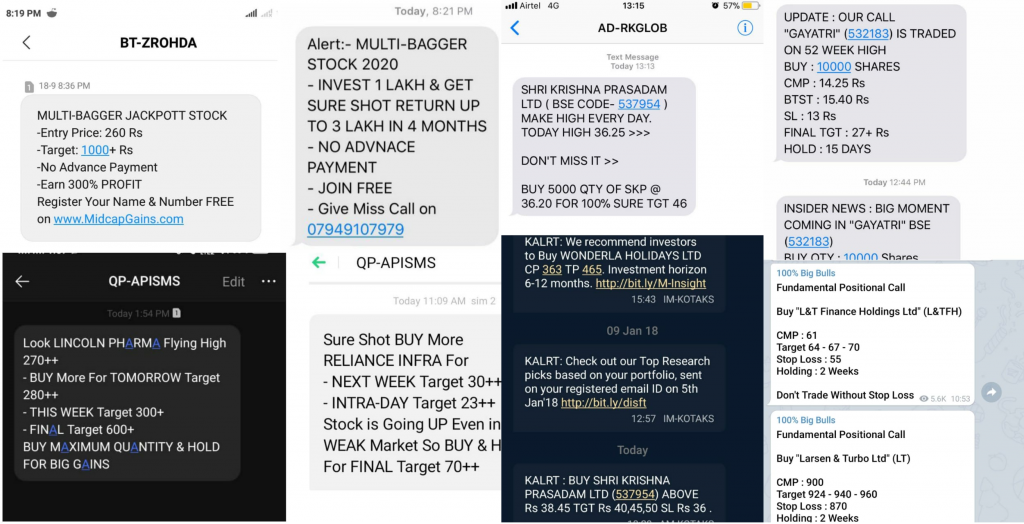
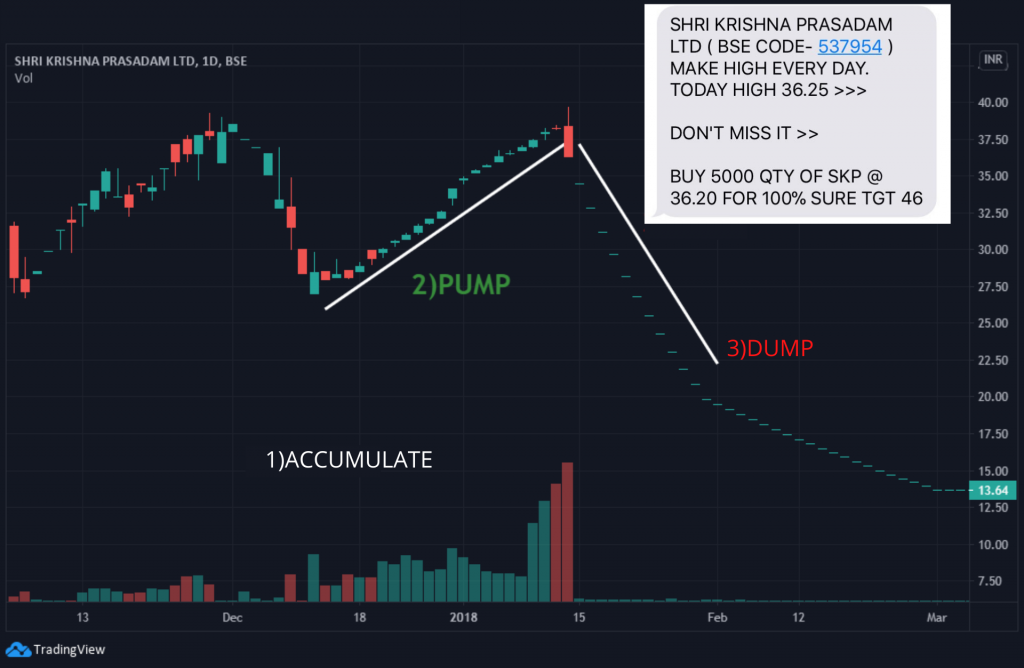
There is a scam going around in the stock market, for almost a decade. Both new and old investors have fallen prey to it. The regulators are trying to find a way around it, but have failed to do so. The scam we are talking about is a ‘Pump and Dump’ scheme that finds its way around through Telegram channels, WhatsApp Groups, and Text Messages. They come in many forms. Chances are you might have come across such ‘unsolicited’ stock market tip messages as given below.

In this scam, the market manipulators or ‘operators’, pump the price of a particular stock by sending stock market tips to traders and investors through bulk text messages and other social media handles. Firstly, The operators buy a certain stock in bulk beforehand, for a cheap price. Secondly, the operators focus on once particular stock and continue sending bulk messages for a week or two. Considering the high returns that these stock tips promise, some investors fall prey to it and buy these illiquid stocks. The buying spree continues, till the operators book profit and SURPRISE!, the price of the stocks comes down tumbling. Many newbies as well as seasoned investors have lost lakhs to these schemes.

How do I Recognize If a Stock Tip is Fake?

  • Firstly, these stocks tips are generally for penny stocks often marketed as ‘MULTIBAGGER!’. The ones which you have never heard of, or ones that exist only on paper. They have no website. No annual or quarterly results. These stocks offer extremely ambitious returns and have stop-losses that have no chances of triggering.
  • Secondly, these are generally from commercial numbers, which are spelled or sound like the names of famous brokerage firms or banks, for example- BT-ZRODHA, VT-KOTKB, etc. Moreover, the operators put a genuine link at the end of some messages. This makes the reader less suspicious of the message or stock tip.
  • Thirdly, many firms that give such advice are registered with SEBI as RIA(Registered Investment Advisors), this gives them a license to give sham recommendations. Do not fall prey to their registration, they are not difficult to come by.
  • Most of these messages are ‘unsolicited’ or ones that you never signed up for. The operators send these text messages to the ones who might have just opened a Demat account. Recently, due to action by TRAI and SEBI, the operators have switched to platforms like Telegram or WhatsApp. This makes it difficult for TRAI or SEBI to regulate the messages, giving them certain anonymity.

The Indore Connection

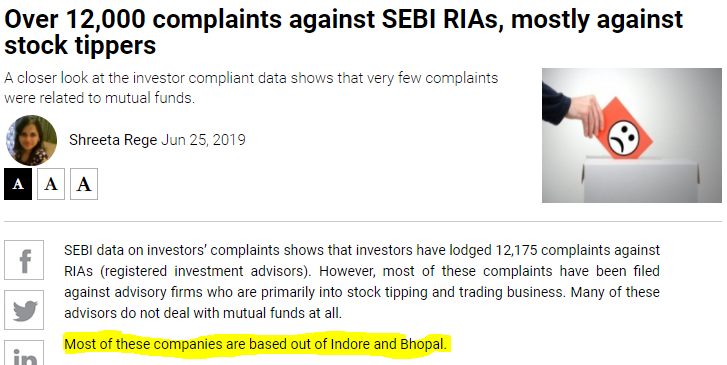
marketfeed accessed the registration of many such firms that provide these ‘SMS Stock Tips’. Most of these companies do not have an established corporate presence online. What was noticed was that most of these companies were registered in one city, Indore, Madhya Pradesh.

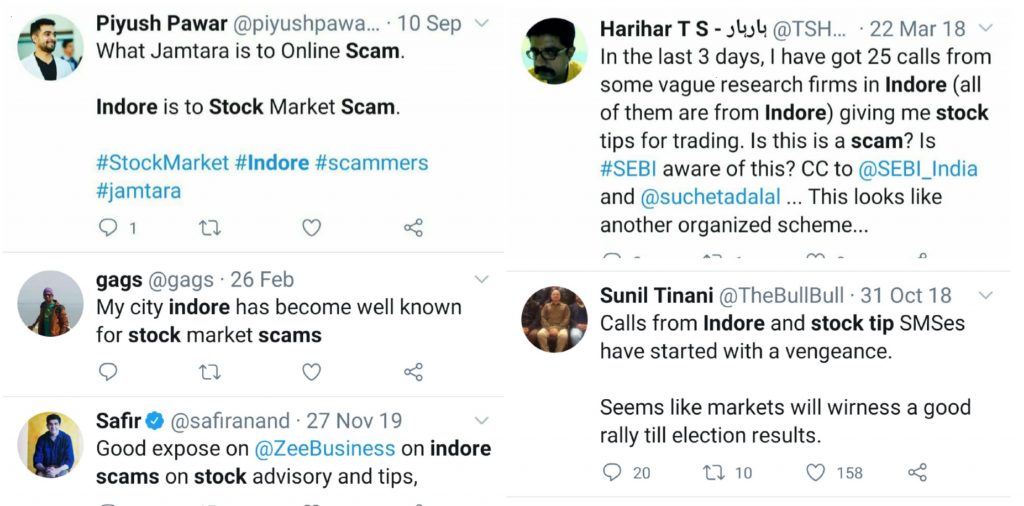
Many users have claimed to have gotten calls from Indore, asking them to invest in a certain stock and get very high returns. The stock market scam is now being related to the city as the ‘Indore Stock Tips Scam’.

Most of these scams are based out of Indore.

Many such companies have been probed and banned by SEBI in the past. These companies would charge huge amounts as fees, running into lakhs, use this money to pump the markets, and then give a part of profits to the client as well. Sometimes the clients wouldn’t get their part of the profit and even end up losing money.

The scam is an open house, anyone can join, anyone can leave. There is no one particular entity controlling it. There are many bulk SMS providers that are available online which anybody can make use of.

Scandal and Candle

Sri Krishna Prasadam was one such stock that was operated around December 2017 and January 2018. As you can see that there is a bulk purchase in the ‘ACCUMULATE’ phase. The companies then start sending bulk SMS messages and pump the stock. Soon enough, the companies DUMP and book profits as seen in the chart given below. The volume bar given at the bottom of the chart shows the volume traded on a particular date. Sri Krishna Prasadam was restricted from trading by BSE for failing to file the necessary paperwork. 

Pump and Dump Scheme in Sri Krishna Prasadam

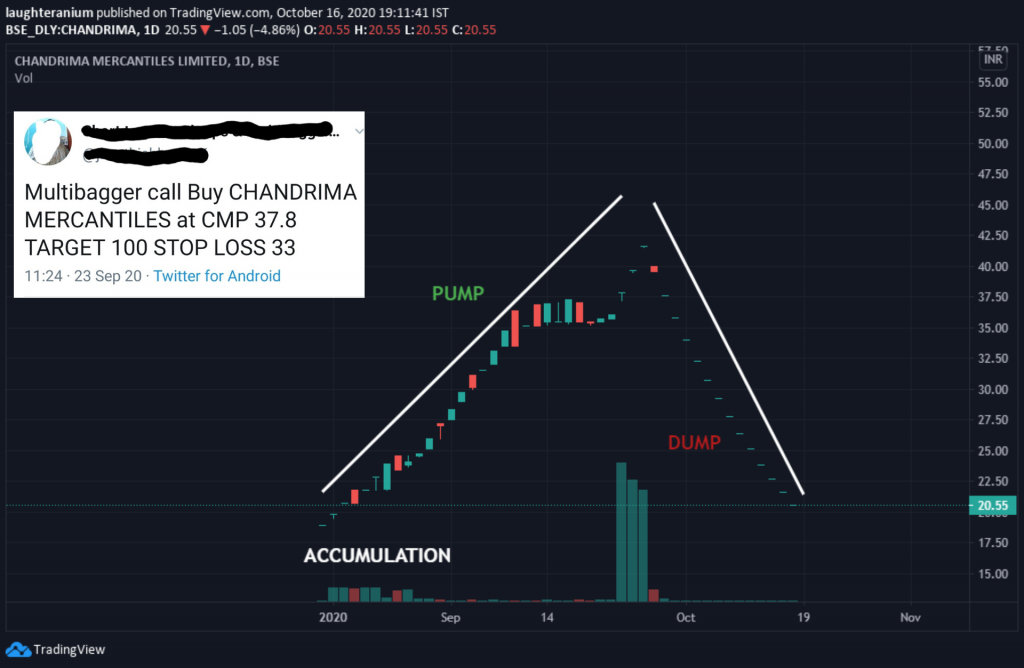
A recent case of the scam was Chandrima Mercantiles. It was manipulated throughout August-September 2020. it is evident that the operators acquired their stock during the ‘ACCUMULATION’ phase. What followed was a ‘Pump and Dump’ activity as evident from the chart.

Chandrima Mercantiles was manipulated throughout September. 

Mid caps, small caps, genuine companies, and shell companies, all have been part of the SMS Stock Tip Scams. Some have knowingly and some have unknowingly been a part of it.

What are Regulators Doing About it?

  • The scam increased a lot during the COVID-19 lockdown, since more and more new players, who had no idea of the stock market started trading and investing.
  • SEBI, NSE, BSE, TRAI, and market participants are trying their best to combat the scam.
    • Report Unsolicited Messages here
    • Watchlist for Unsolicited Messages here
    • Resources on Illicit Stock Tips by Zerodha here
    • List of Stocks with Unsolicited Messages by Zerodha here
  • If at all a stock is noticed by regulators for circulation of unsolicited stock tips, it gets restricted from trading till it meets certain liquidity and regulatory requirements.

The scam has been around for a decade, regulators have failed to curb it. We can even see such low volume stocks being suggested by many ‘SEBI-registered’ Telegram groups. Both seasoned, as well as amateur traders, have fallen prey to it. It could have been lack of knowledge, it could have been greed, it could have been that some joined the bandwagon thinking that other ‘fools’ might invest in the ‘Pump and Dump’ scheme. Whatever the reason might be, an investor should always research before investing in a stock, it is advised that one defers from taking decisions based on these stock tips. As we say at marketfeed: stay invested, stay safe.

Categories
Editorial

Flipkart – Aditya Birla Fashion Deal. Future of Indian Retail Getting Re-written?

About Aditya Birla Fashion & Retail Limited 

Mumbai-headquartered Aditya Birla Fashion & Retail Limited (ABFRL) is an Indian clothing retail chain. ABFRL emerged after the consolidation of two businesses in 2005. These two businesses were Pantaloons Fashion and Retail (PFRL) and Madura Fashion & Lifestyle (MFL).

The company has 3,000+ brand stores and 25,000 multi-brand outlets all over the country. They span around a retail space of 8.1 million sq.ft. Big apparel names like Allen Solly, Louis Philipe, Peter England, Forever 21, Pantaloons, Ted Baker, Ralph Lauren, and Van Heusen are part of ABFRL’s brands. These are some of the most desirable brands for upper-middle-class families in our country!

Source: ABFRL’s Quarter Report

Based on Market Capitalization, ABFRL is the leading company Retail sector (Industry: Textiles-Products) with a market cap of Rs 13,720.05 crore. It is well ahead of its listed competitors Future Lifestyle Fashion Limited and Shoppers Stop.

Focussing on the deal

Aditya Birla Fashion & Retail Limited announced on Friday that the company is raising Rs 1,500 crore from Flipkart Group. Walmart-owned Flipkart will buy a 7.8% stake in Aditya Birla Fashion for Rs 1,500 crore at Rs 205 per share. The promoters will be left with a 55.13% stake in the company after the completion of the issuance, which is a respectable number.

The rumours of Flipkart buying a minority stake in the retail company started surfacing earlier. On Friday morning, the company’s board approved the issuance of equity shares on a preferential basis to Flipkart Investments Private Limited. You can refer to the press release from ABFRL here. This news was taken positively by the market participants. ABFRL’s share price rose by 7.59% to close at Rs 165.05. The stock hit an intraday high of Rs 178.80.

Aditya Birla Fashion & Retail plans to invest this capital to strengthen its balance sheet and accelerate its growth in the apparel segment. This deal reflects how well the apparel industry of the country is expected to do in the near future.

According to Kumar Mangalam Birla, Chairman of Aditya Birla Group, the apparel industry in India will touch $100bn in the next 5 years. With the rise in disposable income of the middle class, people are aspiring to wear clothes from famous brands. Companies in the sector are also following different digital transformation strategies. They believe that the future would comprise both online and offline sales. Thus, the company needs to transform digitally as well.

Covid-19 slowing the business

The business of manufacturing and retailing of branded apparel suffered massively during the lockdown. Aditya Birla Fashion & Retail reported a revenue of Rs 323 crore in Q1FY20. This was 85% below of Rs 2,065 crore they reported in the same quarter the previous year. The company reported a net loss of Rs 410 crore as compared to Rs 21 crore profits they declared in June 2019. Due to poor earnings, their EPS also dropped into negative.

Even though the company reported disappointing first-quarter results, they are expected to bounce back in Q3. As the lockdowns are getting eased, people are returning to the shops as they start to return to offices. Also, Diwali, Navaratri, and Dussehra are just around the corner. The company is optimistic about its sales during this festive season. This cash infusion will help ABFRL revive its business post Covid-19.

A win for both the parties?

Flipkart will benefit from this deal by strengthening the range of brands offered on its e-commerce platforms. It acquired Myntra in 2014 in a deal valued at Rs 2,000 crore. Getting international and domestic brands associated with ABFRL on its platforms will attract more customers to the company. Also, they are getting this deal at Rs 205 per share. This is at a discount as ABFRL was trading above Rs 250 during February 2020. Due to the COVID-19, the company’s share tumbled to Rs 102 in May.

But yes, compared to Flipkart is paying more than the current market price of the stock. So what is the catch? It is that Flipkart gets pre-emptive rights, or the right to buy additional shares from ABFRL before the general public for a period of 1-5 years. That means there is a chance of Flipkart increasing their stake in the future.

Kalyan Krishnamurthy, CEO, Flipkart Group said: “Through this transaction with ABFRL, we will work towards making available a wide range of products for fashion-conscious consumers across different retail formats across the country.”

Covid has forced the ABFRL to relook at their business. Engaging with e-commerce platforms will make them less vulnerable during these times and also help them save rental or other asset-heavy costs. Rather than fighting against the growing prominence of online retail, the decision to collaborate with them makes more sense.

The coming together of two large fashion houses will help them to make use of synergies in manufacturing and supply chain. It will help them to get more customers to derive more sales. Due to synergies in business, the cost of operations will also decrease. Thus, boosting both, the profits and revenue in the long run. According to market analysts, this deal will aid ABFRL to receive the most favoured status on Flipkart’s website.

Hopefully, the brands will refrain from offering their premium products at huge discounts, as Flipkart is notoriously known for doing this. This will decrease the ‘premium’ appeal of the brands of Aditya Birla Fashion like Van Heusen and Louis Philippe.

This new deal does give birth to positive sentiments about the apparel industry but to what extent Flipkart will be able to help ABFRL recover their lost business will be a thing to watch. Either way, ABFRL will surely appreciate this new capital along with the possibility of improved sales. Flipkart is also seeking to brand itself as “India’s Fashion Capital” and ABFRL will help them tackle the premium clients.

Categories
Editorial

Reliance to exit Oil & Gas Industry in Near Future?

The Story

Recently, Mukesh Ambani was spotted speaking to economist and business journalist Omkar Goswami during a book launch event. In the conversation, the chairman of Reliance Industries revealed he is working towards these three things:

  1. Transforming India into a digital society.
  2. Transforming the education sector in India.
  3. To move India away from fossil fuels to renewable energy.

We have seen Reliance already putting a lot of efforts in the digital transformation of India. We did a separate write-up Reliance Jio: The driving force behind India’s digital transformation“. Here, you can read how the company has built itself as one of the leaders of digital change in the country.

Coming back to the interview, the point which surprised us was the thought process of Mukesh Ambani to aid India in shifting from fossil fuels to renewable energy. He said “the third thing that we are working towards is really the transformation of energy. And we think again that the world is right and India is in the right mindset to completely, in the next few decades, move away from fossil fuels to completely renewable energy.”

The core business of Reliance is oil. They came to the global map with unimaginable success in the oil & gas industry. Oil and hydrocarbon are two of the primary fossil fuels. So if Reliance wants to drive the change to renewable energy, doesn’t it counters their own business? What does this statement really signal?

Reliance has grown exponentially this year. They have expanded and received several investments from foreign firms. During the last few months, Nifty 50 rallied mostly due to the heavy presence of Reliance. But all the developments have come either in the Jio front or in the retail domain of Reliance. Its oil & gas business has not expanded much. In fact, a deal with Saudi Aramco in the oil & gas business is pending even after one year of announcement. This situation is completely opposite to what they are facing in different business verticals like telecom and retail, where investors are waiting in line to throw money at Reliance. 

How has the business’ numbers changed?

Reliance has operated in several spaces since their inception. From trading yarn to oil to telecom and now to digital transformation and retail segment. One of the key aspects of any business is how they adapt to the changing times. Reliance is a perfect example of how a company should evolve with the market. “Data is the new oil”.  We are sure that you have heard this several times in the last few years. It seems like Reliance would accept this literally and think of moving their business line in the future. 

The numbers show a downtrend in the oil & gas business for Reliance in the last four years. Also, it shows massive growth in retail and Jio segment. The table below shows the revenue contribution from the different segments in the last four years. 

2017201820192020
Refining63.7%56.4%50.9%47.8%
Petrochemicals23.5%23.1%22.3%17.9%
Crude Petroleum2.7%2.3%2.9%5.2%
Digital Services0.2%4.4%6.3%8.4%
Organized Retail8.6%12.8%16.9%20.1%
(Segment-wise Revenue Contribution)

The table shows how the revenue contribution from the refining and petrochemicals segment has been falling. At the same time, digital services and retail has been on a continuous uptrend. The Compounded Annual Growth Rate, CAGR, (2017-20) for the digital services segments, which stands at 226%, beats all other four segments. It is followed by Organised Retail (49%), petrochemicals (11.9%) and refining (11.4%).

We find a similar pattern when we compare the profits from the oil & gas business with other business. From 2017 to 2020, the profit contribution of the refining segment has been halved from 65% to 30%. Profit generated from petrochemicals has remained constant at around 35%. Contrary to them, organised retail and digital services has jointly contributed more than 30% of the profits in 2020. This percentage was even below 2% in 2017.

No long-love for fossil fuels

Crude oil, hydrocarbon, natural gas or other fossil fuels are limited in nature. Earth does have them in abundance quantity but the rate of its depletion has been very rapid in recent years. In future, there will be a time when oil becomes a scarcity. How would the oil firms conduct exploration then?

The main work of an exploration & production (E&P) company in the oil & gas industry is to search and extract oil and gas. This requires heavy machinery and very high use of technology. Thus, it is no surprise that the companies working in this industry are highly leveraged.

Reliance’s primary work is not in the E&P horizontal (or the upstream segment) but in the downstream segment (Refining and marketing). But if the E&P companies find the level of oil in the surface very low, they won’t be able to sustain their cash inflows. If the E&P companies fail to find oil, how will the Refining and Marketing (R&M) companies like Reliance survive in the long-run?

Again, this is not something which will happen in the next 2-5 years. But, there are high chances of depletion of fossil fuels in the long-run (10-30 years). When this happens, what is left for the core business of Reliance? 

Decreasing oil portfolio

Currently, the company holds two shale gas joint-ventures with Ensign Natural Resources and Chevron. Three years back they exited two oil blocks it held in Myanmar. In 2016, they exited their Peru’s oil and gas block. These move to sell off blocks signalled their aspiration to leave the upstream segment and rely more on the downstream segment.

At one time, the company had 42 oil & gas blocks domestically. Currently, they hold only 5 of these domestic oil & gas blocks. Also, only two of these blocks are fully owned by the company. BP holds almost 33% of the stake in each of the remaining three domestic blocks.

Leading the change

Not once, but many times, Reliance has voiced their desire to lead India’s change to renewable energy. According to Mukesh Ambani, “Energy is an essential requirement for all 8 billion people on this earth. There is a need to provide efficient, clean, affordable energy. And we have to do it in a responsible way. That’s the business. We should not confuse that between clean and unclean.”

India has pledged to decrease the emissions concentration of its GDP by 33%-35% by 2030 from the levels of 2005. On those lines, Reliance also declared its plans to become net-carbon zero by 2035. The government of India also wish to double their consumption of renewable energy to 20% by 2025. Transforming the energy business of the country will give new growth opportunity to the company.

It is also crucial to mention that entering into renewable energy business does not mean leaving fossil fuels instantly. The use of fossil fuels can be decreased by huge amounts but completely replacing them is not possible. So does Reliance wants to lead the fight in both the domains? Or they want to leave one for another? This is something we have to wait and watch in the next two years. But surely, India is geared for a big change in the renewable energy sector and Reliance could be a very big part of that. Until, next time.

Categories
Editorial

‘India’s Own Car Manufacturer’ who is Owned by a Japanese Company – Maruti Suzuki

At some point in our lives, all of us would have had a deep connection with a Maruti Suzuki car. It may have been the very first car in your family. Or, it may have been the one in which you learned how to drive. The growth of this company, from its very origin, is truly a very interesting one. Let us dive deep into its history, and see how it has achieved more than 50% of the market share in India’s automobile sector., as of 2020.

  1. The Golden Days of Maruti
  2. Fast Paced Growth
  3. Entry in to the Stock Market
  4. Suzuki: Showing its Strength
  5. Future Plans

The (G)olden Days of Maruti

During the 1970s and 1980s, there was a very high demand for affordable passenger vehicles amongst middle-class families in India. The number of choices for buying cars was limited to the very famous Hindustan Ambassador and Premier Padmini. Both of these vehicles were not really affordable during those times. The Government of India wanted to address these concerns, and came up with a very promising solution in the form of a new company- Maruti Motors Limited. The incorporation of the automobile company was in June 1971.

Sanjay Gandhi (son of Indira Gandhi) was appointed as the Managing Director of Maruti Motors Limited. Under his leadership, the company did not achieve the launch it deserved. There were allegations of favouring family members and corruption against the new MD. He also did not provide the necessary support and guidance to launch projects. In 1977, the company had to be liquidated, which meant that the firm’s assets were converted into cash to pay off investors or any outside liabilities.

After the sudden death of Sanjay Gandhi in 1980, the Government was looking to collaborate with a major automobile manufacturing company to kickstart its production activities. In order to rescue their image, the Government of India founded Maruti Udyog Limited on 24 February 1981. Around the same time, Suzuki, a Japanese company, saw this as an opportunity to broaden its presence in other countries. In 1982, a license and joint venture agreement (JVA) was signed between Maruti Udyog Limited and Suzuki. Within a few months of their joint venture, production of “The People’s Car” – Maruti 800 had begun. As most know, this car laid the foundation for the growth of Maruti Suzuki India Limited.

Fun fact: According to various sources, Suzuki had not considered partnering with Maruti initially. While on a domestic flight in India, one of the senior directors of Suzuki read an article on a possible tie-up between Daihatsu (another Japanese automobile company) and Maruti. Soon after this, Suzuki immediately bought a stake in Maruti Udyog Ltd.

Fast-paced Growth

By 1988, the company established a new manufacturing plant at Gurgaon, where they could manufacture 1 lakh units every year. Maruti also started exporting its cars to the western markets. Their first export included 500 cars that were sent to Hungary.

When the collaboration had just begun, Suzuki was only a minor partner. In 1992, after the liberalization of the Indian economy, Suzuki increased its stake in Maruti to 50%. The company went on to manufacture back-to-back hits such as the Omni, Zen, Esteem, and most importantly, Alto. The company was able to manufacture these cars with improved Japanese technology, and ultimately sell it at very affordable prices in the Indian market. They also gave immense importance to servicing vehicles, and was one of the first car companies in India to launch dedicated customer service activities. Maruti Insurance and Maruti Finance are two of their subsidiaries launched in 2002, in order to provide a boost to car financing options.

Fun fact: Maruti requires more than 2,40,000 tonnes of steel every year for manufacturing its cars. It has been estimated that 32 Eiffel Towers could be constructed with that amount of steel.

Entry Into The Share Market

In 2003, the company decided to get listed on the stock exchanges. The Government sold off a 25% stake in Maruti Suzuki (it was still known as Maruti Udyog Limited then) at Rs 125 per share. The initial public offering (IPO) was oversubscribed almost 4.19 times within 2 days. The stock made its debut on 9th July 2003 and started trading at Rs 164 levels. The Government received Rs 993 crore for its sale of 25% in the company, which is peanuts compared to the valuation of the car-maker now.

By 2014, through the introduction of many more cars in various segments, Maruti Suzuki had a market share of 45% in India. The company’s Driving School units, as well as its used car sales units (True Value), have also become a huge hit. Maruti Suzuki also launched NEXA in 2015, a new dealership network for its premium cars (Baleno, S-Cross, Ciaz, etc). 

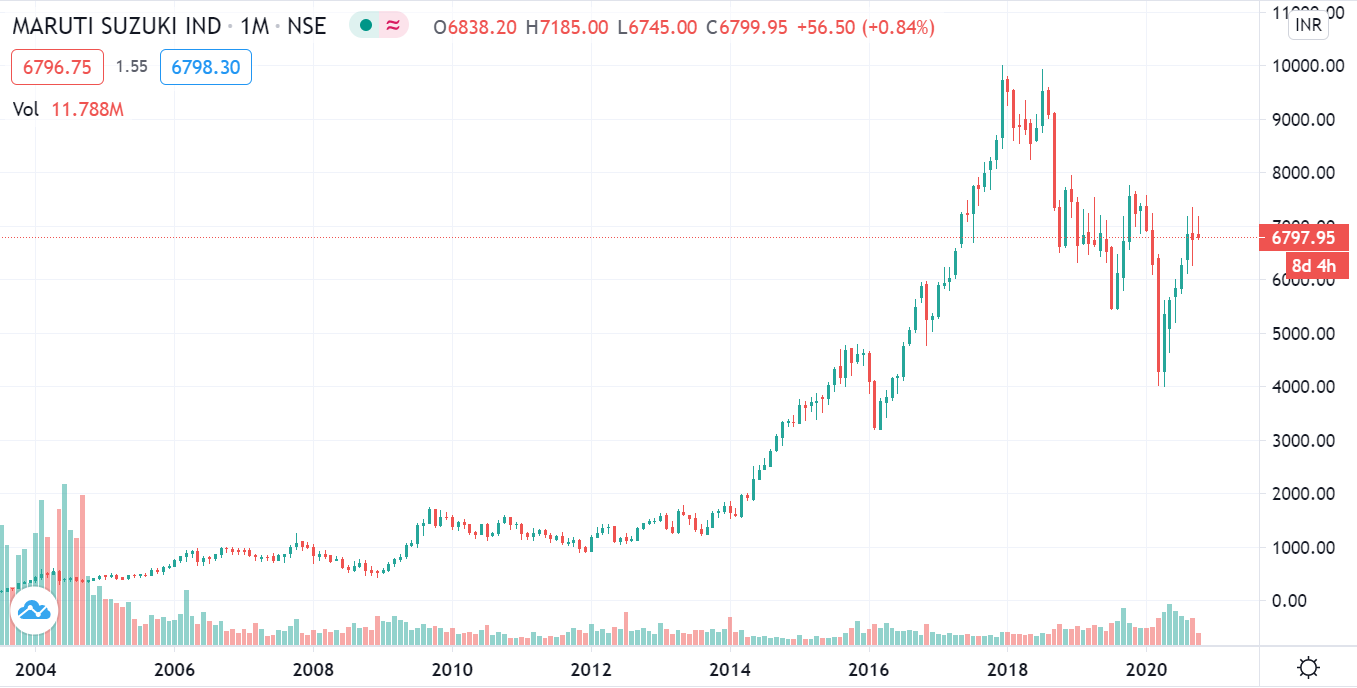
In 2017, people who had held onto their Maruti Suzuki stock since its entry into the NSE and BSE had received an overwhelming 7,900% return. The share prices crossed Rs 10,000 in intraday levels in December 2017. It became one of the top 5 companies in India, in terms of the highest market capitalization. Market capitalization is calculated as the total number of shares multiplied by its corresponding share price.

Suzuki: Showing its Strength

In March 2020, Suzuki increased its stake in Maruti to 56.21%, therefore having a majority in the company. And recently, in September, Suzuki purchased an additional 2,84,322 shares, thereby increasing the stake to 56.37%. It should be noted that Suzuki never changed the Maruti brand name, even after holding more than 56% in the company. They realized the value of how Indian customers had a deep relationship with their cars. Moreover, ‘Maruti’ was a company that had established the foundation for the automobile sector in our country. 

We can attribute the growth of their company to a major boom in the consumption of passenger vehicles in India. Analysts have stated that competitors in the automobile industry have not been able to match up to what Maruti Suzuki has offered throughout the years. They have superior manufacturing capabilities, and the ability to cover almost every single aspect related to car sales. The firm reported a 30.8% increase in total sales at Rs 1.6 lakh units in September 2020. Between April and September, they have sold a total of 4.6 lakh units.

The company is facing rising pressure from foreign manufacturers in its top-end car segment. As of 16th October 2020, the share price of Maruti Suzuki has been trading at Rs 6894.90. The Q2 results are set to be released on 29th October 2020.

Future Plans

Car subscription plans are considered to have a huge potential market in India. People might require cars for a certain period of time, but not necessarily be in a position to buy them.  

In September 2020, Maruti Suzuki India announced the launch of its new vehicle subscription program for individuals – Maruti Suzuki Subscribe. This new program allows customers to use a Maruti Suzuki vehicle without actually owning it. Instead, they would have to pay an all-inclusive monthly fee, that would cover insurance, maintenance, and roadside assistance. Customers will be able to choose a duration ranging from 12-48 months. The program has been introduced currently in Delhi, Bengaluru, and the National Capital Region of Noida, Ghaziabad, Gurugram. Is this the future of the car industry in India?

You may have also noticed that only the letter ‘S’ is on the logo of all Maruti Suzuki cars that are being sold now. We have begun to notice that the brand name ‘Maruti’ is slowly and gradually being removed from their cars. Since Suzuki does have a 56% stake in the company, they would want to make its brand more recognizable in India. Only time will tell if these changes would be welcomed by the Indian customers.

Maruti Suzuki India has dominated the automobile sector for years now. In a space where competition is high, the company has been able to initiate schemes to address the needs of every type of customer. With such a high market share in India, we can understand that Maruti Suzuki Limited has major plans to deliver the best, and ensure they remain at the top. 

Categories
Editorial

Who is Murari Lal Jalan, the Mystery Man in Jet Airways Revival Plan?

On 17th October, the partnership consisting of Kalrock Capital and Murari Lal Jalan won the bid to revive Jet Airways. The troubled airline will finally be able to fly the skies again after more than a year, by initially kickstarting domestic flights. However, this will have to wait, as all the required formalities have to be completed. That aside, we believe that the name Murari Lal Jalan is one that none of us have heard before. Let us understand what this random stranger does, and why he plans to enter the airline industry.

The Mystery Man

According to many in the business world, Murari Lal Jalan is a very mysterious man. There is not much information about how he was able to create all his wealth. He has always kept a very low profile, and is not popular among the business communities in India or abroad. Totally inexperienced in the field, he has confused a lot of people as to how he was able to enter into the airline industry. Let us look at some of the facts which we know are for certain: 

In the 1980s, Murari Lal Jalan began his career by entering into the paper industry. He started working at his family’s paper trading business in Kolkata. He also worked as a trader for JK Paper and Ballarpur Industries, which were once big paper manufacturing companies. In 2003, he wanted to expand his paper business, and thus, acquired Kolkata-based Kanoi Paper and Industries. He renamed the company to Agio Paper, and currently has a manufacturing facility in Bilaspur (Chattisgarh). However, In 2010, the paper company faced a lawsuit from government agencies, for pollution-related issues. The production activities of Agio Paper have been suspended since then. So almost his whole career, his focus was on the paper industry and even that did not end well either.

After his paper company received backlash, Jalan began plans to enter the real estate and healthcare sector. In 2015, he approached Dr. Naresh Trehan and Associates Health Services. He went on to acquire a stake in the company for Rs 75 crore, through a secondary share sale transaction. A secondary sale means that Jalan bought-out the shares from an existing stockholder. Around the same time as the acquisition, Dr. Trehan’s Medanta Hospital had plans to establish a hospital in Dubai, with the help of Jalan. Unfortunately, this plan was not implemented.

Jalan kept going and began to secure his vision of entering into more businesses. Once he moved his base to the UAE, he quickly expanded to sectors such as real estate, mining, fast-moving consumer goods, and construction. He was chairman of the Agio Image group, which sold and distributed photographic and consumer products of well-known companies such as Sony, Panasonic, and Konica.

He established the real estate development company, MJ Developers. The firm has its headquarters in Dubai, but its main businesses span over countries such as Russia, Brazil, and India. MJ Developers is currently engaged in developing residential and commercial properties in Uzbekistan. Jalan is also contributing to the development of the city of Namangan (in Uzbekistan), which has been termed as a land of investment opportunity in pharmaceuticals, the health sector, automobile, and information technology. Various reports state that he was able to improve his business position through these projects in Uzbekistan. In fact, if you search his name on Google, many shady self-praising articles from Uzbekistan will show up.

It is also interesting to know that Jalan had partnered with his own family relatives to set up Patanjali India Distribution Ltd. Certain documents from the Indian Ministry of Corporate Affairs state that this company would be involved in trading, export, distribution, and marketing of milk products and health foods. The list of products also included herbal medicines and ayurvedic cosmetic items. Regardless of these claims, the company never opened, and the founders never looked back on it. We do know that Patanjali Ayurved is owned by the yoga guru, Baba Ramdev. However, it is not clear whether the two companies are linked in some way.

Entry into Airline Industry

At a time when most airline companies are going through huge losses due to the Covid-19 pandemic, we see that Kalrock Group and Murari Lal Jalan have plans to revive a very troubled airline- Jet Airways. You can read more about why the airline company failed here. Some may question as to why there was a sudden need for Jalan to enter into this field. Many have suspicions whether this deal would really help the airline to bring back its former glory.

Through the bid to revive Jet Airways, it would be the first time that Jalan starts his venture into the airline industry.  “Jet Airways is a renowned Indian aviation company with a strong legacy. The aviation sector underwent substantial correction on account of Covid-19 and created an opportune time to enter the sector. Our vision for Jet Airways is to operate the carrier as a full-service airline, both domestic and international”, he declared in a statement. The point to be noted here is that Jalan has no expertise in this particular sector. However, the management team of Kalrock does have the essential experience from cargo and logistics management through past deals. They have big plans to take Jet Airways to new heights.

Now, we know that Murari Lal Jalan has always been interested in entering into multiple business sectors. His latest entry into the aviation or airline industry can be analysed as part of his plan to speed up the expansion of his empire. The proverb ‘don’t put all your eggs in one basket’  can clearly be attributed to him. 

But now, a major doubt remains to be answered – how was Jalan able to create all this wealth and expand his business to such a large magnitude? We have seen that his initial business in the paper manufacturing industry had failed. Also, when Jalan moved to the UAE, he was not able to contribute effectively towards the implementation of projects in the healthcare sector. He created a company in India that was never launched. Moreover, the fact that most business people don’t know about him, makes everything all the more suspicious. All these facts make us feel very unsure and doubtful about his new deal with Jet Airways. Let us wait and watch for the results of this revival plan.