Categories
Editorial

A Deep Dive Into Relaxo Footwear Ltd

The footwear industry in India contributes nearly 2% to India’s overall GDP. It employs over 25 lakh workers, making the sector one of the top employment generators in our country. It is also an engine of growth for the entire Indian leather industry. 

India is only behind China as the largest producer of footwear globally, with 9% of the annual global production of 22 billion pairs. As per Invest India, India’s contribution to global footwear production is 10.7%. Nearly 90% of the footwear produced in India is consumed by the domestic market, and the rest is exported. The revenue in the footwear market in India stood at $23.73 billion in 2022, and the market is estimated to grow annually at a 6.77% CAGR between 2022-2027.

Having said that, let’s talk of an iconic brand synonymous with rubber slippers. It offers some of the most versatile footwear for all segments of society and reflects the attitude, style, dynamism, and spirit of young India. Yes, you guessed it right: it’s none other than Relaxo!

In today’s article, we throw light on how Relaxo monopolised the footwear industry in India and how it remains a trademark brand for most Indian households. 

Relaxo’s Origin Story

In the 1970s, two brothers, Mukand Lal Dua and Ramesh Kumar Dua, aspired to grow their father’s footwear business. With an initial deposit of ₹10,000, they established the venture in Delhi and gave birth to what Relaxo is today— one of the largest and most popular footwear manufacturers in India.

Relaxo initially manufactured both footwear and cycle components. However, it discarded the second segment in 1976 and decided to concentrate solely on footwear. Its most popular brands— Relaxo, Sparx, Flite & Bahamas are a leader in their respective categories. Relaxo’s range of footwear boasts a fine combination of comfort, style, and quality workmanship. The company offers a wide collection of fashionable, colorful, comfortable, and durable footwear. They have products for every age group and more than 6,000 Stock Keeping Units (SKUs).

With eight manufacturing units, Relaxo has the capacity to produce over 7.25 lakh pairs of footwear every day! It has a pan-India distribution footprint and a network of more than 50,500 stores. The company operates 50,000 multi-brand outlets (MBOs), and 402 exclusive brand outlets (EBOs). The company exports its products primarily to China and Sri Lanka.

Financial Performance

Over the years, Relaxo has consistently performed in a superior way. Even though Covid-19 restrictions severely impacted the sales of most footwear companies, Relaxo’s sales declined by just 2.13%. The company sold around 19 crore pairs in FY21! Coming to most recent figures, it sold 3.9 crore pairs in Q2 FY23, down from 4.6 crore pairs sold in Q2 FY22.

Relaxo’s sales have expanded remarkably faster than those of its competitors in terms of CAGR. The 3-year and 5-year sales CAGR growth of Relaxo Footwears was 6.7% and 6.6%, respectively. Meanwhile, CAGR sales growth was in the range of 1-3% for competitors Mirza International and Khadim India. Even in the past three years, Bata India, Liberty Shoes, and Sreeleather’s sales growth had fallen to negative double digits.

Relaxo Footwears has also posted healthy double-digit margins over the years, while other footwear manufacturers have struggled in maintaining healthy and constant EBITDA margins. 
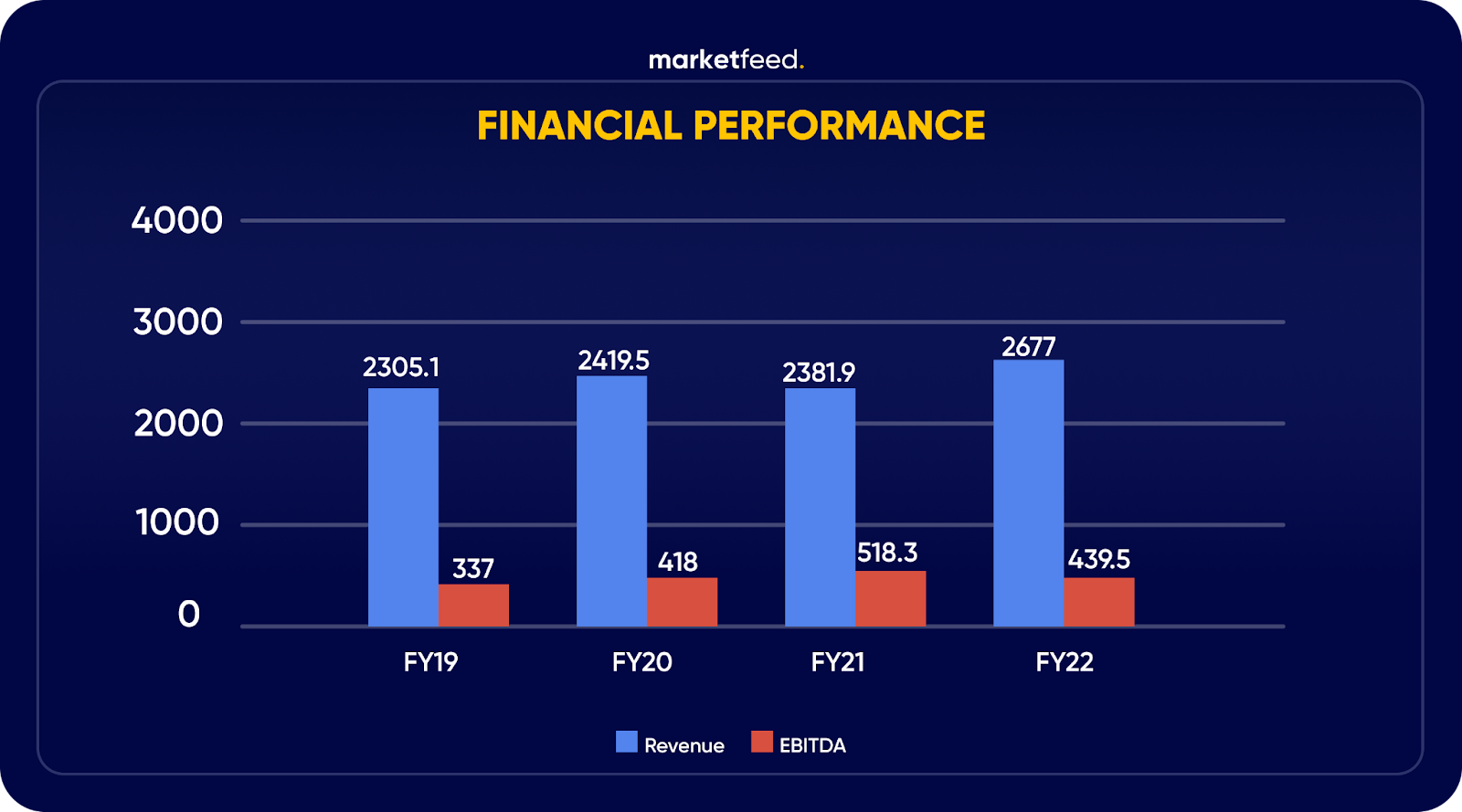
In the quarter ended Sept (Q2 FY23), revenue stood at ₹670 crore, compared to ₹714 crore in Q2 FY22. There was a decline in volumes of categories serving the mass segment, which was experiencing inflationary pressures with reduced affordability. EBITDA stood at ₹59 crore as compared to ₹117 crore in the corresponding period of the previous year. EBITDA was under pressure due to high raw material prices.

Peer Analysis 

Apart from organised and unorganised players, the market is now seeing listed players such as Metro Brands Ltd., Bata India, and Mirza International.

Regardless of high competition, Relaxo Footwears is able to maintain both quality and reasonable pricing. The organisation can sustain high profits because of a persistent focus on healthy margins, operational optimization, and capacity utilisation. This isn’t necessarily true for its competitors that utilise an asset-light model or a hybrid approach that combines asset-light and in-house manufacturing. Due to its substantial dependence on outside manufacturers, Relaxo had an advantage during the Covid-19 disruptions, while others were more negatively affected.

The Challenges

  • Intense competition: In addition to developed and developing competitors, the market also includes unlisted competitors. We can anticipate initial public offerings from these firms in the upcoming months/years. In this circumstance, Relaxo can experience price undercutting, which might impact its profitability and margins.
  • Volatility in Commodity Prices: The production of footwear requires several important raw materials, including ethylene vinyl acetate (EVA), polyurethane (PU), and natural and synthetic rubber. The company’s expenses are greatly impacted by the supply, volatility, and movements of prices of crude oil and its derivatives.  EVA and PU are typically imported by Relaxo for the manufacture of footwear products. As a result, the company also runs the risk of fluctuations in the exchange rate.
  • High MBO Dependency: Relaxo Footwears is highly dependent on its 50,000 MBOs or retailers. The MBOs channel is under significant liquidity stress, which might harm the company’s revenue trajectory.

The Way Ahead

The footwear industry is recognized by the Indian government as a priority sector under the Make In India mission. The Indian footwear industry expects to reach $27.84 billion by 2027, with the potential to grow 10-fold! Without a doubt, there is scope for footwear brands to flourish and strengthen leadership.

Relaxo Footwears seems to be ahead of its peers in this race. The firm has outperformed its competitors in terms of operational and capital efficiency as a result of strong internal manufacturing facilities, successful addition of higher value-added categories, and a solid distribution network. The company may benefit from these aspects in the years to come as well.

Do you think this multinational footwear manufacturer can continue to expand its market share and dominate the industry? Have you invested in Relaxo? Let us know your views in the comments section of the marketfeed app!

Categories
Editorial

Will ONDC Disrupt E-Commerce in India?

Suppose there’s a small bakery in Bengaluru that sells delicious cookies. The owner wants to take his business online, but he feels it will be extremely difficult. He’ll need to make a sizeable investment for creating an online store, inventory management, and order fulfillment. Even after all this, it’s an exhausting process to get customers online. The owner will have to spend a hefty amount for ads and believes it’s not worth the time and effort.

Sure, he could list his products on large platforms like Amazon.com and Walmart-owned Flipkart. However, these global corporations control over 60% of the e-commerce market and give preferential treatment to top sellers.

So how can the bakery owner sell his products online?

Well, he could look into the Open Network for Digital Commerce (ONDC)! And no, it’s not a separate e-commerce platform or app. In this article, let’s understand what ONDC is all about!

What is ONDC?

ONDC is a non-profit company established by our govt’s Department for Promotion of Industry & Internal Trade (DPIIT). It is a network that will allow any seller to display their products and services in search results across all apps registered in it. ONDC will have open protocols and rules for the entire chain of activities involved in the exchange of goods and services (similar to the Unified Payments Interface or UPI for payments in India). Thus, buyers and sellers can trade goods and services irrespective of the applications they use.

For instance, small and medium-sized businesses can now set up a simple website with the help of ONDC’s technology partners and list their products and services on it. And once they integrate with ONDC, their products will be easily visible to consumers on different apps and platforms! ONDC would standardise operations like time-based pricing, inventory & order management, delivery, and digital cataloging for small retailers.

On a wider scale, ONDC network is designed to facilitate any digital transaction between a buyer and seller for goods or services, including wholesale, mobility, food delivery, logistics, and travel services. It will also cover business-to-business (B2B) transactions.

We’ve all seen UPI revolutionising payment systems in India. Similarly, ONDC aims to democratise e-commerce and give small merchants or family-owned stores access to the systems and technology used by giant e-tailers like Amazon & Flipkart. ONDC is expected to increase competition in the e-commerce industry and boost startup innovation.

How Does it Work?

  • ONDC lies in the middle of the interfaces hosting the buyers and the sellers.
  • Sellers will have apps to place their products for sale and accept orders.
  • As consumers, we can use any app registered on the ONDC network to browse and buy products. 
  • The ONDC network will also have apps that broadcast the search request received from buyer-side apps to seller-side apps listed on the ONDC registry.
  • The network will be supported by logistics firms (to facilitate deliveries) and e-commerce store hosting service providers. 

For example, when you’re searching for a laptop on Paytm → The app will connect to the ONDC network → ONDC will connect it to seller-side apps that list all firms from where you can buy the item.

You will be able to download any ONDC app of your choice (similar to UPI) and use it to buy products & services from sellers that offer them.

Major Challenges

  • ONDC is a complex ecosystem to implement. E-commerce has a lot of variables involved, including the quality of the product, payments, returns, customer complaints, etc.
  • Brands that make misleading or inferior products and offer poor after-sales support may get undeserved exposure through the network. Users would find it difficult to trust new brands or platforms that integrate with ONDC.
  • It will require a massive, well-funded adoption campaign to bring in lakhs of existing Kirana stores to the ONDC network.

The Way Ahead

Since 2020, the Competition Commission of India (CCI) has been investigating the alleged anti-competitive practices of Amazon and Flipkart. As per reports, both firms promote specific sellers based on exclusive arrangements and offer them deep discounts. E-commerce giants also allegedly use data derived from users’ buying patterns to help their seller “partners” launch products.

Rather than concentrating power among a few players, ONDC will allow consumers and sellers to choose which apps they want to use to access a single network. With the ONDC network, these big online e-commerce platforms will have to compete with smaller stores, websites, and brands! ONDC expects to increase e-commerce penetration in India from 8% to 25% in the next two years. It also plans to sign up 90 crore buyers and 12 lakh sellers to the network within five years! 

ONDC has commenced trials with select buyers and sellers across major cities in India. We’ve seen numerous companies integrating with ONDC over the past few months. Microsoft, Paytm, Snapdeal, Dunzo, eSamudaay, PhonePe, SBI, HDFC Bank, ITC Store, and India Post have shown interest in joining ONDC. Even Flipkart, Reliance Retail, and Amazon are reportedly in talks to join the network! We’ll have to wait and see how well it is implemented.

What are your thoughts on ONDC? Let us know in the comments section of the marketfeed app.

Categories
Editorial

The Rise of B2B E-Commerce Startup Udaan

E-commerce marketplaces in India are witnessing a transformational boom after the pandemic. The digital transition from offline to online or e-commerce marketplaces has been a real game-changer. While business-to-consumer (B2C) firms like Amazon and Flipkart have flourished, business-to-business (B2B) e-commerce takes the lead in revenue generation due to its large order size and sheer volume.

According to a report by IndianRetailer.com, the B2B sector is witnessing a doubling of valuations every 3-4 months. It brings in an investment of more than $100 million and is expected to reach over $1 trillion by 2024

The unprecedented growth of B2B marketplaces can be credited to several startups that leveraged critical technology. These e-commerce players created a ready-to-go ecosystem to help the B2B sector grow and develop to where it is today. In today’s article, we analyse one such B2B marketplace— Udaan, and how they envisioned changing trading functions in India by merging with new-age technology.

Udaan’s Origin 

Ex-Flipkart executives Sujeet Kumar, Amod Malviya, and Vaibhav Gupta established Udaan in 2016 with a unique vision to transform merchandise trading in India. They initially registered the firm as Hiveloop Technology. 

The Bengaluru-based startup gathers and unites all producers, traders, wholesalers, and retailers under a common network. This streamlines the whole B2B procedures in the nation and allows manufacturers to display their items through the online platform. Prospective traders have the liberty to choose and purchase a variety of items. Likewise, wholesalers and retailers hold the same flexibility to promote and purchase an item. Udaan’s platform features a variety of categories, including electronics, home & kitchen supplies, stationery, toys, fruits, vegetables, and other household items

Udaan has a network of over 30 lakh registered users and 25,000-30,000 sellers across 900+ cities in India. It covers more than 12,000 pin codes. The platform has over 17 lakh retailers, chemists, Kirana shops, farmers, etc, that conduct over 4.5 million transactions per month. This makes Udaan one of the leading players in the B2B e-commerce segment

Funding and Investors 

In October 2022, Udaan raised $120 million in convertible notes and debt from shareholders and bondholders. This is despite a general decline in startup funding.

According to an internal corporate document, Udaan intends to launch an IPO in the next 12-18 months. It has raised $350 million over the last four quarters, making it one of the largest structured instrument fundraisers in the nation.

Udaan’s valuation stood at $3.1 billion in a previous funding round of $280 million in January 2021. According to industry sources, they will estimate the company’s latest valuation at the time of the IPO or during the pre-IPO funding rounds.

The startup’s existing investors include Microsoft, Lightspeed Venture Partners, M&G Prudential, Kaiser Permanente, and Nomura.

Recent Developments 

  • Udaan is booming. There are many people associated with Udaan, including traders, farmers, retailers, proprietors, restaurants, pharmacies, and street sellers. To fulfill more than half of the orders placed on its platform, it has a sizable supply chain network spread all over India. Udaan’s platform presently claims to have more than 5 lakh products.
  • Over the last year, Udaan claimed it has significantly improved its unit economics by a total of over 1000 basis points (bps) with strong improvements in both gross margins and operating costs.
  • The company has reportedly laid off 300-350 on-roll employees and a significant chunk of its contract workforce for a total layoff count of over 1,000 people. This is the second round of layoffs after it dismissed 180–200 employees (5% of its workforce) in June. With these layoffs, the startup aims to improve its efficiency and achieve profitability.
  • UdaanCapital (which helps businesses manage their accounting and get credit) enabled credit of ₹2,200 crore to over one lakh retailers.
  • The company has started delivering stocks to pharmacies four times a day across six cities. It plans to scale up the service to other places after 6-8 months. 
  • Udaan said that the gross margin percentage has gone up almost three-fold year-on-year (YoY) in FY22. The company’s revenue is now at about ₹10,000 crore for FY22, a 1.6X increase compared to FY21.

Udaan’s Key Challenges

  • Udaan’s main struggle was to find the right product and market mix. Though the company has already carved its own niche in the B2B marketplace, it is difficult to stand in its current market position.
  • The businesses listed on Udaan must focus on integrating technology and setting up intricate logistical fulfilment procedures. Convincing retailers and wholesalers to go online with their business is another challenge.
  • The execution of operations will always be a challenge, which the company has to deal with as it grows bigger.
  • Establishing a proper supply chain network is a hassle for B2B e-commerce firms like Udaan.
  • Even as well-funded firms like Flipkart Wholesale, Amazon Business, and Jiomart Partners continue to retain a presence in the sector, Elastic Run and Shop Kirana are emerging as rivals.

Udaan’s Mission

According to US-based research powerhouse  Bernstein, B2B e-commerce players like Udaan are likely to disrupt the $1 trillion consumer retail market in India.

Udaan continues to be a trusted partner to small businesses by equipping them with technology, financial inclusion, and supply chain capabilities to compete and prevail in an increasingly tech-driven world. The company will focus on using fresh capital to expand its supply chain network in India. It also aims to grow the marketplace in both new and existing categories. The founder trio believes that they are creating a better platform for small enterprises in India. They are also aiming towards generating more revenue and cutting down on their losses. [Net loss was reported to be around ₹2,482.3 crore in FY21.]

Udaan has served as a model for several other startup companies seeking to succeed in the e-commerce sector. It is one of the few companies that has occupied a dominant position in the sector in a relatively short time, making its success story rather interesting.

As Udaan’s tagline reads ‘Khole Munafe Ka Shutter’ (open the profit shutter), it will be exciting to witness how competently they achieve and stand by it. What are your views on this startup? Share your thoughts in the comments section of the marketfeed app!
Categories
Editorial

Meet the Top 5 Succesful Investors in India!

The Indian stock market has evolved into one of the most dynamic business environments, with all parties involved sharing the same hopes and aspirations. The way it operates and reaps losses & gains has always always been a site of great interest for all budding investors. In fact, the market capitalisation of all listed firms on BSE hit a new record high of ₹280.5 lakh crore this August!

With the proper strategy and tactics, a ₹10,000 investment per month can turn into a portfolio worth crores over a few years. 

The above statement might seem unbelievable or absurd, but superstar investors like Rakesh Jhunjhunwala, Vijay Kedia, and R.K. Damani have truly turned the tide and have created phenomenal fortunes from the market. 

In today’s article, we will highlight some of the most successful stock market investors in India, in addition to their overall merits and investment strategies!

Rakesh Jhunjhunwala 

  • The late Rakesh Jhunjhunwala, known as the Warren Buffet of India, was admired as a market god. He mastered the art of beating the markets consistently.
  • This billionaire business magnate started investing with merely ₹5,000 in 1985.
  • In 1999, he launched Hungama Digital Media with four other partners. As of 2021, Hungama Music and Hungama Play are available in the OTT market.
  • He held several positions of authority as the chairman and a member of the board of directors of numerous reputable firms.
  • His Titan holdings alone are valued at ₹11,000 crore as of 2022. 
  • Rakesh Jhunjhunwala & Associates (Rare Enterprises) publicly hold 30 stocks with a net worth of over ₹34,320.2 crore.
  • Jhunjhunwala invested $35 million in 2021 for a nearly 40% stake in Akasa Air. He was the co-founder of this new ultra-low-cost Indian airline. 
StocksHolding Value (in ₹ crore)Shareholding (%)
Titan Company Ltd1,3047.105.5
Star Health & Allied Insurance Company Ltd6,982.8017.4
Metro Brands Ltd3,130.5014.4
Tata Motors Ltd1,556.401.1
Crisil Ltd1,193.405.5
(Source: Trendlyne. Holdings as of Q2 FY23)

Radhakishan Damani

  • Radhakishan Shivkishan Damani is a billionaire investor hailing from Bikaner, Rajasthan. He is also the founder of Avenue Supermarts, which operates the DMart chain of supermarkets.
  • He is an astute investor in the Indian stock market with 13 stocks and a portfolio net worth running up to ₹185,782.4 crore. 
  • He manages his portfolio through his investment firm called Bright Star Investments Ltd.
  • In 2022, he was ranked the 98th richest person in the world.
  • His prudence as an investor is evident in the way his stocks have grown over the years. In the previous year, the value of his stocks increased from ₹157.65 crores to ₹322.65 crores.
  • This doubling occurred right after the Russia-Ukraine war when the Indian stock market was at its lowest point. 
  • As per Forbes, Damani has held stakes in an array of businesses, including the 156-room Radisson Blu Resort in Alibag, tobacco firm VST Industries, beer maker United Breweries, and others like India Cements, Sundaram Finance, Blue Dart, and Spencer’s Retail.
StocksHolding Value (in ₹ crore)Shareholding (%)
Avenue Supermarts Ltd1,80,592.5067.5
VST Industries Ltd1,760.4032.3
India Cements Ltd1,566.8020.8
Trent Ltd769.301.5
Sundaram Finance Ltd610.702.4
(Source: Trendlyne. Holdings as of Q2 FY23)

Mohnish Pabrai

  • An ardent follower of Warren Buffet, Mohnish Pabrai is an Indian-American investor.
  • He founded an investment firm named Pabrai Investment Funds in 1999.
  • His firm has generated a staggering 517% return till now.
  • The focus of Pabrai’s investing strategies is considered to be on low-risk, high-certainty stocks, and well-managed businesses with minimal downsides.
  • Mohnish Pabrai publicly holds 3 stocks with a net worth of over ₹1,260.3 crore.
  • With the goal of giving back to society, Monish Pabrai and his wife started the Dakshana Foundation. It helps poor students from rural and semi-urban government schools to crack competitive exams.
StocksHolding Value (in ₹ crore)Shareholding (%)
Rain Industries Ltd517.608.8
Sunteck Realty Ltd379.706.7
Edelweiss Financial Services Ltd3636.4
(Source: Trendlyne. Holdings as of Q2 FY23)

Vijay Kedia 

  • Popularly known as the “Market Master”, Vijay Kishanlal Kedia is an Indian investor hailing from Kolkata.
  • He has been in the market since he was 19 years old. 
  • The commonly used acronym SMILE, which stands for Small in size, Medium in experience, Large in aspiration, and Extra-large in market potential, refers to Kedia’s investment strategy. 
  • As per the latest corporate filings, Vijay Kedia publicly holds 16 stocks with a net worth of over ₹765.9 crore.
  • He invests only after doing a deep study of the management of the respective company and how it functions. 
  • Kedia believes that in order to reap greater rewards, it is crucial to wait and invest for a long period. 
  • From 2000 to 2022, some of his shares have grown by over 47,150%, which shows the vision with which he invests in every stock. 
StocksHolding Value (in ₹ crore)Shareholding (%)
Tejas Networks Ltd246.102.6
Vaibhav Global Ltd103.302
Elecon Engineering Company Ltd97.401.9
Cera Sanitaryware Ltd72.201
Mahindra Holidays & Resorts India Ltd55.501
(Source: Trendlyne. Holdings as of Q2 FY23)

Ashish Kacholia

  • Ashish Kacholia is one of the most prudent investors in the Indian stock market and has built a reputation for being the “whiz-kid” of stocks.
  • The media refers to Kacholia as the “Big Whale”. He began his career with Prime Securities and Edelweiss. Kacholia established his own broking firm, Lucky Investment Managers, in 1995.
  • His investment strategy includes investing in small and mid-size companies.
  • In 1999, he co-founded Hungama Digital (along with Rakesh Jhunjhunwala) and began assembling his portfolio in 2003.
  • Ashish Kacholia publicly holds 41 stocks with a net worth of over ₹1,900.3 crore.
  • Recently, he bought a multi-bagger stock named Best Agrolife that has had a 6000% increase in just five years!
StocksHolding Value (in ₹ crore)Shareholding (%)
Safari Industries (India) Ltd1152.6
Fineotex Chemical Ltd97.202.6
Shaily Engineering Plastics Ltd96.906.5
NIIT Ltd91.202.2
PCBL Ltd91.101.9
(Source: Trendlyne. Holdings as of Q2 FY23)

The stock market is a volatile platform that can swing in either direction at any time. It is not the place to make a rash, uninformed choice. Many people keep a close eye on prominent investors, their investment strategies, and the performance of each stock they own. The methods used by these investors to profit from the equity market provide immense inspiration to aspiring investors.

The tales of wealthy investors convey many vital messages. First and foremost, it’s critical to have a solid investing plan built on thorough observation, and secondly, diversification is key. It is also important to acknowledge the possibility of losses. Keeping that in mind, there is absolutely no doubt that the Indian equity market is a fantastic sector to learn, grow and develop. 

Happy Investing!

Categories
Editorial

The Collapse of FTX: Crypto Industry in Deep Trouble?

Things have turned from bad to worse for the virtual digital assets industry, which comprises cryptocurrencies and NFTs. The second-largest crypto exchange in the world has collapsed, causing widespread sell-off and panic in the crypto markets. FTX has started bankruptcy proceedings in the US, and its CEO Sam Bankman-Fried has resigned. His net worth fell from nearly $16 billion to zero in three days! 

In this article, we dive into the reasons behind FTX’s collapse and recent developments surrounding the crypto firm.

The Rise of FTX

In 2017, former Wall Street trader Sam Bankman-Fried (SBF) wanted to dabble in crypto and established a proprietary trading firm called Alameda Research. The firm offered digital asset products and their derivatives (financial contracts). Two years later, he founded FTX along with ex-Google employee Gary Wang. With its headquarters in the Bahamas, the crypto exchange sought to promote liquidity and transactions of various crypto coins and tokens. FTX connects crypto buyers & sellers and collects a commission on all transactions.

Users can deposit fiat money (USD or other govt-issued currencies) into their FTX account and use the funds to buy & sell crypto. FTX provided leverage to those who were willing to bet big on certain trades. [Leverage is extra money offered by the exchange so that you can trade in larger quantities and potentially make more profit or loss.]

The Case of FTT Tokens:

FTX also introduced its own crypto token  called  FTT. The company promised all token holders priority access to their trading platform (lower fees, no-cost withdrawals), giving FTT some credibility. Moreover, FTX used to buy its token using a portion of its revenue, which meant its price moved up sharply.

With institutional investors like Sequoia and Softbank, FTX quickly became the second-largest exchange in the world. Its daily volumes even touched $2 billion during its peak. The company also brought in Binance (the world’s largest crypto exchange) as an investor in its initial stages. Meanwhile, SBF developed a sort of cult following, and his net worth touched $17 billion at a point. His relationship with the media and young investors contributed immensely to FTX’s sudden growth.

SBF gave credit facilities to crypto lenders like Voyager and BlockFi when they were struggling to survive. He even sponsored F1 teams and entered politics.

Once FTX became popular, Sam Bankman-Fried bought out Binance’s stake in his company in 2021. Reports indicated that SBF may have feared strict regulatory action against Binance and wanted to part ways with it. Binance was paid $2.1 billion for selling the stake in FTX— partly in cash and the rest in FTT tokens.

So What Went Wrong?

  • Since Sam Bankman-Fried established FTX, he had convinced everyone that the firm had no links with Alameda Research. However, this doesn’t seem to be true. A report published by Coindesk on Nov. 2 claimed there was an unusually close relationship between the two entities.
  • The report stated that Alameda held FTT tokens at low prices (worth billions). Thus, when FTT’s prices increased, the value of Alameda’s assets also surged. 
  • Using these highly inflated tokens as collateral, Alameda reportedly started borrowing money from various “unknown” entities. It has also been alleged that FTX transferred tens of billions of customer funds as loans to Alameda.
  • Thus, a fall in FTT’s value could severely hurt both firms due to their shared ownership.
  • Many started raising concerns about FTX’s financial health, risk management, and liquidity. 

FTX vs Binance

  • Even though Binance supported FTX during its rise to the top, both firms have been bitter rivals. FTX has often threatened Binance’s dominance as a crypto exchange. 
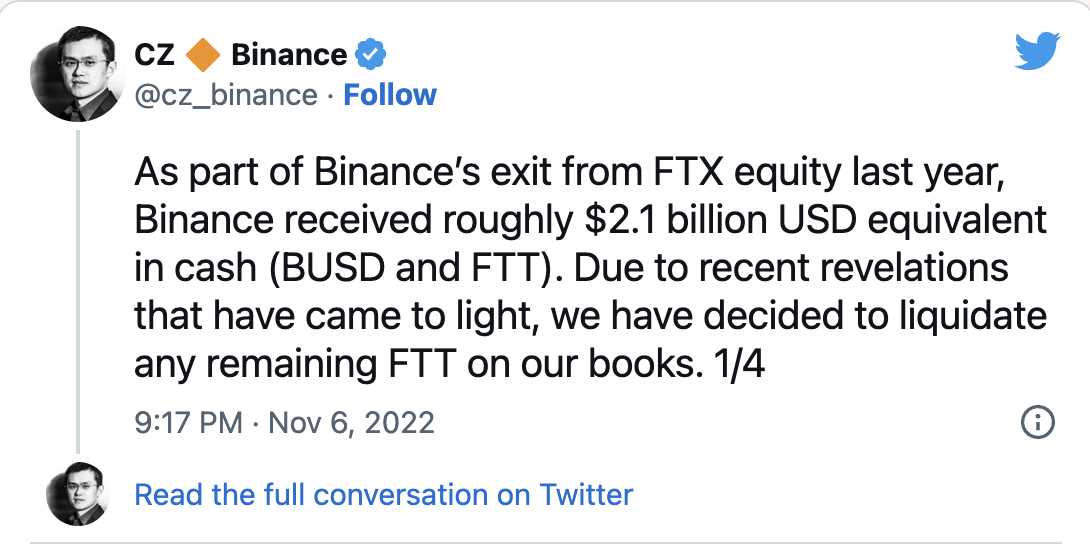
  • Earlier, we mentioned that Binance held FTT tokens. The company’s CEO, Changpeng Zhao (CZ) had been waiting for a perfect time to get back at SBF for his hostile comments on Binance. And this is what he did on Nov 6:
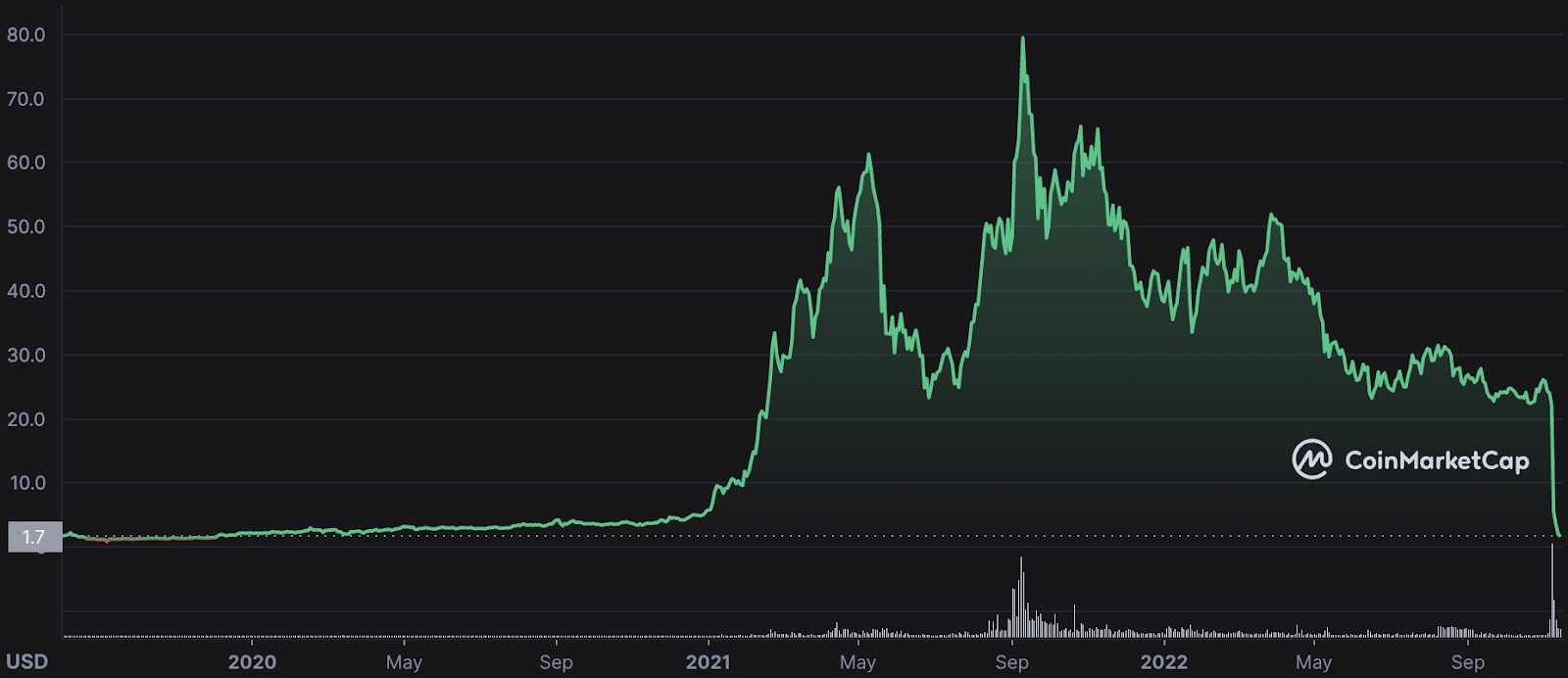
  • Binance’s position in FTT was around 5% of the total— worth around $580 million. Over the span of 2-3 days, $6 billion worth of FTT was withdrawn by investors, and the token crashed more than 90%! CZ was also vocal about the fact that FTX did not have enough cash reserves to process withdrawals. Eventually, FTX had to pause withdrawals on its platform due to a liquidity crunch (a lack of cash or easily convertible-to-cash assets).  
(Source: CoinMarketCap)
  • If FTT’s price fell, Alameda Research’s balance sheet would be emptied in an instant. It would severely harm the firm, and the effect would spread to FTX, especially if it had loaned customer deposits to Alameda.

Recent Developments

In an interesting turn of events, CZ came to the rescue of FTX (well, sort of). On Nov 8, Binance’s CEO announced that the company would acquire FTX amidst its liquidity crisis. They even signed a non-binding agreement, intending to fully acquire FTX.com. However, CZ immediately pulled out of the deal the next day as rumours grew about FTX’s damaged balance sheet

On November 11, FTX filed for Chapter 11 bankruptcy protection in the US., in a move that included its US platform and Alameda. Venture capital firm Sequoia marked down its $150 million investment in FTX to $0! Most investors were not aware of FTX’s related party dealings with Alameda. Softbank also had a $100 million exposure in the crypto exchange. A Reuters report has claimed that at least $1 billion of customer funds had vanished from FTX!  To make matters worse, FTX was reportedly hacked, with more than $600 million stolen from its crypto wallets.

The U.S. Securities & Exchange Commission (SEC) and the Justice Department are investigating the serious allegations against FTX. The company and its CEO are definitely in deep trouble.

FTX’s collapse has raised serious concerns about the future of the crypto industry. It continues to face an uphill battle to regain the trust of retail investors across the globe. We’ve already seen crypto firms like Celsius and Voyager collapsing amidst a brutal “crypto winter”. Will FTX’s clients get their hard-earned money back? What are your thoughts on this entire issue? Let us know in the comments section of the marketfeed app! 
Categories
Editorial

Inox Green Energy Services IPO: All You Need to Know

The IPO mania continues in Dalal Street! Inox Green Energy Services Ltd has launched its initial public offering (IPO) today— Nov 11. It is the fourth IPO to hit the markets this week. In this article, we dive into the company and its IPO.

Company Profile – Inox Green Energy Services Ltd

Inox Green Energy Services Ltd (IGESL) is one of the leading wind power operation and maintenance (O&M) service providers in India. It is a subsidiary of Inox Wind Ltd (a listed company) and part of the Inox GFL Group. Established in 2012, IGESL provides long-term O&M services for wind farm projects.

IGESL exclusively operates and maintains all wind turbine generators (WTG) sold by Inox Wind by entering into contracts with WTG purchasers. These contracts range between 5 to 20 years. The company also offers O&M services for common infrastructure facilities such as electrical substations and transmission lines that support wind farms. They have a dedicated onsite team to provide 24×7 operation services for their customers’ wind farms to help ensure that their WTGs are generating the highest yield possible.

As of June 30, 2022, IGEL’s O&M services portfolio consists of an aggregate of 2,792 megawatts MW) of wind farm capacity and 1,396 WTGs. The company has a presence in Gujarat, Rajasthan, Maharashtra, Madhya Pradesh, Karnataka, Andhra Pradesh, Kerela, and Tamil Nadu.

About the IPO

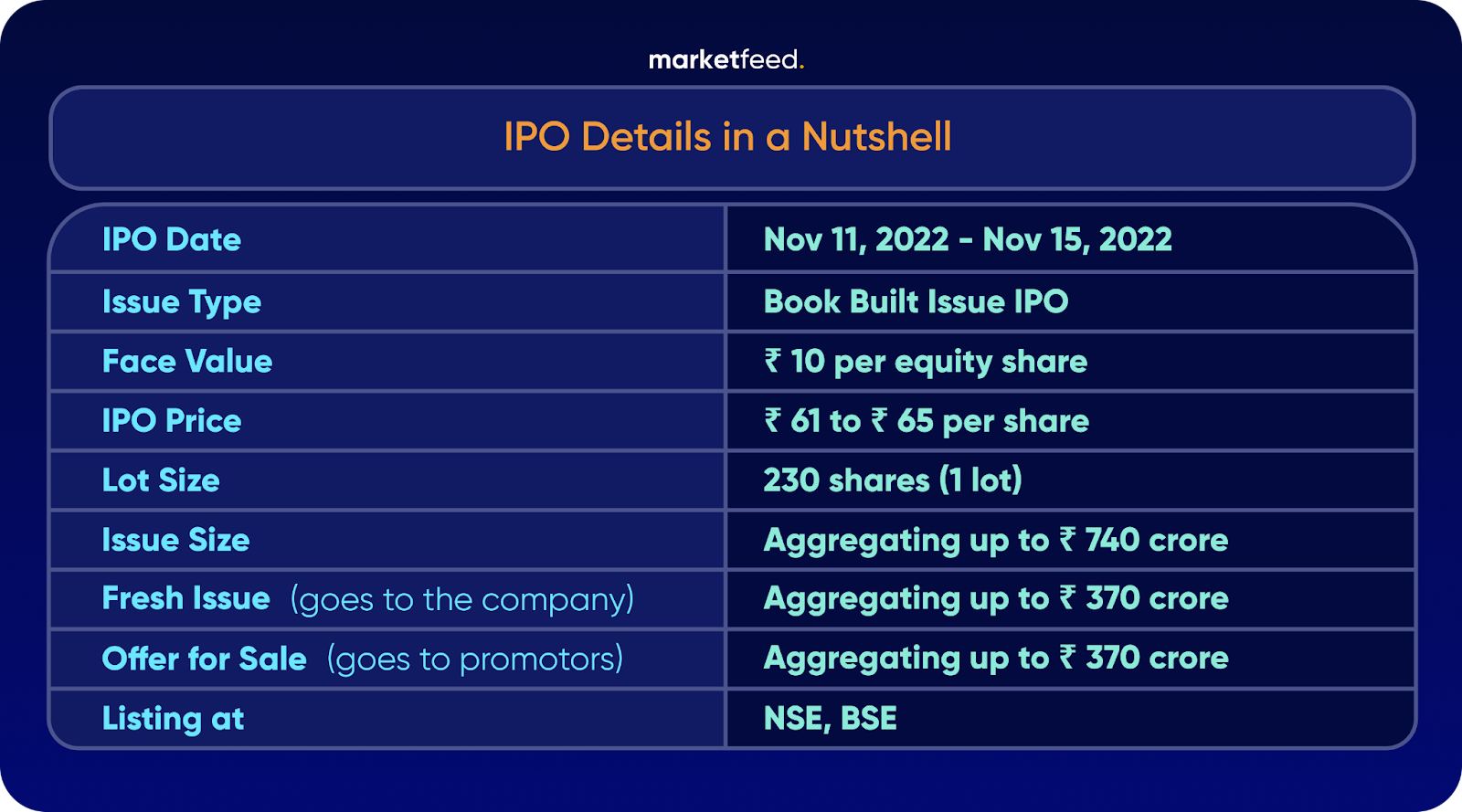
Inox Green Energy’s public issue opens on Nov 11 and closes on Nov 15. The company has fixed ₹61-65 per share as the price band for the IPO.

The fresh issue of shares (of the face value of ₹10 each) aggregates to ₹370 crore. The IPO also includes an offer for sale (OFS) of 5.6 crore shares by promoters and early investors, aggregating to ₹370 crore. Individual investors can bid for a minimum of 230 equity shares (1 lot) and in multiples of 230 shares thereafter. You will need a minimum of ₹14,950 (at the cut-off price) to apply for this IPO. The maximum number of shares that can be applied by a retail investor is 2,990 equity shares (13 lots).

IGESL will utilise the net proceeds from the IPO for the following purposes:

  • Repayment or prepayment of certain borrowings, including redemption of non-convertible debentures (NCDs) in full – ₹260 crore.
  • General corporate purposes.

The total promoter holding in the company will decline from 93.84% to 56.04% post the IPO.

Financial Performance

Inox Green Energy Services has posted losses for the last two financial years (FY21-22). The management clarified that the company’s losses were due to increased interest burden and amortisation provisions. [Amortisation is an accounting strategy used to regularly reduce the book value of a loan or an intangible asset over a certain period.] Through the proceeds of this IPO, IGESL will be able to reduce its loan and interest burden, which should result in an improvement in its margins. Moreover, the company has stable/reliable cash flows supported by long-term O&M contracts.

During the quarter ended June 30, 2022 (Q1 FY23), it reported a loss of ₹11.58 crore and a total revenue of ₹63.16 crore.

Risk Factors

  • The company is entirely dependent on the promoter (Inox Wind) for its business. If IWL chooses any other service provider for operation & maintenance services of wind turbine generators, IGESL’s financial performance would be adversely affected.
  • Orders from IWL may get delayed, modified, or cancelled, which may impact future O&M revenue.
  • The sale of services and renewal rate of service contracts may decline in the future. 
  • IGESL is liable for penalties under its maintenance contracts in case of any deficiencies in the services provided.
  • There are outstanding legal proceedings involving IGESL, its subsidiaries, directors, and group firms.

IPO Details in a Nutshell

IGESL filed the Red Herring Prospectus (RHP) for its IPO on Nov 3. You can read it here. Out of the total offer, 75% is reserved for Qualified Institutional Buyers (QIBs), 15% for Non-Institutional Investors (NIIs), and 10% for retail investors.

Ahead of the IPO, the company raised ₹333 crore from anchor investors. The marquee investors include Morgan Stanley Asia (Singapore), Nomura Singapore, HDFC Mutual Fund (MF), ICICI Prudential MF, etc.

Conclusion

According to the International Energy Agency (IEA), India is the third-largest energy-consuming country in the world and has become one of the largest sources of energy demand growth globally. The Central govt. aims to add 30 gigawatts (GW) of offshore wind projects by 2030. The key strengths of IGESL include its strong/diverse portfolio, established track record, and reliable cash flows

Going forward, the company plans to expand its portfolio and scale operations while transitioning to an asset-light model with minimal capital expenditure. The favourable national renewable energy policy also provides strong visibility for growth.

The company has not received much interest in the grey market. IGESL’s IPO shares are trading at a premium of ₹9-10 in the unofficial market. Before applying to this IPO, we will wait to see if the portion reserved for institutional investors gets oversubscribed. As always, do consider the risks associated with the company and come to your own conclusion.

What are your opinions on this IPO? Will you be applying for it? Let us know in the comments section of the marketfeed app.

Categories
Editorial

Who is Jim Simons: The Mathematician Who Cracked Wall Street?

Investors and traders in the stock market are often encouraged to compare and evaluate their performance with leaders in the industry. It’ll give you an idea of where you stand and how much return you should realistically aim for. While we examine industry benchmarks for trading, one name pops up: Jim Simons. He is arguably one of the most successful traders in the world. Simons is the founder of Renaissance Technologies, a popular quantitative trading hedge fund firm in the US. He used his mathematical skills to make billions from the stock market!

His success story can be a motivation for all aspiring traders out there. In today’s article, learn more about Jim Simons and his journey in the stock market.

Jim Simons – A Brief Profile

James Harris Simons was born in 1938 to a middle-class American Jewish family in Brooklyn, Massachusetts. He loved math and had a talent for numbers from a very young age. Simons went on to study mathematics at the Massachusetts Institute of Technology (MIT) and later completed his Ph.D. at the University of California, Berkeley. 

He secured teaching positions at MIT and Harvard University in the 1960s-70s. During the same period, Simons joined Institute Defense Analysis (IDA), an elite research organization funded by the U.S. government that hired mathematicians to help crack Soviet spy codes. At IDA, he learnt to develop mathematical models to interpret data patterns. 

Jim Simons made an entry into Wall Street in 1978 when he established a hedge fund called Monemetrics. He approached the financial markets with a completely new perspective and used his mathematical skills to find hidden patterns. His firm created an algorithm to make scientific predictions by analysing a chain of events and calculating probabilities. Even though they made profits initially, the company lost millions of dollars and was almost on the verge of collapse.

However, Simons never gave up and was able to find new investors to back his fund. In the 1980s, he renamed the firm to Renaissance Technologies and adopted the use of computers.

The Quant King

With the help of mathematicians, statisticians, and computer programmers, Renaissance Technologies and its flagship Medallion Fund took the world by storm. Jim Simons entirely relied on quantitative analysis and algorithmic investment strategies. His firm gathered vast amounts of historical data from the World Bank, commodity exchanges, and records of currency prices and fed them into computers. They used this data to analyse historical movements and patterns. The company refined its existing algorithm so that it could predict movements in different market conditions.

Thus, Simons and his team were able to develop secret automated strategies based on strict mathematical and statistical models that offered mind-blowing returns. Gradually, the Medallion Fund became the most profitable portfolio in the world. It currently has the best track record on Wall Street. Interestingly, the fund is only open to the company’s owners and employees! Renaissance manages three other funds that are open to all investors.

Source: OfDollarsAndData.com

From 1998 to 2018, the Medallion Fund generated an average annual return of 66% before fees, outperforming legendary investors like Warren Buffet. Since it’s such a profitable fund, the firm charges hefty fees from clients. The avg. annualised returns over 20 years after all charges stood at 39-40%. As of 2022, Renaissance Technologies manages $55 billion, and its Medallion Fund is worth $10 billion!

Giving Back to Society

Jim Simons formed a team of bright individuals to develop and grow his firm. They constantly kept backtesting trading strategies until they were perfect. He’s taught us that good things always take time to materialise. Those who believed in him and invested in his fund have witnessed the magic of compounding on a whole new level. He served as Chairman and CEO of Renaissance Technologies until his retirement in 2010. Except for the extremely secretive managers and owners, no one knows the exact strategies of the Medallion Fund!

Jim Simons co-founded the Simons Foundation with his wife in 1994 and has donated over $2.7 billion of his wealth! He is devoted to supporting education, health, and autism research. He also founded Math for America in 2004, which encourages mathematics and science teachers to remain in their roles and advance their teaching abilities.

With a net worth of $28 billion, he’s one of the most successful self-made billionaires in the world!

Gregory Zuckerman’s popular book, The Man Who Solved the Market: How Jim Simons Launched the Quant Revolution, describes Simons and his investing/trading methods in great detail. He’s a true revolutionary in the world of stock markets!

Categories
Editorial

The RBI’s E-Rupee Explained

On November 1, the Reserve Bank of India (RBI) launched the first trial of the Digital Rupee (e-rupee or e₹) in the wholesale segment for government securities. The central bank will also launch a similar trial of e₹ in the retail segment later this month. 

The RBI has selected nine banks to engage in the pilot project— State Bank of India, Bank of Baroda, Union Bank of India, HDFC Bank, ICICI Bank, Kotak Mahindra Bank, YES Bank, IDFC First Bank, and HSBC.

India’s central bank published a concept note on the Central Bank Digital Currency (CBDC) on Oct. 7, outlining its characteristics and intent. The concept note addresses the objectives, alternatives, benefits, and drawbacks of introducing the Digital Rupee in India. 

In today’s article, we discuss what the e-rupee is and what the RBI aims to achieve with its launch.

What is Digital Rupee?

e-rupee is a digital version of currency notes issued by the RBI, a type of digital money that can be used in contactless transactions. According to the concept note, the Digital Rupee or Central Bank Digital Currency (CBDC) will be a legal tender issued by the RBI. We’ll be able to exchange digital currency with fiat currency/cash (notes).

The digital rupee will serve as the settlement amount for the purchase and sale of government securities such as bonds. Additionally, RBI said e-rupee will soon be available for regular transactions by consumers and businesses.

“A CBDC would vary from present digital money available to the public because it would be a liability of the Reserve Bank, and not of a commercial bank,” the RBI said in a statement.

How Will it Function?

While RBI will be the sole issuer of e₹, its distribution will be handled entirely by commercial banks. One can examine the balance in their e₹ wallet in a manner similar to checking their bank balance. The foundation of CBDC will be blockchain technology.

A blockchain is essentially a collection of blocks. Each block would contain a group of transactions. Specific computers will run the CBDC’s code and store its blockchain. A token-based system would provide universal access to e-rupee while also providing privacy by default. Thus, individuals will be able to pay Digital Rupee to whoever they want to via apps.

CBDCs are of two types: 

  1. Central Bank Digital Currency Wholesale: Used for large-scale transactions. It will be used by large financial institutions, including banks, and large non-banking finance companies.
  1. Central Bank Digital Currency Retail: Used for retail transactions in the second phase. CBDC can be utilised by people for everyday/regular transactions. It will be initially launched at select locations and banks first. The retail project will involve participants of all ages. The features will be modified based on their experiences.

Features of the Digital Rupee

  • CBDC will be the official digital token of the nation. It is a sovereign currency that RBI will issue based on its monetary policies. 
  • CBDC is freely convertible against commercial bank money and cash. 
  • It will simplify commercial dealings. 
  • CBDC is a fungible legal tender for which holders need not have a bank account. 
  • It is expected to lower the govt’s cost of issuing/printing currency. 
  • Money transfers from smartphones will be quick and hassle-free.
  • All individuals, businesses, and government organisations must acknowledge e₹ as a form of payment, legal tender, and a secure store of value. 

Objectives of Launching Digital Rupee

  • CBDC offers an additional payment avenue, and will not replace the current payment systems.
  • RBI is certain that the introduction of the digital rupee will boost India’s digital economy, expand financial inclusion, and improve the efficiency of the monetary & payment systems.
  • e₹ could help resolve the issue of counterfeit money in the nation.
  • To explore the application of CBDC to enhance cross-border transactions.
  • Encourage financial inclusion.
  • Promoting competition, effectiveness, and innovation in payments.
  • Reduction in cost associated with physical cash management.
  • Protect the public’s confidence in the national currency against the growth of crypto assets.
  • The rise in popularity of cryptocurrencies is another justification for this launch. The digital rupee will boost efficiency and transparency owing to blockchain technology.
  • The steady growth of digital payments throughout the Covid-19 pandemic has been a glaring sign of the rising need for acceptable digital substitutes for the Indian currency. The launch of the e-rupee will assist RBI in reducing costs connected with paper money, including slowing down the loss of damaged notes.

Challenges:

  • Weaker banks could find it difficult to retain low-cost deposits if e-rupee becomes popular and RBI does not impose any restrictions on the amount that can be stored in mobile wallets.
  • Unlike perfectly anonymous cash, the RBI will be able to trace the spending patterns of citizens who use CBDC. Moreover, transactions conducted with e₹ may not be accessible to payment apps. Fintech firms may lose access to big data they use for building products and services. 
  • India is already dealing with several cyber security threats. The introduction of digital currency may lead to an increase in cyberattacks and provide a risk of digital theft.
  • There will be many operational issues for the implementation of CBDC, including the Know your Customer (KYC) norms and privacy of data.

The e-rupee will help India progress in the race for digital currencies. The RBI has hailed CBDC’s debut as a landmark milestone in the history of the nation’s currencies. It could fundamentally alter how people do business. What are your views: will the Indian Rupee be propelled into the global arena via RBI’s Central Bank Digital Currency? Let us know in the comments section of the marketfeed app!
Categories
Editorial

The Success Story of Razorpay

The payment gateway ecosystem in India is a huge market to capitalise upon. The firms participating in this industry require a reliable system and robust mechanism of logistics and financial compliance at every stage. Today, Razorpay is one of the leading internet-based financial solution providers revolutionising the fintech space with groundbreaking innovations.

From days of justifying every payment the company made for essential items from its college seed fund to raising millions and becoming members of the coveted unicorn club, Harshil Mathur and Shashank Kumar of Razorpay have come a long way.

In today’s article, we throw light on how Razorpay has been rising up the charts to emerge as a dominant name in the Indian fintech space. 

Razorpay’s Origin 

In 2014,  Kumar and Mathur met at IIT Roorkee when the duo decided to work on a crowdfunding platform. However, they realised that online payment was a problem for small & medium-sized (SME) businesses, especially e-commerce platforms. Thus, they created Razorpay to address this issue. The idea of Razorpay was to offer a simple payment gateway platform for startups/SMEs.

The platform provides access to several online payment methods for business entities, including credit & debit cards, net banking, and UPI. They charge just 2-3% for each transaction. It also supports many leading wallets in India, including JioMoney, Mobikwik, Airtel Money, FreeCharge, OlaMoney, and PayZapp. Razorpay provides a comprehensive dashboard for handling payments for users and is applicable for both web and mobile applications.

The dashboard has various products, namely Razorpay Route, Razorpay Smart Collect, Razorpay Subscriptions, Razorpay Invoices and Razorpay Capital. These products handle tasks such as cash flows, disbursement of money, and automating electronic fund transfers. Razorpay also collects scheduled payments and supports businesses with instant loans to help them resolve cash flow issues. They also offer smart payroll software to manage and automate employee salaries.

Oyo, Cred, Facebook, Flipkart, Zomato and Swiggy, Byju’s, Zilingo, Yatra, Goibibo, and Airtel are some of Razorpay’s most prominent clients! Even marketfeed has been using its payment gateway and payroll services since 2020!

Razorpay’s Latest Funding Rounds

In October 2020, Razorpay obtained $100 million in a funding round headed by Singapore’s sovereign wealth fund GIC and Sequoia India. With this funding, Razorpay joined the exclusive batch of unicorn startups from India. It raised $375 million in a Series F round in December 2021. In May 2022, the firm announced its fourth liquidity event for Employee Stock Ownership Plan (ESOP) for $75 million.

Ribbit Capital, Tiger Global, Y Combinator, Matrix Partners, Singapore’s GIC, and Sequoia India are the platform’s leading investors.

At $7.5 billion, Razorpay is currently India’s most valuable fintech firm!

Razorpay’s Acquisitions 

  • In 2019, Razorpay announced its first acquisition of Thirdwatch, an AI-powered company specialising in big data to reduce return-to-origin and fraud orders for e-commerce businesses.
  • It also acquired cloud-based payroll management startup Opfin in 2019. The acquisition allowed Razorpay to roll out a new HR automation product, primarily for the payroll process. It also complemented RazorpayX’s B2B banking product, which is a neo-banking platform targeted at businesses and corporates.
  • 2021 – Acquired TERA Finlabs to strengthen its B2B Credit Infrastructure.
  • 2022 – The company made an international foray and acquired leading Malaysian fintech startup Curlec to transform the payments ecosystem in Southeast Asia.
  • Purchased a stake in payments tech startup IZealiant Technologies to build industry-first solutions for banks to create a world-class payments experience for their businesses and customers. 
  • Razorpay acquired Ezetap to build a full-stack omnichannel payments solution.
  • Ventured into Loyalty and Rewards Management with the acquisition of PoshVine. The acquisition was made to enhance the offline shopping experience for customers by integrating PoshVine’s loyalty and reward offerings on its point-of-sale network. 

Peer Analysis

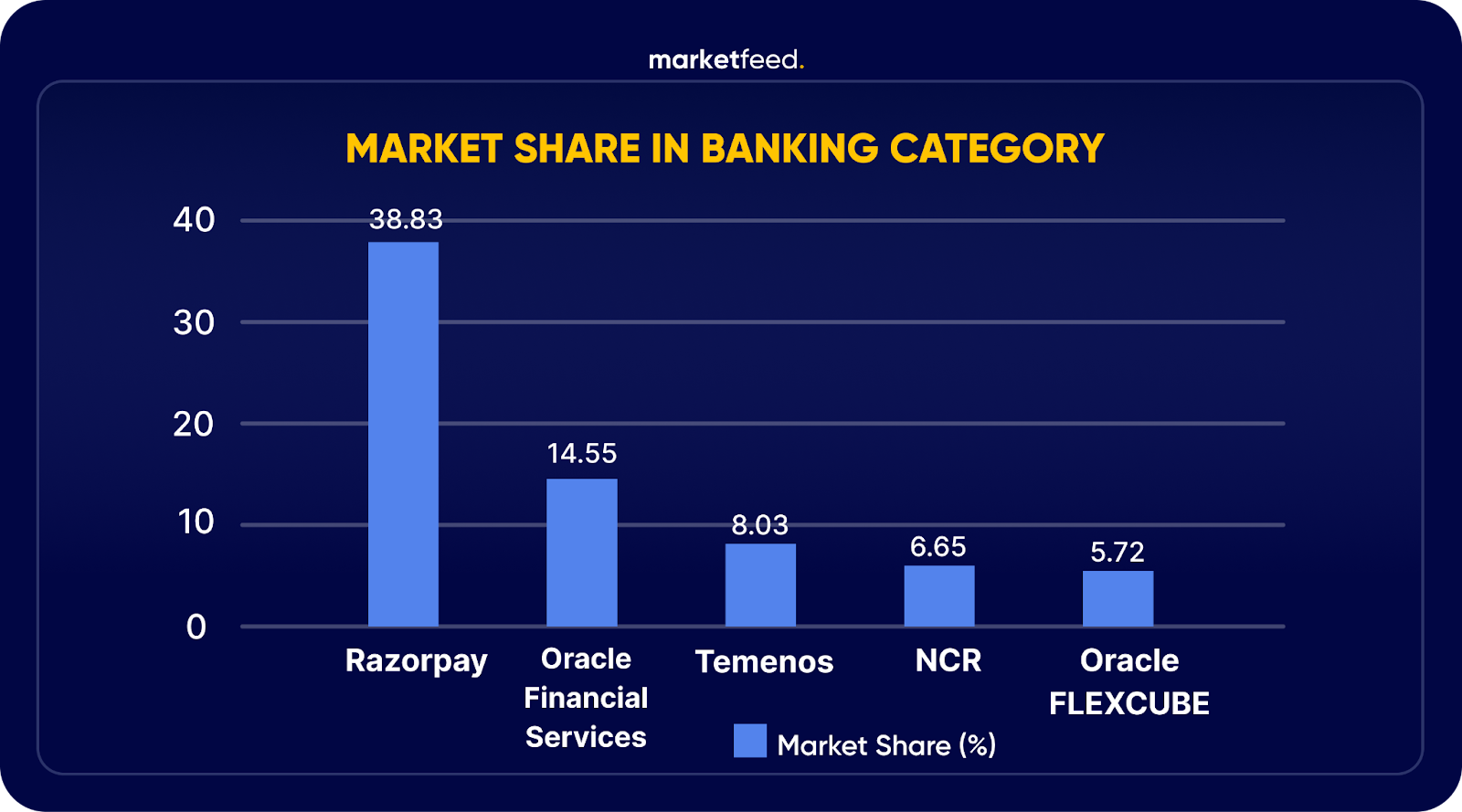
Razorpay faces heavy competition from PayU, Paytm, PayPal India, CCAvenue, BillDesk, Instamojo, and many more. These firms aim to increase their market share by forming multiple partnerships, investing in projects, and launching new products. The market is highly concentrated with various small and large players.

(Razorpay’s market share in the Banking category. Source: Slintel Report, Oct 2022)

Razorpay’s Strong Growth 

  • The platform has close to 80 lakh merchants who are primarily small & medium enterprises (SMEs). This figure is expected to reach 90 crores1 crores as the industry matures.
  • With an annual payment processing volume of roughly $80 billion, the business has a solid opportunity to overtake rival PayU as the leading online payment processing platform.
  • The company clocked revenue of ₹1,484.4 crore in FY22 along with a profit (undisclosed) as per unaudited financial reports. 
  • Over the past years, Razorpay has expanded beyond digital payments. In just four years of its launch, RazorpayX and Razorpay Capital, the company’s lending arm and neo-banking division, have already contributed 30% to its total revenue.
  • With the Curlec acquisition, Razorpay is looking to expand its core payments services to markets in Malaysia, Indonesia, Thailand, the Philippines, etc. 
  • As a result of its strong product and technology stack, Razorpay was also voted as The Economic Times Startup of the Year 2022. 

Razorpay’s Mission

India’s payments space has seen increased activity over the last few years. Consumers are changing their preferences for making online payments as a result of increasing internet penetration and awareness about the ease of online transactions. Razorpay’s mission and vision lie in the objective of making payments easier; making it super-simple for businesses to accept and receive payments. By strengthening its focus on the web and consumer categories through additional acquisitions, Razorpay has been working to establish itself as an omnichannel payments operator. 

The company’s razor-sharp focus on creating start-up offerings has helped them grow substantially. Its focus now lies on increasing market share in India and building a base in the South Asian payments market. 

With larger offerings like upgrading neo-banking platforms and smaller ones like introducing multilingual checkout pages, do you think Razorpay looks ready to dominate the global payments space? Let us know in the comments section of the marketfeed app!
Categories
Editorial

Fusion Micro Finance IPO: All You Need to Know

The second IPO of the week is here! Financial services firm Fusion Micro Finance has launched its three-day initial public offering (IPO) today— Nov 2. In this article, we shall analyse the company and its IPO.

Company Profile – Fusion Micro Finance Ltd

Established in 1994, Fusion Micro Finance Ltd (FMFL) provides financial services to women entrepreneurs belonging to the economically and socially deprived section of society. Its network and services have improved accessibility to formal credit (loans) at affordable rates, thereby positively impacting the lives of people in rural India. Apart from financial support, FMFL also offers financial literacy sessions.

FMFL’s business runs on a joint liability group-lending model— a small number of women form a group (comprising 5-7 members) and guarantee each other’s loans. The company has primarily focused on strategic geographic diversification with a rural focus, embracing technology for growth, nurturing & developing personnel, and careful risk management.

Factsheet:

  • The microfinance institution (MFI) currently has nearly 29 lakh active borrowers
  • Its total assets under management (AUM) grew from ₹4,673.84 crore in FY21 to 6,785.97 crore in FY22. As of June 30, 2022 (Q1 FY23), the company’s AUM stands at ₹7,389.02 crore
  • Bihar, Uttar Pradesh, Odisha, Madhya Pradesh, and Tamil Nadu cumulatively account for 66.12% of its AUM.
  • As of Q1 FY23, FMFL has 966 branches and 9,262 permanent employees spread across 377 districts in 19 states and Union Territories in India
  • The company had the fourth fastest gross loan portfolio CAGR of 53.89% between FY17 and FY21 among the 10 largest NBFC-MFIs in India.

About the IPO

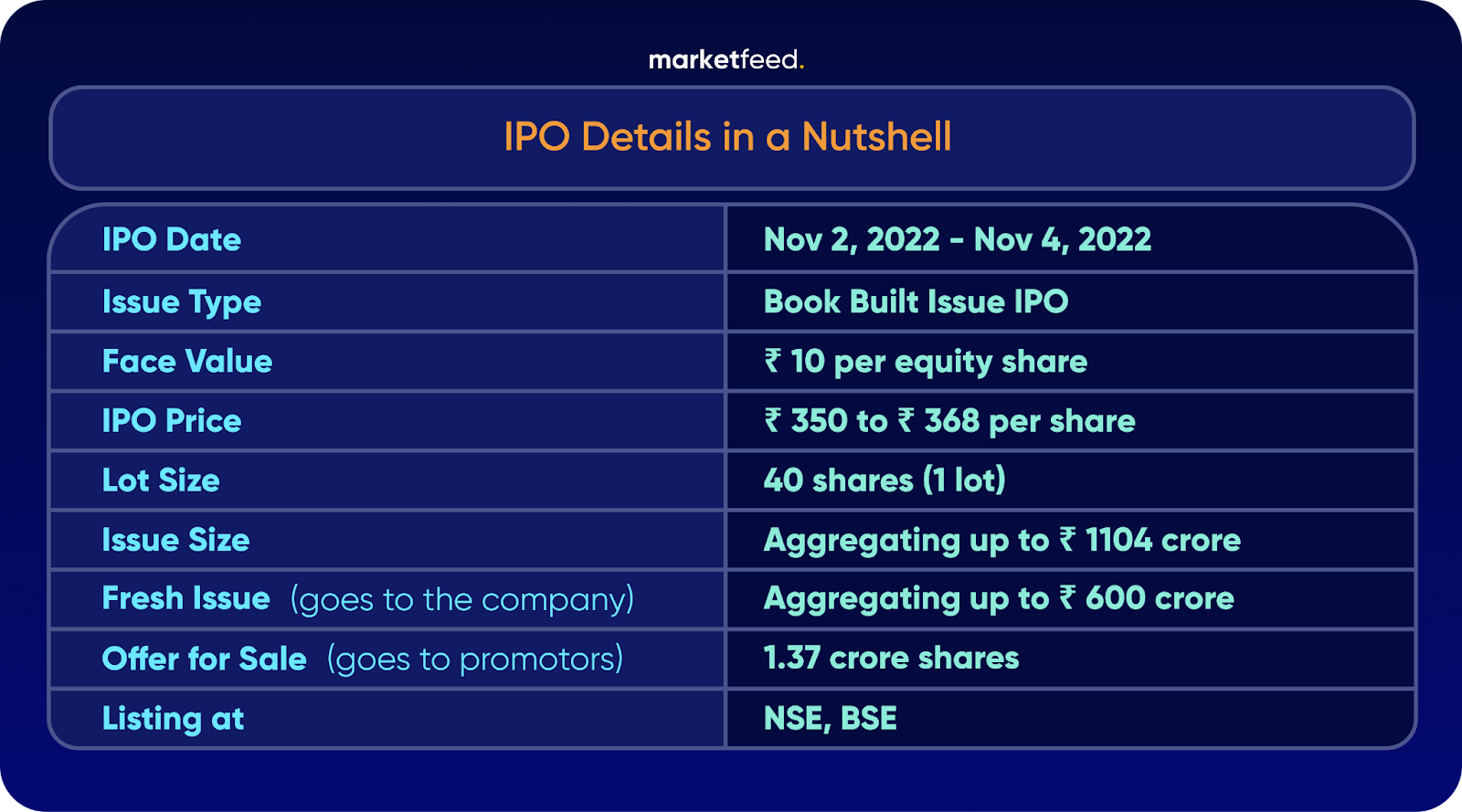
Fusion Micro Finance Ltd’s public issue opens on Nov 2 and closes on Nov 4. The company has fixed ₹350-368 per share as the price band for the IPO.

The fresh issue of shares (of the face value of ₹10 each) aggregates to ₹600 crore. The IPO also includes an offer for sale (OFS) of 1.37 crore shares by promoters and early investors. Individual investors can bid for a minimum of 40 equity shares (1 lot) and in multiples of 40 shares thereafter. You will need a minimum of ₹14,720 (at the cut-off price) to apply for this IPO. The maximum number of shares that can be applied by a retail investor is 520 equity shares (13 lots).

FMFL will utilise the net proceeds from the IPO to augment its capital base.

The total promoter holding in the company will decline from 85.57% to 58.1% post the IPO.

Financial Performance

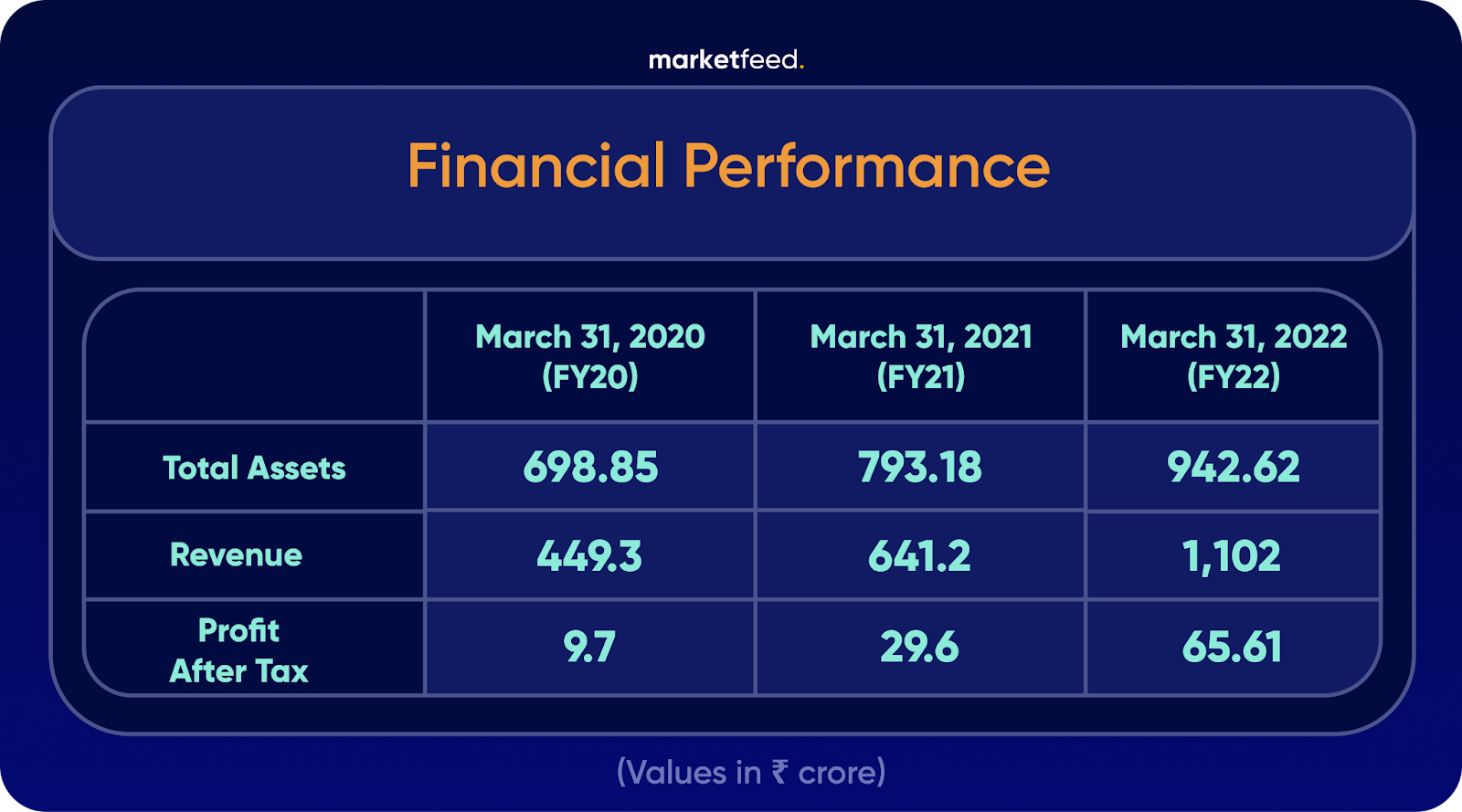
Fusion Micro Finance’s profitability was impacted by higher provisioning due to the Covid-19 pandemic and branch expansions. However, the company’s net profit improved from ₹4.41 crore in Q1 FY22 to ₹75 crore in Q1 FY23, owing to higher interest income and lower provisions. Its revenue has increased at a compound annual growth rate (CAGR) of 26.44% over the past three financial years (FY20-22).

Between March 31, 2016, and June 30, 2022, the number of active borrowers grew at a healthy CAGR of 33.63%, while the number of branches grew at a CAGR of 31.92%. 

FMFL’s capital adequacy ratio (CAR) has remained strong. It stood at 21.13% as of Q1 FY23. [Higher CAR indicates that the bank is in a better position to deal with unexpected losses due to availability of adequate capital.]

Risk Factors

  • An increase in the level of non-performing assets (bad loans) or provisions may adversely affect FMFL’s business and financial performance.
  • A significant portion of the company’s customers is located in rural markets. It may face difficulties in conducting operations and implementing technical measures in such markets due to limited infrastructure.
  • The inability to manage its growth effectively or sustain historical growth rates may severely impact FMFL’s overall business.
  • Any failure or security breach in the firm’s information technology systems could harm its reputation and credibility.
  • Any downgrade of Fusion Micro Finance’s credit ratings may constrain its access to capital and debt markets. It may affect its cost of borrowing and financial condition.

IPO Details in a Nutshell

The book-running lead managers to the public issue are ICICI Securities, CLSA India, IIFL Securities, and JM Financial. FMFL filed the Red Herring Prospectus (RHP) for its IPO on Oct 25. You can read it here. Out of the total offer, 50% is reserved for Qualified Institutional Buyers (QIBs), 15% for Non-Institutional Investors (NIIs), and 35% for retail investors.

Conclusion

Going forward, Fusion Micro Finance plans to grow its business by attracting new customers in existing markets that remain relatively untapped. It has a social vision to provide economic opportunities to underprivileged women and transform their quality of life. FMFL will also enter new regions with lower penetration of microfinance firms. They will continue to automate and digitise various aspects of the business. In terms of financial performance, FMFL is on a recovery path as indicated by Q1 FY23 results.

CRISIL Research expects the MFI industry to grow at 18-20% CAGR between FY22 and FY25. During the same period, NBFC-MFIs are predicted to grow at a much faster rate of 20-22%.

FMFL faces stiff competition from listed peers such as Credit Access Grameen Ltd, Spandana Sphoorty Financial Ltd, Bandhan Bank, Ujjivan Small Finance Bank (SFB), Equitas SFB, and Suryoday SFB.

The company has received some interest in the grey market. FMFL’s IPO shares are trading at a premium of ₹35 in the unofficial market. Before applying to this IPO, we will wait to see if the portion reserved for institutional investors gets oversubscribed. As always, do consider the risks associated with the company and come to your own conclusion.

What are your opinions on this IPO? Will you be applying for it? Let us know in the comments section of the marketfeed app.

Categories
Editorial

An Overview of India’s Booming OTT Market

India is a complex market when it comes to paying for entertainment. Digital content consumption is rapidly growing as a result of easy access to smart devices and affordable mobile data plans. Since the transition from Doordarshan to Direct-to-Home (D2H) to OTT platforms, the content consumption behaviour of Indians has undeniably evolved. According to an Eros Now-KPMG report, an over-the-top (OTT) viewer in India spends approximately 70 minutes per day on video streaming platforms, with a consumption frequency of 12.5 times a week!

In this article, we examine how OTT is continuously altering the dynamics of the media & entertainment industry in the Indian scenario.

Origin of OTT Platforms in India

OTT stands for “over-the-top,” as in going above and beyond streaming cable networks or YouTube. BIGFlix was the first independent Indian OTT platform in India, launched by Reliance Entertainment in 2008. 

In 2010, Gurugram-based Digivive launched the first OTT mobile app in India, nexGTv. It offers live TV and on-demand content. nexGTV was the first app to stream live Indian Premier League matches on mobile devices in 2013 and 2014. Hotstar has seen significant growth in India since acquiring IPL live-streaming rights in 2015.

When DittoTV (Zee) and SonyLiv both debuted in the Indian market around 2013, OTT experienced substantial momentum in India. DittoTV was an aggregator platform containing shows across popular media channels, including Star, Sony, Viacom, Zee, etc.

There are currently about 46 providers of over-the-top media services in India that distribute content over the internet.

How Big is the OTT Market in India?

In the 1980s, the rapid growth of video cassette recorders and players (VCRs/VCPs) challenged the established modes of viewing cinema. However, the rise of multiplexes in large cities in the early 2000s effectively killed the DVD industry and single screens. Now, the popularity of OTT platforms is wreaking havoc on multiplexes.

According to a report published by Media Partners Asia (MPA), the Indian OTT streaming video market is currently in its second growth phase with total revenues of $3 billion in 2022. So far, OTT has captured 7-9% of the entertainment industry’s share and revenue. With over 40-odd players offering original content in all languages, the industry is expanding quickly and consistently. There are currently over 45 million OTT subscribers in India. This figure is expected to reach 50 million by the end of 2023.

The OTT market is set to become a ₹12,000-crore industry by 2023 at a compound annual growth (CAGR) of 36% (from ₹2,590 crore in 2018).

Reasons Behind Strong Growth of OTT Platforms 

  • The rapid adoption and evolution of internet infrastructure have contributed to the enormous popularity of OTT in India. These factors enable OTT platforms to deliver content directly to the viewers, bypassing traditional distribution and media networks.
  • As people were confined to their homes due to the Covid-19 pandemic, OTT platforms gained acceptance and popularity. It has helped people overcome boredom.
  • OTT platforms offer more than just the ability to stream media on the go. One can stream ad-free services at a low cost and download videos in multiple languages to watch offline on their devices.
  • Several television shows and films are available on streaming platforms much before they are broadcast on television. It is an ideal medium for first-time film or web series fans to take their enthusiasm to new heights.
  • A seamless viewing experience across multiple devices is a must-have feature for OTT platform owners looking to build a loyal fan base and subscriber base. Another important factor that has contributed to the streaming industry’s ever-growing customer base is the multi-screen OTT experience. 
  • Quality and Fresh Content— People are drawn to these platforms since they are tired of conventional Indian TV serials, which seem to go on forever.
  • OTT provided opportunities for creators and artists who had lost their relevance due to a shift in cinema or entertainment. Many have reclaimed their place in the spotlight.

Challenges Faced by OTT Platforms 

  • Security and privacy are the two most pressing issues for OTT platforms. User information saved on their platforms during sign-in or search history should not be exploited for illegal purposes.
  • The lack of censorship is another issue with OTT services. Children can be exposed to a wide range of inappropriate content.
  • People with poor internet connections will not be able to enjoy a smooth viewing experience.
  • Viewers may quickly become addicted to OTT platforms due to the wide range of content offered, resulting in a limited social life. Password sharing is another major issue hurting OTT platforms’ revenues.
  • As more individuals access digital platforms to stream content, OTT platforms are losing up to 30% of their annual revenue to piracy. These pirated websites provide all forms of digital content as soon as they are released in OTT.
  • The ad-free content available on OTT platforms is a significant benefit for viewers. However, this appears to be changing, as Netflix is now looking to include ads to increase revenue. This will be concerning for viewers because they are paying for premium services and won’t have the choice to skip ads.

Different OTT Platforms Available in India: 

Indians now have a variety of options when it comes to OTT services. Netflix, Amazon Prime Video, Disney+ Hotstar, ALTBalaji,  Zee 5, Aha, Voot, SonyLIV, Viu, Hoichoi, etc are the prominent OTT providers. All these platforms differ in terms of subscription plans and compatible devices. 

(Figures as of August 2022)

Despite Hotstar and Amazon Prime Video dominating the sphere of OTT platforms, there has been exponential growth in aggregated OTT services such as TATA Play Binge. It provides access to more than 16 apps, including Disney+ Hotstar, MX Player, Voot, Zee5, and SonyLIV. The mergers of ZEEL and Sony, as well as Jio Cinema OTT and Viacom 18 Media, may pose a threat to Netflix and Amazon Prime’s dominant positions.

Future of OTT Platforms in India 

Media & entertainment is one of the fastest-growing industries in India. However, keeping up with evolving content trends and ever-changing consumer demands is quite a challenging task.

Consumers are more likely to watch a variety of content whenever and wherever they want. According to a survey conducted by Ascent Group India, 68.9% of people prefer watching OTT over traditional forms of entertainment. OTT platform consumption subsequently increased during the pandemic as people preferred to stay at home. The impressive marketing strategies used by OTT platforms have helped them attract subscribers.

The diversity of India provides enough room for almost every existing OTT player as well as those looking to enter the space beyond entertainment. As a result, OTT platforms are just getting started, while traditional content creators and platforms are dying slowly.

It will be interesting to see how OTT platforms respond to changing consumer behaviour and demands and whether they’ll also experience a decline. Which OTT platforms have you signed up for? Let us know in the comments section of the marketfeed app!
Categories
Editorial

DCX Systems Ltd IPO: All You Need to Know

Bengaluru-based DCX Systems Ltd will launch its initial public offering (IPO) next Monday— October 31. It is one of the fastest-growing companies in the Indian defence sector. In this article, we analyse the company and its IPO.

Company Profile – DCX Systems Ltd

Incorporated in 2011, DCX Systems Ltd (DCXSL) is one of the leading Indian manufacturers of electronic sub-systems and cable harnesses for the defence and aerospace sectors. It provides product assembly and system integration services as per customers’ requirements.

Key Products:

  • System Integration: They undertake system integration in areas of radar systems, sensors, electronic warfare, missiles, and communication systems.
  • Cable and Wire Harness Assemblies: It manufactures a wide range of cables and wire harnesses assemblies for the aerospace and defence industries.
  • Fine Wire Cable Assemblies: These are lightweight and high-temperature resistant cables used in aerospace, marine, space, and medical applications.
  • Wired Enclosure: The company produces high-reliability backplane assemblies and wired enclosures for the defence and aerospace markets.

DCXSL is one of the largest Indian Offset Partners (IOPs) for ELTA Systems Ltd and Israel Aerospace Industries Ltd, System Missiles & Space Division of Israel, for executing defence & aerospace manufacturing projects. The company operates through its manufacturing facility at Hi-Tech Defence & Aerospace Park SEZ in Bengaluru, Karnataka.

As of June 30, 2022 (Q1 FY23), DCX Systems had 26 customers across Israel, the United States, Korea and India. Their clients include Fortune 500 companies, multinational corporations and start-ups. The company’s prominent clients include Bharat Electronics Ltd, Astra Rafael Comsys, Alpha-Elsec Defence & Aerospace Systems, and Kalyani Rafael Advanced Systems.

About the IPO

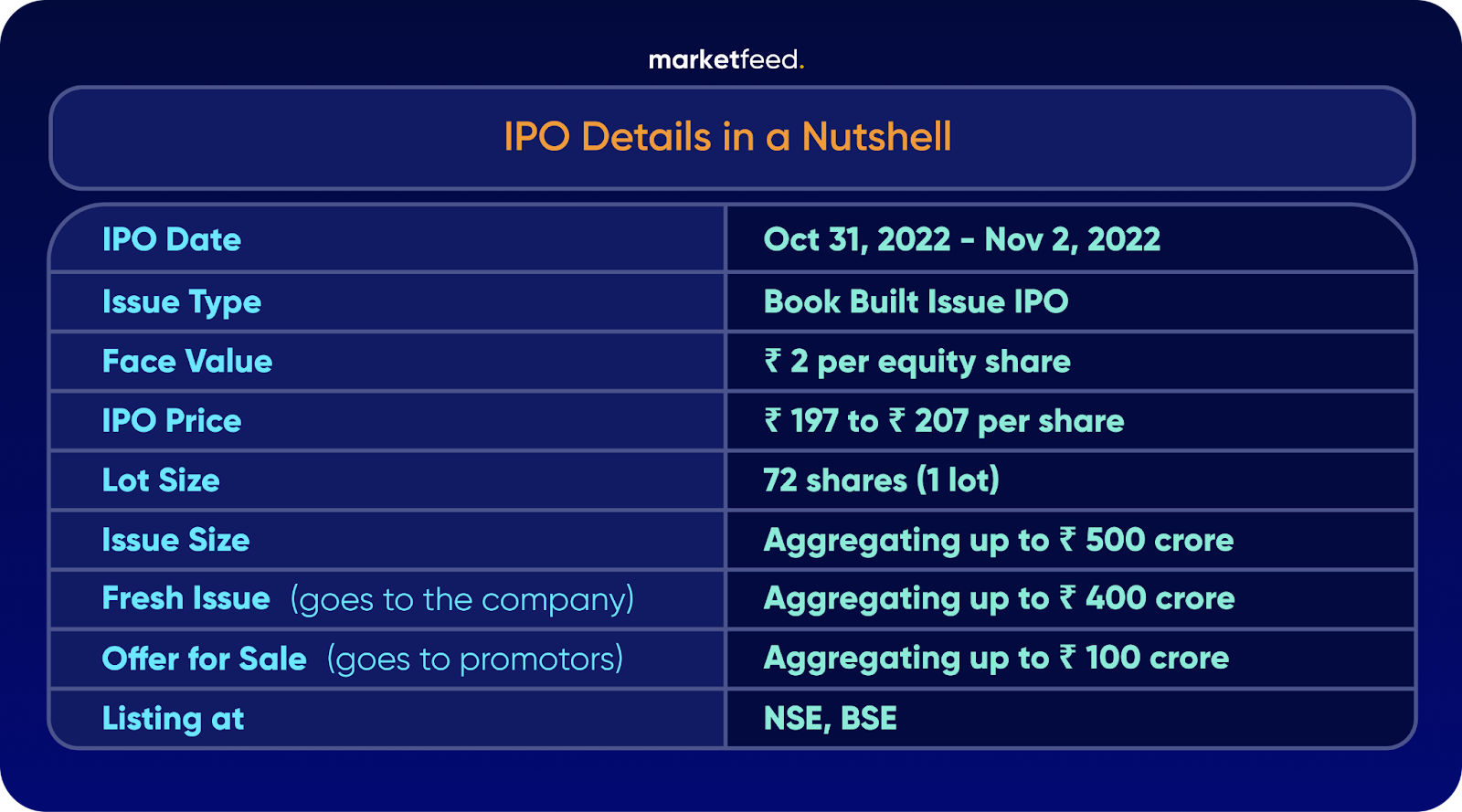
DCX Systems Ltd’s public issue opens on October 31 and closes on November 2. The company has fixed ₹197-207 per share as the price band for the IPO.

The fresh issue of shares (of the face value of ₹2 each) aggregates to ₹400 crore. The IPO also includes an offer for sale (OFS) by promoters and early investors, aggregating to ₹100 crore. Individual investors can bid for a minimum of 72 equity shares (1 lot) and in multiples of 72 shares thereafter. You will need a minimum of ₹14,904 (at the cut-off price) to apply for this IPO. The maximum number of shares that can be applied by a retail investor is 936 equity shares (13 lots).

DCX Systems will utilise the net proceeds from the IPO for the following purposes:

  • Repayment/prepayment of certain borrowings – ₹110 crore
  • Funding working capital requirements – ₹160 crore
  • Investment in its subsidiary, Raneal Advanced Systems Pvt. Ltd, to fund its capital expenditure expenses – ₹44.88 crore
  • General corporate purposes

The total promoter holding in DCXSL will decline from 98.2% to 73.58% post the IPO.

Financial Performance

The company has posted healthy growth in both revenue and profits over the past three financial years (FY20-22). Its revenue has increased at a compounded annual growth rate (CAGR) of 56.64% during the same period! They generate a significant portion of the revenue from exports. In FY22, they exported $76 million worth of equipment, accounting for 4.7% of the overall defence exports from India. 

The company’s order book has grown from ₹1,941.31 crore in FY20 to ₹2,369 crore in FY22. All these metrics indicate that the firm is growing rapidly in the Indian defence space.

Risk Factors

  • DCXSL derived nearly 85.7% of its total sales revenue from its top 3 clients as of FY22. The loss of any of these customers or a fall in demand from them will severely affect the company’s overall business.
  • The company depends significantly on offset defence contracts for a majority of its revenue. Any changes in the offset defence policy or a decline in defence funding by the govt will adversely impact its ability to grow or maintain sales.
  • DCX System’s current order book may not necessarily translate into future income in its entirety. Some customers may modify, cancel, or put orders on hold.
  • Significant shortages or delays in the supply of raw materials could severely impact DCXSL’s estimated costs, expenditures, and timelines.

IPO Details in a Nutshell

The book-running lead managers to the public issue are Edelweiss Financial Services, Axis Capital, and Saffron Capital Advisors. DCX Systems filed the Red Herring Prospectus (RHP) for its IPO on Oct 19. You can read it here. Out of the total offer, 75% is reserved for Qualified Institutional Buyers (QIBs), 15% for Non-Institutional Investors (NIIs), and 10% for retail investors.

Conclusion

India’s military spending in 2021 stood at $76.6 billion, rising 5% from 2020. This rise can be attributed to India’s existing tensions with Pakistan and increasing border tensions with China. Moreover, the market size for the Global Defence Electronics Market is estimated to be $142 billion in 2022. It is expected to grow at a CAGR of 6.6% to ₹237 billion by 2030. With its technology-enabled and scalable end-to-end solutions, DCXSL is well-positioned to capitalise on industry trends.

However, the company faces stiff competition from listed peers such as Bharat Electronics Ltd (BEL), Data Patterns, Paras Defence & Space Technologies, and Astra Microwave Products. To learn more about Indian defence stocks, click here.

The company has received some interest in the grey market. DCXSL’s IPO shares are trading at a premium of ₹80 in the unofficial market. Before applying to this IPO, we will wait to see if the portion reserved for institutional investors gets oversubscribed. As always, do consider the risks associated with the company and come to your own conclusion.

What are your opinions on this IPO? Will you be applying for it? Let us know in the comments section of the marketfeed app.