Categories
Editorial

Understanding the Magic Formula: A Value Investing Strategy

Imagine a value investing strategy that claims to have returned investors a 30% Compound Annual Growth Rate (CAGR) over 26 years. If you had invested ₹1 lakh into this strategy, it says you would have turned into over ₹9 crore! Sounds incredible, right? That’s the Magic Formula investment technique. In this article, we will dive deep into this investment strategy, exploring its origin, the nine key rules it follows, backtesting data, and its relevance in both the U.S. and Indian markets.

The Origins of the Magic Formula

Joel Greenblatt, a renowned asset manager since the 1980s, wrote a book titled The Little Book That Beats the Market, where he presented the magic formula for value investing. Greenblatt is a professional investment manager with an impressive $6.3 billion in Assets Under Management (AUM). His magic formula is said to be a simplified version of the value investing strategies used by legends like Warren Buffett and Charlie Munger.

In his book, Greenblatt outlines how investors can generate market-beating returns by following a set of simple rules. His confidence in the strategy led to a follow-up book, The Little Book That Still Beats the Market, further emphasising its relevance. The formula has been consistently applied for over two decades and claims to outperform traditional market benchmarks.

What is the Magic Formula?

The magic formula is a stock-picking strategy based on two financial metrics: earnings yield and return on capital (ROC). The strategy focuses on buying good companies at bargain prices, similar to Warren Buffett’s approach, but Greenblatt simplifies the process into an easy-to-follow method.

The key idea behind the formula is to select companies with a high earnings yield (indicating that the company is undervalued) and a high return on capital (showing that the company is efficiently using its capital to generate profits). These two metrics help identify companies that have strong earning potential and are available at a relatively cheap price.

Why Use the Magic Formula?

Greenblatt wanted to simplify stock picking to make it understandable even to a teenager. The book is written in simple language and provides a clear framework to follow, making value investing more accessible to beginners. As Greenblatt famously said, “Choosing individual stocks without any idea of what you’re looking for is like running through a dynamite factory with a burning match. You may live, but you’re still an idiot.”

In short, the magic formula provides a structured way to invest in the stock market, ensuring that investors are not making random picks but are following a tested and data-driven strategy.

The Nine Rules of the Magic Formula

Now that we have a basic understanding of the magic formula, let’s break down the nine rules that form the foundation of this strategy:

1. Market Cap Greater Than $50 Million

The formula requires that you only assess companies with a market cap greater than $50 million. In the Indian context, this translates to about ₹400 crore. However, we’ll focus on companies with a market cap of over ₹1,000 crore to account for inflation and currency depreciation.

2. Exclude Utility and Financial Stocks

Greenblatt’s strategy excludes utility and financial companies. Although he doesn’t provide a specific reason, it is likely because these industries tend to carry high debt levels, which may misrepresent/skew the financial metrics the formula relies on.

3. Avoid International Companies

The formula excludes international companies. Since there are very few foreign companies listed in our country, this rule is easily applicable in the Indian market.

4. Calculate Earnings Yield

Earnings yield can be calculated as earnings per share divided by the current share price, or using the formula EBITDA divided by enterprise value. The goal is to understand the company’s earnings capacity, essentially evaluating how well it is managing its profits relative to its price.

5. Calculate Return on Capital (ROC)

Return on capital measures the company’s profitability relative to the capital invested in the business. This metric reveals how efficiently the company is using its resources. Think of Coca-Cola, which can generate high profits with relatively low capital due to the brand’s long-standing moat. This rule is designed to simplify Buffett’s approach to analysing a company’s earnings potential.

6. Rank Companies Based on Earnings Yield and ROC

Once you’ve calculated the earnings yield and return on capital for each company, rank them accordingly. Companies with the highest combined earnings yield and ROC should be prioritised.

7. Invest in Top 20-30 Companies

After ranking the companies, invest in the top 20-30 based on their earnings yield and ROC. In the second edition of the book, Greenblatt introduced a small tweak: invest only in companies with a price-to-earnings (P/E) ratio greater than five. This helps to avoid low-quality or overly volatile stocks.

8. Rebalance Your Portfolio Annually

Greenblatt suggests rebalancing your portfolio once a year. He also introduces a useful tax-saving tip: sell loss-making stocks in the 51st week to account for short-term capital losses, which can be offset against other gains. Hold profitable investments for over 52 weeks to benefit from lower long-term capital gains taxes.

9. Stick to the Strategy for 5-10 Years

Finally, the magic formula requires patience. You need to stick to this strategy for at least five to ten years to see the compounding effect and generate significant returns. Short-term fluctuations in the market can cause temporary losses, but the long-term benefits are where the real value lies.

Backtesting the Magic Formula

Backtesting of the magic formula has shown positive results in different markets. Studies have consistently proven that the strategy outperforms the market over time, especially in non-bearish market conditions. Greenblatt’s own backtest of the U.S. market suggests that the formula has outperformed benchmarks like the S&P500 by a significant margin.

A study conducted in India in 2022 by professors from the University of Delhi revealed that the magic formula worked well in the Indian market. Over a period from July 2012 to 2020, the BSE Sensex gave returns of around 99.8%, while Greenblatt’s magic formula returned more than 1% CAGR during the same period.

This shows that the magic formula is not only relevant in the U.S. market but can also be applied successfully in India. With backtested data supporting its credibility, the magic formula stands as a proven, easy-to-implement value investing strategy.

How to Use the Magic Formula Screener in India?

To implement magic formula investing effectively, you can use online tools such as screener.in. This stock screener platform allows you to filter companies based on specific criteria aligned with the Magic Formula’s rules. Here’s how you can set up the screener:

1. Set a market capitalisation filter of greater than ₹1,000 crore.
2. Set a return on invested capital (ROIC) filter of greater than 25%.

After applying these filters, you’ll generate a list of potential quality companies to evaluate. The next step involves exporting this data into an Excel sheet for further analysis.

Once you have your list of companies, the next step is ranking them based on their ROIC and earnings yield. Use Excel’s rank function to assign ranks to each metric. After ranking, add up the ranks to derive a combined score that reflects both the earnings yield and ROIC. The companies with the lowest total rank are your best candidates for investment.

With your ranked list in hand, it’s essential to conduct a thorough analysis of each company. Look for any “shady” companies that might not align with the quality standards outlined in the Magic Formula. For instance, while a company may appear at the top of the list, further investigation might reveal potential red flags.

As emphasised in the rules, it’s crucial to rebalance your portfolio annually. This involves selling off underperforming stocks and maintaining a long-term investing outlook. Adhering to magic formula investing over a 5 to 10-year horizon can help mitigate short-term volatility and potentially yield higher risk-adjusted returns.

Disadvantages of the Magic Formula

While the Magic Formula presents a structured approach to systematic value investing, it’s not without its drawbacks:

  • Return Expectations: The promised 30% CAGR may not be replicable in the current market environment, particularly in India.
  • Complexity of Smaller Companies: Some smaller market cap companies may have less transparent financials, making them harder to analyse.
  • Market Conditions: The formula tends to outperform during bullish markets but may lag in bearish conditions.

Conclusion

Joel Greenblatt’s magic formula is a time-tested value investing strategy that simplifies stock picking for long-term investors. By focusing on high earnings yield and return on capital, the formula helps investors find good companies at reasonable prices. The nine rules of the formula make it easy to implement, even for beginners, and the strategy has been backtested successfully in both the U.S. and Indian markets.

If you’re looking for a simple yet effective stock-picking method, the magic formula could be a great starting point for your investment journey!

Watch: How To Spot Hidden Stock Gems: Easy Value Investing Screener

Disclaimer: We are not SEBI-Registered Investment Advisors. The investment strategy mentioned in this article is purely for educational purposes. Please do your own research before investing!

Categories
Editorial

Unlocking the Potential of the Covered Call Strategy in India: A Step-by-Step Guide

As an investor, you may be constantly looking out for strategies that offer consistent returns with manageable risks. One such strategy that offers a unique approach to generating income is the covered call strategy. It’s widely recognised globally, but not as popular in India. This approach could be particularly appealing to those who prefer a less hands-on investment method. In this article, we will dive into the covered call strategy, explain its mechanics, and explore its advantages and disadvantages.

The Basics of a Call Option

Before diving into the covered call strategy, it’s crucial to understand what a call option is. A call option is a financial contract that gives a buyer the right, but not the obligation, to buy an underlying asset (like a stock) at a predetermined price (strike price) within a specified time frame. For this right, the buyer pays a premium to the seller.

Let’s look at a simple example. Imagine you’re interested in buying a used car. You negotiate with a seller and agree to pay a token amount to secure the right to buy the car at a specified price by the end of the month. This token amount is similar to the premium paid for a call option. If you decide to buy the car, you pay the agreed price. But if you choose not to, the seller keeps the token amount.

In the stock market, when you purchase a call option for a stock, you are essentially paying for the right to buy that stock at a predetermined price within a specific timeframe. If the market price exceeds this strike price, you can exercise your option and purchase the stock at a lower price.

The Covered Call Strategy Explained

The covered call strategy involves owning shares of a fundamentally strong stock while simultaneously selling call options on that stock. This approach is similar to earning rental income from a property; just as a landlord collects rent from tenants, you can collect premiums from the options you sell.

How to Deploy a Covered Call Strategy?

1. Select a Stock: The first step in deploying a covered call strategy is to choose a fundamentally strong stock. For instance, HDFC Bank, a well-established Nifty 50 company, is an ideal candidate due to its robust fundamentals and steady growth potential.

2. Buying the Stock: Purchase the stock in sufficient quantities to form at least one lot (e.g., 550 shares of HDFC Bank) at say ₹1,500 per share. This investment is similar to acquiring a commercial property.

3. Selling Call Options: After buying the stock, sell call options on it. Going back to our example, we can sell HDFC Bank call options with a strike price of ₹1,700. This strike price is chosen based on the expectation that the stock will not exceed this price significantly within the option’s timeframe (there will be an expiry date for the contract).

4. Generating Income: The premium received from selling call options acts as rental income. If the stock price remains below the strike price, the call options expire worthless, and you retain the premium. If the stock price exceeds the strike price, you sell the stock at the strike price, thus capping your profit but still securing a gain.

When selling call options, suppose you receive a premium of ₹8 per share for a 1.5-month period. Over a year, this could amount to approximately ₹25,000 to ₹30,000 in premium income. This translates to an expected return on investment (ROI) of about 3.8% to 4% annually, a figure comparable to returns from traditional commercial real estate investments.

Advantages of the Covered Call Strategy

  • Consistent Income: By selling call options regularly, you can generate consistent income from the premiums, similar to earning rent from a property.
  • Downside Protection: The premium income can offset potential losses if the stock price declines slightly.
  • Limited Risk: The primary risk is the opportunity cost of missing out on substantial gains if the stock price rises significantly above the strike price.
  • Long-Term Investment: The strategy encourages a long-term investment approach, holding fundamentally strong stocks that are likely to appreciate over time.

Disadvantages of the Covered Call Strategy

  • Limited Upside Potential: Your profit is capped at the strike price of the sold call option. If the stock price soars, you miss out on higher gains.
  • Stock Selection: The success of this strategy hinges on selecting the right stock. Buying a stock at an overvalued price can lead to losses.
  • Capital Requirements: This strategy requires a significant initial investment to buy the necessary stock quantities.
  • Management Complexity: While the strategy reduces the need for constant monitoring, it requires understanding market conditions and adjusting positions accordingly.

Investors must be aware of these risks and ensure they have a solid understanding of market conditions before implementing this strategy. Proper stock selection is crucial, as buying at a high price can significantly impact overall returns.

Enhancing Returns with Margin Pledging

One additional advantage is the ability to pledge the stock holdings to obtain margin (capital) for further trades. For instance, if you invest ₹8.25 lakhs in HDFC Bank shares, you can pledge these shares to get a margin for intraday or positional trades. This margin can be used to generate additional returns, enhancing the overall profitability of your investment.

Conclusion

The covered call strategy offers a unique blend of consistent income and long-term growth potential. This makes it an attractive option for investors seeking a stock market alternative to traditional rental income. By understanding the mechanics and carefully selecting stocks, investors can unlock significant value and generate steady returns with manageable risks.

While there are risks involved, the potential for steady income and long-term capital appreciation makes this strategy worth considering. As with any investment strategy, it’s essential to conduct thorough research, understand market conditions, and consult with financial advisors if necessary.

Whether you’re an experienced trader or a beginner looking to explore new avenues, the covered call strategy could be a valuable addition to your investment portfolio. With proper execution and management, it can help you achieve your financial goals while minimizing risk!

Watch: Rental Income through Trading? Covered Call Trading Strategy Explained | marketfeed

Categories
Jargons

What is Volume in the Stock Market? How to Analyse It?

Volume analysis is a crucial aspect of technical analysis that traders often overlook and misunderstand. In this article, we aim to clarify various misconceptions about volume in the stock market and provide a comprehensive overview of its use. We will discuss what volume is, its purpose, and how it can be used for trend confirmation. Additionally, we will explore the volume profile indicator, a powerful tool for understanding the behaviour of institutional traders. 

What is Volume?

Volume is the total number of shares bought and sold over a specific period. However, people mistake volume for the number of trades that happen. If there are 10 buyers and 10 sellers, and each buyer and seller exchange 10 shares, then the volume is 100. So volume is the number of shares exchanged and not the number of trades, transactions, buyers, or sellers. 

The number of sellers and buyers does not matter because for a trade to take place or a share to be transferred, there must be both a buyer and a seller, as they are the counterparties required for the transaction to occur.

Volumes can be of any time frame as it is measured over a period of time. The 5-minute volume indicates the number of shares exchanged within the 5 minutes. Similarly, a 1-month timeframe shows the number of shares transferred within the month.

The volume indicates the level of interest in a particular security. For example, if there is a huge increase in the volume of security in the 5-minute timeframe, it means that the interest in the particular security at that time has increased.

How to See Volume?

You can see the volume of a stock on your broker’s terminal and charts. The volume indicator displays the volume. 

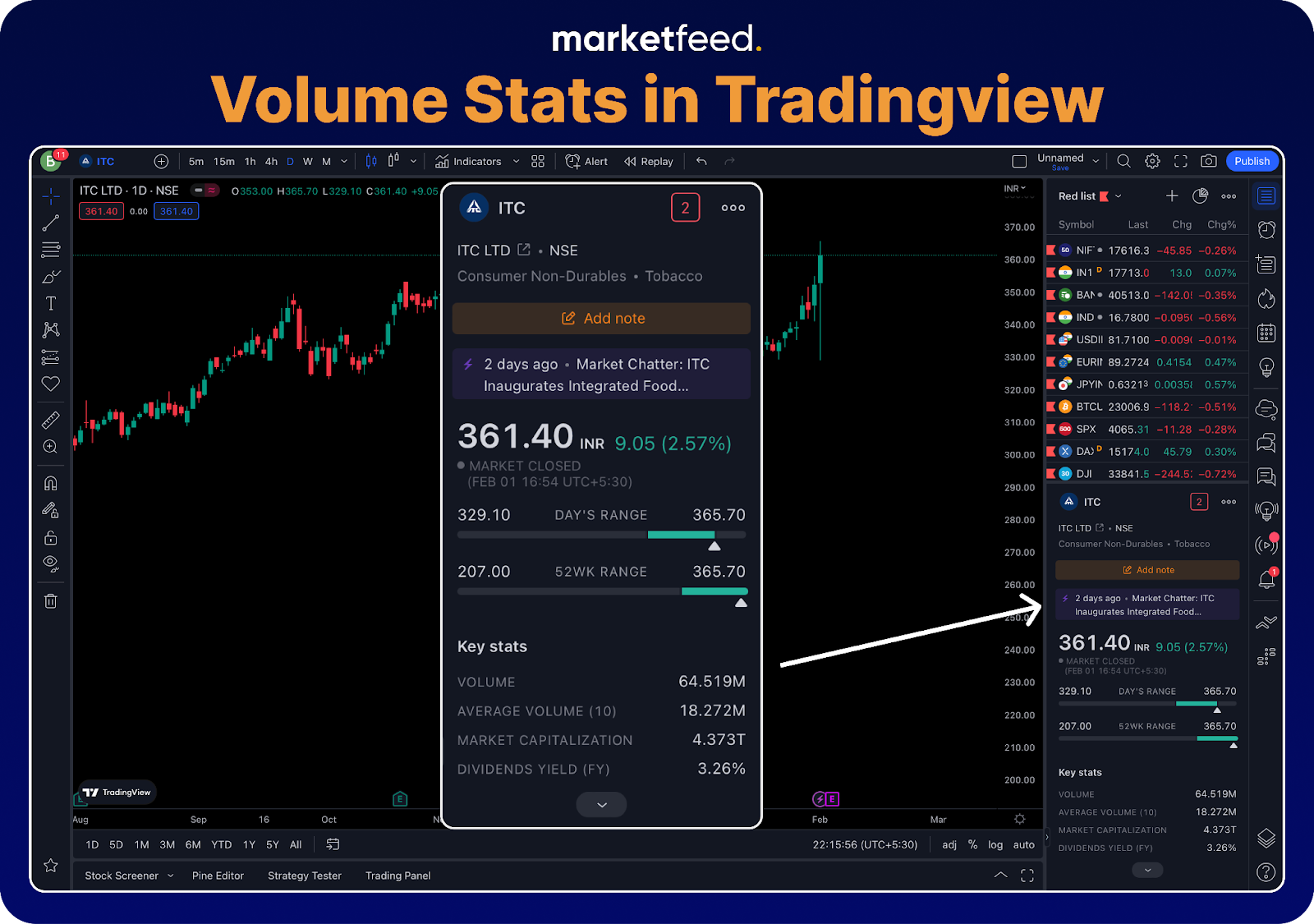
If you go to the key stats section on the right side of the TradingView terminal, it shows the volume of the day and the average volume over the past 10 days.

volume in tradingview | marketfeed

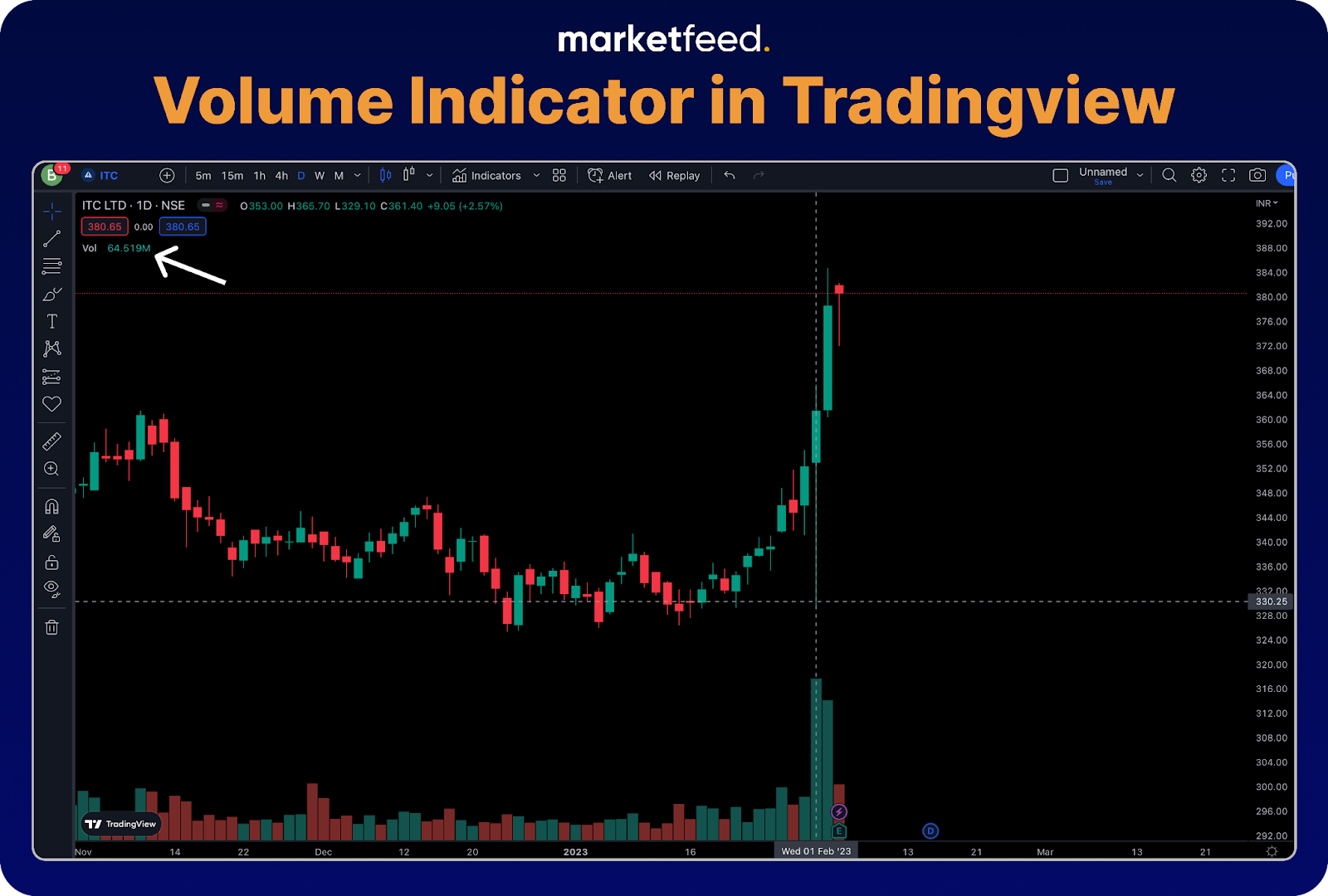
To add the volume indicator to your chart in TradingView, go to the indicators menu on the top bar and add volume by searching on the search bar. 

Once you add the volume indicator, the volume bars will be displayed at the bottom of the chart, like in the below image.

volume in stock market indicator | marketfeed

If you hover the crosshair over any candle, the volume during that time period will be displayed on the top left side of the chart. Each volume bar corresponds to the candlestick above it. In the above example, each candle is of a 1-day timeframe and therefore each volume bar represents daily volume. If you change the timeframe to, say 5 minutes, each volume bar represents volume during 5-minute periods.

Why are Volume Bars Red & Green?

The colour of the volume bar depends on the colour of the candlestick. If the candlestick is red, then the corresponding volume bar will also be red.

A common misconception among beginners is that red volume bars indicate more sellers. A red volume bar only indicates that sellers are more active than buyers and as a result the price gets pushed down, making the candle red or bearish.

Uses of Volume in Stock Market

  • Volume is one of the ‘fundamental truths’ about the market because it indicates the interest in the stock. A higher volume indicates a higher interest.
  • Volume helps us confirm if trends and patterns are backed by the interest of the majority of market participants. For example, If a breakout is happening without volume, it could be seen as market participants not ‘believing’ in that move.
  • Active traders generally prefer high volume when trading an instrument. When you are considering entering a trade, always check if there is enough volume in that security. If it is illiquid, you will face liquidity issues.

Using Volume for Trend Confirmation

volume trend | marketfeed

Traders can use the above cheatsheet to confirm trends and patterns by incorporating volume analysis. To understand if the volume is increasing or decreasing, you can observe the volume bars and their size over a specific period. If the size of the current volume bar is higher than the previous bar.

Practical Application of Volume for Trading

1. You can use volume to confirm breakouts/breakdowns

  • Helps to enter, exit, or remain in a trade.
  • For example, if a breakout happens and there is an increase in volume, you can consider entering a long trade.

2. Use volume shocker screeners to find good stock trading opportunities.

  • You can use platforms like Chartink to filter out stocks with high volume to find trading opportunities.
  • Go to chartink.com and click on screeners.
  • Search volume shocker in the search bar to find screeners that filter stocks with unusual volume.
  • You can select stocks from the screened list to identify stocks with potential trading opportunities.

Volume Profile Indicator

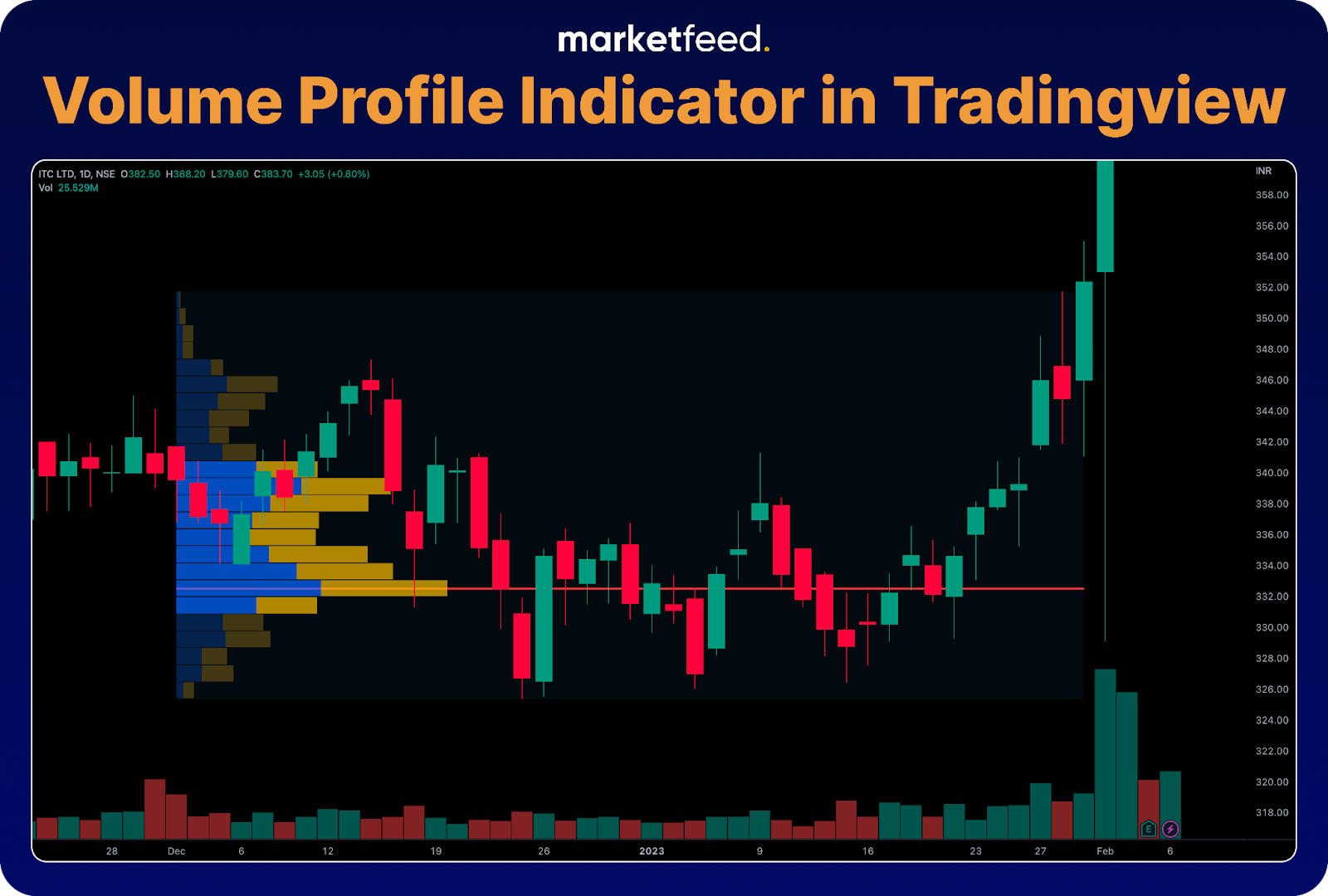
A volume profile indicator shows the trading activity at different price levels over a period of time. 

  • It reveals the significant price levels on the chart by showing the total volume traded at different price levels.
  • A red line indicates the zone with the highest trading volume.
  • Helps to gain an understanding of where significant volumes are being traded, giving them a clearer perspective on market activity and sentiment.

How to Access the Volume Profile Indicator?

  • Select the fixed range volume profile tool from the prediction and measurement tools under the tools panel on the left side of the chart. 
  • Since this indicator calculates data over a time period, we need to set a start and end time. This can be done by clicking on the chart to define the starting time and clicking again to define the ending time. 
  • Once the start and end time is set, the indicator will display the data in the form of a histogram based on the volume at the particular price levels.
volume profile indicator | marketfeed
  • In the above example, the data is measured from December 1, 2022 to January 31, 2023.
  • The red line indicates that the highest number of transactions took place at ₹333.
  • The histogram indicates the number of transactions at different price levels.

In conclusion, volume can help you assess the strength or conviction of buyers and sellers in determining a security’s price and thus volume analysis is one of the most useful tools in technical analysis. Always make sure to use volume analysis in combination with other analyses for better results!

Categories
Jargons

What is the Stock Market? How Does it Work?

Have you ever wondered what the stock market is and how it works? If yes, you’re not alone. The stock market can seem confusing and intimidating for people who don’t know how it works. But don’t worry! In this article, we shall learn what the stock market is, how it works, and who market participants are.

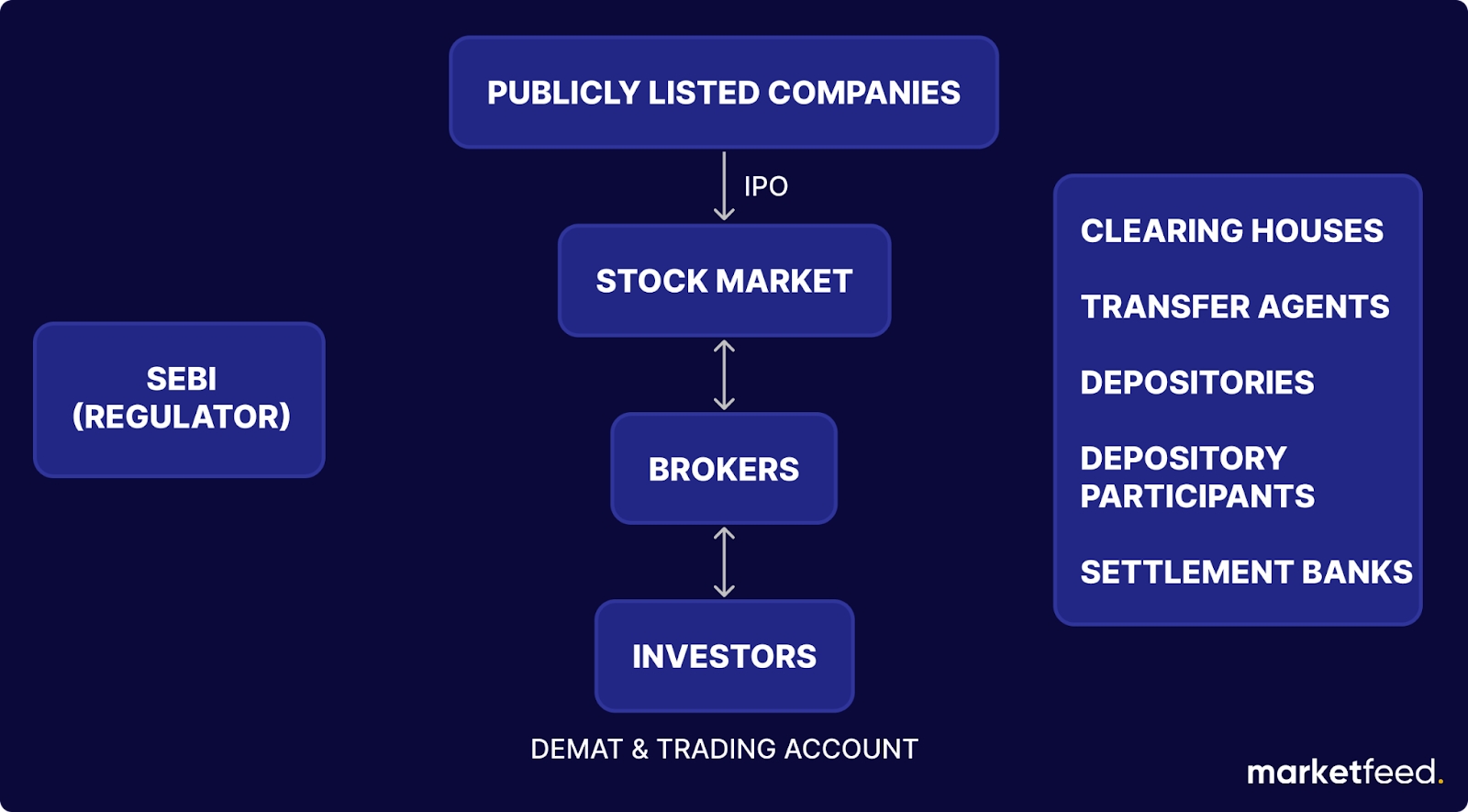
Given below are the different participants in the stock market. We’ll understand more about them through a story.

stock market participants | marketfeed

Let’s Look at a Story!

Mr. Jignesh, an owner of a renowned supermarket in Bengaluru, has been successfully running his business for the past ten years. The supermarket has been generating decent revenue and is highly profitable. His business also has goodwill (proprietary or intellectual property and brand recognition). When it comes to business, there are two things you must understand:

  • Ownership of a Business
    Jignesh completely owns and runs the supermarket, and the profit is not shared with anyone else.
  • Valuation of a Business
    Anything and everything has a value attached to it, even a business. The business has been generating income for Jignesh for the past ten years, so it is valuable. The valuation of a business is the economic value of how much a person has to pay to acquire 100% of the business from him. Let’s assume that the supermarket is valued at ₹1 crore.

    Since Jignesh is growing old, he feels he doesn’t want to work as much as he did and is looking for a partner to operate the business in return for 50% of the ownership of his business. He decided to share his business with a partner, Ms. Riya.

What are Shares?

Shares represent units of ownership of a company. A shareholder is entitled to a part of the profit that the company generates. 

The ownership of Jignesh’s supermarket was divided into 1000 equal shares. The value of each share can be mathematically expressed as:

Value of 1 Share = Total Valuation / Total Number of Shares

= 1,00,00,000 / 1000

= ₹10,000 per share.

Riya agreed to acquire 500 shares (50%) of the supermarket in consideration of the value of those shares in Cash.

Valuation = Total Number of Shares x Value of Each Share

Riya paid ₹50,00,000 to Jignesh, and they both became partners in the supermarket business. 

A few years later, the business expanded with several profitable outlets across Bengaluru. Now, Jignesh and Riya want to open 200 more stores nationwide, for which they need a large amount of capital. The easiest way to get funding or capital is by taking out a loan from a bank and using the business’ assets as collateral. However, this carries the risk of falling into a debt trap. If they are unable to repay the loan for some reason, the assets will be seized by the bank to recover the loan. Jignesh and Rita did not want to deal with these issues. 

An alternative would be to find more people who are interested in becoming part-owners of the business across Bengaluru. Even then, they may not be able to find enough people to do so. At this point, Jignesh becomes aware of the stock market. If they convert their company into a Public Limited company, they can raise capital from thousands of investors across India and other countries. The process of issuing shares to the public to raise capital for a business is known as an Initial Public Offering (IPO).

What is the Stock Market?

A stock market is a place where shares of publicly listed companies are traded. It is a physical place or institution where shares are bought and sold.

So Why Do Companies Go Public?

  • To Raise Capital: The company can gather funds for many objectives, such as paying liabilities (loans) and funding its future expansion projects.
  • Reward Founders & Early Investors: The founders and early investors of a company hold a good portion of the shares in their entity. They can sell these shares to the public and the proceeds go directly to them rather than to the company. It can be considered as a reward for all the time and effort they put in to build the company from the ground up. So going public can give them an early exit.

What are Stock Exchanges?

A stock exchange is a financial institution where different participants come together to buy and sell securities (shares). It provides the infrastructure for these activities. The term Stock Market is an umbrella term for a collection of Stock Exchanges.

The two major Stock Exchanges in India are:

  • Bombay Stock Exchange (BSE)
  • National Stock Exchange (NSE)

BSE is older than NSE, which explains why more companies are listed on the BSE than NSE. 

Coming back to the story, Jignesh’s company had a total of 1000 shares, out of which they decided to issue 15% of the shares to the public. Thus, 150 shares are being offered to the public. 

1000 x 15% = 150

How Many Shares Will a Company Have? Who Decides That?

A company’s promoters can decide how many shares it should have. Some firms may have thousands of shares, while others may have lakhs or even crores of shares. 

For example, the valuation of Jignesh’s company was ₹1 crore in the beginning. But the business has grown over the years, and now the valuation stands at ₹2 crores, bringing the value of each share to ₹20,000. 

Why do Investors Exist? What are their Objectives?

The two main objectives of investors are:

1. Capital Appreciation – When a company grows, the price of its shares increases. If investors buy the shares of a company when the prices are low and sell them when the prices increase, they can make good profits via capital appreciation.

2. Earn Dividends – When a company makes profits every year from its operations, it distributes a portion of the profits to shareholders as dividends. However, it is not necessary for them to declare dividends every year. It’s the company’s choice whether to issue dividends or not. The company may fully retain its profits for future capital needs or may give out a part of the profit and retain the rest. 

In short, the objective of a public limited company is to raise capital for its funding needs and the investors’ objective is to grow their money. But the real question is, how does the stock market fit into this?

Why do Stock Markets Exist? 

The stock market provides an avenue for a public company to raise capital from investors in consideration of shares. Investors will be able to grow their savings and wealth through capital appreciation and dividends. The stock market is the facilitator for the two parties. 

What are Primary Market and Secondary Market?

The stock market is divided into two:

1. Primary Markets
It is a market wherein a firm issues securities/shares to investors directly (via an initial public offering or IPO). These sale proceeds go directly to the issuer to finance their capital requirements.

2. Secondary Markets
It is the market where previously issued securities are bought and sold among investors. These sale proceeds go to the person who holds the securities. 

In our story, many people wanted to buy shares of his company after the IPO. However, the company does not issue any more shares as the IPO is already done. So these new investors can only buy the shares from those already holding them. 

When such transactions happen between investors in the secondary markets, the price of the share gets updated. If an existing shareholder sells the stock to another person for ₹20,100, the price of all the shares of the company gets updated to ₹20,100. Consequently, the net worth of the shareholders increases as the price of the shares they hold increases. 

Who Decides the Price of a Stock?

The two reasons which decide the price of a stock are:

  • Company’s Actual Valuation: A company’s value fluctuates as the revenue, profit, and goodwill change. The future prospects of the company also contribute to the valuation. If the revenue and profits go down, the valuation may also decrease, which causes the share price to drop. However, if the revenue and profit increase, the valuation could also rise.
  • Demand & Supply: The market forces of supply and demand also play an important role in deciding the share price. If the demand for the stock increases, then its price also increases since supply is limited. If the demand for the stock decreases, then its price also decreases since the supply is the same. Demand for the stock depends upon market sentiments, which refers to the overall attitude of investors toward the company. If the market sentiment is positive, then the demand for the stock will be high, thus driving the stock price up. Demand for the stock will be less if the market sentiment is negative. 

Why Do Stock Prices Fluctuate Every Second?

The Last Traded Price (LTP) refers to the price at which the previous share transaction took place. The stock market has lakhs of participants, and transactions happen every second. If a person sells a stock for ₹150, then the LTP at the time will be ₹150. The very next second, if a stock is sold for ₹149, then the LTP changes to ₹149. This is the reason why stock prices fluctuate every second.

Who are Brokers?

If you want to buy a stock, you cannot do it directly from the stock market. We have to approach a stockbroker, and the broker will transact on our behalf. A broker is an intermediary that facilitates transactions in the stock market. If you want to buy a stock, your broker will find a seller in the stock market on your instruction and facilitate the transaction between you and the seller. 

Before technology evolved, an investor had to physically visit the broker’s office and instruct them to buy the stock. The broker would then physically go around the stock market, find a seller, and conduct the transaction. But now, technology has evolved, and transactions can be conducted via our phones. Brokers are accessible on computers and smartphones, and investing & trading are as easy as ever. 

It is absolutely necessary to have an account with a broker to participate in the stock market. As intelligent stock market participants, we must have multiple broking accounts for different purposes. We can use one account for our long-term investing activities and another one for trading. Successful traders use multiple broking accounts for different trading strategies. 

How Does a Broker Work?

how does a stock market broker work? | marketfeed

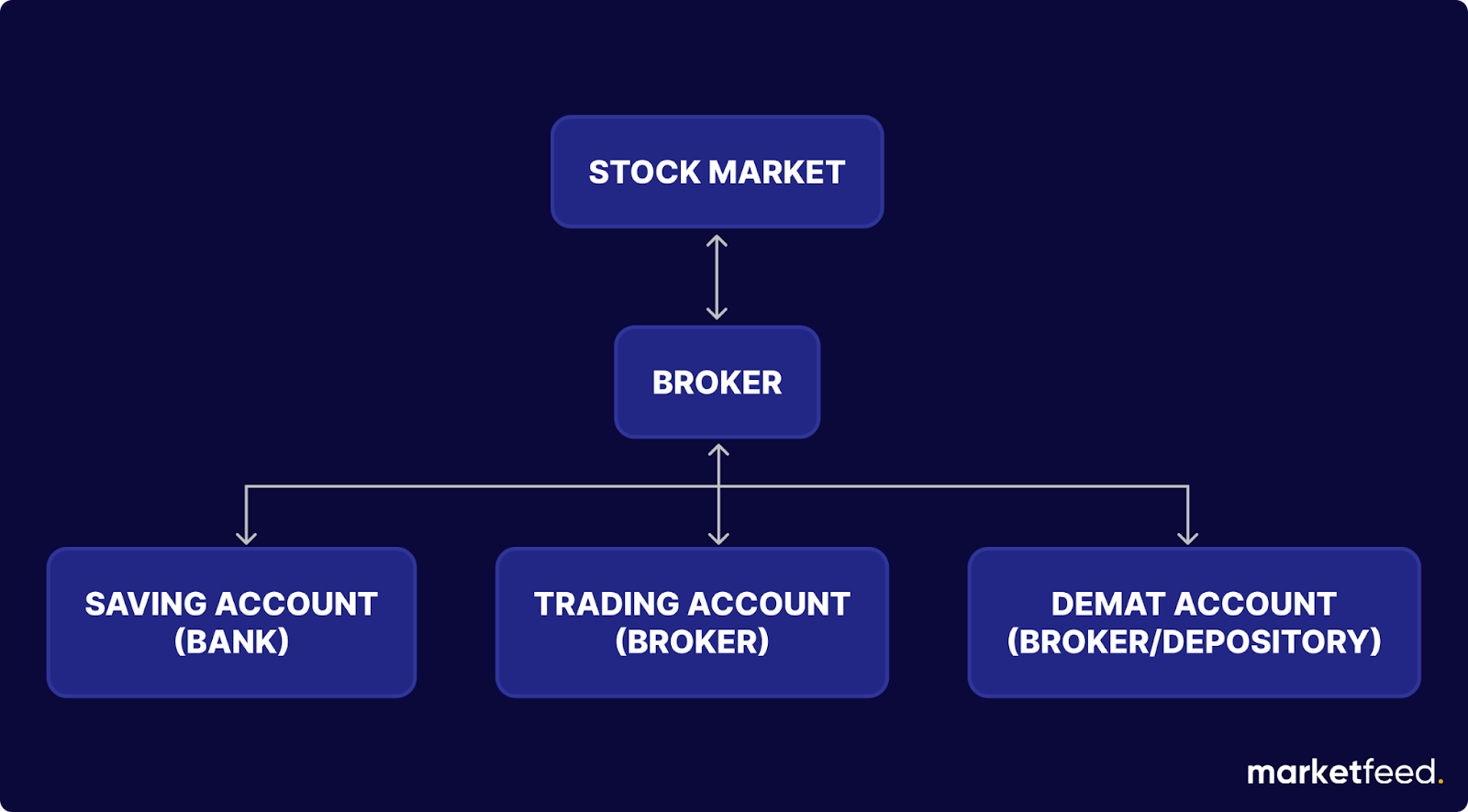
There are two accounts that we open with a broker. Even though they are two separate accounts serving different purposes, both of them come in a bundle.

1. Demat Account
A Demat account or dematerialisation account allows you to hold your shares in an electronic format. It converts the physical shares into an electronic form, therefore dematerialising them. Demat accounts are maintained under depositories.

Earlier, the proof of ownership of shares, bonds, or debentures was in the form of physical share certificates. However, this system had many drawbacks, such as the risk of losing the certificate, fire hazards, getting wet, or even a mismatch in the signatures. 

2. Trading Account
A trading account acts as an interface between the investor’s bank savings account and a broker. For the broker to conduct trading activities on our behalf, they need money. We transfer the money we have in our savings account to a trading account with which the broker then conducts trading activities. Money can be transferred using net banking or UPI.

If we want to buy a stock, we instruct the broker to buy the stock, and the broker uses the money we have in our trading account to conduct the transaction. Similarly, when we sell a stock, the proceeds of the sale come directly into the trading account. 

An Illustration to Understand How Demat & Trading Account Works

  • Arun wants to buy a share of Mahindra & Mahindra (M&M) from the stock market. The first step that Arun should take is to open a Demat and trading account. Arun opens a Demat & trading account with a leading broker and deposits money into his trading account by transferring from his bank savings account via UPI. 
  • When the market opened at 9:15 AM, Arun placed an order with his broker to buy 1 quantity of M&M stock. The market price of M&M at the time was ₹1000. His trading account was debited ₹1000 by the broker to finance the transaction. Apart from this, a small amount was deducted as taxes and charges. 
  • Even though the transaction was completed, the stock will only be transferred into his Demat account after T+1 days, which means he will receive the stock in his Demat account on the next working day. 

While selecting brokers, we should choose the brokers that satisfy our various investing and trading needs. YOu can open a Demat and trading account using the links given below: 

Fyers (FREE) – https://bit.ly/3tx3ZJx

Zerodha – https://bit.ly/3AlErmb

Upstox – https://bit.ly/3OUAJnR

(Full disclosure: These are affiliate links. Do use the links if you wish to support us at no extra cost. ❤️)

Click here for step-by-step instructions on how to open a Demat and trading account.

What are Depositories?

If your shares are held by the broker, there is a risk of the broker running away with the shares they have. As a remedy, all Demat accounts are maintained by depositories. A depository is an institution that acts as a custodian of Demat accounts and shares. A Demat account is opened by a depository participant, who acts as an intermediary between the depository and investors. 

There are two depositories in India, which are governed by the Government of India: 

1. CDSL – Central Depository Services Limited
2. NSDL – National Securities Depository Limited

what are depositories | marketfeed

Who are the Other Facilitators?

The other facilitators part from brokers, depositories, and depository participants are: 

  • Clearing Houses – It is an intermediary between buyers and sellers of financial instruments. It is an agency or separate corporation of a futures exchange responsible for settling trading accounts, clearing trades, collecting and maintaining margin monies, regulating delivery, and reporting trading data.
  • Transfer Agents – A transfer agent keeps records of who owns a publicly traded company’s stocks and bonds. They also ensure investors receive dividends on time.
  • Settlement Banks – It refers to a customer’s bank where payments or transactions are finally settled and cleared for customer use.

What is a Market Regulator?

The Indian stock market is a place where transactions worth lakhs of crores of rupees take place. The Securities and Exchange Board of India (SEBI) is a regulatory authority established under the SEBI Act 1992. It’s the principal regulator for stock exchanges in India. SEBI’s primary functions include protecting investor interests and promoting and regulating the Indian securities markets. It is a government organisation. SEBI exists as the watchdog to make sure nothing wrong is happening in such a massive money-involved ecosystem.

Throughout the article, we discussed the various participants in the stock market and how they all work together in the stock market. We’ve also understood the basics of what the stock market is, who its participants are, and how it works!

Categories
Jargons

How Much Returns Can You Realistically Make From the Stock Market?

From one of our previous articles, you might’ve understood why you should be interested in the stock market and invest or trade. However, it’s important to have a perspective on how much money (or returns) you should aim to make from the stock market. If you ask beginners, the two most common answers would be as much as possible. Or in absolute terms, maybe ₹5000 or ₹10,000 a day with very little capital. If this is your perspective, then you need to reconsider it as soon as possible!

The answer to the question in the title is: meet industry benchmarks.

What are Industry Benchmarks?

An industry benchmark is a reference point that helps you compare your performance with the leaders in the industry. For example, if the average time the top 10 race drivers take to finish a lap is 1 minute, then the industry benchmark is 1 minute. If a driver finishes the lap in 1 minute, we can consider them successful in that particular industry as they have surpassed the industry benchmark.

We now have clarity on the activities you can do in the stock market: trading and investing. But what are the industry benchmarks in trading and investing?

Industry Benchmark in Trading

If we examine how much Jim Simons (one of the most successful traders in the world) earns, we see that he generates 70% returns on his deployed capital each year. That means that if he had deployed ₹1 crore of capital on trading, he would’ve made around ₹70 lakhs that year. The top traders in India make nearly 40-70% returns on their capital every year. So the industry benchmark of 40-60% returns is what you should aim to generate through trading. 

However, the estimations for industry benchmarks were done with scalability in mind. It is possible to make 100%, 200%, or possibly, even more, returns with small capital, but it may not be scalable. Whatever your capital may be, you should target 40-70% profits per annum. 

Industry Benchmark in Investing

It is common knowledge that Warren Buffet, renowned as the greatest investor of all time, averages CAGR returns of 18% per year. The late Mr. Rakesh Jhunjhunwala, India’s top investor, once said “If you’re able to earn an 18% return on your portfolio, you are no less than a king, and if the return is 21%, you are an emperor.” Even India’s leading portfolio management services generate CAGR returns of 20-30%. From this, we can conclude that 18-20% is the industry benchmark for investing, and this is what you should aim to achieve.

3 Points To Remember

1. Set a Target

Without a target or goal, it is like getting into a car without knowing where to go. To comprehend what is possible, practical, and achievable, you need to be aware of industry benchmarks.

2. Think in Percentage Terms

While discussing profits, we should express them as percentages rather than absolutes. This is because absolute terms do not provide any context for how much capital was used to generate those returns. For example, if someone says they made ₹1 lakh a week and used ₹10 crore capital, that would only be 0.1% returns, which is not great. So we should always think and talk in percentage terms.

3. Making Out of the World Returns is Possible

We discussed how generating massive returns of 200% or more may not be practical because of scalability issues. There are a few exceptional traders who make those kinds of returns, but not everyone can be at that level. It may not be possible or practical if we all aim for high returns from the start. Instead, we should focus on beating the benchmarks and then gradually increasing our targets when needed.

To conclude, you need to set realistic expectations of what you can achieve. People often make the mistake of thinking that they’re going to make a fortune overnight. The reality is that it takes time to make money in the stock market, and you need to be patient. If you’re ready to start investing in the stock market, then make sure that you have the right perspective. Otherwise, you’re setting yourself up for disappointment.

Categories
Jargons

How to Build Wealth Through the Stock Market? Investing vs. Trading

Before you learn about the stock market, it is essential to understand why it should interest you, how you plan to generate income from it, and what kind of activities you should do in the market. There are a lot of different perspectives out there when it comes to the world of the stock market. Some people think it’s a great way to make money, while others think it’s a huge gamble. The core objective of this article is to change mindsets and set a strong perspective.

Why Should You Be Interested in the Stock Market?

To understand why you should become interested in the stock market, we must first understand what everyone is striving for in today’s socio-economic environment. What is the absolute goal of an average person? It’s financial freedom!

What is Financial Freedom?

Financial freedom is a desirable condition of having enough money in your bank account to cover your expenses without having to work, run a business, or rely on others. Many people aspire to achieve it before they retire. Financial freedom allows you to pursue your passions without worrying about expenses, even if your passions do not generate income.

Normally, people save a part of their income and deposit it in their savings account, fixed deposit, or recurring deposit. They invest to generate wealth, which can then be used to take care of any long-term financial goals or expenses after retirement. However, it is impossible to achieve financial freedom by such methods as the annual returns generated by these financial instruments are only 5-7%. They cannot help you generate enough income to beat inflation

Inflation in India stands at ~6%, and if you keep your money in a savings account or deposit it into FDs or RDs, you’re barely beating inflation. You won’t even make enough money to keep aside as savings after accounting for all expenses. So what can you do?

The stock market can be one of the most convenient and easy ways to achieve financial freedom as it offers more returns on your investments.

How to Use the Stock Market to Achieve Financial Freedom?

There are mainly two types of activities in the stock market that a retail participant can take part in:

  • Trading
  • Investing

Trading is the buying and selling of stocks for short periods (intraday or for less than a year) or futures and options to generate income in a short period. There are different types of trading such as intraday trading, swing trading, and positional trading, which we will discuss in later sessions. People trade to generate cash flow instead of generating wealth through long-term investing.

Long-term investing involves buying and holding stocks, bonds, commodities, mutual funds, and exchange-traded funds (ETFs) for extended periods to grow your wealth.

How do Trading and Investing Solve the Problems of an Average Person? 

If you recall, the key issue most people face is the inability to beat inflation. So an average person can beat inflation by investing in the stock market for the long term instead of depositing their savings in a fixed deposit, recurring deposit, or even their bank savings account. Long-term investing can help you amass great wealth by generating higher returns. We should view it as a fundamental duty of every citizen.

The second pressing issue for many people is insufficient income to start investing. With rising expenses, they may not have enough salary or wages to set aside to make investments. To fix this issue, a person can upskill for a higher-paying job, start a business, or trade in the stock markets. You can trade both actively and passively.

Should Everyone Trade?

The only motive for trading is to make money or an extra income. Trading is a choice. If you have the potential to make enough income by increasing your skills in your current job or business, then trading is not necessary.

The stock market is a great way to make money. However, it can also be risky. So it’s important to learn the fundamentals of the stock market before you invest or trade. We hope that you have gained clarity on why you should be interested in the stock market and whether you should engage in trading, investing, or both.

Categories
Jargons

Share Market Investment Tips & Tricks

Investing in the share market can be a great way to grow your wealth and achieve your financial goals. However, it can also be overwhelming for those who are just starting out. With so many stocks to choose from and a constantly changing market, it can be difficult to know where to start. In this article, we’ll explore a few share market investment tips and tricks to help you navigate the market and make intelligent decisions.

1. Understand the Different Types of Stocks and How They are Classified

Before you start investing in the share market, it’s important to understand the different types of stocks and how they are classified. Stocks can be classified in several ways: by market capitalization, sector, or investment style. 

  • Market capitalization refers to the total value of a company’s outstanding shares and categorises stocks as large-cap, mid-cap, or small-cap. 
  • Sector refers to the industry in which a company operates, such as technology, healthcare, banking, or energy. 
  • Investment style refers to the approach that an investor takes while selecting stocks. Growth investors seek companies that offer strong earnings growth, while value investors look for stocks that appear to be undervalued in the marketplace.

2. Analyse Financial Statements to Pick Stocks

One of the most important aspects of investing in the stock market is understanding how to analyse financial statements and company earnings to pick stocks. Financial statements provide insights into a company’s financial performance, including its revenues, expenses, assets, and liabilities. By analyzing these statements, investors can gain insights into a company’s financial health and potential for growth. Company earnings (quarterly and annual) reports provide additional information on a company’s performance and can help investors make informed investment decisions.

3. Identify Market Trends and Investment Opportunities

Another key to successful investing in the share market is identifying market trends and investment opportunities. At any given time, the market can be in an uptrend, downtrend, or sideways trend. By staying up to date with market news and trends, investors can identify emerging sectors and companies that have growth potential. This can help investors to capitalise on opportunities and maximise their returns.

4. Create a Diversified Portfolio of Stocks to Reduce Risk

Creating a diversified portfolio of stocks and other investments is essential for reducing risk and maximising returns. By spreading your investments across different asset classes, sectors, and geographies, you can minimise the impact of any single investment on your overall portfolio. This can help to reduce the risk of loss and increase the potential for long-term growth.

5. Learn Technical Analysis to Make Informed Trading Decisions

Technical analysis refers to the study of historical price and volume to forecast future price movements. It does not take into account the financial statements of a company but only the historical price and volume of the shares of the company. Technical analysis can help investors to make informed trading decisions based on market trends and signals. Charting is a tool that is commonly used in technical analysis to visualise market data and identify patterns.

7. Start Systematic Investment Plans

Systematic Investment Plans or SIPs are a smart and hassle-free way to invest in stocks. It. involves investing a fixed amount of money at regular intervals, such as monthly or quarterly, regardless of market conditions. Whether you’re a beginner or a seasoned investor, SIPs provide discipline, convenience, and the potential for long-term wealth creation. 

8. Invest in Blue-Chip Stocks

Blue-chip stocks are stocks of large, well-established companies with a proven track record of performance and stability. These stocks are often considered to be safe investments, as they are less likely to be affected by market volatility or economic downturns. By investing in blue-chip stocks, investors can benefit from steady growth, dividend payments, and the potential for long-term capital appreciation.

9. Avoid Stocks with High Volatility or Questionable Financial Statements

While investing in the share market can be lucrative, avoiding stocks with high volatility or questionable financial statements is important. High-volatility stocks can be risky and unpredictable, making them unsuitable for risk-averse investors. Stocks with questionable financial statements, such as high debt levels or low-profit margins, may also be risky investments. By conducting thorough research and analysis, investors can avoid these types of shares and minimize their risk of loss.

10. Approach a Financial Advisor to Manage Your Portfolio

Financial advisors are professionals who can help investors to manage their portfolios and reduce risk. They provide personalised investment advice and guidance based on an investor’s individual goals and risk tolerance. By utilizing their services, investors can benefit from professional advice and guidance, as well as a reduced risk of loss.

11. Avoid Common Investing Mistakes

Emotional investing and market timing are common investing mistakes that can lead to significant losses. It refers to making investment decisions based on emotions, such as fear or greed, rather than sound investment principles. Market timing refers to trying to predict the direction of the market and making investment decisions based on these predictions, which can be risky and unpredictable. By avoiding these common investing mistakes, investors can reduce their risk of loss and maximise their returns.

12. Stay up to Date with Market Trends

Staying up to date with market trends and news is essential for making informed investment decisions. By reading financial news and analysis, investors can gain insights into market trends, emerging sectors, and potential investment opportunities. This can help investors to make informed investment decisions and maximize their returns.

13. Set Realistic Financial Goals and Determine Your Risk Tolerance

By setting achievable financial goals, such as saving for retirement or a down payment on a house, investors can stay motivated and focused on their long-term objectives. Determining your risk tolerance is also important, as it can help you to select investments that align with your risk appetite and minimise your risk of loss.

In conclusion, investing in the share market can be a great way to grow your wealth and achieve your financial goals. While there is always a risk involved with investing, following these tips and tricks can help you limit the risk of loss and maximize your returns. Remember, investing in the share market is a long-term game. It requires patience, discipline, and a willingness to take risks. Whether you are a seasoned investor or just starting out, these tips and tricks can help you to succeed in the share market and achieve your financial dreams.

Disclaimer: The share market investment tips and tricks mentioned in the article are purely for educational purposes. Please do your own research or consult a registered financial advisor before investing in stocks.

Categories
Jargons

What are the Best Ways to Make Money From the Stock Market?

The stock market is where shares of public companies are bought and sold. A share represents ownership in a company, and shareholders are entitled to a portion of the company’s profits. People have different perspectives on the stock market. Some consider it a great method to generate wealth, while others perceive it as a risky financial gamble. We firmly believe that the stock market can serve as an incredible opportunity for wealth generation and passive income. You need to gain a deep understanding of how it works to make money from the stock market.

Making money from the stock market is not a walk in the park. While the potential for making money is high, it also has an equally high risk of making losses. In this article, we will take a closer look at a few of the ways by which one can make money from the stock market.

1. Investing in Index Funds or Exchange-Traded Funds (ETFs)

An index fund is a type of mutual fund that tries to replicate the returns made by a stock market index such as Nifty 50 by investing in the constituent stocks of that index. These funds are passively managed. This means that the fund manager invests your money in the same securities that constitute the index and in the same proportion. The portfolio composition will remain unchanged.

An Exchange Traded Fund (ETF) is a type of fund that tracks the performance of a certain basket of assets such as an index and can be traded on the stock exchange. Unlike mutual funds, ETFs have low transaction costs, can easily be traded through any broker, and requires very low minimum investment.

2. Investing in Blue-Chip Stocks or Dividend-Paying Stocks

Blue-chip stocks are stocks of large well-established companies with an impeccable reputation and track record of stable earnings and performance. They are fundamentally strong companies with very high market capitalisations. Investing in these stocks is an easy and low-risk way to make money from the stock market. 

Companies that make a profit may choose to share a portion of those profits with shareholders as dividends. As a shareholder, you will receive dividends based on the number of shares you own. Dividend payments can be quarterly, annually, or semi-annually. Investing in dividend-paying stocks can be a way to earn money from the stock market, as dividends provide returns in the form of cash to your bank account.

3. Investing in International Stocks or Emerging Market Funds

International funds are mutual funds that invest in the stocks of global multinational companies. Meanwhile, an emerging market fund is a fund that provides investors access to countries and regions that are undergoing economic transition. One can invest in such funds like any other mutual fund.

4. Investing in Initial Public Offerings (IPOs)

An Initial Public Offering (IPO) is a method by which a company raises equity capital from the public. Equity represents the ownership of a company. Once a company’s IPO is completed, its shares get listed in a stock exchange, i.e. BSE & NSE. You can invest in IPOs of fundamentally strong companies after thorough research. If the public response is positive, you also stand a chance to make money through listing gains. 

5. Trading in Options & Futures Contracts

Futures and options are derivative contracts that derive their value from an underlying asset. These underlying assets can be indices, equities, currencies, commodities, etc. Although derivative contracts were originally invented to hedge risk, it is popularly used as a speculative instrument these days. With the right knowledge and skill, it can be a great way to make money from the stock market. However, derivatives trading is considerably hard and requires practice and learning. This makes it unappealing for beginners.

6. Day Trading or Swing Trading

Day trading or intraday trading refers to the buying and selling of equities or derivatives in a day. For example, if you buy a stock at 10 AM after the market opens and sell the stock at 2 PM before the market closes, it is intraday trading. The trader exploits the small price movements in the stock to make a profit. Features such as short-selling and leverage help to enhance returns and make profits even in falling markets.

Swing trading is a style of trading in which the trader buys and holds the stock for two or more days to capture the short to medium-term price movements in the stock. The trader takes delivery of the stocks and no leverage will be available. Short selling is also not possible in equity swing trading.

7. Investing in Value Stocks or Growth Stocks Based on Market Trends

Value stocks and growth stocks represent different investment philosophies: value investing and growth investing. In value investing, the focus is on finding stocks with intrinsic values higher than their current market value. In growth investing, the emphasis is on companies with strong growth prospects, regardless of their current valuation. Value investors like Warren Buffet and Rakesh Jhunjhunwala are known for their approach to buying undervalued stocks. Growth investors prioritise companies with good fundamentals and growth potential even if their current market value is higher than their anticipated or calculated value.

8. Investing in Socially Responsible Stocks or Funds that Align with Your Value

Investing in socially responsible stocks or funds that align with your value is a way to make money from the stock market. Here, you support companies that are committed to social, environmental, and governance (ESG) principles, while seeking returns. You can start by defining your values and researching funds or stocks that align with those values. Then you can move to invest in these funds or stocks.

Powerful Investment Hacks:

1. Approach a Financial Advisor to Manage Your Portfolio

Seeking professional advice can be beneficial, especially if you’re new to investing or prefer a hands-off approach. A financial advisor can provide personalized guidance based on your risk tolerance, financial goals, and investment horizon. These professionals can help construct and manage a well-diversified portfolio while ensuring it aligns with your individual circumstances.

2. Avoid Common Mistakes Such as Emotional Investing, Overtrading

Always have a solid investment plan, diversify your portfolio, avoid overtrading and chasing hot stocks, manage your emotions, regularly review and evaluate your portfolio, and seek professional advice if needed. Discipline and mindfulness can increase your chances of achieving long-term investment success.

3. Learn Technical Analysis to Make Trading Decisions

Technical analysis is a technique that uses historical price and volume data to form analysis and forecast the direction of prices that can be used for decision-making. Technical analysis can be applied to securities in any freely traded market around the globe. Utilising technical analysis and charting can be a helpful tool for making trading decisions, especially for short-term traders who rely on technical indicators and price patterns.

4. Start SIPs

Systematic Investment Plans or SIPs are a smart and hassle-free way to invest in stocks. It. involves investing a fixed amount of money at regular intervals (monthly or quarterly) regardless of market conditions. Whether you’re a beginner or a seasoned investor, SIPs provide discipline, convenience, and the potential for long-term wealth creation. 

5. Analyse Financial Statements to Pick Stocks

Analysing financial statements and earnings is fundamental to stock picking. Consider reviewing financial health and performance, assessing profitability and growth prospects, and comparing with peers. Thorough research, considering economic and industry factors, and risk awareness are crucial. Fundamental analysis equips you with the right knowledge for analysing financial statements and company earnings.

In conclusion, making money from the stock market requires thorough research, planning, and risk management. Align your investments with your financial goals, risk tolerance, and time horizon, and regularly review and adjust your strategy. Start with small investments and gradually increase over time, staying informed about the market. A financial advisor can be valuable for beginners to avoid mistakes and make informed decisions.

Disclaimer: This article is only for educational purposes. Please do your own research before investing or trading in the stock market!

Categories
Jargons

What are Active Income and Passive Income?

“If you don’t find a way to make money while you sleep, you will work until you die” – Veteran investor Warren Buffett. But what does he mean when he says, ‘Make money while you sleep’? In this article, we will explore the concepts of passive and active income, their differences, and a few ways to earn a passive income.

What is Passive Income?

Passive income is what you earn when you don’t actively work or put forth constant effort on a task/job. It includes regular earnings from a source other than your employer. Simply put, it is an income source that will make you money while you sleep. 

Examples of Passive Income:

Returns from stock/mutual fund investments, dividends, rental income, royalties from book sales, and YouTube revenue are the best examples of passive income.

What is Active Income?

Income earned by performing a service or work actively is termed active income. All the income sources that require persistent work and effort are active income sources.

Examples of Active Income:

The best examples are salaries, wages, and commissions earned from jobs and professions.

How to Earn Active Income?

The most traditional and popular method of earning active income is through full-time jobs. The skills, knowledge, and expertise you have in an area get used for the job. A professional job requires a college degree, while a non-professional job does not. You can look for job openings online on platforms such as Linkedin or in newspapers.

You can also earn an active income by offering freelancing services such as writing, video editing, coding, designing, etc.

What is the Difference Between Active and Passive Income?

  • Active and passive income are two types of income sources that differ only in terms of effort and time spent to earn them
  • An active income can only be earned by devoting a significant part of your time and effectively applying your skills or expertise. 
  • In contrast, passive income eliminates the need for active involvement after the initial effort. However, periodic maintenance and upkeep are required for some passive income sources.

Why is Passive Income Important?

“Passive income” has become one of the most trending topics over the past few years. But why is there so much hype around it? Its rising popularity can be attributed to people’s desire to make extra money without too much effort. A few reasons why you should have a passive income are discussed below:

1. Beat Inflation

Inflation is the increase in the general price level of goods and services in the economy. It eats away the purchasing power of money. With a passive income, you earn more money which can be used to meet expenses comfortably during periods of rising inflation.

2. Financial Freedom

Financial freedom is a desirable condition of having enough money in your bank account to cover your expenses without having to work, run a business, or rely on others. Having a passive income can improve your chances of financial freedom as the extra income can be invested in the long term.

3. Reduced Stress

The inability to pay bills and meet expenses is one of the leading causes of stress and anxiety. By sourcing extra funds through passive income, you will be left with more money that can be used to meet expenses comfortably and on time.

Passive income can give you more freedom and flexibility to pursue personal interests and goals. Spending quality time with family and friends, travelling, and exploring new hobbies can become a reality as passive income sources can reduce work hours.

4. Diversification

Passive income helps you diversify your income streams. Not having a backup source of income will greatly affect you if something happens to your primary income. It will also give you additional income hence increasing your purchasing power.

5. Early Retirement

Multiple passive income sources can create higher surplus funds that can be invested for the long term, which can mean early retirement. Reliable passive income sources can also contribute to retirement income.

Pros and Cons of Active and Passive Income

ProsCons
Active IncomeReliable, consistent income, career advancementRequires more time & energy, limited earning potential, lack of flexibility
Passive IncomeFlexibility, unlimited earning potential, diversification, financial independenceHigh initial investment, inconsistent & unpredictable income.

Importance of Diversifying Income Streams

As the saying goes, “Don’t put all your eggs in one basket.” Relying on a single source of income is not financially intelligent. If the single income source is to stop, you might be in big trouble. Multiple passive income sources will cushion you during financial adversities and help maintain financial stability.

For example, a large number of companies went out of business and many lost their jobs during the pandemic. If they had a source of passive income, the layoff wouldn’t have affected them much.

This is why diversification of income streams is crucial.

Myths About Passive Income

Here are a few myths and misconceptions about passive income sources:

1. Passive Income is Always Reliable

Some types of passive income are unreliable. For example, stock dividends might fall during an economic crisis as the companies’ profits might reduce. Rental income may also decline if the property is mismanaged or not maintained properly.

2. Passive Income Requires Huge Initial Capital

While a few passive income sources require high investments, plenty of options do not. Buying and renting out a property requires high initial investment and maintenance costs while starting an online blog or course can be done at minimal costs.

3. Passive Income is a Get-Rich-Quick Scheme

Passive income is not a get-rich-quick scheme. It requires patience, hard work, and dedication to create a sustainable and reliable source of income.

4. Passive Income is “Completly Passive”

Although passive income needs less work than active income sources, it still requires periodic maintenance and review to sustain and grow the income stream.

Mistakes to Avoid When Pursuing Passive Income

Below are a few tips that you should follow when pursuing passive income to increase your chances of success:

1. Perform Due Diligence

Before committing to any passive income streams, thoroughly research the available options and understand the risks involved. Due diligence can minimize the risks associated with passive income investments and increase your chances of success. It’s important to be patient and take the time to thoroughly evaluate any investment opportunity before committing your funds.

2. Diversify Income Streams

Diversification is crucial when it comes to passive income. Investing all your money in a single source can be risky as it increases your exposure to potential losses. So you’ll need to allocate your money across various financial instruments or industries.

3. Maintain Risk to Reward

High-reward passive income sources can be attractive, but they often come with the same level of risk. It is essential to balance the risk to reward when selecting passive income streams.

4. Don’t Underestimate the Effort Involved

Even passive income streams require some effort and maintenance. Being realistic about the time and effort required to manage your investments and income sources.

How Much Money Can You Make From Passive Income?

The major drawback of active income is scalability and earning potential. Even though it has a higher earning potential in the short-term, passive income sources can earn you more in the long term and possibly in the short term too. The amount of money that you can make from passive income sources depends on several factors such as the type of income stream, the amount invested, the scale of operations, and performance level.

Passive income sources such as trading and real-estate business can generate huge returns if you have sufficient capital and the right strategies.

Future Trends and Opportunities in Passive Income

In the era of digitization and technology, there are lots of opportunities for earning a passive income. Web3 and Artificial Intelligence (AI) have opened up earning opportunities like never before. It is clear that the future will be technology intensive. Therefore, future trends and opportunities lie in tech and related areas.

In conclusion, there are two kinds of income sources: active and passive. While passive income is generated through investments and doesn’t require constant attention or effort, active income involves exchanging time and effort for money. 

Both types of income have advantages and disadvantages, but passive income offers greater flexibility, scalability, and the potential for more significant long-term returns. However, it requires careful planning, research, and a willingness to accept some level of risk. Ultimately, multiple sources of passive income are what we should strive for. You can achieve a more stable financial future by using your active income to invest in passive income streams!

Categories
Editorial

Meet the Top 5 Succesful Investors in India!

The Indian stock market has evolved into one of the most dynamic business environments, with all parties involved sharing the same hopes and aspirations. The way it operates and reaps losses & gains has always always been a site of great interest for all budding investors. In fact, the market capitalisation of all listed firms on BSE hit a new record high of ₹280.5 lakh crore this August!

With the proper strategy and tactics, a ₹10,000 investment per month can turn into a portfolio worth crores over a few years. 

The above statement might seem unbelievable or absurd, but superstar investors like Rakesh Jhunjhunwala, Vijay Kedia, and R.K. Damani have truly turned the tide and have created phenomenal fortunes from the market. 

In today’s article, we will highlight some of the most successful stock market investors in India, in addition to their overall merits and investment strategies!

Rakesh Jhunjhunwala 

  • The late Rakesh Jhunjhunwala, known as the Warren Buffet of India, was admired as a market god. He mastered the art of beating the markets consistently.
  • This billionaire business magnate started investing with merely ₹5,000 in 1985.
  • In 1999, he launched Hungama Digital Media with four other partners. As of 2021, Hungama Music and Hungama Play are available in the OTT market.
  • He held several positions of authority as the chairman and a member of the board of directors of numerous reputable firms.
  • His Titan holdings alone are valued at ₹11,000 crore as of 2022. 
  • Rakesh Jhunjhunwala & Associates (Rare Enterprises) publicly hold 30 stocks with a net worth of over ₹34,320.2 crore.
  • Jhunjhunwala invested $35 million in 2021 for a nearly 40% stake in Akasa Air. He was the co-founder of this new ultra-low-cost Indian airline. 
StocksHolding Value (in ₹ crore)Shareholding (%)
Titan Company Ltd1,3047.105.5
Star Health & Allied Insurance Company Ltd6,982.8017.4
Metro Brands Ltd3,130.5014.4
Tata Motors Ltd1,556.401.1
Crisil Ltd1,193.405.5
(Source: Trendlyne. Holdings as of Q2 FY23)

Radhakishan Damani

  • Radhakishan Shivkishan Damani is a billionaire investor hailing from Bikaner, Rajasthan. He is also the founder of Avenue Supermarts, which operates the DMart chain of supermarkets.
  • He is an astute investor in the Indian stock market with 13 stocks and a portfolio net worth running up to ₹185,782.4 crore. 
  • He manages his portfolio through his investment firm called Bright Star Investments Ltd.
  • In 2022, he was ranked the 98th richest person in the world.
  • His prudence as an investor is evident in the way his stocks have grown over the years. In the previous year, the value of his stocks increased from ₹157.65 crores to ₹322.65 crores.
  • This doubling occurred right after the Russia-Ukraine war when the Indian stock market was at its lowest point. 
  • As per Forbes, Damani has held stakes in an array of businesses, including the 156-room Radisson Blu Resort in Alibag, tobacco firm VST Industries, beer maker United Breweries, and others like India Cements, Sundaram Finance, Blue Dart, and Spencer’s Retail.
StocksHolding Value (in ₹ crore)Shareholding (%)
Avenue Supermarts Ltd1,80,592.5067.5
VST Industries Ltd1,760.4032.3
India Cements Ltd1,566.8020.8
Trent Ltd769.301.5
Sundaram Finance Ltd610.702.4
(Source: Trendlyne. Holdings as of Q2 FY23)

Mohnish Pabrai

  • An ardent follower of Warren Buffet, Mohnish Pabrai is an Indian-American investor.
  • He founded an investment firm named Pabrai Investment Funds in 1999.
  • His firm has generated a staggering 517% return till now.
  • The focus of Pabrai’s investing strategies is considered to be on low-risk, high-certainty stocks, and well-managed businesses with minimal downsides.
  • Mohnish Pabrai publicly holds 3 stocks with a net worth of over ₹1,260.3 crore.
  • With the goal of giving back to society, Monish Pabrai and his wife started the Dakshana Foundation. It helps poor students from rural and semi-urban government schools to crack competitive exams.
StocksHolding Value (in ₹ crore)Shareholding (%)
Rain Industries Ltd517.608.8
Sunteck Realty Ltd379.706.7
Edelweiss Financial Services Ltd3636.4
(Source: Trendlyne. Holdings as of Q2 FY23)

Vijay Kedia 

  • Popularly known as the “Market Master”, Vijay Kishanlal Kedia is an Indian investor hailing from Kolkata.
  • He has been in the market since he was 19 years old. 
  • The commonly used acronym SMILE, which stands for Small in size, Medium in experience, Large in aspiration, and Extra-large in market potential, refers to Kedia’s investment strategy. 
  • As per the latest corporate filings, Vijay Kedia publicly holds 16 stocks with a net worth of over ₹765.9 crore.
  • He invests only after doing a deep study of the management of the respective company and how it functions. 
  • Kedia believes that in order to reap greater rewards, it is crucial to wait and invest for a long period. 
  • From 2000 to 2022, some of his shares have grown by over 47,150%, which shows the vision with which he invests in every stock. 
StocksHolding Value (in ₹ crore)Shareholding (%)
Tejas Networks Ltd246.102.6
Vaibhav Global Ltd103.302
Elecon Engineering Company Ltd97.401.9
Cera Sanitaryware Ltd72.201
Mahindra Holidays & Resorts India Ltd55.501
(Source: Trendlyne. Holdings as of Q2 FY23)

Ashish Kacholia

  • Ashish Kacholia is one of the most prudent investors in the Indian stock market and has built a reputation for being the “whiz-kid” of stocks.
  • The media refers to Kacholia as the “Big Whale”. He began his career with Prime Securities and Edelweiss. Kacholia established his own broking firm, Lucky Investment Managers, in 1995.
  • His investment strategy includes investing in small and mid-size companies.
  • In 1999, he co-founded Hungama Digital (along with Rakesh Jhunjhunwala) and began assembling his portfolio in 2003.
  • Ashish Kacholia publicly holds 41 stocks with a net worth of over ₹1,900.3 crore.
  • Recently, he bought a multi-bagger stock named Best Agrolife that has had a 6000% increase in just five years!
StocksHolding Value (in ₹ crore)Shareholding (%)
Safari Industries (India) Ltd1152.6
Fineotex Chemical Ltd97.202.6
Shaily Engineering Plastics Ltd96.906.5
NIIT Ltd91.202.2
PCBL Ltd91.101.9
(Source: Trendlyne. Holdings as of Q2 FY23)

The stock market is a volatile platform that can swing in either direction at any time. It is not the place to make a rash, uninformed choice. Many people keep a close eye on prominent investors, their investment strategies, and the performance of each stock they own. The methods used by these investors to profit from the equity market provide immense inspiration to aspiring investors.

The tales of wealthy investors convey many vital messages. First and foremost, it’s critical to have a solid investing plan built on thorough observation, and secondly, diversification is key. It is also important to acknowledge the possibility of losses. Keeping that in mind, there is absolutely no doubt that the Indian equity market is a fantastic sector to learn, grow and develop. 

Happy Investing!

Categories
Editorial

Muhurat Trading 2022: All You Need to Know

Diwali, the Festival of Lights, is widely celebrated all over India. It symbolises the spiritual victory of light over darkness or good over evil. Many traditions are carried out during this auspicious time. One such unique and customary tradition in our stock markets during Diwali is Muhurat Trading. The one-hour special trading session has been carried out every year on Diwali for more than six decades. In this article, learn more about Muhurat Trading and how you can take part in it.

What is Muhurat Trading?

The term ‘Muhurat’ means an auspicious time. According to Hindu customs, Muhurat is a period when planets are aligned favorably to ensure positive results. Muhurat Trading is a one-hour special trading session on the day of Diwali approved by both the NSE and BSE. During the period, investing and trading communities across India pay tribute to the goddess Lakshmi, the deity of wealth and prosperity. It also marks the celebration of ‘Samvat’ or the New Year. 

Thus, according to traditions, it is believed that people who trade during the Muhurat session have a better chance of gaining wealth and prosperity throughout the year. Such a tradition is unique to our Indian stock markets only.

History of Muhurat Trading

When we look at the history of stock markets in India, many stockbrokers started their New Year on the day of Diwali. They would open new settlement accounts for their clients on the Muhurat, or “the auspicious time”.

The concept of Muhurat Trading was officially established in India in 1957 when it was approved by the Bombay Stock Exchange. This tradition can be linked to two prominent business communities: the Gujaratis and the Marwaris. Interestingly, these communities have a century-old tradition of performing pooja of their ledgers and ‘wealth chest’ on Diwali. When the National Stock Exchange was established in 1992, it also permitted trading for one hour on the evening of Diwali day.

Today, Muhurat Trading has become more of a symbolic gesture, and investors even conduct prayers when they purchase shares. Most people buy shares of fundamentally-strong companies that can generate good returns in the long run.

Muhurat Trading Timings for 2022

The Muhurat Trading session for this year will be held on October 24, 2022 (Monday). The table given below shows the session timings for Muhurat Trading. The timings are applicable on both NSE and BSE.

1. Block Deal Session – This is when two parties agree to buy/sell a security at a fixed price and inform the stock exchange about it.

2. Pre-Open Session – This is when the stock exchange determines the ideal opening price of a stock for the trading session.

3. Normal Market session – This refers to the one-hour session where the actual trading takes place.

4. Call Auction Session – This is a period when illiquid securities are traded. These are stocks that investors cannot find ready buyers for because of their limited trading. 

5. Closing session – The period when traders can place a market order at a closing price.

Factors to Keep in Mind During Muhurat Trading

When we look at historical records, the Indian stock market has been usually bullish during Muhurat Trading. The BSE Sensex and NIFTY have closed higher in 11 of the last 15 Muhurat sessions.

(Source: NSE Website)

During the session, most investors would prefer to buy stocks that have a potentially higher return on investment (ROI). As always, make sure that the fundamentals of a company are strong before investing in its stock.

Historical records reveal that fast-moving consumer goods (FMCG), textiles, and automobile sectors have a probability to show high growth. This is mainly seen in rural areas, as the festive season is an auspicious time to buy new products. Discount offers and other incentives would also lead to high demand for these goods. Keep a close watch on fundamentally strong companies, and try to add stocks at dips.

At the same time, intraday traders need to be careful as the markets could be volatile in any direction during the Muhurat Trading session. Hence, better trading decisions can be made when the resistance and support levels are given vital importance.

There could also be a lot of fraudulent activities such as free stock tip scams that could be common during this period. marketfeed has prepared a very detailed article on this issue as well. You can read it here. Make sure that you do not fall into any such trap!

As intelligent stock market participants, make sure you watch out for those stocks which could show a potential boom during the festive season. marketfeed wishes all our readers a very Happy and Prosperous Diwali! 🌟

Categories
Editorial

How Does Monsoon Impact The Indian Stock Market?

Many factors drive the stock market. Not just quarterly results, profits, rumors, or news. Even the weather or weather forecast impacts the stock market. Weather plays such a crucial role in the economy that markets in the US have started betting against weather conditions. That’s right! The Chicago Mercantile Exchange had listed Weather Futures and Options way back in 1999. This allows companies to hedge against the risk associated with weather changes which could otherwise lead to a loss.

India is an agrarian economy. Almost every economic aspect in India depends on agriculture. Close to 70% of the Indian population is rural and depends on agriculture for livelihood and mind you, ~84%(FY2021) of India’s annual budget is dedicated to agriculture itself. 

India is a country with two monsoon seasons, one in the north half of India caused by the South-West Monsoon Winds and the other in the southern half of India caused by North-East Monsoon Winds.  Bad rains could hugely affect the Indian economy.  Bad Rains = Bad Agriculture. Farmers start to default on loans. Microfinance companies get affected. Lending Activities Take a Hit. Shortage of food causes food prices to go up and therefore inflation goes up. Government announces loan waivers which impacts credit discipline and the list goes on…

How Does Monsoon Impact The Economy? Where Should I Invest?

The Indian Meteorological Department(IMD) sets a benchmark for monsoon called the Long Period Average or the LPA. LPA is defined as the average rain received by the country as a whole during the southwest monsoon(July-September) over 50 years. The current LPA is 88 cm. The IMD forecasts or predicts the weather before the monsoon each year. However, the predictions are often inconsistent. The IMD has predicted that India is going to receive normal rainfalls at almost 98% of the LPA. Any ‘major’ deviation from the LPA can impact your portfolio

Rains that impact agriculture, finance, inflation, and even power consumption. In this piece, we cover those sectors and stocks that could possibly be impacted by monsoons. One should keep a keen eye on how the monsoon turns out this year and how it can possibly impact the stock market. Speaking of which, the following sectors might get impacted due to monsoons:

Fertilizers Chemicals and Seeds

When rains are optimum, agriculture flourishes. Companies selling fertilizers, chemicals, and seeds tend to profit. This is because due to good produce and sale, farmers’ buying power increases, and thereby prepare for the upcoming sowing season. 

In case of abnormal rains(drought or excess rains), farmers can face a loss and therefore might not be able to scale up for the next sowing season. 

Micro Finance

Agricultural financing and rural financing is a big market in India. They yield a good interest income to banks since many are unsecured, have a bad credit profile, or have risks associated with them. The Reserve Bank of India(RBI) classifies such rural and agricultural financing as ‘Priority Sector Lending(PSL)’.

Small Finance Banks are required to give out at least 75% of Adjusted Net Bank Credit as Priority Sector Lending. Small Finance Banks(SFBs) along with Micro Finance Institutions(MFIs) form the chunk of entities that lend out money for rural and agricultural activities. 

In case the rainfall is optimum, farmers can pay back their respective loans taken from SFBs and MFIs. In case of bad rains, farmers are likely to default on loans. The government might then announce a moratorium for them or a loan waiver. This would eventually impact the balance sheet of SFBs and MFIs as well as overall credit discipline.

Power

We often see pre-monsoon repairs going on in power companies right before the season. This is because power companies lose quite some money due to power cuts and damages caused by heavy rains. In 2018, the financial capital of Mumbai saw a ~30% slump in power consumption due to heavy rains.

Things may work the opposite way around for a state like Kerala. Unlike many states, Kerala receives most of its power from Hydel or Hydro Power. For Kerala, it means that the state needs good rains to generate more electricity. Heavy rainfall would mean the higher generation of electricity. However, this does not save the state from damaged transmission and distribution lines due to heavy rains. 

FMCG

A good monsoon would mean a good harvest and good mobility. FMCG stocks, especially ones that focus on rural themes benefit from a good rainfall. Companies like Dabur, Godrej Consumer, Emami, Britannia, Nestle India, and Marico

Automobile

Rural areas have usage of two-wheelers, tractors, and other agro-tech automobiles. A good rainfall would mean greater income for farmers who are more likely to purchase automobiles after a good harvest. Along with an increase in automobile sales, one can also witness increased sales in tyres, auto-ancillary, batteries, etc.

For two-wheelers, we have companies like Hero and TVS that have a good rural cover. For tyres, we have stocks like Apollo Tyres, MRF, and Balkirshna Industries. A special emphasis on tyres since many might want to change tyres before or after a monsoon to avoid mishaps.  

What Lies Ahead

A lockdown has been imposed due to the second wave of COVID-19. The rural part of India has been impacted this time, which wasn’t the case in the first wave. The question remains, with the second wave of the coronavirus, can monsoon really change things? 

Monsoons have impacted the stock markets over the years. There has been a reduction in the dependence of India on agriculture as a percentage of GDP. Moreover, changes in technology and better weather forecasting have made it easier to be prepared for a calamity way in advance. 

Even though monsoon predictions have been normal for this year, we have the second wave of COVID-19 as well as the challenge of vaccinations on our backs. Do you think that a good monsoon could override the effect of the pandemic? Let us know in the comment section right in the marketfeed app available for both Android and iOS.